Introduction
A growing body of evidence suggests that subthreshold depressive symptoms – i.e. symptoms that do not meet criteria for diagnosis of a mood disorder – may be clinically significant. Subthreshold depressive symptoms have been associated with an increased risk of incident activities of daily living (ADL), instrumental ADL (IADL, and mobility disability, as well as declines in upper- and lower-extremity function (Gallo et al., Reference Gallo, Rabins, Lyketos, Tien and Anthony1997; Penninx et al., Reference Penninx, Guralnik, Ferrucci, Simonsick, Deeg and Wallace1998; Cronin-Stubbs et al., Reference Cronin-Stubbs, de Leon, Beckett, Field, Glynn and Evans2000; Lyness et al., Reference Lyness2006; Reference Lyness2007; Barry et al., Reference Barry, Allore, Bruce and Gill2009; Hybels et al., Reference Hybels, Pieper and Blazer2009). Subthreshold depressive symptoms have also been associated with mild cognitive impairment (Bhalla et al., Reference Bhalla2009), lower self-ratings of global function (Judd and Akiskal, Reference Judd and Akiskal2002), and an increase in physician visits and hospital days (Katon et al., Reference Katon2005).
Subsyndromal depression is also highly prevalent. Across ten European countries, the mean number of depressive symptoms in elderly people ranged between two and three on the EURO-D, which assesses the presence of 12 affective and motivational symptoms (Castro-Costa et al., Reference Castro-Costa2007). Reports of four or more symptoms indicate a possible depressive disorder. Thus, depressive symptoms are common in older adults cross-nationally, which lends support to claims that subthreshold symptoms are the modal presentation of depressive illness in old age (Judd and Akiskal, Reference Judd and Akiskal2002). Given the disability associated with depressive symptoms, interventions to prevent increases in symptoms (“indicated prevention”) are clearly important (van't Veer-Tazelaar et al., Reference van't Veer-Tazelaar2009).
Subthreshold depression is defined in a variety of ways. In studies using the Centers for Epidemiological Studies – Depression scale (CES-D), subthreshold depression is defined as scores in the range of 8–15 (Hybels et al., Reference Hybels, Pieper and Blazer2009) or 10–19 (Barry et al., Reference Barry, Allore, Bruce and Gill2009). The “no symptom” referent group includes people with scores below this range. One limitation in this approach is the grouping of people with few or no symptoms (say, scores of 0–2) and people with mild symptoms (scores of 3 to 7–9). Mild symptoms in this intermediate range may also be associated with disability. Finer specification of mild symptoms may suggest a need for intervention at lower levels of depressive symptoms. A second limitation to use of the CESD is the association between somatic symptoms and disability. Participants endorsing fatigue or sleep problems as part of subthreshold depression, for example, may be at greater risk of disability because these represent other underlying diseases rather than an effect of depressed mood.
We investigated these questions in a sample of older adults who did not meet criteria for depression and who completed the brief Patient Health Questionnaire-2 (Kroenke et al., 2002). We examined the extent to which mild symptoms of depressed mood are associated with physical and cognitive performance to determine ways in which depressive symptoms may lead to disability.
Methods
Participants
Participants in this research were drawn from the Sources of Independence in the Elderly (SITE) project. SITE was designed to investigate risk factors for disability, as well as factors associated with recovery from disability, in people aged 70+. SITE is a tri-ethnic prospective study of white, African-American, and Hispanic seniors likely to experience transitions in disability. People with stroke or other neurological disease (e.g. Parkinson's disease) or who were living in assisted housing were excluded. Inclusion criteria required that respondents report at least some difficulty with upper and lower extremity function or household activities (IADL) and no or only mild symptoms of depressed mood on an initial telephone screen. This screening was repeated again in an in-person home assessment. Respondents also completed neuropsychological assessment at baseline.
Sampling and recruitment for SITE have been described elsewhere (Albert et al., Reference Albert, Bear-Lehman, Burkhardt, Merete-Roa and Noboa-Lemonier2006). Briefly, SITE participants were selected from the larger pool of New York City elders followed in the Washington Heights-Inwood Columbia Aging Project (WHICAP). WHICAP is a population-based survey of Medicare beneficiaries residing in northern Manhattan, New York City. In the parent WHICAP study, 2165 people were enrolled between 1999 and 2002, with roughly equal numbers of white non-Hispanic, African-American, and Hispanic Americans. People with and without telephones were targeted, and overall 61% of eligible people agreed to participate. Comparison of the WHICAP sample to the 2000 US Census for the zip code catchment area suggests no major biases in the distribution of age, gender, or race-ethnicity between the sample and source population. Eighty-five percent of eligible WHICAP participants who were approached for the study agreed to enroll in SITE. SITE participants were enrolled in the period 2002–2004, and 82% of these participants completed follow-up over subsequent years. This research was approved by the Columbia University institutional review board.
Measures
In this research, we examined measures collected at the SITE baseline assessment. Bilingual Spanish-English research assistants conducted all assessments.
Depressive symptoms
Depressive symptoms were assessed with the Patient Health Questionnaire-2 (PHQ), a self-report elicitation consistent with DSM-IV criteria (Spitzer et al., Reference Spitzer, Kroenke and Williams1999). The PHQ-2 asks respondents to report how often they have been bothered by two problems: “little interest or pleasure in doing things” and “feeling down, depressed, or hopeless.” Symptom frequency over the prior two weeks is scored as “not at all” (0), “several days” (1), “more than half the days,” (2), or “nearly every day” (3). Responses are summed, yielding a score range of 0–6. In assessing the criterion validity of the measure, test developers established the critical value of a score of 0–2 vs. 3 or more. Using mental health professionals’ diagnoses as a gold standard, 90% of patients without a major depressive order had PHQ-2 scores less than 3, while 83% of patients who met criteria for a major depressive disorder had scores of 3 or greater (Kroenke et al., Reference Kroenke, Spitzer and Williams2003). This sensitivity and specificity is similar to results for the full PHQ-9 (Spitzer et al., Reference Spitzer, Kroenke and Williams1999). Based on this algorithm, SITE participants with scores of 3 or greater were considered to have possible depression and were excluded. The remainder were considered to have no symptoms (score of 0) or mild symptoms (score 1–2).
Physical performance
Lower-extremity function was assessed with the Short Physical Performance Battery (SPPB) (Guralnik et al., Reference Guralnik1994). The SPPB consists of a 4-meter walk to assess gait speed, progressively more challenging static balance tests (side-by-side, semi-tandem, and full tandem stand), and a chair stand test. Performance is categorized by quartile of performance using population-based norms. Scores across the three domains are summed to yield a score of 0–12, with scores of 10–12 representing best performance. We examined individual components of the SPPB as well as the composite score.
Cognitive status
To identify dementia, all participants completed a neuropsychological evaluation. This assessment was conducted by the bilingual testers and covered the domains of memory, language, and executive function. Results from cognitive assessments were reviewed in a consensus conference along with other information to exclude dementia, which was based on NINDS-ADRDA diagnostic criteria (McKhann et al., Reference McKhann, Drachman, Folstein, Katzman, Price and Stadlan1984).
To assess mild cognitive impairment status, subtests of the memory, language, and executive function assessments were converted to z-scores and summed to create separate composites. Assessment of memory included total and delayed recall from the Selective Reminding Test (Bushke and Fuld, Reference Bushke and Fuld1974) and recognition from the Benton Visual Recognition Test (Benton, Reference Benton1955). Assessment of language included performance on the Boston Naming Test (Kaplan et al., Reference Kaplan, Goodglass and Weintraub1983) and repetition and comprehension from the Boston Diagnostic Aphasia Examination (Goodglass and Kaplan, Reference Goodglass and Kaplan1983). Assessment of executive function included letter and category fluency (Benton and Hamsher, Reference Benton and Hamsher1976) and the Trailmaking Test (Reitan, Reference Reitan1958). The verbal fluency tests ask respondents to name as many words as possible in 60 seconds beginning with the letters C, F, and L (or Spanish equivalents based on word frequency) and animal names. Composites were converted to T scores using a regression model to adjust for differences in age, education, and race. Respondents scoring below 1.5 SD on any of the composites using these normative corrections were considered to meet criteria for mild cognitive impairment (Manly et al., Reference Manly, Bell-McGinty, Tang, Schupf, Stern and Mayeux2005). In addition to these tests, respondents also completed the Trail Making Test. In Trail A test, respondents are timed to establish how long it takes them to draw lines connecting a series of circles in consecutive numeric order. In the Trail B test, respondents alternate between a numeric and letter sequence. Tests of psychomotor speed included the Grooved Pegboard and Moberg Pick-Up tests. In the pegboard test, respondents are timed placing small steel pegs in 30 notched holes in consecutive order (Lafayette Instruments, Lafayette, IN). The test was stopped at 240 seconds and a peg/sec score was calculated to account for people unable to place all pegs in the allotted time. In the Moberg test, people are timed picking up a variety of small items (e.g. coins, screws) and moving them between containers (Moberg, Reference Moberg1958).
Medical and functional status
Participants reported physician-diagnosed medical conditions, including myocardial infarction, angina, congestive heart failure, hypertension, diabetes, arthritis, stroke, cancer, and chronic obstructive pulmonary disease (COPD). SITE participants also reported whether they had difficulty in ADLs and upper and lower extremity function using questions from the Women's Health and Aging Study-I (WHAS) screen (Guralnik et al., Reference Guralnik, Fried, Simonsick, Kasper and Lafferty1995). The question format in the WHAS-I screen asks for a “yes” or “no” response to difficulty with particular tasks. In addition, respondents reported perceptions of balance, mobility, and falls risk using items adapted from the Falls Efficacy Scale (Tinetti et al., Reference Tinetti, Richman and Powell1990). The scale included seven items and had a reliability coefficient of 0.79 in this sample.
Analyses
We examined descriptive statistics for groups defined by mild depressive symptoms. In univariate analyses, we compared the two groups using an independent samples t-test for continuous measures or χ2 for proportions. We also developed linear regression models to examine the effect of mild depressive symptoms on slowing in psychomotor and cognitive performance. These models adjusted for differences in sociodemographic (age, gender, race, education) and medical status (count of self-reported physician-diagnosed conditions). Regression models were similarly developed to examine the association between subthreshold depressive symptoms and self-reported mobility adjusting for observed physical and cognitive performance, in addition to sociodemographic and medical status. Regression models were developed to avoid overfitting (Babyak, Reference Babyak2004). We also examined subthreshold depressed mood as a continuous measure to avoid loss of power and residual confounding associated with dichotomization (Royston et al., Reference Royston, Altman and Sauerbrei2006).
Results
Among the 340 participants in the SITE cohort with complete neuropsychological characterization, 23 (6.7%) were determined as meeting criteria for dementia and were excluded from the analyses; an additional five had PHQ-2 scores above 2 at rescreening during the home visit and were excluded as cases of possible depression. Thus a total of 312 participants were available for analysis. Of these, 110 (35.3%) reported mild depressive symptoms, with loss of interest in activities or depressed mood no more than “several days” over the past two weeks. Of people reporting symptoms, 75 reported one symptom (20 anhedonia, 55 dysphoria) and 35 both symptoms.
Differences between participants with and without mild depressive symptoms
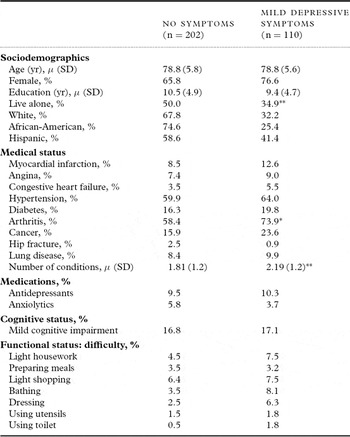
As shown in Table 1, participants reporting mild depressive symptoms did not differ from other participants in sociodemographic features, except for the proportion reporting they lived alone (34.9% of people with mild depressive symptoms, 50.0% otherwise; p < 0.01). In both groups the average age was about 79 years, with about 70% female. The sample as a whole completed an average of 10 years of school. The Hispanic group was more likely to report mild depressive symptoms, but differences did not achieve statistical significance (41.4% vs. 25.4% in African-Americans and 32.2% in whites).
Features of SITE cohort, by mild depressive symptoms status

* p < 0.05, ** p < 0.01 by t-test or χ2.
Participants reporting mild depressive symptoms were more likely to report most physician-diagnosed medical conditions, but differences were significant only for arthritis (73.9% in the mild depressive symptom group, 58.4% in the group without symptoms; p < 0.05). In a count across conditions, the mean number (SD) of diagnosed conditions was 2.19 (±1.3) in the mild symptom group and 1.81 (±1.2) in people without symptoms (p < 0.01). The proportion who met criteria for mild cognitive impairment was similar in the two groups (16.8% in people without symptoms, 17.1% in people with symptoms). The two groups did not differ in the proportion taking an antidepressant or anxiolytic medications. The groups were also similar in self-reported IADL and ADL status.
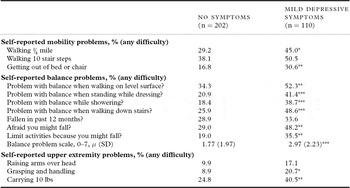
Differences between the groups were more pronounced for self-reported disability. As Table 2 shows, people with mild depressive symptoms were significantly more likely to report difficulty with all indicators of mobility and balance except falling. On the balance-mobility scale, people with subthreshold symptoms reported a mean of 2.97 problems compared to 1.77 in people without symptoms (p < 0.001).
Mild depressive symptoms and self-reported functional limitation

* p < 0.05, ** p < 0.01, *** p < 0.001 by t-test or χ2.
Mild depressive symptoms and slowing
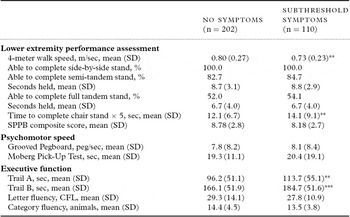
As shown in Table 3, the presence of mild depressive symptoms was associated with slower gait speed (0.73 vs. 0.81 m/sec, p < 0.01, effect size 0.28) and time to complete the five chair stands (14.1 vs. 12.1 sec, p < 0.01, effect size 0.25), though not in the static balance tests or composite SPPB score. Likewise, people reporting mild depressive symptoms were slower in completing Trails A (113.7 vs. 96.2 sec, p < 0.05, effect size 0.33) and B (184.7 vs. 166.1 sec, p < 0.001, effect size 0.36). Differences in psychomotor tests were not significant, though people with mild symptoms were slower on both the pegboard and pick-up tests.
Subthreshold depressive symptoms and performance assessment: lower extremity function, executive function, psychomotor speed

SPPB = Short Physical Performance Battery.
* p < 0.05, ** p < 0.01, *** p < 0.001 by t-test.
Mild depressive symptoms, slowing, and self-reported function
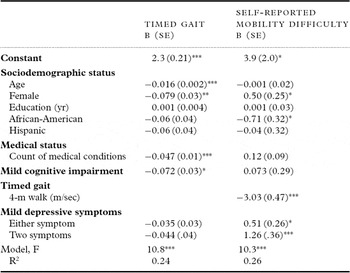
A first set of regression models was developed to assess the association between mild depressive symptoms and slowness, as indicated by timed tests of mobility (gait speed, chair stands) and speed of processing (Trail Making Tests). A second set of models examined the association between mild depressive symptoms and self-reported disability adjusting for indicators of speed of performance. All models included sociodemographic (age, gender, education, and race) and medical (number of reported medical conditions) status as covariates. Models were developed for mild depressive symptoms as a clinical indicator (none vs. any symptom) and as a count (none, one, or two symptoms). Because results were similar for both approaches to depressive symptoms and for both the cognitive and physical performance measures, we limit Table 4 to gait speed and self-reported mobility disability using the count of depressive symptoms.
Association between mild depressive symptoms and performance-based and self-reported mobility: estimates from multivariable models

* p < 0.05, ** p < 0.01, *** p < 0.001.
Mild depressive symptoms were not a significant correlate of gait speed in the regression models. Significant correlates of gait speed were age, female gender, number of medical conditions, and mild cognitive impairment; each was independently associated with slower gait. In the regression model for self-reported mobility disability, by contrast, the number of mild depressive symptoms was a significant correlate, even with timed gait and the other covariates included in the model. A single mild depressive symptom was associated with a half-point increase in balance-mobility problems (p < 0.05). The presence of two symptoms was associated with a 1.25 point increase (p < 0.001) over the range of this seven-point scale.
Discussion
In this sample of community-dwelling older adults with mild disability, subthreshold levels of depressed mood identified in the PHQ-2 (reports of anhedonia or dysphoria no more than “sometimes” over the previous two weeks) were not independent correlates of slower physical or cognitive function, compared to people without symptoms. However, mild depressive symptoms remained a significant correlate of poorer self-rated function even with adjustment for relevant performance-based measures of function.
These results suggest that reports of functional limitation or disability in people with mild depressive symptoms may represent (i) a reporting bias consistent with depressed mood (i.e. overestimates of disability) without true declines in function, or (ii) inadequacy of the performance measures to detect true declines in function perceived by respondents. It is also possible that (iii) the disabling effect of subthreshold symptoms is evident only with more extensive symptoms of depressed mood.
In favor of the first explanation, overestimation of disability in people with depressive symptoms is a common finding. For example, a recent study using occupational therapy assessments found no difference in performance-based assessments in a comparison of older adults successfully treated for depression and matched controls; yet the group treated for depression was significantly more likely to report disability (Rogers et al., Reference Rogers2010). Depressed mood may lead to greater pessimism about functional capacity and heightened awareness of difficulty or limitation in performance.
We cannot exclude the second explanation. The sensitivity of performance measures to detect sources of perceived disability is always open to question. However, subthreshold depression has been associated with declines in lower extremity performance and speed of processing in prospective studies (see summary in Meeks et al., Reference Meeks, Vahia, Lavretsky, Kulkarni and Jeste2011). Other studies suggest cross-sectional associations between higher levels of subthreshold symptoms and poorer performance in daily function. For example, in a non-depressed sample with a mean of score of 5.2 on the CES-D, depressive symptoms were associated with poorer performance on a performance measure of IADL independently of cognitive status (Yen et al., Reference Yen, Rebok, Gallo, Jones and Tennstadt2011).
We conclude that the mild subthreshold symptoms elicited in this non-depressed sample were potent enough to affect self-ratings in the absence of measurable differences in lower extremity ability or cognitive processing speed. To this extent, even mild symptoms of depressed mood, without accompanying deficits in performance, may be disabling.
Limitations of this research include its cross-sectional design. These data cannot establish the temporal priority of subthreshold depressed mood and slowing in physical and cognitive function or changes in self-rated function. Study findings suggest that established symptom thresholds for depressed mood need to be re-examined, since subthreshold symptoms at very mild levels may affect perceived disability in the absence of clear performance deficits.
Conflict of interest
None.
Description of authors’ roles
S. M. Albert obtained funding, designed the research plan, conducted study analyses, and drafted the paper. J. Bear-Lehman and A. Burkhardt developed study assessments, provided clinical expertise, and reviewed the paper for intellectual content.
Acknowledgment
This research was supported by the National Institute of Aging (AG18234 and AG024827).