Introduction
The Ziegler-Natta discovery of catalysts for olefin polymerization and stereospecific α-olefin polymerization has led to the search for new transition metal catalysts and co-catalysts for other olefins, among them, the most interesting ones are the cyclic olefins (cycloolefins). Truett, Natta, and Sartori discovered almost at the same time that a cycloolefin such as norbornene could be polymerized by using heterogeneous systems based on Ti, W, or Mo halides and strong Lewis acidic co-catalysts.Reference Truett, Johnson, Robinson and Montague 1 – Reference Natta, Dall’Asta and Mazzanti 5 The resulting polymer was unsaturated with 1,3-dimethylenecyclopentane repeating units, suggesting that polymerization occurred via ring-opening. Conventional heterogeneous Ziegler-Natta catalysts generally yield cycloolefin polymers containing both addition and ring-opening metathesis polymerized (ROMP) units.Reference Sartori, Ciampelli and Cameli 2 The two alternative cycloolefin polymerizations are illustrated in Scheme 1 .
Addition polymerization and ring-opening olefin metathesis polymerization (ROMP) of cyclic olefins.

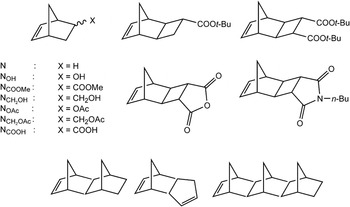
Cycloolefins such as cyclopentene, cyclooctene, and norbornene (common name of bicyclo(2.2.1)hept-2-ene) can be polymerized via ROMP and via addition ( Scheme 2 ). There is tremendous interest in their homo- and copolymers because of the easy availability of the monomers and interesting polymer properties.
Examples of cyclic olefins and functionalized norbornenes that can be homo- or copolymerized by transition metal catalysts. Note: t-Bu, tert-butyl; Ac, acetyl; n-Bu, normal butyl; Me, methyl.

The ring strain release is the main driving force of ROMP reaction cycles, thus strained monomers such as norbornene are readily polymerized.Reference Ivin and Saegusa 6 After the initial studies, synthesis of unsaturated ROMP polymers was reported from homogeneous catalysts, with reproducible activities, creating prospects for industrial applications. This led to in-depth investigations and evidence for the metal carbene mechanism.Reference Grubbs 7
In addition, with polymerization, both the ring strain of the cycloolefin and the non-planarity of the reacting double bond influence the reactivity, while the possibility of undergoing β-hydrogen elimination, which leads to isomerization and chain termination, has consequences on polymer structure and molar mass.Reference Kaminsky, Arndt-Rosenau, Scheirs and Kaminsky 8 – Reference Kaminsky, Boggioni, Tritto, Matyjaszewski and Möller 11
The discovery of homogeneous metallocene/methylaluminoxane (MAO) catalysts (see the Introductory and Busico articles in this issue) led to the first report on additional cycloolefin polymerization without ROMP by KaminskyReference Kaminsky, Bark and Arndt 12 and to great interest in these polymers. Cycloolefin homopolymers synthesized by metallocene polymerization are not processable because of their low solubility in organic solvents and their high melting points.Reference Kaminsky, Arndt-Rosenau, Scheirs and Kaminsky 8 By copolymerization of cycloolefins, namely norbornene with ethene, amorphous cycloolefin copolymers (COC) (Topas) are produced with excellent transparency and high refractive index, making them suitable for optical applications. Soluble saturated cycloaliphatic homopolymers can now be obtained by late transition metal catalysts (palladium, nickel, and cobalt) in high-yield. Polymers with cycloaliphatic repeating units display good thermomechanical properties, high optical clarity, and low dielectric constants and are suited for microelectronic and optical applications. A brief review of historical aspects and of the state of the art of cycloolefin polymerization by ROMP and via addition of cycloolefin copolymerization is presented here.
Cycloolefin homopolymerization
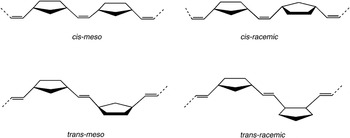
ROMP polyalkenamers have cis- or trans-structures and elastomeric properties ( Scheme 3 ).Reference Grubbs 7 They have typically been produced using heterogeneous catalyst systems based on molybdenum, tungsten, or ruthenium salts along with various co-catalysts and additives. Polyalkenamers from cyclopentene, cyclooctene, norbornene, and dicyclopentadiene have been developed into commercial products. For example, Vestenamer is a polyoctenamer with trans- structures, used as a component of rubber blends. The ROMP of dicyclopentadiene gives Metton and Telene. Norsorex produced by ROMP of norbornene is used in the automotive industry (e.g., for vibration and noise dampening and for soft seals). Zeonex is an amorphous cycloolefin polymer from ROMP of norbornene derivatives and subsequent hydrogenation, with properties similar to Topas.
Microstructures of polynorbornenes obtained by ring-opening metathesis polymerization.

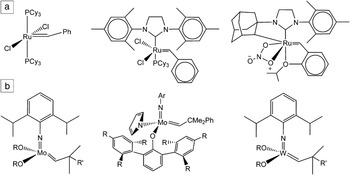
Over the last 25 years, a series of “well-defined” catalystsReference Buchmeiser 13 – Reference Keitz, Fedorov and Grubbs 20 based on a range of metals, including titanium, tantalum, tungsten, and molybdenum, has been prepared thanks to advances, especially those of Grubbs and Schrock (awarded the 2005 Chemistry Nobel Prize jointly with Chauvin)Reference Schrock 16 , Reference Grubbs 17 ( Scheme 4 ). Now, living ROMP catalysts and catalysts tolerant of functional groups exist. ROMP is considered a powerful methodology for the preparation of a wide range of polymers, including block, brush, and cyclic architectures with specific microstructures. These comprise various tacticities (e.g., atactic, isotactic, syndiotactic), double-bond arrangements (cis/trans), and relative monomer configurations (e.g., head-to-tail, head-to-head). This method has great utility in the synthesis of macromolecular materials with interesting biological, electronic, and mechanical properties. The current trend in catalysis suggests that future challenges will be to look toward generations of catalysts based on other late transition metals such as Fe or Re.
Some modern “well-defined” (a) Ru Grubbs’ and (b) Mo and W Schrock’s metathesis catalysts. Note: Ph, phenyl; Cy, cyclohexyl; R and R′, alkyl; Me, methyl.

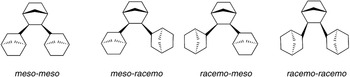
Cyclobutene, cyclopentene, norbornene, cyclooctene, and their substituted compounds can be successfully polymerized or copolymerized via addition, without ROMP, from metallocene and late transition metal catalysts.Reference Kaminsky, Arndt-Rosenau, Scheirs and Kaminsky 8 – Reference Kaminsky, Boggioni, Tritto, Matyjaszewski and Möller 11 Cyclohexene could not be polymerized until recently.Reference Wang, Fujiki and Nomura 21 These polymers feature two chiral centers per monomer unit and therefore are ditactic. Chiral C 2 metallocene catalysts produce tactic, low soluble, crystalline homopolymers with extremely high melting points (485°C for polycyclobutene, about 600°C for polynorbornene) and decompose before melting, whereas atactic cycloolefin polymers are partially soluble in hydrocarbon solvents. Hydrooligomerization, with metallocene catalysts known to produce atactic, isotactic, and syndiotactic poly(α-olefins), led to isolation and characterization of model dimers and trimers. Norbornene was shown to undergo cis-exo insertion into the metal-carbon bonds, and the different stereochemistry of oligomers (and polymers) was demonstrated ( Scheme 5 ).Reference Arndt 22 – Reference Arndt, Engehausen, Kaminsky and Zoumis 24
Structures of hydrotrimers of norbornene identified by Arndt-Rosenau.Reference Arndt, Engehausen, Kaminsky and Zoumis 24

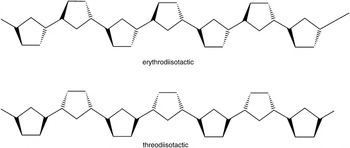
Isotactic polycyclopentene has low solubility and is crystalline (T m = 395°C, where T m is the melting point). Pure tri- and tetramers isolated from hydrooligomerization by chiral metallocene are allowed to establish their 1,3 enchainment and tacticity ( Scheme 6 ).Reference Collins and Kelly 25 , Reference Kelly, Taylor and Collins 26 The 1,3 insertion results from steric hindrance, which makes probable β-hydrogen transfer to the metal, olefin rotation, and cis insertion. Polycyclopentenes by nickel and palladium diimine complexes, activated with MAO and borate, are crystalline cis-1,3 (T m= 240–330°C) and atactic polymers, respectively.Reference McLain, Feldman, McCord, Gardner, Teasley, Coughlin, Sweetman, Johnson and Brookhart 27
Two of the possible microstructures of poly(cyclopentenes) obtained by addition polymerization.

Substituted poly-cyclopropenes and -cyclobutenes can be obtained using palladium catalysts.Reference Rush, Reinmuth, Risse, O’Brien, Ferro and Tritto 28 , Reference Curran, Risse, Boggioni and Tritto 29 The substitution decreases the activity, therefore the polymerization rate can be controlled.
Open late transition metal catalysts based on palladium salts and complexes are highly active in norbornene homopolymerization in contrast to ansa-zirconocene catalysts, which have low activity for steric hindrance. SenReference Sen and Lai 30 found that the dicationic system [CH3CN]4Pd[BF4]2 is a very active catalyst. Subsequently, Risse investigated the homo- and copolymerization of norbornene and its derivates (e.g., ester substituents) with Pd(II)-catalysts.Reference Mehler and Risse 31 , Reference Breunig and Risse 32
Goodall et al. recognized the potential of these polymers based on norbornene derivatives and used highly active catalysts based on cationic or neutral nickel and palladium complexes.Reference Goodall, McIntosh and Rhodes 33 – Reference Goodall, Rieger, Baugh, Kacker and Striegler 37 The polymers have high decomposition temperatures, small optical birefringence, good transparency for short wavelength radiation and high plasma etch resistance, and are suitable as advanced photoresist compositions in the microelectronics industry. The palladium catalysts are less active than the nickel analogues. The ligand structure does not influence the polymer microstructure and properties; α-olefins act as chain transfer agents and allow control of the molecular weight. Promerus LLC 38 produces a range of homo-, co-, and terpolymers based on substituted norbornenes developed at BF Goodrich such as Avatrel, Appear, and Duvcor.
Cycloolefin copolymers
Cycloolefin copolymers, especially of cyclopentene and norbornene with ethene or propene made accessible from metallocenes, represent a new class of thermoplastic amorphous materials. Modern metallocenes and other single site catalysts are about ten times more active than vanadium systems and other Ziegler-Natta catalysts.Reference Kaminsky, Bark and Arndt 39 , Reference Kaminsky, Sperber and Werner 40
Cyclopentene can be copolymerized with ethene or propene by heterogeneous and homogeneous Ziegler-Natta catalysts. Cyclopentene is incorporated into the copolymer chain by 1,2-enchainment,Reference Jerschow, Ernst, Hermann and Müller 41 – Reference Lavoie and Waymouth 46 in contrast to the homopolymerization.Reference Kelly, Taylor and Collins 26
Ethylene-norbornene copolymers
Among the new cyclic olefin copolymers (COC), the ethene (E)−norbornene (N) copolymers are the most versatile and interesting. The fine-tuning of ligand substituents of Group 4 metallocene catalysts allows control of the copolymer structures, from random to alternating, and consequently control of properties. After their first synthesis by Kaminsky,Reference Kaminsky, Bark and Arndt 12 E–N copolymers were developed into commercial products, including Topas from Ticona, while Mitsui produces Apel using vanadium-based catalysts.
E–N copolymers are usually amorphous and display a wide range of glass transition temperatures (T g), from room temperature to about 220°C. They are characterized by high chemical resistance as well as good processability. They show excellent transparency and high refractive index, owing to their high carbon/hydrogen ratio (e.g., the refractive index is 1.53 for a 50:50 E–N copolymer). These properties make them suitable for optical applications such as coatings for high-capacity CDs and DVDs, lenses, medical equipment, blister packs, toner binder, and packaging. The industrially produced copolymers have norbornene contents between 30 and 60 mol% and T g values of 120–180°C.
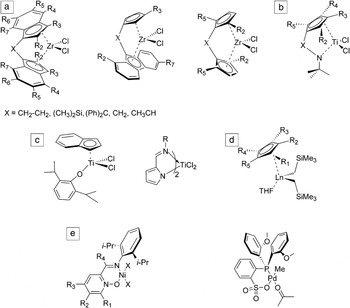
A variety of metallocene catalysts having C 1, C 2, C 2v, and C S symmetry were studied for E–N copolymerization. Subsequently, homogeneous organometallic catalysts, including half-sandwich and cyclopentadienyl (Cp)-free Group 4 metal catalysts, late transition metal catalysts, and more recently cationic rare-earth metal half-sandwich alkyls have been reported to catalyze E–N copolymerization ( Scheme 7 ).Reference Kaminsky, Arndt-Rosenau, Scheirs and Kaminsky 8 , Reference Tritto, Boggioni and Ferro 9 , Reference Kaminsky, Boggioni, Tritto, Matyjaszewski and Möller 11 , Reference Li and Hou 47 – Reference Provasoli, Ferro, Tritto and Boggioni 67
Examples of (a) Group 4 ansa-metallocenes, (b) constrained geometry catalysts, (c) half-sandwich complexes, (d) rare-earth, and (e) late transition metal catalysts for norbornene copolymerization. Note: R, R1, R2, R3, R4, R5, R6, and R7, alkyl; Ph, phenyl; Me, methyl; i-Pr, isopropyl; THF, tetrahydrofurane.

The resultant copolymer properties depend on different parameters, such as comonomer content and distribution throughout the polymer chain, as well as the configuration of the asymmetric carbons of the comonomer units. The microstructure of the copolymer can be controlled by the appropriate choice of reaction conditions and catalyst structure.
A description of the microstructures by 13 C NMR (nuclear magnetic resonance) spectroscopy of these copolymers as well as a detailed understanding of the processes and mechanisms involved in these copolymerizations proved difficult to achieve. A number of groups took on this challenge with various methodologies, including synthesis of model compounds,Reference Arndt, Engehausen, Kaminsky and Zoumis 24 NMR pulse sequences,Reference Bergstrom and Seppala 63 synthesis of a series of copolymers with different norbornene content and by catalysts with different symmetries,Reference Tritto, Boggioni, Sacchi and Locatelli 64 , Reference Tritto, Marestin, Boggioni, Zetta, Provasoli and Ferro 65 synthesis of copolymers selectively 13 C enriched,Reference Wendt and Fink 66 chemical shift prediction, and ab initio chemical shift computations.Reference Provasoli, Ferro, Tritto and Boggioni 67 Such assignments allowed Tritto et al.Reference Tritto, Boggioni and Ferro 9 to obtain detailed information on copolymerization mechanisms. They employed a computer optimization routine, which allows the best fit of the microstructural analysis by 13 C NMR spectra and the derivation of the reactivity ratios for both first- and second-order Markov models (M1 and M2, respectively).
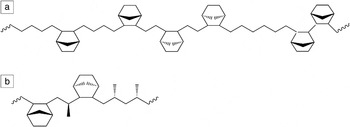
Ansa-metallocenes with C 2 and C S symmetries generate random copolymers containing norbornene microblocks ( Scheme 8 ). Copolymers with norbornene content well above 50 mol% and T g values as high as 220°C can be synthesized. The type of bridge in the ansa-metallocene catalyst has an influence on polymerization activity and norbornene content. Random copolymers having a norbornene content between 48 and 60 mol% showed T g values that can reach about 200°C.
Structures of a (a) random poly(E-co-N) and of an (b) isotactic poly(P-co-N). Note: E, ethene; N, norbornene; P, propene.

Highly alternating stereoregular (isotactic) E–N copolymers were synthesized with C 1-symmetric, bridged metallocenes R2C[(Flu)(3-R’Cp)]ZrCl2 [Flu = fluorenyl, R = alkyl = Me or Ph, R’ = alkyl = Me or t-Bu, t-Bu = tert-butyl, Me = methyl, Ph = phenyl], in the presence of an excess of norbornene. The copolymers obtained are semicrystalline if the norbornene content is higher than 37 mol% and have melting points of 270–320°C. They are still transparent owing to the small size of their crystalline regions (5 nm).
On the other hand, atactic alternating copolymers are amorphous with T g-values up to about 130°C. They are obtained by constrained geometry catalysts (CGC), which also copolymerize ethene and norbornene with lower activity than ansa-zirconocenes, but can give perfectly alternating copolymers. Random E–N copolymers with high molar masses (up to 63,000 g/mol, M w/M n = 1.32, where M w = weighted average of the molecular weight and M n = number average molecular weight) and high norbornene content were produced by ShionoReference Hasan, Shiono and Ikeda 58 by using the half-sandwich titanocene precatalyst Me2Si(Flu)(Nt-Bu)TiMe2 activated with MAO free from Me3Al.
Living α-olefin polymerization, that is α-olefin polymerization in which chain transfer and chain termination are absent, are still quite rare despite modern efficient examples recently developed.Reference Domski, Rose, Coates, Bolig and Brookhart 53 The molecular mass of E–N copolymers, at temperatures between 30 and 50°C with ansa-metallocenes such as rac-[Et(Ind)2]ZrCl2 (Et = ethyl and Ind = indenyl) and high norbornene feed fractions, increases with time for up to one hour, maintaining narrow polydispersity (1.1).Reference Jansen, Mendichi, Locatelli and Tritto 54 The narrow polydispersity value indicates that E–N copolymerizations are quasi-living under these conditions. Highly alternating E–N copolymers could be obtained with bis(pyrrolide-imine) Ti living complexes (named PI catalysts, where PI = pyrrolide-imine), developed by FujitaReference Yoshida, Matsui and Fujita 60 and co-workers. These electronically flexible catalysts displayed a tendency to produce E–N copolymers with a stereoirregular structure despite the C 2 symmetric nature of the catalysts.
NomuraReference Nomura 61 showed that nonbridged half-titanocenes containing anionic donor ligands of the type Cp’TiX2(Y) (X = halogen, alkyl; Y = aryloxo, ketimide) displayed unique characteristics such as efficient incorporation of bulky olefins. Random E–N copolymers with high norbornene contents could be obtained with (Ind)TiCl2(O-2,6-i-Pr2C6H3) (i-Pr, isopropyl) that exhibited higher norbornene incorporation than the Cp*-aryloxo analogue, the 1,2,4-Me3C5H2-aryloxo analogue, and CGC.
Recently, Hou reported the first example of efficient COC synthesis by rare-earth metal catalysts.Reference Matsui, Yoshida, Takagi, Spaniol and Okuda 62 – Reference Li, Baldamus and Hou 69 The combination of half-sandwich scandium bis(alkyl) complexes such as [Sc(η5Cp’)(CH2SiMe3)2(THF)] [THF = tetrahydrofurane] with 1 molar equivalent of a borate compound, such as [Ph3C][B(C6F5)4], showed excellent activity for E–N copolymerization.Reference Li, Baldamus and Hou 69 , Reference Ravasio, Zampa, Boggioni, Tritto, Hitzbleck and Okuda 70
A catalyst for the copolymerization of ethene with functionalized norbornenes must be both tolerant of functional groups and resistant to β-hydrogen elimination. Late transition metals are more tolerant to polar functionalities; however, they are often ineffective for the copolymerization of ethene with norbornene because 1-alkenes act as a chain transfer agent through β-hydrogen elimination.
Grubbs introduced (salicylaldimino)nickel methyl complexes,Reference Younkin, Connor, Henderson, Friedrich, Grubbs and Bansleben 71 which operate without the requirement of a cocatalyst, allow the incorporation of bulky cycloolefins such as norbornene, as well as functionalities into polyethene. Kaminsky et al. succeeded in E–N copolymerization using α-diimine palladium catalysts. The T g values of E–N copolymers produced are very high and range from 98°C to 217°C.72,73 Copolymers produced at a molar fraction x N = 0.80 and higher, as well as homo-polynorbornenes, show no T g-values or T m-values under 350°C and decompose above 350°C. Copolymerization of ethene with norbornene and functionalized norbornenes in both nonaqueous and aqueous solutions could be carried out by (salicylaldimino)nickel methyl complexesReference Bauers and Mecking 74 – Reference Wehrmann, Zuideveld, Thomann and Mecking 77 and square-planar nickel complexes containing anionic P^O chelates78 and by Pd phosphine aryl sulfonates.Reference Skupov, Marella, Hobbs, McIntosh, Goodall and Claverie 79 – Reference Ravasio, Boggioni and Tritto 81 Bazan reported the synthesis of pseudo-tetrablock copolymers composed of ethylene and 5-norbornene-2-yl acetate, using the initiator system (LiPr2)Ni(η1-CH2Ph)(PMe3) [(LiPr2) = N-(2,6-diisopropylphenyl)-2-(2,6-diisopropylphenylimino)propanamide] and 2.5 equivalents of Ni(COD)2 [bis(1,5-cyclooctadiene) nickel].Reference Diamanti, Ghosh, Shimizu and Bazan 82 , Reference Coffin, Diamanti, Hotta, Khanna, Kramer, Fredrickson and Bazan 84 Square-planar nickel complexes with anionic P,O-chelate ligands were used by Goodall for the co- and terpolymerization of norbornene, 5-norbornene-2-carboxylic acid ethyl ester with ethene.Reference Coffin, Diamanti, Hotta, Khanna, Kramer, Fredrickson and Bazan 84
Poly(E-co-N)1-block-poly(E-co-N)2, PE-block-poly(E-co-N), and thus new materials consisting of crystalline and amorphous segments, which are chemically linked, were successfully synthesized with PI-catalysts,Reference Yoshida, Mohri, Ishii, Mitani, Saito, Matsui, Makio, Nakano, Tanaka, Onda, Yamamoto, Mizuno and Fujita 85 rare-earths,Reference Hou, Luo and Li 68 and by fluorinated enolatoimine titanium catalysts.Reference Ravasio, Boggioni, Bertini and Tritto 86
Propene–norbornene copolymers
Propene (P)–N copolymers feature higher T g values than E–N copolymers with the same norbornene content and molar mass since polypropene has a higher T g value than polyethene. Differences in stereo- and regioregularity of propene units as well as in the comonomer distribution and stereoregularity of the bicyclic units were expected to allow fine tuning of copolymer microstructure and properties. However, reports regarding P–N copolymers are very limited compared to E–N copolymers.Reference Henschke, Köller and Arnold 87 – Reference Hasan, Ikeda and Shiono 94 After a first report on amorphous P–N copolymers with the rac-[Me2Si(Ind)2]ZrCl2/MAO system,Reference Henschke, Köller and Arnold 87 Tritto et al.Reference Boggioni, Bertini, Zannoni, Tritto, Carbone, Ragazzi and Ferro 88 , Reference Carbone, Ragazzi, Tritto, Boggioni and Ferro 89 tackled the synthesis and microstructural studies of P–N copolymers with C 2-symmetric rac-[Et(Ind)2]ZrCl2 and rac-[Me2Si(Ind)2]ZrCl2, which were proven effective for producing prevailingly isotactic and regioregular polypropene with MAO as a cocatalyst. 13 C NMR experiments and ab initio theoretical chemical shift calculations for the most relevant conformers of model compounds, combined with the rotational-isomeric state statistics of the P–N chain, gave the first assignment of the 13 C NMR spectra of P–N copolymers. Cis-2,3-exo norbornene insertion occurs into the metal−carbon bond, the same mechanism as observed in E–N copolymerization. All propene consecutive monomer units have methyl groups in erythro relationships as in an isotactic polypropene chain (see Scheme 7). Such assignments showed the presence of 1,3-propene misinsertions, which are formed in significant amount when increasing the [N]/[P] ratio of the feed.Reference Zampa, Ravasio, Tritto and Ferro 91 Recently, Boggioni et al.Reference Boggioni, Ravasio, Zampa, Ferro and Tritto 92 , Reference Boggioni, Ravasio, Boccia, Ferro and Tritto 93 succeeded in quantitative analysis of the microstructure of the 13 C NMR spectra at the triad level of a number of P–N copolymers by a method that included: (1) definition of the possible triads composing the copolymer chain, (2) use of NMR techniques for assigning new signals, and (3) use of a best-fitting procedure to determine the copolymer microstructure. This could lead to mechanistic understanding and to advances in polymer synthesis. Shiono et al. succeeded in the synthesis of P–N copolymers with high norbornene content up to 71 mol% with catalyst (t- BuNSiMe2Flu)TiMe2 activated by Me3Al-free methylaluminoxane (dried MAO).Reference Hasan, Ikeda and Shiono 94
Copolymers of bulkier cyclic olefins
Properties of COC based on bicyclic monomers can be modulated by varying the norbornene content or the structure of the bicycloolefin. E–N copolymers endowed with high T g values are brittle. One approach to obtain more ductile COC is the substitution of norbornene with a bulkier cycloolefin monomer or by terpolymerization. This would allow obtaining the same T g values for a lower amount of cycloolefin incorporated and thus a higher amount of flexible ethene units in the polymer chain. Bulky cycloolefins such as norbornadiene, dicyclopentadiene, dimethanooctahydronaphthalene, or trimethanododecahydroanthracene have been copolymerized, often with low activity.Reference Kaminsky and Bark 95 – Reference Li and Hou 102 Recently, copolymerization of ethene with a partially hydrogenated tricyclopentadiene by using the same catalytic systems has given a nearly alternating copolymer with a T g value significantly higher (177°C) than that of alternating E–N copolymers.Reference Cho, Wu, Sujith, Han, Kang and Lee 103 – Reference Yu, Na, Lim and Lee 105 Tensile stress-strain curves showed more ductile properties than E–N copolymers with similar T g.Reference Yu, Na, Lim and Lee 105 Very recently, effective copolymerization of ethylene and exo-1,4,4a,9,9a,10-hexahydro-9,10(1′,2′)-benzeno-1,4-methanoanthracene (HBMN) by CGC catalyst activated with Al(i-Bu)3/[Ph3C][B(C6F5)4] has been obtained.Reference Hong, Cui, Liu and Li 106 E−HBMN copolymers show alternating E−HBMN sequences, high molecular weight, and T g up to 207°C at comonomer incorporation of 30.4 mol%. Tensile tests indicate that these copolymers are more flexible than E−N copolymers and other previously reported COC even at a higher T g level.
Conclusion
In contrast to the successful E–N copolymerization, copolymerizations of norbornene with higher α-olefins or polycyclic olefins still yield low activity, low comonomer incorporation, and molar masses. Thus, future syntheses of new organometallic complexes with various metal centers and ancillary ligands could lead to COC with desired physical, mechanical, and optical properties. Moreover, late transition metal catalysts that are more tolerant to polar functional groups need further developments to be efficiently used in olefin-cycloolefin copolymerizations.