1. Introduction
Protection racket is a global phenomenon. There are however some places across the world where this practice is endemic, as in Italy (Gambetta, Reference Gambetta1993; Savona, Reference Savona2012), Russia (Varese, Reference Varese2001), Japan (Hill, Reference Hill2003), and to some extent, in Latin America (Elsenbroich et al., Reference Elsenbroich, Anzola and Gilbert2016). The protection racket is a continuous, regular and systematic demand for money (or favours) using the threat of violence in exchange for more or less genuine protection. Such protection includes the supply of real, but often illegal, services, whereby the racketeers protect businesses from criminals and legal competition (Apollonio and Montanaro, Reference Apollonio and Montanaro2015). Yet, in some cases it consists of pure extortion, in which the only ‘protection’ that racketeers provide is from themselves.
This practice harms the societies in which it operates by imposing costs on business creation and development and on institutional health, in both economic and political dimensions (Gennaro and Spina, Reference Gennaro and Spina2016; Lisciandra, Reference Lisciandra2014; Pinotti, Reference Pinotti2015). For example, in Sicily, where Mafia organisations have a stronghold on several industrial sectors, such as the building trade and waste management, entrepreneurs can operate only if they agree to pay protection money. Such protection money in Italian is referred to as pizzo.Footnote 1 In Sicily, the term pizzo refers to a bird's beak, used when drinking water, a natural and daily habit (Vasile, Reference Vasile2005). According to estimates of 2012, protection racket pizzo amount to 49% of Mafia revenue (Calderoni, Reference Calderoni2014) that in turn generates monetary revenues that range from 0.18 to 0.49% of the Italian GDP in 2012 (Lisciandra, Reference Lisciandra2014). In the long run, the payment of pizzo undermines the potential growth of the economy, by increasing the uncertainty and riskiness of business and political environments (Daniele and Geys, Reference Daniele and Geys2015; Pinotti, Reference Pinotti2015). Economic and political costs arising from societal asymmetries (Lavezzi, Reference Lavezzi2014) are not the only costs harming societies and institutional health. Social and psychological ones have to be added. Violence and predatory activities destroy part of the human capital stocks. According to Gambetta (Reference Gambetta1988), this mechanism erodes the level of general and institutional trust among citizens where the Mafia operates. Factors such as distrust, violence and predatory activities, not only weaken existing institutions (Putnam et al., Reference Putnam, Leonardi and Nanetti1994) and impact the type of new institutions they are creating (i.e. illegal ones), but also they change people's belief systems (Greif, Reference Greif2006). In the long run, social tolerance of illicit and criminal activities may result in the emergence of what has been described as a ‘culture of lawlessness’ (Williams, Reference Williams2009) which – as we will argue in the present paper – is characterised by the diffused expectation that paying the pizzo is the typical behaviour of people living in certain geographical areas, and refusal to conform to this norm would be punished not only by the Mafia, but also by peers through social ostracism and reprobation (La Spina, Reference La Spina2008).
So far, stringent anti-Mafia laws (Lavezzi, Reference Lavezzi2014) have been proposed and enacted since the 1980s by the Italian State to prevent the practice of paying the pizzo to the Mafia from spreading.Footnote 2 Yet, in Southern Italy, the payment of the pizzo is still pervasive (Lisciandra, Reference Lisciandra2014). It has been estimated that around 80% of Sicilian businesses still pay the pizzo (Apollonio and Montanaro, Reference Apollonio and Montanaro2015; Di Gennaro, Reference Di Gennaro2015).
Building on the studies by North (Reference North1990) and Ostrom (Reference Ostrom2005), we claim that a core difficulty around successfully combatting the problem of pizzo payment lies in its collective nature, which depends on the interdependent behaviour of many actors. Collective action problems are situations in which the interest of a group to act together to acquire a collective good is not aligned with the interest of single individuals to act on their own. The pizzo payment is a collective action problem because even though it is in the interest of all entrepreneurs not to pay the pizzo and to report the requests for such payments to the police, no one will refuse to pay the pizzo or file a report to the authorities for fear of both the Mafia's retaliation and the social punishment from peers.
We argue that the difficulty in solving the collective action problem of the pizzo practice can, in part, be explained by the existence of a social norm underlying this behaviour. Thus, eliminating such practice requires a change in the social norm on which it is based. When social norms conflict with legal norms, the former undermine the latter preventing a behavioural change (Bicchieri and Mercier, Reference Bicchieri and Mercier2014). Instead, when social and legal norms match, they support and reinforce each other leading to rapid and effective behavioural change (Bicchieri and Mercier, Reference Bicchieri and Mercier2014). We refer to social norms as informal institutions,Footnote 3 or shared behavioural rules that, unlike legal norms, are not codified (Bicchieri, Reference Bicchieri2006; North, Reference North1990) but they are learnt through social interaction. Those rules prescribe what individuals ought or ought not to do, and whose violation is often enforced through informal punishment, such as ostracism, gossip or dishonour for the transgressor (Bicchieri, Reference Bicchieri2006; Conte et al., Reference Conte, Andrighetto and Campennl2013; Ostrom, Reference Ostrom2005). Based on the definition by Bicchieri (Reference Bicchieri2006) that we adopt in this study, social norms are sustained by two types of expectations: empirical and normative. Empirical expectations describe the social world and in the specific case of the norm of paying pizzo are the beliefs that pizzo payment is widespread in a certain area. Normative expectations provide the normative aspect and in our context are the beliefs that others think pizzo should be paid and not reported to the police. Moreover, these two types of expectations are enforced through social sanctions: the news is full of stories detailing how entrepreneurs who refused to pay the pizzo and/or reported the request to the authorities were isolated by other citizens, both on a personal and commercial level.Footnote 4 The presence of a social norm of paying pizzo – along with being weary of punishment by the Mafia – undermines the efforts of the State to create a context in which laws motivate citizens to stop paying the pizzo and report the request to the authorities (Arcidiacono et al., Reference Arcidiacono, Avola and Palidda2016). The question then becomes: how can a change of such social norm be initiated?
During the last decade, non-governmental organisations that use non-legal means to combat the Mafia have emerged and they offer an important example of how to change the social norm of pizzo paying. Among these, the best known is AddiopizzoFootnote 5 (or ‘Goodbye pizzo’). We propose that the ability of Addiopizzo in becoming one of the most successful non-governmental resistance groups against the Mafia can be explained by its ability to recognise that there are multiple reasons behind the choice to pay the pizzo, including the social acceptance to comply with the norm prescribing the payment of pizzo and not to report the request to the authorities. Here, we argue that Addiopizzo put into practice a five-phase strategy that changed this socially undesirable norm and as a consequence also the practice of paying pizzo.
Given the secretive nature of the pizzo practice, we followed the methodology already used by related literature (see Lavezzi, Reference Lavezzi2014, Skarbek, Reference Skarbek2011) and combined a wide spectrum of resources such as the extensive academic literature referring to the Mafia, the pizzo requests and the activities of Addiopizzo (Daniele and Geys, Reference Daniele and Geys2015; Daniele and Marani, Reference Daniele and Marani2011; Dimico et al., Reference Dimico, Isopi and Olsson2017; Gambetta, Reference Gambetta1993; Gunnarson, Reference Gunnarson2014, Reference Gunnarson2015), publicly available information about Addiopizzo (the official website of the organisationFootnote 6 and newspaper articles) and personal communication (an interview with one of the founders of the organisation, Daniele Marananno, conducted by the authors of this paper). Such methodology allows us to merge three strands of literatures. We recognise, in line with the theoretical and empirical literature on protection racketeering (Balletta and Lavezzi, Reference Balletta and Lavezzi2019; Battisti et al., Reference Battisti, Lavezzi, Masserini and Pratesi2018; Gunnarson, Reference Gunnarson2014, Reference Gunnarson2015; Lavezzi, Reference Lavezzi2014; Scaglione, Reference Scaglione2017, Reference Scaglione2020; Sciarrone, Reference Sciarrone2002), that a multiplicity of factors, such as fear, economic and political constraints, maintains the extortion practice. Yet, the paper aims to complement this literature by pointing out the role of social norms in sustaining the practice of paying pizzo. To our knowledge, this is the first study proposing this hypothesis.
Concerning social norms and their change, we refer to both the prolific outcome oriented research on how to change socially undesirable behaviours, such as female genital mutilation (Insight, Reference Insight2010), child marriage (Bicchieri et al., Reference Bicchieri, Lindemans and Jiang2014), tax evasion (Wenzel, Reference Wenzel2005), corruption (Hoffman and Patel, Reference Hoffman and Patel2017) and to the body of theoretical and empirical studies on the specific mechanisms that are relevant to particular stages in the life cycle of a norm (Bicchieri, Reference Bicchieri2006, Reference Bicchieri2016; Conte et al., Reference Conte, Andrighetto and Campennl2013, Xenitidou and Edmonds, Reference Xenitidou and Edmonds2014).
Finally, in accordance with the literature on institutional change (e.g. Greif and Laitin, Reference Greif and Laitin2004; North, Reference North1990; Ostrom and Basurto, Reference Ostrom and Basurto2011), we will define institutions looselyFootnote 7 as the formal and informal ‘rules of the game’ and we will focus on the way those rules change. Kingston and Caballero (Reference Kingston and Caballero2009) show that there are two broad perspectives underlying institutional change, the first considering institutions as ‘rules’ (North, Reference North1990) and the second as ‘equilibria’ (Aoki, Reference Aoki2001; Greif, Reference Greif2006). Looking at social change through the lens of social norms will allow us to integrate these two approaches. Similar to Greif and Kingston (Reference Greif and Kingston2011), we do believe that the two perspectives are complementary for social change. No law can be effective and resilient law if it is not supported by social norms and builds on them.
Drawing on the studies of protection racketeering, the literature on social norms and their change, and the study on institutional change, we argue that what Addiopizzo has successfully changed is the existing social norm of paying pizzo and not reporting the request to the authorities, into a new social norm of not paying pizzo. The social change operated by Addiopizzo points to the possibility that social norms-based interventions can bring about institutional and cultural change in a context marked by high risk, distrust and a lack of cooperative tradition.
The paper is structured as follows: section 2 illustrates different top-down and bottom-up interventions used to contrast pizzo payment and their consequences; section 3 traces the origin, strategy and diffusion of Addiopizzo; section 4 details the characteristics of the social norm sustaining the pizzo practice and discusses how the strategy used by Addiopizzo has triggered a process of social norm change. Finally, section 5 outlines the conclusions.
2. Top-down and bottom-up interventions to counter protection racket
The practice of pizzo paying occurs as an exchange between two actors: the Mafia's operators, who go around requesting an illegal tax, and the victims – entrepreneurs and shopkeepers – who have to decide whether to comply or not with the pizzo request. The interaction between the actors occurs in secrecy and with a capillary system, difficult to detect by the authorities without the help of citizens willing to report the pizzo requests. What drives entrepreneurs to surrender to extortion? Daniele Marananno, answered: ‘There is not one, but many motivations’ and listed different reasons. First, he said, when deciding whether to pay the pizzo or not, shopkeepers face three types of risks: personal, economic and social. At the personal level not paying the pizzo could be punished with retaliatory acts by the Mafia (Gambetta, Reference Gambetta1993, Mete, Reference Mete2018); whereas at the economic level, not paying the pizzo could result in damages to the business activities of the entrepreneurs or shopkeepers (Balletta and Lavezzi, Reference Balletta and Lavezzi2019; Gambetta, Reference Gambetta1993; Lavezzi, Reference Lavezzi2014; Mete, Reference Mete2018; Scaglione, Reference Scaglione2017, Reference Scaglione2020; Vaccaro, Reference Vaccaro2012) or in increased insurance costs (Asmundo and Lisciandra, Reference Asmundo and Lisciandra2008). Finally, at the social level, not paying the pizzo may increase the probability of being socially punished by peers, through acts of ostracism or social reprobation.
Most of the corrective actions to oppose pizzo paying enacted so far in Italy tried to address such risks, but with limited effect because the actions neglected to consider the role of social norms. Lavezzi (Reference Lavezzi2014) classifies the interventions as the ‘top-down legal’ interventions, mainly consisting of the State's actions (i.e. deterrence actions), and ‘bottom-up social’ interventions, consisting of grass-root activities using non-legal means to counteract the Mafia (i.e. public demonstrations).
When social norms are consistent with laws, they provide legitimacy and political stability to the governments issuing them (Weber, Reference Weber1968). Under such circumstances, voluntary compliance spreads simultaneously with citizens' willingness to those norms informally. As Akerlof and Yellen (Reference Akerlof and Yellen1994) claim, ‘the major deterrent to crime is not an active police presence but rather the presence of knowledgeable civilians, prepared to report crimes and cooperate in police investigations’.
In the specific case of the fight against pizzo paying, top-down legal interventions aim to alter the incentives (North, Reference North1990) behind the supply and demand of the services offered by the Mafia, thus defending formal legal and economic institutions from racketeering. However, the usual crime reduction which occurs through deterrence actions mainly directed towards criminalsFootnote 8 is not effective in the case of protection racketeering because, due to the semi-collusive nature of the practice, the interventions need to target not only the criminals but also the victims. From 1992, the Italian State started offering protection, relocation and even financial compensation to people deciding to resist or report requests of pizzo paying (La Spina, Reference La Spina2008; Lavezzi, Reference Lavezzi2014).
Yet, most of these top-down legal interventions have failed to obtain durable and relevant effects due to the lack of trust and legitimacy in formal institutions that Sicilian citizens experience (Bicchieri, Reference Bicchieri2016; Gambetta, Reference Gambetta1988; Mete, Reference Mete2018). Such distrust stems from citizens' perception of the State's poor capacity to protect them from Mafia retaliation. Another important reason neglected by legal interventions is the fact that they do not recognise that compliance with pizzo requests is motivated by social norms. We argue in this study that when social norms are not aligned with the legal norms the efficacy of the latter in eradicating the practice is impaired (Bicchieri and Mercier, Reference Bicchieri and Mercier2014).
The bottom-up social interventions aim to change people's actions through non-legal means. Often these actions attempt to shape citizens' moral values and expectations about the socially-appropriate action to take: ‘not paying the pizzo’ and ‘reporting to the authorities’, for instance. Educational and promotional campaigns, public discussions are all tools of the bottom-up social approach. Restoring morality among citizens can be achieved in different ways such as via expressing reprobation towards the practice of paying the pizzo, or expelling entrepreneurs who are paying the pizzo from business associations.
Yet, bottom-up social interventions have also shown problems of resilience. In particular, they face the daunting task of coordinating the change in values and social expectations of people. Even if all the citizens are motivated to change and are aware that such change is necessary, no one would act alone: both the spread of new values and social expectations are dependent on the behaviour of other people. Another difficulty faced by the bottom-up social interventions is that they cannot work alone, and they need the support of the legal power. This is because when people change their behaviour and start resisting paying pizzo and reporting the requests of racket to the authorities, they may be subject to retaliation by the Mafia and need the protection of the State (Székely et al., Reference Székely, Nardin and Andrighetto2018).
Hence, both types of intervention have their own limitations (Lavezzi, Reference Lavezzi2014). As in other cases of socially undesirable practices, such as female circumcision, child marriage, foot binding, top-down interventions alone were not successful at changing the behaviour, because they failed to target the social norms supporting it. In the same way, we argue that Addiopizzo was able to produce an effective reduction in the payment of protection money in the Sicilian city of Palermo by triggering, among other things, a process of social norm change.
3. Addiopizzo: the history, activities and diffusion
Addiopizzo is a civic movement originating in 2004 from seven friends who, in preparing their business plan to open a bar, found themselves having to account for, among other expenses, the illegal tax of pizzo. This cost was something that nobody in the group had considered before, and they started discussing the possibility of not paying extortion money. The seven friends were young and motivated and shared a moral compass of not abiding to the protection racketeering system. The first initiative through which Addiopizzo went public was a sticker attack. Waking up on the 29th of June 2004, the citizens of the city of Palermo found hundreds of small stickers all around the historical city centre that read ‘a whole population that pays the pizzo is a population without dignity’. The publicity and the noise created by the stickers forced an entire city to discuss one of the biggest taboos in the Sicilian society – the requests for pizzo paying and its widespread compliance.
The first Addiopizzo campaign entitled ‘contro il pizzo cambia i consumi’ (to stop the pizzo, change how you shop) was launched a few months later. In only a few weeks, the activists for Addiopizzo were able to raise 3,500 signatures among consumers. The list of consumers rebelling against the racket was published by the Giornale di Sicilia in May 2005. In 2006, Addiopizzo extended their strategies from those tailored towards consumers, to other key actors, such as shopkeepers and producers. It compiled a list of more than 100 businesses committed to report publicly the pizzo requests to the authorities and claim their refusal to pay it. The list was later presented during the first ‘pizzo free party’ and was followed by diffusion in the Italian national media.
Members of Addiopizzo pledge not to pay the pizzo and have their finances thoroughly investigated to verify the pledge. To get this certification, firms have to undergo a fairly accurate review process. From that moment the decision to join Addiopizzo's anti-racketeering campaign is a public act; the name and address of the participating businesses appears on a list that is available on-line and in printed publications, including city maps. Businesses who join the campaign receive a sticker with the Addiopizzo symbol and are asked to post it in a visible place, typically the window of their commercial activity, signalling their willingness to avoid paying the pizzo.
Addiopizzo is engaged in a broad set of activities that include the organisation of a yearly fair, school visits, the production of maps to pizzo-free shops, promotional activities and educational campaigns. To be successful in convincing people to stop paying the pizzo and report their perpetrators to the authorities, the organisation had to find ways to address the three risks – personal, economic and social risks – faced by entrepreneurs, as reported by Daniele Marananno. In particular, to reduce the economic risks, such as losing customers and markets, Addiopizzo enacted a set of market-based actions. The association made an appeal to the citizens of Palermo to be conscious consumers and use their ‘shopping bag power’ as a way of fighting organised crime and stimulated citizens and consumers to manifest their opposition to the Mafia's power daily through ‘buycotting’ acts,Footnote 9 that is, harmless and simple acts consisting of avoiding commercial relations with those shops not adhering to Addiopizzo.
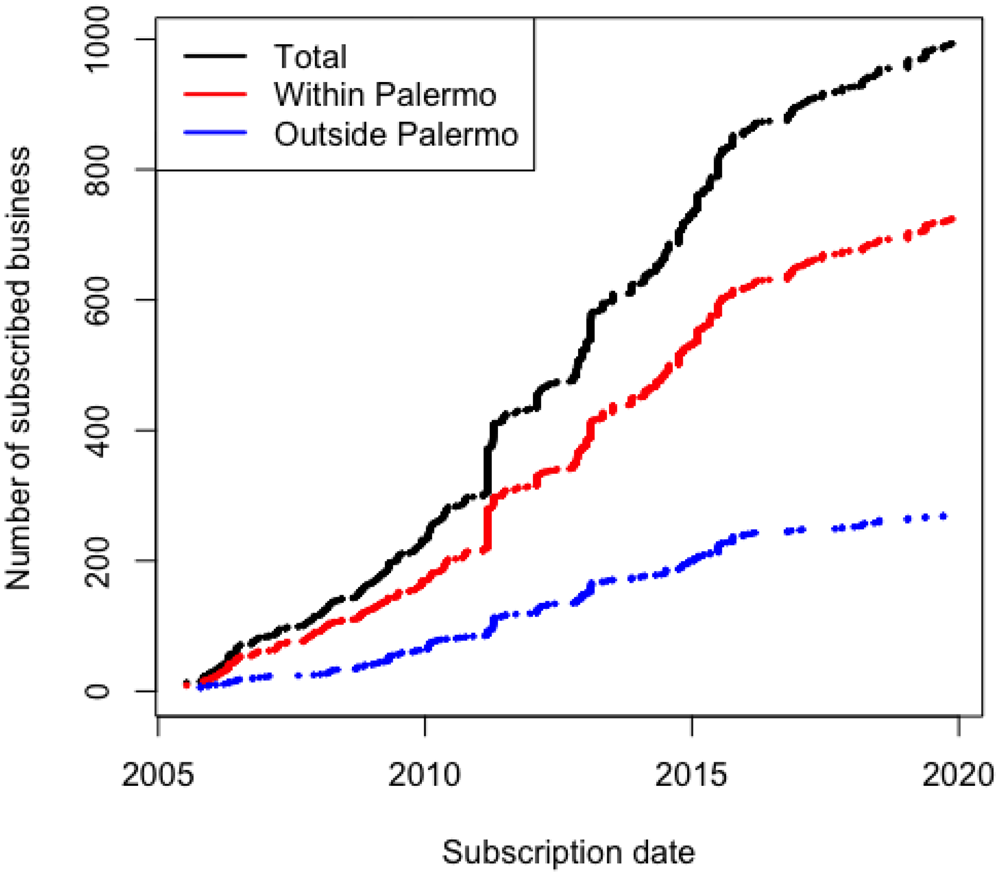
From 2005 to 2019, Addiopizzo has recruited an increasing number of entrepreneurs, from small shops and restaurants to large corporations, with a current membership of 1,214 entrepreneurs and 13,376 consumers taking an anti-pizzo stance (see Figure 1). A recent study (Scaglione, Reference Scaglione2020) shows empirically how the presence of Addiopizzo in six neighbourhoods of the city of Palermo represented an impediment to the racket activity during the years 2005 to 2015. As shown in Figure 1, not all the entrepreneurs became members of Addiopizzo all at once. The increasing number of members of Addiopizzo from 2005 to 2019 is an expression of the rate of adoption of the new practice of not paying the pizzo. Such rate looks like the curve of adoption of an innovation (Rogers, Reference Rogers1962).Footnote 10
Subscription to Addiopizzo from 2005 until 2019. Source of data comes directly from Addiopizzo dataset. Elaboration of the authors.

The motivations for joining Addiopizzo and to rebel against the pizzo payment
The literature on protection racketeering is abundant (Scaglione, Reference Scaglione2017, Reference Scaglione2020; Sciarrone, Reference Sciarrone2002). Yet, study on the motives that bring people to rebel against the payment of a pizzo and associate with anti-racket organisations, such as Addiopizzo, is scant. Joining initiatives such as Addiopizzo is associated with people's willingness to perturb the institutional inertia linked to the payment of the pizzo. In the literature of institutional change (Kingston and Caballero, Reference Kingston and Caballero2009), several sources of inertia are identified, such as the free-riding problem and the role of history (North, Reference North1990). Scholars have proposed three approaches to explain how to overcome these different types of institutional inertia: the social interaction, the economic-based and the legal-based approaches.
Gunnarson (Reference Gunnarson2014) focused on the role of social interactions as a key factor leading people to join Addiopizzo. She claimed that Addiopizzo had to face the issue that joining the organisation might be dependent on the behaviour of other people, thus constituting a coordination problem. Gunnarson proposed that Addiopizzo was able to overcome this coordination problem by using differentiated strategies of mobilisation through organisations and personal recruitment using the help of weak ties.Footnote 11 Addiopizzo had, for example, circulated information about its activities by exploiting the relationships that individuals developed in their social networks, made of acquaintances and social movements.
Lavezzi (Reference Lavezzi2014) and Balletta and Lavezzi (Reference Balletta and Lavezzi2019), instead, used standard concepts of economic analysis, such as demand, supply and equilibrium, and focused on the role that economic incentives play in people's decisions to join Addiopizzo. Battisti et al. (Reference Battisti, Lavezzi, Masserini and Pratesi2018) provide a rigorous statistical analysis to identify to what extent a firm's characteristics correlate with the decision to resist a protection racket and to join Addiopizzo. They showed that economic incentives were mediated by peers' effect and that both factors were key drivers in motivating shopkeepers and entrepreneurs to join Addiopizzo.
Finally, Vaccaro (Reference Vaccaro2012) and Vaccaro and Palazzo (Reference Vaccaro and Palazzo2015), the advocates of the legal-based perspective, pointed to the importance of legitimacy to convince firms to join Addiopizzo. They suggest that organisational transparency and commitment to informational disclosure both concurred to increase individuals' perception of the legitimacy of Addiopizzo and that Addiopizzo investment in credibility and in the promotion of values, such as dignity and legality, were key factors in legitimacy building. In the institutional economics literature, trust plays an important role (Gambetta, Reference Gambetta1988; Knack and Keefer, Reference Knack and Keefer1997; North, Reference North1990). The repeated lack of success of the State in fighting the Mafia instilled in Sicilians a sentiment of distrust with respect to the central government. To succeed Addiopizzo had to gain the trust of people in order to be considered as legitimate.
Social interactions, economic incentives and legitimacy, if taken in isolation, are not able to capture the complexity of the intervention proposed by Addiopizzo. In the next section, we argue that the behavioural shift that Addiopizzo was able to initiate is also the result of a change in the social norm prescribing payment of the pizzo in favour of the alternative norm prescribing resistance to pay, a perspective absent from the current analyses of the phenomenon.
4. Addiopizzo and social norm change
The social norm of paying the pizzo
Social norms are informal and shared behavioural rules that prescribe what individuals ought or ought not to do because of social expectations and potentially social sanctions (Bicchieri, Reference Bicchieri2006; Conte, et al., Reference Conte, Andrighetto and Campennl2013; Ostrom, Reference Ostrom2005). So indispensable to social life, they are referred to as the ‘grammar’ of society (Bicchieri, Reference Bicchieri2006). The definition of social norms that we adopt in this study is the one proposed by Bicchieri (Reference Bicchieri2006)Footnote 12 that assumes that people's behaviour is conditional upon the existence of empirical and normative expectations. Such expectations are the key elements of the compliance to social norms. Empirical expectations are people's beliefs about how prevalent a behaviour is in a certain group; the normative expectations refer to the people's beliefs about what others think is the socially appropriate action.
To provide support to our hypothesis that Addiopizzo enacted a social norm change, we will illustrate that the practice of paying the pizzo is sustained by a social norm, and hence, it is characterised by personal normative beliefs and social expectations, which are key constituents of a social norm. Personal normative beliefs are beliefs about what people think one should do. In the case of the practice of paying the pizzo, personal normative beliefs shared by Sicilians are: ‘I think one should pay the pizzo for her own and her family's survival’. Empirical expectations relevant to our case are: ‘I think that people in my neighbourhood pay the pizzo’. The existence of those expectations does not mean that individuals associate positive value to the act of paying the pizzo, it rather entails that the behaviour is present in those areas. Finally, in the case of pizzo payment, the relevant normative expectations are the beliefs that others think that the pizzo should be paid and requests should not be reported to the authorities. Normative expectations should not be confused with personal normative beliefs. Personal normative beliefs are people's beliefs about what one should do. Normative expectations are beliefs about other people's personal beliefs. Often the normativity of those expectations is sustained by punishment from peers. For example, if the pizzo payment is not paid and requests are reported to the police, individuals might face social exclusion. Several are the cases reported in the news in which shopkeepers reveal being avoided by other citizens and having their shops boycotted for facing the Mafia. An example is the case of the entrepreneur Pasquale Scimeca,Footnote 13 one of the first to join the Addiopizzo movement, who was the owner of two commercial activities. In 2004 he reported his extortionist and, as a reaction, his fellow citizens stopped going in his shops. Pasquale Scimeca felt abandoned by the State for its poor or absent interventions in protecting him when he decided to rebel against the pizzo payment; but he also had to face a lack of social support from his neighbours, who started not to buy from his shop as an act of social punishment for going against the social norm, i.e. pay the pizzo and don't report to the authorities.
The proposed definition of social norm allows us to distinguish between a behaviour and the preference for that behaviour. For example, assume that there is an area in which the rate of the pizzo payment is widespread. A person in that area may have a personal preference to conduct her business without paying the racketeering fee. However, because she believes that others are paying the pizzo and that they also believe that one should pay pizzo, she will pay it too. The shopkeeper's behaviour is conditional on the empirical and normative expectations and driven by a social norm: she engages in the practice of paying pizzo not because she thinks that is the socially appropriate behaviour (personal normative beliefs), but because she believes that others are engaging in it (empirical expectations) and because she believes that others think that one should engage in it (normative expectations).
Social norm change
In the previous section, we illustrated that the act of paying pizzo is characterised by the beliefs and social expectations constituting a social norm. In this section, we discuss how the initiatives enacted by Addiopizzo were able to trigger a shift in the social norm prescribing the pizzo payment.
The norm change path illustrated by Bicchieri (Reference Bicchieri2016) includes the following five phases: (1) the awareness phase aims to change factual and personal normative beliefs about the practice by raising awareness about the negative externalities caused by the practice and the possible solutions; (2) the deliberation phase entails the collective decision to abandon the old practice in order to promote a shared reason to change behaviour; (3) the individual coherence phase aims at increasing the understanding that the cooperation of everybody is required by urging coordinated actions; (4) the new web of beliefs phase seek a collective change of social expectations supporting the new practice and (5) the social coherence phase propels the creation of a synergic supporting net of formal and informal institutions in order to increase the legitimacy of the behavioural change.
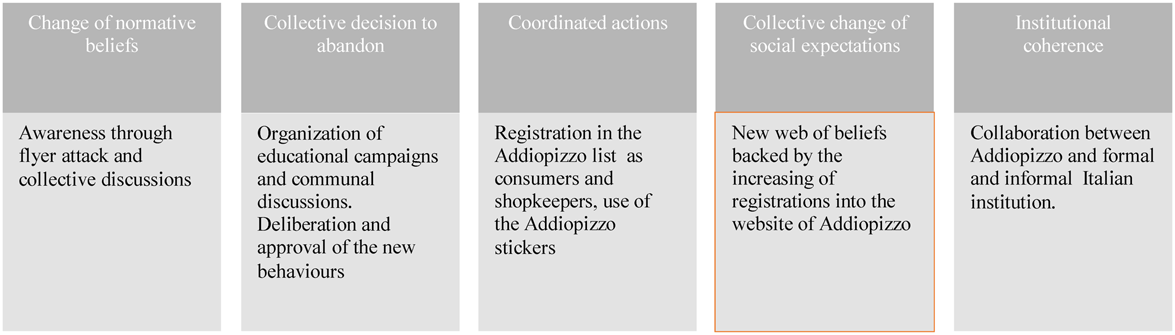
In what follows, we map the activity of Addiopizzo onto the five phases characterising the path of social norms' change. For each phase we identify both the social mechanisms (dark grey area in Figure 2) and the cognitive mechanisms (light grey area in Figure 2). The social mechanisms are the actions enacted by Addiopizzo with the effect of modifying the beliefs underlying the practice of paying pizzo; whereas the cognitive mechanisms are mental processes that need to be in place for the social mechanism to be successful. For example, in order to change social beliefs, it is necessary to make people aware of their beliefs about the practice. Figure 3 displays the steps that Addiopizzo has taken along the path of social norm change.
The social norm change path (adapted from Bicchieri, Reference Bicchieri2016).

Addiopizzo's norm change path.

Awareness phase
People are often unaware of the beliefs and social expectations that motivate a practice that they follow, especially if that practice has long existed and covered by a taboo (Bicchieri, Reference Bicchieri2006). The first step to gain awareness is to unveil the taboo. In the case of the practice of paying pizzo, the flyer attack carried out by Addiopizzo with the message ‘a whole population that pays the pizzo is a population without dignity’Footnote 14 was precisely aimed at breaking the silence about the practice and to make all citizens, both consumers and shopkeepers, aware that they have responsibilities in the fight against extortion rackets. The second important step to achieving awareness is to engage the whole community in collective discussions about the value of the practice, the beliefs supporting it and the negative externalities produced. This step is particularly important because it helps reveal the inconsistency between the beliefs and existing behaviour. People care about being consistent and pointing out their incoherence will lead them to revise their beliefs and possibly their behaviour (Festinger, Reference Festinger1957). Given the publicity and attention created by the flyer attack, Addiopizzo brought the pizzo racket and its compliance into the main squares of Sicily. In this phase it is fundamental to elicit specific beliefs and expectations, as typically done in behavioural diagnostics (Bicchieri, Reference Bicchieri2016). An example of such elicitation is the following: ‘Have we ever thought that while doing our daily shopping, we give money also to the Mafia? Certainly not, nevertheless this is what we do. If the bakeries, the tobacconists, the bars, the fish markets, the cinemas, the toy stores, etc. where we do our shopping, are forced to pay the pizzo, part of our money is given to the Mafia, even if it's a small percentage’.Footnote 15
To start this phase of awareness, ‘social’ or ‘ideological’ entrepreneurs are needed (Bicchieri, Reference Bicchieri2016; Li et al., Reference Li, Junxin and Hongping2006; Storr et al., Reference Storr, Grube and Haeffele-Balch2017). These actors attempt to give rise to the change by developing innovative solutions, mobilising ‘the ideas, capacities, resources and social arrangements required for sustainable social transformation’ (Alvord et al., Reference Alvord, Brown and Letts2004: 262), by convincing others that the ideological underpinnings of the existing institutional structure are unjust.
In the case of Addiopizzo, the seven founders were the social entrepreneurs (also referred to as innovators or trendsetters in the terminology of Rogers (Reference Rogers1962) and Bicchieri (Reference Bicchieri2016), respectively). They started creating a core group of individuals around them, sharing the same values about legality, pizzo and freedom and attempted to find new and creative ways (such as the flyers attack, the involvement of the consumers, the creation of the Addiopizzo's label) to solve the collective action.
Deliberation and legitimacy phase
This is a key phase in which people form reasons to change or abandon a practice. Reasons may involve receiving new information leading to a change in personal normative beliefs and factual beliefs. The requisites to succeed in this phase are open discussions on the topic carried on through a participatory approach guided by legitimate leaders and supported by trustworthy sources of information. Through collective deliberation, a shared reason or common knowledge on ‘why there is the need for a change’ is built.
Addiopizzo organised a variety of activities to inform and educate the citizens, in particular, focusing on schools and on the students' development of a concept of legality. Addiopizzo activists – whom, following Rogers (Reference Rogers1962) and Bicchieri (Reference Bicchieri2016) terminology, we referred to as social entrepreneurs or trendsetters – highlighted the negative externalities caused by the Mafia on Sicilian society. The reasons to abandon the practice of paying pizzo, once presented and discussed, need to be considered legitimate for being accepted. Usually individuals consider legitimate what they believe is appropriate, or just. Vaccaro (Reference Vaccaro2012) and Vaccaro and Palazzo (Reference Vaccaro and Palazzo2015) find that a crucial factor that helped Addiopizzo to gain legitimacy was its organisational transparency, namely the way it disclosed its decisions to stakeholders and civil society in general. Addiopizzo's leadership was made collective, as well as the decision making, and the structure was flexible. Every participant would be granted a voice and the consideration of the other members. The organisation wanted to be transparent in all organisational levels by keeping its affiliates informed about its current activities and initiatives, the names of consumers and companies subscribing to the initiative, its budget and so on.
Individual coherence phase
This phase consists of two stages: (i) signalling the willingness of change through public manifestations (declarations, pledges, etc.) and (ii) coordination of actions across actors.
Once the players have reasons to change, then consistent actions are required to bring about the change. In collective action problems, similar to the one represented by the payment of pizzo, in order to modify their behaviour, people must be reasonably sure that they are not acting alone. When behaviours are interdependent, acting alone is risky. The behaviour ruled by a social norm is not just ‘normal’, but also socially approved and violating it unilaterally may ignite many negative consequences (Bicchieri, Reference Bicchieri2016). To change a collective, interdependent behaviour it is often necessary that the group coordinates the change and promises to follow it (Haile, Reference Haile2006). Addiopizzo was able to coordinate the social expectations and actions of the different players thanks to an innovative strategy. The activity of the organisation was first directed towards the consumers. Addiopizzo realised that only after collecting evidence of consumers' demand for pizzo-free consumption, would it succeed in persuading the shopkeepers to adhere to the programme. Indeed, through the evidence of a clear positive response from the consumers, not only were the businesses ensured that their activity would financially survive, but they would also realise they were not alone in the battle against the pizzo leading thus to a change in empirical expectations. Consumers were the easiest players to involve in the Addiopizzo campaign because their participation did not face either significant risks or elevated costs. With the goal of creating this consumer support base, in 2005 Addiopizzo drafted a Manifesto appealing to the entire community to play an active role in the fight against the pizzo, on the one hand the economic activities by refusing to pay pizzo and on the other hand the consumers in choosing products and services provided by economic activities that committed not to pay the pizzo. The document had been signed by around 3,500 consumers and had been made available on-line and published by the Giornale di Sicilia. This first group of early adopters signing the Manifesto was composed of consumers already sharing normative beliefs and having good reasons to abandon the pizzo payment practice. Their public commitment of abandoning the old practice and adopting the new one, helped to build trust that the change is indeed occurring. Public pledges have the advantage that the promisor is more likely to keep his or her word since not doing so results in ‘loss of face’ and possibly also reputational damage (Bicchieri and Mercier, Reference Bicchieri and Mercier2014). Knowing the cost of a broken promise makes it credible and generates the trust that people will adopt the new behaviour and the expectation of such behaviour. The change in empirical expectations produced by the adherence of the first group of committed consumers to the Addiopizzo programme is a crucial step, in part because, as assumed by Bicchieri (Reference Bicchieri2016), it weakened people's pre-existing normative expectations (Bicchieri, Reference Bicchieri2016) and strengthened the belief that the adoption of the new behaviour is not going to be punished.
The creation of a new market for the pizzo-free product was fundamental to align the economic incentives of both parties. This is a strategy already used in other examples of social change achieved through social norms, such as the child marriage practice (Bicchieri et al., Reference Bicchieri, Lindemans and Jiang2014). Once a first group of consumers committed to choose pizzo-free products has been created, the activity of Addiopizzo was directed towards the business side. The businesses experienced a different kind of problem than the one faced by consumers since their risks in participating in the Addiopizzo initiative were elevated. In the past, the Mafia retaliated against those that refused to pay the pizzo. Addiopizzo created a label that certified compliance to the standard of legality. This label was assigned to the economic activities that decided to affiliate to the organisation after a process of certification and they were asked to post it in a visible place. The label ensured the consumer of specific, socially responsible behaviour of the businessman. A first group of economic activities sharing anti-mafia values (i.e. normative beliefs) decided to join Addiopizzo and display the sticker (Gunnarson, Reference Gunnarson2015).
Small ‘protected’ networks of motivated shopkeepers and consumers deciding to abandon an existing practice were created. We may think of these starting groups as ‘early adopters’ who wanted to spread their new ideas to other networks.
New web of beliefs phase
Since the necessary actions are interdependent, a change in normative beliefs needs to be shared by a large part of the population. Yet, moving against the old norm all alone may be too dangerous, even when some people have already stopped to endorse it. People will not change until they believe that a critical number among their group of peers has started to change and this requires a collective and coordinated shift in both empirical and normative expectations.
With their actions, the networks of ‘early adopters’ composed of consumers and shopkeepers that decided to abandon the existing practice of pizzo payment helped to coordinate behavioural change on a broader level to reach an ‘early majority’ (see Figure 1) (Rogers, Reference Rogers1962). How do these first networks of trendsetters successfully reach other networks?
Similarly to the Manifesto signed by the consumers, the Addiopizzo's sticker displayed on the shop windows acted as a public promise from the shopkeepers to abandon the old practice (Bicchieri and Mercier, Reference Bicchieri and Mercier2014). The fact of being costly made the signal convincing and effective at making other economic activities trust that the change was occurring and produced a change in their empirical expectations. As a result, new expectations were created about how many members of their reference network approved of the newly established behaviour (i.e. normative expectations) working as an insurance that their choice to abandon the existing norm would not be penalised. The sticker also worked as a deterrent against the Mafiosi's requests. Mafiosi arrested by the police had been found to have lists of shopkeepers affiliated to Addiopizzo with notes stating not to approach them. As reported by Marananno during an interview with the authors, a possible reason behind this strategy by the Mafia was to avoid shopkeepers that were more likely to report racket requests and put the Mafia under the spotlight.
Moreover, the Addiopizzo label served also the other important function of making the behaviour of the consumers susceptible to being evaluated by others. Consumers going to buy in shops displaying the Addiopizzo sticker were seen as consumers active in the battle against the Mafia. The label has then also the effect of motivating new consumers who do not want to be considered Mafia accomplices, to adopt the new behaviour and go shopping in economic activities adhering to the Addiopizzo campaign. Reputational concerns, and not necessarily anti-mafia values, may motivate later supporters among consumers. The joining of new consumers has the twofold effect of carrying on the shift in social expectations – both empirical and normative – about the behaviour of the members of the reference network and providing evidence that the consumers' demand for pizzo-free has grown. As a result, a larger number of economic activities is motivated to adhere to the Addiopizzo programme and abandon the old practice both because of adherence to the new social norm and for economic considerations.
Discussions and deliberations also play a crucial role in establishing ways to enforce commitment (Bicchieri and Mercier, Reference Bicchieri and Mercier2014). When a group of people is trying to institute a norm, they are likely to realise that some sanctions for norm-breakers are in order. Agreeing upon sanctions against those who decide not to comply with the new norm creates or facilitates the spread of normative expectations about the new practice and discourages norm violations, making the new behaviour more resistant. The community itself decides collectively which social sanctions to inflict on transgressors. The resulting punishment scheme will be perceived as more legitimate and will therefore be more effective (Xiao and Houser, Reference Xiao and Houser2011). Agreeing upon punishment helps spreading within the community the normative message that people should not pay the pizzo because this is what the community thinks should be done. For example, in 2007, Confindustria Sicilia, i.e. the Sicilian division of the Italian confederation of industrial firms, introduced in its ethical code a rule prescribing the expulsion of members colluding with the Mafia and in 2010 this rule became enforceable nationwide (Lavezzi, Reference Lavezzi2014). Being registered to Addiopizzo was the tool to identify the compliant entrepreneurs from those colluding.
The first four phases are the fundamental actions for social norm change to occur: once shared reasons to change are set (phase 1) and a collective decision is taken to abandon the old practice and punish whoever still conforms to it (phases 2 and 3), then compliance with the new social norm should follow. The emergence of the new social norm-based behaviour – driven by the new normative expectations created and reinforced through punishment – will lead to updated empirical expectations (phase 4) that create a feedback effect in which all the social expectations reinforce each other and allow the new social norm to spread.
Social coherence phase
Finally, the fifth phase of the social norm change path is aimed at harmonising formal institutions and informal ones to achieve coherence among laws, social norms and actions necessary for the appropriate functioning of the society. In order to abandon a harmful practice, sustained by a social norm, it is necessary that top-down and bottom-up interventions work together. As already explained, if a law strays too far from the social norm the public will not respect the law, and hence will not stigmatise those who violate it (Stuntz, Reference Stuntz2000). At the same time, a bottom-up approach alone will have a limited efficacy. Yet, the combination of a social and legal approach creates efficiency gains (Székely et al., Reference Székely, Nardin and Andrighetto2018).
Once the change is initiated, the enforcement of the new behaviour needs to be supported by all the legal, economic and educational institutions. Indeed, Addiopizzo is constantly collaborating with the Direzione Investigativa Antimafia (the Anti-Mafia Investigation Directorate), specialised lawyers, tax advisors and magistrates. In a few years, Addiopizzo has achieved the consensus of many institutional players fighting the Mafia, such as the FAI (the Italian Antiracket Federation), Centro Peppino Impastato (the Sicilian Centre of Documentation on the Mafia), Libera (an association which deals with civic education and the social use of confiscated real estate), the Ethical Bank, Adiconsum (one of the largest Italian consumers' organisation) and Confindustria. Moreover, it has engaged in several outreach programmes with schools, at all levels, in order to continue the task of spreading awareness and positive beliefs and expectations about a pizzo-free society.
5. Conclusions
The goal of this study is to show that the action of Addiopizzo produced an effective reduction in the payment of protection money in the Sicilian city of Palermo because it has been able – among other things – to trigger a change in the social norms underlying the pizzo practice. The case we analysed here shares similarities with the interventions that led to the abandonment of other damaging practices, such as female genital infibulation, child marriage and foot-binding. For example, foot-binding in China was a practice that remained in place for many centuries even when reforms and laws were issued to stall it (Mackie, Reference Mackie1996). Yet, it disappeared almost entirely within a single generation due to a deliberate campaign to eradicate the practice. The reformers organised ‘natural foot societies’ in which families pledged not to bind their daughters and not to allow their sons to marry bound women. In addition, they conducted public campaigns explaining the adverse consequences of foot binding for health, mobility and employability. In other words, they recognised that the key problem was to shift simultaneously the social expectations of interacting families and also to increase people's awareness of the harmful effects of the practice. These behaviours, as with the payment of the pizzo, are not just the expression of individuals' preferences: people do not follow those practices because they believe they are right or just. People's decisions to comply with those practices – we argue – are also motivated by the presence of social norms and social sanctions that are put in place every time people decide to deviate from them. We suggest here that the willingness to comply with the social norms and the consequent fear of being punished for their violation are important, but often neglected, drives behind people's endorsement and enforcement of these daunting practices. The existence of a social norm supporting the practice of paying pizzo prevented many policy interventions and grass-root initiatives to be fully successful on their own.
In this study, we have discussed how the initiatives of social change enacted by Addiopizzo were able to change the old socially undesirable social norm supporting the pizzo payment and create a new one with the effect of reducing the payment of protection money in the city of Palermo and a few other villages. Consistent with the path illustrated by Bicchieri (Reference Bicchieri2016), we have identified five phases through which Addiopizzo was able to bring about the process of social norm change. These phases had been supported by the following five mechanisms: (i) awareness via flyer attacks and collective discussions organised by Addiopizzo, (ii) deliberation and approval of the new behaviour during communal discussions and educational campaigns, (iii) pledges by registering in the Addiopizzo list as consumers and shopkeepers; synchronisation of expectations through the use of the Addiopizzo stickers, (iv) a new web of beliefs emerging from the increase in registrations on the website of Addiopizzo and (v) coordination between Addiopizzo and formal and informal institutions active in fighting the Mafia.
Acknowledging the importance of a shift in social norms for achieving social change allows us to link the two theories of institutions, as ‘rules’ and as ‘equilibria’. Greif and Kingston (Reference Greif and Kingston2011) identify the two approaches as complementary and we believe that a combination of the two is pivotal for social change. We propose that the behavioural change that Addiopizzo was able to initiate, was also the effect of the resolution of the mismatch between the social norms shared by the Sicilian population and the legislation issued by the State to oppose the pizzo practice. The lessons learnt from Addiopizzo can also be relevant in other contexts in which informal institutions are not in agreement with formal constraints, such as in the fight against corruption in many European countries, as they show the importance of grassroots movements in bringing about change in social norms and achieving effective and resilient social change.
As discussed, a change in the rules of the game alone had not been sufficient to deter the payment of pizzo. This is due to the fact that laws do not properly affect social expectations, nor they do provide enough reasons to change them. People need reasons to change their social expectation. Those reasons, if shared, are necessary preconditions for collective changes (Bicchieri, Reference Bicchieri2016). That is why an institutions-as-equilibria approach that focuses on changes in beliefs, norms and expectations (Greif, Reference Greif2006; Greif and Laitin, Reference Greif and Laitin2004) constitutes the complementary process to achieve a successful social change. The social and institutional change promoted by Addiopizzo highlights the necessity to have both processes, in accordance with what Ostrom and Basurto (Reference Ostrom and Basurto2011) suggested about the necessity of crafting theoretical and empirical tools able to accommodate the intrinsic dynamism that characterise such change.
Still, paying the pizzo is a widespread practice regardless of Addiopizzo's study, alongside that of the State and of local governmental bodies and it is extremely difficult to provide suggestions to policy-makers about how to eradicate it completely. We suggest here that paying the pizzo is a practice that has turned into a social norm and that successful strategies to counteract it should be able to operate a change in the social norms sustaining it. In a future study, we aim to collect empirical evidence to back up further our supposition, and in particular data on the social expectations and punishment sustaining the pizzo payment practice that may help to design more effective strategies to promote a long-standing and resilient social and institutional change.