Introduction
In addition to directly affecting fitness through mortality, development, reproduction and/or offspring's performance (Kroon & Veenendaal, Reference Kroon and Veenendaal1998; Ellers & van Alphen, Reference Ellers and van Alphen2002; Wang et al., Reference Wang, Xue, Hua and Ge2006; Chuche & Thiéry, Reference Chuche and Thiéry2012), diapause may have an indirect influence by changing the synchrony of insect occurrence with host resources. In phytophagous insects, synchrony with the host plant's phenology can be defined as the time elapsed between the appearance of the insect and the most relevant host phenological stages to its development (Yukawa & Akimoto, Reference Yukawa and Akimoto2006; van Asch & Visser, Reference van Asch and Visser2007). Variation in the degree of synchrony has important consequences on reproductive success. Indeed, larvae emerging when food is missing or not optimal for their development must escape to find more suitable habitats or develop on poor quality food, which has a fitness cost (Lawrence et al., Reference Lawrence, Mattson and Haack1997; van Asch & Visser, Reference van Asch and Visser2007). In contrast, individuals leaving diapause when their host plant is in the most favourable condition for their development have a greater fitness (Dixon, Reference Dixon1976; Watt & McFarlane, Reference Watt and McFarlane1991; Yukawa & Akimoto, Reference Yukawa and Akimoto2006).
Depending on the host plant's phenology, the composition and texture of the targeted organs varies, resulting in great consequences on insect fitness (Mattson, Reference Mattson1980; Gould et al., Reference Gould, Jones, Rifleman, Perez and Coleman2007; Marchi et al., Reference Marchi, Tognetti, Minnocci, Borghi and Sebastiani2008). Thus, the poor food quality and/or quantity available for larvae generally leads to a smaller adult size with a lower energy reserve, which may hinder female fecundity and/or the reproductive success of male insects (Scriber & Slansky, Reference Scriber and Slansky1981; Awmack & Leather, Reference Awmack and Leather2002; Moreau et al., Reference Moreau, Arruego, Benrey and Thiery2006, Reference Moreau, Thiéry, Troussard and Benrey2007).
Plant quality is mainly determined by its chemical composition, including the concentrations of secondary metabolites and the nitrogen content (Mattson, Reference Mattson1980; Awmack & Leather, Reference Awmack and Leather2002). Nitrogen content is a key factor for a wide range of phytophagous insects because of its importance in protein synthesis (Mattson, Reference Mattson1980; Karley et al., Reference Karley, Douglas and Parker2002; Wilkinson & Douglas, Reference Wilkinson and Douglas2003). Hence, a high availability of nitrogen often increases the growth and survival rates (Hunter & McNeil, Reference Hunter and McNeil1997; Jonas & Joern, Reference Jonas and Joern2008). In the same way, the carbon-to-nitrogen (C:N) ratio is often crucial and was shown to limit the spatial distribution and growth of several sap-feeding insect populations (Mattson, Reference Mattson1980; Wilkinson & Douglas, Reference Wilkinson and Douglas2003; Bi et al., Reference Bi, Castle and Toscano2007). The chemical composition of plants varies within the season. This was specifically demonstrated for the sucrose and amino acid phloem contents (Douglas, Reference Douglas1993; Yao & Akimoto, Reference Yao and Akimoto2002; Quental et al., Reference Quental, Trigo and Oliveira2005). It was also demonstrated that the phloem composition varies among plants of the same species and within plants, particularly as a function of leaf age (Merritt, Reference Merritt1996; Karley et al., Reference Karley, Douglas and Parker2002).
Scaphoideus titanus (Hemiptera: Cicadellidae) feeds on phloem, which has a high sugar level and a low nitrogen content (Mattson, Reference Mattson1980; Douglas et al., Reference Douglas, Price, Minto, Jones, Pescod, Francois, Pritchard and Boonham2006). Free amino acids are the main available nitrogen form in the phloem and their composition, especially in essential amino acids, is a determining factor of the sieve quality (Wilkinson & Douglas, Reference Wilkinson and Douglas2003; Hunt et al., Reference Hunt, Pritchard, Bennett, Zhu, Barrett, Allen, Bale and Newbury2006). Sucrose is the most important mobile sugar in the phloem of many plants (Karley et al., Reference Karley, Douglas and Parker2002) and, as the only carbon source for phloem-sap feeding insects, it acts as a phagostimulant, strongly impacting feeding behaviour (Douglas et al., Reference Douglas, Price, Minto, Jones, Pescod, Francois, Pritchard and Boonham2006; Pescod et al., Reference Pescod, Quick and Douglas2007).
Even though S. titanus was introduced from north-eastern America to France and the rest of Europe more than 70 years ago (Bonfils & Schvester, Reference Bonfils and Schvester1960; Chuche & Thiéry, Reference Chuche and Thiéry2014), it is subjected to surprisingly little predation or parasitism (Malausa & Sentenac, Reference Malausa, Sentenac and Sentenac2011). Scaphoideus titanus was first observed in southwestern France in 1958 (Bonfils & Schvester, Reference Bonfils and Schvester1960). In the 1960s, S. titanus individuals were discovered in many south French vineyards, southern Switzerland and in north-western Italy (Schvester et al., Reference Schvester, Moutous, Bonfils and Carle1962; Vidano, Reference Vidano1964). This species continued to expand quickly and was found in Slovenia in the 1980s, in Portugal in the 1990s, in Austria, Bulgaria, Bosnia-Herzegovina, Croatia and Romania in the 2000s (Chuche & Thiéry, Reference Chuche and Thiéry2014). Scaphoideus titanus is a specialist of Vitis and its distribution is restricted to the European vineyards between 35 and 50° north latitude (Chuche & Thiéry, Reference Chuche and Thiéry2014), which can partly be explained by climatic factors. The current hypothesis is that it adapts well to cold winters in accordance with its North American origin (Caudwell & Larrue, Reference Caudwell and Larrue1979). Recent studies confirmed the role of cold winter conditions on hatching dynamics (Chuche & Thiéry, Reference Chuche and Thiéry2009) and on the synchrony between the two sexes (Chuche & Thiéry, Reference Chuche and Thiéry2012). Scaphoideus titanus is a univoltine species that lay their eggs at the end of the summer. Then, eggs pass the winter during a 6–8 month diapause stage (Chuche & Thiéry, Reference Chuche and Thiéry2014). Diapause does not require the exposure to cold temperatures to be broken but hatching dynamics appear to vary according to winter temperature (Chuche & Thiéry, Reference Chuche and Thiéry2009, Reference Chuche and Thiéry2012, Reference Chuche and Thiéry2014).
In this study, our goal was to assess if the success of S. titanus could be partly explained by good synchrony between hatchings and host plant bud break, and/or plasticity for maintaining a good fitness level despite the sub-optimal food quality. Specifically, we tested the following hypotheses: (1) S. titanus egg hatchings are synchronized with grapevine bud break, irrespective of the winter temperatures; (2) first and last hatching nymphs are not exposed to the same phloem quality; and (3) phloem quality has no significant effect on S. titanus nymph and adult fitness.
Materials and methods
Biological materials
Grapevine (Vitis vinifera cv. Cabernet Sauvignon) cuttings used for experiments were grown in a potting compost mix (Substrate 5; Klasmann-Deilmann, Geeste, Germany) and irrigated twice a week. No pesticide was used on these plants.
Leafhopper nymphs were obtained from two natural egg populations collected as previously described (Caudwell et al., Reference Caudwell, Kuszala, Bachelier and Larrue1970; Chuche & Thiéry, Reference Chuche and Thiéry2009). Two-year-old grapevine woody canes carrying eggs were collected in mid-February 2010 in organic vineyards where sizable populations were observed over successive years. Egg hatchings were obtained by placing woody canes inside plastic hatching cages (50×38×36 cm) in a climate chamber under a 16:8 (L:D) photoperiod, at 23±1 °C, and 65–70% relative humidity (RH). To avoid egg desiccation, a 1-cm layer of vermiculite (Efisol, Strasbourg, France) was placed below the eggs and humidified with water every 7 days. To harvest neonatal nymphs, six cut leaves of a grapevine maintained in a glass tube with water, were added to the cage approximately 20 days after the eggs were placed at 23±1 °C. Leaves were replaced when they began to wither.
Insect–plant synchrony
In this experiment, we used two S. titanus populations: one from the S. titanus introduction area, near Bordeaux (44°53′54.41″N 0°2′0.30″W), and the other from the north-eastern limit of its spread in France, in Burgundy (46°45′27.31″N 4°41′23.95″E). Woody canes were randomized by grouping all the collected canes from a same origin and splitting them into three samples with ca. 3 kg in each. Using this method, batches are expected to bear equivalent amounts of eggs. Because the egg populations came from two vineyards, the cultivars of origin also differed: in Bordeaux, the cultivar was Merlot and in Burgundy, it was Pinot Noir. Because the Burgundy vineyard is subjected to colder conditions than the Bordeaux vineyard, we assumed that these two geographical origins offered sufficiently different populations on which to conduct this experiment. In each hatching cage, nymphs were gently removed each day from the leaves using a pooter, and the number of nymphs found was taken to be the number of hatching eggs. Additionally, the number of buds that broke on the Merlot or Pinot Noir woody canes carrying eggs were scored. Observations ended when no hatching occurred for 7 consecutive days.
Leafhopper fitness
When a high number (over 100) of eggs hatched on the same day, they were placed in rearing cages (same as hatching cages) on a different cultivar, Cabernet Sauvignon, with one of the grapevine age classes: young, at the 5–6 leaf phenological stage, or old, at the 20 leaf phenological stage. Young leaves of old cuttings were isolated from the leafhoppers by enclosing their apical shoots in a clear plastic box ventilated with a piece of insect-proof mesh. To avoid inducing physiological changes in the plants, they were not pruned. Rearing cages were then stored in a climate chamber under a 16:8 (L:D) photoperiod, at 23±1 °C, and 65–70% RH, and cuttings were replaced every 3 weeks.
From the day of eggs hatching until all the individuals became adults, a weekly sample of 40 insects was taken, characterized and put back in the rearing cage. They were measured, to the nearest 0.01 mm, from the head extremity, without antenna, to the telson ending using a stereomicroscope with a micrometre, and the 4th instar or older nymphs were weighed to the nearest 0.01 mg. We also checked the developmental instar and the sex of 5th nymphal instar and adults (Della Giustina et al., Reference Della Giustina, Hogrel and Della Giustina1992). To compare the developmental state of S. titanus egg populations from Burgundy and Bordeaux, we treated all instars as equal development stages by averaging a population instar like the Developmental Index used by Bird & Hodkinson (Reference Bird and Hodkinson2005) for Psyllidae:
 $${\rm ID} = \sum\limits_{i = 1}^{6} {(n_i. i)} /T$$
where T=total number of S. titanus, i=instar code (1st nymphal instar=1… 5th nymphal instar=5, adult=6) and n i =number of individuals in instar i.
Sampling leaf phloem
Phloem, the food source of S. titanus, was analysed to compare the nutritional quality of leaves. Sap samples were collected following the exudation technique described by King & Zeevaart (Reference King and Zeevaart1974) between the hours of 02.00 and 06.00 p.m. to avoid circadian composition fluctuations in the sap. Exudates were collected from three leaf classes of the Cabernet Sauvignon cultivar: mature leaves from the bottom of the old cuttings (N=30), intermediate leaves from the top of the old stage cuttings (N=32) and young leaves from the young cuttings (N=31).
To ensure a convenient exudation before sap collection, cuttings were stored in a climate chamber at 20±1 °C with a water vapour-saturated atmosphere using a saturated solution of KH2PO4 for 24 h. Grapevine leaves were cut just above the petiole/stem junction with sharp scissors and directly re-cut with a razor blade in 20 mM Na2EDTA, pH 7.0. The petioles were then placed into 1.5-ml Eppendorf tubes filled with 200 μΛ of 20 mM Na2EDTA, pH 7.0 solution. Exudation took place in a light proof-box at 20 °C with close to 100% humidity owing to the saturated solution of KH2PO4. This eliminated evapotranspiration that would disturb exudation. After 20 h of exudation, 50 μl of each sample were collected and stored in Eppendorf tubes at −20 °C until analysed for sucrose contents. The remainder was evaporated with a vacuum concentrator (Speedvac RC1010; Jouan, Winchester, USA) and resuspended in 30 μl of 0.1 N HCl until their use for amino acid analyses.
Because leaf area is highly correlated to the leaf's nitrogen content (van Wijk et al., Reference van Wijk, Williams and Shaver2005), leaf areas were measured after exudation with a LI-3100 Area meter (Li-Cor; Nebraska, USA) to normalize samples by relating volume to leaf size.
Amino acid compositions
Exudates in the HCl solution were shaken by hand and centrifuged at 30,000 g for 8 min. Free amino acids were analysed by reverse-phase high-performance liquid chromatography with pre-column derivatization using o-phthaldialdehyde and 9-fluorenylmethyloxycarbonyl (Jones et al., Reference Jones, Pääbo and Stein1981). The amino acids were separated on a ZORBAX Eclipse AAA C18 column at 40 °C, using an Agilent Technologies 1100 system, and fluorescence and ultraviolet detectors. Amino acids were then quantified by comparing sample peak areas to a reference Amino Acid Supplement (Agilent Technologies, Santa Clara, USA) containing glutamine, asparagine, tryptophan and norvaline using linear regression forced through the origin. All of the amino acids, except proline and cysteine, could be detected by this method, with a detection limit of approximately 0.5 pmol. The protocol followed the Agilent ZORBAX Eclipse AAA application with two mobile phases, NaH2PO4 (40 mM, pH 7.8) and acetonitrile/methanol/water mix (45:45:10, v/v/v).
Sucrose content
Because the soluble phloem carbohydrate was mainly sucrose (Turgeon & Wolf, Reference Turgeon and Wolf2009), the sucrose:amino acid ratio was used as a measure of the C:N content of the phloem sap, on which leafhoppers feed. The sucrose concentration in the phloem exudates was analysed with a Sigma Glucose Assay Kit (procedure no. 510). This method required an enzymatic hydrolysis of sucrose by invertase at 10 u.i./ml dissolved in acetate buffer pH 4.5. A volume of 100 μl of phloem exudates were mixed with 10 μl of invertase and incubated for 30 min at 37 °C. Then, 200 μl of a reaction mixture containing glucose oxidase, peroxidase and o-dianisidine reagent was added. After a 30 min incubation at 37 °C, the reaction was stopped by the addition of 200 μl of 12 N H2SO4.
The sample absorbance was measured at 540 nm (UV-1605; Shimadzu, Kyoto, Japan) and compared with glucose standards.
Statistics
Effects of instar, insect origin and leaf age on nymph and adult size and weight were examined using an analysis of variance (ANOVA) test after a logarithmic transformation to improve the normality of the data. Before performing the ANOVA tests, data were tested for normality using the Shapiro–Wilk test and homogeneity of variance using the Levene test.
The indexes of development (ID) were compared using an ANCOVA with a feeding category as a covariate (Garcia-Berthou, Reference Garcia-Berthou2001).
The developmental rates of the leafhopper populations feeding on young or mature grapevine cuttings were determined using linear regressions calculated with I D values. Regressions were then compared using Fisher's test (Snedecor & Cochran, Reference Snedecor and Cochran1967).
Synchrony between hatching and bud break was analysed by Spearman's correlation test on the accumulated hatching and bud break dynamics.
In order to avoid any statistical bias in the comparison of phloem chemical composition, all exudates with no sucrose were discarded. The data were tested for normality using the Shapiro–Wilk test and homogeneity of variance using the Levene test.
The amino acid compositions of phloem were compared using a non-parametric multiple ANOVA (NPMANOVA) for 1000 permutations (Anderson, Reference Anderson2001). Then, a principal component analysis (PCA) was performed to describe the influence of plant age on the phloem's amino acid composition after a logarithmic transformation of the data.
Total amino acid and sucrose contents, and the sucrose:amino acid (C:N) ratio, were compared with a Kruskall–Wallis test. Then, we performed post-hoc comparisons using Nemenyi's test (Zar, Reference Zar2010).
All statistical analyses were performed using the software R 2.8.0 for Windows (R Development Core Team, 2007).
Results
Insect–plant synchrony
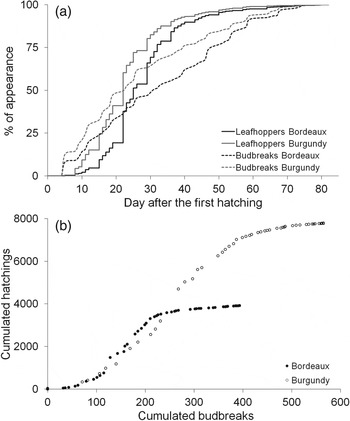
Eggs from Burgundy hatched in a shorter period than those from Bordeaux (log rank: χ 2 =371; Gehan-Wilcoxon: χ 2 =636, P<0.001, fig. 1a). After 15, 20 and 26 days, 25, 50 and 75%, respectively, of the eggs from Burgundy had hatched, whereas for the Bordeaux eggs to reach the same hatching proportions it took 20, 25 and 31 days, respectively. However, the major peak of hatching was similar, occurring 22 days after the first hatching for eggs that had been exposed to natural cold and mild winters before the experiments. Despite the difference between the two hatching dynamics, the daily variation of hatchings was significantly correlated (r S =0.82, P<0.001). Hatching dynamics in the lab evolved similarly, irrespective of the winter conditions the eggs had been subjected to. The difference between the two hatching patterns was based on hatching levels before and after the major peak. Indeed, when the major peak of hatchings occurred, only 25% of the Bordeaux population had hatched, compared with 50% of the Burgundy population.
(a) Cumulative percentage of S. titanus egg hatchings and grapevine wood bud breaks from Bordeaux and Burgundy. (b) Synchrony between hatching and bud break for the two vineyards.

The number of hatchings were significantly correlated with grapevine bud break regardless of the origin of the eggs (Burgundy: r S =0.99, P<0.001; Bordeaux: r S =0.99, P<0.001, fig. 1b).
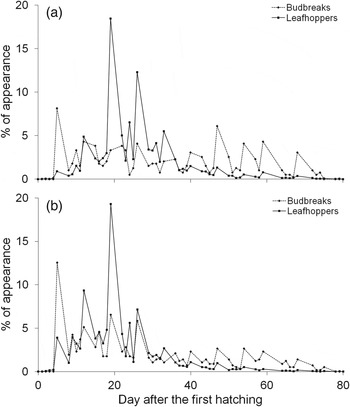
For Bordeaux and Burgundy, the peak of bud break occurred 8 days after the first hatching, while the hatching peak was reached after 22 days (fig. 2). The degree of synchrony between food availability and hatchings is the same for both areas because the hatching dynamic exceeds the bud break dynamic after the hatching peak (fig. 2).
Daily dynamics of S. titanus egg hatchings and grapevine wood bud breaks from (a) Bordeaux and (b) Burgundy.

Leafhopper fitness
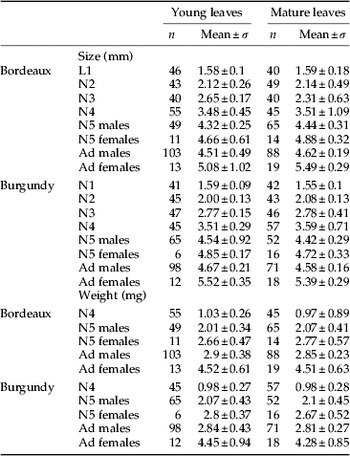
Nymphal development was not affected by the leaf age in our experiments (table 1). Insects that fed on young or mature leaves had similar sizes (F=0.01; P>0.05) and weights (F=1.20; P>0.05). Moreover, size (F=0.81; P>0.05) and weight (F=3.17; P>0.05) were not influenced by the origin of S. titanus populations.
Body size and weight of S. titanus from Bordeaux and Burgundy vineyards when feeding on young or mature leaves. Nx, nymphal instar x; Ad, adult.

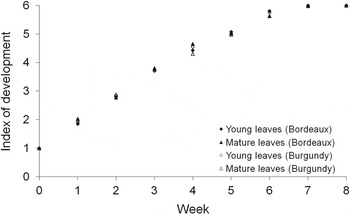
The developmental rate at the different hatching dates could be presented by their linear regression (all r 2>0.95, P<0.001; fig. 3). The developmental rate did not depend on the leaf age (analysis of covariance; Burgundy: F 1,16=0.0458; P>0.05; Bordeaux: F 1,16=0.0098; P>0.05).
Evolution of the developmental index of S. titanus from Bordeaux and Burgundy vineyards when reared on young or mature leaves.

Effects of plant and leaf age on phloem quality
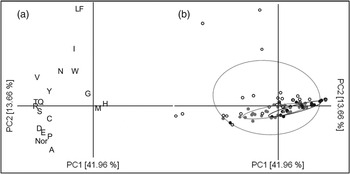
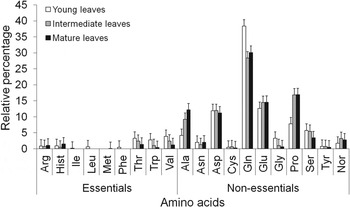
The amino acid composition of phloem exudates of young, intermediate and mature leaves were significantly different (NPMANOVA; F 2,92=5.17; P<0.001, fig. 4). To explore the variation in phloem amino acid composition, a PCA was performed to compare the different leaf classes. The first two principal components (PC1 and PC2) accounted for 55.62% of the total variation in the dataset (fig. 4a). A plot of the amino acid attributes revealed that PC1 tended to separate essential from non-essential amino acids (fig. 4a). Non-essential amino acids were grouped under PC1, except asparagine. These two components achieved a good separation of young, intermediate and mature leaves (fig. 4b). There was a shift in the amino acid composition during plant development, with some essential amino acids that were present in young leaves, such as isoleucine, leucine and phenylalanine, disappearing during leaf maturation, while the non-essential amino acids content increased. The non-essential amino acids alanine and proline were at a higher concentration in intermediate and mature leaves, representing 29 and 26%, respectively, of the phloem composition, than in younger leaves (only 11% of the composition). Glutamine was detected in all leaves and represented approximately 40% of the concentration of amino acids in young leaves, as opposed to approximately 30% for intermediate and mature leaves. The essential amino acids leucine, isoleucine and phenylalanine represented 12% of the amino acid concentration of young leaves, whereas they are absent in intermediate and mature leaves (fig. 5).
PCA of the phloem profiles from V. vinifera leaves of different ages based on relative amounts of amino acids. (a) Plot of amino acids from leaves of different ages on a grid defined by principal components 1 and 2. For a better readability, amino acids are represented by their single letter code, excepted for norvaline that is a non-proteinogenous amino acid. A: alanine, C: cysteine, D: aspartic acid, E: glutamic acid, F: phenylalanine, G: glycine, H: histidine, I: isoleucine, L: leucine, M: methionine, N: asparagine, Nor: norvaline, P: proline, Q: glutamine, R: arginine, S: serine, T: threonine, V: valine, W: tryptophan, Y: tyrosine. (b) Plot of phloem samples on a grid defined by principal components 1 and 2. Open circle and broken ellipse: young leaves; grey circles and ellipse: intermediate leaves; black circles and ellipse: mature leaves.

Amino acid composition of phloem from grapevines of different ages. Ala: alanine, Arg: arginine, Asn: asparagine, Asp: aspartic acid, Cys: cysteine, Gln: glutamine, Glu: glutamic acid, Gly: glycine, His: histidine, Ile: isoleucine, Leu: leucine, Met: methionine, Nor: norvaline, Phe: phenylalanine, Pro: proline, Ser: serine, Thr: threonine, Trp: tryptophan, Tyr: tyrosine, Val: valine.

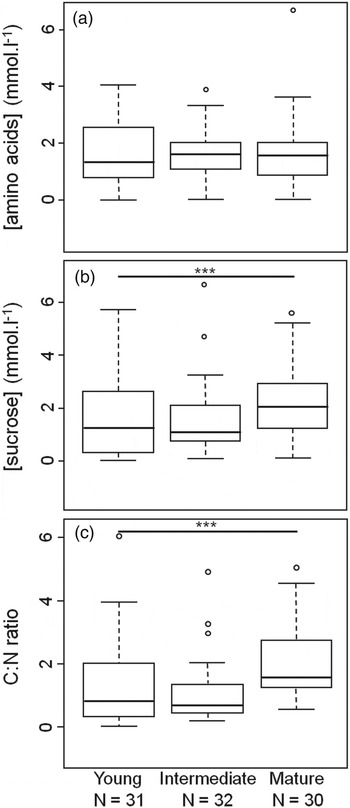
There was a significant difference in the sucrose concentration between the three leaf classes (Kruskal–Wallis; χ 2 =7.71; P<0.01; fig. 6b). The sucrose:amino acid ratio in phloem exudates varied significantly depending on the age of the leaf (Kruskal–Wallis; χ 2 =15.39; P<0.001). Mature leaves had a higher ratio than intermediate and young leaves (fig. 6c). No differences of total amino acid concentrations were found between the leaves of different ages (Kruskal–Wallis; χ2=0.149; P>0.05; fig. 6a).
(a) Amino acid, (b) sucrose content and (c) C:N ratio of phloem from plants of different ages.*** P<0.001 (Nemenyi post-hoc test).

Discussion
We examined if winter temperature affected the synchrony between a univoltine leafhopper and its host plant. We hypothesized that: (1) hatching would be synchronized with plant bud break, independent of the winter temperatures; (2) early and late hatching nymphs would encounter phloem of different chemical compositions; and (3) phloem quality would have no effect on S. titanus fitness.
Our results are in agreement with our hypotheses. We found that S. titanus hatching and grapevine bud break dynamics had similar degrees of synchrony after being exposed to either cold or mild winter in their natural environment. We showed that phloem quality varies during plant development without serious consequences on the fitness parameters measured. This minimizes the role of plant-sap quality and maximizes the role of food availability, as determined by hatching and bud break synchrony. We conclude that the persistence of good synchrony and the ability to develop on different qualities of food without a fitness cost can partly explain the invasive success of this species.
European vineyards have very different characteristics. A huge number of cultivars, mainly issued from hybridization within V. vinifera, but also across V. vinifera and other Vitis species, are planted under varying climates. These cultivars have very different anatomical and physiological characteristics, in particular in their phenology (van Leeuwen et al., Reference van Leeuwen, Garnier, Agut, Baculat, Bersnard, Bois, Boursiquot, Chuine, Dessup, Dufrourcq, Garcia-Cortazar, Merguerite, Monamy, Koundouras, Payan, Parker, Renouf, Rodriguez-Lovelle, Roby, Tonietto and Trambouze2008). During its expansion in Europe, S. titanus was confronted by varied ecological niches with different climates and host plants with different qualities and precocities. Despite this, S. titanus is now widespread in most of the European vineyards (Chuche & Thiéry, Reference Chuche and Thiéry2014). The success of this invasive species is probably based, in part, on its ability to accept different phloem qualities, which are characteristic of the great number of different grape cultivars and their very different growing and training conditions, and on its capacity to maintain a good synchrony with its host plant whatever the climate and the cultivar. Another factor that may explain the invasive success of S. titanus is that only a portion of the S. titanus egg population is sensitive to winter temperatures, with the other part hatching independently of the temperature treatment (Chuche & Thiéry, Reference Chuche and Thiéry2009). This phenotypic variance could be a bet-hedging strategy allowing for good synchronization in the temperature-sensitive population (Hopper, Reference Hopper1999), while the temperature-insensitive population will survive in an unfavourable environment. Thus, the risk of extinction caused by exceptional climatic events is limited (Rajon et al., Reference Rajon, Venner and Menu2009).
Like most deciduous woody species of temperate zones, grapevines undergo vegetative dormancy. Bud dormancy is controlled genetically, naturally induced by photoperiod and temperature, and generally breaks after exposure to cold temperatures (Horvath et al., Reference Horvath, Anderson, Chao and Foley2003). The time required for initiating bud break, and the time between first and last bud to break, decrease with the duration of the grapevine's exposure to cold, while the number of breaking buds per grapevine increases (Kliewer & Soleimani, Reference Kliewer and Soleimani1972). Winter temperatures are a signal inducing both the resumption of the development of the grapevine and of S. titanus. Hence, one may expect the leafhopper and its host plant to be sensitive to the same climatic parameters, but not in the same manner. Indeed, cold temperatures are needed to have a good grapevine dormancy break (Lavee & May, Reference Lavee and May1997) but not to break S. titanus diapause (Chuche & Thiéry, Reference Chuche and Thiéry2012). However, the different responses of grapevines and S. titanus to temperatures allow the insect and the plant to be synchronized. Indeed, outbreaks of S. titanus are correlated with bud break in V. vinifera, after exposure to a mild or a cold winter.
For univoltine phytophagous species, synchrony between hatchings and the occurrence of target plant organs insures optimal food, which reduces nymphal mortality (Rossi & Strong, Reference Rossi and Strong1991). To guarantee optimal nymphal survival and fitness, S. titanus egg hatchings should be synchronized with grapevine bud break, not before leaf appearance, and when the young leaves have the highest nitrogen content (Mooney & Gulmon, Reference Mooney and Gulmon1982). This can be illustrated in Drepanosiphum platanoidis aphids (Homoptera: Callaphididae). Adults hatching at the same time as the bud of their host plant Acer pseudoplatanus (Sapindales: Aceraceae) are twice as large and have faster growing offspring than those hatched after bud break (Dixon, Reference Dixon1976).
The increase in average temperatures induces early bud break of vines (Duchêne & Schneider, Reference Duchêne and Schneider2005), and Chuche & Thiéry (Reference Chuche and Thiéry2009) observed that a warmer winter induces a greater spread of hatchings in S. titanus. Therefore, an asynchrony between egg hatching and bud break can be associated with higher winter temperatures and have serious consequences on larval survival (Watt & McFarlane, Reference Watt and McFarlane1991). For example, the synchrony of Operophtera brumata (Lepidoptera: Geometridae) with its host plant Picea sitchensis (Pinales: Pinaceae) in Scotland shows a lag of 20±2.5 days when the ambient temperature increases 2 °C (Dewar & Watt, Reference Dewar and Watt1992). With global warming effecting warmer winter areas, one could expect an earlier but more prolonged hatching period (Chuche & Thiéry, Reference Chuche and Thiéry2009, Reference Chuche and Thiéry2012) when the bud occurrence was early. This could desynchronize the grapevine and S. titanus. The majority of nymphs would then appear on older leaves with a lower nutritional quality but without consequences on S. titanus fitness, according to our results. Thus, in the context of climate warming, the expected asynchrony between S. titanus and V. vinifera would not affect leafhopper populations and S. titanus would not be expected to contract its distribution area in future years.
The synchrony of S. titanus with the grapevine is an important adaptive advantage, allowing them to receive optimal nutrition both quantitatively and qualitatively, because specialist insects often prefer to feed on young organs (Cates, Reference Cates1980). The comparison of the phloem contents between leaves of different ages showed a quantitative variation of sucrose and the qualitative composition of amino acids. Phloem composition varies between leaf cuttings of different ages, even between leaves of different ages from the same plant. This can be explained by differences in metabolic activities. Young organs are sinks for compounds produced by other organs of the plant, and they use them to ensure their development. In contrast, mature leaves, by their intense photosynthetic activity, are sources, especially of carbon compounds such as sucrose (Araya et al., Reference Araya, Noguchi and Terashima2006). The older leaves are thus less nutritious because of a higher C:N ratio (Wilkinson & Douglas, Reference Wilkinson and Douglas2003; Jonas & Joern, Reference Jonas and Joern2008), and they have a lower content of essential amino acids (Hunt et al., Reference Hunt, Pritchard, Bennett, Zhu, Barrett, Allen, Bale and Newbury2006; Bi et al., Reference Bi, Castle and Toscano2007). This decrease in the resource quality exists in many plant species and stimulates phytophagous insects to feed on young bodies to increase their reproductive success (Karley et al., Reference Karley, Douglas and Parker2002; Bi et al., Reference Bi, Castle and Toscano2007).
Even when simulating asynchrony by feeding nymphs on mature leaves, the life traits measured were not affected by the age of the plant. Differences in measured qualities were not large enough to generate significant differences. The fact that sap quality and fitness were not related in this study suggests that S. titanus can accept food variation without a fitness cost, which could represent a strong advantage for the colonization process in different vineyards. Hemiptera, such as aphids, host many secondary symbionts, which provide many functions and allow the insects to expand their ecological niches (Oliver et al., Reference Oliver, Degnan, Burke and Moran2010). The role of hemipteran symbionts on plant host adaptation and nutrient supply are well known (Sandstrom et al., Reference Sandstrom, Telang and Moran2000; Wu et al., Reference Wu, Daugherty, Van Aken, Pai, Watkins, Khouri, Tallon, Zaborsky, Dunbar, Tran, Moran and Eisen2006; Chandler et al., Reference Chandler, Wilkinson and Douglas2008; Frago et al., Reference Frago, Dicke and Godfray2012). These symbiotic microorganisms are capable of using low-quality food for the synthesis of vitamins and essential amino acids (Douglas, Reference Douglas1998, Reference Douglas2009; Chandler et al., Reference Chandler, Wilkinson and Douglas2008). They may supply elements, such as sucrose, or amino acids, such as aspartate or glutamine (Sasaki & Ishikawa, Reference Sasaki and Ishikawa1995). The symbionts are particularly important for insects that are specialized to nutrient-deficient food resources, such as plant sap (Feldhaar & Gross, Reference Feldhaar and Gross2009). The microbial community associated with S. titanus was studied and revealed the existence of many symbionts, including the acetic acid bacteria Asaia sp. (Marzorati et al., Reference Marzorati, Alma, Sacchi, Pajoro, Palermo, Brusetti, Raddadi, Balloi, Tedeschi, Clementi, Corona, Quaglino, Bianco, Beninati, Bandi and Daffonchio2006; Sacchi et al., Reference Sacchi, Genchi, Clementi, Bighardi, Avanzati, Pajoro, Negri, Marzorati, Gonella, Alma, Daffonchio and Bandi2008; Crotti et al., Reference Crotti, Damiani, Pajoro, Gonella, Rizzi, Ricci, Negri, Scuppa, Rossi, Ballarini, Raddadi, Marzorati, Sacchi, Clementi, Genchi, Mandrioli, Bandi, Favia, Alma and Daffonchio2009). Acetic acid bacteria are suspected to play a role in insect host metabolism by supplying nutrients, such as vitamins or cofactors, by oxidizing certain substrates, or indirectly by supplying metabolites to other microbes beneficial to the host (Crotti et al., Reference Crotti, Rizzi, Chouaia, Ricci, Favia, Alma, Sacchi, Bourtzis, Mandrioli, Cherif, Bandi and Daffonchio2010). If the amino acid composition of old leaves is a limiting factor for the development of S. titanus, this deficiency could be filled via the synthesis of essential amino acids by symbionts, such as Asaia sp. For example glutamine could be produced from the phloem. This theory on the role of symbionts in S. titanus’ invasive success, by providing food supplements when the host is unfavourable, requires further investigation.
Acknowledgements
We thank Denis Clair and Bernard Alixant (INRA Dijon) for their assistance in insect collection and Sébastien Gambier (our Lab.) for the plants growth and care. This project was supported by grants from the Conseil Interprofessionnel des Vins de Bordeaux, the region Aquitaine and the INRA SPE department. This study has been carried out in the framework of the Cluster of Excellence COTE.