Introduction
Mild cognitive impairment (MCI) is an intermediate medical state between normal aging and Alzheimer's disease. It is defined as a condition characterized by newly acquired cognitive decline beyond what is expected for an individual's age and education, yet leaving activities of daily living intact (Albert et al., Reference Albert2011). The prevalence of MCI in late life varies according to the sample and definition (Rosenberg and Lyketsos, Reference Rosenberg and Lyketsos2008; Werner and Korczyn, Reference Werner and Korczyn2008). Amnestic MCI has a prevalence of 3%–6% in population-based samples of older persons, while all MCI subtypes have a prevalence of as high as 16% (Lopez et al., Reference Lopez2003; Feldman and Jacova, Reference Feldman and Jacova2005). Moreover, the outcome of MCI is unclear, for some deteriorating into a state of dementia, while for others remaining stable, deteriorating slowly, or even improving (Werner and Korczyn, Reference Werner and Korczyn2008; Olazaran et al., Reference Olazaran2011).
The high prevalence of this impairment and the distinct possibility that it may deteriorate into dementia emphasizes the importance of assessing the condition as early as possible and providing adequate help to improve the quality of life and prognosis of individuals with MCI (Werner and Korczyn, Reference Werner and Korczyn2008). A critical determinant in this respect is physicians’ knowledge about MCI and their preferences regarding the referral and treatment options for persons with MCI. Previous research in other diseases (Reiner et al., Reference Reiner, Sonicki and Tedeschi-Reiner2010; Joukar et al., Reference Joukar, Mansour-Ghanaei, Soati and Meskinkhoda2012) suggests that physicians’ knowledge of diseases may well determine their assessment and treatment of those diseases. Thus, reaching a greater understanding of the knowledge and beliefs that physicians hold in relation to MCI is a critical first step for improving the quality of care for individuals with MCI.
Few studies have been conducted on physicians’ knowledge, attitudes, and practice related to MCI, and existing studies have focused more on practice than on knowledge and attitudes. For example, studies on general practitioners (Kaduszkiewicz et al., Reference Kaduszkiewicz2010; Mitchell et al., Reference Mitchell, Meader and Pentzek2011) reveal that they have substantial difficulty in correctly identifying patients with MCI. In a study conducted in Australia and New Zealand among 163 geriatricians (Mitchell et al., Reference Mitchell, Woodward and Hirose2008), 70% of the participants indicated that it was very important to separate MCI from normal cognitive status, as well as from dementia. Findings from various studies have also shown that regardless of their specialty, physicians tend to recommend non-pharmacological treatments to a far greater extent than pharmacological treatments (Frisoni et al., Reference Frisoni, Canu, Geroldi, Zenetti and Zacchi2006; Mitchell et al., Reference Mitchell, Woodward and Hirose2008; Roberts et al., Reference Roberts, Karlawish, Uhlmann, Petersen and Green2010). Regarding physicians’ attitudes, a study conducted among 420 neurologists (Roberts et al., Reference Roberts, Karlawish, Uhlmann, Petersen and Green2010) showed that the majority endorsed positive attitudes toward MCI as a clinical diagnosis, especially insofar as it helped patients to plan for the future (87%), to involve them in risk reduction activities (85%), and to conduct financial planning (72%).
In light of the increasing importance attributed to MCI as a clinical diagnosis, and the sparse information regarding physicians’ knowledge and beliefs about MCI, we conducted a survey of family physicians in Israel to explore their familiarity, knowledge, help-seeking, and treatment preferences regarding MCI. Family physicians were selected because in Israel, as in many other countries (Lopponen et al., Reference Lopponen, Raiha, Isoaho, Vahlberg and Kivela2003; Serrano et al., Reference Serrano, Allegri, Caramelli, Taragano and Camera2007; Olazaran et al., Reference Olazaran2011; Sadowsky and Galvin, Reference Sadowsky and Galvin2012), they have a gatekeeper role and play a central part in the diagnosis and management of cognitive problems. Based on the few studies described above, we hypothesized that family physicians will have low levels of knowledge, especially regarding the diagnosis of MCI, will report family physicians as the first help-seeking source and will prefer non-pharmacological treatments.
Method
Participants
Participants included a convenience sample of 197 family physicians working in one of the largest Health Maintenance Organizations in Israel.
Approximately half of the participants were male (49.2%) and the rest female, their average age was 50.1 (SD = 9.2; range 28–69), and their average number of years of seniority was 21.9 (SD = 10.4; range 1–44). The majority (88%) reported that persons aged 65 years and over with cognitive deterioration represented up to 25% of their patients, and almost three-quarters (72.3%) reported diagnosing a person with MCI during the last month.
Instruments
A questionnaire assessing physicians’ knowledge, attitudes, and practice in regard to MCI was developed, piloted, and administered in 2011. The questionnaire was adapted from Dubois and Verstidal (2003) and Serrano et al.'s (Reference Serrano, Allegri, Caramelli, Taragano and Camera2007) studies. For the current study, the following measures were included:
Familiarity with MCI. Familiarity with MCI was assessed by asking participants whether they had heard of MCI (no/yes). Participants who reported not being familiar with MCI were excluded from the following analyses.
Subjective knowledge. Participants’ subjective knowledge was assessed with an item asking how much they knew about MCI (on a scale ranging from 1 = “I have no knowledge at all” to 5 = “I have much knowledge”). Participants were also asked to what extent they would like to receive information about MCI (on a scale ranging from 1 = “not at all” to 5 = “very much”).
Objective knowledge. Participants’ objective knowledge was assessed regarding the causes for MCI, its characteristics and progression.
Causes for MCI. Participants were presented with a list of five plausible causes for MCI (Alzheimer's disease, cerebrovascular disease, Lewy bodies disease, and normal aging) and were asked whether or not they considered them as causes for MCI.
Characteristics and progression of MCI. Participants were presented with a list of characteristics (e.g. MCI is always pathological, MCI always deteriorates with time, and MCI only impairs memory) and were asked whether or not these characteristics pertained to MCI.
An overall scale of participants’ objective knowledge was calculated by totaling all the correct answers given in response to the items assessing objective knowledge.
Practice beliefs. Participants were asked whether or not they believed that MCI can be diagnosed by a family doctor (no/yes).
Preferences regarding MCI. Physicians’ preferences regarding diagnosis, help-seeking, and treatment of MCI were assessed as follows.
Diagnosis and test preferences. Participants were asked whether or not they used the MCI diagnosis in their practice (no/yes). In addition, they were presented with a list of nine procedures and laboratory tests: neuropsychological assessment; neuropsychiatric assessment; thyroid-stimulating hormone (TSH), triodothyronine (T3), and free thyroxine (FT4); B12; folic acid; Venereal Disease Research Laboratory Test (VDRL); a computed tomography (CT) of the brain, an magnetic resonance imaging (MRI) of the brain, and a single-photon emission computed tomography (SPECT) scan of the brain; used in the evaluation of cognitive impairment and were asked whether or not they considered each one to be necessary for reaching a diagnosis of MCI.
Help-seeking preferences. Participants were presented with a list of 11 possible sources of help derived from previous studies (Werner, Reference Werner2007a). Given the importance of involving non-professionals as well as professionals in the care of persons with MCI, the list of sources of help included: spouse, child, friend, other family member, religious advisor, family physician, psychiatrist, psychologist, neurologist, nurse, and social worker. For each source, participants were asked to what extent they would recommend this source for a person with MCI. Each response was rated on a five-point Likert-type scale, ranging from 1 = “would not recommend to seek help at all from this source” to 5 = “would recommend to seek help to a great extent from this source.”
Treatment preferences. Participants were presented with a list of 11 pharmacological and non-pharmacological therapies derived from our previous work on Alzheimer's disease (Werner, Reference Werner2007b) and from the latest literature on MCI. The list of therapies included: relaxation exercises, meditation/yoga, pharmacotherapy, psychotherapy, social activities, natural medicines, vitamins, physical activity, support groups, cognitive training, and diet changes. For each treatment, participants were asked whether or not they would recommend the treatment to a person with MCI. Each item was rated on a five-point Likert-type scale, ranging from 1 = “would not recommend at all” to 5 = “would highly recommend.”
Socio-demographic characteristics. These included gender (female/male) and age.
Professional characteristics. These included number of years in the profession; percentage of patients aged 65 years and over with cognitive deterioration seen in practice (less than 10%, between 10% and 25%, between 25% and 50%, more than 50%); and the number of patients diagnosed with MCI during the six months preceding the interview.
Procedure
A self-administered structured questionnaire was distributed during professional meetings and in continuing education courses provided to family physicians by the HMO. Participants were not provided with any incentive. This protocol was approved by the Ethics Committees of the HMO and the University of Haifa.
Statistical analysis
Descriptive statistics (percentages, means, and standard deviations (SD)) were used to describe the sample and the main variables. In order to examine whether help-seeking and treatment preferences reflected underlying dimensions, factor analysis using principal components and varimax rotation was performed. Factors were identified by applying the criteria of eigenvalues above 1.0. Finally, relationships with sociodemographic and professional characteristics were examined using Pearson correlations for continuous variables and t tests for dichotomous variables.
Results
Familiarity with MCI. The great majority of the participants (82.2%) reported having heard of MCI. As would be expected, a higher percentage of physicians who had diagnosed at least one patient with MCI in the last six months reported hearing about MCI as compared to those who had not (89.6% and 70.0%, respectively; X (1) = 8.4, p < 0.01). No other statistically significant differences were found between physicians who had heard about MCI and those who had not. All subsequent analyses were performed only with participants who reported hearing about MCI (n = 168).
Subjective knowledge. The participants’ subjective knowledge about MCI was found to be relatively low (mean = 2.9, SD = 0.8, range 1–5), with as many as one-third (30%) reporting knowing nothing or almost nothing about MCI. Male participants reported higher levels of subjective knowledge than female participants (3.2 and 2.7, respectively; t (154) = 3.5, p < .01). Physicians who had diagnosed at least one patient with MCI in the last six months also reported higher levels of subjective knowledge than those who had not (3.1 and 2.5, respectively; t (122) = −3.5, p < 0.01). No other statistically significant differences were found.
Despite their low levels of subjective knowledge, the participants’ willingness to learn about MCI was relatively high (mean = 4.1, SD = 1.0, range 1–5), with almost half (46.6%) reporting a great extent of willingness to learn about MCI. Physicians who had diagnosed at least one patient with MCI in the last six months reported higher levels of willingness to learn more about MCI than those who had not (4.2 and 3.6, respectively; t (122) = −3.2, p < 0.01). No other statistically significant differences were found.
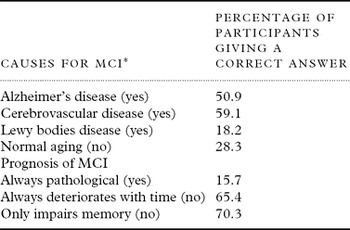
Objective knowledge. As shown in Table 1, approximately half of the participants provided the correct answer that Alzheimer's disease, and cerebrovascular disease contribute to the symptoms of MCI. Interestingly, 71.7% of the physicians in this study believed incorrectly that MCI is caused by normal aging. Regarding the progression of MCI, the majority of the participants correctly reported that MCI does not always deteriorate with time (65%) and does not impair memory only (70%).
Objective knowledge (n = 168)

*Correct answer in parentheses.
MCI: Mild cognitive impairment.
Overall, the participants’ objective knowledge about MCI was found to be moderate (mean = 3.5, SD = 1.7, range = 0–8). No statistically significant associations were found between objective knowledge and any of the participants’ sociodemographic or professional characteristics.
Practice beliefs. The vast majority of the participants (84.4%) believed that family physicians can diagnose MCI. As would be expected, a higher percentage of physicians who had diagnosed at least one patient with MCI in the last six months expressed higher confidence than those who had not (90.9% and 71.0%, respectively; X (1) = 7.9, p < 0.01). Male physicians expressed greater confidence than female physicians, although this comparison did not reach statistical significance (85% and 80%, respectively; p = 0.08).
Preferences regarding MCI
Diagnosis and test preferences. The tests that were most commonly deemed necessary for an MCI diagnosis were TSH, FT4, and T3 (96.5%); B12 (92.9%); folic acid (67.4%); neuropsychiatric assessment (59.3%); VDRL (52.9%); and a CT of the brain (51.1%). Tests considered as less necessary were neuropsychological assessment (46.3%); an MRI of the brain (8.8%); and a SPECT scan of the brain (3.0%).
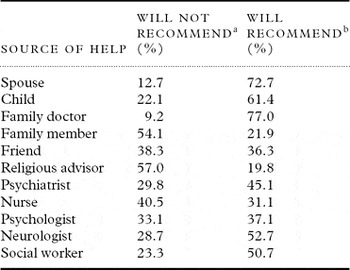
Help-seeking preferences. Table 2 presents the percentages of participants who recommended seeking or not seeking help from different sources for a person with MCI. The first source of help recommended was the family physician, followed by the spouse and the children of the person with MCI. Among other professional sources, the main sources of help recommended were a neurologist and a social worker. Only a small percentage of the participants recommended less close non-professional sources of help, such as a friend or other family member.
Help-seeking recommendations for persons with MCI (n = 168)

aResponse categories 1 + 2.
bResponse categories 4 + 5.
MCI: Mild cognitive impairment.
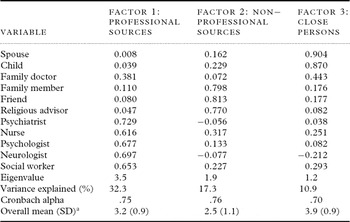
Factor analysis using principal components and varimax rotation was performed for exploratory purposes. Tests of the suitability of the data for factor analysis proved satisfactory, with the Kaiser–Meyer–Olkin test value of 0.74 exceeding the recommended value of 0.60 (Kaiser, Reference Kaiser1974) and Bartletts’ test of Sphericity (Bartlett, Reference Bartlett1954) reaching statistical significance (p = 0.0001). Inspection of the final solution (Table 3) shows three factors explaining 60.4% of the total variance: (1) professional sources – psychiatrists, nurses, psychologists, neurologists, and social workers; (2) other non-professional sources – other family members, friends, and religious advisors; and (3) other close persons – spouse, children, and family physician.
Factor solution (Varimax rotation) for help-seeking preferences (n = 168)

aAll differences were statistically significant at the p < 0.001 level.
Three indices were derived by averaging the items in each factor, which showed a moderate internal reliability. The participants consistently recommended seeking help from close persons more often than from professional and other non-professional sources. Regarding the correlates of help-seeking preferences, older age was found to be associated with decreased recommendations for seeking help from close persons (r = −0.18, p < 0.05) and from non-professionals (r = 0.23, p < 0.01). In addition, physicians who had diagnosed at least one patient with MCI in the last six months recommended seeking help from non-professional sources more than those who had not (2.6 and 2.0, respectively; t (122) = −2.8, p < 0.01). No other statistically significant differences were found.
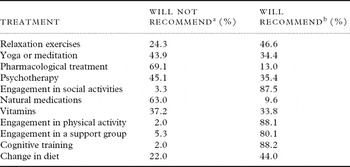
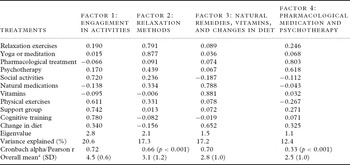
Treatment preferences. Table 4 presents the percentages of participants who recommended different treatment options for MCI. The majority of the participants (over 80%) reported engagement in activities (social, physical, or cognitive) as the most preferred treatment and the use of medications (either natural or conventional) as the least preferred treatment for MCI.
Family physicians’ preferences for treatment for a person with MCI (n = 168)

aResponse categories 1 + 2.
bResponse categories 4 + 5.
Factor analysis using principal components and varimax rotation was performed for exploratory purposes. Tests of the suitability of the data for factor analysis proved satisfactory, with the Kaiser–Meyer–Olkin test value of 0.67 exceeding the recommended value of 0.60 (Kaiser, Reference Kaiser1974) and Bartletts’ test of Sphericity (Bartlett, Reference Bartlett1954) reaching statistical significance (p = .0001). Inspection of the final solution (Table 5) shows four factors explaining 67.4% of the total variance: (1) engagement in activity (social, physical, and cognitive); (2) relaxation methods; (3) natural remedies, vitamins, and changes in diet; and (4) pharmacotherapy and psychotherapy.
Factor solution (Varimax rotation) for treatment preferences (n = 168)

aAll differences were statistically significant at the p < 0.001 level, with the exception of differences between factors 3 and 4, which were significant at the p < 0.05 level.
Four indices were derived by averaging the items in each factor, which showed a moderate internal reliability. The participants recommended engagement in activities more than any other treatment, with female physicians preferring engagement in activities more than male physicians (mean = 4.6 and 4.3, respectively; t (122) = −2.1, p < 0.05). No other statistically significant differences were found regarding the correlates of treatment preferences.
Discussion
An increase in the number of aging persons with dementia is a global phenomenon that requires public health attention to meet their needs as well as those of their caregivers. Scientific and clinical research in the area of dementia and cognitive disorders during the last decade has shifted to focus on the early diagnosis of the disease and, more specifically, on MCI. Consequently, a vast literature has been devoted to studying the epidemiology, diagnosis, and treatment of MCI (e.g. Werner and Korczyn, Reference Werner and Korczyn2008; Luck et al., Reference Luck, Luppa, Briel and Riedel-Heller2010; Albert et al., Reference Albert2011).
Although family physicians are often the first medical contact for persons with MCI and their caregivers (Lopponen et al., Reference Lopponen, Raiha, Isoaho, Vahlberg and Kivela2003), a recent meta-analysis has shown that general practitioners are able to recognize less than half of persons with MCI (Mitchell et al., Reference Mitchell, Meader and Pentzek2011). Since interventions aimed at increasing physicians’ knowledge have been proven beneficial to improving the accuracy of their diagnoses (van den Dungen et al., Reference Van den Dungen2012), it is surprising that little is known about family physicians’ familiarity, knowledge, and treatment preferences regarding MCI. Therefore, the aim of this study was to examine the familiarity, knowledge, referral, and treatment preferences of Israeli family physicians regarding MCI.
Our survey identified significant gaps in the knowledge of family physicians regarding MCI. First, one in five of the physicians in the study (19%) reported not having heard about MCI at all. This percentage is higher than the one reported by Roberts and colleagues (Reference Roberts, Karlawish, Uhlmann, Petersen and Green2010) in their study assessing neurologists’ knowledge about MCI. The discrepancy might stem from the different specializations examined by both studies or might be attributable to the fact that our study presented the participants only with the term MCI, whereas the neurologists in Roberts et al.'s study were presented with a list of terms (e.g. age-associated memory impairment and cognitive impairment with no dementia) and were asked to state which ones they identified as clinical concepts.
Second, the participants’ subjective knowledge (i.e. what they think they know) was found to be low, with approximately one-third of those who claimed to be familiar with MCI reporting knowing almost nothing about the concept. Moreover, subjective knowledge was lower among participants who had not diagnosed patients with MCI during the last six months and among female participants. In a study assessing Irish general practitioners’ attitudes and practices regarding dementia, Cahill and colleagues (Reference Cahill, Clark, Walsh, O'Connell and Lawlor2006) found similar subgroups to have lower levels of confidence in their ability to deal with dementia issues. In our study, these subgroups were also associated with higher confidence regarding family physicians’ ability to diagnose MCI, though this relationship did not reach statistical significance for gender.
Third, in contrast with our previous findings in relation to Alzheimer's disease (Werner, Reference Werner2007a), the overall levels of objective knowledge about MCI were found to be low in this study. Most notably, the majority of the participants who had heard of MCI (approximately 70%) believed it to be caused by normal aging, indicating a general lack of knowledge or even stigmatic beliefs about MCI. Moreover, a substantial percentage of the physicians who had heard of MCI (approximately 84%) did not believe that it was always pathological, which may have been associated with the idea that MCI is a product of normal aging.
Nonetheless, the participants’ objective knowledge in other areas was found to be more adequate. For example, the other most commonly stated cause of MCI (approximately 60%) was vascular disease, which has indeed been reported in the literature (Petersen et al., Reference Petersen2009). Regarding the progression of MCI, most of the physicians who had heard of MCI (approximately 65%) believed that it does not always deteriorate, which is in line with the latest published research (Werner and Korczyn, Reference Werner and Korczyn2008; Olazaran et al., Reference Olazaran2011). Moreover, the majority of the physicians in this study (approximately 87%) believed that MCI is not limited to the impairment of memory alone, but rather encompasses additional cognitive impairment in some patients, which is in agreement with the currently accepted definition of MCI (Albert et al., Reference Albert2011).
Thus, it would seem that the level of knowledge of the physicians in this study corresponds with the literature on MCI in some respects, while in others reflects a lack of knowledge about the causes of MCI, its pathological nature, and its relationship with the processes of normal aging. This lack of knowledge might explain why previous studies have found general practitioners to have difficulty in identifying patients with MCI (Kaduszkiewicz et al., Reference Kaduszkiewicz2010; Mitchell et al., Reference Mitchell, Meader and Pentzek2011).
With regard to the participants’ test preferences in the diagnosis of MCI, we found that the majority believed TSH, FT4 and T3, B12, and folic acid to be the most necessary for the diagnosis of MCI. These are indeed the most common laboratory tests included in the most recent guidelines for the diagnosis of MCI (Albert et al., Reference Albert2011). More sophisticated neuropsychological assessments and biomarkers were considered as less necessary. This might be a result of the consensus that advanced diagnostic techniques require the involvement of other specialists (Sorbi et al., Reference Sorbi2012).
In terms of their help-seeking preferences, the vast majority of the participants in our study reported family physicians and close relatives (spouses and children) to be a source of help. This finding is similar to those in our previous study assessing physicians’ help-seeking preferences regarding Alzheimer's disease (Werner, Reference Werner2007a). Furthermore, it corroborates the importance that family physicians attribute to themselves in the diagnosis and management of cognitive deterioration (van Hout et al., Reference Van Hout, Vernooioij-Dassen, Bakker, Blom and Grol2000). Also in line with our previous study (Werner Reference Werner2007a), professional sources of help (neurologist, social worker, psychiatrist, psychologist, and nurse) were cited as preferred sources of help, while non-professional sources (friend, family member, and religious advisor) received the lowest scores.
Older age was associated with lower levels of preference for non-professional and close persons as a source of help. This finding is somewhat puzzling and underlines the complex relationship between physicians’ age and their collaborative practice pattern (Sarma et al., Reference Sarma, Devlin, Thind and Chu2012). Since multidisciplinary models of care are increasingly recommended as the preferred type of care in general (Vellas et al., Reference Vellas, Cestac and Moreley2012), as well as in the diagnosis and management of MCI in particular (Werner and Korczyn, Reference Werner and Korczyn2008; Vellas et al., Reference Vellas, Cestac and Moreley2012), further research is needed to understand this relationship.
In relation to treatment preferences, the treatments most recommended were physical, social, or cognitive activities and the least recommended were medications (either conventional or natural remedies). Several explanations can be provided for this finding. First, it is in accordance with recent evidence that increased activity is associated with a reduced risk of developing MCI (Geda et al., Reference Geda2010), as well as with a previous study conducted in New Zealand indicating that physicians are more likely to recommend non-pharmacological treatments for MCI (Mitchell et al., Reference Mitchell, Woodward and Hirose2008). Second, this finding might be associated to unique characteristics of the clinical practice in Israel. For example, unlike other countries (Roberts et al., Reference Roberts, Karlawish, Uhlmann, Petersen and Green2010), there are no guidelines in Israel supporting the provision of pharmacological treatment for MCI. In fact, even in the case of Alzheimer's disease the provision of pharmacological treatment is suggested only in the case of a score below 26 in the Mini Mental State Examination (Folstein et al., Reference Folstein, Folstein and McHugh1975). Finally, also a previous study we conducted assessing family physicians’ treatment preferences for Alzheimer's disease (Werner, Reference Werner2007b) found that Israeli physicians preferred the use of non-pharmacological treatments more than pharmacological treatments, reflecting probably cultural and educational preferences in treating persons with cognitive deterioration. Female and younger physicians in the study tended to recommend non-pharmacological treatments to a greater extent than male and older physicians. Although, there is no evident explanation for these associations, gender differences might be based on universally described gender differences according to which male physicians might be more confident in prescribing pharmacological treatments and female physicians more inclined to recommend other treatment options. Additional research regarding this matter should be conducted to elucidate the role of physicians’ gender and age in their recommendations for MCI treatments.
In a study assessing physicians’ perceptions and practices related to the prevention of cognitive impairment, Day et al. (Reference Day2011) found that physicians with a higher number of years in practice (which is associated with higher age) were more likely than less experienced physicians to recommend being physically and socially active and adopting a healthy lifestyle. These findings were explained as being related to a more optimistic view of preventing cognitive deterioration among younger physicians. Obviously, these findings call for further research into the role of physicians’ sociodemographic characteristics in the quality of care provided (Berthold et al., 2008; Gouni-Berthold and Berthold, Reference Gouni-Berthold and Berthold2011; Sarma et al., Reference Sarma, Devlin, Thind and Chu2012).
Several limitations of the study should be noted. First, it included a relatively small convenience sample of participants, rather than a large random sample. Thus, the results should be generalized with caution. Second, all measures were based on self-report, rendering the participants’ reports subjective rather than an objective account of their actual practice. Third, when referring to MCI, no specifics were given. Future studies should examine whether physicians’ knowledge and preferences vary according to the subtypes of MCI (i.e. amnestic vs. non-amnestic). Finally, given the ongoing conceptual and labeling debate in the literature regarding MCI (Werner and Korczyn, Reference Werner and Korczyn2008), a wider choice of terms than only that of MCI might have affected the percentage of participants reporting familiarity with MCI in our study.
Despite these limitations, our study adds to a surprisingly narrow body of research assessing family physicians’ awareness, knowledge, help-seeking, and treatment preferences for persons with MCI. In summary, the findings of this study indicate the importance of providing further information on MCI to family physicians, particularly regarding the causes of MCI, the relationship between MCI and normal aging, and the way in which MCI is diagnosed. Special attention should be paid to the information needs of female and less experienced physicians, who might use the additional information to strengthen their confidence in their diagnostic capabilities for persons with MCI. As efforts are invested in developing new and clearer guidelines for the diagnosis of MCI (Albert et al., Reference Albert2011), and the inclusion of “mild neurocognitive disorder” in the upcoming DSM-V (American Psychiatric Association, 2012) there is a need to broaden our understanding of primary care physicians’ knowledge and preferences regarding the topic. The present study provides a first step in this direction.
Conflict of interest
None.
Description of authors’ roles
P. Werner designed the study, supervised data collection, performed statistical analyses and wrote the paper. J. Heinik and E. Kitai, were involved in the recruitment of the participants, supervised data collection, read, commented and assisted on writing the paper.