Introduction
Individuals with eating disorders are particularly susceptible to experiencing suicidal thoughts and behaviors, with more than 40% of individuals with eating disorders endorsing suicidal ideation (Smith, Zuromski, & Dodd, Reference Smith, Zuromski and Dodd2018). Suicide is one of the most commonly reported causes of death in individuals with eating disorders (Kostro, Lerman, & Attia, Reference Kostro, Lerman and Attia2014). Suicidal ideation represents significant distress and may lead to more serious and lethal forms of suicidality, such as self-injurious behaviors and attempts (Klonsky, Saffer, & Bryan, Reference Klonsky, Saffer and Bryan2018). Thus, a better understanding of factors that predict suicidal ideation in individuals with eating disorders may improve quality-of-life and decrease future suicide risk among this vulnerable population.
Theories have been proposed to explain the suicide–eating disorder relationship; however, support for these theories has been modest (Pisetsky, Crow, & Peterson, Reference Pisetsky, Crow and Peterson2017; Smith et al., Reference Smith, Dodd, Forrest, Witte, Bodell, Ribeiro and Bartlett2016; Witte et al., Reference Witte, Zuromski, Gauthier, Smith, Bartlett, Siegfried and Goodwin2016), suggesting that the identification of novel risk factors may be important for advancing theories and prevention efforts (Franklin et al., Reference Franklin, Ribeiro, Fox, Bentley, Kleiman, Huang and Nock2017). While research using advanced modeling techniques has identified some longitudinal predictors of suicidal thoughts (Barak-Corren et al., Reference Barak-Corren, Castro, Nock, Mandl, Madsen, Seiger and Smoller2020; Smith, Wang, Carter, Fox, & Hooley, Reference Smith, Wang, Carter, Fox and Hooley2020; Walsh, Ribeiro, & Franklin, Reference Walsh, Ribeiro and Franklin2017), machine learning does not necessarily result in superior performance over regular logistical regression (Jacobucci, Littlefield, Millner, Kleiman, & Steinley, Reference Jacobucci, Littlefield, Millner, Kleiman and Steinley2021; Littlefield et al., Reference Littlefield, Cooke, Bagge, Glenn, Kleiman, Jacobucci and Steinley2021; McHugh & Large, Reference McHugh and Large2020; van Mens et al., Reference van Mens, de Schepper, Wijnen, Koldijk, Schnack, de Looff and De Beurs2020). Indeed, recent research highlights the value and utility that examining predictors in regression-based models can provide, including increased interpretability relative to more complex models m (Siddaway, Quinlivan, Kapur, O'Connor, & de Beurs, Reference Siddaway, Quinlivan, Kapur, O'connor and de Beurs2020). Hence, the purpose of this study is to test the utility of two promising proximal risk factors, sleep quality and agitation, in predicting suicidal ideation in a sample of individuals with elevated suicidal thoughts and behaviors, namely those with eating disorders.
Recent work has identified a cluster of acute, rapidly increasing symptoms that precede suicidal thoughts and behaviors, which include a sudden increase in suicidal intent, marked social or self-alienation, feeling hopeless, and marked over-arousal, including agitation, irritability, and sleep difficulties. The presence of these presenting symptoms has been coined ‘acute suicidal affective disturbance’ (ASAD; Joiner, Simpson, Rogers, Stanley, & Galynker, Reference Joiner, Simpson, Rogers, Stanley and Galynker2018; Rogers, Chu, & Joiner, Reference Rogers, Chu and Joiner2019; Rogers, Galynker, Yaseen, DeFazio, & Joiner, Reference Rogers, Galynker, Yaseen, DeFazio and Joiner2017; Tucker, Michaels, Rogers, Wingate, & Joiner, Reference Tucker, Michaels, Rogers, Wingate and Joiner2016). ASAD symptoms facilitate the relationship between other risk factors for suicide and suicidal ideation (Buckner, Lewis, & Tucker, Reference Buckner, Lewis and Tucker2019). Additionally, ASAD symptoms are associated with rumination about one's suicidal thoughts, intentions, and plans (Rogers & Joiner, Reference Rogers and Joiner2018).
The two primary constructs that comprise the over-arousal component of ASAD are agitation and sleep difficulties. Agitation, which refers to symptoms of trapped tension and restlessness, has been described as a state of ‘psychic anxiety’, and demonstrates a strong relationship with suicidal thoughts (Ribeiro et al., Reference Ribeiro, Bender, Buchman, Nock, Rudd, Bryan and Joiner2015; Rogers, Ringer, & Joiner, Reference Rogers, Ringer and Joiner2016a). Agitation and anger are independently associated with increased suicidal ideation and facilitate the relationship between other risk factors and increased suicidal ideation (Rogers et al., Reference Rogers, Tucker, Law, Michaels, Anestis and Joiner2016b). Irritability and psychomotor agitation are some of the strongest predictors of future suicide attempts (Balázs et al., Reference Balázs, Benazzi, Rihmer, Rihmer, Akiskal and Akiskal2006). Agitation mediates the relationship between feeling disconnected to one's body and subsequent suicidal ideation in individuals with and without eating disorders, suggesting that a sense of feeling of ‘trapped arousal’ in one's own body contributes toward suicidal thoughts and behaviors (Duffy et al., Reference Duffy, Lieberman, Siegfried, Henretty, Bass, Cox and Joiner2020; Duffy, Rogers, Gallyer, & Joiner, Reference Duffy, Rogers, Gallyer and Joiner2019). Almost 80% of patients in inpatient settings who attempt suicide endorse feelings of agitation, suggesting that assessing for agitation could help us identify patients at acute risk for attempting suicide (Busch, Fawcett, & Jacobs, Reference Busch, Fawcett and Jacobs2003). In sum, the intense, wound-up feeling of agitation may leave individuals vulnerable to suicidal thoughts.
In addition to a wound-up mind, unsound sleep is another risk factor for suicidal thoughts and behaviors. Although sleep can be a respite and chance to recoup from the stresses of the day, many individuals experiencing acute suicidal thoughts suffer from nightmares and other sleep disturbances that extend their pain from the day into the night. Sleep disturbances, such as insomnia, nightmares, and poor sleep quality, are additional aspects of ASAD identified as risk factors for suicidal ideation (Bernert & Joiner, Reference Bernert and Joiner2007; Bernert, Turvey, Conwell, & Joiner, Reference Bernert, Turvey, Conwell and Joiner2014; Pigeon, Pinquart, & Conner, Reference Pigeon, Pinquart and Conner2012). Sudden increases in sleep disturbances may predict an increased likelihood to die by suicide (Goldstein, Bridge, & Brent, Reference Goldstein, Bridge and Brent2008). Longitudinal studies indicate that having trouble sleeping in early adolescence predicts suicidal ideation several years later (Wong, Brower, & Zucker, Reference Wong, Brower and Zucker2011). Compared to individuals without suicidal ideation, individuals with suicidal ideation report a pattern of more severe and frequent sleep problems, including poor sleep quality, insomnia, and nightmares (Krakow, Ribeiro, Ulibarri, Krakow, & Joiner, Reference Krakow, Ribeiro, Ulibarri, Krakow and Joiner2011; Nadorff, Nazem, & Fiske, Reference Nadorff, Nazem and Fiske2013). Moreover, feelings of hopelessness and being trapped (which have been recognized as additional aspects of ASAD) may partially mediate the relationship between nightmares and increased suicidal thoughts (Sandman et al., Reference Sandman, Valli, Kronholm, Vartiainen, Laatikainen and Paunio2017). In sum, feelings of being trapped and restless, without even the brief respite of sleep, may leave individuals feeling so acutely distressed that they seriously consider every way out of the suffering – including suicide.
Notably, agitation and sleep difficulties are also elevated in individuals with eating disorders. There is a high degree of psychomotor agitation and restlessness in individuals with eating disorders, particularly in individuals with anorexia nervosa (AN) (Belak et al., Reference Belak, Gianini, Klein, Sazonov, Keegan, Neustadt and Attia2017; Scheurink, Boersma, Nergårdh, & Södersten, Reference Scheurink, Boersma, Nergårdh and Södersten2010). Agitation and restlessness may also motivate restriction and drive for physical activity/exercise in patients with eating disorders, and indicate more severe disordered eating symptomatology (Casper, Reference Casper2006; Holtkamp et al., Reference Holtkamp, Herpertz-Dahlmann, Hebebrand, Mika, Kratzsch and Hebebrand2006). Similarly, sleep difficulties are common in individuals with eating disorders, with patients self-reporting insomnia and poor sleep quality (Asaad Abdou et al., Reference Asaad Abdou, Esawy, Abdel Razek Mohamed, Hussein Ahmed, Elhabiby, Khalil and El-Hawary2018; Cooper, Loeb, & McGlinchey, Reference Cooper, Loeb and McGlinchey2020; Padez-Vieira & Afonso, Reference Padez-Vieira and Afonso2016). Individuals with eating disorder symptoms are more likely than individuals without to suffer from nightmares (Kelly & Yu, Reference Kelly and Yu2018). Increased sleep difficulties are associated with more severe disordered eating symptomatology (Padez-Vieira & Afonso, Reference Padez-Vieira and Afonso2016) and poorer mental health overall (Lemyre, Bastien, & Vallières, Reference Lemyre, Bastien and Vallières2019). Taken together, past research has implicated agitation and sleep difficulties in suicidal ideation independently and has demonstrated that these symptoms are elevated in individuals with eating disorders.
Only one study to date has investigated the relationships among agitation, eating pathology, and suicidal ideation. In a cross-sectional study, Duffy et al. (Reference Duffy, Lieberman, Siegfried, Henretty, Bass, Cox and Joiner2020) found that agitation explained the relationship between interoceptive deficits and suicidal ideation in individuals with eating disorders. Furthermore, in the only existing study on disordered eating, sleep quality, and suicidal ideation, Mayes et al. (Reference Mayes, Fernandez-Mendoza, Baweja, Calhoun, Mahr, Aggarwal and Arnold2014) found that suicidal ideation and attempts were more common in children with eating disorders if sleep difficulties were present. Despite the clear relationship between agitation and sleep difficulties and the severity of eating disorder and suicide symptoms, relatively few studies have examined agitation and sleep difficulties in relation to suicidal ideation among people with eating pathology. Additionally, to our knowledge, no study to date has examined both agitation and sleep difficulties in relation to suicidal ideation and eating disorder symptoms within the same study. Moreover, research has yet to examine the longitudinal relationships between agitation, sleep difficulties, and ideation. Given the high risk for suicide in individuals with eating disorders, examining promising constructs, like agitation and sleep disturbances, over clinically relevant intervals is necessary to better inform risk assessments and models. Therefore, the purpose of the current study was to examine relations between agitation, sleep difficulties, and suicidal ideation among a residential eating disorder sample. Consistent with prior research (Duffy et al., Reference Duffy, Lieberman, Siegfried, Henretty, Bass, Cox and Joiner2020; Mayes et al., Reference Mayes, Fernandez-Mendoza, Baweja, Calhoun, Mahr, Aggarwal and Arnold2014), it was hypothesized that both higher agitation and poorer sleep quality would be longitudinally associated with suicidal ideation. Furthermore, it was hypothesized that on weeks when individuals experienced both high levels of agitation and poorer sleep, they would show the highest levels of suicidal ideation.
Method
Participants and procedures
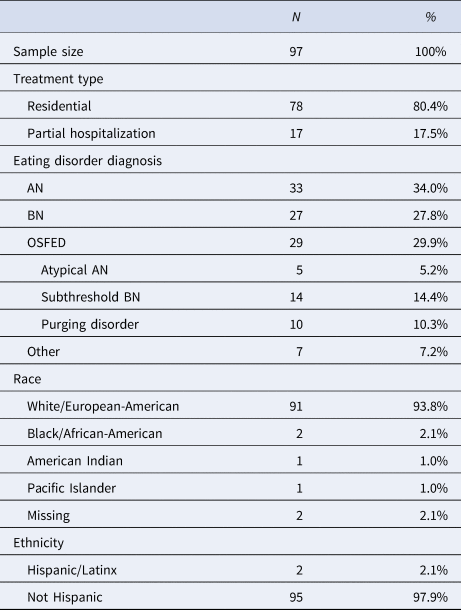
Demographic information and participant characteristics are presented in Table 1. Participants were women recruited from an eating disorder treatment center in the Southern United States (N = 100). Given the longitudinal analyses, participants who completed fewer than two follow-up assessments (n = 3) were excluded, leaving 97 participants for the current study. The majority of the sample was in residential treatment (n = 78), while the rest were in a partial hospitalization program at the same facility (n = 17). All study procedures were approved prior to data collection and analysis. Data from this sample have been published previously (e.g. Bodell, Smith, & Witte, Reference Bodell, Smith and Witte2020; Forrest et al. Reference Forrest, Bodell, Witte, Goodwin, Bartlett, Siegfried and Smith2016; Witte et al. Reference Witte, Zuromski, Gauthier, Smith, Bartlett, Siegfried and Goodwin2016), but the aims and specific data analyses are unique for this research study. Eating disorder diagnoses were determined by multiple doctoral-level researchers who reviewed client intake assessment data from the residential facility (for details see Bodell et al., Reference Bodell, Smith and Witte2020; Witte et al., Reference Witte, Zuromski, Gauthier, Smith, Bartlett, Siegfried and Goodwin2016). Thirty-four percent of participants met criteria for AN (n = 33), 27.8% met criteria for bulimia nervosa (BN) (n = 27), 1% met criteria for binge eating disorder (n = 1), 29.9% met criteria for other specified feeding or eating disorder (n = 29), and 7.2% met criteria for an unspecified feeding or eating disorder (n = 7). The majority of this sample was European American (n = 91) and the age range was between 18 and 68 years old (M age = 26.7; s.d. = 7.6).
Participant demographic information

After informed consent was obtained, participants completed self-report questionnaires at admission, as well as weekly through the duration of their treatment. A university institutional review board approved all procedures of the current study, and no compensation was provided for participation, due to participant recruitment from an eating disorder treatment center. The average length of treatment was approximately 10 weeks (M = 9.99, s.d. = 5.32).
Measures
Weekly assessment measures
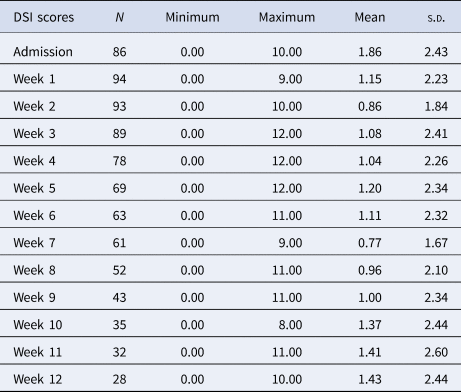
Suicidal ideation. Suicidal ideation symptoms were assessed using the Depressive Symptoms Inventory Suicidality Subscale (DSI-SS; Metalsky & Joiner, Reference Metalsky and Joiner1997). The DSI-SS is a four-item self-report scale that assesses the frequency/intensity of suicidal ideation. The baseline assessment of the DSI-SS asked about symptoms over the past 14 days, whereas subsequent weekly assessments asked about symptoms over the past 7 days. Responses range from 0 to 3, with higher values indicating greater levels of suicidal ideation (Metalsky & Joiner, Reference Metalsky and Joiner1997). Furthermore, responses are summed to create a total score for the severity of suicidal ideation that ranges from 0 to 12. Past research has suggested that the DSI-SS shows strong construct validity (Joiner, Pfaff, & Acres, Reference Joiner, Pfaff and Acres2002; von Glischinski, Teismann, Prinz, Gebauer, & Hirschfeld, Reference von Glischinski, Teismann, Prinz, Gebauer and Hirschfeld2016). Internal consistency for the DSI-SS ranged from α = 0.88 to α = 0.96 across all time points in the current study. Table 2 includes descriptive statistics of the DSI-SS across treatment. Participant endorsement of suicidal ideation ranged from 52.3% at treatment admission to 18.6% at the 9th week of treatment.
Descriptive statistics of participant suicidal thought severity, based on DSI scores

Agitation. Agitation symptoms were assessed using the Brief Agitation Measure (BAM; Ribeiro, Bender, Selby, Hames, & Joiner, Reference Ribeiro, Bender, Selby, Hames and Joiner2011). The BAM is a three-item self-report measure designed to assess participant levels of ‘recent’ agitation over the past week. Responses are recorded on a seven-point Likert scale that ranges from 0 (strongly disagree) to 6 (strongly agree). An example item is: I feel so stirred up inside I want to scream. This measure has shown to have acceptable levels of validity and reliability (Ribeiro et al., Reference Ribeiro, Bender, Selby, Hames and Joiner2011). Internal consistency for the BAM ranged from α = 0.85 to α = 0.92 across all time points in the current study.
Sleep quality. Sleep quality was assessed using a single-item question created for the purpose of this study. The question (Please rate the quality of sleep you have gotten in the past week, using the following scale) asked participants to rate the quality of sleep they have gotten in the past week on an 11-point Likert-type scale that ranged from 0 (extremely poor sleep) to 10 (excellent sleep). Although psychometric information on this sleep quality item is not currently available, its wording/response scale is similar to that of other single-item sleep quality measurements, such as the Sleep Quality Scale (SQS) and the sleep quality subscale of the Pittsburgh Sleep Quality Index (PSQI), both of which have shown strong psychometric properties such as construct validity, test-retest reliability, and divergent validity (Carpenter & Andrykowski, Reference Carpenter and Andrykowski1998; Snyder, Cai, DeMuro, Morrison, & Ball, Reference Snyder, Cai, DeMuro, Morrison and Ball2018).
Covariates assessed at baseline
Eating disorder symptoms. Eating disorder symptoms were assessed using the Eating Disorders Examination Questionnaire-Version 6 (EDE-Q; Fairburn & Beglin, Reference Fairburn, Beglin and Fairburn2008). The EDE-Q is a 28-item self-report questionnaire developed from the Eating Disorder Examination (EDE; Fairburn & Cooper, Reference Fairburn, Cooper, Fairburn and Wilson1993) that captures participant disordered eating attitudes and behaviors over the previous 28 days. The EDE-Q is composed of four subscales: a five-item ‘Restraint’ subscale, a five-item ‘Eating Concern’ subscale, an eight-item ‘Shape Concern’ subscale, and a five-item ‘Weight Concern’ subscale. Furthermore, the 28-items can be averaged together to create a global score for the EDE-Q (Fairburn & Beglin, Reference Fairburn, Beglin and Fairburn2008). Responses are coded on a seven-point scale that ranges from 0 to 6, with higher scores indicating greater levels of disordered eating symptoms. For the current study, only the global EDE-Q score was used to assess eating disorder symptoms and severity at treatment admission and added as a covariate in the data analyses. Notably, the EDE-Q has shown to have strong levels of criterion validity, construct validity, and test-retest reliability (Grilo, Masheb, & Wilson, Reference Grilo, Masheb and Wilson2001; Mond, Hay, Rodgers, Owen, & Beumont, Reference Mond, Hay, Rodgers, Owen and Beumont2004; Reas, Grilo, & Masheb, Reference Reas, Grilo and Masheb2006). Internal consistency for the EDE-Q global score at admission in the current sample was α = 0.95.
Depression. Depressive symptoms were assessed using the Beck Depression Inventory (BDI; Beck et al., 1996), a 21-item multiple-choice self-report inventory. Each item is rated on a four-point Likert scale from 0 to 3, with higher scores indicating greater severity of depressive symptoms. In the current study, depressive symptoms were added into the model as a covariate. Internal consistency for this measure at baseline was α = 0.95.
Body mass index (BMI). BMI was assessed by measuring participants' height and weight. Height and weight were converted to meters (m) and kilograms (kg), respectively, and BMI was computed as kg/m2. In the current study, BMI at admission was added into the model as a covariate.
Data analyses
General linear mixed models were conducted using STATA (version 16) to examine whether agitation or sleep quality were concurrently or prospectively associated with suicidal ideation during treatment. Specifically, we followed steps outlined by Hoffiman (Reference Hoffiman2015) for modeling within-person fluctuations. The best-fitting unconditional model included fixed and random effects of both time (linear) and time2 (quadratic); as recommended by Wang and Maxwell (Reference Wang and Maxwell2015), these effects were included in the main analyses as a way to detrend the data at the individual level and account for any systematic change (e.g. treatment effects) in ideation over time (for full details see Bodell et al., Reference Bodell, Smith and Witte2020).Footnote †Footnote 1 To assess whether within-person fluctuations in agitation or sleep quality co-occur with fluctuations in suicidal ideation, these variables were person-mean-centered, such that within-person (level-1) effects were represented by the deviation from the person's mean agitation or sleep quality, respectively, across weeks in treatment. Between-person (level-2) effects were calculated as the person's mean value across weeks in treatment centered at the sample grand mean. We also conducted time-lagged analyses in which the agitation and sleep variables were linked to suicidal ideation at the subsequent time point to test whether agitation and sleep in one week were longitudinally associated with suicidal ideation in the following week. All models included admission BMI, BDI, and EDE-Q global scores as covariates. These variables were centered at the sample average prior to being included in the models. Models were estimated using maximum likelihood. Analyses were not preregistered, thus should be considered exploratory.
Results
Associations between agitation and suicidal ideation
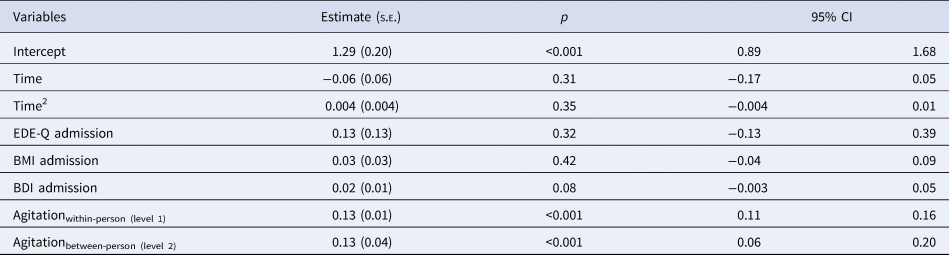
There was a significant between-person effect of agitation on suicidal ideation such that individuals who reported higher levels of agitation than the average person experienced more severe suicidal ideation across treatment [B(s.e.) = 0.13(0.04), p < 0.001; Table 3]. There also was a significant within-person effect for agitation such that when an individual reported greater agitation compared to their own average, they also experienced greater suicidal ideation that same week [B(s.e.) = 0.13(0.01), p < 0.001; Table 3]. However, in the time-lagged analysis, an individual's agitation in one week did not prospectively predict their level of suicidal ideation in the following week [B(s.e.) = 0.01(0.02), p = 0.43].
Concurrent associations between agitation and suicidal ideation

Associations between sleep quality and suicidal ideation
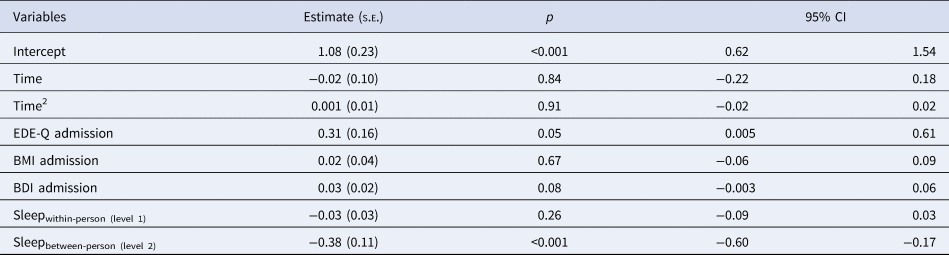
Although there was a significant between-person (level-2) effect of sleep quality on suicidal ideation, there was no within-person (level-1) effect (Table 4). Specifically, individuals with poorer sleep quality had more severe suicidal ideation compared to individuals with better sleep. However, an individual's fluctuations in sleep quality were not significantly associated with their own fluctuations in ideation. Moreover, in the time-lagged analysis, an individual's sleep quality in one week did not prospectively predict their level of suicidal ideation in the following week [B(s.e.) = −0.03(0.03), p = 0.31].
Concurrent associations between sleep quality and suicidal ideation

Interaction between agitation and sleep quality on suicidal ideation
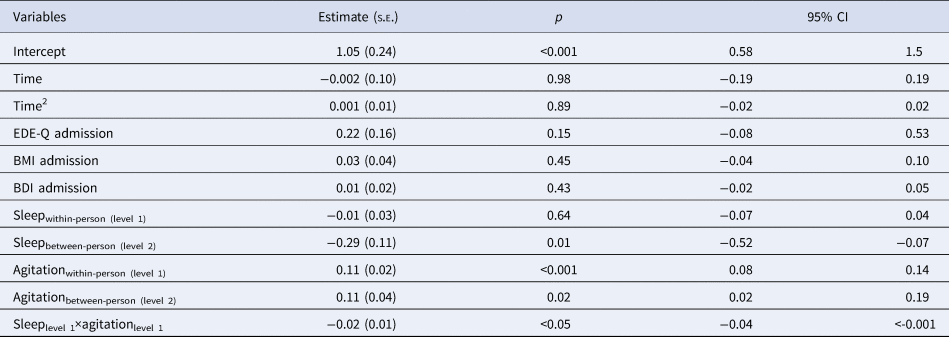
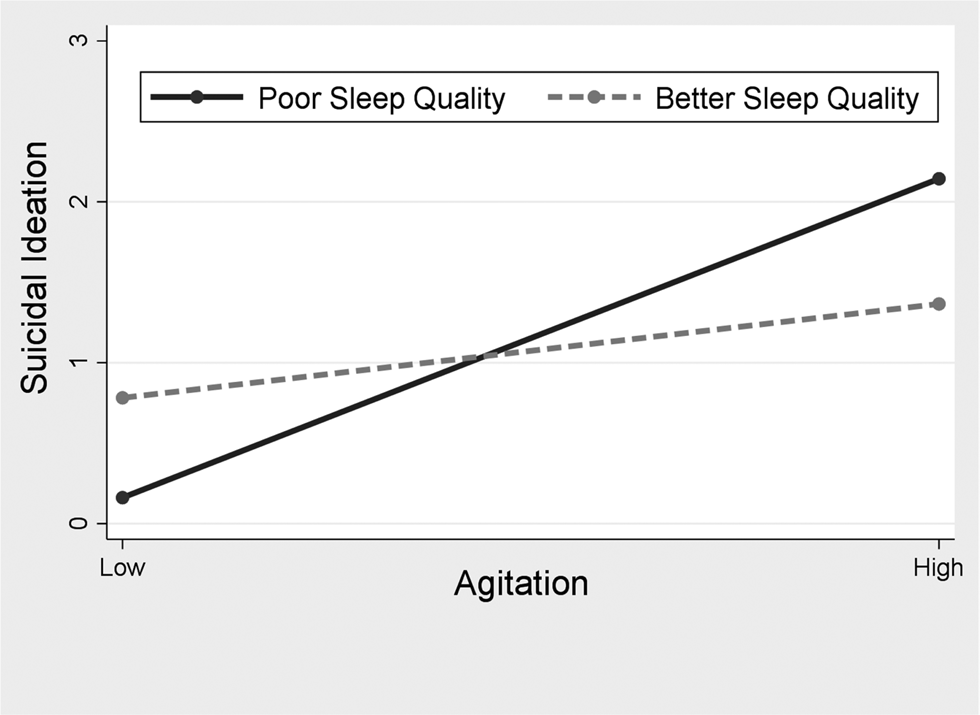
Table 5 contains results from the mixed model that included the main effects of and interaction between agitation and sleep on suicidal ideation. There was a significant interaction between within-person (level-1) agitation and sleep quality on suicidal ideation [B(s.e.) = −0.02(0.01), p < 0.05]. Consistent with hypotheses, on weeks when an individual experienced both higher than their average agitation and lower than their average sleep quality, they also experienced their highest levels of suicidal ideation (Fig. 1). However, this model did not hold in time-lagged analyses when predicting suicidal ideation in the following week [B(s.e.) = −0.001(0.01), p = 0.96; 95% CI = −0.02 to 0.02].
Interaction between within-person sleep and agitation on suicidal ideation

Within-persons (level-1) interaction between sleep and agitation on suicidal ideation.

Compared to the baseline conditional model that included time, time2, eating disorder symptoms, body mass index, and depressive symptoms (r = 0.39970, R 2 = 0.1576), models that included agitation (r = 0.4752, R 2 = 0.2258) or sleep (r = 0.4769, R 2 = 0.2274) accounted for an additional ~7% of total variance in weekly ideation.Footnote 2
Discussion
The current study examined the longitudinal associations between agitation and sleep difficulties with subsequent suicidal ideation, as well as between- and within-person correlates of suicidal ideation over a 12-week time frame among individuals receiving treatment for their eating disorder. To our knowledge, this is the first study to examine relations between agitation, sleep difficulties, and suicidal ideation in an eating disorder sample. Consistent with a priori hypothesis, results indicated that when individuals conjointly experienced elevated levels of agitation and poor sleep quality, they also experienced their highest reported levels of suicidal ideation. However, neither agitation nor sleep quality prospectively predicted suicidal ideation.
The results of the current study are consistent with prior literature on ASAD symptoms, which suggests that symptoms of over-arousal, such as agitation and poor sleep quality, may be proximally related to suicidal thoughts and behaviors (Bernert et al., Reference Bernert, Turvey, Conwell and Joiner2014; Ribeiro et al., Reference Ribeiro, Bender, Buchman, Nock, Rudd, Bryan and Joiner2015; Rogers et al., Reference Rogers, Ringer and Joiner2016a). These findings lend credence to the notion that feelings of restlessness/being trapped, along with a lack of respite provided by sleep, may contribute to acute distress that leaves individuals wanting escape through means such as suicide. This phenomenon may be particularly salient for individuals with eating disorders, given the elevated rates of suicidality, agitation, and sleep difficulties that this population presents with (Belak et al., Reference Belak, Gianini, Klein, Sazonov, Keegan, Neustadt and Attia2017; Cooper et al., Reference Cooper, Loeb and McGlinchey2020; Padez-Vieira & Afonso, Reference Padez-Vieira and Afonso2016; Preti, Rocchi, Sisti, Camboni, & Miotto, Reference Preti, Rocchi, Sisti, Camboni and Miotto2011; Scheurink et al., Reference Scheurink, Boersma, Nergårdh and Södersten2010; Smith et al., Reference Smith, Zuromski and Dodd2018). Notably, the current study suggests that assessing for agitation and sleep difficulties in eating disorder patients may help identify patients with more severe suicidal ideation (Bernert et al., Reference Bernert, Turvey, Conwell and Joiner2014; Busch et al., Reference Busch, Fawcett and Jacobs2003). For example, supplementing suicide risk assessments with questions regarding agitation/sleep difficulties may identify participants reporting these symptoms who may be at higher risk than individuals with ideation alone.
Consistent with previous literature (Bernert et al., Reference Bernert, Turvey, Conwell and Joiner2014; Bernert & Joiner, Reference Bernert and Joiner2007), individuals with lower quality of sleep had more severe suicidal ideation. However, contrary to our hypotheses, sleep quality was not a within-person correlate of suicidal ideation, and poor sleep quality did not longitudinally predict severe suicidal ideation the following week. It is possible that sleep quality was not a within-person predictor of suicidal ideation as recent findings suggest that agitation temporally precedes sleep quality difficulties (Denning, Reference Denning2020) and may mediate the relationship between sleep quality and suicidality (Sandman et al., Reference Sandman, Valli, Kronholm, Vartiainen, Laatikainen and Paunio2017). Additionally, it is possible that sleep quality may predict greater suicidal ideation across smaller time intervals, such as the day following sleep difficulties (Littlewood et al., Reference Littlewood, Kyle, Carter, Peters, Pratt and Gooding2018). Moreover, many different variables may go into sleep quality, such as the presence of nightmares, insomnia, waking up too early, and not being able to fall asleep (Sjöström, Waern, & Hetta, Reference Sjöström, Waern and Hetta2007); the current study only assessed self-reported sleep quality as a whole.
The current findings regarding agitation and suicide were also consistent with previous literature (Ribeiro et al., Reference Ribeiro, Bender, Buchman, Nock, Rudd, Bryan and Joiner2015; Rogers et al., Reference Rogers, Ringer and Joiner2016a), as higher levels of agitation were associated with increased suicidality even after accounting for BMI and eating disorder and depressive symptoms. Specifically, greater than average agitation was associated with severe suicidal ideation across time, both within and between individuals. However, agitation at one week did not longitudinally predict greater suicidal ideation that following week. It is possible that, similar to sleep difficulties, agitation alone may be an even more proximal predictor of suicide that predicts greater suicidal ideation across even smaller time intervals, such as days or hours, as opposed to weeks. To our knowledge, no prior studies have examined the associations of agitation and suicidality over shorter time intervals using methods such as ecological momentary assessment. Additionally, it is possible that agitation may be a stronger predictor of suicide behaviors than of suicidal thoughts, as past studies have found agitation to be related to suicide attempts (Balázs et al., Reference Balázs, Benazzi, Rihmer, Rihmer, Akiskal and Akiskal2006; Bryan et al., Reference Bryan, Hitschfeld, Palmer, Schak, Roberge and Lineberry2014).
However, consistent with some of the other findings, the within-person interaction was concurrently, but not prospectively associated with suicidal ideation in this sample. As suggested earlier, this finding could be due to the fact that we only measured suicidal thoughts, as opposed to behaviors. As shorter sleep duration and poor sleep quality on one day predict increased suicidal ideation the next day (Littlewood et al., Reference Littlewood, Kyle, Carter, Peters, Pratt and Gooding2018), it is possible that for each individual, sleep more so influences suicidal ideation from day-to-day rather than weekly. It is unclear if agitation on one day may predict suicidal ideation for a specific individual on the next day, as this has not yet been empirically tested, and warrants further research.
The results of the current study can inform clinical practice. Due to the significant associations between sleep difficulties, agitation, and suicidal ideation, clinicians should consider screening for these variables among individuals with eating disorders, in order to identify individuals at elevated risk for suicidality over the course of treatment. This screening may be especially warranted given individuals with eating disorders regularly struggle with agitation and/or sleep difficulties (Belak et al., Reference Belak, Gianini, Klein, Sazonov, Keegan, Neustadt and Attia2017; Padez-Vieira & Afonso, Reference Padez-Vieira and Afonso2016). Notably, screening for these risk factors may help to reduce the burden of suicidality among these vulnerable populations by identifying individuals in need of brief sessions targeted at reducing agitation/improving sleep quality. It is possible that the implementation of such brief agitation or sleep interventions may indirectly prevent the exacerbation of suicidal ideation. Moreover, treatments involving distress tolerance and emotion regulation skills such as those taught in Dialectical Behavior Therapy (DBT) may help alleviate the acute anxiety that accompanies agitation (Chapman, Gratz, & Tull, Reference Chapman, Gratz and Tull2011; Linehan, Reference Linehan1993; Neacsiu, Eberle, Kramer, Wiesmann, & Linehan, Reference Neacsiu, Eberle, Kramer, Wiesmann and Linehan2014). Indeed, treatments utilizing DBT have already shown to be effective among individuals with suicidality (Linehan et al., Reference Linehan, Korslund, Harned, Gallop, Lungu, Neacsiu and Murray-Gregory2015; McCauley et al., Reference McCauley, Berk, Asarnow, Adrian, Cohen, Korslund and Linehan2018). Additionally, pharmacologic treatments may help reduce agitation, which may help decrease suicidality symptoms in conjunction with psychotherapy (Citrome, Reference Citrome2004; Zeller & Rhoades, Reference Zeller and Rhoades2010). Additionally, mindfulness-based interventions and Cognitive Behavioral Therapy for Insomnia (CBT-I) may be useful for addressing sleep problems and therefore subsequently reduce suicidality in treatment-seeking patients (Cunningham & Shapiro, Reference Cunningham and Shapiro2018; Ong et al., Reference Ong, Manber, Segal, Xia, Shapiro and Wyatt2014; Taylor & Pruiksma, Reference Taylor and Pruiksma2014).
The findings of the current study should be considered in light of certain limitations.
First, the sample consisted of only women, and the majority was White. Second, the current study was only able to test suicidal ideation as a primary outcome, potentially neglecting other relevant aspects of suicidality, such as suicidal behaviors (e.g. making preparations) or attempts. Third, sleep quality was assessed using a single item and specific facets of sleep quality, such as nightmares and trouble falling asleep, were not explored. Past studies suggest that these specific facets of poor sleep quality may drive increased suicidality (Lemyre et al., Reference Lemyre, Bastien and Vallières2019; Nadorff et al., Reference Nadorff, Nazem and Fiske2013). Furthermore, psychometric information was not available for this single item sleep quality measure. Lastly, symptoms of post-traumatic stress disorder (PTSD) were not able to be utilized as a covariate due to a lack of available data for this construct. This may be especially problematic considering that PTSD and its symptoms may influence sleep quality via nightmares, insomnia, difficulty initiating and maintaining sleep, etc. (Krakow et al., Reference Krakow, Germain, Schrader, Hollifield, Koss, Warner and Melendrez2001; Zayfert & DeViva, Reference Zayfert and DeViva2004), in addition to being associated with suicidality (Panagioti, Gooding, Dunn, & Tarrier, Reference Panagioti, Gooding, Dunn and Tarrier2011; Tarrier & Gregg, Reference Tarrier and Gregg2004). Finally, the measures in our study asked participants to report average sleep quality and suicidal ideation over the past week in order to increase feasibility and retention across assessment points, and it may have been preferable to ask participants to report symptoms across a shorter time frame to get a more nuanced understanding of the interactions between these variables. Several noted limitations of the current study may be used to inform future research on agitation and sleep quality in eating disorder samples. For example, future studies should consider exploring the relationship between agitation, sleep quality, and suicidality in a more diverse sample of individuals with eating disorders and explore these relations by studying more specific facets of sleep quality and suicidal behaviors in addition to thoughts. Furthermore, future studies should consider using methods such as ecological momentary assessment and/or wearable actigraph sensors to assess relations between these variables across a shorter time frame, as these methods have promise in assessing short-term suicidal behaviors, but have been underutilized in the suicide literature (Carretero, Campaña-Montes, & Artés-Rodríguez, Reference Carretero, Campaña-Montes, Artés-Rodríguez and Baca-Garcia2020; Davidson, Anestis, & Gutierrez, Reference Davidson, Anestis and Gutierrez2017). These methods would be useful in delineating relations as it is possible that agitation and sleep quality may be more strongly related to suicidality within an even shorter time frame, such as hours or days. Additionally, future iterations of the current research topic should investigate the relationships between agitation, sleep quality, and suicidality while controlling for PTSD symptoms due to their associations with both sleep quality and suicidality found in past research (Krakow et al., Reference Krakow, Germain, Schrader, Hollifield, Koss, Warner and Melendrez2001; Panagioti et al., Reference Panagioti, Gooding, Dunn and Tarrier2011; Tarrier & Gregg, Reference Tarrier and Gregg2004; Zayfert & DeViva, Reference Zayfert and DeViva2004). Future studies should also consider examining associations between agitation, sleep quality, and suicidality using a shorter time frame such as measuring symptoms daily or using ecological momentary assessment.
In sum, the current study demonstrated that on weeks when an individual experienced both higher than their average agitation and lower than their average sleep quality, they also experienced their highest levels of suicidal ideation. Overall, this study adds to the literature noting significant relationships between ASAD symptoms and suicidality in patients with eating disorders. Results suggest that ongoing assessment for overarousal symptoms, such as agitation and poor sleep quality, in individuals with eating disorders may be warranted in order to manage suicidal ideation among this vulnerable population.
Financial support
This research received no specific grant from any funding agency, commercial or not-for-profit sectors.
Conflict of interest
None.
Ethical standards
The authors assert that all procedures contributing to this work comply with the ethical standards of the relevant national and institutional committees on human experimentation and with the Helsinki Declaration of 1975, as revised in 2008.