Introduction
Women are living longer than before, largely thanks to advances in health and medicine. In Iran and other developing countries, however, the improvement in women's longevity has not seen a concomitant increase in their ‘healthy life expectancy’. Healthy living is characterized by sustained commitment to behaviours that positively affect health: diet and regular physical activity (Henderson & Ainsworth, Reference Henderson and Ainsworth2002; van Weel-Baumgarten, Reference van Weel-Baumgarten2008). According to the World Bank, the healthy life expectancy of Iranian women and those of other Middle-East and neighbouring countries (such as Oman, Qatar, Russia, Saudi Arabia, Syria, Turkey and the United Arabic Emirates (UAE)) is 59–65 years, but for countries like Ireland, Norway and Sweden it has been reported to be between 73 and 75 years (Housmann et al., Reference Housmann, Tyson and Zahid2007). In most developing countries, women spend the final third of their lives battling with highly prevalent conditions such as metabolic and cardiovascular diseases (World Health Organization, 2008, 2011a, b; Hadaegh et al., Reference Hadaegh, Harati, Ghanbarian and Azizi2009; Robroek et al., Reference Robroek, Van Lenthe, Van Empelen and Burdorf2009; Mosca, et al., Reference Mosca, Benjamin, Berra, Bezanson, Dolor and Lloyd-Jones2011; Subramanian et al., Reference Subramanian, Perkins, Özaltin and Davey Smith2011, Reference Subramanian, Perkins, Özaltin and Davey Smith2011; Salehuddin et al., Reference Salehuddin, Choudhury, Islam, Rhaman, Ghosh and Majib2011). In addition to causing suffering, these conditions burden the countries' health systems with huge costs. However, they could be prevented by limiting the risk factors and modifying lifestyles (World Health Organization, 2008).
The social determinants of health are the conditions in which people are born, grow, live, work and age. In the majority of developing countries, cultural and social factors are the key predictors of health disparity (Woolf et al., Reference Woolf, Dekker, Byrne and Miller2011). The values and beliefs, norms and customs, and rules in every society can influence health-related behaviours both directly and indirectly (Shumaker et al., Reference Shumaker, Ockene, Riekert, Rosal and Jamie2009; Scott et al., Reference Scott, Wilson and Scott2011); occasionally the cultural norms and social conditions in developing countries prevent women from achieving good health. Hence, health programmes in developing countries should adopt strategies that allow greater focus on the health requirements of groups that are rendered more vulnerable by adverse cultural and social influences. For example, ‘the dietary habits of Asian and African communities are strongly influenced by social/cultural factors, including beliefs, expectations, family roles, and degree of health awareness’ (Hennings et al., Reference Hennings, Williams and Haque1996; Worsley, Reference Worsley2002; James, Reference James2004). Ludwig et al. (Reference Ludwig, Cox and Ellahi2010), in their examination of the social and cultural determinants of obesity among Muslim Pakistani women in Britain, concluded that the health education programmes targeting members of Asian communities should take account of their cultural and religious beliefs, practices, ethnicity and social identity. Wandel et al. (Reference Wandel, Råberg, Kumar and Holmboe-Ottesen2008) found that the dietary habits of South Asian immigrants in Oslo were influenced by their social/cultural background.
Cultural factors, as well as inadequate access to exercise facilities, have been shown to limit the physical activity of Iranian, Pakistani and Indian women (Lawton et al., Reference Lawton, Ahmad, Hanna, Douglas and Hallowell2006; Vahidi et al., Reference Vahidi, Sadeghi, Rahnoma, Ghazeezadeh, Masomee and Matlabi2008). Gender discrimination and financial dependence have also been blamed for women's inadequate access to health care services (Visaria et al., Reference Visaria, Anandjiwala and Desai1990; Noone, Reference Noone2009). As in developing countries, including the Middle East and Iran, research on social and cultural patterns of health, especially women's health, is in its infancy. Most previous studies in this area have examined the social and cultural barriers to the health of Asian immigrants in the US and other European countries (Koçtürk, Reference Koçtürk2004; Benavides-Vaello, Reference Benavides-Vaello2005; Wandel, et al., Reference Wandel, Råberg, Kumar and Holmboe-Ottesen2008; Dans et al., Reference Dans, Ng, Varghese, Tai, Firestone and Bonita2011).
This study investigated the social and cultural impediments to women's health promotion in Iran, a developing country with a predominantly Islamic culture that is similar to other Middle East countries. The results of the survey results may be useful for other health care providers in countries with similar socio-cultural context. Research in social and cultural dimensions of health in developing countries, including Middle Eastern nations and Iran, is scanty; this is more so in the field of women's health. Such research is necessary in order to develop strategies for universal health planning appropriate with special cultural/social conditions. For this reason, the authors carried out a comprehensive study in Iran to provide strategies for a social programme to promote the health of middle-aged women by listening to their voice (Enjezab et al., Reference Enjezab, Farajzadegan, Taleghani, Aflatoonian and Morowatisharifabad2012). In this primary study, middle-aged women's health-promoting behaviour (HPB) scores were estimated. Spiritual growth and physical activity had the highest and the lowest HPB scores, respectively. The women's HPB score had a positive significant correlation with age (p=0.02) and education level (p=0.001) and a significant negative correlation with number of children (p=0.005). The HPB scores were higher in retired women than in employees and housewives. Their HPB scores for physical activity and health responsibility were low. This means that the health features of middle-aged Iranian women in Asian cultures and developing countries are probably different from those of women in industrialized, developed countries; hence, these women need different intervention programmes (Enjezab et al., Reference Enjezab, Farajzadegan, Taleghani, Aflatoonian and Morowatisharifabad2012).
The current study was a qualitative study based on content analysis and was part of a wider study using a sequential mixed-method design. Qualitative researchers rely on various qualitative methods to explore the behaviours, attitudes and experiences of people within the context of their lives (Holloway & Wheeler, Reference Holloway and Wheeler2009). Thematic content analysis is useful in health studies attempting to describe subjects of importance to a certain group of people and gauge their specific reactions (Green & Thorogood, Reference Green and Thorogood2004). Hence here a qualitative approach was adopted to gain an in-depth understanding of the social and cultural factors influencing the health of middle-aged women in Iran, and the data extracted from their statements were used to propose strategies for promoting their health.
Methods
The study was conducted in the central Iranian city of Yazd, a city with a population of nearly half a million and well known for its highly religious and traditional culture. Interviewed women were selected from those who had participated in a cross-sectional study of middle-aged women conducted in spring 2010. The original sample has been described previously (Enjezab et al., Reference Enjezab, Farajzadegan, Taleghani, Aflatoonian and Morowatisharifabad2012). To determine the social/cultural factors influencing health-related behaviours, in-depth, semi-structured interviews were conducted with women at the best and worst extremes of the health behaviour spectrum, as per scores given to subjects in part of the quantitative study. The aim was to have maximum variation in terms of age (40–60 years), education, employment, number of children, marital status and socioeconomic background. Using questionnaires completed in the quantitative phase of the study, suitable candidates were selected and contacted by telephone before meeting them face-to-face; the aim was to explain the purpose of the study to them and interviews were arranged at a convenient time and location. The interviews continued until data saturation and finally 21 women were interviewed in the study.
Two of the interviews were conducted in two sessions and the rest of them were conducted in one session. The interviews lasted 20–60 minutes and were digitally recorded; these would complement other data. Immediately after each interview, field notes were taken of the verbal/non-verbal interactions during the interview; these would complement other data. Data were processed using content analysis. Recordings of interviews were listened to several times and transcribed verbatim. Interview transcripts/field notes were carefully examined to extract key meanings/concepts. Primary codes were assigned to each sentence/keyword identified as a unit of meaning. Primary categories were extracted from the grouping of similar primary codes. Main categories emerged from the assimilation of primary categories; abstraction was applied at each stage to yield fewer categories.
To increase the credibility and validity of the findings, in-depth interviews with selected participants were conducted at different times and locations and interviews were listened to several times to achieve data immersion. Participants were selected from across the community spectrum to achieve maximum diversity of age and socioeconomic/cultural status. Member-checking and peer examination were used to ensure the objectivity, transferability and reliability of findings. External evaluators were asked to examine the codes/categories and report any consistency that might exist between the extracted categories and the interviewees' remarks; consensus about the accuracy of codes was over 90%. The study was approved by the Medical Ethics Committee of Isfahan University of Medical Sciences, Iran.
Results
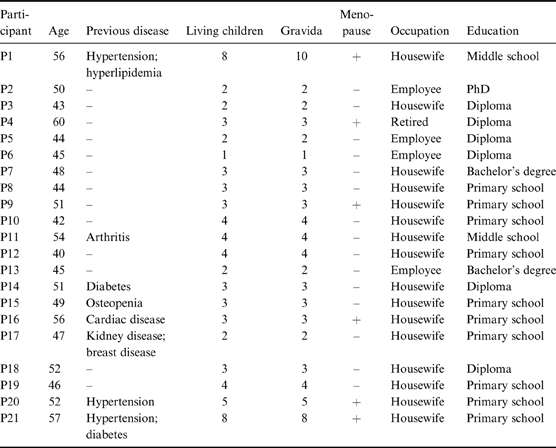
Table 1 summarizes the 21 participants' characteristics, as obtained from the in-depth interviews. Analysis of the data revealed five main themes in relation to social and cultural factors influencing the health of middle-aged women:
1. Higher priority to non-health-related needs.
2. The dominance of the husband's will in the family.
3. Preference of children's needs over one's own.
4. Fulfilment of multiple responsibilities/conflicting roles.
5. Access to community resources for health promotion.
Characteristics of the study participants, Yazd, Iran, 2010

Higher priority to non-health-related needs
Cultural factors were found to adversely influence prioritization of household resources, with families tending to exhaust their limited financial resources in ways that did not make any difference to women's health. Poverty, lack or poor quality of care in the family, unemployment, reduced accountability of men in family life, consumerism, a traditional obligation to ease children's marriage by paying their early expenses and pressure to compete with other families were among the social influences negatively impacting on women's health. Women from low-income families pointed to poverty as the principal factor that made them careless about their health. A participant stated:
Our problems are many, my husband is unemployed; come noon and you must feed 7 or 8 grown ups. How could you think of your own health?
(P21)Another participant said:
When you owe people money and have to repay instalments…like when you want to buy a TV set, or have bought a sofa for a million Toomans which you didn't have, you need to repay the instalments; first you should think of these.
(P12)Physical activity was affected by family income; members of low- or middle-income households said economic constraints kept them from engaging in regular exercise. A participant said:
Attending in a gym requires money, you also need to have the right clothes and shoes. I guess everyone's a bit short of cash these days… these are difficult times you know.
(P11)Attending regular medical examinations and screening tests involves expenses. Women from low-income families and/or those lacking financial independence were put off by the costs, and at times endangered their health by forgoing and important procedure. A women who was the sole earner in the family said:
I did not obtain regular medical exams because I had no medical insurance. The doctor said I needed to have a mammography as soon as I could sort out my insurance. I didn't have enough money; I was told it could not be done, so I came back.
(P17)The effect of economic deprivation on women's health was evident in their remarks. Women from lower-income families and those with more children were too preoccupied with providing for their families to be mindful of their own health. Staying on a healthy diet, paying for exercise sessions and undergoing screening/laboratory tests were luxuries they could hardly afford. By contrast, women who were financially better off never alluded to economic pressure as an impediment to caring for their health. Financial status is perhaps the single most important factor influencing the health of middle-aged women.
The dominance of the husband's will in the family
This featured strikingly in the interviews as a factor greatly influencing the health of middle-aged Iranian women. The interviewees opined that knowledge of the benefits of starting a healthy diet and getting regular physical exercise would be of little value without their husbands' endorsement. The superiority of the men's will is abundantly clear from the way their preferences influence the household's shopping list:
My husband does all shopping; we'll eat whatever he buys, I have no say in this. If I say something my husband does not agree to, everything will be affected, even our meals.
(P15)Likewise, the husbands' healthy behaviours/preferences had a desirable influence on their wives' health:
Fruit is abundant in our home; my husband thinks fruit is important. We don't eat as much fish though; we often eat chicken meat. My husband likes red meat a lot.
(P1)The husbands' decisions, co-operation and support affected the health behaviours of their wives:
I used to go for a walk every day, but since 2 years ago when my husband retired he has not allowed me to go out walking.
(P19)While another participant said:
My husband's partnership is very important when we go walking, in fact, his presence is reassuring.
(P14)Preference of children's needs over one's own
Devotion to one's children was another cultural facet emerging from the interviews. Mothers' eating preferences and needs of their children had priority over their own nutritional needs. A participant stated:
My children come first, I try to feed them rich meals with vitamins, I want to feed them good food; I eat the same meals I cook for the children… more or less.
(P18)In Iranian culture, women primarily regard themselves as being entrusted with serving the needs of their children. Few women paid attention to their own dietary requirements; the children's needs were foremost. Caring for children left some women with little time to attend to important check-ups. One woman made the following statement about attending a mammography session:
I feel no pain. It doesn't feel like much when I touch it. I'm too busy. I have so many children I cannot think or take care of myself. I have 5 girls and 3 boys.
(P21)Another woman said the following about physical activity:
Although I exercise, I can't do it regularly, because I must feed the children and send them off to their classes.
(P13)The common theme was one of mothers' self-sacrifice to care for their young or grown-up children, even at the expense of their own health.
Fulfilment of multiple responsibilities/conflicting roles
Middle-aged Iranian women have to assume multiple roles and responsibilities: performing household tasks, caring for family members (aged parents, husband, children and grandchildren), out-of-home employment, and/or working at home to help the family economy are some examples of responsibilities that cause women to have no time for their own health. A 54-year-old woman who worked domestically to help with expenses, and also cared for her mother-in-law and the child of her working daughter, made the following statement about exercise:
I have so much work at home that I have no time for anything else.
(P11)Another woman said:
I'm employed; I also have to do the housework. I must do the shopping and other errands and take care of my children's school work. All this work during daytime leaves you no time to do anything else.
(P13)In addition to working and being socially active, the contemporary Iranian woman retains the traditional roles of motherhood: being a spouse and caring for her husband and children. Little time is left for their self-care.
Access to community resources for health promotion
Many of the women interviewed complained about inadequate access to fresh food, lack of convenient access to health screening services and women-only exercise facilities, and cultural pressures that made them feel insecure when going for a brisk walk on city streets. Participants said:
There are no nearby gyms at low price.
(P17)I used to go swimming, it was refreshing and I felt healthier but I stopped going to the pool because it was too far away …I didn't have a car and it was to hard to get there.
(P8)The environment is not good for walking; there are no parks or places for walking.
(P12)About the access to healthy food, another participant state:
They don't supply fresh fish here, it's all frozen. We buy fresh fish that comes from the south to make sure it's safe.
(P3)Yazd's desert climate makes the supply of fresh food difficult. The city lies distant from the sea; hence fresh seafood is also scarce. The consumption of healthy foods in this region is reduced due to the scarcity of supply.
Discussion
The women interviewed in this study were unanimous about the perceived close link between their health behaviours and socio-cultural factors. These women are giving priority to the needs of others largely due to economic constraints. Family income has long been recognized as an important determinant of health. In a qualitative study of health determinants in rural Black American communities, Scott et al. (Reference Scott, Wilson and Scott2011) found that family income has a major influence on health. Family income and employment have also been recognized as stronger predictors of health than education. Andvik (Reference Andvik2010) found that socioeconomic factors, including income, education and occupation, influence lifestyle. In a study of barriers to healthy eating conducted by Biloukha & Utermohlen (Reference Biloukha and Utermohlen2001) in Ukraine, 64.5% of participants cited the cost of food as the main barrier to healthy eating. Another study in the UK showed that being unable to afford exercise class fees was a barrier to physical activity (Ziebland et al., Reference Ziebland, Thorogood, Yudkin, Jones and Coulter1998). In addition, several studies have found that higher family income improves health behaviours (Johnson, Reference Johnson2005; Najman et al., Reference Najman, Toloo and Siskind2006; Sit et al., Reference Sit, Kerr and Wong2008; Eshah, Reference Eshah2011). In Iran, as in many developing countries, people have to pay for health care and treatment, and this may cause individuals to delay or forgo essential treatment (Russell, Reference Russell1996).
The results of this study also show that middle-aged Iranian women, especially illiterate or semi-literate housewives in families with lower socioeconomic status, are strongly influenced by tradition and religion. Patriarchy is not a self-sufficient phenomenon, but a product of various historical and social influences. However, institutionalization of the central role of the male as the primary authority figure in a family can influence some or all aspects of women's lives (Piran, Reference Piran2004), such as their health and eating habits. In the Islamic family tradition, men are expected to strive to provide for the needs of their families; this does not just mean the rule of men over women, but also is a responsibility for them. Nevertheless, in the study population, considering the age and educational level of participants and the traditional structure and cultural believes and false perceptions of religion, women's obedience to their husbands in every aspect of life is not merely a norm but it is a culturally institutionalized value. Tradition dictates that men command their family and living. However, traditional attitudes in the Iranian community are changing as education becomes more widely available and women's participation in society becomes more common. Fikree & Pasha (Reference Fikree and Pasha2004) studied the role of gender in health disparity in South Asia, noting that many women are economically, socially and culturally dependent on men, find themselves in subordinate positions to them, are largely excluded from making decisions and have limited access and control over resources. Cultural norms and traditions in Asian countries, including Pakistan, have defined gender-specific roles in the family. Women are responsible for the housework and men have the final word in every aspect of life, including what women should or should not do (Ali et al., Reference Ali, Fani, Afzal and Yasin2010).
The study population appears to be similar in its patriarchal elements to that of its neighbouring country, Pakistan. In this traditional cultural system, women are responsible for cooking, child-rearing and all other domestic work. Some women cannot make independent decisions even about cooking; their sole task is to prepare the meal decided by the ‘man of the house’. Exercise may or may not be allowed by the husband. Because of financial dependence, women can only receive medical attention with their husband's approval. However, the spread of mass communication media and increasing access to education have inevitably influenced family dynamics in Iran. The society is witnessing a departure from stereotypical gender roles and traditions are also gradually giving way to modernity. In this sociological transition, Iranian women's status in the family, as well as their decision-making authority, are showing signs of improvement.
Women's self-sacrifice to meet their children's needs may cause them to neglect their own. In contemporary Iranian society, traditional beliefs about the role of a mother in the family are facing the test of time. Combining child care and paid employment is becoming increasingly difficult for mothers in Iran. Unlike Western culture, which advocates individualism and personal independence, Asian cultures promote the principles of communal living; in the latter, the needs and interests of the individuals are not taken into consideration, and instead family goals and interests are given priority (Craft-Rosenberg & Pehler, Reference Craft-Rosenberg and Pehler2011). A ‘good’ mother in such a cultural system prefers the caring of her family to anything else, even her employment and/or health (Norzareen & Nobaya, Reference Norzareen and Nobaya2010). In Iran and many other Muslim nations, women subscribe to the cultural/religious notion that motherhood is the most important role in their life (Rajaram & Rashidi, Reference Rajaram and Rashidi1999; Ahmad-Nia, Reference Ahmad-Nia2002; Batnitzky, Reference Batnitzky2011). However, economic pressures for married women to work, the duty of care they feel towards their children/elders and inducements to participate in society, all take their toll on women's health and make them less likely to address their own health needs (Rajaram & Rashidi, Reference Rajaram and Rashidi1999; Rashidi & Rajaram, Reference Rashidi and Rajaram2001; Ahmad-Nia, Reference Ahmad-Nia2002). Of course the health of future generations could improve with the increase in women's education, fewer offspring and increasing women's employment and financial autonomy.
Middle-aged women, especially those who are employed and have children, feel under great pressure to fulfil the roles culturally expected of them; they also feel obliged to meet their traditional responsibilities of caring for their elderly parents as well as their grandchildren leaving little or no time to attend to their own health needs (Norzareen & Nobaya, Reference Norzareen and Nobaya2010; Craft-Rosenberg & Pehler, Reference Craft-Rosenberg and Pehler2011). Ali et al. (Reference Ali, Fani, Afzal and Yasin2010) found that women with more household responsibilities have less free time to devote to themselves. In a qualitative study conducted by Lawton et al. (Reference Lawton, Ahmad, Hanna, Douglas and Hallowell2006), shortage of time and perceived responsibilities towards others were recognized as the main barriers to being physically active among Indian and Pakistani diabetics in Britain; women felt obliged to stay at home and fulfil their domestic responsibilities. Time limitations arising from the perceived need to fulfil multiple roles were found to be barriers to physical activity in elderly Ecuadorian women (Juarbe et al., Reference Juarbe, Turok and Pérez–Stable2002). In a study conducted by Backett & Davison (Reference Backett and Davison1995), the majority of participants believed that striking a balance between work and home, social life and family commitments, and personal satisfaction and social commitments would influence health, but only a few were satisfied with the state of the balance they had been able to achieve.
Adequate access to community resources as a factor influencing women's health was another issue emerging from the interviews. Access to free and convenient exercise/recreational facilities, health checks and cancer screening tests were seen as inadequate. Lawton et al. (Reference Lawton, Ahmad, Hanna, Douglas and Hallowell2006) found that in religious cultures, even women who consciously decide to be physically active ultimately fail, because public facilities for women's exercise are limited. Also in a study conducted by Vahidi et al. (Reference Vahidi, Sadeghi, Rahnoma, Ghazeezadeh, Masomee and Matlabi2008), lack of access to public exercise facilities and cultural barriers curtailing women's free physical activity in the urban scope were highlighted. The religious and social barriers to women's physical activity in Iran call for a new approach to urban planning and improvement of the systems for public health services provision in order to provide for women's health requirements.
The study, conducted in the city of Yazd in central Iran, has some limitation when generalizing the finding to the whole country. Despite Yazd having many similarities with other Iranian cities, the traditional, religious and social fabric of Yazd may not be representative of the entire country. In addition, the low levels of literacy and employment among the studied middle-aged women might also limit generalization of the results. Indeed, this was not the aim of the study. However, it may be possible to transfer the findings to other communities with similar cultural/religious characteristics.
In conclusion, this study demonstrates that middle-aged Iranian women are expected to undertake multiple responsibilities, while caring for and fulfilling the expectations of their husbands, parents, children and sometimes grandchildren; this huge burden tends to foster negligence of their own well-being. Policymakers and health planners, especially in Asia, should remain mindful of the influences of traditional cultures on the health and life-cycle of middle-aged women. To promote the health of these women, interventions should focus on educating the public, especially men, to shift the gender dynamic away from patriarchal tendencies and towards more egalitarian roles. Such education could take place at the workplace and public venues. Religious scholars could also play a role by recounting examples from the history of religion where men and women have enjoyed equal rights. Religious scholars could play an essential role in traditional Iranian community by preaching the equal entitlement of men and women to health, welfare and education.
Acknowledgments
The authors thank the Yazd University of Medical Sciences and Isfahan University of Medical Sciences in Iran for funding this study. The researchers also extend their thanks to the women whose co-operation was vital to the study.