


Introduction
Beliefs are central to the cognitive model (Beck, Reference Beck1976) but remain inherently complex. One reason for this is that they vary along multiple dimensions such as conviction, distress, disability, preoccupation, rigidity, resistance to counter evidence, personal salience and implausible content (Oltmanns, Reference Oltmanns, Oltmanns and Maher1988). Consequently, how we categorize beliefs remains a challenge, exemplified by theorists’ and clinicians’ efforts to define and distinguish obsessions, overvalued ideas (OVIs) and delusional beliefs in obsessive compulsive disorder (OCD).
Although there is no consensus in how to categorize beliefs as obsessions, OVIs or delusions, two dimensions are often cited as key indicators: rigidity and abnormality. Thus, obsessions are understandable and recognized by the individual as irrational, OVIs are held with less than delusional intensity and are not normally shared within the particular culture, and delusions are completely unfounded and held with unwavering certainty (Veale, Reference Veale2002). However, patients with OCD have been found to hold their beliefs with very strong certainty, and lack insight into their senselessness (Lelliott et al. Reference Lelliott, Noshirvani, Basoglu, Marks and Monteiro1988; Basoglu et al. Reference Basoglu, Laz, Kasvikis and Marks1988; E. B. Foa & M. J. Kozak, unpublished data). Beliefs of obsessional patients can also be difficult to comprehend and in stark contrast to the culture's accepted norm (L. Solyom et al. unpublished data).
A further challenge is one of measurement. Kozak & Foa (Reference Kozak and Foa1994) noted that insight can vary by how and when a patient is approached about their belief. They cited Insel & Akiskal's (Reference Insel and Akiskal1986) finding that patients with OCD were found to believe that their beliefs were completely senseless, while simultaneously believing that their compulsions were entirely necessary.
Categorically distinguishing obsessive beliefs from OVIs and delusions in OCD remains a theoretical challenge, but what are the clinical implications of working with complex beliefs in OCD? The following study illustrates the formulation and treatment of one such case.
The case was formulated and treated using Wells & Matthews Self-Regulatory Executive Function (S-REF) model (Wells & Matthews, Reference Wells and Matthews1994). This model was selected over other models (e.g. Salkovskis, Reference Salkovskis1985), as it was thought that a meta-cognitive approach might be helpful. Trans-diagnostic processes such as meta-worry have been reported as maintenance mechanisms in a range of presenting beliefs from delusions (Freeman & Garety, Reference Freeman and Garety1999; Morrison & Wells, Reference Morrison and Wells2003) to OCD (Fisher & Wells, Reference Fisher and Wells2005). Targeting such processes may be beneficial to individuals, whose beliefs fall somewhere between the two.
Case summary and main presenting problem
JohnFootnote † was a 50-year-old man, a manager by profession, who lived at home with his wife and three children. He was referred by his GP to a secondary care service for cognitive therapy for OCD that was reportedly causing increasing disruption to both himself and his family. More specifically, he experienced hundreds of intrusive thoughts a day regarding perceived harm coming to himself and others through his action or inaction, e.g. thoughts of being poisoned, burgled, his son drowning in the bath and so on. Even more disturbingly for John, he experienced intrusive thoughts about transforming into a six-foot giant fly, an experience that he had felt too ashamed to disclose to his family, friends, or any previous health professional for the past 25 years.
History
John's childhood and adolescence was characterized by years of protracted physical abuse and neglect. He distinctly recalled that, as a child, he experienced frequent images of himself becoming blind, and that he felt compelled to touch the banister at home, which he felt reassured him somehow. Such experiences of intrusive thoughts of harm and checking behaviours became commonplace throughout his childhood and into adulthood.
In his late teens, John watched the film, ‘The Fly’ (a film in which a man gradually genetically mutates into a grotesque giant fly). He recalls finding the film deeply disturbing, and images of himself transformed into a giant fly immediately intruded upon his consciousness. Initially, he began to worry that this was going to happen to him unless he took action to prevent it, and over time he became more certain of this.
Five years prior to this referral, John had attended four sessions of CBT for OCD. At that time, he was too embarrassed to disclose his thoughts of transforming into a fly, and the treatment mainly consisted of discussions that helped normalize his other intrusive thoughts. He found the sessions useful and his symptoms reduced, so he no longer felt the need to continue attending. However, his symptoms quickly returned and gradually worsened, hence his latest referral.
Assessment
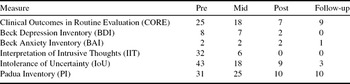
Routine service measures and additional selected measures were undertaken pre-, mid-, post- therapy and at 2 years follow-up. These were: the Clinical Outcomes in Routine Evaluation Outcome Measure (CORE; Evans et al. Reference Evans, Mellor-Clark, Margison, Barkham, McGrath, Connell and Audin2000), a 34-item questionnaire designed to measure a pan-theoretical ‘core’ of clients’ global distress and functioning; the Beck Depression Inventory (BDI; Beck et al. Reference Beck, Ward, Mendelson, Mock and Erbaugh1961), a 21-item measure of depressive symptoms; the Beck Anxiety Inventory (BAI; Beck et al. Reference Beck, Epstein, Brown and Steer1988), a 21-item measure of anxiety symptoms; the Interpretation of Intrusive Thoughts Scale (IIT; Freeston et al. Reference Freeston, Ladouceur, Provencher and Blais1995), a 28-item measure of the meanings that can be given to intrusive thoughts; the Padua Inventory (Sanavio, Reference Sanavio1988), a 60-item measure of obsessive thoughts and behaviours and the Intolerance of Uncertainty Scale (IoU; Dugas et al. Reference Dugas, Freeston and Ladouceur1997), a 27-item measure of reactions to the uncertainties of life. John's total scores on the CORE (25), BDI (8), BAI (3) and Padua Inventory (31) were within the sub-clinical range; his scores on the IIT (32) and the IoU (43) were within the clinical range.
At baseline, John described his obsessions as extremely frequent (hundreds occurring throughout the day), that were often extremely distressing (at times he rated his distress as 100%), and interfered with his daily functioning. John's belief conviction that he would transform into a fly was 100%. However, he also accepted that the idea sounded ludicrous and that most people would find the notion extremely bizarre.
Formulation
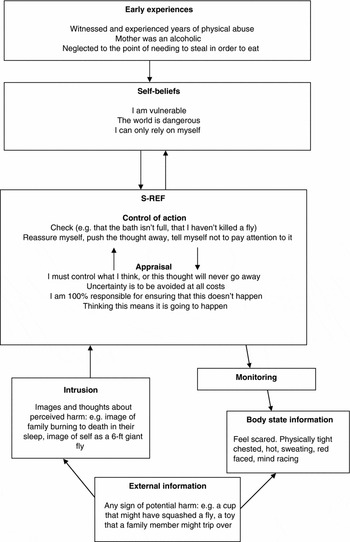
We hypothesized that John's experience of neglect in childhood had led him to view the world as unsafe, dangerous and unpredictable, and that if others could not be relied upon, then responsibility for his and other’ safety lay solely with him. We hypothesized that John has developed rules for living that would see uncertainty as equated with danger and consequently should be avoided at all costs. We agreed that these rules were understandable and even functional in his childhood context of such an unpredictable and dangerous environment.
John's initial response of disgust and fear to the film ‘The Fly’ was understandable given his concern that this could happen to him (the film itself was produced to elicit such an emotional response from the audience; Cronenberg & Rodley, Reference Cronenberg and Rodley1996). This strong emotional reaction led to him experiencing intrusive thoughts of himself transformed into a giant fly. His early experiences and self-beliefs made him seek certainty that this could not happen to him, but he began to consider that a mystical process such as karma could potentially transform him into a giant fly, if indeed he harmed a fly himself. He found this possibility of danger intolerable, and he began to spend increasing proportions of his time attempting to secure a sense of safety and certainty. He did this by ensuring that he did not harm a fly – looking under his shoes before walking, looking under cups before putting them down, checking virtually every object that he handled. This motivation to prevent himself transforming into a giant fly dominated his every movement throughout the day, and the image continued to intrude hundreds of times a day.
Figure 1 presents an outline of the formulation adapted from the S-REF model. Due to the complexity of the model, only selected elements were presented at a time with John, and in practical terms, most of treatment explored just two components – appraisal and control of action. The S-REF model emphasizes the role of meta-cognitive beliefs concerning the need to control thoughts, and associated attentional strategies, thus most of the early sessions were spent identifying John's inflated responsibility, need for certainty, and his beliefs that thoughts equated to events. He found this process useful in helping him understand the development and maintenance of his concerns regarding threat in general. However, he could not see how the same beliefs underpinned his fly belief, which he viewed as radically different, both in terms of its bizarreness, conviction and stability. Consequently, we agreed to delay treating the fly transformation belief, as he thought his other obsessions and compulsions were more understandable and easier to shift.
Case formulation [adapted from Wells & Matthew's (Reference Wells and Matthews1994) S-REF model].

Treatment of John's general obsessions
John was seen weekly over 17 sessions. His initial goals were to reduce his obsessional thinking and checking, to feel more relaxed, and more at ease with his family. During the initial sessions, the focus was on his beliefs about keeping him and his family safe. Constructing the formulation helped identify John's maintaining processes, and three were selected as targets of therapy – his threat perception, reacting to a thought as if it were true, and his safety-seeking behaviours.
Approximately the first ten sessions were spent using Socratic dialogue to explore two key processes. The first was John's threat perception. We compared his perception of threat to the actual threat by estimating the accumulative odds of all the necessary steps that were required to cause his predicted catastrophes. For example, the necessary steps for his son to drown in the bath included: his son waking in the night, needing the bathroom, knocking himself out, falling into the bath, the bath being full of water, etc. As John began to reconfigure a more accurate appraisal of threat, he began to realize that thoughts were not facts, but that he had been reacting to them as if they were.
The second process we examined was John's safety-seeking behaviours. Specifically, how much were his cognitive and behavioural strategies influencing the predicted catastrophic outcome? For example, John believed that his multiple nightly routine of checking that the bath was empty was protecting his son from drowning. When we examined this, we agreed that his checking had made no actual difference to his son's safety, as he had never found his son, or indeed any water, in the bath. This helped John re-conceptualize his difficulties in a meta-cognitive way: he was not influencing any potential harm, rather he was attempting to stop his thoughts about harm.
The realization that his prior strategies to stop his thoughts had clearly not been successful led to the second phase of therapy: exposure and response prevention (ERP). Initially John began exposing himself to his feared images of harm without engaging in his usual safety behaviours of checking and reassurance seeking. This proved successful in reducing his distress in therapy sessions, and he then began exposing himself to situations that would trigger such thoughts (e.g. mess on the floor that his children could trip up on). Gradually, his distress in such situations began to drop, and we moved onto the fly belief.
Treatment of John's fly transformation belief
During the next five sessions, we targeted a number of beliefs that were thought to maintain John's unusual belief about transforming into a giant fly: ‘that because he thought he had harmed a fly, that he probably had’, ‘that if he thought about becoming a fly, that meant that he probably would’, and ‘that unless he controlled his thoughts about flies, they would never stop’. The first two beliefs could be characterized as thought action fusion (TAF) and thought event fusion (TEF). As before, these beliefs were considered using Socratic dialogue (exploring questions such as ‘how did he believe that his cognitive strategies could potentially avert the predicted catastrophic outcome?’) and examining evidence that his beliefs most accurately reflected actual risks or worry (theory A/theory B; Salkovskis, Reference Salkovskis1999). John initially believed that his ‘fly belief’ was distinct to his more ‘understandable’ obsessional beliefs, but in fact we re-conceptualized his fly belief in an identical meta-cognitive way: he was not influencing any potential harm, rather he was attempting to stop his thoughts about harm. Again, we agreed that John's attempts to stop his thoughts of the fly were maladaptive and we began exploring alternative strategies. Initially we used the ‘White Bear’ thought-suppression experiment (Purdon & Clark, Reference Purdon and Clark2000) to demonstrate the paradoxical effect of thought control. This provided John with enough confidence to expose himself to his specific intrusive thought of transforming into a giant fly, without engaging in attempts to control the thought. This was a success, in which the image of himself as a giant fly repeatedly evaporated throughout the experiment.
The first behavioural experiment produced new learning in John, and began loosening his beliefs around the necessity of thought control. However, it was noted that John's anxiety level was rather low throughout the experiment, calling into question whether the experiment was in the optimal learning zone. We wondered if we could produce higher anxiety from his intrusive thoughts and the next session we repeated the experiment, but this time John made the decision himself to kill a fly in session to produce a stronger intrusive image. He reported concerns that the intrusive thoughts would be overwhelming that night, and that he would wake up the following day as a giant fly. The next day John was hugely relieved that he had not turned into a fly, that his intrusive thoughts had dissipated throughout the night and that he had slept well. He reported that although anxiety inducing, he also felt very positive throughout the day and the experiment had been a major step forward for him. Further sessions helped John assimilate this learning into his everyday life (for example, he continued to kill flies if opportunities presented themselves) and focused upon relapse prevention.
Outcomes
Measures were repeated at mid-, post- and 2-year follow-up. As can be seen in Table 1, the outcome measures indicated that observed change was particularly pronounced in the IoU scale (changing from a total score of ‘43’ at pre-therapy to ‘3’ at follow-up) and IIT scale (‘32’ at pre-therapy to ‘0’ at follow-up). This broader change was reflected in change on the individual items such as ‘the fact that the thought occurs means that there is a chance that it might happen’ (endorsed as ‘corresponds completely’ pre-therapy, and endorsed as ‘does not correspond at all’ at post-therapy and at follow-up). John's self-report indicated that his recovery was clinically significant, with a reported reduction of over 50% in the frequency of his intrusive thoughts and associated distress. His conviction rating of transforming into a fly had dropped to 5% at discharge and at follow-up. He also no longer met diagnostic criteria for OCD at discharge and at 2-year follow-up.
Outcome measures at pre-, mid-, post-therapy and at 2-year follow-up

Discussion
Was John's fly transformation belief an obsession, OVI or a delusion? Judged solely by the criterion of abnormality, the belief could be described as delusional. John also reported a high conviction rating, but was certainly amenable to discussion around the possibility that he might have been mistaken. Kozak & Foa (Reference Kozak and Foa1994) suggested that OVIs are ‘almost’ unshakable beliefs, but make the valid point that there is no reliable means of testing how much ‘shaking’ is required in order to establish that an idea is an OVI or a delusion. Overall, the characteristics of John's belief (high bizarreness and conviction, while retaining some flexibility) indicate to the authors that it falls midway on the spectrum between obsession and OVI.
The successful intervention on John's more typical obsessions may have ‘primed’ him for the later work on the fly belief. Perhaps it provided him with enough time to reflect on an alternative explanation, one that helped him experiment with different means of responding to his less threatening obsessions. In particular, calculating the accumulative odds of John's typical obsessions and him transforming into a fly helped him connect the one to the other and realize that he was grossly overestimating the threat.
Highly rigid delusions undoubtedly present greater challenges than the example presented here. There may be a rationale for employing a more meta-cognitive approach. It could potentially allow the clinician to essentially shift the goalposts, from investigating evidence for and against a delusion, to asking more meta-cognitive questions such as, ‘what are the advantages and disadvantages of thinking about this?’ The S-REF model provided a useful template for this, although arguably other ‘traditional’ CBT models would have proven as helpful in identifying the same meta-cognitive processes as targets for therapy. Salkovskis’ (Reference Salkovskis1985) model emphasizes the role of threat appraisals and counter-productive safety strategies, which were targeted in this case. M. Freeston & R. Ladouceur's model (unpublished document) highlights the beliefs around the importance of intrusions, incorporating TAF, which were picked up here. Perhaps responsibility for action and intolerance of uncertainty (as identified in the assessment phase) would have been emphasized had these models been applied.
Ultimately, a model's value may lie in its utility to help the client bring about change (Flitcroft et al. Reference Flitcroft, James, Freeston and Wood-Mitchell2007), and John's reflections at discharge and follow-up indicated that it had succeeded. He reported that it was his development of acceptance and tolerance of his thoughts that produced the central change in him. He had come to believe that disturbing thoughts were ‘just thoughts’ that he could now let ‘come and go’, and even laugh at. He commented that toleration of thoughts was a ‘massive thing’ for him. John's understanding that ‘thoughts aren't necessarily facts’ had generalized into all aspects of his life. He provided an example of experiencing a hangover, and having the thought that ‘I'm going to be in a bad mood all day now’. He was able realize that this was not necessarily true just because he had experienced the thought, and that he himself could define his mood and behaviour that day, rather than mindlessly accepting his negative automatic thought. This realization had improved his mood on a recent holiday, and he felt that he was now a better father and husband. Owing to the absence of his obsessions and repeated checking, John was able to enjoy his time with his family which was an important value-based goal he was working towards.
John's scores on some measures (BDI, BAI and to some extent the Padua Inventory) were sub-clinical, which appeared at odds with his presentation. It remained uncertain if he underreported some symptoms, or they truly reflected his experience. It is possible that his resilience and support network may have shielded him against depression to some extent.
This case study is inherently limited by its design – change cannot be attributed to the specific components of therapy, and we must allow for the possible effects of maturation, time, generic therapeutic and other therapist and patient factors that may have impacted on outcome. Monitoring of beliefs and frequency of distressing cognitions on a sessional basis would allow for firmer conclusions to be drawn regarding the effective change mechanism in this case. Another shortcoming is that the goals that were set were not particularly specific, although all indications are that John was satisfied with the outcome. Finally, the Overvalued Ideas Scale (Neziroglu et al. Reference Neziroglu, McKay, Yaryura-Tobias, Stevens and Todaro1999) clearly would have been helpful in this case.
Summary
This article presented a case study of a man who presented with commonly reported symptoms of OCD and a belief about transforming into a giant fly. The categorization and clinical implications of treating such beliefs were discussed. Progress at the 2-year outcome stage provides some additional support for CBT interventions for strongly held abnormal beliefs within OCD.
Declaration of Interest
None.
Acknowledgements
The authors thank the client (John) for his consent and thoughtful input.
Learning objectives
(1) To explore the dimensions along which obsessions, overvalued ideas and delusions vary.
(2) To illustrate clinically the formulation and treatment of a distressing belief, in the absence of diagnostic certainty.
(3) To explore potential common change mechanisms between obsessions and overvalued ideas.



Comments
No Comments have been published for this article.