In his 2007 Lugard Lecture Peter Geschiere pointed out that over the past fifteen years discourses on autochthony and belonging have become an overriding theme in the politics of many African and lately also European countries (Geschiere Reference Comaroff and Comaroff2007; see also Bayart et al. 2001; Ceuppens and Geschiere 2005). Similarly, Jean and John Comaroff reported that in South Africa discourses of autochthony have been applied not only to people but also to animals and plants (Comaroff and Comaroff Reference Comaroff and Comaroff2007; see also Comaroff and Comaroff 2001). The flip-side of this preoccupation with belonging is the attempted exclusion of ‘the other’, the stranger, l'allogène. However, autochthone and allogène are rather fuzzy notions that can be applied to different units or groups whose relationship may be constantly redefined.
Geschiere, as well as Konings, Nyamnjoh and Socpa, has pointed out the ambivalent outcomes of autochthony discourses in Cameroon.Footnote 1 As Geschiere argues, the new emphasis on indigeneity and minority rights, which has been promoted by the Cameroonian government as well as by international development and global rights organizations, is geared towards surpassing national citizenship (2004, 2005a). This development he considers precarious, as in many African countries the idea of formal equality of all citizens in the face of the law is still weakly institutionalized (Geschiere Reference Ceuppens and Geschiere2005a: 13).
While I largely share Geschiere's concern about the demise of national citizenship, I will adopt in this article the perspective of a minority group that clearly benefited from the new opportunities ensuing from Cameroon's democratization and from changes in the international development establishment. My focus will be on the Mbororo (agro-pastoral Fulbe) in north-west Cameroon (Western Grassfields) who, in the view of many Cameroonians, are a prime example of a stranger population. As members of the Fulbe ethnic group, the Mbororo are thought to have emerged from somewhere in West Africa. They are seen as culturally and religiously different from their Grassfields neighbours. Furthermore, having settled in the Western Grassfields only in the twentieth century, they are considered latecomers. And finally, as cattle pastoralists they are seen as nomads: people constantly on the move and with no permanent home. Yet despite their reputation as strangers and migrants, the Mbororo have been able to challenge local autochthony discourses. By claiming regional citizenship and minority status in the Cameroonian state, they have attained the same legal entitlement to political representation and natural and government resources as their Grassfields neighbours. However, as I will argue below, the Mbororo's newly found self-esteem and improved legal status may also have negative consequences, particularly with regard to inter-ethnic relations. Furthermore, the identification of the Mbororo as an ‘indigenous people’ – that is, as a pastoral group whose cultural identity and presumed nomadic way of life has to be protected – tends to be problematic. As Geschiere rightly pointed out in his Lugard Lecture, claims to autochthony or to ‘indigeneity’ are not aimed at returning to the village or to a ‘traditional’ lifestyle and culture that has to be protected, but at getting access to global resources. Let me make it clear: my misgivings are not directed against Mbororo claims, but concern Western and, more precisely, UN notions of ‘indigeneity’. These and other aspects make the Mbororo's quest for regional and national citizenship a particularly interesting case that sheds a somewhat different but complementary light on autochthony discourses in Cameroon.
The arguments in this article are based on fourteen months of fieldwork conducted between 2000 and 2002 on the subject of inter-ethnic relations and identity politics in north-west Cameroon. Information on further developments since my departure in 2002 has been obtained through regular communication with Cameroonian acquaintances and friends as well as through Internet research. Related and more comprehensive analyses can be found in my PhD thesis (Pelican Reference Dafinger and Pelican2006) and in a comparative article co-authored with Andreas Dafinger (Dafinger and Pelican 2006) on herder–farmer relations in Burkina Faso and north-west Cameroon.
THE MBORORO IN THE WESTERN GRASSFIELDS
In what follows I will introduce the Mbororo and their neighbours in the Western Grassfields. Subsequently, I will give an overview of their socio-political and economic trajectories during the colonial and post-colonial periods, thus providing the historical background to the Mbororo's changing strategies of the 1990s.
The Mbororo and their neighbours
The Mbororo constitute a minority in the Western Grassfields, accounting for 5–10 per cent of the region's total population (Boutrais Reference Boutrais and Blanc-Pamard1984: 230; 1995/6: 548). The majority are Grassfielders who belong to linguistically distinct communities but share common features of economic and socio-political organization. They are largely subsistence farmers and are organized in centralized chiefdoms and confederations. Most Grassfielders are both Christians and adherents of African local religions. They entertain strong political, economic and religious bonds with their settlement area based on citizenship in a chiefdom, ancestral ties, and links with the land's ritual topography. They thus consider themselves ‘natives’ and ‘guardians of the land’. A third population group are Hausa, a term locally used to denote the heterogeneous group of Muslim village dwellers. They include descendants of early Hausa traders, sedentary Fulbe from Nigeria and Northern Cameroon, and local Grassfields converts.Footnote 2 They are a tiny minority and are represented in only a few urban and rural centres. As Muslims, Mbororo and Hausa also constitute a religious minority.
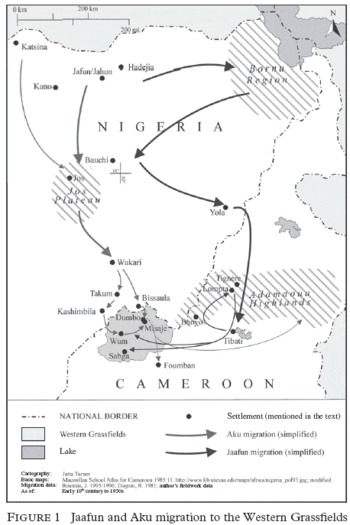
The Mbororo community in the research area is internally diversified, comprising members of two sub-groups, namely Jaafun and Aku. Originally, both groups lived in the Kano area in present-day Nigeria. In the course of the nineteenth century they adopted diverging migration trajectories and developed distinct sub-ethnic identities (Boutrais Reference Boutrais1995/6: 15–210; Dognin 1981). Driven by a continuous search for new pastures, the Jaafun started entering the Western Grassfields in the early twentieth century. They came from northern Cameroon, mainly the Adamawa Plateau, and established themselves on the Bamenda Highlands. The Aku followed later, from the 1940s onwards, attracted by favourable grazing conditions and administrative policies. They entered the Grassfields mainly from the Jos Plateau in Nigeria, and settled on the lowland pastures on the northern fringes of the Bamenda Highlands.3
Mbororo socio-political and economic trajectories (1910s–1980s)
The first Mbororo to enter the Western Grassfields were members of the Jaafun community of Lompta in Adamawa. They established themselves in the vicinity of Bamenda, the regional capital, in the late 1910s. Their settlement was named Sabga after its initiator, and later became the headquarters of the Mbororo community in north-west Cameroon. During the subsequent decades, many more Mbororo were attracted to the Western Grassfields, as the Bamenda Highlands became renowned for their favourable ecological conditions, offering fertile pastures and numerous salt springs. Most pastoralists migrated in kin or lineage groups, headed by an Mbororo leader (Fulfulde: ardo) who also acted as their representative to the Grassfields communities and the colonial administration.4
The British colonial administration supported the influx of Mbororo pastoralists as a means of diversifying the regional economy and augmenting its tax income. Concurrently, local Grassfields chiefs welcomed the pastoralists’ establishment on their chiefdom's territory, as long as they paid tribute and acknowledged their hosts’ territorial and political primacy. Even though population densities were relatively low and farming and pasture lands abundant, crop damage was a recurrent problem, as the Mbororo's practice of extensive grazing and seasonal transhumance collided with the Grassfielders’ system of shifting cultivation. In consequence, Grassfields farmers looked on the pastoralists’ settlement with mixed feelings, and occasionally responded with public protest and violence (Boutrais Reference Boutrais1995/6: 734; Dafinger and Pelican Reference Dafinger and Pelican2006; Harshbarger 1995). The British colonial administration was faced with the predicament of implementing its policy of indirect rule and, at the same time, protecting the Mbororo against the hostility of Grassfields farmers and exactions by local chiefs. This dilemma resulted in frequently changing policies regarding the pastoral sector and the management of farmer–herder relations (Njeuma and Awasom 1988, 1990).
Despite difficulties with the local farming population, many Mbororo benefited from the favourable ecological environment of the Bamenda Highlands and prospered over time. By the mid-1940s, many had settled permanently in their rainy season camp, with only part of the family undertaking a seasonal transhumance. This trend towards sedentarization was further endorsed by the administrative imposition of ‘grazing rules’ that restricted pastoral mobility (Boutrais Reference Boutrais1995/6: 115–18). At the same time, the Mbororo in the Western Grassfields developed a conscious political identity. Perceiving their pastoral interests to be inadequately represented by local Grassfields chiefs, a group of outspoken Mbororo leaders appealed for direct representation to the colonial administration. However, the British headquarters in Nigeria denied the Mbororo the status of a politically independent minority and classified them as ‘strangers’ rather than ‘natives’ (Boutrais Reference Boutrais1995/6: 112–15). In response, the Mbororo leaders formed a ‘Fulani Council’ that, although its existence was never officially acknowledged, effectively acted as an intermediary between the Mbororo population and the British administration. Furthermore, the British granted the Muslim community limited juridical autonomy (Awasom Reference Awasom1984: 226–41, 269–303). Yet it was only after Cameroon's independence that the Mbororo attained Cameroonian citizenship, and in the context of constitutional changes of 1972 an official say in pastoral matters (Boutrais Reference Boutrais1995/6: 182–5).
The adoption of a more sedentary lifestyle also altered the pastoralists’ economic strategies. In order to safeguard their pastoral resources, many Mbororo started to combine their herding activities with limited subsistence agriculture. Depending on good relations with their Grassfields neighbours, they began to cultivate small plots close to their settlements, growing maize, tubers and vegetables for home consumption. Legal entitlement to cultivate within the grazing area was provided in 1962, but the size of farming plots was restricted to 0.4 hectares per family (Boutrais Reference Boutrais1995/6: 797–8). Jaafun and Aku adopted different strategies regarding their farming activities. While Jaafun relied primarily on employing local farmers to cultivate their fields, Aku tended to perform most tasks themselves. These different attitudes reflected their distinct pastoral development and previous experiences with agriculture (Pelican Reference Dafinger and Pelican2006: 211–15). Economic diversification was also encouraged by the British colonial administration, and subsequently the Cameroonian state, both as a means of augmenting rural production and as a way of improving farmer–herder relations. The assumption was that comprehensive knowledge of both economic systems would promote mutual understanding. Yet, although many Mbororo and some Grassfielders were both cattle herders and farmers, the notion of distinct ethnic-occupational categories remained vivid and farmer–herder conflicts continued to be perceived in ethnic terms (Pelican Reference Dafinger and Pelican2006: 201–48).
Changes in Mbororo mobility and economy also affected the socio-cultural sphere. With growing wealth, many Mbororo aimed at improving their living conditions by investing in consumer goods and Islamic education. Mbororo youths gradually adopted the practices and consumption patterns of their Grassfields peers, such as frequenting local bars, attending Grassfielders’ rituals and festivities, or dating Grassfields partners. Mbororo elders considered such practices incompatible with their Mbororo and Muslim identity (Boutrais Reference Boutrais1995/6: 967–70; Frantz 1986). As they worried about their youngsters’ acculturation to a non-Muslim environment, they emphasized an Islamic lifestyle and encouraged Islamic education while rejecting Western or Christian schooling. It was only gradually that Mbororo individuals became aware of the practical advantages of Western education and started sending some of their children to school. By the late 1980s just a few Mbororo had undergone secondary or university education. Yet, as we will see below, members of this small elite were extremely instrumental in exploring new political strategies.
Eventually, in the second half of the twentieth century, the Mbororo began to face socio-economic difficulties as a result of increasing population density and competition over natural resources (Boutrais Reference Boutrais1995/6: 679–712). Many families experienced gradual impoverishment. While their family sizes continuously increased, the rate of herd growth stagnated due to the effects of overgrazing. In addition, farmer–herder conflicts became exacerbated, both as a result of farmers’ expansion into grazing zones and the Mbororo's negligence in the adequate control of their cattle herds. Many Mbororo spent considerable wealth on administrative and judicial procedures that benefited state agents rather than producing lasting solutions. Furthermore, as a legacy of the colonial period, the Mbororo lacked formal institutions of political representation, and largely relied on patron–client relationships in defending their economic and political interests. Such relationships often developed between Mbororo herders and Grassfields individuals who had an interest in cattle husbandry, a proximity to the local hierarchy and a certain standard of education. These relationships were – and still are – largely of an individual character and were frequently couched in the terminology of friendship (Pelican Reference Geschiere, Englund and Nyamnjoh2004). However, patron–client relations with local Grassfielders proved ineffective in withstanding influential entrepreneurs who began to institute private and state ranches on Mbororo grazing land.Footnote 5 In addition, their relative wealth and lack of formal education had made Mbororo prime targets of the venality of state agents.
As a result, the Mbororo in the Western Grassfields experienced themselves as a politically marginalized and economically exploited minority. The British colonial administration had classified them as ‘strangers’ and had denied them autonomous political representation. Local Grassfielders’ attempts to integrate them into their socio-political community constituted a constant source of dependency and exploitation. Under the regime of Cameroon's first President, Ahmadou Ahidjo, they qualified as Cameroonian citizens, but were subsumed under the cultural category of ‘northerners’ on account of their Muslim identity and Fulbe ethnicity. Consequently, Mbororo who were born and grew up in the Grassfields still counted as ‘strangers’ to the area, with limited rights to the region's natural and state resources. It was only with Cameroon's democratization in the 1990s that the Mbororo eventually obtained the opportunity to engage in the political arena and to express their interests and grievances directly to the state.
MBORORO RESPONSES TO NEW POLITICAL AND LEGAL AVENUES
By the late 1980s, Cameroon (like many African countries) faced a serious economic crisis. As part of the structural adjustment programme proposed by the World Bank and the International Monetary Fund, the Cameroonian state was obliged to embark on a process of economic and political liberalization. Concurrent geopolitical transformations – epitomized by the end of the Cold War – supported the rise of democracy and human rights movements on a global scale.
In Cameroon the demand for democracy was publicly voiced in 1990 by political movements in the city of Douala and in the Anglophone north-west, which soon became the heart of political opposition (Takougang and Krieger 1998). The same year, and only in response to considerable internal and international pressure, the current regime under President Paul Biya introduced a multi-party system. Subsequently, the government endorsed the formation of ethnic and regional elite associations as vehicles of political representation to the state and its resources (Nyamnjoh and Rowlands 1998). It is in this context that a growing preoccupation with ‘autochthony’ and ‘belonging’ emerged; promoted by the Biya regime, it had the result of dividing and weakening the opposition (Geschiere Reference Ceuppens and Geschiere2005a; Geschiere and Nyamnjoh 2000).
As a consequence, a number of established and novel political avenues opened up and were soon explored by various regional and ethnic groups, including the Mbororo. The most effective way forward turned out to be the formation of ethnic elite associations that acted as representatives to the state and to international development agencies. Thus in 1992 a group of young, educated Mbororo founded MBOSCUDA, the Mbororo Social and Cultural Development Association. While alternative associations were created in the same period, MBOSCUDA rapidly became the most vocal and effective organ of Mbororo self-representation.Footnote 6 Its activities will be described in more detail below.
The Mbororo of the Grassfields also explored other lobbying strategies, often with the support of MBOSCUDA members. Like their Grassfields counterparts, Mbororo leaders formed a chiefs’ association, ‘the North West Lamidos’ Forum’ (Awasom Reference Awasom, Coquery, Goerg, Mande and Rajaonah2003).Footnote 7 Although this body did not function for long, it drew attention to the continuing demand for an Mbororo leaders’ forum.Footnote 8 Another strategy is the co-option of high-ranking officials. In 2002 the Mbororo counted two Members of Parliament as ambassadors of their cause, namely Peter Abety, Minister for Special Duties, and Manu Jaji Gidado, Attaché at the Presidency (Hickey Reference Geschiere, Englund and Nyamnjoh2004). Mimicking their Grassfields neighbours’ practice of awarding neo-traditional titles to their elite members (Fisiy and Goheen Reference Fisiy and Goheen1998; Goheen 1996), the lamido (Mbororo paramount chief) of Sabga gave them the titles of Messenger and Chief's Representative. Since then, Abety has been discharged from office but continues to support Mbororo interests in his role as a university lecturer in Yaoundé. In addition, new sympathizers have been won among current officials.
MBOSCUDA activities in north-west Cameroon
In this article, I am particularly concerned with MBOSCUDA's interaction with the Cameroonian state and international development agencies. MBOSCUDA is a national, membership-based organization with approximately 30,000 members and branches in nearly all provinces (MBOSCUDA press release, Bamenda, 16 March 2005). It was formed on the initiative of young, mostly educated Mbororo individuals who were searching for answers to their shared experience of a crisis in Mbororo cultural and political identity. MBOSCUDA's founding members explicitly distanced themselves from sedentary Town Fulbe in northern Cameroon and stressed their identification with (agro-)pastoral Fulbe. They argued that the two populations’ interests and problems differed substantially and that the Mbororo in particular lacked efficient strategies of political representation to the state. They designed a number of regional programmes aimed at the revitalization of Mbororo cultural practices, the improvement of Mbororo women's socio-economic situation, the promotion of Mbororo children's education, and the improvement of pastoral conditions. A number of these programmes have been realized with the support of local communities and national or international non-governmental organizations.
MBOSCUDA's most active branch is in the North West Province, where leading members have learned from the socio-political and organizational example of their Grassfields neighbours. Most educated Mbororo are familiar with Grassfielders’ institutional practices, as many have spent considerable time in the households of Grassfields acquaintances who supported their quest for education. In north-west Cameroon transformations in Mbororo self-perception and political strategies are also more pronounced than in other parts of the country.
In the initial phase, MBOSCUDA members were preoccupied with convincing the Mbororo of the advantages of joint action and collective political representation. As a result of their pastoral heritage, Mbororo were used to pursuing their interests via individual strategies, such as patron–client relationships. Their solidarity networks focused on the kin or lineage group. Moreover, interaction between Jaafun and Aku was limited. MBOSCUDA activists, however, encouraged both sub-groups to see themselves as one and pursue collective strategies. In this context, the phrase ‘don't make pulaaku’ or in Fulfulde ‘taa wadda pulaaku’ became a popular slogan among MBOSCUDA sympathizers (Davis Reference Davis1995). In their view, pulaaku – or behaving like a pullo (sing. of Fulbe) – was an outdated strategy and no longer compatible with the requirements of their current economic and political situation. They thus called on individuals to transcend socio-cultural barriers and to express disagreement openly.Footnote 9 Many Mbororo elders took offence and accused MBOSCUDA of eroding Mbororo morale and identity. Furthermore, as part of their cultural renewal programme, MBOSCUDA aimed at revitalizing Mbororo youth culture by encouraging singing, dancing and the display of horse-riding skills during public meetings. This engendered the disapproval of Muslim clerics who reproached MBOSCUDA for promoting immoral and aggressive behaviour among Mbororo youth. Gradually, MBOSCUDA officials adopted a more inclusive strategy, involving Mbororo elders and Muslim scholars in the planning and execution of their programmes.
By the second half of the 1990s, MBOSCUDA was widely established among Mbororo in the Western Grassfields. In order to realize its community development projects, the association sought the collaboration of international NGOs such as the German Development Service and Village AiD, a UK funding-partner agency. As a result of this collaboration, and in line with current trends in international development policies and global rights discourses, MBOSCUDA shifted its initial focus from redefining Mbororo identity to redefining Mbororo political and legal status (Duni et al. 2005; Hickey 2002, 2007). Its earlier focus on women's empowerment and children's education remained operational, and a new programme component was introduced, aimed at the strengthening of civil awareness among Mbororo.Footnote 10 MBOSCUDA's current projects include training women in alternative income strategies, the establishment of Anglo-Arabic schools (co-educational schools that provide primary school education in English as well as instruction in Arabic language and Muslim religion), and the provision of legal advice in land disputes and in cases of human rights abuse and illegal extortion by government officials. On account of these activities MBOSCUDA is well-regarded among Mbororo in the Western Grassfields, many of whom have benefited from its ongoing projects.
Redefining Mbororo regional and national citizenship
MBOSCUDA significantly contributed to promoting civil awareness among Mbororo, and also succeeded in redefining Mbororo political and legal status vis-à-vis the state. I will now focus on these two achievements and illustrate the ways in which Mbororo individuals justify their claims to regional citizenship and national minority status.
In 2000 new computerized identity cards were issued and MBOSCUDA encouraged Mbororo citizens to register. While in the previous system, Mbororo were generally registered as being born in northern Cameroon, the new identity cards indicated their actual birthplace. Mbororo hence qualified as regional citizens with claims and rights to natural resources and political representation in their home areas. Concurrently, the association also encouraged Mbororo individuals to stand as candidates in municipal elections and to participate actively in community development projects.
Many Mbororo in the Grassfields acquired the new identity cards and expressed their satisfaction with being recognized as regional citizens. As they argued, they have been living in their current settlement area for several decades. Their children have grown up with Grassfields children, have learnt their neighbours’ language, have adopted a number of Grassfields customs, and don't know any other home. Furthermore, they have integrated themselves into local Grassfields communities, participating in communal activities and supporting the local Grassfields chief. They thus see themselves as able members of Grassfields chiefdoms, and claim rights and belonging in the same way as their Grassfields neighbours. Furthermore, some influential Mbororo communities, such as the one in Sabga, have developed an exceptional preoccupation with their group history as a way of endorsing their claims to power and land (Pelican Reference Dafinger and Pelican2006: 164–88). While Mbororo are known for their lack of collective historical consciousness (Boutrais Reference Boutrais1995/6: 43, 65), the Sabga community has produced a written codification of its history that is structured on similar lines to the historical accounts of Grassfields chiefdoms.
Above all, Mbororo are concerned with their entitlement to grazing land, as competition has increased with growing population density (both in humans and animals). While a few long-established and influential individuals have acquired land titles, the majority rely on the goodwill of local administrators and Grassfields chiefs. Such informal arrangements are vulnerable, of course, to changing economic and political fortunes. To counter this situation, MBOSCUDA has organized workshops to alert Mbororo, Grassfielders and administrators to the rights of Mbororo citizens (Pelican Reference Dafinger and Pelican2006: 233–41). Furthermore, the association has offered legal advice in land disputes. However, as MBOSCUDA officials acknowledge, there is no generally applicable and easy solution to farmer–herder conflicts and land disputes.
MBOSCUDA has also been instrumental in redefining Mbororo national citizenship. Alongside collaborating with international development agencies, it has created links with transnational human and minority rights organizations, including Amnesty International, Survival International, Minority Rights Group International, and the World Intellectual Property Organization.Footnote 11 This international backing proved vital in contesting human rights abuses committed by state agents against Mbororo individuals.12
Furthermore, in line with the proclamation of the decade of ‘indigenous peoples’ (1995–2004) by the United Nations, MBOSCUDA promoted the Mbororo as an ‘indigenous minority’ whose cultural survival had to be protected.Footnote 13 Consequently, MBOSCUDA officials were enrolled to participate in government programmes for the development of indigenous and autochthonous peoples in Cameroon.Footnote 14 The United Nations and the International Labour Organization officially recognized the Mbororo alongside the Baka, Bakola, Bagyeli and Bedzang (commonly regarded as ‘Pygmies’) as ‘indigenous peoples’. In 2005 MBOSCUDA was granted special consultative status by the Economic and Social Council of the United Nations.
In analysing these recent developments two questions emerge: what does it mean if the Mbororo are classified as an ‘indigenous people’ alongside the ethnic groups of Baka, Bakola, Bagyeli and Bedzang? And what practical implications do these developments have for the Mbororo and MBOSCUDA?
As Hodgson (2000) and Kuper (2003) have pointed out, the term ‘indigenous peoples’ is decidedly a political notion that may refer to different things in different locations. While in North, Central and South America indigenous activism has a long history and the status of ‘first peoples’ is generally uncontested, the situation in Africa is different. Here it is much more problematic and controversial to define which groups may count as ‘indigenous’, as there are long and ongoing histories of migration, assimilation and conquest. This difficulty is also reflected in current working definitions of ‘indigenous peoples’ as applied by the International Labour Organization and the United Nations, which emphasize self-identification as a fundamental criterion (Hodgson Reference Hodgson2000; Tchoumba 2006).
Many African states have been opposed to the concept of ‘indigenous peoples’ and their entitlement to land and resources, arguing that all Africans are ‘indigenous’ and should have equal access to natural resources (Lutz Reference Lutz2007). Cameroon is one of the few African countries that has adopted the notion of ‘indigenous peoples’ in its National Constitution, though without providing clear definitions. In a recent report for the International Labour Organization, Tchoumba (2006) summarizes the situation as follows:
In Cameroon, as elsewhere in Africa, the concept of indigenous peoples is somewhat controversial. No community in Cameroon is legally recognized as an indigenous people, although the National Constitution provides for the protection of minorities and the rights of the indigenous peoples. However, based on the principle of self-identification, our work will focus on the so-called ‘Pygmies’ and Mbororo who identify themselves in Cameroon as indigenous peoples. These two ethnic groups share a common attachment to their cultures, lifestyles and their marginalization in political life and the development process. Their cultures and lifestyles differ significantly from those of the dominant society and their survival depends on the recognition of their rights and access to their traditional land and natural resources. They suffer from discrimination insofar as they are considered as being ‘less developed’ and ‘less advanced’ than the other more dominant groups of the society. These groups have been identified by the working group of the African Commission on Human and Peoples’ Rights as indigenous communities in Africa and the principle of respect for the lifestyle, customs, cultures and institutions as well as the self-identification of the indigenous and tribal peoples is recognized by ILO Convention No. 169 as fundamental for these peoples. (Tchoumba Reference Tchoumba2006: 6–7)
Tchoumba gives a long list of criteria that classify the Mbororo and the ‘Pygmies’ as ‘indigenous peoples’. It strikes me, however, that the two groups fall into the category of pastoralists and hunter-gatherers respectively. Here we may consider Kuper's (2003: 389–90) argument that the United Nations has tended to give precedence to hunters and nomadic herders, viewing them as representatives of the original human populations of the world. This renders the case of the Mbororo somewhat ambiguous. The Grassfields Mbororo are not nomadic herders but largely sedentary agro-pastoralists. Ironically, their assumed nomadic lifestyle may be less ‘endangered’ by national policies than by their desire for a settled and more comfortable life.
Another issue is their alignment with the ‘Pygmies’: in other words, for Mbororo the question of ‘belonging’ also emerges with regard to ‘indigenous peoples’. The Fulbe (including the Mbororo) are renowned as a proud and exclusive people who tend to look down on other ethnic groups (Burnham Reference Burnham, Baxter and Sansom1972). This may apply to the Mbororo in the Grassfields to a lesser degree than to Fulbe in northern Cameroon. Nonetheless it was foreseeable that their ethnic pride may overshadow their collaboration with the ‘Pygmies’, who are generally ranked lowest on an ethnic scale. Accordingly, when Village AiD proposed to extend its civil awareness programme to include both Mbororo and ‘Pygmies’, they were confronted with outright rejection by some MBOSCUDA officials – a development also related to increasing divisions within the association. The planned project had to be abandoned.15
This leads us to the second question concerning the practical implications of the Mbororo's recognition as an ‘indigenous people’. So far, this political status change has had no impact on the lives of ordinary Mbororo in the Grassfields. In effect, most Mbororo are not aware of their recognition as an ‘indigenous people’ and its potential implications. Conversely, some educated individuals and MBOSCUDA representatives have benefited considerably from opportunities for advanced training and international travel. For example, over the past four years MBOSCUDA's current provincial programme coordinator attended six international workshops in the United States, Britain, Tanzania and Nigeria, as well as three skill enhancement trainings in southern Cameroon. His wife attended a three-month Indigenous Fellowship Programme in Geneva organized by the Office of the High Commissioner for Human Rights.Footnote 16 Thus, the ‘indigenous peoples’ discourse benefits mainly the Mbororo elites.
Against the background of these emerging new opportunities, it is not surprising that there are indications of increasing rivalries and ruptures within MBOSCUDA. Furthermore, criticism has also been raised by Mbororo leaders who submitted a petition to the British High Commission, accusing Mbororo intellectuals of falsely portraying the Mbororo as an impoverished people, and of misappropriating international aid.17
Mbororo emotional attachment to the Grassfields
Besides political and economic objectives, Mbororo claims to regional citizenship and minority status also entail an emotional component. As compared to Grassfielders’ apparent emotionality regarding discourses on autochthony and belonging, Mbororo attachment to their home area is quite different in character and expression. While Grassfielders tend to be very passionate about issues of land, Mbororo are culturally restrained in expressing their feelings.Footnote 18 Furthermore, Grassfielders and Mbororo have different relationships to their settlement areas. For Grassfielders ‘the soil’ of the home region is an economic, political and, above all, a spiritual resource. It is the seat of the ancestors, and the place where one needs to be buried.Footnote 19 This religious dimension is absent in the Mbororo's attachment to the land, which is defined by the longevity of their stay and by ensuing economic and social ties.
In the course of their settlement in the Grassfields, many Mbororo have made considerable economic and social investments and, consequently, have developed an emotional attachment to their home area. As indicated above, they have built permanent compounds and invested in settling farms and the conservation of their grazing land. Furthermore, many Mbororo have established stable work and friendship relations with their Grassfields and Hausa neighbours (Pelican Reference Geschiere, Englund and Nyamnjoh2004). In particular, youths frequently entertain social relationships across ethnic boundaries, participating in sports activities and youth associations as well as socializing during festivities and nightly outings. Some Mbororo are in love relationships with Grassfields or Hausa partners, and a few are married to non-Mbororo spouses (Pelican Reference Dafinger and Pelican2006: 306–41).
Most Mbororo see themselves as Garafi (Pidgin English for Grassfielders) or ‘Grassfields Mbororo’. This feeling of belonging and commitment to their home area is expressed even more strongly among educated Mbororo – many of whom have benefited from the support of Grassfields acquaintances, as Mbororo parents have been reluctant to invest in their children's education. Similarly, MBOSCUDA officials from north-west Cameroon tend to ally with politicians and state agents originating from the Western Grassfields rather than with Fulbe from northern Cameroon.
ADMINISTRATORS' AND NEIGHBOURS' PERSPECTIVES
The question emerges, how local administrators and neighbouring groups have responded to the Mbororo's recent political strategies and their status change. Concerning the Mbororo's recognition as an ‘indigenous people’, I have, as yet, no substantial information. Regarding their assessment of MBOSCUDA and its activities, Grassfielders and Hausa as well as state agents have expressed their approval rather than contempt.
Most Grassfields groups have their own ethnic elite association and consider it normal that the Mbororo should organize themselves collectively. Furthermore, many of MBOSCUDA's projects are met with sympathy, as their objectives of promoting children's education, women's socio-economic status and individual human rights are shared by local Grassfielders. However, regarding property rights in natural resources, Grassfields communities are opposed to Mbororo claims, and insist on their self-proclaimed status as ‘first-comers’ and ‘guardians of the land’. Since MBOSCUDA has limited its involvement in land disputes, no official objections have been raised against them.
Similarly, the Hausa assess MBOSCUDA's activities in a positive light. Due to the small size and ethnic heterogeneity of the Hausa community in Cameroon, no Hausa ethnic elite association has emerged. Some Hausa individuals have expressed the idea of joining MBOSCUDA, as they see their two groups united by shared religion, cultural similarities and minority status. However, the Mbororo have been reluctant to integrate Hausa in their political activities, and MBOSCUDA's ethnically exclusive approach has been met with incomprehension by their Hausa neighbours.
Government officials in the Western Grassfields are generally aware of MBOSCUDA and its community development projects, particularly in those areas with a strong Mbororo presence. While some state agents approve of the organization's efforts to counter their colleagues’ venality, others are critical. Overall, government officials have taken a neutral or positive stance to the Mbororo's new political and civil self-consciousness.
MBOSCUDA officials are aware of the potentially disruptive impact that the Mbororo's new self-consciousness may have on inter-ethnic relations. Occasionally, they aim at integrating both Mbororo and members of neighbouring communities into their projects, in order to promote communication and collaboration on the local level. However, the long-term effects of the Mbororo's novel political strategies on the local power balance and on inter-ethnic relations are still to be observed.
CONCLUSION
We have seen that the national political transformations of the 1990s and the changes in international development policies have largely benefited the Mbororo. By successfully claiming regional citizenship and minority status from the Cameroonian state, they have been able to challenge local autochthony discourses. Yet, at the same time, they have entered new discourses of belonging – though on a smaller scale – concerning who counts as ‘indigenous peoples’, who should be represented by MBOSCUDA, and who is entitled to ensuing travel and training opportunities.
Another domain affected by the Mbororo's bolstered self-confidence and their recognition as regional citizens is their relationship with neighbouring population groups. As the Cameroonian government now attributes equal status to Mbororo and Grassfielders, the regional power balance has changed. And while former inequalities have been resolved, a potential for new tensions has emerged. There is an observable tendency among Mbororo in the Grassfields to secure access to natural and state resources via legal claims, as an alternative or in addition to cultivating good relations with their Grassfields neighbours. Concurrently, MBOSCUDA has assisted and encouraged Mbororo individuals to defy the exploitative practices of state agents who – irrespective of their ethnic backgrounds – are largely interested in self-enrichment. Consequently, integration into the overarching regional community is increasingly negotiated on the level of the state rather than the local or regional community itself.20
At this point it is too early to provide a general assessment of the long-term effects of the Mbororo's current political and legal strategies on inter-ethnic and interpersonal relations. Yet I tentatively suggest that, rather than facilitating social relations, international and state recognition of citizenship, land and minority rights may tend to discourage integration on the local level and to promote the polarization and politicization of inter-ethnic relations.
ACKNOWLEDGEMENTS
An earlier version of this article was presented in the panel ‘Autochthony, citizenship and exclusion – struggles over resources and belonging’ at the ECAS/AEGIS conference in Leiden (July Reference Duni, Fon, Hickey and Salihu2007). I wish to thank the panel organizer Peter Geschiere as well as Ben Page and Paul Nkwi for their valuable comments. Encouragement and incisive criticisms also came from Billy MacKinnon as well as the editor and anonymous readers of Africa. Special thanks go to Aliou Sali, Musa Ndamba, Nuhu Salihu Jafaru, Ramatu Nuhu, Ramatu Sali and Sarli Sardou Nana for sharing with me their perspectives on recent developments concerning theMbororo and MBOSCUDA in Cameroon. Finally, I would like to thank the Max Planck Institute for Social Anthropology, Halle/Saale, Germany for generously supporting my PhD research.
Jaafun and Aku migration to the Western Grassfields

Mbororo girl (left front) playing bass drum in her school band, Wum, 1982 (Courtesy of Fadimatu Umaru)