The Serbs had had no regular access to a Cyrillic printing shop since the end of the fifteenth century. During the following two centuries, books were published in the printing shop of the Vuković brothers in Venice and in a few short-lived monastic printing shops in Bosnia and western Serbia. Apart from the scarcity of books, this also meant that exclusively theological and liturgical works were printed. During the first seven decades of the eighteenth century, before Kurzböck's Cyrillic printing shop opened, the Habsburg Serbs relied mostly on books imported from Russia or a few books they had printed in Rimnik, Wallachia, although this satisfied only the demand for the most basic church and schoolbooks.Footnote
1
During the 1760s and the 1770s a few non-liturgical books were also printed in Venice and in Breitkopf's printing shop in Leipzig.Footnote
2
Reliance on imported books meant not only irregular and inadequate access to books, but also presented a serious economic problem, as large sums of money were taken out of the country to pay for the books, while at the same time the prices that had to be paid for the books were enormous.Footnote
3
An additional problem was that the book trade was a perfect opportunity for the increase of Russian influence, while the prevalence of Russian liturgical books meant that in the 1760s most Orthodox Christians were celebrating not Habsburg but Russian rulers during their services simply because their names were printed in the books.Footnote
4
Vienna viewed this with growing dissatisfaction but could not stop it completely. Bans were placed on importing Russian books (1729 and 1751), but this was not a satisfactory solution. As the Orthodox needed the books, the bans only resulted in the increase of smuggling and therefore were never fully enforced.
This situation was equally unsatisfactory from the point of view of the Orthodox bishops, who especially wanted easier access to basic textbooks and liturgical books. Thus, in 1750, barely a year after his election as metropolitan, Pavle Nenadović wrote to the Illyrische Hofdeputation asking for permission to open a Cyrillic printing shop. His main reason for this request was economical, namely that “Alljärl(ich) eine nicht geringe Summa Gelt, Theils in das [sic] Türckey, gröste theils aber nach Russland zu erkauffung der benöthigen Kirch- und Schuhl-Büchern, hinaus geschleppet wird.”Footnote
5
The metropolitan was granted permission to open a printing shop in the Rakovac monastery on Fruška Gora, and during 1752 he made inquiries about the costs, workers, and materials necessary for running the printing shops both in Vienna and Wallachia, and even requested information indirectly from some printers in Nuremberg. In the end, however, he gave up on the idea and the printing shop was never opened.Footnote
6
Most likely the metropolitan realized that it would be very difficult financially to support a Cyrillic printing shop.Footnote
7
By the 1760s the growing demand for Cyrillic books and the prospect of what looked like a profitable enterprise repeatedly attracted travelling printers. During the following decade, several Temeswar merchants proposed starting a printing shop, but all of them needed significant state subsidies, and Vienna was reluctant to give permission, let alone funds, for such risky schemes.Footnote
8
However, in the late 1760s, Vienna was preparing to embark on significant reforms of the Orthodox metropolitanate of Karlovci. Some of the envisaged reforms, especially elementary school reform, and the reduction of the number of feast days, necessitated having access to a Cyrillic printing shop. Thus, at the suggestion of the Banat administration, it was decided that state itself should sponsor the opening of a Cyrillic printing shop. Two of the most prominent Viennese printers—Thomas Edler von Trattner and Joseph Kurzböck—were approached and asked to give proposals for such a printing shop. Kurzböck offered better conditions, as he was ready to open the printing shop at his own expense and was able to promise to print the first books within a year at acceptable prices.Footnote
9
The offer was accepted by the Illyrische Hofdeputation and forwarded to Empress Maria Theresa, who on 31 January 1770 issued Privilegium impressorium privatum, which granted Kurzböck both permission to open a Cyrillic printing shop and the status of privileged imperial Cyrillic printer.Footnote
10
The privileges were officially handed over to Kurzböck on 14 February 1770, while the Orthodox metropolitan Georgijević was informed that the printing shop had been founded only a couple of weeks later. The privileges were issued for twenty years, and they granted Kurzböck exclusive rights to print Cyrillic books, both Orthodox and Greek Catholic, and to import such Cyrillic books as were needed but that he was unable to print himself. At the same time, any other import of Cyrillic books was strictly forbidden. The Illyrische Hofdeputation and the Bücher Censur Commission were responsible for finding proofreaders and censors.Footnote
11
After receiving the printing privileges Kurzböck quickly sorted out the technical side of the job: He bought a new house in the suburbs of Vienna, equipped it with six new printing presses, and had several sets of Cyrillic letters made. The Illyrische Hofdeputation turned to van Swieten for advice on the selection of a proofreader, and in March 1770 he appointed Sava Lazarević, the interpreter for Serbian and Romanian at the Illyrische Hofdeputation.Footnote
12
In other matters, however, the Illyrische Hofdeputation sought advice from Metropolitan Georgijević, who was asked to suggest the books to be printed and how they should be distributed, as well as who should censor Orthodox books.Footnote
13
The question of the books was quickly resolved. In May 1770, the metropolitan suggested that the first books to be published ought to be the Zbornik [General prayer book], the psalter, and a primer. Four months later these books were almost finished, and were to be distributed through a network of Serbian merchants from Temeswar, Szeged, and Novi Sad.Footnote
14
The question of a censor was a much bigger challenge for both the Illyrische Hofdeputation and the metropolitan. Cyrillic books were not included on the list of prohibited books, but were censored separately, through the Illyrische Hofdeputation. The censor for the Orthodox books was therefore to be attached to the deputation and was also to be the chaplain at the Orthodox Chapel of St. George in Vienna. The deputation first asked Metropolitan Georgijević for a censor in February 1770. It took more than six months and three more demands before he finally replied.Footnote
15
The long delay was due not to the metropolitan's unwillingness to find a censor, but to the problems he encountered in finding a suitable person. The only person the metropolitan considered sufficiently educated for the job was Jovan Rajić, at that time a schoolmaster in the clerical school in Novi Sad.Footnote
16
The metropolitan contacted him immediately and spent the next several months in correspondence with Rajić, trying to persuade him by all possible means, from threats to offers of money, to accept the job.Footnote
17
Rajić rejected the offer on the grounds of his poor health, and remained firm in his decision.Footnote
18
What is clear from the correspondence is that the metropolitan was fully supportive of the new printing shop, but that he could also envisage that there might be popular suspicions towards it. He therefore thought that it was important to get someone of Rajić’s reputation to accept the post of censor. As he could not persuade Rajić the metropolitan had to suggest a different candidate, Petar Kuzmanović, a priest from Temeswar. Fr. Petar was sufficiently educated for the job; however, at that time he was under investigation for spreading accusations against his bishop, Vićentije Jovanović Vidak. He was therefore deemed unsuitable for the job.Footnote
19
By this time the lack of an Orthodox censor was becoming a serious problem. Kurzböck had already printed material for the three suggested books, but the books could not be finished until a censor was appointed. In this situation Count Koller decided to choose a person himself, and appointed Fr. Ignat Mihajlović, the current chaplain of St. George's Orthodox Chapel in Vienna, as the censor for Cyrillic books.Footnote
20
Metropolitan Georgijević accepted the appointment almost with relief, writing that it had greatly reduced his worries that he would have to punish all of his clergy before being able to find a proper and willing candidate for this position. His only concern was that the priest was not sufficiently well-qualified for such a position.Footnote
21
Count Koller must have had similar doubts about Fr. Ignat's qualifications, because, before he contacted Metropolitan Georgijević, he had asked Adam Kollar, the curator of the Imperial Library, to examine Fr. Ignat on his ability to work as a censor. Kollar's report was positive, and after the metropolitan's approval, Mihajlović was appointed censor on 14 December 1770.Footnote
22
Mihajlović remained the censor for less than a year. On 4 December 1771, Metropolitan Georgijević was informed that Mihajlović’s moral conduct was unacceptable (a policeman caught him committing adultery), and the deputation asked that he be withdrawn from both his position as a censor and his role as a priest in St. George's Chapel.Footnote
23
After several months the metropolitan came up with a suggestion for a new censor: Atanasije Demetrović Sekereš. He was an Orthodox priest in Győr, and, according to Metropolitan Georgijević’s letter, knew “Illyrisch, Griechisch, Lateinisch, Ungarisch und Deutsch.”Footnote
24
Sekereš was an obvious choice, for he was learned and conscientious, and it was probably only his inclination towards Catholicism that had prevented the metropolitan from mentioning him as a potential candidate in 1770. That also must have been the reason why in 1775 Metropolitan Vidak suddenly decided to withdraw Sekereš from Vienna and make him an archimandrite and a councillor at the metropolitan's church court, even though he had no other censor in mind.Footnote
25
Sekereš seems to have accepted the metropolitan's decision and was preparing to come to Karlovci, but Count Koller strongly opposed it. The metropolitan must have given in to Koller's opposition in the end, as Sekereš remained in Vienna. He converted to Catholicism in 1776, but despite this remained in the post of censor for Cyrillic books until his death in 1794.Footnote
26
Book Production
As we have seen, Kurzböck's Cyrillic printing shop was a state-sponsored enterprise, with a monopoly on printing all Cyrillic books but also on import of all such books. Both Vienna and the Orthodox bishops retained a strong interest in its work and remained highly engaged in book production. The printing shop was opened to provide the publications necessary for the imminent state reforms, and that was precisely what Kurzböck did during the first decade of the operation of its Cyrillic “department.” In popular opinion Kurzböck and his printing shop were associated with the state reforms, and as the reforms were in general received with suspicion and discontent, these feelings were transferred to the printing shop.
Joseph II's reign saw a surprising reduction of reform activity in the metropolitanate of Karlovci. The emperor finished some of the reforms started by Maria Theresa and introduced a few of his own, but on the whole, the 1780s were a period of relative calm in the metropolitanate.Footnote
27
As the pressure from the state for reform decreased and the introduced reforms started to take hold towards the end of the 1770s the attitude to Kurzböck's printing shop also started to change. At the same time the positive effects of the reforms became visible: there were more schools and more literate people among the Serbs. With that the number of active supporters of Josephinist reforms also grew (although it remained small). All of these changes were reflected to a certain degree in the book production of Kurzböck's Cyrillic printing shop.
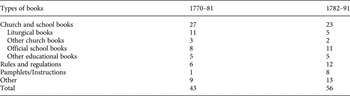
The main aim of his printing shop was to provide necessary church books and textbooks, and when we look at the overview of its books production (see Table 1), especially during the 1770s, this was precisely what he did.Footnote
28
Church books represented the biggest category of book production during the 1770s. All church book editions were either subsidized by the Illyrische Hofdeputation or were the metropolitans’ private editions. In both cases the metropolitans (or the synod) were the ones who chose the titles to be printed.Footnote
29
How badly supplied churches must have been with even the most basic church books is immediately obvious from one look at the list of books published by Kurzböck during the first decade of production. These consisted primarily of prayer books, psalters, books of hours, and irmologia, the most basic of the liturgical books of the Orthodox Church. Many of these books were printed at the expense of the state and then distributed to poor churches free of charge. Kurzböck considered printing some less basic and more expensive liturgical books, but the demand was too small to make this profitable. Instead, he sold to the metropolitan the books he had imported from Russia to use as templates, to be distributed to churches.Footnote
30
Before I go into greater detail on the book production of Kurzböck's Cyrillic “department,” I should say a little bit about the language (or rather languages) these books were printed in. The church books were always printed in Church Slavonic. The language of the other books was more complex. I always call the language used in correspondence, textbooks, and all other secular books simply Slavonic, although in purely philological terms “Slavonic” does not mean much. For the purposes of this article it best conveys the fact that it was neither vernacular Serbian nor Russian nor Church Slavonic, and not yet slavenoserbskii either. In fact, these books were written in a variety of “languages,” all based on Serbian or Russian versions of Church Slavonic and all with various premises of vernacular Serbian and/or literary Russian.Footnote
31
A contemporary document, written by Teodor Janković-Mirijevski, the school director of the Orthodox schools in the Habsburg lands in the 1770s, identified three different languages used by the Habsburg Serbs: first, Church language (Kirchenmundart), in which church books were written—that is (Russian) Church Slavonic; second, vernacular language (Civil-Sprache), the language of chancellery and correspondence; and third, vulgar language (Gemeine Pöbelsprache), the dialect spoken by peasants and the general population.Footnote
32
Most of the Kurzböck's non-church Cyrillic books were printed in varieties of “Civil-Sprache.”
The profile of Kurzböck's Cyrillic book production changed in the 1780s. Although church books still featured prominently, their number had declined: from 1770 to 1781 fourteen books were printed, as opposed to only seven in the years between 1782 and 1791. The cause for this reduction was a decrease in the demand for the more common church books, as few new churches were being built and even fewer new priests were being ordained.Footnote
33
Once most of the churches and parishes were equipped with the necessary books, the demand suddenly dropped. The list of required church books compiled by Metropolitan Putnik for the Sabor in 1781 shows how much the situation had changed. The psalter was not even on the list, while books like the prayer book or the Book of Hours were only on the lower part of the list. The books the metropolitan thought were the most necessary, apart from the Bible, were big, expensive books (Menaion, Triodion, Pentecostarion) that were needed in small numbers and which Kurzböck could not make a profit on and was therefore reluctant to print.Footnote
34
The situation with the schoolbooks was slightly different. From the start Kurzböck was asked to print textbooks, especially primers. In fact, the first Cyrillic book he printed was a primer. The demand for schoolbooks increased dramatically when the reform of elementary schools picked up pace with Felbiger's arrival and the proclamation of the Školski ustav, the equivalent of the Allgemeine Schulordnung for Orthodox schools, in 1776.Footnote
35
Felbiger's method required the use of his specific schoolbooks, so all the textbooks and two teachers’ manuals were translated into Slavonic (and Romanian) and printed in Kurzböck's printing shop. Although the school reform started to lose pace after 1782, and fewer new schools were opened, the new generations of schoolchildren still required at least the most basic textbooks. New editions of primers and readers were printed almost every year, which explains the considerable number of textbooks among the books Kurzböck printed during the 1780s.
Kurzböck also printed two editions of regulations compiled during the 1770s, which aimed to regulate and reorganize to an extent the position of the metropolitanate of Karlovci.Footnote
36
His printing shop also published two Orthodox calendars, with a reduced number of non-working feast days.Footnote
37
However, it was an edition of a textbook that was behind the eruption of popular dissatisfaction with Viennese reforms. By association, this led to the growing popular mistrust of Kurzböck's printing shop, causing it to be viewed with increasing suspicion. One textbook that could not be simply translated from German was the catechism. An Orthodox catechism was therefore commissioned and was written by Jovan Rajić and printed in 1776.Footnote
38
However, after the book had already been published, several changes in the text had to be made at the demand of imperial confessor Ignaz Müller. Kurzböck did this by cutting out the pages and pasting in new ones. Although the metropolitan had approved the changes, in the atmosphere of general tension over various reforms, these alterations were seen as an attempt to introduce Catholic teaching into an Orthodox catechism, with Kurzböck as an accomplice in the process. The catechism, along with the new edition of the church calendar, which appeared at the same time and dramatically reduced the number of non-working feast days, was the main trigger behind the violent anti-reform protests that erupted in Vršac in 1777.Footnote
39
The new calendar was eventually accepted, but the general dissatisfaction with the new catechism was so great, that Vienna agreed to withdraw it from use and replace it with a small Russian catechism.Footnote
40
As the tension subsided and people started to accept the reform, suspicion of alterations in Rajić’s catechism also subsided. The second edition was published in 1785 and reintroduced into schools. The book then went through multiple editions and was translated into several languages over the next couple of decades.Footnote
41
However, one could argue that the popular reputation of Kurzböck and his printing shop never fully recovered, at least among the general population.
Despite the dominance of church and schoolbooks, several books were published even in the 1770s which show that Kurzböck's printing shop facilitated a trickle of different types of books among the Habsburg Serbs. The first to appear was Phillipides de Gaya's Josif vtorii, imperator rimski [Joseph II, Roman emperor]. De Gaya was an imperial councillor and a clerk with the Illyrische Hofdeputation. He was involved in the attempts to open a Cyrillic printing shop in the 1760s and sent his own proposal to the empress.Footnote
42
The first years were slow for Kurzböck; when in 1773 it looked like he would not publish a single Cyrillic book that year, de Gaya had his text on Joseph II translated into Slavonic and published as a bilingual German-Slavonic edition.Footnote
43
The book was a panegyric to Joseph, extolling his numerous “corporal” and “spiritual” virtues. He was praised as a ruler who kept up with the spirit of the time, kept his word, and respected the law. He was declared “better than all his ancestors.” The text does not appear to have had a large readership among the Serbs.Footnote
44
Its publication was unfortunately timed—the reforms of Maria Theresa were picking up the pace and the general opinion of the Habsburg rulers was not very high.
Two years later another two “unusual” publications appeared. Both were translations of French literary works, although they were made not using the French originals but German translations. Both books were translated and their publication paid for by Pavle Julinac, one of the few well-educated Serbs of the time, although we know very little about him. He was one of the Serbian students at the Lutheran Gymnasium in Pressburg in the 1750s.Footnote
45
He left for Russia and became an officer in the Russian army. When he published these works he was back in Vienna, as a member of the staff of the Russian embassy. He later became a Russian consul in Naples.Footnote
46
The shorter of the two works, Put k postojaniji slave i istinnom veličestvu [On the lasting glory and true greatness] (Vienna, 1775) was a translation of a work written by a French pedagogue, Charles Rollin. Rollin published the essay, Sur le gout de la solide gloire, et de la veritable grandeur, as part of a larger work, Traité des Études (published in Paris between 1726–28).Footnote
47
Traité is primarily a manual that explains the method of teaching and studying belles lettres. Julinac, however, chose to translate only the part that explained how to live a good and righteous life, and proceeded to give practical advice on decorating the house, managing the servants, clothes, table manners, and so on. The aim was to provide the small but growing Serbian professional (middle) class with a guide to the ways of polite society.Footnote
48
The second book, Velizarij, was a translation of Bélisaire, a didactic and educational novel by a minor French writer, Jean François Marmontel. It was published as Julinac's private edition in 1776. The choice of the book might seem unusual, as at that time no work of French Enlightenment had been translated into Slavonic. One would expect that if one was going to put the effort into translating the first French literary work, it would be a work by Rousseau or Voltaire. However, his choice was not random. Marmontel's novel was one of the “current” popular books of the reading public in Vienna. The novel itself was a modest work about the life of a soldier, Bélisaire, under the Byzantine emperor Justinian. However, in chapter fifteen, the protagonist speaks strongly and openly in favor of religious tolerance. Because of this chapter, the theological faculty in Paris condemned the novel when it was first published in 1767. This action provoked a flow of pamphlets by Voltaire and Turgot in Marmontel's defense, which led to a serious confrontation between the philosophes and the church, and ultimately to much greater international fame than the novel's literary qualities merited.Footnote
49
The German translation of Bélisaire was published in Vienna in 1768 and met with strong protests from Cardinal Migazzi.Footnote
50
However, not only was the book not banned, but a Latin edition appeared in 1772, and three years later another German translation. It was most probably this edition that prompted Julinac to translate the book into Slavonic. Although Julinac's translation was not very good, Velizarij became quite popular among the Serbs and was recommended reading in the Serbian Gymnasium in Karlovci the 1800s. It was adapted and published as a play in 1832, while fifteen years later it was reprinted in Belgrade, this time translated into vernacular Serbian.Footnote
51
These three works were an exception among the Cyrillic books printed by Kurzböck during the 1770s. But the situation began slowly to change in the early 1780s. Although church and schoolbooks were still being published, a larger proportion of Kurzböck's output consisted of books or printed works of different genres. Surprisingly, Joseph II's relaxation of the censorship did not have a noticeable effect on Kurzböck's Cyrillic book production. Not only did opponents of Joseph II's regime use the proclaimed freedom of the press, Joseph himself also used it very effectively to publish materials in support of his ideas and reforms; the Cyrillic printing shop, however, was not used for these purposes.Footnote
52
Of the more than a thousand “political” pamphlets that were published during Joseph's reign, only one was translated into Slavonic.Footnote
53
This is not to say that the nature of Joseph II's reign, when a large number of regulations and instructions were issued, was not felt. What I called “pamphlets” in my overview of the publications were precisely these types of publications: short works that either regulated various aspects of life or were meant to educate people on how to do things more efficiently and therefore improve their standard of living. Although only a few of these booklets were translated from German, they still formed a noticeable part of Kurzböck's Cyrillic book production. Many of them were just laws regulating trade with Hungary and Transylvania (Uvjedomljenije [Vienna, 1782]), the use of gold currency (Uredba o zlatnom novcu [Vienna, 1786]), marriage laws (Bračnoje uzakonjenije [Vienna, 1786]), or laws for beggars (Zakon o skitnicama [Vienna, 1788]). Much more interesting are the regulations by which the state tried to educate the people. Some of them dealt with strictly economic matters (e.g., sowing tobacco—Nastavljenije za sjejatelje duvana kraljevstv Mažarske i Galicije [Vienna, 1790]), while some discussed what seemed like ecclesiastical matters such as confession or the duties of parish priests (Kratkoje poučenije o ispovjedi [Vienna, 1787]; Kratkoje nastavljenije duhovnim otcem [Vienna, 1787]; Kratka nauka protoprezviterom o ih dolžnosjeh [Vienna, 1787]). It is difficult to say how much of an impact these publications had. I have not been able to find any records of how many copies were printed; often, only one example has survived.Footnote
54
The only Josephinist “political” pamphlet that was translated was Joseph Valentin von Eybel's controversial book Was ist der Papst? The Orthodox Church would not have been unduly worried about the polemics that surrounded the pope's visit to Vienna in 1782. But the main argument of the booklet, that the pope had no more power than any other bishop, was appealing to the Orthodox Christians and served their purposes rather well. The booklet first appeared among the Serbs in the original German in 1783, when Zaharija Orfelin moved to Karlovci and brought his copy of the book from Vienna. He died a few months later, and his library, including Eybel's book, were incorporated into the metropolitans’ library.Footnote
55
However, the book was also translated into Slavonic, by Mihailo Maksimović, a clerk at the quarantine administration in Zemlin (Zemun) and published by Kurzböck in 1784. Maksimović most likely did not know about the copy of Eybel's book in the metropolitans’ library, and would have acquired the original either from one of the travelers through Zemun, or on one of his numerous business travels to Vienna. Although the book was apparently very popular among the Serbs at the time, only a few copies have been preserved.Footnote
56
The most important development during the second decade of Kurzböck's Cyrillic printing shop was the appearance of the first (original) works in Slavonic that more or less directly reflected and openly supported Josephinist reforms. They stayed well within the framework of Serbian society, and did not comment on or engage with the administrative or political aspects of Josephinist reforms. Joseph II's issues and power struggle with the Catholic Church also remained outside the scope of interest of this group of Serbian “enlightened” writers. They concentrated on the reforms that promoted a rational approach to religion, and dismissed traditions they perceived as harmful and unnecessary for true faith.
The most cautious, though not the earliest, steps in this direction were two books compiled by Antonije Vezilić. Vezilić was a teacher at the Latin and German school in Karlovci and later inspector for Serbian schools in the district of Grosswardein. Towards the end of his life he considered becoming a monk, and came to live in Rakovac, one of the monasteries on Fruška Gora. He appears, however, to have died before he could take monastic vows.Footnote
57
His first work, Kratkoje sočinjenije o privatnih i publičnih djela (Vienna, 1785), is a manual that provides templates for private and business correspondence, invoices, bills, contracts, and the like. At the end of the book he published several short literary works, one of which is an ode in praise of the enlightened reign of Joseph II. He compares Joseph II with “wise Augustus, the pride of all Romans,” and especially admires his efforts to suppress superstition and “disperse the darkness of old ages.”Footnote
58
His second book is a literary work, Kratkoje napisanije o spokojnoj žizni [A short introduction to peaceful life] (Vienna, 1788), written for Serbian youth. In short verse Vezilić gives advice on topics such as how to live a righteous life, how to get to know oneself, or how to resist anger, jealousy, vanity, and other sins. In the second part of the work he praises various well-known Serbs—military and civilian figures, clergy, and members of the church hierarchy.Footnote
59
The work was written in a pious tone, although it still shows glimmers of the opinions of the person who was an admirer of Joseph II. The whole chapter is dedicated to dealing with popular beliefs and religious practices. Vezilić energetically attacked all forms of superstition and magic. He even went a step further and reprimanded all who brought Christianity down to the level of meaningless customs and superstition.Footnote
60
Even stronger examples of the “local” support for Josephinist policies were the works of Jovan Muškatirović. Muškatirović was the first Serbian lawyer in Hungary, who practiced first in Novi Sad but later moved to Pest, where he became a senator.Footnote
61
He was also the official legal representative of the metropolitanate of Karlovci and a friend of metropolitans Vićentije Jovanović-Vidak and Mojsije Putnik.Footnote
62
He published several short works, but his Kratkoje razmišljenije o prazdnici [A short essay on feast days] (Vienna, 1787), which appeared in the mid-1780s, is especially interesting.Footnote
63
It was written not only to promote Josephinist ideas, but also in a direct defense of one of Joseph's policies—the third reduction in the number of non-working feast days in the Orthodox calendar, sanctioned by the synod in 1786. Muškatirović uses arguments typical of Josephinist reformers, turning to the practices of the early church, and rejecting all unnecessary rituals. The book gives a short history of the development of feast days and points out that the extensive celebration of feast days was not an essential part of Christianity. He indicated that they were not ordered by Christ or mentioned in the Bible, but were later additions: harmful customs and the result of ignorance and superstition. The Protestant rulers had been the first to realize that, but other rulers had done the same. Peter the Great had also reduced the number of feast days to seventeen in 1723, and so had Joseph II for the Catholic Church. The synod of the metropolitanate of Karlovci was therefore only following what most of the Christian world had already done. Muškatirović did not ask for the complete abolition of religious practices, but for moderation and a return to the values essential to the Christian faith.
Zaharija Orfelin's works published by Kurzböck took a somewhat different approach, though they were still very much in the spirit of Joseph II's policies. Orfelin was a well-known Serbian man of letters, though information about his life remains somewhat obscure.Footnote
64
We know little about his early life, but judging by the books he possessed in the 1750s, when he was in his twenties, Orfelin was fairly well-educated and had some literary ambitions. He spent his life between various centers of the Habsburg Serbs (Vukovar, Karlovci, Temeswar, Novi Sad), Venice, and Vienna, working mostly as a teacher or a clerk in bishops’ offices. In 1783, towards the end of his life, he spent a year as a proofreader for Cyrillic books at Kurzböck's printing shop. He was a prolific writer, but is now possibly best known for his biography of Peter the Great.Footnote
65
His last two works were published at Kurzböck's and, more than his previous books, were written explicitly with the idea to inform and educate.
The first, Vječnii kalendar [A perpetual calendar] (Vienna, 1783) is an unusual combination of a church calendar and a short introduction to modern science. The book follows the format of a traditional church calendar and starts with a calendar of feast days. It also contains a chronology of events from the Old and New Testament, a short history of the early church, and a very short history of the Serbs. It finishes with contemplations about the end of the world and a prayer. Between these conventional parts, Orfelin also included in the book a list of all the universities in Europe.Footnote
66
However, the middle part of the book, O sostojaniju mira [On the substance of the universe], shatters any illusions that this was just another church calendar. In the introduction Orfelin had observed that people, out of natural curiosity, wanted to know about the phenomena in the world around them (clouds, winds, air, fog, etc.), and that there are many benefits to be gained from understanding nature. In the middle part of his work he attempted to answer some of these questions by giving rational scientific explanations of space, planets, Earth, and various aspects of life on Earth (seasons, climate, weather, natural world, etc.). This part of Orfelin's book was not entirely original. He based it heavily on a textbook of natural science written by Adam Daniel Richter, rector of the gymnasium in Zittau.Footnote
67
For Serbian society, which still looked at the world exclusively through the perspective of theology, this was a completely new view of the world.
Orfelin's second work published at Kurzböck's was of a more practical nature. Iskusni podrumar [Experienced cellarer] (Vienna, 1783) is a manual for tending vineyards and making wine. It provides detailed advice on everything from how to select the right type of grapes to grow, to how to organize cellars, make barrels, and even make artificial wine. At the end, it gives an overview of herbs and aromatic plants that might be used in cooking or as medicine. It is fairly certain that this work was also not entirely Orfelin's original work, but thus far his source remains unknown.Footnote
68
Both of Orfelin's late works remained fairly popular. Vječnii kalendar went through another two editions (1789 and 1817), while Iskusni podrumar was being reprinted well into the nineteenth century (it had at least four more editions: 1808, 1817, 1874, and 1885).Footnote
69
****
Kurzböck had originally been given privileges for the printing shop for only twenty years. In 1783 he managed to extend them for another six years.Footnote
70
However, in 1791, mostly due to ill health, he decided to sell the printing shop to Stefan Novaković, the Serbian agent in Vienna.Footnote
71
Together with the printing shop Novaković also acquired all the printed books that had not been sold. He inherited Kurzböck's imperial privileges, which were extended for a further fifteen years. However, by 1793, after only two years, Novaković was already heavily in debt. He then tried to reorganize the printing shop into a cooperative. Despite initial enthusiasm among Serbian merchants, this enterprise was not a success, and he finally sold the printing shop to the University of Pest in 1795.Footnote
72
Kurzböck's printing shop was from the start viewed with some suspicion, in the first place because it was operating from Vienna. Kurzböck also made unfortunate mistakes in some of the first books he printed (e.g., he printed the metropolitan's coat of arms on the Uniate version of the Paschal Tables), which further increased popular suspicion. The printing shop was seen as closely tied to the unpopular Josephinist reforms and major new ideas of the (Austrian) Enlightenment. The main blow to his standing, however, was the episode with Rajić’s Catechism in 1776/77. With time, the attitudes towards the printing shop relaxed as part of the general acceptance of the Josephinist reforms. The growing class of Serbian professionals saw the printing shop as an opportunity, the source of necessary schoolbooks and a medium through which works of the Enlightenment could be made available to a Serbian audience.
For all its shortcomings, in the long run Kurzböck's Cyrillic printing shop made an enormous difference to the Serbs. After decades when the only books available were a few imported from either Venice or Russia, almost a hundred new titles in twenty years made a big difference. However, it remains to be said that the most important Serbian man of letters and supporter of Joseph II's reforms, Dositej Obradović, published his most important works not at Kurzböck's shop but in Leipzig at the Breitkopf printing shop. And although without him no story of the “Serbian Enlightenment” can be complete, I hope I have been able to show that Kurzböck's printing shop played a significant role in bringing some of the ideas of the Austrian Enlightenment closer to the Serbian-speaking population of the Habsburg lands.





 You have
Access
This is an ambitious title. Not only does it assume that there was such a thing as an (Austrian) Enlightenment among Austria's Serbs, but also that Joseph Kurzböck's Cyrillic printing shop played a role in its dissemination. I do not want to claim too much for Kurzböck and his printing shop. Its Cyrillic department was a small and short-lived enterprise. It existed for merely twenty years and in that time produced around a hundred titles (see Table 1). However, it provided the Habsburg Serbs for the first time with direct access to a Cyrillic printing shop. Thus, I would like to explore here how the printing shop was founded, with what goals, and what the roles were of both Vienna and the Serbian higher clergy in its operation. Against that background the second part of the article will examine how and to what extent Kurzböck's printing shop provided, on the one hand, a channel for a top-down (from Vienna to the Serbs) dissemination of the ideas of the Enlightenment, and, on the other hand, a “voice” for rare “Enlightened” individuals among the Serbs.
Cyrillic books published by Kurzböck, 1770–91
The Serbs had had no regular access to a Cyrillic printing shop since the end of the fifteenth century. During the following two centuries, books were published in the printing shop of the Vuković brothers in Venice and in a few short-lived monastic printing shops in Bosnia and western Serbia. Apart from the scarcity of books, this also meant that exclusively theological and liturgical works were printed. During the first seven decades of the eighteenth century, before Kurzböck's Cyrillic printing shop opened, the Habsburg Serbs relied mostly on books imported from Russia or a few books they had printed in Rimnik, Wallachia, although this satisfied only the demand for the most basic church and schoolbooks.Footnote 1 During the 1760s and the 1770s a few non-liturgical books were also printed in Venice and in Breitkopf's printing shop in Leipzig.Footnote 2 Reliance on imported books meant not only irregular and inadequate access to books, but also presented a serious economic problem, as large sums of money were taken out of the country to pay for the books, while at the same time the prices that had to be paid for the books were enormous.Footnote 3 An additional problem was that the book trade was a perfect opportunity for the increase of Russian influence, while the prevalence of Russian liturgical books meant that in the 1760s most Orthodox Christians were celebrating not Habsburg but Russian rulers during their services simply because their names were printed in the books.Footnote 4 Vienna viewed this with growing dissatisfaction but could not stop it completely. Bans were placed on importing Russian books (1729 and 1751), but this was not a satisfactory solution. As the Orthodox needed the books, the bans only resulted in the increase of smuggling and therefore were never fully enforced.
This situation was equally unsatisfactory from the point of view of the Orthodox bishops, who especially wanted easier access to basic textbooks and liturgical books. Thus, in 1750, barely a year after his election as metropolitan, Pavle Nenadović wrote to the Illyrische Hofdeputation asking for permission to open a Cyrillic printing shop. His main reason for this request was economical, namely that “Alljärl(ich) eine nicht geringe Summa Gelt, Theils in das [sic] Türckey, gröste theils aber nach Russland zu erkauffung der benöthigen Kirch- und Schuhl-Büchern, hinaus geschleppet wird.”Footnote 5 The metropolitan was granted permission to open a printing shop in the Rakovac monastery on Fruška Gora, and during 1752 he made inquiries about the costs, workers, and materials necessary for running the printing shops both in Vienna and Wallachia, and even requested information indirectly from some printers in Nuremberg. In the end, however, he gave up on the idea and the printing shop was never opened.Footnote 6 Most likely the metropolitan realized that it would be very difficult financially to support a Cyrillic printing shop.Footnote 7
By the 1760s the growing demand for Cyrillic books and the prospect of what looked like a profitable enterprise repeatedly attracted travelling printers. During the following decade, several Temeswar merchants proposed starting a printing shop, but all of them needed significant state subsidies, and Vienna was reluctant to give permission, let alone funds, for such risky schemes.Footnote 8 However, in the late 1760s, Vienna was preparing to embark on significant reforms of the Orthodox metropolitanate of Karlovci. Some of the envisaged reforms, especially elementary school reform, and the reduction of the number of feast days, necessitated having access to a Cyrillic printing shop. Thus, at the suggestion of the Banat administration, it was decided that state itself should sponsor the opening of a Cyrillic printing shop. Two of the most prominent Viennese printers—Thomas Edler von Trattner and Joseph Kurzböck—were approached and asked to give proposals for such a printing shop. Kurzböck offered better conditions, as he was ready to open the printing shop at his own expense and was able to promise to print the first books within a year at acceptable prices.Footnote 9 The offer was accepted by the Illyrische Hofdeputation and forwarded to Empress Maria Theresa, who on 31 January 1770 issued Privilegium impressorium privatum, which granted Kurzböck both permission to open a Cyrillic printing shop and the status of privileged imperial Cyrillic printer.Footnote 10 The privileges were officially handed over to Kurzböck on 14 February 1770, while the Orthodox metropolitan Georgijević was informed that the printing shop had been founded only a couple of weeks later. The privileges were issued for twenty years, and they granted Kurzböck exclusive rights to print Cyrillic books, both Orthodox and Greek Catholic, and to import such Cyrillic books as were needed but that he was unable to print himself. At the same time, any other import of Cyrillic books was strictly forbidden. The Illyrische Hofdeputation and the Bücher Censur Commission were responsible for finding proofreaders and censors.Footnote 11
After receiving the printing privileges Kurzböck quickly sorted out the technical side of the job: He bought a new house in the suburbs of Vienna, equipped it with six new printing presses, and had several sets of Cyrillic letters made. The Illyrische Hofdeputation turned to van Swieten for advice on the selection of a proofreader, and in March 1770 he appointed Sava Lazarević, the interpreter for Serbian and Romanian at the Illyrische Hofdeputation.Footnote 12 In other matters, however, the Illyrische Hofdeputation sought advice from Metropolitan Georgijević, who was asked to suggest the books to be printed and how they should be distributed, as well as who should censor Orthodox books.Footnote 13 The question of the books was quickly resolved. In May 1770, the metropolitan suggested that the first books to be published ought to be the Zbornik [General prayer book], the psalter, and a primer. Four months later these books were almost finished, and were to be distributed through a network of Serbian merchants from Temeswar, Szeged, and Novi Sad.Footnote 14
The question of a censor was a much bigger challenge for both the Illyrische Hofdeputation and the metropolitan. Cyrillic books were not included on the list of prohibited books, but were censored separately, through the Illyrische Hofdeputation. The censor for the Orthodox books was therefore to be attached to the deputation and was also to be the chaplain at the Orthodox Chapel of St. George in Vienna. The deputation first asked Metropolitan Georgijević for a censor in February 1770. It took more than six months and three more demands before he finally replied.Footnote 15 The long delay was due not to the metropolitan's unwillingness to find a censor, but to the problems he encountered in finding a suitable person. The only person the metropolitan considered sufficiently educated for the job was Jovan Rajić, at that time a schoolmaster in the clerical school in Novi Sad.Footnote 16 The metropolitan contacted him immediately and spent the next several months in correspondence with Rajić, trying to persuade him by all possible means, from threats to offers of money, to accept the job.Footnote 17 Rajić rejected the offer on the grounds of his poor health, and remained firm in his decision.Footnote 18 What is clear from the correspondence is that the metropolitan was fully supportive of the new printing shop, but that he could also envisage that there might be popular suspicions towards it. He therefore thought that it was important to get someone of Rajić’s reputation to accept the post of censor. As he could not persuade Rajić the metropolitan had to suggest a different candidate, Petar Kuzmanović, a priest from Temeswar. Fr. Petar was sufficiently educated for the job; however, at that time he was under investigation for spreading accusations against his bishop, Vićentije Jovanović Vidak. He was therefore deemed unsuitable for the job.Footnote 19
By this time the lack of an Orthodox censor was becoming a serious problem. Kurzböck had already printed material for the three suggested books, but the books could not be finished until a censor was appointed. In this situation Count Koller decided to choose a person himself, and appointed Fr. Ignat Mihajlović, the current chaplain of St. George's Orthodox Chapel in Vienna, as the censor for Cyrillic books.Footnote 20 Metropolitan Georgijević accepted the appointment almost with relief, writing that it had greatly reduced his worries that he would have to punish all of his clergy before being able to find a proper and willing candidate for this position. His only concern was that the priest was not sufficiently well-qualified for such a position.Footnote 21 Count Koller must have had similar doubts about Fr. Ignat's qualifications, because, before he contacted Metropolitan Georgijević, he had asked Adam Kollar, the curator of the Imperial Library, to examine Fr. Ignat on his ability to work as a censor. Kollar's report was positive, and after the metropolitan's approval, Mihajlović was appointed censor on 14 December 1770.Footnote 22
Mihajlović remained the censor for less than a year. On 4 December 1771, Metropolitan Georgijević was informed that Mihajlović’s moral conduct was unacceptable (a policeman caught him committing adultery), and the deputation asked that he be withdrawn from both his position as a censor and his role as a priest in St. George's Chapel.Footnote 23 After several months the metropolitan came up with a suggestion for a new censor: Atanasije Demetrović Sekereš. He was an Orthodox priest in Győr, and, according to Metropolitan Georgijević’s letter, knew “Illyrisch, Griechisch, Lateinisch, Ungarisch und Deutsch.”Footnote 24 Sekereš was an obvious choice, for he was learned and conscientious, and it was probably only his inclination towards Catholicism that had prevented the metropolitan from mentioning him as a potential candidate in 1770. That also must have been the reason why in 1775 Metropolitan Vidak suddenly decided to withdraw Sekereš from Vienna and make him an archimandrite and a councillor at the metropolitan's church court, even though he had no other censor in mind.Footnote 25 Sekereš seems to have accepted the metropolitan's decision and was preparing to come to Karlovci, but Count Koller strongly opposed it. The metropolitan must have given in to Koller's opposition in the end, as Sekereš remained in Vienna. He converted to Catholicism in 1776, but despite this remained in the post of censor for Cyrillic books until his death in 1794.Footnote 26
Book Production
As we have seen, Kurzböck's Cyrillic printing shop was a state-sponsored enterprise, with a monopoly on printing all Cyrillic books but also on import of all such books. Both Vienna and the Orthodox bishops retained a strong interest in its work and remained highly engaged in book production. The printing shop was opened to provide the publications necessary for the imminent state reforms, and that was precisely what Kurzböck did during the first decade of the operation of its Cyrillic “department.” In popular opinion Kurzböck and his printing shop were associated with the state reforms, and as the reforms were in general received with suspicion and discontent, these feelings were transferred to the printing shop.
Joseph II's reign saw a surprising reduction of reform activity in the metropolitanate of Karlovci. The emperor finished some of the reforms started by Maria Theresa and introduced a few of his own, but on the whole, the 1780s were a period of relative calm in the metropolitanate.Footnote 27 As the pressure from the state for reform decreased and the introduced reforms started to take hold towards the end of the 1770s the attitude to Kurzböck's printing shop also started to change. At the same time the positive effects of the reforms became visible: there were more schools and more literate people among the Serbs. With that the number of active supporters of Josephinist reforms also grew (although it remained small). All of these changes were reflected to a certain degree in the book production of Kurzböck's Cyrillic printing shop.
The main aim of his printing shop was to provide necessary church books and textbooks, and when we look at the overview of its books production (see Table 1), especially during the 1770s, this was precisely what he did.Footnote 28
Church books represented the biggest category of book production during the 1770s. All church book editions were either subsidized by the Illyrische Hofdeputation or were the metropolitans’ private editions. In both cases the metropolitans (or the synod) were the ones who chose the titles to be printed.Footnote 29 How badly supplied churches must have been with even the most basic church books is immediately obvious from one look at the list of books published by Kurzböck during the first decade of production. These consisted primarily of prayer books, psalters, books of hours, and irmologia, the most basic of the liturgical books of the Orthodox Church. Many of these books were printed at the expense of the state and then distributed to poor churches free of charge. Kurzböck considered printing some less basic and more expensive liturgical books, but the demand was too small to make this profitable. Instead, he sold to the metropolitan the books he had imported from Russia to use as templates, to be distributed to churches.Footnote 30
Before I go into greater detail on the book production of Kurzböck's Cyrillic “department,” I should say a little bit about the language (or rather languages) these books were printed in. The church books were always printed in Church Slavonic. The language of the other books was more complex. I always call the language used in correspondence, textbooks, and all other secular books simply Slavonic, although in purely philological terms “Slavonic” does not mean much. For the purposes of this article it best conveys the fact that it was neither vernacular Serbian nor Russian nor Church Slavonic, and not yet slavenoserbskii either. In fact, these books were written in a variety of “languages,” all based on Serbian or Russian versions of Church Slavonic and all with various premises of vernacular Serbian and/or literary Russian.Footnote 31 A contemporary document, written by Teodor Janković-Mirijevski, the school director of the Orthodox schools in the Habsburg lands in the 1770s, identified three different languages used by the Habsburg Serbs: first, Church language (Kirchenmundart), in which church books were written—that is (Russian) Church Slavonic; second, vernacular language (Civil-Sprache), the language of chancellery and correspondence; and third, vulgar language (Gemeine Pöbelsprache), the dialect spoken by peasants and the general population.Footnote 32 Most of the Kurzböck's non-church Cyrillic books were printed in varieties of “Civil-Sprache.”
The profile of Kurzböck's Cyrillic book production changed in the 1780s. Although church books still featured prominently, their number had declined: from 1770 to 1781 fourteen books were printed, as opposed to only seven in the years between 1782 and 1791. The cause for this reduction was a decrease in the demand for the more common church books, as few new churches were being built and even fewer new priests were being ordained.Footnote 33 Once most of the churches and parishes were equipped with the necessary books, the demand suddenly dropped. The list of required church books compiled by Metropolitan Putnik for the Sabor in 1781 shows how much the situation had changed. The psalter was not even on the list, while books like the prayer book or the Book of Hours were only on the lower part of the list. The books the metropolitan thought were the most necessary, apart from the Bible, were big, expensive books (Menaion, Triodion, Pentecostarion) that were needed in small numbers and which Kurzböck could not make a profit on and was therefore reluctant to print.Footnote 34
The situation with the schoolbooks was slightly different. From the start Kurzböck was asked to print textbooks, especially primers. In fact, the first Cyrillic book he printed was a primer. The demand for schoolbooks increased dramatically when the reform of elementary schools picked up pace with Felbiger's arrival and the proclamation of the Školski ustav, the equivalent of the Allgemeine Schulordnung for Orthodox schools, in 1776.Footnote 35 Felbiger's method required the use of his specific schoolbooks, so all the textbooks and two teachers’ manuals were translated into Slavonic (and Romanian) and printed in Kurzböck's printing shop. Although the school reform started to lose pace after 1782, and fewer new schools were opened, the new generations of schoolchildren still required at least the most basic textbooks. New editions of primers and readers were printed almost every year, which explains the considerable number of textbooks among the books Kurzböck printed during the 1780s.
Kurzböck also printed two editions of regulations compiled during the 1770s, which aimed to regulate and reorganize to an extent the position of the metropolitanate of Karlovci.Footnote 36 His printing shop also published two Orthodox calendars, with a reduced number of non-working feast days.Footnote 37 However, it was an edition of a textbook that was behind the eruption of popular dissatisfaction with Viennese reforms. By association, this led to the growing popular mistrust of Kurzböck's printing shop, causing it to be viewed with increasing suspicion. One textbook that could not be simply translated from German was the catechism. An Orthodox catechism was therefore commissioned and was written by Jovan Rajić and printed in 1776.Footnote 38 However, after the book had already been published, several changes in the text had to be made at the demand of imperial confessor Ignaz Müller. Kurzböck did this by cutting out the pages and pasting in new ones. Although the metropolitan had approved the changes, in the atmosphere of general tension over various reforms, these alterations were seen as an attempt to introduce Catholic teaching into an Orthodox catechism, with Kurzböck as an accomplice in the process. The catechism, along with the new edition of the church calendar, which appeared at the same time and dramatically reduced the number of non-working feast days, was the main trigger behind the violent anti-reform protests that erupted in Vršac in 1777.Footnote 39 The new calendar was eventually accepted, but the general dissatisfaction with the new catechism was so great, that Vienna agreed to withdraw it from use and replace it with a small Russian catechism.Footnote 40 As the tension subsided and people started to accept the reform, suspicion of alterations in Rajić’s catechism also subsided. The second edition was published in 1785 and reintroduced into schools. The book then went through multiple editions and was translated into several languages over the next couple of decades.Footnote 41 However, one could argue that the popular reputation of Kurzböck and his printing shop never fully recovered, at least among the general population.
Despite the dominance of church and schoolbooks, several books were published even in the 1770s which show that Kurzböck's printing shop facilitated a trickle of different types of books among the Habsburg Serbs. The first to appear was Phillipides de Gaya's Josif vtorii, imperator rimski [Joseph II, Roman emperor]. De Gaya was an imperial councillor and a clerk with the Illyrische Hofdeputation. He was involved in the attempts to open a Cyrillic printing shop in the 1760s and sent his own proposal to the empress.Footnote 42 The first years were slow for Kurzböck; when in 1773 it looked like he would not publish a single Cyrillic book that year, de Gaya had his text on Joseph II translated into Slavonic and published as a bilingual German-Slavonic edition.Footnote 43 The book was a panegyric to Joseph, extolling his numerous “corporal” and “spiritual” virtues. He was praised as a ruler who kept up with the spirit of the time, kept his word, and respected the law. He was declared “better than all his ancestors.” The text does not appear to have had a large readership among the Serbs.Footnote 44 Its publication was unfortunately timed—the reforms of Maria Theresa were picking up the pace and the general opinion of the Habsburg rulers was not very high.
Two years later another two “unusual” publications appeared. Both were translations of French literary works, although they were made not using the French originals but German translations. Both books were translated and their publication paid for by Pavle Julinac, one of the few well-educated Serbs of the time, although we know very little about him. He was one of the Serbian students at the Lutheran Gymnasium in Pressburg in the 1750s.Footnote 45 He left for Russia and became an officer in the Russian army. When he published these works he was back in Vienna, as a member of the staff of the Russian embassy. He later became a Russian consul in Naples.Footnote 46 The shorter of the two works, Put k postojaniji slave i istinnom veličestvu [On the lasting glory and true greatness] (Vienna, 1775) was a translation of a work written by a French pedagogue, Charles Rollin. Rollin published the essay, Sur le gout de la solide gloire, et de la veritable grandeur, as part of a larger work, Traité des Études (published in Paris between 1726–28).Footnote 47 Traité is primarily a manual that explains the method of teaching and studying belles lettres. Julinac, however, chose to translate only the part that explained how to live a good and righteous life, and proceeded to give practical advice on decorating the house, managing the servants, clothes, table manners, and so on. The aim was to provide the small but growing Serbian professional (middle) class with a guide to the ways of polite society.Footnote 48
The second book, Velizarij, was a translation of Bélisaire, a didactic and educational novel by a minor French writer, Jean François Marmontel. It was published as Julinac's private edition in 1776. The choice of the book might seem unusual, as at that time no work of French Enlightenment had been translated into Slavonic. One would expect that if one was going to put the effort into translating the first French literary work, it would be a work by Rousseau or Voltaire. However, his choice was not random. Marmontel's novel was one of the “current” popular books of the reading public in Vienna. The novel itself was a modest work about the life of a soldier, Bélisaire, under the Byzantine emperor Justinian. However, in chapter fifteen, the protagonist speaks strongly and openly in favor of religious tolerance. Because of this chapter, the theological faculty in Paris condemned the novel when it was first published in 1767. This action provoked a flow of pamphlets by Voltaire and Turgot in Marmontel's defense, which led to a serious confrontation between the philosophes and the church, and ultimately to much greater international fame than the novel's literary qualities merited.Footnote 49 The German translation of Bélisaire was published in Vienna in 1768 and met with strong protests from Cardinal Migazzi.Footnote 50 However, not only was the book not banned, but a Latin edition appeared in 1772, and three years later another German translation. It was most probably this edition that prompted Julinac to translate the book into Slavonic. Although Julinac's translation was not very good, Velizarij became quite popular among the Serbs and was recommended reading in the Serbian Gymnasium in Karlovci the 1800s. It was adapted and published as a play in 1832, while fifteen years later it was reprinted in Belgrade, this time translated into vernacular Serbian.Footnote 51
These three works were an exception among the Cyrillic books printed by Kurzböck during the 1770s. But the situation began slowly to change in the early 1780s. Although church and schoolbooks were still being published, a larger proportion of Kurzböck's output consisted of books or printed works of different genres. Surprisingly, Joseph II's relaxation of the censorship did not have a noticeable effect on Kurzböck's Cyrillic book production. Not only did opponents of Joseph II's regime use the proclaimed freedom of the press, Joseph himself also used it very effectively to publish materials in support of his ideas and reforms; the Cyrillic printing shop, however, was not used for these purposes.Footnote 52 Of the more than a thousand “political” pamphlets that were published during Joseph's reign, only one was translated into Slavonic.Footnote 53 This is not to say that the nature of Joseph II's reign, when a large number of regulations and instructions were issued, was not felt. What I called “pamphlets” in my overview of the publications were precisely these types of publications: short works that either regulated various aspects of life or were meant to educate people on how to do things more efficiently and therefore improve their standard of living. Although only a few of these booklets were translated from German, they still formed a noticeable part of Kurzböck's Cyrillic book production. Many of them were just laws regulating trade with Hungary and Transylvania (Uvjedomljenije [Vienna, 1782]), the use of gold currency (Uredba o zlatnom novcu [Vienna, 1786]), marriage laws (Bračnoje uzakonjenije [Vienna, 1786]), or laws for beggars (Zakon o skitnicama [Vienna, 1788]). Much more interesting are the regulations by which the state tried to educate the people. Some of them dealt with strictly economic matters (e.g., sowing tobacco—Nastavljenije za sjejatelje duvana kraljevstv Mažarske i Galicije [Vienna, 1790]), while some discussed what seemed like ecclesiastical matters such as confession or the duties of parish priests (Kratkoje poučenije o ispovjedi [Vienna, 1787]; Kratkoje nastavljenije duhovnim otcem [Vienna, 1787]; Kratka nauka protoprezviterom o ih dolžnosjeh [Vienna, 1787]). It is difficult to say how much of an impact these publications had. I have not been able to find any records of how many copies were printed; often, only one example has survived.Footnote 54
The only Josephinist “political” pamphlet that was translated was Joseph Valentin von Eybel's controversial book Was ist der Papst? The Orthodox Church would not have been unduly worried about the polemics that surrounded the pope's visit to Vienna in 1782. But the main argument of the booklet, that the pope had no more power than any other bishop, was appealing to the Orthodox Christians and served their purposes rather well. The booklet first appeared among the Serbs in the original German in 1783, when Zaharija Orfelin moved to Karlovci and brought his copy of the book from Vienna. He died a few months later, and his library, including Eybel's book, were incorporated into the metropolitans’ library.Footnote 55 However, the book was also translated into Slavonic, by Mihailo Maksimović, a clerk at the quarantine administration in Zemlin (Zemun) and published by Kurzböck in 1784. Maksimović most likely did not know about the copy of Eybel's book in the metropolitans’ library, and would have acquired the original either from one of the travelers through Zemun, or on one of his numerous business travels to Vienna. Although the book was apparently very popular among the Serbs at the time, only a few copies have been preserved.Footnote 56
The most important development during the second decade of Kurzböck's Cyrillic printing shop was the appearance of the first (original) works in Slavonic that more or less directly reflected and openly supported Josephinist reforms. They stayed well within the framework of Serbian society, and did not comment on or engage with the administrative or political aspects of Josephinist reforms. Joseph II's issues and power struggle with the Catholic Church also remained outside the scope of interest of this group of Serbian “enlightened” writers. They concentrated on the reforms that promoted a rational approach to religion, and dismissed traditions they perceived as harmful and unnecessary for true faith.
The most cautious, though not the earliest, steps in this direction were two books compiled by Antonije Vezilić. Vezilić was a teacher at the Latin and German school in Karlovci and later inspector for Serbian schools in the district of Grosswardein. Towards the end of his life he considered becoming a monk, and came to live in Rakovac, one of the monasteries on Fruška Gora. He appears, however, to have died before he could take monastic vows.Footnote 57 His first work, Kratkoje sočinjenije o privatnih i publičnih djela (Vienna, 1785), is a manual that provides templates for private and business correspondence, invoices, bills, contracts, and the like. At the end of the book he published several short literary works, one of which is an ode in praise of the enlightened reign of Joseph II. He compares Joseph II with “wise Augustus, the pride of all Romans,” and especially admires his efforts to suppress superstition and “disperse the darkness of old ages.”Footnote 58 His second book is a literary work, Kratkoje napisanije o spokojnoj žizni [A short introduction to peaceful life] (Vienna, 1788), written for Serbian youth. In short verse Vezilić gives advice on topics such as how to live a righteous life, how to get to know oneself, or how to resist anger, jealousy, vanity, and other sins. In the second part of the work he praises various well-known Serbs—military and civilian figures, clergy, and members of the church hierarchy.Footnote 59 The work was written in a pious tone, although it still shows glimmers of the opinions of the person who was an admirer of Joseph II. The whole chapter is dedicated to dealing with popular beliefs and religious practices. Vezilić energetically attacked all forms of superstition and magic. He even went a step further and reprimanded all who brought Christianity down to the level of meaningless customs and superstition.Footnote 60
Even stronger examples of the “local” support for Josephinist policies were the works of Jovan Muškatirović. Muškatirović was the first Serbian lawyer in Hungary, who practiced first in Novi Sad but later moved to Pest, where he became a senator.Footnote 61 He was also the official legal representative of the metropolitanate of Karlovci and a friend of metropolitans Vićentije Jovanović-Vidak and Mojsije Putnik.Footnote 62 He published several short works, but his Kratkoje razmišljenije o prazdnici [A short essay on feast days] (Vienna, 1787), which appeared in the mid-1780s, is especially interesting.Footnote 63 It was written not only to promote Josephinist ideas, but also in a direct defense of one of Joseph's policies—the third reduction in the number of non-working feast days in the Orthodox calendar, sanctioned by the synod in 1786. Muškatirović uses arguments typical of Josephinist reformers, turning to the practices of the early church, and rejecting all unnecessary rituals. The book gives a short history of the development of feast days and points out that the extensive celebration of feast days was not an essential part of Christianity. He indicated that they were not ordered by Christ or mentioned in the Bible, but were later additions: harmful customs and the result of ignorance and superstition. The Protestant rulers had been the first to realize that, but other rulers had done the same. Peter the Great had also reduced the number of feast days to seventeen in 1723, and so had Joseph II for the Catholic Church. The synod of the metropolitanate of Karlovci was therefore only following what most of the Christian world had already done. Muškatirović did not ask for the complete abolition of religious practices, but for moderation and a return to the values essential to the Christian faith.
Zaharija Orfelin's works published by Kurzböck took a somewhat different approach, though they were still very much in the spirit of Joseph II's policies. Orfelin was a well-known Serbian man of letters, though information about his life remains somewhat obscure.Footnote 64 We know little about his early life, but judging by the books he possessed in the 1750s, when he was in his twenties, Orfelin was fairly well-educated and had some literary ambitions. He spent his life between various centers of the Habsburg Serbs (Vukovar, Karlovci, Temeswar, Novi Sad), Venice, and Vienna, working mostly as a teacher or a clerk in bishops’ offices. In 1783, towards the end of his life, he spent a year as a proofreader for Cyrillic books at Kurzböck's printing shop. He was a prolific writer, but is now possibly best known for his biography of Peter the Great.Footnote 65 His last two works were published at Kurzböck's and, more than his previous books, were written explicitly with the idea to inform and educate.
The first, Vječnii kalendar [A perpetual calendar] (Vienna, 1783) is an unusual combination of a church calendar and a short introduction to modern science. The book follows the format of a traditional church calendar and starts with a calendar of feast days. It also contains a chronology of events from the Old and New Testament, a short history of the early church, and a very short history of the Serbs. It finishes with contemplations about the end of the world and a prayer. Between these conventional parts, Orfelin also included in the book a list of all the universities in Europe.Footnote 66 However, the middle part of the book, O sostojaniju mira [On the substance of the universe], shatters any illusions that this was just another church calendar. In the introduction Orfelin had observed that people, out of natural curiosity, wanted to know about the phenomena in the world around them (clouds, winds, air, fog, etc.), and that there are many benefits to be gained from understanding nature. In the middle part of his work he attempted to answer some of these questions by giving rational scientific explanations of space, planets, Earth, and various aspects of life on Earth (seasons, climate, weather, natural world, etc.). This part of Orfelin's book was not entirely original. He based it heavily on a textbook of natural science written by Adam Daniel Richter, rector of the gymnasium in Zittau.Footnote 67 For Serbian society, which still looked at the world exclusively through the perspective of theology, this was a completely new view of the world.
Orfelin's second work published at Kurzböck's was of a more practical nature. Iskusni podrumar [Experienced cellarer] (Vienna, 1783) is a manual for tending vineyards and making wine. It provides detailed advice on everything from how to select the right type of grapes to grow, to how to organize cellars, make barrels, and even make artificial wine. At the end, it gives an overview of herbs and aromatic plants that might be used in cooking or as medicine. It is fairly certain that this work was also not entirely Orfelin's original work, but thus far his source remains unknown.Footnote 68 Both of Orfelin's late works remained fairly popular. Vječnii kalendar went through another two editions (1789 and 1817), while Iskusni podrumar was being reprinted well into the nineteenth century (it had at least four more editions: 1808, 1817, 1874, and 1885).Footnote 69
****
Kurzböck had originally been given privileges for the printing shop for only twenty years. In 1783 he managed to extend them for another six years.Footnote 70 However, in 1791, mostly due to ill health, he decided to sell the printing shop to Stefan Novaković, the Serbian agent in Vienna.Footnote 71 Together with the printing shop Novaković also acquired all the printed books that had not been sold. He inherited Kurzböck's imperial privileges, which were extended for a further fifteen years. However, by 1793, after only two years, Novaković was already heavily in debt. He then tried to reorganize the printing shop into a cooperative. Despite initial enthusiasm among Serbian merchants, this enterprise was not a success, and he finally sold the printing shop to the University of Pest in 1795.Footnote 72
Kurzböck's printing shop was from the start viewed with some suspicion, in the first place because it was operating from Vienna. Kurzböck also made unfortunate mistakes in some of the first books he printed (e.g., he printed the metropolitan's coat of arms on the Uniate version of the Paschal Tables), which further increased popular suspicion. The printing shop was seen as closely tied to the unpopular Josephinist reforms and major new ideas of the (Austrian) Enlightenment. The main blow to his standing, however, was the episode with Rajić’s Catechism in 1776/77. With time, the attitudes towards the printing shop relaxed as part of the general acceptance of the Josephinist reforms. The growing class of Serbian professionals saw the printing shop as an opportunity, the source of necessary schoolbooks and a medium through which works of the Enlightenment could be made available to a Serbian audience.
For all its shortcomings, in the long run Kurzböck's Cyrillic printing shop made an enormous difference to the Serbs. After decades when the only books available were a few imported from either Venice or Russia, almost a hundred new titles in twenty years made a big difference. However, it remains to be said that the most important Serbian man of letters and supporter of Joseph II's reforms, Dositej Obradović, published his most important works not at Kurzböck's shop but in Leipzig at the Breitkopf printing shop. And although without him no story of the “Serbian Enlightenment” can be complete, I hope I have been able to show that Kurzböck's printing shop played a significant role in bringing some of the ideas of the Austrian Enlightenment closer to the Serbian-speaking population of the Habsburg lands.