Introduction
Recent estimates indicate that more than 7 million people living in the United States have died during the COVID-19 pandemic, most of whom (87.7%) died of causes other than COVID-19 (Ahmad et al. Reference Ahmad, Cisewski and Anderson2022). Based on this figure, an estimated 63 million people were left to grieve the loss of their family member or close friend (Verdery et al. Reference Verdery, Smith-Greenaway and Margolis2020). The COVID-19 pandemic has impacted the grieving process and accompanying social experiences (e.g., funerals) for bereaved individuals (Breen et al. Reference Breen, Mancini and Lee2022; Neimeyer and Lee Reference Neimeyer and Lee2022). Changes in the grieving process during the COVID-19 pandemic have partially been due to public health recommendations/mandates, such as physical distancing and stay-at-home orders, which have resulted in individuals being unable to engage in typical end-of-life proceedings, such as providing proper bedside care or burials for the person who has died (Eisma et al. Reference Eisma, Boelen and Lenferink2020; Neimeyer and Lee Reference Neimeyer and Lee2022; Wallace et al. Reference Wallace, Wladkowski and Gibson2020). Numerous studies (Breen et al. Reference Breen, Mancini and Lee2022; Neimeyer and Lee Reference Neimeyer and Lee2022; Singer et al. Reference Singer, Spiegel and Papa2020) have highlighted various factors (e.g., increased isolation, feeling guilty about not being able to be there for the deceased, and lack of social support) that might help to explain bereavement outcomes for people who have lost someone during the COVID-19 pandemic.
Research has shown that, even though losing a loved one can be a highly stressful experience, most individuals are resilient following a loss (Bonanno Reference Bonanno2004; Lundorff et al. Reference Lundorff, Holmgren and Zachariae2017). Yet, a minority of bereaved individuals experience persistent grief symptoms, which can become increasingly debilitating over time (Lundorff et al. Reference Lundorff, Bonanno and Johannsen2020; Prigerson et al. Reference Prigerson, Horowitz and Jacobs2009), and may lead to prolonged grief disorder (PGD). Defined as an intense yearning for a deceased close person and a preoccupation with thoughts or memories of the deceased, PGD was recently (March 2022) added to the Diagnostic and Statistical Manual of Mental Disorders, Fifth Edition, Text Revision (DSM-5-TR) and has been shown to affect 4–9.8% of individuals (American Psychiatric Association 2022; Aoun et al. Reference Aoun, Breen and Howting2015; Kersting et al. Reference Kersting, Brahler and Glaesmer2011; Nielsen et al. Reference Nielsen, Neergaard and Jensen2017). The large range has been postulated to be due to circumstances of the death and environmental influence (Lundorff et al. Reference Lundorff, Holmgren and Zachariae2017). Furthermore, studies have highlighted that risk and protective factors of PGD can differ drastically depending on various contextual variables (Shear et al. Reference Shear, Ghesquiere and Glickman2013; Singer et al. Reference Singer, McLean and Kahler2022).
Studies have evaluated how the circumstances of a death can affect the bereavement process of those left to grieve. For example, individuals bereaved due to a sudden and unexpected death have reported significantly higher rates of prolonged or complicated grief (Currier et al. Reference Currier, Holland and Neimeyer2006; Kaplow et al. Reference Kaplow, Howell and Layne2014). Using a narrative-constructivist perspective, Currier et al. posit that these traumatic losses complicate the bereavement process by preventing the grieving individuals from processing the significance of the death itself (Currier et al. Reference Currier, Neimeyer and Berman2008). Violent causes of death (e.g., homicide) are also associated with negative bereavement outcomes, including a greater risk for prolonged grief symptoms, compared to natural causes of death (e.g., stroke and heart attack; Currier et al. Reference Currier, Neimeyer and Berman2008; Rozalski et al. Reference Rozalski, Holland and Neimeyer2017). Additionally, other factors, such as the relationship between the deceased (e.g., loss of a primary attachment figure and loss of a child) and the bereaved and the age of the deceased, may impact bereavement outcomes. For example, parents of children who have died are at an increased risk of suicide following the loss (Agerbo Reference Agerbo2005; Qin and Mortensen Reference Qin and Mortensen2003; Rozalski et al. Reference Rozalski, Holland and Neimeyer2017; Stroebe et al. Reference Stroebe, Schut and Stroebe2007).
Given the evidence of how circumstances of the death may impact bereavement outcomes (Currier et al. Reference Currier, Holland and Neimeyer2006), it is vital that researchers and clinicians consider how deaths in the context of the COVID-19 pandemic may uniquely impact grief. Recent studies (Lee and Neimeyer Reference Lee and Neimeyer2022; Neimeyer and Lee Reference Neimeyer and Lee2022) aimed to identify and measure unique risk and protective factors for maladaptive grief within the context of the pandemic (i.e., generalized anxiety, depression, and functional impairment). However, studies have yet to examine these risk factors for PGD in bereaved individuals who lost someone during the COVID-19 pandemic, limiting our understanding of whether the same factors may translate to PGD risk during these unprecedented times. The current study aimed to address this gap in the literature and evaluate these pandemic-specific risk factors in relation to PGD using the DSM-5-TR criteria (American Psychiatric Association 2022) in bereaved individuals during the pandemic. Other lines of research have examined the prevalence of PGD during the COVID-19 pandemic, yielding equivocal findings. First, Eisma et al. (Reference Eisma, Tamminga and Smid2021) compared bereaved individuals who lost someone to COVID-19 (n = 49) compared to unnatural (e.g., accident, suicide, and homicide; n = 210) and natural (n = 1182) death during the COVID-19 pandemic. Findings indicated that people who lost a family member to COVID-19 reported higher levels of PGD than those who lost a family member due to natural causes; however, there was no difference in PGD levels between those bereaved by COVID-19 and those bereaved due to unnatural causes (Eisma et al. Reference Eisma, Tamminga and Smid2021). Second, Breen et al. (Reference Breen, Mancini and Lee2022) compared 3 types of losses (i.e., COVID-19, natural causes, and violent causes) and found no significant differences in rates of PGD between the groups. Despite these mixed findings, the results of both studies provide evidence that changes in circumstances (e.g., secondary stressors and social isolation) due to the COVID-19 pandemic resulted in higher rates of PGD than those found in past studies (Breen et al. Reference Breen, Mancini and Lee2022; Eisma et al. Reference Eisma, Tamminga and Smid2021; Gang et al. Reference Gang, Falzarano and She2022).
Nascent literature indicates that higher rates of PGD during the COVID-19 pandemic may be due to circumstances of the death and environmental factors following the loss (Breen et al. Reference Breen, Mancini and Lee2022; Eisma et al. Reference Eisma, Tamminga and Smid2021), which suggests that there are unique risk and protective factors of PGD in this historical context. To examine this, Lee and Neimeyer (Reference Lee and Neimeyer2022) evaluated 831 adults who lost a loved one to COVID-19 to identify risk and protective factors for PGD that were unique to this population. Some of the risk factors specific to the pandemic included “feeling upset about not being able to say goodbye to the deceased properly” and “feeling alone in grief because of public health protections to control the pandemic.” Utilizing these risk factors, the authors developed a 10-item scale, which they named the Pandemic Grief Risk Factors (PGRF) scale. The PGRF measure has been validated in previous research (e.g., Breen et al. Reference Breen, Mancini and Lee2022; Lee and Neimeyer Reference Lee and Neimeyer2022; Neimeyer and Lee Reference Neimeyer and Lee2022) and more recently in a Spanish sample (Caycho-Rodríguez et al. Reference Caycho-Rodríguez, Lee and Vilca2022). Though, given the novelty of the measure and the recency of the pandemic, clinical cutoffs have not yet been defined. However, the measure does allow clinicians to monitor for elevated rates of these risk factors. Studies to date have not examined the relationship between the PGRF scale and rates of PGD, specifically, in bereaved individuals who experienced loss during the COVID-19 pandemic. Therefore, this study aimed to examine whether the specific risk factors on the PGRF scale significantly correlated with higher rates of PGD in a sample of young adults who have lost someone during the COVID-19 pandemic.
Young adults, more specifically undergraduate students, confronted unique challenges in relation to the pandemic. Due to stay-at-home orders, students were forced to return home or to isolate in their dormitory and started remote learning in the middle of the semester (Liu et al. Reference Liu, Pinder-Amaker and Hahm2022), which resulted in social isolation. Social isolation has been found to be a robust risk factor for PGD (e.g., Benkel et al. Reference Benkel, Wijk and Molander2009; Utz et al. Reference Utz, Swenson and Caserta2014), so students who lost a loved one during the pandemic and were then forced into a situation of social isolation and lower social support could be hypothesized to experience higher rates of PGD. More specifically, Utz et al. (Reference Utz, Swenson and Caserta2014) found that social support, especially social support from close family or friends, is vital for adaptive bereavement. Thus, we hypothesized that these students were at higher risk for PGD, and due to the impact on student life during COVID-19, we believe there are unique pandemic risk factors for PGD.
While PGD is hardly the only negative bereavement outcome that may be a result of losing a close person during the pandemic, the current study aimed to focus on PGD as it has recently been added to the DSM-5-TR (American Psychiatric Association 2022) and ICD-11. Furthermore, there have been recent calls to action to investigate PGD across cultural and sociodemographic factors (e.g., Prigerson et al. Reference Prigerson, Boelen and Xu2021a), which extends to an undergraduate population during the COVID-19 pandemic. Therefore, the current study answers this call and provides critical information to evaluate the risk of this new diagnosis in the context of the COVID-19 pandemic.
Methods
Participants
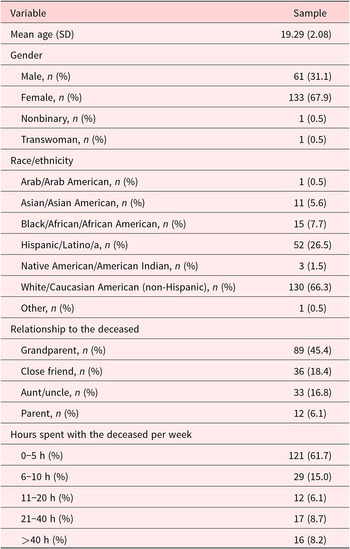
Full descriptive statistics are noted in Table 1. The study sample comprised 196 (M age = 19.29, SDage = 2.08) young adults who reported having a close person die during the COVID-19 pandemic. The inclusion criteria were as follows: (1) experience of a loss of someone close (e.g., friend and family member) in the last 2 years (since March 2020) and (2) the death occurred at least 1 year from the date of the survey (i.e., before January 2021). The 1-year cutoff is used for diagnosing PGD in the DSM-5-TR (Prigerson et al. Reference Prigerson, Boelen and Xu2021a). Most participants reported being a woman (cisgender: n = 133, 67.9%; transgender: n = 1, 0.5%) and White (n = 118, 59.6%). One participant identified as nonbinary (0.5%). The majority of participants reported losing a grandparent (n = 89, 45.9%), but other losses included those of a close friend (n = 35; 17.7%), aunt/uncle (n = 33; 16.7%), or a parent (n = 12; 6.1%). Most participants reported they had seen the deceased 0–5 h a week before they died (n = 121; 61.1%), with fewer reporting seeing the deceased 6–10 h a week (n = 30; 15.2%) and 21–40 h a week (n = 17; 8.6%).
Sample descriptive statistics (N = 196)

Procedure
The survey was completed online between January 2022 and February 2022. Participants were undergraduate students recruited through a SONA pool of a southern university in the United States. After consent was acquired electronically, participants were redirected to an online (Qualtrics) survey to complete study measures. Upon completion of the survey, participants were provided information about local mental health resources and were granted a class credit for their participation.
Measures
PGD symptoms
To measure PGD symptoms, we used the PGD-12 Questionnaire (PGD-12, previously known as the PG-13-R; Prigerson et al. Reference Prigerson, Kakarala and Gang2021b), which was modified to correspond with the PGD criteria per the DSM-5-TR (American Psychiatric Association 2022). The primary difference between the 2 measures is that the loss had to occur a year prior, compared to 6 months prior as on the PG-13-R. We first used the PGD-12 as a continuous measure by summing the symptom items (range 10–50) and excluding the duration (i.e., length of time since the death; this was an exclusion criterion for the study) and functional impairment items. This scoring approach has been found to have good reliability and validity in past studies (a = .83–.95; Prigerson et al. Reference Prigerson, Horowitz and Jacobs2009; Singer et al. Reference Singer, McLean and Kahler2022). The continuous measure had good internal consistency in this study (a = .95). Participants had a mean score of 22.87 (SD = 10.0). We also used the full PGD criteria that are used in the DSM-5-TR and found that 18 (9.1%) of participants met the diagnostic criteria, which is similar to other studies examining PGD (American Psychiatric Association 2022; Aoun et al. Reference Aoun, Breen and Howting2015; Kersting et al. Reference Kersting, Brahler and Glaesmer2011; Nielsen et al. Reference Nielsen, Neergaard and Jensen2017; Prigerson et al. Reference Prigerson, Kakarala and Gang2021b; Singer et al. Reference Singer, McLean and Kahler2022).
Pandemic grief risk factors
Pandemic grief risk factors were measured using the 10-item PGRF Questionnaire (Neimeyer and Lee Reference Neimeyer and Lee2022). The PGRF measures circumstantial risk factors that are specific to grief during the COVID-19 pandemic. Some of the items include, “I felt guilty about not being able to be there for the deceased before he/she died” and “I felt that the circumstances of the death created emotional distance between us.” Responses ranged from 0 (not at all) to 3 (nearly every day), with an overall range of 0–30. Higher scores on the measure indicate a higher number of PGRF risk factors. Prior research has found excellent internal consistency (a = .89; Lee and Neimeyer Reference Lee and Neimeyer2022). This study also had excellent internal consistency for the PGRF (a = .88). Participants had a mean score of 5.60 (SD = 6.02) on the PGRF.
Statistical analysis
All analyses were run in RStudio (RStudio Team 2020). Following descriptive statistics, we utilized Pearson’s correlations, chi-squared tests, and Analysis of Variance (ANOVAs) to examine the relationship between possible covariates (i.e., pre-loss contact, race, and gender) and prolonged grief symptom sum score and PGD diagnosis. Only those variables that shared a significant relationship with prolonged grief symptom sum score and/or PGD diagnosis were included in the models to address the primary research question. One participant identified as a transgender woman and, due to the small group size (0.5%), was included in the gender analysis with cisgender women (n = 133, 67.9%). One participant identified as nonbinary (0.5%) and, due to the small group size, was not included in the gender analyses. This participant was included in all other analyses. Pre-loss contact was a categorical variable with 5 categories: 0–5 h of pre-loss contact, 6–10 h of pre-loss contact, 11–20 h of pre-loss contact, 21–40 h of pre-loss contact, and >40 h of pre-loss contact. Due to the small number of participants in each racial category other than White, we dichotomized the race variable for the primary aims of the study into non-White (n = 75; 37.9%) and White (n = 115; 58.1%). Eight participants did not answer the question about their race, so they were removed from the analyses that included race. We then conducted a multiple linear regression analysis using prolonged grief symptom sum score (M = 22.87, SD = 10.0) as the outcome variable, PGRF total scores as the predictor variable (M = 5.60, SD = 6.02), and any covariates that were significant in the above analyses. Lastly, we conducted a multiple logistic regression analysis using PGD diagnosis as the outcome variable, PGRF total scores as the predictor variable, and any covariates that were significant in the above analyses. An a priori power analysis was conducted using G*Power to determine the minimum sample size required to test the study hypothesis. Results indicated the required sample size to achieve 95% power for detecting a small effect (d = .20) at a significance criterion of a = .05 was N = 81. To ensure adequate power for logistic regression, we aimed for 10 events per variable (EPVs). EPV refers to the quotient of the N of the less common option of the dichotomous outcome divided by the number of predictor terms in the model (Hosmer et al. Reference Hosmer, Lemeshow and Sturdivant2013). Researchers recommend a minimum of between 5 (Vittinghoff and McCulloch Reference Vittinghoff and McCulloch2006) and 10 (Bagley et al. Reference Bagley, White and Golomb2001; Peduzzi et al. Reference Peduzzi, Concato and Kemper1996) EPVs for a model to be adequately powered. Our final logistic regression models had 9 EPVs, indicating adequate power.
Results
Pearson’s correlation revealed a significant positive relationship between the amount of pre-loss contact and prolonged grief symptom sum score, r = .399, t(188) = 5.97, p < .001. Additionally, a chi-squared test of independence indicated a significant relationship between pre-loss contact (i.e., hours per week) and PGD diagnosis, χ 2 (4, N = 190) = 31.18, p < .001. We proceeded with pre-loss contact (dummy coded with the 0–5 h category as the reference group) in the regression analyses. Regarding the relationship between race and prolonged grief symptom sum scores, a t-test indicated the non-White group (M = 25.03, SD = 10.55) reported significantly higher prolonged grief symptom scores than the White group (M = 21.44, SD = 9.40), t(188) = 2.41, p = .02. The dichotomized race variable and PGD diagnosis were not significant, χ 2 (1, N = 190) = 1.47, p = .22. We proceeded with the dichotomized racial–ethnic variable for the remainder of the analyses due to the lack of participants in each racial–ethnic category. Gender was unrelated to prolonged grief symptom scores, t(188) = 1.53, p = .13, and PGD diagnosis, χ 2 (1, N = 190) = .17, p = .68.
Pandemic grief risk factors and prolonged grief symptom total score
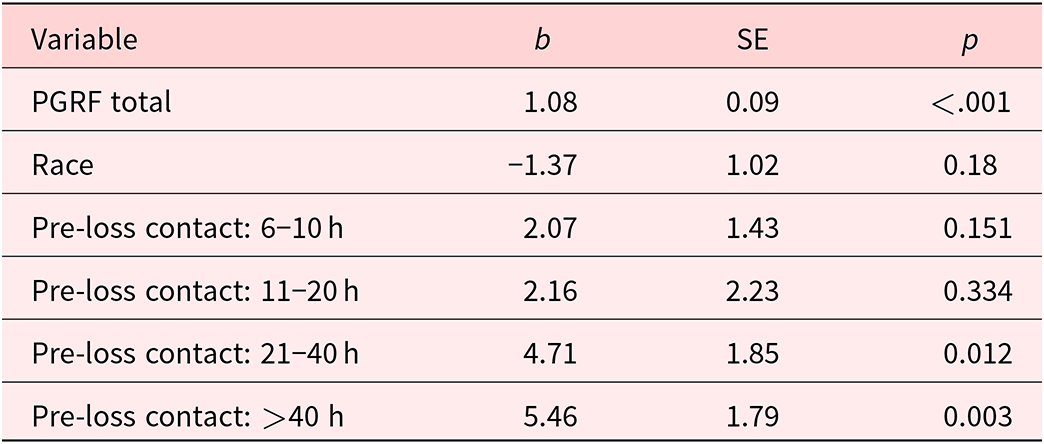
The overall model predicting prolonged grief symptom scores using PGRF total scores, race, and pre-loss contact was significant, F(6,182) = 40.28, p < .001, R 2 = .57 (see Table 2). PGRF total scores explained a significant amount of variance in prolonged grief symptom scores, b = 1.08, t(182) = 12.36, p < .001, ηp 2 = .46. Additionally, the 21–40-h pre-loss contact group, b = 4.71, t(182) = 2.55, p = .01, and the >40-h pre-loss contact group, b = 5.46, t(182) = 3.05, p < .01, reported significantly higher prolonged grief symptom scores than the 0–5-h pre-loss contact group, b = 5.46, t(182) = 3.05, p < .01. Race was not a significant correlation of prolonged grief symptom scores (p = .18).
Results of regression analysis with the greater endorsement of pandemic grief risk factors standardized regression coefficients for linear regression models

Note: R 2 = .57; F = 40.28; PGRF total, Pandemic Grief Risk Factors total score.
Dummy coded with the 0–5 h category as the reference group.
Pandemic grief risk factors and PGD diagnosis
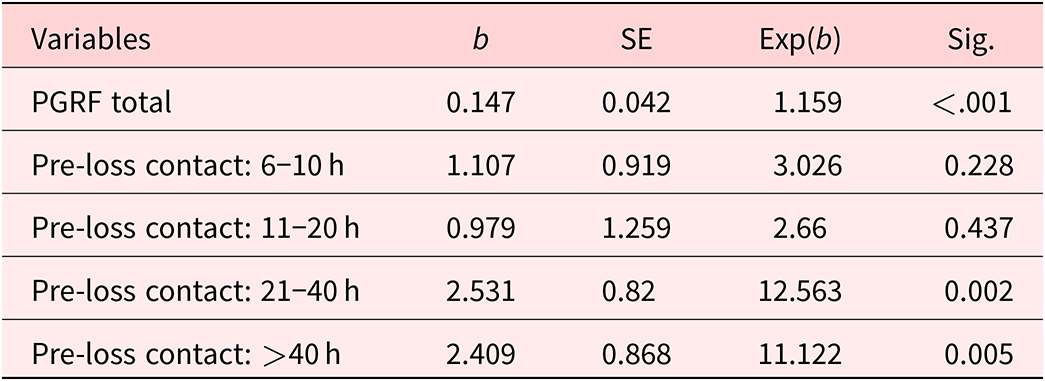
Overall, 18 (9.47%) of the participants met the criteria for PGD. PGRF total score accounted for significant variance in whether participants met the criteria for PGD, b = .15, z = 3.53, p < .001, OR = 1.16. As PGRF total scores increased, participants were more likely to meet the criteria for PGD, when controlling for pre-loss contact. Additionally, the 21–40-h pre-loss group was significantly more likely to meet the criteria for PGD, b = 2.53, z = 3.09, p < .01, OR = 12.56, than the 0–5 h group when controlling for PGRF total scores, b = 2.53, z = 3.09, p < .01, OR = 12.56. The >40-hour group was also significantly more likely to meet the criteria for PGD than the 0–5-h group when controlling for PGRF total scores, b = 2.41, z = 2.78, p < .01, OR = 11.12 (see Table 3 for further details).
Binary logistic regression assessing the greater endorsement of pandemic grief risk factors on prolonged grief disorder

Note: Nagelkerke’s R 2 = .39; PGRF total, Pandemic Grief Risk Factors total score.
Dummy coded with the 0−5-h category as the reference group.
Discussion
The current study aimed to evaluate risk factors for PGD symptoms and diagnostic criteria in a sample of bereaved young adults who lost a person during the COVID-19 pandemic. Findings indicated that more hours spent with the deceased prior to the loss and a greater number of PGRF (e.g., feeling the deceased died alone and feeling they would lose others to the same disease) experienced by the bereaved individual was significantly correlated with greater PGD symptoms and a greater likelihood of meeting the criteria for a PGD diagnosis. These findings add to a growing body of literature examining grief and loss within the unique context of the COVID-19 pandemic and suggest that there may be detrimental long-term psychological outcomes for these bereaved individuals, regardless of the cause of death.
Our finding that a greater amount of pre-loss contact was associated with increased PGD symptoms and an increased likelihood of a PGD diagnosis is in line with previous research (e.g., Prigerson et al. Reference Prigerson, Kakarala and Gang2021b; Singer et al. Reference Singer, McLean and Kahler2022, Reference Singer, Spiegel and Papa2020). Regarding our analysis of time spent with the deceased before their death, it is important to reiterate the time frame of the study. Participants were included if they had lost someone close to them at least 1 year prior to the study, but no more than 2 years prior to the study. Therefore, due to COVID-19 restrictions (e.g., social distancing and visitor restrictions), pre-loss contact may have been different than it would have been prior to the context of the pandemic. It is important to note that it was not known at what point during the pandemic the close person died, so there is no way to know how the quality of time spent together was affected by COVID-19. Depending on the time point, the COVID-19 recommendations and restrictions differed, and each participant could have experienced a unique bereavement experience when grieving the loss of their loved one. However, pre-loss contact still stands as a risk factor for PGD.
When evaluating demographic differences, our findings differed from those of previous literature. While we found non-White participants endorsed more prolonged grief symptoms, given the lack of racial–ethnic diversity in our sample, and the decision to dichotomize the variable based on the small number of participants in each group (see, e.g., McGowan et al. Reference McGowan, Barry and Sonneville2022; Paterno et al. Reference Paterno, Jablonski and Klepacki2019), we are not able to conclude if specific racial–ethnic groups (e.g., Black and Latinx) have more prolonged grief symptoms than other racial–ethnic groups. Had our sample size been larger, we may have been able to see racial–ethnic group differences. Although our sample size was too small to evaluate differences between racial and ethnic groups, it is important to note that prior studies have found a 2.5-fold increased risk of PGD in African Americans as compared to White individuals (Goldsmith et al. Reference Goldsmith, Morrison and Vanderwerker2008). It has also been found that immigrant ethnic minorities, refugees, and groups affected by conflict have endorsed elevated levels or persistent distress following an unnatural loss (Nickerson et al. Reference Nickerson, Liddell and Maccallum2014; Smid et al. Reference Smid, Drogendijk and Knipscheer2018). While COVID-19 proved to be an unprecedented crisis to all, multiple studies (Garcia et al. Reference Garcia, Homan and García2020; Geno Tai et al. Reference Geno Tai, Sia and Doubeni2022; Laurencin et al. Reference Laurencin, Wu and McClinton2021) exemplify the disproportionate impact of the pandemic on the Black and Latinx communities. To highlight a few of these disparities, death rates in these racial and ethnic groups were higher than in White populations (Garcia et al. Reference Garcia, Homan and García2020; Laurencin et al. Reference Laurencin, Wu and McClinton2021), the unemployment rate peaks were 2–4% higher than in White persons (Geno Tai et al. Reference Geno Tai, Sia and Doubeni2022), and school closures disproportionately affected the Black and Latinx parents who face more difficulty accessing affordable childcare (Geno Tai et al. Reference Geno Tai, Sia and Doubeni2022; Lee and Parolin Reference Lee and Parolin2021; Marron Reference Marron2021). Current knowledge on grief and bereavement in racial and ethnic minority groups is unfortunately limited and is an area that needs further development in future studies.
The literature surrounding the variable of gender has shown to be mixed. While early literature has suggested that men suffer greater health consequences in response to bereavement than do women, some more recent literature on PGD has exemplified the opposite. Recent studies have found women to be at a higher risk for developing PGD (Kersting and Kroker Reference Kersting and Kroker2010; Maercker and Lalor Reference Maercker and Lalor2012; Singer et al. Reference Singer, McLean and Kahler2022). It is important to note that, however, some studies have shown conflicting findings. Lundorff et al. (Reference Lundorff, Bonanno and Johannsen2020) conducted a study that compared the variable of gender on 4 PGD trajectories (i.e., resilient characterized by low symptoms, moderate-stable characterized by moderate symptoms, recovery characterized by elevated symptoms showing a decrease over time, and prolonged grief characterized by continuous elevated symptoms). The authors found that men endorsed more baseline symptoms in the prolonged grief trajectory, but women showed higher amounts of symptom increase over time. In the current study, when controlling for PGRF, we found no gender differences in either PGD symptoms or PGD diagnosis. These findings indicate that the COVID-19 pandemic is a unique context during which specific risk factors (PGRF) may better explain PGD outcomes than previously established demographic factors. These findings have important clinical implications as clinicians continue to intervene with and support the psychological functioning of bereaved individuals during these unprecedented times.
These findings expand upon the growing body of literature examining COVID-specific risk factors that are related to deleterious bereavement outcomes. In turn, the PGRF can be employed to identify and screen young adults who are at an increased risk of PGD and could benefit from clinical services in the future, as deemed appropriate. Notably, given our sample comprised young adults who lost a loved one during the COVID-19 pandemic – but not necessarily due to COVID-19 itself – the findings suggest a larger body of individuals than previously assumed may be susceptible to suboptimal bereavement outcomes in response to the unique environmental and societal circumstances in the context of the pandemic. Specifically, individuals who lost a loved one due to causes of death other than COVID-19 still share the same unique PGRF as those individuals who lost a loved one to COVID-19 infection. It also provides evidence that these unique risk factors translate to our understanding of PGD symptom severity and young adults’ likelihood of meeting the criteria for PGD in response to a loss during the COVID-19 pandemic. Furthermore, young adults faced unique challenges during the COVID-19 pandemic, with classes being moved abruptly to an online format and students being made to either isolate to their dormitories or move out of them, which resulted in possible isolation from their family, friends, and peers (Liu et al. Reference Liu, Pinder-Amaker and Hahm2022). These challenges likely contributed to increased symptoms of prolonged grief following the loss of a loved one.
Limitations
There are limitations to note in this study. Our sample consisted of only undergraduate students and might not generalize to other populations (e.g., older adults). The current study also did not ask participants to specify the cause of death of their loved ones. Therefore, we could not assess differences between types of death during the pandemic as a risk factor for PGD. However, it is important to note that some previous research has found no significant differences for individuals who lost someone due to natural causes, violent causes, and COVID-19 during the COVID-19 pandemic (Breen et al. Reference Breen, Mancini and Lee2022), while other studies have shown different patterns. Another limitation is that our data were collected cross-sectionally; thus, conclusions about causality and possible changes in the study relationships over time cannot be made. We also asked individuals to recall their experience following the death of their loved one on the PGRF scale, so responses may have been influenced by recall bias. This study was also limited when it came to participants’ relationship to the deceased, as participants in this study endorsed losing primarily grandparents, close friends, and aunts/uncles, leaving only 6% to endorse losing a parent. The relationship between the deceased and the bereaved is an established risk factor; however, we were unable to examine if the relationship to the deceased was a significant risk factor for PGD due to a small number of participants losing certain people in their life (e.g., parent and child). The next limitation to note is that, by collapsing our racial identities, we were not able to distinguish differences between races. However, due to our small sample size, we had to dichotomize race. A final limitation to note in our study concerns time spent with the deceased before they passed. While this study inquired about the quantity of time bereaved persons spent with their loved ones before their passing, it was beyond the scope of this study to evaluate the quality of this pre-loss contact. Future studies should consider asking participants about the quality of the time they spent with their loved ones before their death (e.g., what valued activities did they engage in together).
Conclusions and future directions
The current study supports that the COVID-19 pandemic created a unique bereavement experience. Findings have important implications for future research and clinical work. First, the previously identified risk factors for suboptimal bereavement outcomes also apply to our identification of risk for PGD symptom severity and PGD diagnosis. Replication of findings in a larger, more diverse sample of relationships to the deceased is warranted and should explore whether various additional demographic factors (e.g., gender and relationship type) may differentiate the risk of PGD, as typically found outside of the COVID-19 pandemic. Second, recognizing these specific risk factors (e.g., feeling upset the deceased was not given a proper funeral or memorial service and worrying they would lose other people they cared for to the same disease) will help to identify individuals at risk for PGD who were left bereaved during any point of the unique environment of the COVID-19 pandemic. While the PGRF is specific to the COVID-19 pandemic, it can be utilized as a guide in future catastrophic events (e.g., war, natural disaster, and another pandemic) in which similar circumstances may be present (e.g., lockdown and separation from friends and family) and may create unique adverse bereavement risks as a result.
Furthermore, existing evidence-based interventions and preventions should be tested and possibly modified to address the identified unique PGRF to better identify and support affected individuals. Routine screening for the risk factors in medical and psychological clinics is warranted to help identify those individuals who could benefit from early intervention. In addition, existing psychological interventions such as behavioral activation (Papa et al. Reference Papa, Rummel and Garrison-Diehn2013) may be useful in helping encourage bereaved individuals to re-establish and/or maintain regular social contact. Notably, these existing interventions may need to be modified during the context of the pandemic (Singer et al. Reference Singer, Spiegel and Papa2020). Examples of modifications could include but are not limited to scheduling virtual contact with others via video conferencing, or having patients attend virtual workout groups to build social support. These opportunities for future research and clinical work are necessary to explore and may ensure this at-risk population is adequately supported during the current pandemic and as society continues to transition to a “new normal.”
Funding
This research received no specific grant from any funding agency, commercial, or not-for-profit sectors.
Conflicts of interest
The authors declare none.
Ethical approval
This study was approved by an institutional review board in the southern United States.