Introduction
The term structural priming refers to the fact that when producing a sentence, speakers tend to re-use structures that they have recently heard (Levelt & Kelter, Reference Levelt and Kelter1982; Bock, Reference Bock1986). Numerous studies have shown that structural priming occurs for many different structures, in many languages, and in a variety of contexts including spontaneous speech, written text, and experiments using several different paradigms (see Branigan, Reference Branigan2007, and Pickering & Ferreira, Reference Pickering and Ferreira2008, for comprehensive reviews).
A key question in psycholinguistic research on multilingualism is the extent to which the two languages of a bilingual individual interact with each other during the processing and production of sentences. The phenomenon of cross-linguistic structural priming has provided substantial insight into this question. Loebell and Bock (Reference Loebell and Bock2003) have shown that structural priming also occurs across languages. In their study, L1 German speakers of L2 English processed a German or English prime sentence that contained either a prepositional object (PO) or a double object (DO), and then had to describe a picture in the other language that could also be described using one of these two structures. The results showed that, despite the fact that prime and target were in different languages, participants were primed by the structure of the preceding prime sentence, producing significantly more PO sentences after PO primes than after DO primes.
A number of subsequent studies have replicated the cross-linguistic structural priming effect for PO/DO prime-target pairs, using a variety of language pairs and experimental paradigms (Meijer & Fox Tree, Reference Meijer and Fox Tree2003; Salamoura & Williams, Reference Salamoura and Williams2006; Bernolet, Hartsuiker & Pickering, Reference Bernolet, Hartsuiker and Pickering2007; Schoonbaert, Hartsuiker & Pickering, Reference Schoonbaert, Hartsuiker and Pickering2007). Further, Kantola and van Gompel (Reference Kantola and van Gompel2011) have shown that structural priming effects across different languages are of a similar magnitude to priming effects within a single language. In addition, cross-linguistic priming effects are not limited to sentences with the PO/DO alternation, but can also occur for other structures. For example, Desmet and Declercq (Reference Desmet and Declercq2006) showed that Dutch temporarily ambiguous relative clause attachment ambiguities, in which the ambiguity was resolved in favor of either high or low attachment, prime either high or low attachment in subsequent ambiguous target sentences in English. Hartsuiker, Pickering and Veldkamp (Reference Hartsuiker, Pickering and Veltkamp2004) found a cross-linguistic priming effect for active/passive sentences, with participants producing significantly more English passive structures after listening to Spanish passive primes than to Spanish active primes.
Cross-linguistic structural priming and constituent order
While it is uncontroversial that cross-linguistic structural priming occurs, researchers have proposed different explanations for it. In their previously mentioned study with English–German bilinguals, Loebell and Bock (Reference Loebell and Bock2003) found cross-linguistic priming between English and German for the PO/DO alternation, but no cross-linguistic priming for active vs. passive sentences. The authors explained this difference on the basis of constituent order, arguing that priming occurs only when the constituent order for both possible structures is the same in the two languages. Thus, priming occurs with PO and DO constructions because each of these constructions takes the same constituent order in English and German (V-Prep-NP1-NP2 for POs; V-NP2-NP1 for DOs). Priming does not occur for active vs. passive sentences, however, because although simple active constructions share the same constituent order in English and German, passive constructions do not. We subsequently refer to this explanation of cross-linguistic structural priming as the constituent order account.
A different explanation for cross-linguistic priming is offered by Hartsuiker and colleagues (Hartsuiker et al., Reference Hartsuiker, Pickering and Veltkamp2004; Hartsuiker & Pickering, Reference Hartsuiker and Pickering2008). According to their account, cross-linguistic structural priming effects are based on the activation of combinatorial nodes for particular structures such as POs or DOs, which are situated at the lemma stratum. For example, the account assumes a PO combinatorial node that is connected to the lemmas of all verbs which can be used as part of a PO structure. Importantly, these combinatorial nodes are not necessarily language-specific. In native German learners of L2 English, for example, the already-existing PO combinatorial node for German can be used for English as well because the structure of English and German POs is the same. It is not necessary for the cognitive system to create an additional, separate combinatorial node for English PO structures.
How does this account explain cross-linguistic structural priming effects? Assume that a human parser comes across a German PO prime sentence that contains the German verb schicken (‘to send’). As a result, the parser activates the lemma schicken and the PO combinatorial node connected to this lemma. Immediately afterwards, the individual is asked to produce an English target sentence containing a ditransitive verb. In principle, either a PO or a DO structure could be used to accomplish this task. However, due to prior processing of the German PO prime sentence, the PO combinatorial node, to which all German and English verbs which can be used with a PO structure are connected, is still activated. This remaining activation makes it more likely that the individual will produce a PO structure when completing the target sentence. We refer to this explanation as the combinatorial node account.
The combinatorial node account offers a different explanation for the lack of a priming effect for active vs. passive sentences in Loebell and Bock's (Reference Loebell and Bock2003) study. Specifically, the account assumes that a particular combinatorial node is only shared between languages if the two languages are similar with regard to the particular constituent order required for a structure. If constituent order differs between languages, as is the case for the German vs. English passive, the lemma stratum contains a separate combinatorial node for each language. Indeed, Hartsuiker et al. (Reference Hartsuiker, Pickering and Veltkamp2004) found structural priming for active vs passive sentences across English and Spanish, a language pair with the same constituent order in each language for both active and passive constructions. Bernolet et al. (Reference Bernolet, Hartsuiker and Pickering2007), in a study using relative clause constructions (e.g., the sheep that is red) vs. adjectival constructions (e.g., the red sheep) as primes, directly compared priming in a language pair with the same constituent order (German and Dutch) to priming in a language pair in which constituent order differs between languages (English and Dutch). They found priming only for the former, but not for the latter.
While the constituent order account and the combinatorial node account both acknowledge the importance of constituent order in cross-linguistic structural priming, they differ with regard to what this role is. Within the constituent order account, constituent order is essentially the driving force behind cross-linguistic priming effects, with the parser repeating a particular constituent order in the target sentence because it was previously activated during processing of the prime sentence. In the combinatorial node account, if a structure closely resembles an already-known structure from the other language, the existing combinatorial node for this structure is shared between languages. Similarity with regard to constituent order influences whether a new combinatorial node is created for this structure and language, or whether an existing combinatorial node is shared between languages. However, the cross-linguistic priming effect itself is considered to be caused by the fact that a combinatorial node is shared, and not by the activation of a particular constituent order during the processing of the prime.
It deserves to be mentioned that while both theoretical accounts assume that constituent order plays an important role in cross-linguistic priming, some studies have come to different conclusions. For example, Shin and Christianson (Reference Shin and Christianson2009), in a cross-linguistic priming study from Korean to English using the PO/DO alternation, found significant priming effects despite the fact that Korean and English differ with regard to head position. In addition, their design also included Korean PO primes with a non-canonical constituent order that is different from that in English. The authors found that these non-canonical PO primes also primed English POs. A similar result occurred in Chen, Jia, Wang, Dunlap and Shin's (Reference Chen, Jia, Wang, Dunlap and Shin2013) study on active-passive priming between English and Chinese, with a significant priming effect despite the fact that the two languages differ with regard to constituent order in passive structures. Finally, in the above-mentioned study by Desmet and Declercq (Reference Desmet and Declercq2006), cross-linguistic priming for high vs. low relative clause attachment occurred between verb-final Dutch and V2 English relative clauses. The results from these studies suggest that cross-linguistic priming might, at least in some cases, also occur when structures differ with regard to constituent order, but are similar on a more abstract level.
The studies described so far have relied on two ways of investigating the role of constituent order in cross-linguistic structural priming. Some studies have investigated two different structures (such as PO/DO vs. active/passive) within one language pair, comparing the priming effect for structure A that shares the same constituent order in the two languages to the priming effect for structure B that requires different constituent orders in the two languages. Other priming studies have focused on one structure across two different language pairs, comparing a structure in languages A and B (in which constituent order for the particular structure is the same) with the same structure in languages A and C (in which constituent order is different). In the current study, we make use of a third option to approach this question. Specifically, we investigate only one structural alternation (in our case, PO vs. DO) within only one language pair, but the PO or DO sometimes shares constituent order across the two languages and sometimes does not. We achieve this by making use of a different source of within-language constituent order difference: the level of embedding in German.
The present study
For within-language priming, particular structural properties of German have been successfully used in the past to investigate the role of constituent order (e.g., Pappert & Pechmann, Reference Pappert and Pechmann2014). In the present study, we examine PO/DO priming from German to English, comparing conditions where constituent order is the same vs. different across the two languages. The experiment makes use of a differential effect of level of embedding across the two languages. In English, constituent order remains the same regardless of level of embedding. In German, in contrast, level of embedding – i.e., whether the PO or DO occurs within a main clause or a subordinate clause – has direct consequences for the constituent order within the clause. Specifically, German is obligatorily verb-final in subordinate clauses, but not in main clauses. Consider the PO structures in German sentences such as (1a) and (1b):
-
(1a) Der Rechtsanwalt schickte den Vertrag an den Klienten.
-
(The lawyer sent the contract to the client.)
-
(1b) Kristin dachte, dass der Rechtsanwalt den Vertrag an den Klienten schickte.
-
(Kristin thought that the lawyer sent the contract to the client.)
Both (1a) and (1b) contain German PO structures which consist of the verb schickte, the preposition an, and the two noun phrases den Klienten and den Vertrag. While both (1a) and (1b) contain the same constituents, their order is different. In (1a), the PO structure occurs within a main clause, and its constituent order is the same as that required for English POs: V-NP1-Prep-NP2. In (1b), the PO structure occurs within a German subordinate clause. Because German subordinate clauses are obligatorily verb-final, the constituent order within the PO structure is NP1-Prep-NP2-V. In other words, the structural context (i.e., the fact that the clause in which the PO structure occurs is a subordinate clause) affects the required constituent order within this PO structure. The same is also the case for DO structures.
In the present study, we make use of this property of German to experimentally manipulate constituent order within a PO or DO prime structure. Specifically, this property allows us to present the same PO or DO prime in two different constituent orders, and to investigate whether this affects cross-linguistic priming. As an example, consider prime/target pairs such as (2a) and (2b):
-
(2a)

-
(2b)


(2a) shows an example of a typical item in a cross-linguistic priming experiment with sentence completion. Participants process a German prime sentence and are subsequently shown an incomplete English target fragment, which they are supposed to complete in a grammatically correct way. One grammatically correct possibility to complete the fragment would be to use a PO structure. However, the fragment can also be completed in a number of other ways, such as with a DO or a monotransitive. If participants are primed by a PO structure in the prime sentence, they should produce relatively more PO completions following prime sentences that contain a PO structure than following otherwise identical prime sentences that contain a DO structure instead.
In (2b), the prime sentence is almost identical to (2a), except for the fact that the PO structure is situated within a subordinate clause. As explained above, because German is verb-final in subordinate clauses, the verb brachte occurs in sentence-final position here. As a result, the position of the verb in the prime sentence differs from the position of the verb in the target fragment. The key question is whether this difference has an influence on the cross-linguistic priming effect.
The PO structures in sentences (2a) and (2b) differ not only with regard to constituent order, but also with regard to level of embedding. In (2a) the PO is part of a main clause, while in (2b) it is embedded in a subordinate clause. This is important because prime/target similarity with regard to level of embedding might also influence priming effects independent of constituent order. Branigan, Pickering, McLean and Stewart (Reference Branigan, Pickering, McLean and Stewart2006) investigated this issue for monolingual within-English priming in a set of eight experiments. Specifically, they compared priming for cases in which prime and target were of the same clause type (i.e., either both main clauses or both subordinate clauses) with otherwise identical cases in which prime and target were of different clause types (i.e., priming from main clause primes to subordinate clause targets, or vice versa). Their results showed that, at least for English, within-language structural priming does not require prime/target similarity with regard to global structural context, and can also occur from main clause primes to subordinate clause targets or vice versa.
Importantly, the constituent order account and the combinatorial node account predict different results with regard to the comparison between priming from German main clause primes to English main clause targets and priming from German subordinate clause primes to English subordinate clause targets. According to the constituent order account, cross-linguistic structural priming is caused by the activation of a particular constituent order. Thus, the account predicts significant cross-linguistic priming from German main clauses to English main clauses (because German and English share the same constituent order for POs and DOs in main clauses), but no priming from German subordinate clauses to English subordinate clauses (because German subordinate clauses are verb final, while English ones are not). In the combinatorial node account, in contrast, priming between German and English is caused by shared combinatorial nodes for English and German. This combinatorial node is assumed to get activated whenever the parser processes a German or English PO or DO structure, irrespective of the global structural context around the PO or DO. Thus, the combinatorial node account predicts significant cross-linguistic priming for both conditions.
Note that in our case, the manipulation of constituent order is of a different nature than in Shin and Christianson's (Reference Shin and Christianson2009) study mentioned above. While their study also manipulated constituent order within the PO prime, their manipulation involved the order of the two NPs within a PO structure. As PO and DO structures are verb-argument structures, the position of the verb relative to its arguments can be considered especially important. Also, Shin and Christianson compared an unmarked PO order with a marked PO order. This may mean that the priming effect for the marked PO order is not entirely structural in nature, but might instead be related to the markedness of the structure. In our study, this is different in the sense that the particular constituent order in which the PO occurs is the only grammatical order in the particular clause type that contains the PO. In this respect, neither of the constituent orders can be considered especially marked relative to the other.
Experiment 1: Method
Participants
Thirty-two students from the University of Kaiserslautern (age range 19–32, mean age = 23, SD=2.8, 13 female) participated in the study for course credit or payment. All participants described themselves as native speakers of German who had acquired English at school as a foreign language, but reported frequent use of L2 English in their everyday lives and studies. Prior to the experiment, all participants completed the LexTALE word recognition test (Meara, Reference Meara1996; Lemhöfer, Dijkstra & Michel, Reference Lemhöfer, Dijkstra and Michel2004) and Part 1 of the grammar section of the Oxford Placement Test (OPT, Allen, Reference Allen2004) as measures of their lexical and syntactic proficiency in L2 English. Only participants with a minimum OPT score of 27 out of 50 were included in the experiment. Participants received an average score of 39.0 out of 50 (SD: 5.2) in the OPT, which corresponds to an average proficiency of C1 (labeled as ‘advanced’ or ‘effective operational proficiency’) on the Common European Framework of Reference for Languages (CEFR). In the LexTale test, participants correctly identified an average of 75% (SD: 12.8) of words across all trials.
Items
Twenty-four sets of prime-target pairs were constructed. Each set consisted of two main clause and two subordinate clause versions of a German prime sentence, such as (3a)–(3d) below.
-
(3a) Der Sohn brachte das Zeugnis zu dem Vater. (main clause, PO prime)
-
(The son brought the school report to the father.)
-
(3b) Der Sohn brachte dem Vater das Zeugnis. (main clause, DO prime)
-
(The son brought the father the school report.)
-
(3c) Die Tante erzählte, dass der Sohn das Zeugnis zu dem Vater brachte. (subclause, PO prime)
-
(The aunt reported that the son brought the school report to the father.)
-
(3d) Die Tante erzählte, dass der Sohn dem Vater das Zeugnis brachte. (subclause, DO prime)
-
(The aunt reported that the son brought the father the school report.)
The main clause primes (3a) and (3b) started with a noun phrase (e.g., Der Sohn) followed by a ditransitive verb (e.g., brachte), and either a prepositional object (e.g., das Zeugnis zu dem Vater in (3a)) or a double object, (dem Vater das Zeugnis in (3b)). In the subordinate clause versions (3c) and (3d), the sentences were introduced by a short main clause consisting of a noun phrase (e.g., Die Tante) and a main verb (e.g., erzählte); the remainder of the sentence was identical to the corresponding main clause versions, except for the fact that due to German being verb-final in subordinate clauses, the verb was located at the end of the subordinate clause.
Each of the four primes was followed by an English target sentence such as (4a) or (4b).
-
(4a) The man brought _____. (target following main clause primes)
-
(4b) Marion guessed that the man brought _____. (target following subordinate clause primes)
The English target fragments following main clause primes always consisted of a noun phrase (e.g., the man) followed by a verb (e.g., brought). All English verbs used in the target fragments were translation equivalents of the German verbs used in the preceding prime sentence. Target fragments following subordinate clause primes were identical to target fragments following main clause primes in the sense that they contained the same noun phrase and verb as their main clause counterparts, but were preceded by a short main clause consisting of a noun (e.g., Marion), a verb (e.g., guessed) and a subordinate conjunction (e.g., that), turning the clause that contained the blank into a subordinate clause. This was done to control for prime/target similarity with regard to level of embedding: for all prime-target combinations, the blank to be filled in the target fragment was situated on the same level of embedding as the PO/DO in the preceding prime sentence.
Design
We constructed four different presentation lists, with each list comprising 24 prime-target pairs, six from each of the four conditions. Each of the four versions of each item was assigned to one of the four lists on the basis of a Latin-square design. Forty-eight filler items were added; each filler item consisted of a complete German pseudo-prime sentence followed by an English pseudo-target sentence fragment. Fillers were of a similar length as the experimental items, but consisted of a variety of different syntactic structures. Each participant was randomly assigned to one of the four lists and tested on this list only, ensuring that each participant saw only one of the four versions of each item.
Procedure
Participants were tested in a quiet lab room. Prior to the actual experiment, all subjects completed the OPT and word recognition test mentioned earlier, as well as a short questionnaire about basic biographic information including their language history. During the experiment, all sentences were presented on a 17-inch computer screen using the DMDX experiment software (Forster & Forster, Reference Forster and Forster2003). Participants were informed that they would see a number of German and English sentences or incomplete sentence fragments on the computer screen. They were instructed to read all sentences aloud as soon as they appeared on the computer screen, and to complete any incomplete sentences in a grammatically correct way as spontaneously as possible.
Experiment 1: Results
Scoring
Participants’ completions were recorded and transcribed. Two scorers scored the completions as either ‘prepositional object’, ’double object’, ‘other grammatically correct’, or ‘incomplete/ungrammatical’. Locatives and completions containing phrasal verbs were scored as ‘other grammatically correct’ completions. Cases in which the participant changed any of the words already contained in the fragment were scored as ‘incomplete/ungrammatical’.
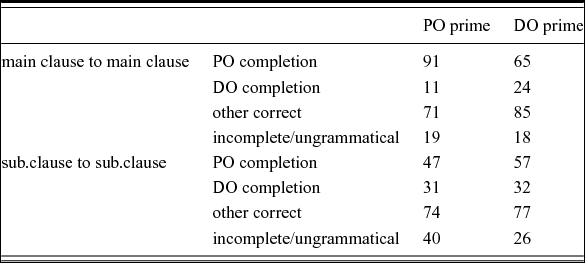
Table 1 shows the number of ‘PO’, ‘DO’, ‘other grammatically correct’, and ‘incomplete/ungrammatical’ completions separately for each condition.
Frequencies of completions by conditions in Experiment 1

The high number of ‘other grammatically correct’ completions is presumably due to the fact that the target fragments were L2 sentences, causing participants to often prefer simple completions such as monotransitives. Also, unlike for experimental tasks such as picture description, in which participants are almost forced to produce a form of ditransitive structure, participants are considerably freer with regard to the structure they choose in a sentence completion task.
As in the majority of previous cross-linguistic priming studies, we conducted inferential analyses on the basis of all trials with PO and DO completions, excluding data points with ‘other’ responses. Jaeger (Reference Jaeger2008) argues that this can potentially lead to spurious interactions. However, with regard to all analyses presented below, complementary analyses in which the ‘other’ responses were not excluded (i.e., with models predicting ‘PO completion vs. non-PO completion’ instead of ‘PO completion vs. DO completion’) show the same pattern of effects, suggesting that this is not an issue in the current study.
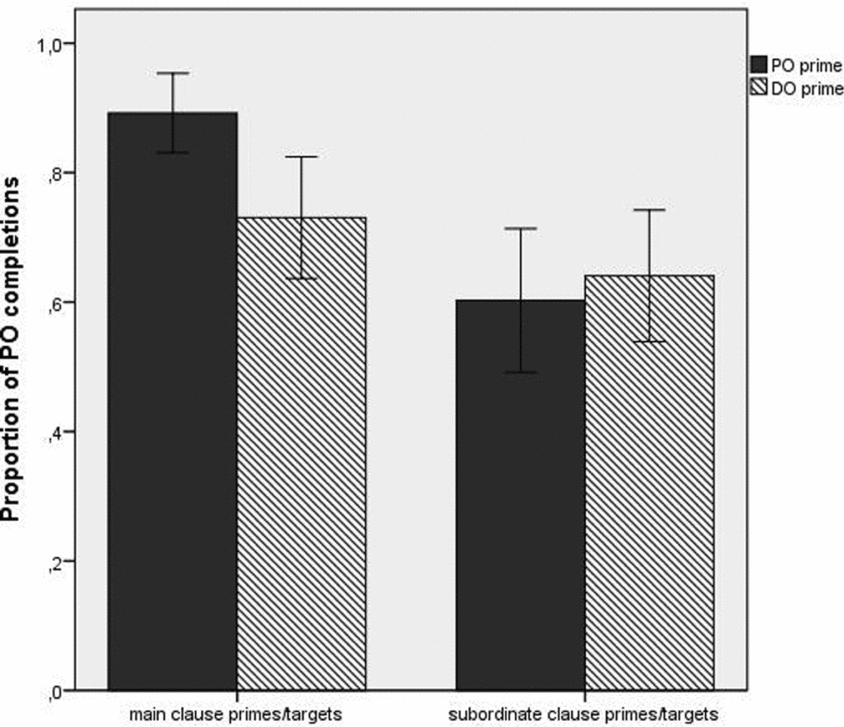
Figure 1 shows the frequencies of PO completions relative to the sum of all PO and DO completions by prime type and clause type.
Mean proportion of PO completions by condition in Experiment 1. Error bars represent 95% confidence intervals.

Completions
As ANOVAs are inappropriate for the analysis of categorical data, we used logit mixed-effects models for data analysis (Jaeger, Reference Jaeger2008). As suggested by Barr, Levy, Scheepers and Tily (Reference Barr, Levy, Scheepers and Tily2013), all model analyses reported below started with models containing a maximal random-effects structure, with random intercepts as well as random slopes for all effects (i.e., the main effects of prime type and clause type and the interaction between the two) for both subjects and items. We report the results from the most complex model which reached convergence.
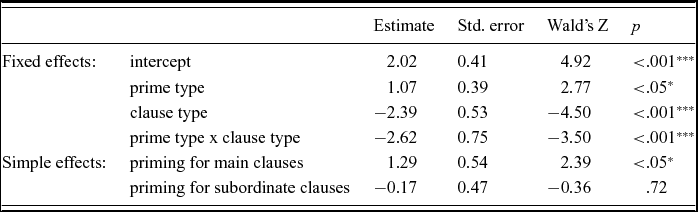
The model predicted ‘PO completion vs. DO completion’ as a binomial outcome variable; it contained ‘prime type’ (PO prime vs. DO prime) and ‘clause type’ (main clause vs. subordinate clause) as centered fixed effects, and ‘subject’ and ‘item’ as random effects. Fixed effects from the model are shown in Table 2.
Fixed and simple effects from the logit mixed effects model for Experiment 1.

Notes: * = p<.05, ** = p<.01, *** = p<.001
Crucially, the results showed a significant interaction between prime type and clause type. To explore this interaction, we determined simple effects by conducting separate models for each clause type. These models contained ‘prime type’ (PO prime vs. DO prime) as a centered fixed effect and ‘subject’ and ‘item’ as random effects, again with random slopes and intercepts for ‘subject’ and ‘item’. As shown in Table 2, the simple effects revealed a significant priming effect for main clauses, but no priming for subordinate clauses.
The interaction aside, the model also showed a significant main effect of clause type, with fewer PO completions for subordinate clauses relative to main clauses irrespective of prime type. While this effect was not expected, a possible explanation for it is that participants tried to avoid long completions when the target fragment itself was already quite long (i.e., when it was a subordinate clause). As POs are longer than DOs, participants might have used fewer PO completions in fragments with a subordinate clause, simply to avoid a long completion in target fragments which were already quite long.
Experiment 1: Summary and conclusions
With regard to main clauses, our results replicate the findings from previous cross-linguistic priming studies. We found a significant cross-linguistic priming effect from German main clause primes to English main clause targets, with participants producing significantly more English PO completions following German PO primes than following German DO primes. For subordinate clauses, however, this priming effect did not emerge, resulting in a significant interaction between clause type and prime type. Thus, at the very least, our results confirm the general claim of both the constitufent order account and the combinatorial node account that constituent order plays an important role in cross-linguistic structural priming.
In Experiment 1, we compared a case in which constituent order was the same in prime and target (i.e., priming from German main clauses to English main clauses) with a case in which constituent order differed between prime and target (i.e., priming from German subordinate clauses to English subordinate clauses). To some extent, the results from Experiment 1 resemble the results from Loebell and Bock (Reference Loebell and Bock2003), in which a cross-linguistic priming effect emerged only for structures for which English and German are similar with regard to the required constituent order (PO/DO priming), but not for structures for which constituent order differs between the two languages (active/passive priming). Our results are similar in the sense that constituent order for PO and DO structures is the same across the two languages when the sentence is a main clause, but differs when it is a subordinate clause. In this respect, the interaction between prime type and clause type is consistent with the constituent order account.
The combinatorial node account explains Loebell and Bock's (Reference Loebell and Bock2003) result by assuming that combinatorial nodes might only be shared between languages when the required structures are similar with regard to constituent order. However, this approach struggles to explain our results. Specifically, as both the subordinate PO and main clause PO versions of the primes contained a PO, the PO combinatorial node should have been activated in both cases, leading to priming effects in both conditions. However, a revised version of the combinatorial node account, which assumes that head position is represented within the combinatorial nodes, might be able to account for our findings. Such an account would assume separate combinatorial nodes for verb-final and V2 position German POs and DOs, with only the V2 position nodes being shared with the English PO and DO nodes. We return to this issue below, when discussing the results from Experiment 2.
In Experiment 1, main clause primes were followed by main clause targets while subordinate clause primes were followed by subordinate clause targets. Thus, prime and target, while different with regard to constituent order in the subordinate clause condition, were always situated on the same level of embedding in all conditions. In Experiment 2, we investigate cases that are the same with regard to constituent order, but differ with regard to level of embedding. Consider a prime/target pair such as (5):
-
(5)

In (5), the PO structure is part of a German main clause while the gap in the target fragment is embedded in a subordinate clause. Thus, prime and target differ with regard to level of embedding. However, as both German main clauses and English subordinate clauses require the verb to occur in second position, the target clause the man brought does not differ from the prime with regard to constituent order. The key question is whether the difference with regard to level of embedding prevents cross-linguistic priming or not.
Experiment 2
Experiment 1 suggests that cross-linguistic priming can only occur when prime and target are similar with regard to constituent order within the PO/DO. So far, our findings are consistent with an account assuming that cross-linguistic priming is caused by the activation of a particular constituent order. In Experiment 2, we compare a case where prime and target are the same with regard to constituent order but different with regard to level of embedding (i.e., priming from German main clauses to English subordinate clauses), with a case where prime and target differ with regard to both constituent order and level of embedding (i.e., priming from German subordinate clauses to English main clauses). Again, the constituent order account and the combinatorial node account predict different results with regard to the comparison between the two conditions. If cross-linguistic priming is caused by the activation of a particular constituent order, it should occur from German main clauses to English subordinate clauses (because in this case POs and DOs require the same constituent order in prime and target), but not from German subordinate clauses to English main clauses (because German subordinate clauses are verb-final, while English main clauses are not). The combinatorial node account, in contrast, predicts no difference between the two conditions. Processing of the prime should lead to the activation of the PO or DO combinatorial node irrespective of whether the prime is a main or subordinate clause, and this should influence target completion in both conditions.
Experiment 2: Method
Participants
We recruited 32 participants from the University of Kaiserslautern (age range 19–35, mean age 24.4, SD=3.8, 9 female). None of the participants were involved in Experiment 1. As in Experiment 1, all participants completed the OPT and LexTALE tests, and only participants with a minimum OPT score of 27 or higher were included in the analysis. The average OPT score across participants was 39.3 out of 50 (SD: 5.1). Average performance in the LexTALE test was 74% (SD: 13.0).
Items
We used the same 24 item sets as in Experiment 1, except for the fact that the main clause versions of the primes were combined with the subordinate clause versions of the target fragments, and vice versa. As a result, just as in Experiment 1, prime and target were based on translation equivalents of the same verb.
Design, procedure, instruction, and scoring
The experiment was conducted in the same way as Experiment 1.
Experiment 2: Results
Scoring
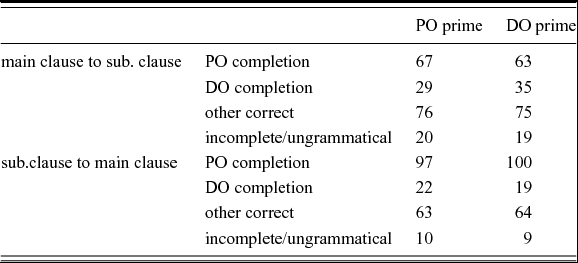
Frequencies of the different types of completions by condition are shown in Table 3.
Frequencies of completions by conditions in Experiment 2

Completions
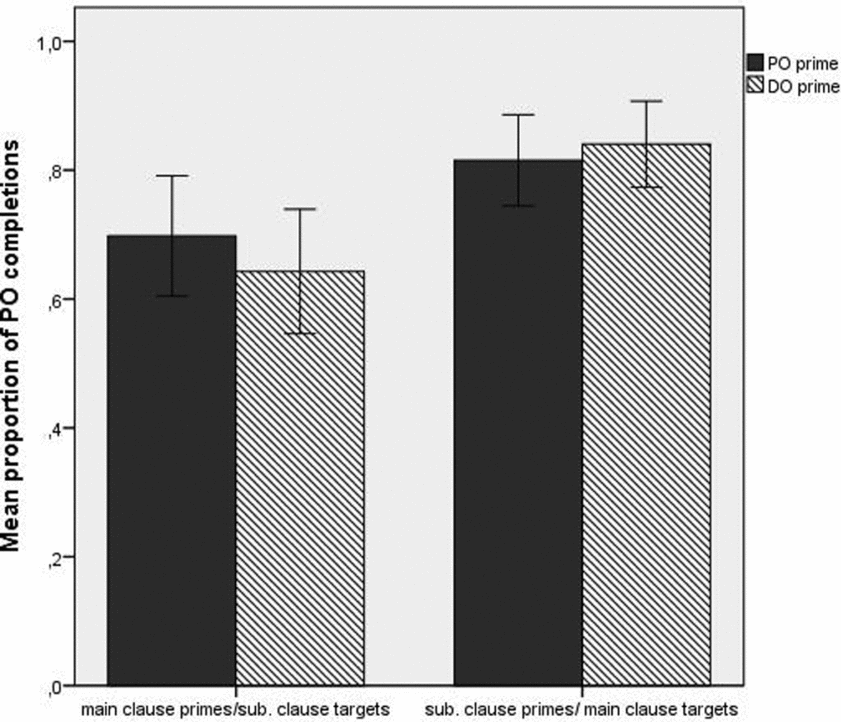
Figure 2 shows the relative frequencies of PO completions across the sum of all PO and DO completions by prime type and clause combination.
Mean proportions of PO completions by clause type and prime type in Experiment 2. Error bars represent 95% confidence intervals.

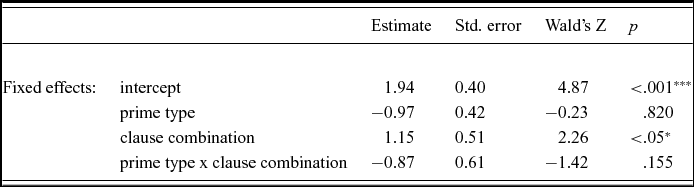
Again, we used a logit mixed effects model to analyze the data. The model predicted ‘PO completion vs. DO completion’ as possible outcomes. ‘Prime type’ (PO prime vs. DO prime) and ‘clause combination’ (main clause prime / subordinate clause target vs. subordinate clause prime / main clause target) were included as centered fixed effects, ‘subject’ and ‘item’ as random effects. Fixed effects from the model are shown in Table 4.
Fixed and simple effects from the logit mixed effects model for Experiment 2.

Notes: * = p<.05, ** = p<.01, *** = p<.001
As in Experiment 1, the results showed a significant main effect of clause combination, with fewer PO completions for subordinate clause targets relative to main clause targets. Again, this can be explained by assuming that participants tend to avoid longer completions when the fragment itself is already relatively long.
Crucially, the results showed no significant priming effects for either of the two clause combinations. For priming from German subordinate clauses to English main clauses, where prime and target differ in constituent order, the results corroborate the findings from the subordinate clause condition in Experiment 1, where prime and target also differ with regard to constituent order. In both instances, no priming effect emerged. Interestingly, however, the results of Experiment 2 also showed no priming from German main clauses to English subordinate clauses – a condition where prime and target share the same constituent order. If only constituent order similarity were needed for cross-linguistic priming to occur, priming effects should have emerged in this condition. The lack of a priming effect suggests that cross-linguistic priming not only requires constituent order similarity, but also similarity with regard to level of embedding.
When looked at in isolation, Experiment 2 showed a null effect, with no priming effects for either clause combination. However, Experiments 1 and 2 were based on the same materials, and conducted with subjects groups that were highly similar to each other with regard to background, age, and L2 proficiency. This allows us to conduct a post-hoc cross-experiment comparison between the main clause prime / main clause target condition from Experiment 1 and the main clause prime / subordinate clause target condition from Experiment 2. Note that within this comparison, similarity with regard to constituent order is controlled for: as this comparison contains no condition with German subordinate clauses, prime and target always require a constituent order with the verb in second position. Therefore, an interaction between prime type and clause combination cannot be explained on the basis of constituent order.
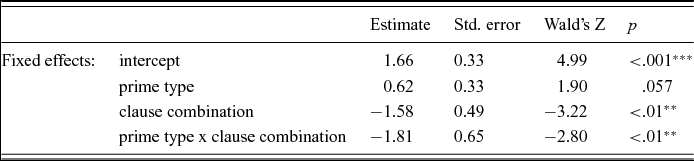
Table 5 shows fixed effects from a logit mixed effects model for this post-hoc comparison. The model is based on the data points from the main clause prime / main clause target condition in Experiment 1 and the data points from the main clause prime / subordinate clause target in Experiment 2. The model predicted ‘PO vs. DO completion’ as an outcome variable, contained ‘prime type’ (PO prime vs. DO prime), ‘clause combination’ (main clause prime / main clause target vs. main clause prime / subordinate clause target), and the interaction between the two, as centered fixed effects, and ‘subject’ and ‘item’ as random effects. Note that unlike in the models for the two experiments, the factor ‘clause combination’ is based on a between-subjects comparison here; we thus adjusted the random-effects structure accordingly.
Fixed effects from the logit mixed effects model for the cross-experiment comparison (main clause to main clause priming vs. main clause to subordinate clause priming).

Notes: * = p<.05, ** = p<.01, *** = p<.001
As shown in Table 5, the model shows a significant interaction between prime type and clause combination, suggesting significant priming effects from German main clauses to English main clauses, but no priming effects from German main clauses to English subordinate clauses.
General discussion
In the two experiments reported here, significant cross-linguistic structural priming emerged only if prime and target were similar with regard to both constituent order and level of embedding. For all cases where prime and target were different from each other with regard to either constituent order, level of embedding, or both, we found no cross-linguistic priming. In this respect, the results from Experiment 2 also rule out a trivial explanation assuming that the interaction in Experiment 1 is simply a result of subordinate clauses being bad primes per se. If this were the case, the priming effect should have emerged for the main clause prime / subordinate clause target condition in Experiment 2, but this was not the case.
The lack of a priming effect in the main clause prime / subordinate target condition could theoretically be due to the slightly increased distance between the prime and the blank in the target (i.e., the fact that subordinate targets contain three additional words). However, we consider this unlikely. First, structural priming effects have been shown to emerge even with several sentences (rather than just 3 words) occurring between prime and target (e.g., Bock & Griffin, Reference Bock and Griffin2000). Second, this account can only explain the results for one of the conditions, but struggles to explain our findings for the subordinate prime / main clause target condition, where the distance between prime and blank is not different from the main clause prime / main clause target condition.
With regard to the role of constituent order, our results are consistent with previous findings from studies in which cross-linguistic priming only emerged when prime and target shared the same constituent order (e.g., Loebell & Bock, Reference Loebell and Bock2003; Bernolet et al., Reference Bernolet, Hartsuiker and Pickering2007). Additionally, our findings suggest that although constituent order similarity in prime and target is a necessary prerequisite for cross-linguistic priming effects, it cannot itself be the cause of the priming effect. In this case, we should have found a priming effect from German main clauses to English subordinate clauses. The results from Experiment 2, however, show no priming in this condition, resulting in a significant interaction between prime type and clause combination in the above cross-experiment comparison. With regard to the role of the global structural context surrounding the prime structure, our findings suggest that cross-linguistic priming also requires similarity between prime and target with regard to the level of embedding in which the PO or DO occurs.
As already pointed out, both the constituent order account and the combinatorial node account struggle to explain particular aspects of our data pattern. Additionally, note that even a revised version of the combinatorial-node account, which assumes that head position is represented within the combinatorial nodes, cannot fully account for our findings for level of embedding. Specifically, consider priming from German main clauses to English subordinate clauses. In this condition, the head occurs in the same position in prime and target (both German main clauses and English subordinate clauses require the verb in V2 position), with prime and target differing only with regard to level of embedding. Nevertheless, this difference, as shown by the significant interaction in the above analysis, had a profound influence on the priming effect.
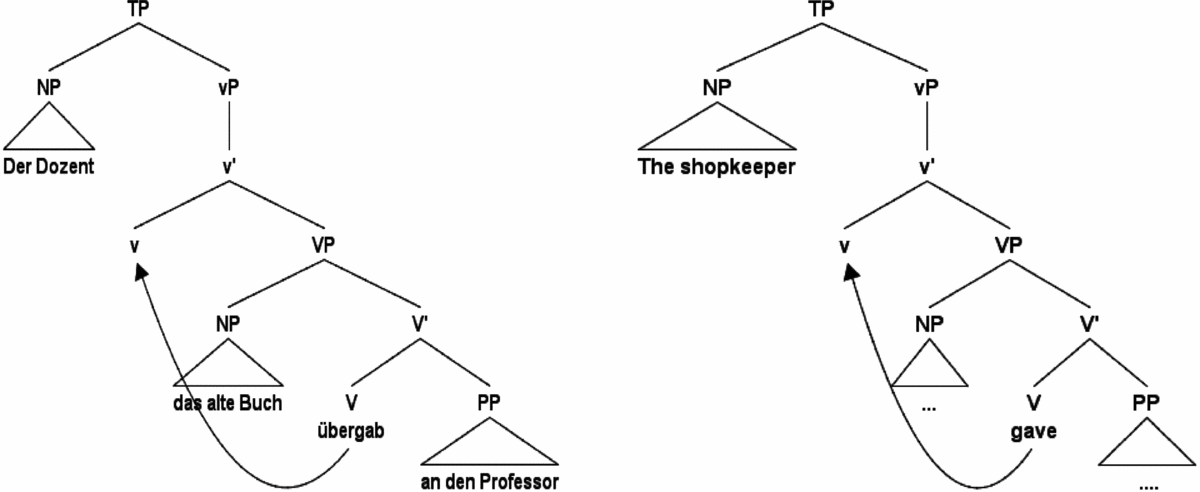
This raises the question of what else could be driving cross-linguistic priming effects. Because our results suggest that both constituent order and level of embedding play a role in cross-linguistic priming, the effect can presumably only be caused by a linguistic representation that contains information about both of these factors. While an answer to this question is necessarily speculative to some degree, an obvious candidate for this is a hierarchical syntactic tree representation. Figure 3 shows such tree representations for a German main clause PO sentence and its English target fragment.
Hierarchical tree representation for a main clause PO prime and its target fragment.

Assume that during processing of the prime, the parser computes a hierarchical tree representation of the syntactic structure of the sentence, in which information about both constituent order and levels of embedding is specified. This hierarchical tree is still active during completion of the target fragment. In Figure 3, the structural information specified in the tree is consistent with the structural requirements of the target fragment. Thus, the already-computed syntactic tree can be re-used for the completion of the target. However, if particular features specified in parts of the tree (such as head position) are inconsistent with the requirements of the target fragment or even ungrammatical in the other language (e.g., because the target fragment requires a completion with the verb in second position, while the verb position specified in the syntactic tree is verb-final), the formulator might inhibit the syntactic tree in order to prevent the production of an ungrammatical sentence. The result would be a data pattern such as the one observed in our study.
Note that the proposed account does not assume that priming can only occur if the tree representations for prime and target are entirely identical with regard to all levels of the tree. For example, several studies (e.g., Shin & Christianson, Reference Shin and Christianson2009, Chen et al., Reference Chen, Jia, Wang, Dunlap and Shin2013) have shown cross-linguistic priming between languages with and without articles. In these cases, the internal structure within each noun phrase is automatically different in prime and target, with the NPs either containing articles or not. Thus, we assume that differences on lower levels of the tree (such as the internal structure within an NP which constitutes part of a PO or DO) should still allow a priming effect to emerge.
To what extent can an account based on hierarchical tree structures account for previous findings on the role of constituent order in cross-linguistic priming? Loebell and Bock (Reference Loebell and Bock2003) found cross-linguistic priming between German and English only for structures for which the hierarchical tree is identical for the two languages (POs vs. DOs), but not for structures for which, due to differences with regard to head position, the trees were substantially different in each language (actives vs. passives). In Hartsuiker et al. (Reference Hartsuiker, Pickering and Veltkamp2004), in contrast, active/passive priming emerged for a language pair in which the tree representations for passive structures are identical. Bernolet et al. (Reference Bernolet, Hartsuiker and Pickering2007) found priming effects for relative-clause vs. adjectival constructions only for language pairs requiring the same head position within relative clauses. As head position is specified within a hierarchical tree, an account based on tree structure activation can explain these differential effects. This is also the case for at least some of the studies which have shown significant priming effects despite differences with regard to constituent order. For example, Desmet and Declercq (Reference Desmet and Declercq2006) found significant cross-linguistic priming effects for high vs. low relative-clause attachment between Dutch and English, despite the fact that Dutch and English differ with regard to the required head position within relative clauses. However, on the level of the tree that specifies relative-clause attachment, a relative clause constitutes a single unit that is, as a whole, attached to one of two different NPs. Thus, at the level of the tree that specifies high or low attachment, the Dutch and English trees are actually identical, allowing for cross-linguistic priming effects to emerge.
Shin and Christianson's (Reference Shin and Christianson2009) results for PO/DO priming between Korean and English are more difficult to account for. Specifically, in this study, significant priming effects emerged despite the fact that the two languages differ with regard to head position. However, like in our study, head position always differed between primes and targets; thus, it is impossible to say whether additional similarity with regard to constituent order or level of embedding would have led to a significant interaction as in our study. As for the priming effect itself, note that even though English and Korean differ with regard to head position, the tree representations for English and Korean PO and DO sentences are still similar with regard to some properties, which might have caused a priming effect. While such priming effects did not reach significance in our study, a hierarchical tree account does not completely rule out priming effects when prime and target differ with regard to constituent order or level of embedding, but predicts significantly stronger effects when the entire tree structure (rather than just particular parts) is identical in prime and target.
Effects of constituent order aside, an account based on hierarchical tree structures possesses the inherent advantage that it can also account for the effect of level of embedding which emerged in our study. Unlike in both the constituent order and combinatorial node accounts, level of embedding is represented in a hierarchical tree even when it has no consequences for constituent order within the clause. Interestingly, hierarchical syntactic trees have also been used to explain priming effects across entirely different cognitive domains, such as from mathematical equations to high vs. low relative-clause attachment (Scheepers, Sturt, Martin, Myachykov, Teevan & Viskupova, Reference Scheepers, Sturt, Martin, Myachykov, Teevan and Viskupova2011). In this respect, the account can not only explain cross-linguistic priming effects, but also offers a more general explanation for priming effects across different domains.
To conclude, prime/target similarity with regard to both constituent order and level of embedding were found to constitute necessary prerequisites for cross-linguistic priming effects in our study. In this respect, our experiments have revealed two important structural factors that modulate the cross-linguistic priming effect. With regard to this issue, it deserves to be mentioned that in studies investigating effects of level of embedding for within-language priming (e.g., Branigan et al., Reference Branigan, Pickering, McLean and Stewart2006; Melinger & Cleland, 2011), level of embedding had no such effect, with equally strong priming effects emerging irrespective of whether prime and target were situated on the same level of embedding or not. This could potentially suggest that while cross-linguistic priming is not weaker than within-language priming with regard to the size of the priming effect (Kantola & van Gompel, Reference Kantola and van Gompel2011), it might be more constrained than within-language priming in the sense that it can only occur when particular prerequisites are fulfilled. However, these studies were obviously based on different materials and experimental design, making any direct comparisons difficult. We are thus reluctant to draw strong conclusions about whether the effects of constituent order and level of embedding are specific to cross-linguistic priming or not, but consider this a valuable field for future research.
Appendix: Materials
The following list contains the PO versions of main and subordinate prime sentences, and the main and subordinate versions of the respective target fragments. Note that the corresponding DO versions of the primes can be derived from the PO versions.
1. (Der Studienberater bestätigte, dass) Andrea (brachte) die Testergebnisse zu dem Professor (brachte).
(The assistant remembered that) the mathematician brought _____.
2. (Der Redakteur glaubte, dass) der Chef (faxte) den Bericht an den Betrüger (faxte).
(Kim realized that) the widow faxed _____.
3. (Der Bericht bestätigte, dass) die Sekretärin (schickte) die Rechnung an den Manager (schickte).
(The rumors implied that) the boyfriend mailed _____.
4. (Herr Mayer behauptete, dass) die Mitarbeiterin (überreichte) das Präsent an den Chef (überreichte).
(The website revealed that) the postman handed _____.
5. (Der Bankangestellte berichtete, dass) der Verwandte (brachte) die Blumen zu dem kranken Mann (brachte).
(Alice announced that) the architect brought _____.
6. (Der Postbote wusste, dass) die Mutter (schickte) eine Geburtstagskarte an die Kindergärtnerin (schickte).
(The foreigner thought that) the policeman mailed _____.
7. (Frau Schmidt behauptete, dass) der Dozent (übergab) das alte Buch an den Professor (übergab).
(The librarian knew that) the shopkeeper gave _____.
8. (Der Autor erzählte, dass) der Botschafter (sandte) einen Brief an den Präsidenten (sandte).
(The man reported that) the locksmith sent _____.
9. (Der Arzt beobachtete, dass) die Krankenschwester (überreichte) das schreiende Baby an den Vater (überreichte).
(The journalist reported that) the renowned physicist handed _____.
10. (Die Tante erzählte, dass) der Sohn (brachte) das Zeugnis zu dem Vater (brachte).
(Marion guessed that) the man brought _____.
11. (Monika erkannte, dass) die Frau (sandte) die Schadensmeldung an den Vertreter (sandte).
(The journalist heard that) the fan sent _____.
12. (Der Bericht enthüllte, dass) der Maler (überreichte) das Bild an die Galeristin (überreichte).
(The observer stated that) the junior surgeon handed _____.
13. (Der Reporter sah, dass) der berühmte Schwimmer (übergab) das Autogramm an die Kellnerin (übergab).
(The paper reported that) the monk gave _____.
14. (Thomas sagte, dass) der Wissenschaftler (faxte) das Foto an das Museum (faxte).
(The doctor thought that) the patient faxed _____.
15. (Philipp sagte, dass) der Junge (schickte) das Spielzeug an den netten Lehrer (schickte).
(The secretary believed that) the private detective mailed _____.
16. (Martin sah, dass) der Vermieter (übergab) dem Mieter die Schlüssel (übergab).
(The picture showed that) the dean gave _____.
17. (Der Feuerwehrmann bestätigte, dass) der Kriminelle (sandte) eine Bombe an den Bürgermeister (sandte).
(Anna knew that) the young man sent _____.
18. (Der Vorgesetzte vermutete, dass) der Händler (faxte) das Angebot an den Kunden (faxte).
(The headmaster heard that) the teacher faxed _____.
19. (Der Klempner wusste, dass) der Mann (brachte) die Donuts zu den Mitarbeitern (brachte).
(The report stated that) the sculptor brought _____.
20. (Kristin dachte, dass) der Rechtsanwalt (schickte) den Vertrag an den Klienten (schickte).
(Oliver said that) the farmer mailed _____.
21. (Die Mutter erzählte, dass) der Großvater (überreichte) das Geschenk an das kleine Mädchen (überreichte).
(The headline claimed that) the tennis fan handed _____.
22. (Sarah beschwerte sich, dass) der Kapitän (übergab) die Urkunde an den alten Seemann (übergab).
(The passenger saw that) the bus driver gave _____.
23. (Der Verleger erwartete, dass) der Buchhalter (faxte) die Abrechnungen an das Büro (faxte).
(The doctor hoped that) the new sheriff faxed _____.
24. (Die Zeitung behauptete, dass) der Erpresser (sandte) die Fotos an den Politiker (sandte).
(The man saw that) the lonely sailor sent _____.