I. Introduction
The Federalist is widely recognized as a major text of political philosophy. Though originally written with the expressed purpose of explaining and defending the proposed Constitution of the United States (which was ratified in 1789), it expounded in the process the essential features of republican federalism, which distinguish modern democracies from their classical precursors. Soon after its publication, Thomas Jefferson praised it as “the best commentary on the principles of government which ever was written.”1
Thomas Jefferson, letter to Madison, November 18, 1788, in Papers of Thomas Jefferson, ed. Julian P. Boyd, Charles T. Cullen, and John Catanzariti (Princeton, NJ: Princeton University Press, 1950), vol. 14: 188.
Jefferson, letter to Thomas Mann Randolph, May 30, 1790, in Jefferson: Political Writings, ed. Joyce Appleby and Terence Ball (Cambridge: Cambridge University Press, 1999), 261–62.
Terence Ball, introduction, The Federalist with Letters of “Brutus” (Cambridge: Cambridge University Press, 2003), xvii.
Martin Diamond, “The Federalist,” in History of Political Philosophy, ed. Leo Strauss and Joseph Cropsey, 3d ed. (Chicago: University of Chicago Press, 1987), 660.
Quotations are from The Federalist: The Gideon Edition, by Alexander Hamilton, John Jay, and James Madison, ed. George W. Carey and James McClellan (Indianapolis, IN: Liberty Fund, 2001). Spelling, punctuation, and emphasis of this edition are retained.
See Charles McIlwain, Constitutionalism, Ancient and Modern (Ithaca, NY: Cornell University Press, 1940).
The authors of The Federalist might have been surprised to learn that they were deploying an idea which had been first adumbrated by the ancient Greek philosopher Plato (c. 427–347 b.c.) more than two thousand years before. Although Plato's dialogues were read in American colonial schools, he evidently had little or no direct influence on political thinkers during the Revolution and the founding.7
For example, James Madison studied Greek and Latin at boarding school, and read Plato along with Herodotus, Thucydides, and many Latin authors. See Carl J. Richard, The Founders and the Classics: Greece, Rome, and the American Enlightenment (Cambridge, MA: Harvard University Press, 1994), 18.
About the Republic, Thomas Jefferson wrote to John Adams on July 5, 1814: “While wading thro' the whimsies, the puerilities, and unintelligible jargon of this work, I laid it down often to ask myself how it could have been that the world should have so long consented to give reputation to such nonsense as this? … In truth, he [Plato] is one of the race of genuine Sophists, who has escaped the oblivion of his brethren, first by the elegance of his diction, but chiefly by the adopting and incorporation of his whimsies into the body of artificial Christianity. His foggy mind is forever presenting the semblances of objects which, half seen thro' a mist, can be defined neither in form or dimension.” The Adams-Jefferson Letters, ed. Lester J. Cappon (Chapel Hill: University of North Carolina Press, 1959), vol. 2: 432–33. Adams replied on July 16, “I am very glad that you have read Plato: and still more rejoiced to find that your reflections upon him so perfectly harmonize with mine. Some thirty Years ago I took upon me the severe task of going through all his Works. With the help of two Latin Translations, and one English and one French Translation and comparing some of the most remarkable passages with the Greek, I laboured through the tedious toil. My disappointment was very great, my Astonishment was greater and my disgust shocking. Two Things only did I learn from him. 1. that Franklins ideas of exempting Husbandmen and Marines etc. from the depredations of War were borrowed from him. 2. that Sneezing is a cure for the Hiccups. Accordingly I have cured myself and all my Friends of that provoking disorder, for thirty Years with a Pinch of Snuff” (ibid., 437). It is unclear whether Adams had by this time forgotten his own earlier published praise of Plato cited in the text below, or whether he was humoring Jefferson.
John Adams, “Letters of Novanglus,” in The Papers of John Adams, ed. Robert J. Taylor (Cambridge, MA: Harvard University Press, 1977–), vol. 2: 230.
John Adams, A Defence of the Constitutions of Government of the United States of America, against the Attack of M. Turgot in his Letter to Dr. Price (Philadelphia: Budd and Bartram for William Cobbett, 1797), vol. 1, letter 34: 208–9. Adams devoted letter 33 to Plato.
The only explicit reference to Plato in The Federalist is a brief allusion to “the philosophical race of kings wished for by Plato” (No. 49, Madison, 262), a passage discussed below.
Plato's principle is that, if a system contains both rational and nonrational parts, the former should rule over the latter. This implies that a regime is legitimate only if the rulers (whether monarch, elected officials, assembly, etc.) exercise power in a rational manner.12
In other words, a necessary condition for political legitimacy is that the state is governed in a rational manner. As will be seen, Plato's texts also support the wider thesis that rational rule is sufficient as well as necessary for political legitimacy. This implies that a regime can be legitimate even if its subjects are unwilling to be ruled. Consent of the governed is evidence for legitimacy, on the assumption that sensible people would voluntarily obey rational rulers; but the subjects may fail to consent if, for example, they are too obtuse or obdurate to recognize a legitimate government. This essay only argues that The Federalist endorses the narrower thesis that rational rule is a necessary condition for legitimacy.
The rule of reason emerges as a cosmological theme before Plato. Xenophanes (c. 570–c. 478 b.c.) says that there is one god who “shakes everything with the thought of his mind (noou phreni) (DK 21B23). Anaxagoras (c. 500–428 b.c.) says that “mind (nous) controls all things that have soul” (DK 59B12). Diogenes of Apollonia (mid-fifth century b.c.) says that “by thought (noêsis) all things are governed” (DK 64B5). Plato's pupil Aristotle (384–322 b.c.) also makes the rule of reason a fundamental principle in his own political science; e.g., “It is clear that it is natural and advantageous for the body to be ruled by the soul, and the passionate part of the mind by the part possessing reason” (Pol. I.5.1254b6–9). I discuss Aristotle's view under the rubric “the principle of rulership” in Miller, Nature, Justice, and Rights in Aristotle's Politics (Oxford: Oxford University Press, 1995), 20 and passim.
The guardians in the Republic are called “craftsmen” (dêmiourgoi) (III.395b9–c1, IV.421c2), and the legislator is compared to a statue painter (IV.420c). Similarly, the Timaeus employs the craftsman analogy in its “likely story” about the origin of the empirical world, with an immaterial intelligent demiurge looking to transcendent forms as models and shaping preexisting matter into an orderly cosmos (30a, c, 37d, 50d, 53a–b, 69b–c). On the parallels between the cosmic demiurge and the human legislator, see Glenn R. Morrow, “The Demiurge in Politics: The Timaeus and the Laws,” Proceedings of the American Philosophical Association 27 (1953–54): 5–23; and André Laks, “Legislation and Demiurgy: On the Relationship between Plato's Republic and Laws,” Classical Antiquity 9 (1990): 209–29.
It is by means of dialectical reasoning that we grasp the Form of the Good, also known as the good itself, and “it's by their relation to it that just things and the others [i.e., other good things] become useful and beneficial” (Rep. VI.505a2–4; cf. VII.534b3–d1). Translations of Plato's Republic are by G. M. A. Grube, revised by C. D. C. Reeve, in John M. Cooper, ed., Plato: Complete Works (Indianapolis, IN: Hackett, 1997), 971–1223.
The doctrine of the rule of reason first appears in Republic Book IV after Socrates distinguishes three parts of the soul: the rational, the spirited, and the appetitive. Socrates asks, “Is it not appropriate for the rational part to rule, since it is really wise and exercises foresight on behalf of the whole soul … ?” (441e4–5). The virtues of moderation and justice are defined in terms of the rule of reason. An individual is moderate “when the ruler and the ruled [within the soul] believe in common that the rational part should rule and don't engage in civil war against it” (442c10–d1; cf. 431a). Similarly, justice—in the abstract, “doing one's own” (443b)—is found in the soul when reason rules, because the rational part is naturally suited to rule, while the appetitive part is naturally suited to be ruled, and the spirited part is by nature the helper of the rational part (444b, 441a). Therefore, in psychology the rule of the rational part is natural, whereas the rule of the nonrational part is contrary to nature (444d8–11).
Socrates' application of the rule of reason in the Republic seems problematic. Although he contends that “our city, if indeed it has been correctly founded, is completely good” (IV.427e6–8), Socrates prescribes very controversial policies for his Kallipolis or “beautiful city” (cf. VII.527c2), involving elitism (a segregated class of guardians rules with the aid of warriors over a disenfranchised class of workers), communism of property and of spouses and children, and authoritarianism (extensive use of deception, manipulation, propaganda, surveillance, censorship, and coercion). Socrates winsomely describes his proposals as greeted by waves of laughter that threaten to drown him in ridicule and contempt (V.473c6–9). This aptly describes the reaction of modern readers such as John Adams: “Nothing can be conceived more destructive of human happiness; more infallibly contrived to transform Men and Women into Brutes, Yahoos, or Dæmons than a Community of Wives and Property.”16
Cappon, ed., The Adams-Jefferson Letters, vol. 2: 437. For fuller discussion of Plato's first articulation of the rule of reason in the Republic, see my essay “Plato on the Rule of Reason,” The Southern Journal of Philosophy 43 (2005): 50–83.
Section II of this essay argues that the Statesman offers a clearer understanding of Plato's principle of the rule of reason than the Republic, and it also indicates how this principle gave rise to the ideal of constitutionalism. Although this ideal was adopted and modified by Aristotle, Polybius, Cicero, and many other later thinkers, it will be illuminating to trace it back to its source in Plato. Section III argues that the rule of reason is a major tacit assumption at work throughout the American Federalist, and that The Federalist offers striking parallels with Plato's Statesman. A comparison of these two works reveals the ramifications of Plato's political theory for modern constitutionalism, and provides a fuller understanding of the philosophical framework of the American founders.17
Morton White argues that “a thorough understanding of The Federalist requires us to see that it contains or relies upon a theory of knowledge, a doctrine of normative ethics, a psychology of motivation, a theory of the causes of factions … and even some metaphysics and theology—all of them used in different ways to support the adoption of the Constitution.” Morton White, Philosophy, The Federalist, and the Constitution (New York: Oxford University Press, 1987), 7.
On the classical republican interpretation, see Gordon S. Wood, The Creation of the American Republic, 1776–1787 (New York: Norton, 1972); and J. G. A. Pocock, The Machiavellian Moment: Florentine Political Thought and the Atlantic Republican Tradition (Princeton, NJ: Princeton University Press, 1975).
Morton White contends that The Federalist contains striking parallels with Locke's philosophy in White, Philosophy, The Federalist, and the Constitution; and Thomas L. Pangle argues for a more pervasive influence in Pangle, The Spirit of Modern Republicanism: The Moral Vision of the American Founders and the Philosophy of Locke (Chicago: University of Chicago Press, 1988). Douglass Adair offers an illuminating comparison between Madison (Federalist No. 10) and David Hume in Adair, Fame and the Founding Fathers, ed. Trevor Colbourn (Indianapolis, IN: Liberty Fund, 1998 [1974]). See also Michael Chan, Aristotle and Hamilton on Commerce and Statesmanship (Columbia: University of Missouri Press, 2006). Along similar lines, the present essay tries to show that a comparison with Plato's Statesman also sheds valuable light on the philosophical framework of The Federalist. I offer no argument that the American founders were indirectly influenced by Plato (though I suspect this was the case). Claims of causal dependence in the history of ideas are very difficult to prove in any case, and, as noted earlier, Plato's political works were seldom even mentioned by the founders (apart from Adams).
II. The Rule of Reason in Plato's Statesman
The Statesman (Latin title Politicus) has long languished in the shadow of the Republic, Plato's literary masterpiece.20
Quotations of the Statesman are (except where noted) from the translation by C. J. Rowe in Cooper, ed., Plato: Complete Works, 294–358. For the sake of consistency, however, the translation has been systematically altered with Greek terms rendered as follows:

, “man”;

, “rule”;

, “second sailing”;

, “form”;

, “knowledge”;

, “city-state”;

, “holy”;

, “multitude.”
It is generally agreed that the Statesman is one of Plato's later dialogues, written after the Republic and before the Laws.21
That the Statesman is one of Plato's later dialogues was firmly established in the nineteenth century. See Lewis Campbell, The Sophistes and Politicus of Plato (Oxford: Clarendon Press, 1867), xix–xlii. For recent work on the dating of Plato's dialogues, see Leonard Brandwood, The Chronology of Plato's Dialogues (Cambridge: Cambridge University Press, 1990); and Brandwood, “Stylometry and Chronology,” in Richard Kraut, ed., The Cambridge Companion to Plato (Cambridge: Cambridge University Press, 1992), 90–120.
See Charles Griswold, “Politikê Epistêmê in Plato's Statesman,” in John P. Anton and Anthony Preus, eds., Essays in Ancient Greek Philosophy, vol. 3 (Albany: State University of New York Press, 1989), 159.
For the view that Plato's philosophical views changed substantially between the Republic and the Statesman, see Gilbert Ryle, Plato's Progress (Cambridge: Cambridge University Press, 1966), 135–36, 285–86; G. E. L. Owen, “The Place of the Timaeus in Plato's Dialogues,” Classical Quarterly 3 (1953): 79–95; and George Klosko, The Development of Plato's Political Philosophy (New York and London: Methuen, 1986), 183–97. For the opposing view that Plato's political theory remained largely unchanged on the level of fundamental principles, see Trevor Saunders, “Plato's Later Political Thought,” in Kraut, ed., The Cambridge Companion to Plato, 464–92; and Charles Kahn, “The Place of the Statesman in Plato's Later Work,” in C. J. Rowe, ed., Reading the Statesman: Proceedings of the Third Symposium Platonicum (St. Augustin: Academia Verlag, 1995), 49–60.
“Editor's Introduction,” in Plato, Statesman, trans. J. B. Skemp, ed. Martin Ostwald (Indianapolis, IN: Hackett, 1992), xiv.
Readers unfamiliar with the Statesman may find the synopsis in Appendix I helpful.
The rule of reason is a central theme of the Statesman in three important ways: it provides a criterion for distinguishing the true statesman from the counterfeit; it is indispensable for the proper aim of politics; and it is a standard for comparing and evaluating constitutions. The following three subsections discuss these points in turn.
A. The science of politics
The argument of the Statesman elaborates upon the Socratic thesis that ruling justly involves a craft (technê) comparable to navigation, medicine, and horse-breeding, as well as herding (Plt. 258b1–259c4; cf. Rep. I.332d2–3, 341d–342c; Gorg. 521d6–8). The Eleatic Stranger seeks to define the statesman by means of dialectic, which involves the method of classifying objects by collecting and dividing them into kinds (Plt. 285d–287b; cf. Sph. 253d–e).26
As Julius M. E. Moravcsik remarks, the method of collection and division is an “attempt to link the theoretical and the practical, and to insist that the latter can be solved successfully only if such solutions are based on an adequate conception of the former.” See Moravcsik, “The Anatomy of Plato's Divisions,” in Exegesis and Argument, ed. E. N. Lee, Alexander P. D. Mourelatos, and R. M. Rorty (Assen: Van Gorcum, 1973), 348. The method is also described by Socrates at Phaedrus 265d; cf. 273d. Note that there is no indication in the Statesman that the eidê (kinds or classes) undergoing division are to be identified with the transcendent Forms of the Republic. Although collection and division may be anticipated at Rep. V.454a, dialectic as practiced in the Statesman seems a more mundane activity than dialectic as described in the Republic: the highest form of philosophical inquiry aiming at the cognition of the imperceptible, immutable, and eternal Forms (see Rep. VII.533c–534d).
See Roslyn Weiss, “Statesman as

: Caretaker, Physician, and Weaver,” in Rowe, ed., Reading the Statesman, 213–22.
This seems to imply that the existence of a rational ruler is both a sufficient condition and a necessary condition for a government to be legitimate. As I remarked in note 12 above, this essay focuses on the narrower claim that the existence of a rational ruler is a necessary condition.
Although the Stranger remains rather vague about the nature of the science of statecraft, he does provide a valuable clue in a digression concerning excess and deficiency (283b–287b). Here he discusses the art of measurement, which has two parts: the first part, concerning “the number, lengths, depths, breadths, and speeds of things,” examines the relation of the greater to the less and identifies in principle the due measure of things; the second part applies these abstract principles to what comes into being. The Stranger asserts that “there is in fact an art of measurement (metrikê) relating to everything that comes into being” (285a1–2). The expert at measuring grasps universal, eternal truths about what is due measure and applies this knowledge to particular circumstances. The Stranger also, significantly, suggests that the statesman must be such an expert. For the Stranger says of statesmanship and other crafts: “[B]y preserving measure they produce all the good and fine things they produce” (284b1–2). The implication is that political science is a kind of applied mathematics.
Is the statesman also a “ruler with insight into Forms” and thus the counterpart of Socrates' philosopher-ruler in the Republic?29
As suggested by Trevor Saunders, “Plato's Later Political Thought,” in Kraut, ed., The Cambridge Companion to Plato, 467.
This comparison to an inspection of supplies and equipment is due to J. B. Skemp, Plato: The Statesman (London: Routledge, 1952), 74 n. 3.
See Moravcsik, “The Anatomy of Plato's Divisions,” 324–48.
As argued by G. E. L. Owen, “Plato on the Undepictable,” in Lee et al., eds., Exegesis and Argument, 349–61. Owen's thesis (“Read in context the passage says nothing of the paradigm-metaphysics. It makes a sound philosophical point in plain terms.”) seems plausible, even if his more radical thesis, that the paradigmatic Forms are jettisoned in Plato's later dialogues, is contestable. For a detailed discussion of whether there are paradigmatic Forms in the Statesman, see W. K. C. Guthrie, A History of Greek Philosophy, vol. 5, The Later Plato and the Academy (Cambridge: Cambridge University Press, 1978), 175–80. Although Guthrie believes there are, he concedes the evidence is indecisive and attaches a footnote (“May one occasionally leave a decision to the reader?”), which must suffice for the present discussion.
B. The proper aim of the statesman
The thesis that the statesman as such possesses expertise or knowledge is supported by analogies with craftsmen: the herdsman, the doctor, the steersman, and, above all, the weaver. All of these are concerned in one way or another with the well-being of their charges. The statesman qua herdsman is initially assigned the task of nurturing or rearing (trophê) humans and animals, but this turns out to be a task better suited to the divine herdsman, whereas the statesman should be concerned with merely caring for or looking after (epimeleia) his subjects in a narrower manner (Plt. 274e–275e). The Stranger also offers the parallel of doctors. We believe in them regardless of whether they cure us with our consent or without it, with or without written rules, and whether they are rich or poor, “so long as they are in charge of us on the basis of expertise, purging or otherwise reducing us, or building us up—it is no matter if only each and every one of those who care for our bodies acts for our bodies' good, making them better than they were, and so preserves what is in their care” (293b5–c1). Similarly, genuine rulers are to aim at the well-being of the community:
And whether they purge the city-state for its good by killing or exiling individuals, or whether again they make it smaller by sending out colonies somewhere like swarms of bees, or build it up by introducing people from somewhere outside and making them citizens—so long as they act to preserve it on the basis of knowledge and what is just, making it better than it was so far as they can, this is the constitution which alone we must say is correct…. (293d4–e2; cf. 294a10–b2)
The Stranger also supports this teleological argument for expertise or knowledge by analogy with the steersman who, “always watching out for what is to the benefit of the ship and the sailors, preserves his fellow sailors not by putting things down in writing but offering his expertise as law.” Similarly, wise rulers are not mistaken, “whatever they do, provided that they watch for one great thing, that by always distributing to those in the city-state what is most just, as judged by the intelligent application of their expertise, they are able both to preserve them and so far as they can to bring it about that they are better than they were” (296e3–297a2, a6–b3). He suggests later that such a ruler is “willing and able to rule with virtue and knowledge, distributing what is just and holy correctly to all” (301d1–2).33
This is consistent with the above-cited statement that the ruler benefits the city-state by killing and exiling individuals (293d4–5), for a later passage states that those who are killed, exiled, or punished are guilty of godlessness, insolence, and injustice (308e10–309a3).
The art of weaving finally emerges as the most important model for statesmanship, which “rules all of these [i.e., the subsidiary arts], and the laws, and cares for every aspect of things in the city-state, weaving everything together in the most correct way” (305e2–4). The statesman is also a weaver of souls. By means of education, the statesman weaves together opposing human natures “by fitting together that part of their soul that is eternal with a divine bond, in accordance with its kinship with the divine, and after the divine, in turn fitting together their mortal aspect with human bonds” (309c1–2). He creates a bond of opinion which is “really true and guaranteed,” opinion which verges on knowledge (309c5–7).34
Christopher Bobonich suggests that “such opinions seem to consist in grasping—albeit in a way that amounts to less than knowledge—the reasons behind the law, that is, grasping why they are fine, just, and good.” See Bobonich, Plato's Utopia Recast: His Later Ethics and Politics (Oxford: Oxford University Press, 2002), 118. Cf. Melissa Lane, “A New Angle on Utopia: The Political Theory of the Statesman,” in Rowe, ed., Reading the Statesman, 282 n. 24; cf. C. J. Rowe, Plato: Statesman (Warminster, UK: Aris & Phillips, 1995), note on 309c6.
C. Constitutional applications
The rule of reason also serves as a standard for comparing and evaluating constitutions in the Statesman. Although the ideal constitution would consist in untrammeled rule by a statesman with knowledge, “the second sailing for those who establish laws and written rules” is a system in which everyone without exception abides by the laws (300c1–3). “Second sailing” (deuteros plous), a nautical euphemism for hauling out the oars when the wind has failed, is a metaphor for the second-best method of proceeding (cf. Phaedo 99c9–d1). As Ernest Barker describes this development, “Plato makes his peace with reality, and acknowledges that there is room in political life for consent and law and constitutionalism and all the slow unscientific ways of the actual world of men.”35
Ernest Barker, Greek Political Theory: Plato and His Predecessors (London: Methuen, 1918), 330.
George Klosko, The Development of Plato's Political Theory (New York and London: Methuen, 1986), 196. A similar interpretation is defended by John Gould, who speaks of “Plato's despair of ever finding the man to rule as a true man, with epistêmê” in the Statesman; see Gould, The Development of Plato's Ethics (Cambridge: Cambridge University Press, 1955), 214. The latter book is criticized by Gregory Vlastos, “Socratic Knowledge and Platonic ‘Pessimism’,” Philosophical Review 66 (1957): 226–38; reprinted in Vlastos, Platonic Studies, 2d ed. (Princeton, NJ: Princeton University Press, 1981), 204–17.
Vlastos, “Socratic Knowledge,” 217. Cf. Kahn, “The Place of the Statesman,” 54; Kahn contends that although the political ideal of the Republic is shared by the Statesman, in the latter work “Plato has turned his attention to a painstaking study of existing laws and institutions in order to reshape them in the light of his paradigm.”
Saunders, “Plato's Later Political Thought,” 471.
These interpretations are often associated with more general views on Plato's political development. Klosko holds that Plato in the Statesman was well on his way to jettisoning the “two-world” ontology and tripartite psychology of the Republic, a process completed by the time he wrote the Laws; see Klosko, The Development of Plato's Political Theory, chap. 11. Saunders, in contrast, maintains that Plato continued to express fundamentally the same views in these three dialogues; see Saunders, “Plato's Later Political Thought.” In this essay, as I remarked earlier, I do not address the broader developmental issue, which, arguably, should be kept in abeyance until more progress can be made in understanding each of the dialogues separately. In any case, even on the developmental interpretation, the later Plato may have accepted a political ideal different from that of the Republic (see Laws V.739a3–740a2, and cf. Bobonich, Plato's Utopia Recast, 10–12).
Because they possess knowledge, “there is no mistake for wise rulers, whatever they do,” provided their aim is just (Plt. 297a5–6). The Statesman makes no attempt to explain how the ideal constitution could arise or sustain itself—a problem addressed by the Republic. It does say, however, that the statesman must make use of laws even in the ideal case. Just as gymnastic experts who must train large numbers and do not have time for individualized instructions “regard it as necessary to make rough prescriptions about what will bring physical benefit, as suits the majority of cases and a large number of persons,” similarly the statesman cannot issue individualized prescriptions but must “set down the law for each and every one according to the principle of ‘for the majority of people, for the majority of cases, and roughly, somehow, like this,’ whether expressing it in writing or in unwritten form, legislating by means of ancestral customs” (295a4–7). But the legislator is at liberty to override his own laws when necessary (295e4–296a2). The Eleatic Stranger also criticizes the common view that legal reforms must be adopted by persuading the city-state to accept them (296a7–9) on the basis of the doctor analogy: if a doctor forces his patient to do what is healthy for him, he will not commit an “unhealthy mistake” (296b9). Similarly, if the rulers force the ruled to do just, good, and noble acts, it does not matter whether they use persuasion or not (296d7–8). All that matters is that “by always distributing to the those in the city-state what is most just, as judged by the intelligent application of their expertise, they are able both to preserve them and so far as they can to bring it about that they are better than they were” (297b1–3).
Could there be scientific rulers such as the Eleatic Stranger describes? He implies that they could be found in our day.40
That is, in the age of Zeus in the cosmological myth (cf. Appendix I below). The statesman is a mortal, in contrast with the divine shepherd in the age of Cronus (see 275a1–2).
For a similar interpretation, see Vlastos, “Socratic Knowledge,” 214. Cf. Christopher Gill, “Rethinking Constitutionalism in Statesman 291–303,” in Rowe, ed., Reading the Statesman, 295–96. See also Griswold, “Politikê Epistêmê,” 158–61.
As the Athenian Stranger does suggest in Plato's Laws IX.875b–d. His argument may contain a small loophole, however. If by divine dispensation (theia moira) someone were naturally able to acquire the requisite knowledge and came to power, he would need no laws. “For neither law nor regulation is superior to knowledge; nor is it right for reason to be subject or slave to anything, but it should be ruler over everything” (875c2–d1). The Athenian Stranger grants that such a nature is not found anywhere, “except to a small extent” (875d2–3). See Kahn, “The Place of the Statesman,” 53. For a different interpretation, see Bobonich, Plato's Utopia Recast, 110 and 506 n. 21.
Given that absolute rule by the statesman is best but not feasible, actual city-states ought to adopt the principle “that no one in the city-state should dare to do anything contrary to the laws, and that the person who dares to do so should be punished by death and all the worst punishments. This is very correct and fine as a second choice, when one changes the principle we discussed just now [i.e., that rule should be assigned on the basis of knowledge], which is our first choice” (297e1–5; cf. 300c1–3). Granted that the rule of law is inferior to the rule of the wise person, what is the basis for the claim that the rule of law is second best—that is, better than the lawless alternatives?
The Eleatic Stranger's answer is as follows: “All the others that we generally say are constitutions we must say are not genuine, and not really constitutions at all, but imitations of this one [i.e., the correct constitution]; those we say are law-abiding have imitated it for the better, the others for the worse” (293e2–5). This implies that all the incorrect constitutions can be rank-ordered, because each is an imitation of the correct one and imitations can be compared as better or worse. What is the standard by which one imitation is better or worse than another? The Stranger points out that just as the statesman may act on his own knowledge without regard to written laws, “any man whatsoever or any multitude whatsoever, for whom there are actually written laws established, who undertake to do anything at all that is different on the grounds that it is better, will do the same thing according to their ability as the true expert” (300d4–7). He adds that “if they were to do such a thing without having knowledge, they would be undertaking to imitate what is true, but would imitate it altogether badly; but if they did it on the basis of expertise, this is no longer imitation but that very thing that is most truly what it sets out to be” (300d9–e2).43
Kahn charges Plato with “oscillation verging on contradiction” at 300e1–2 (“The Place of the Statesman,” 52), on the grounds that Plato implies that a law-abiding constitution can be unqualifiedly correct. Kahn's objection seems to be based on a misinterpretation. The point of these lines is that if the statesman acts contrary to his own laws on the basis of his knowledge and expertise, this is not an imitation of statesmanship but the real thing.
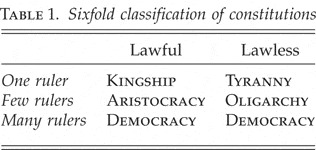
Aristotle (in Politics III.7) adopted this sixfold scheme, except that he dropped the confusing use of “democracy” for two distinct kinds of constitution, instead calling the good form “polity.”
Sixfold classification of constitutions

Any lawful constitution is better than any lawless constitution, and a good (or bad) constitution tends to be less efficacious and, hence, less good (or less bad) the more that power is disseminated throughout the citizenry as increasingly minor offices are distributed among increasingly many people (cf. 303a4–7). On this basis, the ordinary constitutions can be ranked as follows from worse to better:
tyranny → oligarchy → lawless democracy → lawful democracy → aristocracy → kingship
Superior to all these, however, is the seventh constitution—rule by one man with knowledge—which stands out from the ordinary ones “like a god from men” (303b4).
Why does the Eleatic Stranger maintain that ordinary lawful constitutions imitate this godlike constitution “finely” whereas bad constitutions do so “badly”? Before we can answer this question, we must ask why laws are necessary even in the ideal state. The ruler of such a state possesses the wisdom necessary to prescribe what is fitting for each case. Presumably this is because, having mastered the art of collection and division, he is able to classify every case accurately and thus to prescribe effectually. When the statesman legislates for his subjects, however, his laws are imperfect, because “the law could never accurately prescribe what is best and just for all at the same time” (294a10–b2). Because human beings and their actions are dissimilar in many ways, and human affairs are generally unstable, no form of expertise can set forth simple unqualified rules for all cases and all times (294b2–6). The legislator “will never be capable, in prescribing for everyone together, of assigning accurately to each individual what is appropriate for him” (295a1–2). Instead, he will legislate for each of them according to the principle “for the most part and somehow, in this way, roughly” (295a4–5). But he has the prerogative to depart from his own rules and offer a different prescription when necessary, like the doctor who finds that some other treatment is better “because of winds or else some other of the things that come from Zeus which occurred unexpectedly and unusually” (295c9–d2, my translation).
The Eleatic Stranger argues that the laws are “imitations of the truth of each and every thing” (300c6). According to Saunders, this also explains why the second-best constitution is lawful: “The second-best form of government, therefore, is a good code of laws, ‘imitations of truth,’ in that they incorporate as far as possible the insights of a Statesman with genuine politikê epistêmê (political knowledge).”45
Saunders, “Plato's Later Political Thought,” 467.
Martin Ostwald, introduction to Plato, Statesman, trans. J. B. Skemp (Indianapolis, IN: Hackett, 1992), xxxv–xxxvi.
This interpretation is challenged by C. J. Rowe, who objects that the laws which are called “imitations of the truth” (300c6) are the ideal laws laid down by the scientific ruler instead of the conventional laws found in inferior law-abiding constitutions such as democracy.47
Rowe, Plato: Statesman, 15–18. In part, the issue turns on the translation of 300c5–7. J. B. Skemp translates: “laws seem to be written copies of scientific truth in the various departments of life they cover, copies based as far as possible on the instructions received from those who possess the scientific truth on these matters.” C. J. Rowe translates: “imitations of the truth of each and everything would be these, wouldn't they—the things issuing from those who know which have been written down as far as they can be?” Skemp assumes that

modifies the phrase

, and Rowe assumes that it modifies

. Skemp's rendering has slightly more support from word order, but either translation is grammatically permissible.
A problem for Rowe's interpretation is that the preceding lines 300b1–c4 discuss conventional laws, whereas 300c5–7 abruptly shifts to ideal laws. There is, however, no suggestion in the text of such a shift. If anything, the context suggests that 300c5–7 is intended to support the previous claim that the second-best method is to abide strictly by the established laws (300c1–3).
Campbell understands charientôs as “by right opinion without science” and notes similar usage in Aristotle's Nicomachean Ethics (e.g., I.3.1095a18, 5.1095b22) in Campbell, The Sophistes and Politicus of Plato, 156.
Gill, “Rethinking Constitutionalism,” 296. A similar interpretation is defended by Jean François Pradeau, Plato and the City, trans. Janet Lloyd (Exeter, UK: University of Exeter Press, 2002 [1997]), 104–6.
C. J. Rowe, “The Politicus and Other Dialogues,” in Christopher Rowe and Malcolm Schofield, eds., The Cambridge History of Greek and Roman Political Thought (Cambridge: Cambridge University Press, 2000), 250; cf. Rowe, introduction, Plato: Statesman, 17. Similarly, André Laks describes conventional laws as “a mindless second best that is our most hopeful option if no true statesman is available,” in Laks, “The Laws,” in Rowe and Schofield, eds., Cambridge History, 271.
Even so, the Statesman does not go as far as the Laws, which claims that law is the encapsulation of divine reason, so that the very name of law, nomos, derives from that of reason, nous (see Laws IV.714a1–2, XII.957c5–7).
The Statesman concludes by exploring the implications of the weaver paradigm. The paradigm is used first to show that statecraft is a higher-order art distinct from other arts which it directs. The political art
must not itself act but rule over the capacities to act because it knows when it is the right time to begin and set in motion the most important things in city-states, and when it is the wrong time, and the others [i.e., the other capacities] must do what has been prescribed for them…. For this reason the sorts of expertise we have just examined [e.g., rhetoric, generalship, judgeship] rule neither each other nor themselves, but each is concerned with some special practical activity of its own, and in accordance with its special kind of activities has justly acquired a special name…. But the one that rules all of these and the laws and cares for every aspect of things in the city-state, weaving everything together in the most correct way—this, embracing its capacity with the name belonging to the whole [i.e., the city-state], we would, it seems, most appropriately call statesmanship. (305d1–4, 6–9, e2–6)
Political science is architectonic: its primary role is to coordinate subsidiary arts that attend more directly to the needs of the city-state.52
This idea is appropriated by Aristotle himself at the beginning of the Nicomachean Ethics, where politics is treated as a master science or art under which lesser capacities such as strategy, economics, and rhetoric fall (I.2.1094a27–b3).
The weaver analogy is also used to distinguish the statesman from the expert in faction (303c1–2). Rather than setting the different classes against each other, the statesman tries to unify the city-state, not by obliterating the differences of the citizens but by drawing on their different strengths and enabling them to work together. The Eleatic Stranger addresses a conflict between two classes of citizens—namely, the courageous and the moderate—a conflict which arises, surprisingly, from a natural enmity or faction between the character traits themselves (306b9–11, 307c2–d5, 308b6–8). Although these two sorts of persons frequently disagree on matters of policy, the well-being of the city-state requires that they cooperate with each other. The Eleatic Stranger proposes two ways in which these opposed elements may be bound together. The first is a “divine bond,” that is, an “opinion (doxa) about what is noble, just, and good, and the opposites of these, which is really true and is guaranteed” (309c5–7). This bond of true moral opinion is produced by means of education, and it unites “parts of virtue that are by nature unlike each other and tend in opposite directions” (310a4–5). The remaining “human bonds” involve customs and laws concerning marriage and procreation. The aim should be to encourage intermarriage between the two groups in order to produce a citizenry with a better “mixture” of the courageous nature and moderate nature (310d6–e3). The result of these two bonds, especially the divine, is that the citizens share a single opinion in moral matters (310e6–7). By weaving together the dispositions of brave and moderate humans “as if with a shuttle” and bringing their lives together in concord (homonoia) and friendship, statesmanship “rules and directs without, so far as it belongs to a city-state to be happy, falling short of that in any respect” (311b7–c6). Statesmanship thus avoids faction and brings the citizens together so that they are able to cooperate for the common good.
Plato's Statesman is not immune to criticism. The Eleatic Stranger's theorizing remains abstract and programmatic. He never becomes very clear about the precise nature of the art of measurement and the art of weaving which are essential to the science of statesmanship. He is especially vague about the laws and political institutions whereby a diverse citizenry might be “woven” into a uniform city-state. It also needs to be explained how the rule of reason could be realized in everyday political life among citizens who are motivated by passion rather than reason.53
Plato's Laws may be viewed as an attempt to spell out in much more detail the implications of the rule of reason for legislation for actual city-states. I hope to examine this topic in a future essay.
In spite of these serious difficulties, the Statesman is a seminal work in the history of constitutionalism. In developing the implications of the rule of reason for political theory, the Eleatic Stranger distinguishes between two types of constitutionalism. The first is unreflective constitutionalism of the sort expressed by Young Socrates (293e; cf. 297c). The Eleatic Stranger shows this view to be mistaken (cf. 297d1) because it relies on a false standard of constitutional correctness: for example, the idea that a constitution is correct if, and only if, the rulers abide by whatever laws have been established. What makes a constitution correct is that it embodies rationality, which enables the government to promote what is objectively good for the citizens. Hence, Young Socrates is mistaken when he objects that the ruler should without exception be constrained by laws. But there is a second type of constitutionalism which is correct, though in a way Young Socrates could not have understood.54
This discussion generally follows Gill, “Rethinking Constitutionalism,” 295, who calls the two types “pre-theoretical” and “post-theoretical constitutionalism.” See also Griswold, “Politikê Epistêmê,” 160–62.
III. The Rule of Reason in The Federalist
The Federalist was originally published as part of the debate over the United States Constitution, which had been approved by a constitutional convention held in Philadelphia, Pennsylvania, from May 25 until September 17, 1787. Ratification, requiring approval of nine states, was not assured. In the pivotal state of New York, for example, the governor and most legislators and judges vehemently opposed ratification. The Antifederalists, often with pseudonyms such as “Brutus,” “Cato,” “Centinel,” and “The Federal Farmer,” published numerous articles (the equivalent of modern “op-ed” pieces) contending that the constitutional convention was illegal, because it had only been authorized to revise the Articles of Confederation, and that the document it produced was deeply flawed. In response, a series of papers signed by “Publius” appeared in newspapers from October 27, 1787, to April 2, 1788, to persuade the citizens of New York to support the proposed constitution.55
The name “Publius” derives from Publius Valerius Poplicola (or Publicola), whom eighteenth-century Americans would have regarded as a founder of the Roman republic through reading the legendary accounts by Livy and Plutarch.
Three men collaborated in writing the papers. Alexander Hamilton (1755–1804), who conceived of and orchestrated the project, became the first secretary of the Treasury. James Madison (1751–1836), who had previously taken detailed notes at the constitutional convention of 1787, later served two terms as president. John Jay (1745–1829) became the first chief justice of the Supreme Court. Hamilton oversaw a corrected second edition of the papers, printed in New York by George F. Hopkins in 1802. Finally, Madison authorized a corrected third edition printed by Jacob Gideon in 1818, which was the first to include the corrections of all three authors. In this edition, Madison also corrected the authorship of the various papers.56
According to Madison, Hamilton wrote fifty-one papers (Nos. 1, 6–9, 11–13, 15–17, 21–36, 59–61, and 65–85), Madison twenty-nine (Nos. 10, 14, 18–20, 37–58, and 62–63), and Jay, who fell ill, only five (Nos. 2–5 and 64). Hamilton had claimed thirteen others (Nos. 18–20, 50–52, 54–58, and 62–63), but subsequent scholarship has confirmed Madison's attributions. See Adair, Fame and the Founding Fathers, chap. 2; and Frederick Mosteller and David L. Wallace, Inference and Disputed Authorship: The Federalist (Reading, MA: Addison-Wesley, 1964).
Readers unfamiliar with The Federalist may find the synopsis in Appendix II helpful.
A. The science of politics
The question of ratification is characterized in The Federalist as a problem “submitted to the people themselves” for rational deliberation. It has been reserved to the American people to decide by their conduct and example “whether societies of men are really capable or not, of establishing good government from reflection and choice, or whether they are forever destined to depend, for their political constitutions, on accident and force” (No. 1, Hamilton, 1; cf. No. 40, Madison, 205). Hence, “it certainly would not be wise in the people at large to adopt these new political tenets, without being fully convinced that they are founded in truth and sound policy” (No 2, Jay, 5). The Americans are an “intelligent people” who “perceived and regretted” the defects of the Articles of Confederation and therefore convened the constitutional convention “as with one voice.” The proposed constitution is “only recommended, not imposed” and is open to the “sedate and candid consideration” of the people (ibid., 7; cf. No. 3, Jay, 9).
The proper basis for this consideration is “the science of politics,” which “like most other sciences, has received great improvement.” Hamilton emphasizes that the rapid advance of this modern science has made it possible to fashion a government far more advanced than ancient constitutions:
The efficacy of various principles is now well understood, which were either not known at all, or imperfectly known to the ancients. The regular distribution of power into distinct departments; the introduction of legislative balances and checks; the institution of courts composed of judges, holding their offices during good behaviour; the representation of the people in the legislature, by deputies of their own election; these are either wholly new discoveries, or have made their principal progress towards perfection in modern times. (No. 9, Hamilton, 38)
Hamilton's understanding of the science of politics is based upon a particular view of reason as a process by which the mind derives conclusions from self-evident first principles:
In disquisitions of every kind, there are certain primary truths, or first principles, upon which all subsequent reasonings must depend. These contain an internal evidence, which, antecedent to all reflection or combination, commands the assent of the mind. Where it produces not this effect, it must proceed either from some disorder in the organs of perception, or from the influence of some interest, or passion, or prejudice. (No. 31, Hamilton, 150)
It is noteworthy that Hamilton here contrasts a rational procedure with an irrational process resulting from misperception, interest, passion, or prejudice.
Echoing the Eleatic Stranger in Plato's Statesman, Hamilton draws an analogy between the methods of mathematics and politics:
Of this nature are the maxims in geometry, that the whole is greater than its part; that things equal to the same, are equal to one another; that two straight lines cannot inclose a space; and that all right angles are equal to each other. Of the same nature, are all other maxims in ethics and politics, that there cannot be an effect without a cause; that the means ought to be proportioned to the end; that every power ought to be commensurate with its object; that there ought to be no limitation of a power destined to effect a purpose which is itself incapable of limitation. And there are other truths in the latter two sciences, which, if they cannot pretend to rank in the class of axioms, are such direct inferences from them, and so obvious in themselves, and so agreeable to the natural and unsophisticated dictates of common sense, that they challenge the assent of a sound and unbiassed mind, with a degree of force and conviction almost equally irresistible. (Ibid.)
As will be seen, this axiomatic method plays an important role in Hamilton's arguments for an energetic national government.58
Although he makes good rhetorical use of historical examples, Hamilton seems more at ease when “quitting the dim light of historical research, and attaching ourselves purely to the dictates of reason and good sense …” (No. 70, Hamilton, 364).
Madison's language and reasoning are very similar to Federalist No. 33, Hamilton, 158–59; compare No. 40, Madison, 201.
Hamilton's method is also comparable to Spinoza's (see Roy P. Fairfield, ed., The Federalist Papers [Garden City, NY: Anchor, 1961], xxii–xxiii, 285 n. 55) and to Locke's (see White, Philosophy, The Federalist, and the Constitution, 34–37), as well as to Plato's.
This vision of the science of politics might be expected to result in a utopian call for a heavenly city on earth. Nothing could be further from the intention of The Federalist, which approves of the Athenian legislator Solon when he “confessed that he had not given to his countrymen the government best suited to their happiness, but most tolerable to their prejudices” (No. 38, Madison, 187).61
This echoes a remark of Pierce Butler during the June 5, 1787 session of the constitutional convention: “We must follow the example of Solon who gave the Athenians not the best Government he could devise; but the best they would receive.” See The Debates in the Federal Convention of 1787 which Framed the Constitution of the United States of America Reported by James Madison, ed. Gaillard Hunt and James Brown Scott (Oxford: Oxford University Press, 1920; reprint, Westport, CT: Greenwood Press, 1970), 61. The anecdote is found in Plutarch's life of Solon, 15.2.
The faculties of the mind itself have never yet been distinguished and defined, with satisfactory precision, by all the efforts of the most acute and metaphysical philosophers. Sense, perception, judgment, desire, volition, memory, imagination, are found to be separated, by such delicate shades and minute gradations, that their boundaries have eluded the most subtle investigations, and remain a pregnant source of ingenious disquisition and controversy. (Ibid, 182)
Within the national government, there is the problem of separating the privileges and powers of the legislative, executive, and judicial branches while maintaining effective checks and balances among them. There are the inherent limitations of the law itself: “All new laws, though penned with the greatest technical skill, and passed on the fullest and most mature deliberation, are considered as more or less obscure and equivocal, until their meaning be liquidated and ascertained by a series of particular discussions and adjudications” (ibid., 183). Finally, in addition to these largely theoretical problems, the constitutional convention faced imposing practical problems:
The result of the deliberations of all collective bodies, must necessarily be a compound as well of the errors and prejudices, as of the good sense and wisdom of the individuals of whom they are composed. The compacts which are to embrace thirteen distinct states, in a common bond of amity and union, must as necessarily be a compromise of as many dissimilar interests and inclinations. How can perfection spring from such materials? (No. 85, Hamilton, 455)
Because the contending claims of the different states—large and small, mercantile and agrarian, northern and southern, free and slaveholding—could only be resolved by compromise, “the convention must have been compelled to sacrifice theoretical propriety, to the force of extraneous considerations.” In view of all of these obstacles, it would be no surprise if “the convention should have been forced into some deviations from that artificial structure and regular symmetry, which an abstract view of the subject might lead an ingenious theorist to bestow on a constitution planned in his closet or in his imagination.” Madison exclaims, “The real wonder is, that so many difficulties should have been surmounted” (No. 37, Madison, 184–85).62
A noteworthy sacrifice of “theoretical propriety” concerns the compromise over slavery, which is implicitly sanctioned by the Constitution. A slave was reckoned both as property and as three-fifths of a person. The Federalist concedes that the reasoning on this “may appear to be a little strained in some points” (No. 54, Madison, 286).
Although Madison writes that “it is the reason of the public alone, that ought to control and regulate the government,” he immediately adds, “The passions ought to be controled and regulated by the government” (No. 49, Madison, 264).63
Madison is here arguing against a provision (along lines suggested by Thomas Jefferson in a draft constitution for the state of Virginia) for calling a convention to alter the constitution whenever two branches concur by two-thirds. The alleged basis for this proposal is the doctrine that “the people are the only legitimate fountain of power” (No. 49, Madison, 261). Madison's ideas about how the passions may be controlled and regulated by government are discussed in the following subsection.
Likewise, Hamilton rejects the possibility of a scientific legislator as envisioned by Plato: “[T]o balance a large state or society whether monarchical or republican, on general laws, is a work of so great difficulty, that no human genius, however comprehensive, is able by mere dint of reason and reflection, to effect it.” Statecraft necessarily requires a collective effort over a long period of time: “The judgments of many must unite in the work: Experience must guide their labour: Time must bring it to perfection: And the feeling of inconveniences must correct the mistakes which they inevitably fall into, in their first trials and experiments” (No. 85, Hamilton, 457). Hamilton here quotes David Hume, “The Rise of Arts and Sciences,” reprinted in Hume, Essays Moral, Political, and Literary, rev. edition, ed. Eugene F. Miller (Indianapolis, IN: Liberty Fund, 1987), 124.
B. Government and rational rulers
“Why has government been instituted at all? Because the passions of men will not conform to the dictates of reason and justice, without constraint” (No. 15, Hamilton, 73). In order to rule over themselves in a rational and just manner, a people must establish a unitary government:
One government can collect and avail itself of the talents and experience of the ablest men, in whatever part of the union they may be found. It can move on uniform principles of policy. It can harmonize, assimilate, and protect the several parts and members, and extend the benefit of its foresight and precautions to each. In the formation of treaties it will regard the interest of the whole, and the particular interests of the parts as connected with that of the whole. (No. 4, Jay, 15)
According to John Jay, a unitary government, such as the proposed federal system, has three main advantages: it can employ the most capable persons as officials; it can most effectively promote the interests of the whole people while protecting each part and member; and it can follow uniform (i.e., rationally integrated) policies. This subsection will consider the first point; the other two points will be taken up in the following subsections.
A government can exemplify the rule of reason only if power is exercised by individuals qualified to govern. For, although the American people are generally “intelligent and well informed,” there is a subset, “the best men in the country,” who have special “talents and other qualifications” for high political office (No. 3, Jay, 9–10). This introduces a central thesis of The Federalist, that the American constitution should be a republic not a democracy. We are warned against confounding the two: “in a democracy, the people meet and exercise the government in person: in a republic, they assemble and administer it by their representatives and agents. A democracy, consequently, must be confined to a small spot. A republic may be extended over a large region” (No. 14, Madison, 63). A republic is defined as “a government which derives all its powers directly or indirectly from the great body of the people; and is administered by persons holding their offices during pleasure, for a limited period, or during good behaviour.” In addition, “it is essential to such a government, that it be derived from the great body of the society, not from an inconsiderable or favoured class of it,” and “it is sufficient for such a government, that the persons administering it be appointed, either directly or indirectly, by the people; and that they hold their appointments by either of the tenures just specified …” (No. 39, Madison, 194). Although ancient city-states often included officials selected from the citizenry, “the true distinction between these [i.e., the ancient constitutions] and the American governments, lies in the total exclusion of the people, in their collective capacity, from any share in the latter [i.e., the American constitutional system], and not in the total exclusion of the representatives of the people from the administration of the former [i.e., the ancient democracies].” Indeed, as we shall see, The Federalist commends the proposed constitution not only for excluding the people from direct decision-making, but also for erecting fire-walls between the people and the selection of the most important officials, including the president, the senators, and federal judges. The people must exercise rationality deliberately and dispassionately through carefully designed legal and political procedures, since “liberty may be endangered by the abuses of liberty, as well as by the abuses of power” (No. 63, Madison, 329–30).
The claim that rational rule must be exercised by means of representatives is open to two main objections. The first is that these representatives may be unscrupulous or may become corrupt while in a position of power. In reply, Madison contends that it is reasonable to assume the existence of wise and virtuous candidates. “As there is a degree of depravity in mankind, which requires a certain degree of circumspection and distrust: so there are other qualities in human nature, which justify a certain portion of esteem and confidence. Republican government presupposes the existence of these qualities in a higher degree than any other form” (No. 55, Madison, 291). The constitution must provide reliable procedures for selecting such persons and keeping them virtuous: “The aim of every political constitution is, or ought to be, first, to obtain for rulers men who possess most wisdom to discern, and most virtue to pursue, the common good of the society; and in the next place, to take the most effectual precautions for keeping them virtuous, whilst they continue to hold their public trust” (No. 57, Madison, 295). The Federalist argues that the proposed constitution has a number of devices for achieving this aim, including a procedure for impeachment.
The second and even more difficult objection is that government officials, though knowledgeable and scrupulous, may represent special interests—for example, those of their own economic class—rather than the interests of everyone. The Federalist offers two different, perhaps not entirely compossible, solutions to this problem. The first is advanced by Hamilton, who grants that “[t]he idea of an actual representation of all classes of the people, by persons of each class, is altogether visionary.” However, certain classes are better positioned to represent the interests of others. Merchants are especially well suited:
Mechanics and manufacturers will always be inclined, with few exceptions, to give their votes to merchants, in preference to their own professions or trades…. They know that the merchant is their natural patron and friend; and they are aware, that however great the confidence they may justly feel in their own good sense, their interests can be more effectually promoted by the merchant than by themselves.
Moreover, there are “the learned professions” which, “according to their situation and talents, will be indiscriminately the objects of the confidence and choice of each other, and of other parts of the community.” A member of one of these professions will feel a neutrality toward the different branches of industry and will be “likely to prove an impartial arbiter between them, ready to promote either, so far as it shall appear to him conducive to the general interests of the community.” Further, affluent landowners can represent the interests of all landholders—for example, the interest in keeping taxes on land as low as possible. Assuming the House of Representatives will be mainly composed of large landholders, merchants, and men of the learned professions, it can be relied on to promote the public interest. Finally, the man who has a thorough knowledge of the principles of political economy, especially taxation, “will be least likely to resort to oppressive expedients, or to sacrifice any particular class of citizens to the procurement of revenue” (No. 35, Hamilton, 169–72).
Hamilton's arguments seem plausible at first. “Will not the merchant understand and be disposed to cultivate, as far as may be proper, the interests of the mechanic and manufacturing arts, to which his commerce is so nearly allied?” (ibid., 171). It is true that the merchant depends for his livelihood on the goods and services provided by the manufacturers and mechanics. It might be objected, however, that the interests of merchants may at times diverge and even collide with those of other classes. Hamilton himself notes that a tax may affect different sectors of the economy and hence different states inequitably. For example, manufacturers may benefit from high duties on imported goods that protect them from competition by foreign producers, but these taxes may have to be paid by the merchants if they cannot pass them on to consumers when demand is elastic (ibid., 168). Again, large landowners may share certain interests with small landowners (an interest in lower taxes, for example), but large landowners may benefit disproportionately from the construction of roads and other public works. Hamilton's argument about “the learned professions” recalls Plato's assumption that persons who possess political knowledge and expertise will be motivated to promote the public interest. Such persons (including presumably doctors, lawyers, and teachers) are, however, no less self-interested than others, and when in office may advance the special interests of their professions by seeking special advantages from government which impose costs on other parts of society.65
This is called “rent seeking” in the public choice literature. A rent is income in excess of what would be received in a competitive market. Rent seeking is the use of resources for the purpose of obtaining rents for individuals especially where the rents result from an activity that has negative social value: for example, a manufacturer making campaign contributions to a candidate who is expected to vote for a higher tariff on an imported product. Although the producer obtains greater earnings, consumers are worse off due to the higher price they must pay for each unit and the lower output due to resources diverted to rent-seeking and rent-protecting activities. See Gordon Tullock, The Rent-Seeking Society (Indianapolis, IN: Liberty Fund, 2005).
Jay's argument seems open to similar objections: “It will not be in the power of the president and senate to make any treaties, by which they, and their families and estates, will not be equally bound and affected with the rest of the community; and having no private interest distinct from the nation, they will be under no temptations to neglect the latter” (No. 65, Jay, 336–37). Although treaties and laws apply to everyone equally, certain groups (including the office-holders themselves, their families, and their estates) may gain as individuals from the adoption of new laws and treaties.
Madison proposes a different approach to the problem, an approach which concedes that faction is an ineluctable political datum. He defines faction as “a number of citizens, whether amounting to a majority or minority of the whole, who are united and actuated by some common impulse of passion, or of interest, adverse to the rights of other citizens, or to the permanent and aggregate interests of the community.” Much as Plato's statesman seeks to remedy faction (stasis) by means of the political art of weaving, Madison sees it as a fundamental aim of government “to brake and control the violence of faction.” Although a just regime should protect the interests of all, what is to prevent the most powerful faction from controlling the legislators and judges? “It is vain to say, that enlightened statesmen will be able to adjust these clashing interests, and render them all subservient to the public good. Enlightened statesmen will not always be at the helm.” Madison concludes that since “the causes of faction cannot be removed,” the “relief is only to be sought in the means of controlling its effects” (No. 10, Madison, 42–45).
History attests that “[a] pure democracy, … a society consisting of a small number of citizens, who assemble and administer the government in person,” has no remedy for faction because there is nothing to prevent a majority from exploiting a minority (ibid., 46). The American republic, in contrast, extends over a larger territory and necessarily involves the delegation of authority to a relatively small number of citizens elected by the rest. Madison's solution seems to involve two different sorts of remedies for the problem of faction, remedies which may be described as geographical and social-psychological. The first involves the territorial advantage of a large republic:
Extend the sphere, and you take in a greater variety of parties and interests; you make it less probable that a majority of the whole will have a common motive to invade the rights of other citizens; or if such a common motive exists, it will be more difficult for all who feel it to discover their own strength, and to act in unison with each other…. In the extent and proper structure of the union, therefore, we behold a republican remedy for the diseases most incident to republican government. (Ibid., 48)67
Similar reasoning is found in Federalist No. 60, Hamilton, 312. Douglass Adair argues that Madison closely followed David Hume, who argued, in “Idea of a Perfect Commonwealth,” that “[i]n a large government … the parts are so distant and remote, that it is very difficult, either by intrigue, prejudice, or passion, to hurry them into any measures against the public interest” (Hume, Essays, 528). See Adair, “‘That Politics May Be Reduced to a Science’: David Hume, James Madison, and the Tenth Federalist,” Huntington Library Quarterly 20 (1957): 343–60; reprinted in Adair, Fame and the Founding Fathers, 132–51.
This geographical remedy has turned out to be only partially effective, however. The emergence of two dominant political parties has facilitated the formation of great coalitions of factions. Thus, the contemporary very contentious division of the United States into “blue” and “red” states involves broad alliances of diverse economic, social, ethnic, religious, and ideological interest groups which can achieve their ends only by supporting politicians in the Democratic or Republican party. Political conflict has become increasingly acrimonious as the disparate factions have become increasingly determined to achieve their objectives and equally fearful of their adversaries' succeeding.
Madison's second, social-psychological solution relies on “so contriving the interior structure of the government, as that its several constituent parts may, by their mutual relations, be the means of keeping each other in their proper places” (No. 51, Madison, 267). The Federalist states the problem in a famous passage:
If men were angels, no government would be necessary. If angels were to govern men, neither external nor internal controls on government would be necessary. In framing a government which is to be administered by men over men, the great difficulty lies in this: you must first enable the government to control the governed; and in the next place oblige it to control itself. A dependence on the people is, no doubt, the primary control on the government; but experience has taught mankind the necessity of auxiliary precautions. (Ibid., 269)68
Madison's first premise is criticized by Gregory S. Kavka in “Why Even Morally Perfect People Would Need Government,” Social Philosophy and Policy 12, no. 1 (1995): 1–18.
Or, as Plato's Eleatic Stranger might well have said, “If all men were true statesmen possessing complete wisdom and virtue, no government would be necessary. If true statesmen were to govern men, neither external nor internal controls on government would be necessary.” The Statesman appeals to the rule of law supplemented by education as the only effective control. The Federalist has additional resources only dimly understood by ancient political theorists: in particular, Montesquieu's prescriptions in The Spirit of the Laws for separating the three branches of government—legislative, executive, judicial—and implementing checks and balances among them.69
On Montesquieu and the separation of powers, see Federalist No. 47, Madison, 250–52. See Montesquieu, The Spirit of the Laws, trans. and ed. Anne M. Cohler, Basia C. Miller, and Harold S. Stone (Cambridge: Cambridge University Press, 1989).
Madison's social-psychological remedy makes two assumptions. The first is the doctrine that man behaves in accordance with his roles.70
This idea is expounded by Ralf Dahrendorf, Erving Goffman, Robert E. Park, and many other sociologists. It should be distinguished, however, from the more sweeping thesis that everyone is always and everywhere, more or less consciously, playing a role.
Luc de Clapiers, Marquis de Vauvenargues, eighteenth-century French philosophe, quoted and translated by Albert O. Hirschman, The Passions and the Interests (Princeton, NJ: Princeton University Press, 1977), 27. Hirschman argues that this theory assumed greater importance as political theorists became more skeptical about the ability of reason by itself to control the passions directly. Hirschman also notes (ibid., 29–31) that the theory is applied in two very different ways in The Federalist. Hamilton (No. 72, 376) argues that a chief executive eligible for re-election will keep his appetites in check, because “[h]is avarice might be a guard upon his avarice.” Here the doctrine of countervailing passions applies intrapersonally. In Madison's proposed remedy, it is applied interpersonally: the ambition of one politician is made to counteract that of another.
Notwithstanding the abovementioned qualifications, The Federalist argues that a federal government can best satisfy the requirement that government should be in the hands of the most knowledgeable and capable persons.
C. The proper aim of government
The Federalist also claims that a unitary federal government is best suited to promoting the common good of the people (see No. 4, Jay, 15, cited in Section III.B above). “A good government implies two things: first, fidelity to the object of government, which is the happiness of the people; secondly, a knowledge of the means by which that object can be best attained” (No. 62, Madison, 322). A government is thus evaluated in terms of the end it pursues and its knowledge of the means needed to attain the end. Let us consider these two points in turn. First, as for the object, happiness, The Federalist affirms “that the public good, the real welfare of the great body of the people, is the supreme object to be pursued; and that no form of government whatever, has any other value, than as it may be fitted for the attainment of this object” (No. 45, Madison, 238). This requires “one government watching over the general and common interests, and combining and directing the powers and resources of the whole” (No. 4, Jay, 16). Moreover, the public good requires cooperation for mutual advantage: “the government must be a weak one indeed, if it should forget, that the good of the whole can only be promoted by advancing the good of each of the parts or members which compose the whole” (No. 64, Jay, 336). Hence, the government should not advance the interests of the rich and powerful at the expense of the poor and weak: “Happy it is when the interest which the government has in the preservation of its own power, coincides with a proper distribution of the public burthens, and tends to guard the least wealthy part of the community from oppression!” (No. 36, Hamilton, 177).
Regarding the second point, concerning the means required to attain this end, Hamilton appeals to “axioms, as simple as they are universal: … the means ought to be proportioned to the end; the persons from whose agency the attainment of any end is expected, ought to possess the means by which it is to be attained” (No. 23, Hamilton, 113). From these simple and seemingly indisputable axioms, Hamilton draws an unexpectedly strong conclusion, based on the additional observation that in time of war a nation is confronted with unlimited dangers:
The circumstances that endanger the safety of nations are infinite; and for this reason, no constitutional shackles can wisely be imposed on the power to which the care of it is committed. This power ought to be co-extensive with all the possible combinations of such circumstances… .
This is one of the truths which, to a correct and unprejudiced mind, carries its own evidence along with it; and may be obscured, but cannot be made plainer by argument or reasoning. (Ibid.)
Even if the constitution impeded the government from warding off foreign invaders, Hamilton predicts that the constitutional impediments would be disregarded, and the laws themselves would be discredited:
Wise politicians will be cautious about fettering the government with restrictions, that cannot be observed; because they know, that every breach of the fundamental laws, though dictated by necessity, impairs that sacred reverence, which ought to be maintained in the breast of rulers towards the constitution of a country, and forms a precedent for other breaches, where the same plea of necessity does not exist at all, or is less urgent and palpable. (No. 26, Hamilton, 126)
The proposed constitution gives Congress “a general power of taxation” in order to provide for support of the national armed forces, provide for the support of the national civil list, pay national debts, and “for all those matters which call for disbursements out of the national treasury” (No. 30, Hamilton, 145).72
Article I, Section 8, clause 1 of the U.S. Constitution gives Congress the power “to lay and collect taxes, duties, imposts and excises, to pay the debts and provide for the common defence and general welfare of the United States.” The expression “national civil list” refers to a list of projects to be supported out of public revenues (see No. 13, Hamilton, 60).
In response to the objection that the power of internal taxation should be reserved for the states, while the federal government should be permitted to raise external taxes (for example, commercial imposts and duties on imported articles), Hamilton argues, “This distinction, however, would violate that fundamental maxim of good sense and sound policy, which dictates that every power ought to be proportionate to its object….” He appeals “to the principle more than once averted to, the power of making provision for them [i.e., the present and future exigencies of the nation] as they arise ought to be equally unconfined. I believe it may be regarded as a position, warranted by the history of mankind, that in the usual progress of things, the necessities of a nation, in every stage of its existence, will be found at least equal to its resources” (No. 30, Hamilton, 147). On the basis of his axioms, Hamilton argues, “A government ought to contain in itself every power requisite to the full accomplishment of the objects committed to its care, and to the complete execution of the trusts for which it is responsible; free from every other control but a regard to the public good and to the sense of the people.” Therefore, “the federal government must of necessity be invested with an unqualified power of taxation in the ordinary modes” (No. 31, Hamilton, 151–52). The resources needed for future wars are unpredictable and thus should not be limited ex ante by constitutional provision.73
Hamilton should not be misunderstood. He did not propose that government expenses during time of war should be paid immediately out of taxes, which could have a deleterious economic impact. Instead, he advocated a system of public finance including the power of government to borrow and thus create new funds, backed up by the power of unlimited taxation (see No. 30, Hamilton, 149). Hamilton later, as secretary of the Treasury, stated his views more fully in his “Report on Public Credit” (January 9, 1790). He also argued that a national bank was essential to public finance in his “Report on a National Bank” (December 13, 1790) and his “Opinion on the Constitutionality of a National Bank” (February 13, 1791). These papers are reprinted in Alexander Hamilton, Writings (New York: Library of America, 2001), 531–74, 575–612, and 613–46.
Stated abstractly, the argument is as follows:
(1) A good government knows the means by which its end can best be attained.
(2) The means ought to be proportional to the end.
(3) Defense against foreign enemies is an end of the national government.
(4) There is no way to predict the resources needed to defend against foreign enemies.
(5) Therefore, the national government ought to have the unlimited power to tax.
This argument is not free from difficulty. Premise (2) needs to be qualified, since government has a number of competing ends, and in a federal system the states also have ends which they can pursue only if they have the requisite revenues. Step (5) is unclear about the “unlimited” power assigned to the national government. Even if it were granted that the government has unlimited power over individual citizens, it would not follow that it has unlimited power vis-à-vis the states.74
See Morton White, The Philosophy of the American Revolution (New York: Oxford University Press, 1978), 81–98, for exegesis and criticism of Hamilton's argument.
Further, the argument as it stands is invalid. It is hard to see how the conclusion could follow unless it were also assumed, at the very least, that the federal government will be a good government, which in fact knows the means by which its ends can be attained, and that a government with knowledge of the means necessary to attaining its ends should not be impeded by the constitution from carrying out these means. This sounds like an echo of the Statesman that wise rulers should not be impeded by the laws because “there is no mistake for them, whatever they do,” provided their aim is just (297a5–6). Unless Hamilton is relying on such Platonic assumptions, it is hard to see how his conclusion could follow.
D. Constitutional applications
The Federalist also argues that a unitary federal government is best suited to formulate and implement uniform (i.e., rationally integrated) policies (see No. 4, Jay, 15, cited in Section III.B above). The American government should be a “mixed constitution.” In such a “compound republic, partaking both of the national and federal character, the government ought to be founded on a mixture of the principles of proportional and equal representation” (No. 40, Madison, 199; No. 62, Madison, 320). Such a system is ultimately based on the principle of popular sovereignty: “The federal and state governments are in fact but different agents and trustees of the people, instituted with different powers, and designated for different purposes…. [T]he ultimate authority … resides in the people alone” (No. 46, Madison, 243). Nonetheless, the people must be constrained so that they exercise their authority in a rational and just manner (see No. 15, Hamilton, 73, cited in Section III.B above).
Madison emphasizes that the central government is inherently limited: “[T]he general government is not be charged with the whole power of making and administering laws: its jurisdiction is limited to certain enumerated objects, which concern all the members of the republic, but which are not to be attained by the separate provisions of any” (No. 14, Madison, 65). Madison also contrasts the powers of the central government with those of the state governments:
The powers delegated by the proposed constitution to the federal government, are few and defined. Those which are to remain in the state governments, are numerous and indefinite. The former will be exercised principally on external objects, as war, peace, negotiation, and foreign commerce; with which last the power of taxation will, for the most part, be connected. The powers reserved to the several states will extend to all the objects, which, in the ordinary course of affairs, concern the lives, liberties, and properties of the people; and the internal order, improvement, and prosperity of the state. (No. 45, Madison, 241)
This is in striking contrast to Hamilton's emphatic statement that “the wants of the states will naturally reduce themselves within a very narrow compass” (No. 34, Hamilton, 163, cited above). The two claims are not literally inconsistent—Madison is talking about objects of power, whereas Hamilton is talking about the degree of power—but they seem to draw opposed implications: Madison that the federal government is inherently limited, Hamilton that it is unlimited.
In defending the proposed constitution, Madison argues that its provisions will ensure that it provides for a more rational mode of governance. Against the Antifederalists' insistence that “where annual elections end, tyranny begins,” Madison contends that representatives should have biennial terms so that they acquire more experience of the subjects on which they are to legislate (No. 53, Madison, 276–79). Those who are re-elected repeatedly “will be thoroughly masters of the public business” (ibid., 281). Madison also defends age requirements—“a senator must be thirty years at least; as a representative must be twenty-five”—on the grounds that a more advanced age will help to ensure “greater extent of information and stability of character” (No. 62, Madison, 319). Similarly, Jay defends the age requirement for senators and the president (thirty-five years) on the grounds that by that age they “have had time to form a judgment” (No. 64, Jay, 333).
The number of legislators must also be strictly limited. There should be enough representatives to secure the benefits of free consultation and discussion and to guard against too easy a combination for improper purposes, but “the number ought at most to be kept within a certain limit, in order to avoid the confusion and intemperance of a multitude. In all very numerous assemblies, of whatever character composed, passion never fails to wrest the sceptre from reason. Had every Athenian citizen been a Socrates, every Athenian assembly would still have been a mob” (No. 55, Madison, 288). The size of deliberative bodies must be limited in order to ensure that reason rules over the passions:
[T]he more numerous any assembly may be, of whatever characters composed, the greater is known to be the ascendancy of passion over reason…. The people can never err more than in supposing, that by multiplying their representatives beyond a certain limit, they strengthen the barrier against the government of a few. Experience will for ever admonish them, that, on the contrary, after securing a sufficient number for the purposes of safety, of local information, and of diffusive sympathy with the whole society, they will counteract their own views, by every addition to their representatives. The countenance of the government may become more democratic; but the soul that animates it will be more oligarchic. (No. 58, Madison, 304)
The legislature will also conduct itself more rationally if it is divided into two parts, one of which consists of older members serving longer terms. The Senate will be more deliberative and less reactive to shifting tides of sentiment:
As the cool and deliberate sense of the community ought, in all governments, and actually will, in all free governments, ultimately prevail over the views of its rulers: so there are particular moments in public affairs, when the people, stimulated by some irregular passion, or some illicit advantage, or misled by the artful misrepresentations of interested men, may call for measures which they themselves will afterwards be the most to ready to lament and condemn…. What bitter anguish would not the people of Athens have often escaped, if their government had contained so provident a safeguard against the tyranny of their own passions? Popular liberty might then have escaped the indelible reproach of decreeing to the same citizens, the hemlock on one day, and statues on the next. (No. 63, Madison, 327)75
According to Diogenes Laertius (II.43) the Athenians felt remorse after the execution of Socrates and erected a bronze statue in his honor. My thanks to Peter Celello for this reference.
Hamilton also argues that the office of president must be strong in order to ensure public rationality:
It is a just observation, that the people commonly intend the public good. This often applies to their very errors. But their good sense would despise the adulator who should pretend, that they always reason right about the means of promoting it. They know, from experience, that they sometimes err…. When occasions present themselves, in which the interests of the people are at variance with their inclinations, it is the duty of the persons whom they have appointed, to be the guardians of those interests; to withstand the temporary delusion, in order to give them time and opportunity for more cool and sedate reflection. (No. 71, Hamilton, 371)
Hamilton also argues that it is better if appointments are made by the president than by a collective body: “one man of discernment is better fitted to analyze and estimate the peculiar qualities adapted to particular offices, than a body of men of equal, or perhaps even of superior discernment” (No. 76, Hamilton, 392).
In addition, the Electoral College is defended by Hamilton as the most rational method for selecting the president.76
It is also defended by Madison (No. 45, 240) on federalist grounds, in that it assigns to the state legislatures the authority to decide how electors are chosen (cf. U.S. Constitution, Article II, Section 1, clause 2).
should be made by men most capable of analyzing the qualities adapted to the station, and acting under circumstances favourable to deliberation, and to a judicious combination of all the reasons and inducements that were proper to govern that choice. A small number of persons, selected by their fellow citizens from the general mass, will be most likely to possess the information and discernment requisite to so complicated an investigation. It was also peculiarly desirable, to afford as little opportunity as possible to tumult and disorder. (No. 68, Hamilton, 352)
If there is a tie in the Electoral College, then it is left up to the House of Representatives to decide.77
U.S. Constitution, Article II, Section 1, clause 3. Although this clause was superseded by the Twelfth Amendment and further modified by the Twentieth and Twenty-fifth Amendments, the Electoral College and House of Representatives still play essential roles in presidential elections.
Finally, following “the celebrated Montesquieu,” Hamilton argues for “the complete independence of the courts of justice…. If there are such things as political axioms, the propriety of the judicial power of a government being coextensive with its legislative, may be ranked among the number” (No. 78, 402–3; No. 80, 412). The power of the judiciary is unique: it has “neither Force nor Will, but merely judgment.” In passing judgment on legal cases, the judges have the prerogative to interpret the laws and the constitution itself: “The interpretation of the laws is the proper and peculiar province of the courts. A constitution is in fact, and must be, regarded by the judges as a fundamental law.” Ultimately, the courts may determine that a law is “void, because contrary to the constitution”: “No legislative act … contrary to the constitution can be valid.” If they invalidate a law, the judges are not legislating from the bench. They are merely interpreting the constitution. Where the will of the legislature stands in opposition to that of the people as declared in the constitution, the judges are to serve as an intermediate body keeping the legislature “within the limits assigned to their authority.” In order to perform this function, the judges must be persons of integrity who are guided solely by their knowledge of the constitution and laws. They will be few and hard to find, so they should have lifetime appointments: “[T]here can be but few men in the society, who will have sufficient skill in the laws to qualify them for the stations of judges. And making the proper deduction for the ordinary depravity of human nature, the number must be still smaller of those who unite the requisite integrity with the requisite knowledge.” Lifetime appointments will protect the independence of the judiciary from the other branches of government, though impeachment is still available in order to get rid of bad eggs. Although the U.S. Constitution itself does not explicitly provide for the kind of judicial review envisaged by Hamilton, he regards this power as implicit in “the nature and reason of the thing” (No. 78, Hamilton, 402–7).78
John Marshall, chief justice of the Supreme Court from 1801 until 1835, echoed Hamilton in Marbury v. Madison: “written constitutions [form] the fundamental and paramount law … and, consequently, … an act … repugnant to the constitution is void” (5 U.S. [1 Cranch], 176 [1803]). A similar position on judicial review was earlier expressed by James Iredell, one of the earliest members of the Supreme Court: see Willis P. Wichard, “James Iredell: Revolutionist, Constitutionalist, Jurist,” in Seriatim: The Supreme Court before John Marshall, ed. Scott Douglas Gerber (New York: New York University Press, 1998), 198–230.
James R. Stoner, Jr., “The New Constitutionalism of Publius,” in History of American Political Thought, ed. Bryan-Paul Frost and Jeffrey Sikkenga (Lanham, MD: Lexington, 2003), 242–43.
In sum, The Federalist argues that the proposed constitution can employ the best officials, promote the public good, and exercise authority in a consistent and just manner. On each point, Publius argues that such a federal system will best embody the rule of reason.
IV. Conclusion
Practical men, who believe themselves to be quite exempt from any intellectual influences, are usually the slaves of some defunct philosopher.80
The aphorism is borrowed from John Maynard Keynes, The General Theory of Employment, Interest, and Money (London: Macmillan, 1936), 403 (final paragraph), who says “economist” rather than “philosopher.”
See Chan, Aristotle and Hamilton on Commerce and Statesmanship, 140–212, for detailed analysis of Hamilton's proposals for expansionary government.
Cecelia M. Kenyon argues that Hamilton espouses a holistic view of the common good “in the great tradition of Plato, Machiavelli, and Rousseau,” in contrast with the individualistic views of Madison and Jefferson, in Kenyon, “Alexander Hamilton: Rousseau of the Right,” Political Science Quarterly 73 (1958): 161–78.
Appendix I. Synopsis of Plato's Statesman
Following a brief introduction (257a–258a), the Eleatic Stranger claims that statesmanship (politikê) is a single art or science shared in common by the statesman, king, slave-master, and household-manager, and he employs the method of division to define this art as theoretical directive knowledge concerned with the rearing of a herd of featherless, two-footed, dry-land-living, hornless, non-interbreeding animals. The elaborate definition turns out to be inadequate, however, because others such as merchants, farmers, millers, and bakers might claim to satisfy it also (258e–268d). Abruptly shifting course, the Stranger recites a myth concerning cosmic cycles. In the age of Cronus, a god controls the universe, and divine spirits rear herds of humans and animals living in it. But the god relinquishes control in the age of Zeus (for example, our age) in which all natural processes are reversed and humans must fend for themselves (268d–274d). The myth reveals how the first definition of the statesman was mistaken. Although that definition assigned the function of rearing the human herd to the statesman, this task properly belongs to the divine herdsmen, whereas human statesmen are only capable of providing care for those among their charges who voluntarily accept it (274e–277a, though the consent proviso is retracted at 292c5–9). The Stranger maintains that the definition needs further improvement by means of a model or example (paradeigma), which when compared to an object under consideration enables us to grasp an important feature that they share (277a–279a). The model for statesmanship is the art of weaving woolen clothes, which is distinguished from kindred as well as subordinate arts (279a–283b). Though it might be complained that his account of weaving is too long, the Stranger points out that there is an art of measurement which determines whether anything is excessive, deficient, or of due measure (283b–287b). He resumes his inquiry into the statesman, who is distinguished from those who have subordinate functions, e.g., laborers, merchants, and priests (287b–290e). This leads to the problem of distinguishing the true statesman from a motley crew of impostors (291a–294a). The criterion of statesmanship must be knowledge, and the correct constitution “is the one in which the rulers would be found truly possessing knowledge, and not merely seeming to do so, whether they rule according to laws or without laws, over willing or unwilling subjects, and whether the rulers are poor or wealthy.” The constitutions which are law-abiding are mere imitations of the best (293c–d). Young Socrates at lasts demurs, remarking that it would be hard to accept “that one should rule without laws” (293e; cf. 297c). The Stranger responds that rule by a kingly man who possesses wisdom is superior to the rule of law, but that if no such ruler is available the rule of law is the second-best way of proceeding (294a–300e). He goes on to distinguish and evaluate the various constitutions which imitate the correct constitution (300e–303b). Finally, the Stranger returns to the true statesman and uses the paradigm of the weaver to explain how the statesman rules the city-state and directs it toward happiness (303b–311c).
Appendix II. Synopsis of The Federalist
The introductory paper proposes an outline with six main topics to be discussed (No. 1, Hamilton, 4). The first topic is “[t]he utility of the proposed union to your political prosperity” (discussed in Nos. 2–14). The second is “[t]he insufficiency of the present confederation to preserve that Union” (discussed in Nos. 15–22). The third topic is “[t]he necessity of a government at least equally energetic with the one proposed, to the attainment of this object” (discussed in Nos. 23–36). The fourth concerns “[t]he conformity of the proposed constitution to the true principles of republican government” (discussed in Nos. 37–84, nearly the remainder of the work). The concluding paper notes that the final two topics have already been covered in passing, namely, “the analogy of the proposed government to your state constitution,” and “the additional security which its adoption will afford to republican government, to liberty, and to property” (No. 85, Hamilton, 452; cf. No. 1, Hamilton, 4). Perhaps the treatment of the fourth topic, why the proposed constitution conforms to republican principles, consumed more time and effort than anticipated. This begins with a disquisition on republican government, including a defense of the constitutional convention (Nos. 37–40), a reply to the objection that the powers delegated to the national government threaten the states (Nos. 41–46), and a demonstration of how Montesquieu's principle of separation of powers applies to the constitution (Nos. 47–51). There follows a detailed explanation and defense of each branch of the proposed government: the House of Representatives (Nos. 52–61), the Senate (Nos. 62–66), the presidency (Nos. 67–77), and the judiciary (Nos. 78–83). The last paper of this part answers miscellaneous objections (No. 84).