EXPLICIT KNOWLEDGE AND SECOND LANGUAGE LEARNING
Understanding how explicit knowledge affects second language (L2) learning is important for both practical and theoretical reasons. From a practical perspective, understanding if, when, and how explicit knowledge promotes or hinders L2 acquisition can guide decisions about curriculum design and task sequencing in the L2 classroom. From a theoretical point of view, such an understanding can give insight into the nature of L2 learning. Several positions have been taken in the discussion of how explicit and implicit knowledge and learning interact, which is known as the interface debate. Some, most notably Krashen (Reference Krashen1981, Reference Krashen1985, Reference Krashen and Ellis1994), have taken a no-interface position, claiming that explicit learning and knowledge have little to do with becoming a proficient user of the L2. Proficiency is claimed to result from implicit learning processes and to be based on implicit or procedural knowledge of the L2. Others have taken the position that explicit and implicit knowledge interact. The strong-interface position proposes that explicit knowledge can be converted into implicit knowledge (DeKeyser, Reference DeKeyser, Doughty and Williams1998, Reference DeKeyser and DeKeyser2007; Hulstijn, Reference Hulstijn1999; O’Malley, Chamot, & Walker, Reference O’Malley, Chamot and Walker1987; Schmidt, Reference Schmidt and Schmidt1995), whereas the weak-interface position holds that explicit knowledge can indirectly foster implicit learning and knowledge (Doughty & Williams, Reference Doughty and Williams1998; N. C. Ellis, Reference Ellis2005; R. Ellis, Reference Ellis1997). Finally, some see language learning as a process of gradually becoming aware of the structures of the L2 through analysis (Bialystok, Reference Bialystok, Rutherford and Sharwood Smith1989, Reference Bialystok1994), which can be seen as an interface in the opposite direction. In 2006, R. Ellis noted that “no published study has directly tested whether explicit knowledge converts directly into implicit knowledge or simply facilitates its development” (p. 97). The goal of this study was to find evidence of either conversion or application of explicit knowledge in an online processing task favoring the use of implicit knowledge.
Form-focused instruction (FFI) studies have provided some insights into the interface discussion. However, there are several design criteria that should be met for FFI studies to be maximally informative of the interface debate (Andringa, de Glopper, & Hacquebord, Reference Andringa, de Glopper and Hacquebord2011). These criteria include the use of pretest-posttest designs and random assignment to instruction conditions. Of crucial importance is controlling for differences in the amount of exposure to the target structure by comparing explicit with implicit instruction conditions rather than with controls that receive no input. This excludes the possibility that differences between conditions are due to unequal opportunities for implicit learning. Another crucial requirement is the inclusion of measures of progress that likely tap into implicit knowledge. Several meta-analyses and reviews suggest that metalinguistic knowledge about the target form benefits the L2 learner (e.g., DeKeyser, Reference DeKeyser, Doughty and Long2003; R. Ellis, Reference Ellis2002; Norris & Ortega, Reference Norris and Ortega2000; Spada & Tomita, Reference Spada and Tomita2010), but they also reveal a strong bias: Researchers tend to use tests of controlled language use, which favor the use of explicit or declarative knowledge. Finally, explicit measures need to be included to ascertain that the groups compared actually differ in explicit knowledge of the target structure. Accomplishing such a design is challenging, first and foremost because too little is known about when tests measure either implicit or explicit knowledge (see Bowles, Reference Bowles2011; R. Ellis, Reference Ellis2004, Reference Ellis2005; Godfroid et al., this issue; Han & R. Ellis, Reference Han and Ellis1998).
If only the studies that potentially meet the mentioned criteria are considered (see Andringa et al., Reference Andringa, de Glopper and Hacquebord2011, for a review), it can be concluded that there is still little solid evidence that explicit knowledge helps learners in becoming proficient users of the L2. Andringa et al. (Reference Andringa, de Glopper and Hacquebord2011) reviewed studies that compared explicit and implicit instruction conditions and used spoken or written free-production tasks as measures of implicit knowledge (e.g., Day & Shapson, Reference Day and Shapson2001; Mackey & Philp, Reference Mackey and Philp1998; Muranoi, Reference Muranoi2000; Sanz & Morgan-Short, Reference Sanz and Morgan-Short2004; VanPatten & Sanz, Reference VanPatten, Sanz, Eckman, Highland, Lee, Mileham and Rutkowski Weber1995; Williams & Evans, Reference Williams, Evans, Doughty and Williams1998). Conclusions about the superiority of explicit over implicit instruction could not be drawn, for one of the following three reasons: (a) the exposure was unequal among the groups compared, often because explicit instruction was an extra activity; (b) studies did not include measures of explicit knowledge; or (c) no differences were found between the groups in explicit knowledge. Sanz and Morgan-Short (Reference Sanz and Morgan-Short2004) was the only study that met all design requirements, but they did not find differences between the groups on the measure of explicit knowledge. For both implicit and explicit instruction conditions, they found significant but not differential progress on both measures of implicit and explicit knowledge. Studies with appropriate designs published since 2011 confirm this picture (e.g., Hernández, Reference Hernández2011; Zyzik & Marqués Pascual, Reference Zyzik and Marqués Pascual2012). This conclusion seems to run counter to the outcomes of Spada and Tomita’s (Reference Spada and Tomita2010) meta-analysis, in which larger effect sizes were reported for explicit instruction types on free-response measures. However, very few studies contributed to the free-response effect sizes reported in this analysis, and hardly any of the studies directly pitted explicit instruction against implicit instruction. Instead, most of them compared one instruction type with a no-exposure control condition. As a result, the difference in the reported effect sizes on free-response measures was most likely due to factors other than the instruction type.
However, the empirical data of Andringa et al. (Reference Andringa, de Glopper and Hacquebord2011) did suggest that explicit knowledge can benefit implicit learning and knowledge. A free-written response task and a written grammaticality judgment task (GJT) were used as measures of implicit and explicit knowledge to assess the effectiveness of implicit and explicit instruction for speakers of different first language (L1) backgrounds in their acquisition of two structures of Dutch. For one of the target structures (the degrees of comparison), explicit instruction proved to be more effective than implicit instruction as measured by the free-writing task, but this was the case only for the learners whose L1 expressed degrees of comparison in a way similar to Dutch (i.e., morphosyntactically). For those learners whose L1 expressed degrees of comparison periphrastically only, the implicit instruction was found to be significantly more effective, and the explicit instruction appeared counterproductive.
Implicit Processing in the L2
In recent years, researchers have increasingly turned to online processing measures—most notably measures of self-paced reading, event-related brain potentials (ERPs), eye-tracking, and functional magnetic resonance imaging (fMRI)—to investigate the nature of language processing in L1 language users and in L2 learners at different levels of proficiency. These measures are of interest to the interface discussion, as they can assess language ability under conditions that do not readily allow for the application of explicit knowledge. They may provide evidence that L2 learners have learned particular L2 structures up to a point that little or no conscious effort is required to process them (i.e., that they process the structures implicitly; Godfroid & Winke, Reference Godfroid, Winke and Rebuschatin press; Morgan-Short, Faretta-Stutenberg, & Bartlett-Hsu, Reference Morgan-Short, Faretta-Stutenberg, Bartlett-Hsu and Rebuschatin press).
Using such measures, solid evidence has been provided suggesting that L1 sentence processing is incremental (e.g., Altmann, Reference Altmann, Liversedge, Gilchrist and Everling2011; Huettig, Rommers, & Meyer, Reference Huettig, Rommers and Meyer2011). This means that sentences are processed in a word-by-word fashion, and listeners or readers make rapid predictions about the upcoming linguistic material rather than waiting until the end of a sentence, which makes the general processing faster and more effective. For instance, by means of eye-tracking, Lew-Williams and Fernald (Reference Lew-Williams and Fernald2007) found that both Spanish adults and very young children used grammatical gender information marked on articles to predict the object that followed the article. Such processing has been attested for different languages and several linguistic structures, although the processing of determiners that carry gender information about the noun has received the most attention in research so far (e.g., Dahan, Swingley, Tanenhaus, & Magnuson, Reference Dahan, Swingley, Tanenhaus and Magnuson2000; Dussias, Valdés Kroff, Guzzardo, & Gerfen, Reference Dussias, Valdés Kroff, Guzzardo and Gerfen2013; Grüter, Lew-Williams, & Fernald, Reference Grüter, Lew-Williams and Fernald2012; Lew-Williams & Fernald, Reference Lew-Williams and Fernald2007, Reference Lew-Williams and Fernald2010; Loerts, Wieling, & Schmid, Reference Loerts, Wieling and Schmid2013). In a study that was conducted in parallel to the study presented in this article, Curcic, Rivera, and Andringa (Reference Curcic, Rivera and Andringa2014) investigated whether Spanish native speakers could use differential object marking (DOM; according to which animate but not inanimate direct objects are preceded by preposition a “to”) to predict the following direct object. They found that participants used the presence of the preposition to predict that animate objects followed, but they did not use the absence of the preposition as a cue that inanimate objects followed. This result was in line with distributional properties of DOM in Spanish. Namely, the presence of the preposition is a reliable cue that an animate object follows, whereas the absence of the preposition is not a reliable cue that an inanimate object follows. This is because factors other than animacy (e.g., specificity) play a role in Spanish DOM (Guijarro-Fuentes, Reference Guijarro-Fuentes2012).
Online processing measures have also been used to investigate whether L2 learners are sensitive to morphosyntactic cues in their L2 processing (e.g., Dowens, Vergara, Barber, & Carreiras, Reference Dowens, Vergara, Barber and Carreiras2010; Dussias et al., Reference Dussias, Valdés Kroff, Guzzardo and Gerfen2013; Hopp, 2013; Osterhout, McLaughlin, Pitkanen, Frenck-Mestre, & Molinaro, Reference Osterhout, McLaughlin, Pitkanen, Frenck-Mestre and Molinaro2006; Osterhout et al., Reference Osterhout, Poliakov, Inoue, McLaughlin, Valentine, Pitkanen and Hirshensohn2008; Sabourin & Stowe, Reference Sabourin and Stowe2008; Tokowicz & MacWhinney, Reference Tokowicz and MacWhinney2005; Tokowicz & Warren, Reference Tokowicz and Warren2010). Several studies have provided striking evidence of L2 learners’ abilities to process their L2 implicitly even if their performance on tests that allow for the use of explicit knowledge (i.e., grammaticality judgments) is extremely poor (Osterhout et al., Reference Osterhout, McLaughlin, Pitkanen, Frenck-Mestre and Molinaro2006; Tokowicz & MacWhinney, Reference Tokowicz and MacWhinney2005; Tokowicz & Warren, Reference Tokowicz and Warren2010). It has also been shown that, irrespective of the observation technique used, L2 learners’ processing abilities are modulated by their proficiency level as well as by crosslinguistic similarity between the learners’ L2 and L1. For example, Tokowicz and MacWhinney (Reference Tokowicz and MacWhinney2005) and Tokowicz and Warren (Reference Tokowicz and Warren2010) obtained very similar results using ERPs and self-paced reading. Both studies showed that learners displayed sensitivity to morphosyntactic violations when the target structure was either similar to or different from the one present in their L1 but not when it was completely absent in their L1. In both studies, participants performed poorly or at chance on the explicit measure of sensitivity (i.e., the GJT). Tokowicz and MacWhinney concluded that “learners are able to implicitly process some aspects of L2 syntax even in early stages of learning, but this knowledge depends on the similarity between the L1 and the L2” (p. 174).
With eye-tracking, similar findings have been reported: Dussias et al. (Reference Dussias, Valdés Kroff, Guzzardo and Gerfen2013) investigated gender-dependent incremental processing in high- and low-proficiency L2 speakers of Spanish. Their L1 was English, which does not have gender marking on articles. The results showed that high-proficiency L2 speakers of Spanish used gender information to predict the coming object in a way similar to that of native Spanish speakers, but the low-proficiency L2 Spanish speakers did not show such predictive processing. However, in a group of Italian low-proficiency learners of Spanish, Dussias et al. (Reference Dussias, Valdés Kroff, Guzzardo and Gerfen2013) found gender-dependent anticipatory effects (although only when the participants heard feminine articles), which is most likely due to the fact that Italian also marks gender on articles.
Finally, using ERPs, Osterhout et al. (Reference Osterhout, McLaughlin, Pitkanen, Frenck-Mestre and Molinaro2006) obtained similar results in a setting of instructed, classroom L2 learning. Specifically, English students of French showed N400 effectsFootnote 1 for word form properties after only 14 hr of classroom instruction, whereas they became sensitive to word meaning after about 60 hr of instruction. In a follow-up study, Osterhout et al. (Reference Osterhout, Poliakov, Inoue, McLaughlin, Valentine, Pitkanen and Hirshensohn2008) investigated how quickly English learners of French could incorporate grammatical knowledge into their online L2 processing, and they found clear signs of implicit processing in learners’ L2 after just 1 month of classroom instruction. Namely, syntactic violations of a French morphosyntactic rule that was phonologically realized and present in the learners’ L1 (i.e., subject-verb agreement in person) elicited N400-like effects. After 4 months of instruction, P600-like effectsFootnote 2 replaced the N400 effects, indicating that learners became sensitive to syntactic violations.
Implicit Processing and Metalinguistic Information
Several researchers have begun to use measures of online implicit processing to study how metalinguistic information influences L2 processing. Such studies can potentially speak to the interface issue if they demonstrate that explicit, metalinguistic information somehow does or does not affect the way learners process their L2 (Godfroid & Winke, Reference Godfroid, Winke and Rebuschatin press; Morgan-Short et al., Reference Morgan-Short, Faretta-Stutenberg, Bartlett-Hsu and Rebuschatin press).
A study by Davidson and Indefrey (Reference Davidson and Indefrey2009) suggested that explicit knowledge can contribute to implicit processing after just 20 min of instruction. They investigated Dutch speakers’ online processing of several morphosyntactic structures in German (i.e., adjective declension, article-noun agreement, and adjective-noun agreement in gender). They showed that a short explicit training (consisting of one-session learning tasks and a training task containing feedback) triggered the learners’ development of P600 effects in response to adjectival declension violations. There were no such effects in response to the other structures.
Morgan-Short, Sanz, Steinhauer, and Ullman (Reference Morgan-Short, Sanz, Steinhauer and Ullman2010) and Morgan-Short, Steinhauer, Sanz, and Ullman (Reference Morgan-Short, Steinhauer, Sanz and Ullman2012) used ERPs to examine the neurocognitive processes resulting from implicit versus explicit L2 instruction and found online processing of the target structures to be differentially influenced by different instruction types. In these studies, 41 adult L1 English speakers learned noun-article gender agreement and noun-adjective gender agreement in an artificial language consisting of 13 words. The participants learned the language through either implicit or explicit instruction. The explicit instruction consisted of metalinguistic information on the target structures and 33 example sentences, whereas the implicit instruction consisted of the same 33 examples complemented by 94 additional example sentences to match the length of explicit and implicit training (13.5 min). Event-related potentials were recorded at low-proficiency performance, after extra practice 1 to 4 days later, and after a third practice session another 1 to 5 days later. At low proficiency, only the implicitly trained group was found to exhibit an N400 effect. At the high-proficiency level, the implicit group showed a nativelike sensitivity to the morphosyntactic violations tested (i.e., an anterior negativity followed by a P600 and a late anterior negativity), whereas the explicit group showed an anterior positivity followed by a P600. The authors’ conclusion for the explicit group results was that “although the P600 is reminiscent of native-like processing, this response pattern as a whole is not” (Morgan-Short et al., Reference Morgan-Short, Steinhauer, Sanz and Ullman2012, p. 933).
Batterink and Neville (Reference Batterink and Neville2013) also compared explicit and implicit instruction conditions to investigate the possibility that these two instruction types lead to different use of neural mechanisms as measured by ERPs. Speakers of English learned a miniature version of French. The language consisted of subject-verb-object sentences, which were presented visually with corresponding pictures. The target structures were article-noun agreement, subject-verb agreement, and word order. Knowledge of these structures was assessed with grammaticality judgments during which ERPs were recorded. They found no evidence of a differential impact on ERP measures, but on the judgment task, implicitly trained participants were found to perform more poorly than explicitly trained participants. However, nativelike P600 effects were observed for high-proficiency learners in both conditions.
The use of online processing measures to study L2 acquisition has produced insights that are potentially of value to the interface debate. They have shown that learners can learn to process their L2 in nativelike ways in a very short time, although this seems especially true for structures that are processed in similar ways in the learners’ L1. Interestingly, several ERP studies have also shown nativelike online processing even though learners performed very poorly on measures considered to tap into explicit knowledge, which confirms the notion that explicit and implicit knowledge are dissociated. When it comes to the studies that assessed the impact of metalinguistic information on implicit processing (Batterink & Neville, Reference Batterink and Neville2013; Morgan-Short et al., Reference Morgan-Short, Sanz, Steinhauer and Ullman2010; Morgan-Short et al., Reference Morgan-Short, Steinhauer, Sanz and Ullman2012), it should be noted that only Batterink and Neville’s (Reference Batterink and Neville2013) study was designed to address the interface issue. Drawing firm conclusions is difficult for several reasons. First, although these studies used online measures of processing that potentially tap into implicit processing, it is questionable whether the learning that preceded the measurement in the implicit conditions was in fact implicit. The learning, practice, and/or assessment tasks and procedures themselves likely generated awareness of the target structure, for example, because of the use of ungrammatical items and the absence of fillers. As a result, learning in the training and practice sessions in these studies is probably best characterized as explicit learning through rule discovery. Second, in Morgan-Short et al. (Reference Morgan-Short, Sanz, Steinhauer and Ullman2010) and Morgan-Short et al. (Reference Morgan-Short, Steinhauer, Sanz and Ullman2012), explicit and implicit groups had radically different instruction materials, and the language used consisted of just a few words, which may have made the participants’ learning experience quite detached from the experience of learning a real language.
The Goals of the Present Study
In light of the reviewed literature, this study aims to answer the following research question: Can the presence of metalinguistic information in the initial stage of adult L2 instruction promote learners’ online processing of the target (i.e., DOM) structure?
The study also tries to address some of the shortcomings pointed out in the previous subsection. Most notably, care is taken to avoid learners in the implicit condition becoming aware of the target structure during training and testing. Adult native speakers of Dutch who had never learned Spanish were exposed to an artificial language based on Esperanto. Their task was to learn the language by listening to sentences that described the images they saw. The language included a DOM structure, according to which animate but not inanimate direct objects are preceded by the preposition al “to.” For half of the participants, the instruction was complemented by brief metalinguistic information. Visual world eye-tracking was used to see if learners anticipated direct objects of a certain animacy based on the DOM rule. In addition, oral grammaticality judgments were used to measure their explicit knowledge of DOM.
METHOD
Participants
The participant group consisted of 51 adult native speakers of Dutch. They were university students or graduates majoring in different fields, and they were between 19 and 31 years old (M = 22.71, SD = 2.62). Participants were randomly assigned to either the explicit group (n = 26; 20 females and 6 males; M age = 22.42, SD = 2.96) or the implicit group (n = 25; 17 females and eight males; M age = 23, SD = 2.24).Footnote 3 They all reported having good hearing and normal or corrected-to-normal vision. None of them had any knowledge of Esperanto or Spanish. This was important because the target language was based on Esperanto, and the target DOM structure was an existing structure in Spanish, which is why participants with some knowledge of Esperanto or Spanish might have found the language or DOM easier to learn. All participants had at least some knowledge of one or more other L2s. They were paid 10 euros for participation.
Target Structure and Target Language
The target structure under investigation was DOM, which exists in Spanish. Differential object marking is a morphosyntactic rule according to which direct objects are preceded by the preposition a “to” if they are animate but not if they are inanimate. This rule is somewhat more complex in Spanish, as it is conditioned not only by animacy but also by some other factors, such as specificity (Guijarro-Fuentes, Reference Guijarro-Fuentes2012). However, in the artificial language that participants learned for this study, the DOM structure was simplified and involved only the animacy dimension.
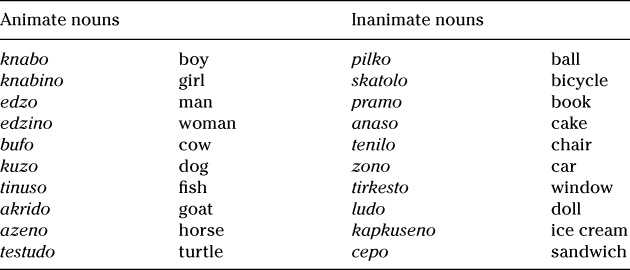
The language to be learned was based on Esperanto and consisted of 20 different nouns—10 animate and 10 inanimate (see Appendix A)—19 transitive verbs, six intransitive verbs, and five adjectives. We created the language by either taking over both the form and the meaning of existing Esperanto words or by taking the form of Esperanto words and giving them a new meaning.
We also modified the grammar of Esperanto to include DOM. The DOM preposition was al “to.” The language had subject-verb-object word order. Nouns were preceded by the definite article ese “the.” Verbs always appeared in the third-person singular present tense and ended in the suffix -as (e.g., batas “eats,” estas “is,” etc.). Also, participial adjectives in the predicate position ended in the suffix -ita (e.g., vundita “broken,” hakita “cut,” etc.). Four simple sentence structures were used (see Table 1).
Target language sentence types
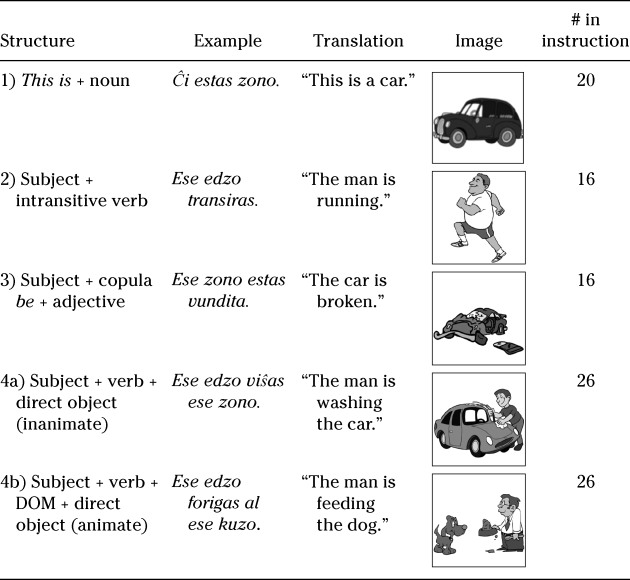
Note. DOM = differential object marking.
Instruction
The purpose of the instruction was to teach participants the new language and the target DOM structure within this language. The instruction materials consisted of 104 simple black-and-white images that straightforwardly represented everyday objects and activities, and 104 auditorily presented sentences describing these images. Every trial started with a simple image presented on the screen. After 1,000 ms, the sentence describing that image was played. After that, the image remained on the screen for another 1,500 ms, and then a new trial started.
Half of the trials (i.e., 52) in the instruction were filler trials. Their purpose was to hide the real focus of the instruction for the implicitly instructed group and also to introduce nouns and to facilitate participants’ learning of nouns. The other 52 trials were target trials whose purpose was to provide exposure to DOM. These trials consisted of transitive sentences, of which half had animate direct objects and the other half had inanimate direct objects. Among the 10 animate nouns, nine appeared twice, and one noun (kuzo “dog”) was overrepresented and appeared eight times in the object position.Footnote 4 Among the 10 inanimate nouns, nine appeared twice and one (anaso “cake”) was overrepresented and appeared eight times as a direct object. Trials were presented in a fixed order and in such a way that new object names were always first introduced by both this is fillers and intransitive fillers before they appeared in the target trials. The instruction also featured target blocks whose purpose was to provide a more intensive exposure to the target structure and to facilitate its noticing. These blocks always consisted of two target trials featuring animate objects, followed by two target trials featuring inanimate objects, or vice versa.
The verbs always appeared in the third-person singular form. Fourteen of the 19 transitive verbs appeared three times, whereas the remaining five appeared twice. There were four verbs that were animacy neutral, which means that they could be combined with both animate and inanimate objects and produce equally plausible sentences. These verbs were kunigas “holds,” kirlas “looks at,” viŝas “washes,” and gastas “buys.” In the instruction, each of them appeared three times.
The instruction for the explicit and implicit instruction groups was identical, the only difference being that two target trials in the explicit instruction were replaced by screens explaining the rule to the participants, using the two replaced trials as examples. The DOM rule explanation was presented after 15 trials (10 fillers and five target trials), and it was in Dutch. The participants were first told that the word order in the language they were learning was the same as in Dutch—namely, subject-verb-object word order. Then the DOM rule was explained using two example sentences (one featuring an animate direct object, and the other featuring an inanimate direct object) that were presented auditorily. Participants were never exposed to the written form of the language they were learning, neither during the instruction nor during the rule explanation.
Implicit Processing Test
The visual world eye-tracking paradigm was used to measure learners’ ability to use DOM as a cue to predict either animate or inanimate direct objects. In the task, participants listened to sentences and had to recognize the last word mentioned in each sentence by choosing the image that represented it. In every trial, two simple, black-and-white images were displayed, one on the left and one on the right side of the screen. Participants were already familiar with the images they saw in this test because they had previously encountered them in the instruction (in the this is trials). The key word to which they were expected to respond was always the last noun in the sentence. They were encouraged to be as fast and accurate as possible, but they were not reminded of the target structure nor were they told where to look. In total, 72 trials were presented. Half of them were experimental trials, and half of them were fillers, which were included to hide the purpose of the experiment. The 36 experimental trials were transitive sentences, half of which had an animate direct object as the target noun (i.e., the noun to which the participants were expected to respond by choosing the correct image), and the other half had an inanimate direct object as the target noun. Also, in half of the trials, the images presented on the screen had same animacy (both animate or both inanimate), whereas in the other half of the trials, the images had different animacy (one animate and one inanimate). In this way, the variables direct object animacy (animate vs. inanimate) and options’ animacy (same vs. different) were systematically varied in the experiment, creating four conditions: animate same, animate different, inanimate same, and inanimate different. Participants were expected to use DOM to predict the correct direct object but only in the trials in which the animacy of the options was different (i.e., trials in which DOM was predictive of the correct answer, see the example in [1]). Specifically, in animate different trials, they were expected to use the preposition to predict that an animate object followed. In inanimate different trials, they were expected to use the absence of the preposition to predict that an inanimate object followed, because in the input to which they had been exposed, the absence of the DOM preposition was a reliable cue for the inanimacy of the direct object. The trials in which the options were of the same animacy (i.e., those in which DOM was not predictive of the correct answer) served as a baseline for comparison.
(1) Animate different trial
Ese knabo kunigas al ese tinuso.
“The boy is holding the fish.”

Nontarget image Target image


A balanced design was created that had eight experimental items per condition. The following factors were balanced across the four conditions: Four animacy-neutral verbs were used equally frequently in each of the four conditions: kunigas “holds,” viŝas “washes,” kirlas “looks at,” and gastas “buys”; eight different direct object nouns were used, once per condition; each of the four subject nouns was used twice per condition: edzo “man,” edzino “woman,” knabo “boy,” and knabino “girl”; and in each of the four conditions, the target image was presented on the left and on the right side of the screen equally often. There were four additional items that featured unknown target nouns that had not appeared in the instruction. Their purpose was to check how learners mapped their acquired DOM knowledge onto new items. The remaining 36 items were fillers. They had this is + noun structure. As with the experimental items, the animacy of the target nouns and the options’ animacy status were varied systematically.
All sentences in the implicit processing task were constructed in such a way that both target and nontarget nouns were plausible direct objects of the sentences (e.g., The girl looks at the turtle vs. the doll). This was important to avoid plausibility-motivated eye predictions. Participants practiced on six items before the actual test started.
Before each trial, participants saw a fixation cross in the middle of the screen. After they fixated their eyes on the cross for 1,000 ms, the trial started and the fixation cross was replaced by two images, which the participants could look at for 1,000 ms before the sound was played. As soon as the participants chose the correct image by pressing either “z” (to choose the left image) or “m” (to choose the right image) on the keyboard, the next trial started. Participants had 5,000 ms maximally to respond, and if this time limit was reached, the next trial started. Participants’ accuracy, response times (RTs), and eye movements were recorded.
Oral Grammaticality Judgment Task
An oral GJT was used to measure participants’ explicit knowledge of the DOM structure. In every trial, participants saw an image representing a transitive activity, and they heard a sentence describing the image. They had to decide if the sentence was grammatical or ungrammatical. For each item, source attributions were elicited (i.e., whether the decision was based on guessing, intuition, familiarity, or rule; Dienes & Scott, Reference Dienes and Scott2005). Images were added to facilitate understanding of the sentences and to make sure that grammaticality judgments were not conditioned by incomplete acquisition of the words. Participants were allowed to replay every sentence as often as they wanted. Ungrammaticality always stemmed from incorrect use of the DOM structure. If the sentences were grammatical, they had al in front of animate but not inanimate objects, and if the sentences were ungrammatical, they had al in front of inanimate but not animate objects, as shown in the example in (2). Thus, there were four types of trials (conditions): grammatical and ungrammatical animate trials and grammatical and ungrammatical inanimate trials. There were 16 trials in total (four per condition). Sentences used in the GJT were always combinations of verbs and direct object nouns that participants had not heard before. Also, the number of different verbs and direct object nouns that the sentences contained was balanced across the four conditions.
(2) Ungrammatical animate trial
*Ese knabo bekas al ese kapkuseno.
“The boy is eating the ice cream.”

Procedure
Participants did the experiment in a quiet room, and the materials were presented using the E-Prime software (Schneider, Eschman, & Zuccolotto, Reference Schneider, Eschman and Zuccolotto2002) on a Tobii TX120 computer. The screen was 60 cm away from participants’ eyes, and the sentences were presented through loudspeakers. Before the experiment started, the eye-tracker was calibrated to each participant’s eyes. During the experiment, the Tobii recorded the participants’ eye movements at a rate of 120 Hz.
Participants were randomly assigned to either the implicit or explicit instruction group. The instructions that the participants received before each part of the experiment were in Dutch. They were presented visually on the screen and were also played out loud as recorded by a female native speaker of Dutch. The experimental session consisted of 11 min of instruction in the new language followed by the implicit processing test and the oral GJT. The instruction and test materials were recorded by a male native speaker of Spanish from Chile. Several instances of every sentence were recorded, and the best one was chosen and included in the experiment. Participants were told that they would be taught a new language and that their task was to try and learn the new language as well as they could. They were also told that their knowledge of the new language would be tested after the instruction. The experiment lasted about 35 min.
After the experiment, participants were debriefed. First they were asked about the general purpose of the experiment and about aspects of the new language they managed or did not manage to learn. Then, the target rule was explained to them, and they were asked whether they had noticed it and whether it had helped them in Test 1 and Test 2. After this, they were told the purpose of the experiment. The study was approved by the Ethics Committee of the University of Amsterdam.
Eye-Tracking Data Analyses
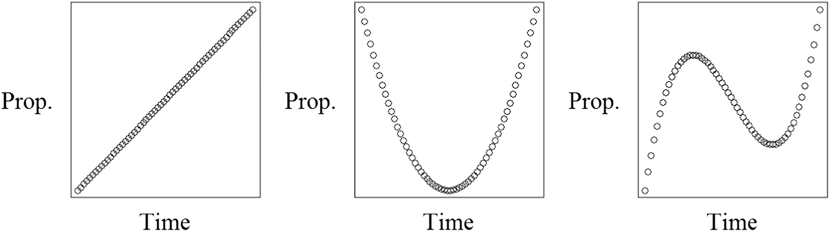
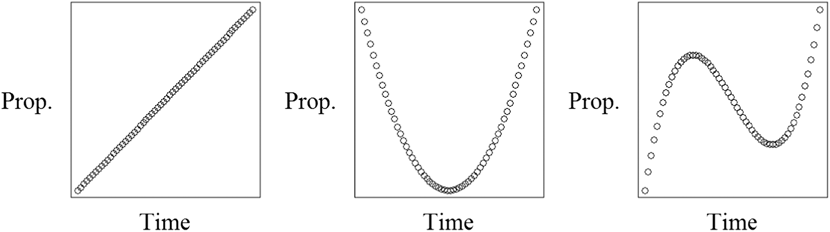
For the eye-tracking data, a generalized linear mixed-effects (GLME) growth curve analysis was chosen. The method is described in Mirman, Dixon, and Magnuson (Reference Mirman, Dixon and Magnuson2008) and is applied in Lentz (Reference Lentz2011). By fitting latent growth curve models, we tested whether our participants were more likely to look at the correct image in the course of time. Participant and trial were modeled as joint random variables. The dependent variable was binomial: whether the participant was or was not looking at the correct image at each point in time within the critical region. The variables group (implicit or explicit) and options’ animacy (same or different) were introduced as fixed effects. In addition, for each analysis presented, third-order (linear, quadratic, and cubic), orthogonal, and polynomial time vectors were created in the time range under investigation, which were introduced as additional fixed effects variables. Figure 1 displays these vectors, each of which is a potential description of how the proportion of looks at the correct image develops over time. An exploratory procedure was used to test which (combination of) time vectors described our data best.
First-, second-, and third-order orthogonal polynomials that can describe possible courses for the proportion (prop.) of looks to the correct image over time.
Time was expressed in sampling frames, in which each frame equaled 8.33 ms. For each frame, one or zero was scored, depending on whether the participant was looking at the correct or the incorrect image, respectively. Frames were excluded from the analyses when participants were looking outside the regions of interest or when data were missing due to blinking or looking away. Approximately 29% of all frames were excluded. Because the time ranges of the critical regions in animate (al ese) and inanimate (ese) trials differed, all analyses were run separately for animate and inanimate sets of trials. In both sets, we tested the hypothesis that the time course of looks at the correct image differed with options’ animacy status, such that anticipatory processing (an increase over time in the proportion of looks at the correct image) was only present when the options had different animacy status. In addition, we tested the hypothesis that metalinguistic information allowed learners to anticipate, which would be evidence of an interface. In other words, we were interested in whether there was an interaction between options’ animacy status and group.
When using linear mixed-effects modeling for confirmatory hypothesis testing, Barr, Levy, Scheepers, and Tily (Reference Barr, Levy, Scheepers and Tily2013) recommend applying maximal random effects structures. We followed this recommendation and included by-subject and by-item random intercepts and slopes for each effect modeled. In the eye-tracking data, the by-subject random slope for group and the by-item random slope for options’ animacy status were not included. They were not identifiable because subjects were nested within groups and items within item type (same or different). As previously indicated, the analyses were also exploratory in that we did not know in advance what trajectory to expect and how this trajectory might be affected by our fixed variables. We therefore ran several models that always included the variables options’ animacy status and group, but these models varied by which polynomial time vectors were included.Footnote 5
Participants’ eye movements were recorded from sentence onset to sentence offset. Two time ranges were created. The first one included only the time before the disambiguating target noun. In animate trials, the critical region (in which DOM-based predictions could be observed) ran from the onset of the DOM preposition to the onset of the target noun. An independent-samples t test showed that the duration of the critical region did not differ significantly between the different (M = 501 ms, SD = 41 ms) and the same (M = 498 ms, SD = 55 ms) trials, t(14) = 0.12, p = .909. In inanimate trials, the critical region was shorter and ran from the onset of the determiner ese “the” to the onset of the target noun. Again, an independent-samples t test showed that the duration of this region did not differ significantly between the different (M = 299 ms, SD = 54 ms) and the same (M = 291 ms, SD = 52 ms) trials, t(14) = 0.30, p = .769. The second time range consisted of the first time range plus 500 ms into the target noun. In other words, this time range captured not only predictive looks but also looks in response to the disambiguating noun. To both time ranges a correction of 200 ms was applied to account for the fact that adult eye responses to auditory stimuli are typically delayed by at least 200 ms (Dahan, Magnuson, Tanenhaus, & Hogan, Reference Dahan, Magnuson, Tanenhaus and Hogan2001).
The items with new, unknown objects were excluded from the analyses, as these may have elicited rather divergent response behavior. To perform the analyses, R (R Development Core Team, 2011) and the lme4 package (Bates, Maechler, & Bolker, Reference Bates, Maechler and Bolker2011) were used.
RESULTS
Grammaticality Judgment Test Results
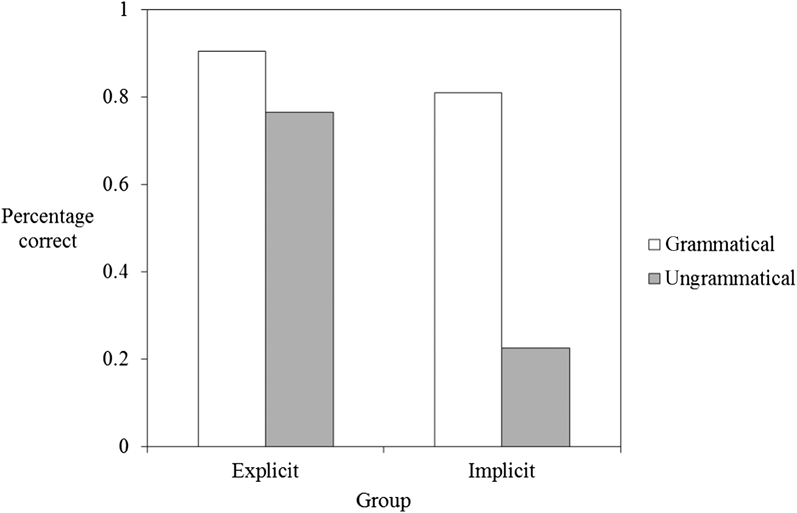
The first step in the analysis was to confirm that our implicitly and explicitly instructed groups differed in their explicit knowledge of DOM, a prerequisite for a valid investigation of the impact of explicit knowledge on implicit processing. On the oral GJT, participants averaged 68% correct (SD = 46.7). The explicit group had an average accuracy of 83% (SD = 37.2), whereas the implicit group performed at chance (52% accurate, SD = 50.0). We ran a fully specified GLME model with participant and item as joint random effects. The chance of a correct answer was modeled to be a function of group (explicit or implicit) and trial grammaticality status (grammatical or ungrammatical). We found a main effect of group, b = −1.19, SE = 0.43, p = .006, meaning that explicit learners were significantly more accurate than implicit learners. There was no main effect of grammaticality, b = −1.01, SE = 0.61, p = .100, but we found an interaction between group and grammaticality, b = −2.02, SE = 0.65, p = .002. Namely, both groups scored well on the grammatical items, but the implicit learners were significantly less accurate when responding to ungrammatical items compared to the grammatical ones. Apparently, they had a strong preference for labeling sentences in the GJT as grammatical. Figure 2 displays the results graphically.
Accuracy on the grammaticality judgment task (GJT), split by group and grammaticality.

The source attribution data confirmed that the explicit learners based their decisions on the rule, as they reported having done so for 71% of all trials. Only one participant in the explicit group never reported having used the rule, whereas six participants based their decisions on the rule only. The implicit group based their decisions on the rule in 12% of all trials; 14 participants never based any decisions on the rule, whereas only one participant claimed to have used the rule in 10 out of 16 trials (63%).
Implicit Processing Test Results: Accuracy and RTs
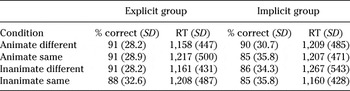
To explore the implicit processing test results, we first investigated how well participants had learned the language by assessing how accurate and how quick they were in choosing the correct image in the implicit processing task. It should be noted that both the accuracy and the RT measures may reflect DOM-related processing effects; if participants used the presence or absence of DOM to decide on the correct image, this would show up as a significant effect of options’ animacy status or of the group by options’ animacy status interaction. Overall test accuracy was 88% (SD = 32.7) for the experimental items. Table 2 displays the accuracies for each group and condition. A fully specified GLME model showed that there were no effects of group, b = −0.01, SE = 0.04, p = .875; direct object animacy, b = 0.00, SE = 0.04, p = .921; and options’ animacy status, b = −0.01, SE = 0.04, p = .740. The group by options’ animacy status interaction was also not significant, b = −0.04, SE = 0.05, p = .419, nor were any of the other interactions. Both groups managed to learn the nouns of the artificial language equally well, and trial features did not affect accuracy.
Overview of mean accuracies, RTs, and their standard deviations for the two groups in each of the four conditions of Test 1

Note. RT = response time.
A similar analysis was run on the RT data. This analysis was based on correct responses to the experimental items only. Participants’ RTs were measured from target noun onset. Table 2 presents mean RTs per group and condition. We ran a fully specified linear mixed model that included group, direct object animacy, and options’ animacy status. Noun duration was also included to control for the effects of differences in target noun length. This model failed to converge. Therefore, we ran a simpler model without random slopes, including random intercepts for participant and item only. There were no effects of group, b = 60.91, SE = 81.07, p = .453; direct object animacy, b = 15.95, SE = 94.71, p = .867; options’ animacy status, b = 20.07, SE = 94.89, p = .833; or noun duration, b = 0.28, SE = 0.59, p = .640. There was also no significant group by options’ animacy status interaction, b = −24.32, SE = 72.44, p = .741), or any other interaction. The results imply that in Test 1, explicit knowledge of DOM did not give explicit learners any speed advantage in deciding on the correct answer.
Implicit Processing Test Results: Eye-Tracking Data
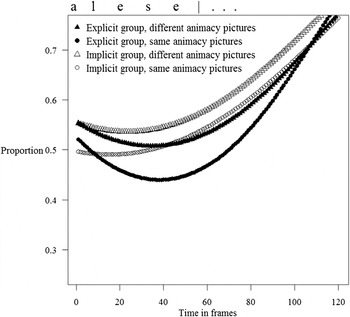
To investigate the hypothesis that participants can learn to use DOM as a cue to predict the direct object and that this ability may be different for explicitly and implicitly instructed learners, a maximally specified random effects baseline model was fitted that included the fixed effects of group (implicit or explicit) and options’ animacy status (images of same or different animacy). The analyses were run separately for animate and inanimate trials. In an exploratory procedure, we investigated how the proportion of looks toward the correct direct object developed over time in the critical window between preposition/determiner onset and direct object onset. The first-, second-, and third-order time vectors (and their combinations) were added step by step. Appendix B lists the models compared. In Model 1, for example, the linear time vector was added, and this model assessed whether the proportion of looks toward the correct image can be described as a gradual, linear development (increase or decrease) over time. Likelihood tests were used to assess model improvement. The second-order quadratic time vector was found to describe this time course best for both animate and inanimate trials: Models that included this vector always fitted the data significantly better than the baseline model. When we compared the models containing the second-order polynomials against one another, Model 2 was found to be the best fitting model for the inanimate trials, whereas Model 4, which also includes the linear polynomial, fitted the animate trials better.
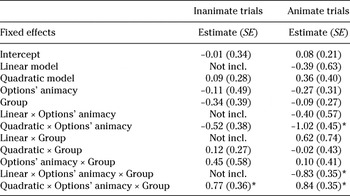
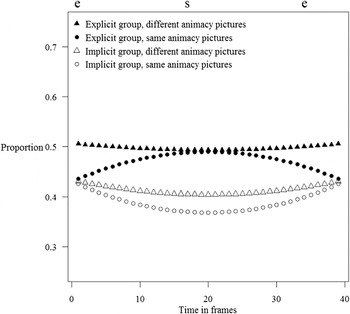
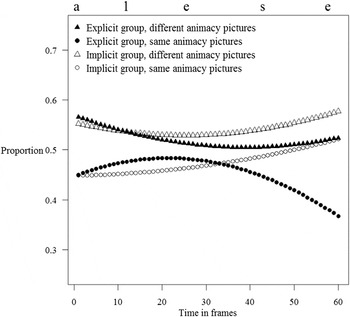
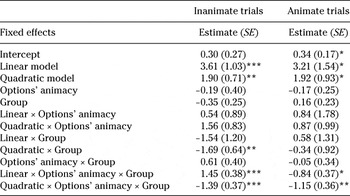
Table 3 spells out the fixed effects parameter estimates of the best fitting model for inanimate trials and animate trials. We expected that the time course of looks on the correct image would be different depending on the options’ animacy status and group. For the inanimate trials, no significant effects were found except for the three-way interaction between the second-order time vector, options’ animacy status, and group. For the animate trials, a similar picture emerged, although two additional effects were found to be significant: the interaction between second-order time vector and options’ animacy status and the three-way interaction between first-order time vector, options’ animacy status, and group. To help understand these interactions, the estimated values for each condition were plotted in Figures 3 and 4. The figures show that the general pattern in both inanimate and animate trial sets is an initial slight decrease in the proportion of looks at the correct image followed by a slight increase. However, explicitly instructed learners showed the exact opposite pattern when the animacy of the options was the same. This finding appeared to be true for both animate and inanimate trials. We must also point out the nonsignificant intercept terms, which indicate that, over the entire time range, participants were equally likely to look at the correct and the incorrect direct objects. In summary, participants were not found to predict the upcoming direct object in the trials that featured options of different animacy status, but there was a difference between the groups on the same animacy trials.
Model results (fixed effects only) for inanimate and animate trials on a time range from determiner/preposition onset to direct object onset

Note. Not incl. = not included in the model.
* Significantly different from zero when α < .05.
The proportion of looks (estimated values) toward the target image on inanimate trials over time (each frame equals 8.33 ms), split by group (explicit or implicit) and options’ animacy (images of same or different animacy). The text above the figure indicates what participants were listening to in the time course presented.

The proportion of looks (estimated values) toward the target image on animate trials over time (each frame equals 8.33 ms), split by group (explicit or implicit) and options’ animacy (images of same or different animacy). The text above the figure indicates what participants were listening to in the time course presented.

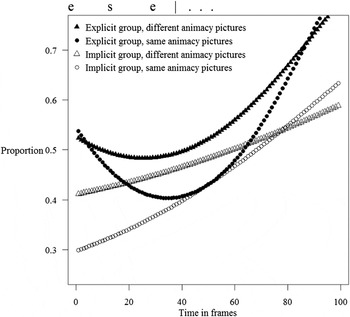
Next, we ran the same analyses on the second time range that included 500 ms of the disambiguating direct object to check if the effects of explicit instruction were somehow delayed. For both animate and inanimate trial sets, the model that included both linear and quadratic time vectors was found to be the best fitting model (Model 4 in Appendix B). Table 4 lists the results for both sets, and Figures 5 and 6 display the results graphically. Significant effects were found for the linear and quadratic time vectors, which indicate that the development of the proportion of looks toward the correct image over time can be described by a line that decreases before it increases (the second-order time vector) and that this line is tilted upward, reflecting an overall increase over time in looks toward the correct image (the first-order time vector). Despite this overall increase, the intercept for the inanimate set is not significant, indicating that, over the entire time range, participants were not looking at the correct image more than the incorrect image. The significant three-way interaction effects that are present in both the inanimate and animate data sets suggest that the trajectories for the explicitly instructed learners seem to follow the second-order polynomial more, consistently showing a stronger dip before the lines rise, whereas the implicit learners’ trajectories pattern more with the first-order polynomial, which describes a linear increase.
Fixed effects for inanimate and animate trials on the time range that included 500 ms of the disambiguating noun

* p < .05.
** p < .01.
*** p < .001.
The proportion of looks (estimate values) toward the target image on inanimate trials over time (each frame equals 8.33 ms), including 500 ms into the direct object, split by group (explicit or implicit) and options’ animacy (images of same or different animacy). The text above the figure indicates what participants were listening to in the time course presented.

The proportion of looks (estimated values) toward the target image on animate trials over time (each frame equals 8.33 ms), including 500 ms into the direct object, split by group (explicit or implicit) and options’ animacy (images of same or different animacy). The text above the figure indicates what participants were listening to in the time course presented.

Because the GJT results revealed that not all explicitly instructed learners had gained much explicit knowledge of the DOM structure, the analyses were rerun on a sample from which eight explicitly instructed participants were excluded because they scored less than 70% correct on the GJT. The analyses showed that even the participants who clearly had explicit knowledge of DOM were not able to show DOM-related predictions.
Debriefing Results
A debriefing session revealed that none of the learners were aware of the real purpose of the experiment. They generally reported that they thought the experiment was about how quickly and successfully one can learn a new language. Participants from the implicit group reported that they mostly managed to learn the new nouns but were not paying much attention to the grammar of the language. When asked whether they had noticed the DOM rule, all of them said that they had not. In the GJT, they started to realize that they had been supposed to learn grammar, but they based their judgments on the nouns they had learned. Participants from the explicit group reported that they managed to learn the nouns and the DOM rule. When asked whether they had found the rule helpful, all participants agreed that the rule was helpful during the GJT. Only three of the 26 explicit learners said that the rule was helpful during the implicit processing test as well. The other learners said that they had been paying attention not to the rule but to the nouns in this task.
DISCUSSION
In this study, we investigated how explicit knowledge of the DOM rule in an artificial language influenced its implicit processing. Participants were taught an artificial language that included DOM by looking at images and listening to sentences describing the images. Two groups were randomly created, one of which received a brief explicit instruction about DOM. The results of the oral GJT and the debriefing session confirmed that there were clear differences between the groups in explicit knowledge of the target structure, although not all explicitly instructed participants gave evidence of having explicit knowledge of DOM. This result replicates the findings of numerous SLA studies that have repeatedly found strong effects of explicit instruction on explicit measures of knowledge (for reviews, see DeKeyser, Reference DeKeyser, Doughty and Long2003; Doughty, Reference Doughty, Doughty and Long2003; Norris & Ortega, Reference Norris and Ortega2000).
The implicit processing task results were not so clear cut. Learners’ eye-movement behavior was obtained to investigate whether learners were able to use DOM to predict the upcoming direct object and, more specifically, to investigate if the presence of explicit DOM knowledge would promote this ability. Considering that Spanish native speakers have been shown to use the presence of DOM to predict animate direct objects (Curcic et al., Reference Curcic, Rivera and Andringa2014), we hypothesized that if learners were able to process DOM implicitly, they would increasingly look toward the correct image (immediately on hearing the DOM preposition and before hearing the target noun) in animate trials in which the images had different animacy status. Also, given the nature of the artificial language input, we considered it possible that learners might use the absence of the DOM preposition as a reliable cue toward inanimate direct objects.
However, in the critical region from DOM preposition onset to direct object onset, we did not find an increase in looks toward the correct image. Contrary to our expectations, a three-way interaction was observed, indicating that the explicitly instructed group behaved differently when the pictures had the same animacy status. One would be inclined to dismiss this effect as spurious if it had not been observed independently in both inanimate and animate trial sets. When the critical region was prolonged to include 500 ms of the disambiguating direct object, the results gave further evidence of a group difference in that the implicit group appeared to show a gradual linear increase in the proportion of looks toward the correct image, whereas the explicit group showed a decrease before an increase.
It is not easy to explain why a group effect in eye-tracking data was observed in same animacy trials. Our hypothesis was that metalinguistic information might be a shortcut to more nativelike ways of DOM processing whenever it was predictive of the direct object. Namely, we expected DOM-related effects to appear in the trials of different animacy status only. This hypothesis was clearly falsified, as an unexpected difference between the explicit and implicit group was observed in same animacy trials only, although it was small and appeared somewhat late. This difference could perhaps be described as an extended period of indecision and might be evidence of a disambiguation process that was triggered by the presence of metalinguistic information. It may have appeared in the same animacy trials exactly because disambiguation is problematic in these trials, and it may have appeared late because learners were probably expending quite some conscious effort in trying to understand the sentences of a language they did not fully master. However, this may be reading too much into the data. It is still possible that these results were somehow caused by unexpected features of the trials or by a mere coincidence. In any case, there are fundamental reasons to interpret these results with caution.
Interpreting the present data is difficult because too little is known about how metalinguistic information influences implicit processing. Good reference studies do not exist for eye-tracking data and this particular method. In this study, we tested a clearly defined hypothesis, but it was based on reference data of native speakers of Spanish. They were found to use DOM predictively, but it is important to note that they were processing their native language, to which they had effortless and easy access. Therefore, their results probably stemmed from fully unconscious and automatic processing of DOM, although it is possible that native speakers actually had processing capacities to spare to execute the task in more strategic ways by applying some kind of explicit rule knowledge. In any case, it may not have been entirely valid to base our hypothesis on native speaker processing.
Our hypothesis was also based on several studies that showed that learners can come to process L2 structures in nativelike ways (e.g., Dussias et al., Reference Dussias, Valdés Kroff, Guzzardo and Gerfen2013; Osterhout et al., Reference Osterhout, McLaughlin, Pitkanen, Frenck-Mestre and Molinaro2006; Osterhout et al., Reference Osterhout, Poliakov, Inoue, McLaughlin, Valentine, Pitkanen and Hirshensohn2008; Sabourin & Stowe, Reference Sabourin and Stowe2008; Tokowicz & Warren, Reference Tokowicz and Warren2010) and on studies showing that metalinguistic information can help learners to process their L2 in more nativelike ways (Davidson & Indefrey, Reference Davidson and Indefrey2009). It should be reiterated that the use of ERPs and eye-tracking measures does not ensure that a particular structure is processed implicitly. For instance, Davidson and Indefrey (Reference Davidson and Indefrey2009) investigated gender-based processing in the context of three- and four-word phrases, and both the native speakers and L2 learners must have been highly aware of the target structures under investigation due to the use of grammaticality judgments. It is questionable whether ERP data on such judgments give insight into implicit processing. They more likely reflect the online application of explicit knowledge. In the present study we attempted to prevent the implicit group from becoming aware of the target structure by using auditory materials, fillers, and a test procedure that included only grammatical trials and that attracted attention away from the target structure. More research is needed to investigate the nature of online processing in different tasks (but see Godfroid et al., this issue).
This study was one of the first to investigate the impact of metalinguistic information on implicit processing in the initial stages of L2 acquisition and is best interpreted as an exploratory study. Because the effects were small and unexpected, they stand in need of replication before too much weight is given to them. The study can be improved in several ways. The instruction was relatively brief, and the metalinguistic information given to the explicit group took the form of a mere rule statement. In a replication, the difference between the two groups could be made larger by reinforcing the rule throughout the instruction and perhaps even right before or during the online processing task. Also, the input could be intensified to investigate if learners’ processing will start to resemble native speaker implicit processing at some point as well as to see to what extent differences occur between the groups in terms of not only success and speed but also levels of awareness, because it is not unthinkable that implicitly instructed learners may generate a certain amount of awareness at some point in the course of their learning process. The purpose of this study was not to investigate implicit learning. The implicit condition served as a mere control. However, this method can perhaps also be used to study implicit learning if a design is adopted that allows for sufficient time and input for implicit learning to take place.
Perhaps the most important contribution that this study has made is that it has demonstrated a method that may potentially further the interface debate. If the results reported hold in an improved replication, then this may be evidence of an interface between metalinguistic knowledge and implicit processing.
APPENDIX A TARGET LANGUAGE NOUNS
APPENDIX B LIST OF TIME VECTOR MODELS COMPARED