INTRODUCTION
Large-bodied (>3 kg), frugivorous primates are often important seed dispersers (Koné et al. Reference KONÉ, LAMBERT, REFISCH and BAKAYOKO2008, Link & DiFiore Reference LINK and DI FIORE2006, Moses & Semple Reference MOSES and SEMPLE2011, Poulsen et al. Reference POULSEN, CLARK and SMITH2001, Stevenson et al. Reference STEVENSON, CASTELLANOS, PIZARRO and GARAVITO2002). In such circumstances primates fit the criterion for true dispersal proposed by Howe (Reference HOWE1989), in that as a result of dispersal (whether from expulsion in faeces, spitting out, being dropped during processing or carried to new locations: Lambert & Garber Reference LAMBERT and GARBER1998), seeds are moved beyond the mother tree canopy. Primates are not tidy eaters, and it is common for a significant amount of food to be dropped during a feeding bout (de Figueiredo Reference DE FIGUEIREDO1993, Zhang Reference ZHANG1995). In frugivorous or granivorous species, many of these discarded items contain seeds.
Seed dispersal is considered a common byproduct of primate feeding, but such dispersal has not been regularly associated with three constituent genera (Cacajao, Chiropotes and Pithecia) of Neotropical primate subfamily Pitheciinae, all of which have traditionally been considered as specialist consumers of unripe seeds (Barnett & Brandon-Jones Reference BARNETT and BRANDON-JONES1997, Barnett et al. Reference BARNETT, DE CASTILHO, SHAPLEY and ANICÁCIO2005, Kinzey Reference KINZEY1992). In species of uacari (Cacajao spp.) and cuxiú (Chiropotes spp.; also called bearded sakis, see Barnett et al. in press), seeds may exceed 60% of the diet (Ayres Reference AYRES1989, Boubli Reference BOUBLI1999, Boyle et al. Reference BOYLE, ZARTMAN, SPIRONELLO and SMITH2012, Veiga Reference VEIGA2006). Immature seeds dominate, and most are not ingested whole, but triturated to a pulp (Norconk Reference NORCONK, Campbell, Fuentes, MacKinnon, Bearder and Stumpf2011). Such primates are ‘pre-dispersal seed predators’ (sensu Janzen Reference JANZEN1971). However, Norconk et al. (Reference NORCONK, GRAFTON and CONKLIN-BRITTAIN1998) considered the possibility that pitheciins can assist with seed dispersal via different mechanisms, including removing the pericarp and seed coat before dropping it and swallowing seeds without masticating them. However, these observations were not backed-up with germination trials. In another study, Grafton et al. (Reference GRAFTON, NORCONK and RAGHANTI2002) found whole seeds of Alibertia latifolia and Coccoloba striata (Polygonaceae) in 83.1% of tested P. pithecia faecal samples (N = 160). However, this study also lacked germination trials and, while demonstrating dispersal was possible, did not conclusively demonstrate its occurrence.
Here we report on field studies of seed dispersal by three pitheciin seed-predators: the golden-backed uacari (Cacajao melanocephalus ouakary), the brown-backed cuxiú (Chiropotes chiropotes) and the red-nosed cuxiú (Chiropotes albinasus). The Cacajao population annually spends 9 mo (Barnett Reference BARNETT2010) in blackwater flooded forest (igapó: sensu Prance Reference PRANCE1979) and the two Chiropotes study populations inhabit lowland Amazonian unflooded (terra firme) forest (Boyle et al. Reference BOYLE, LOURENÇO, DA SILVA and SMITH2009, Pinto Reference PINTO2008). Fruits of terra firme trees are mostly bird- or primate-dispersed, whereas fish and water are the dominant fruit dispersal agents in igapó (Correa et al. Reference CORREA, WINEMILLER, LÓPEZ-HÉRNANDEZ and GALETTI2007, Goulding et al. Reference GOULDING, LEAL CARVALHO and FERREIRA1988). Because of these fundamental disparities in dispersal ecology, we examined the potential for seed dispersal in igapó and terra firme species.
Uacaris and cuxiús are sclerocarpic foragers (Kinzey & Norconk Reference KINZEY and NORCONK1990, Rosenberger Reference ROSENBERGER1992), specializing in hard-husked fruits whose protective pericarps they remove using their procumbent incisors and hypertrophied canines (Kinzey Reference KINZEY1992). The eaten seeds are often immature, but, based on the work of Norconk et al. (Reference NORCONK, GRAFTON and CONKLIN-BRITTAIN1998), we hypothesized that these three species act as effective seed dispersers for some species. Therefore, we predicted that these three primate species may serve as primary dispersers of some plant species by (1) discarding or dislodging unripe and ripe fruit during feeding bouts, without damage to the seeds; (2) ingesting and subsequently defecating intact seeds; and (3) transporting the seeds from the mother tree; and that seeds under these three conditions would germinate successfully.
METHODS
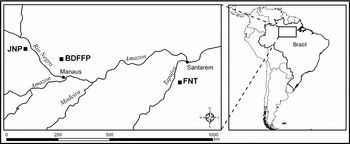
The three pitheciin species were studied at three separate study sites in Brazilian Amazonia (Figure 1): Cacajao melanocephalus ouakary at Jaú National Park (Barnett et al. Reference BARNETT, SHAW, SPIRONELLO, MACLARNON and ROSS2012b), Chiropotes chiropotes in forest fragments and continuous forest near Manaus (Boyle & Smith Reference BOYLE and SMITH2010, Boyle et al. Reference BOYLE, LOURENÇO, DA SILVA and SMITH2009, Reference BOYLE, ZARTMAN, SPIRONELLO and SMITH2012) and Chiropotes albinasus at Tapajós National Forest (Pinto Reference PINTO2008). These three studies were conducted independently and then the results brought together for comparative purposes of the current study. For this reason, differences exist in the precise details of how seed germination trials were conducted. However, we do not consider these variations to impair overall data comparability.
Study site locations for Cacajao melanocephalus ouakary (Jaú National Park; JNP); Chiropotes chiropotes (Biological Dynamics of Forest Fragments Project; BDFFP); and Chiropotes albinasus (Tapajós National Forest; FNP) in the Brazilian Amazon.

The Latin name for the golden-backed uacari follows Hershkovitz (Reference HERSHKOVITZ1987) because the precise appellation is currently disputed (Boubli et al. Reference BOUBLI, DA SILVA, AMADO, HRBEK, PONTUAL and FARIAS2008). Chiropotes taxonomy is also debated (Bonvicino et al. Reference BONVICINO, BOUBLI, OTAZÚ, ALMEIDA, NASCIMENTO, COURA and SEUÁNEZ2003, Hershkovitz Reference HERSHKOVITZ1985), and here we follow Barnett et al. (Reference BARNETT, SHAW, SPIRONELLO, MACLARNON and ROSS2012a, in press).
Study sites
Cacajao melanocephalus ouakary was studied in Jaú National Park (01°53.16′S, 61°44.31′W), a 2 227 000-ha protected area on the southern bank of the Rio Negro some 220 km upriver from Manaus, Brazil, between October 2006 and April 2008 (Barnett Reference BARNETT2010). Data collection involved three groups of uacaris, two of which seasonally used both terra firme and igapó forests, and one of which used only igapó.
Chiropotes chiropotes was studied at the Biological Dynamics of Forest Fragments Project (BDFFP) site (02°20′S, 60°06′W–02°26′S, 59°44′W), approximately 60 km north of Manaus, from January 2005 until April 2006. During this time cuxiús were observed eating 244 plant species (Boyle et al. Reference BOYLE, ZARTMAN, SPIRONELLO and SMITH2012). Data on seed dispersal, presented in this manuscript, were collected from January 2006 to April 2006. Data collection involved six groups, two that lived in continuous forest, two that lived in separate 10-ha forest fragments, and two that travelled between the continuous forest and two different 100-ha forest fragments.
Chiropotes albinasus was studied in Tapajós National Forest (FNT), Pará State, Brazil (03°21′S, 54°56′W), a 560 000-ha protected area approximately 100 km from Santarém on the Santarém-Cuiabá road, between August 2004 and January 2006 (Pinto Reference PINTO2008). Data collection involved a single group inhabiting an area of dense, little-disturbed, lowland rain forest.
Field protocols
At Jaú National Park, C. m. ouakary in igapó was followed either on foot or in paddled wooden canoes, depending on floodwater levels. Terra firme observations were made from two 2-km transects, walked at 1 km h−1. Data on feeding and social behaviour were collected with scan sampling (Altmann Reference ALTMANN1974) every 30 s, in 5-min blocks, each block interspersed with 1-min of ad libitum sampling. At BDFFP, C. chiropotes groups were followed on foot (Boyle & Smith Reference BOYLE and SMITH2010, Boyle et al. Reference BOYLE, ZARTMAN, SPIRONELLO and SMITH2012), with behavioural and ecological data recorded every 5 min using group scan sampling (Altmann Reference ALTMANN1974, Boyle & Smith Reference BOYLE and SMITH2010). At FNT three people independently walked a trail system covering 1400 ha, until one team member contacted the C. albinasus study group. The other two team members were then summoned by radio. Behaviour was recorded once per visible individual at 10-min intervals (Pinto Reference PINTO2008).
At all three sites, animals were searched for and observed, whenever possible, from the start of morning activity until the end of afternoon activity (c. 06h00–18h00). At all sites, samples of diet items were collected directly from beneath a feeding tree following a feeding bout. If supplemental material was required to aid identification, it was collected directly from feeding trees after monkeys had left.
For the golden-backed uacari and brown-backed cuxiú, plant material was identified using a field guide to fruits (van Roosmalen Reference VAN ROOSMALEN1985), regional floras (Gentry Reference GENTRY1993, Ribeiro et al. Reference RIBEIRO, HOPKINS, VICENTINI, SOTHERS, DA COSTA, DE BRITO, DE SOUZA, MARTINS, LOHMANN, ASSUNÇÃO, DA PEREIRA, DA SILVA, MESQUITA and PROCÓPIO1999), Flora Neotropica volumes and the herbarium staff at the National Institute for Amazonian Research (INPA), Manaus. For the red-nosed cuxiú, in addition to the above, a study site-specific field guide to trees (Parrota et al. Reference PARROTA, FRANCIS and ALMEIDA1995) was used, with specimen identities checked with Universidade Federal do Pará specialists.
Germination trials
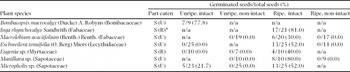
In the Cacajao study, seeds that fell during feeding bouts were collected from seven locally abundant species: Bombacopsis macrocalyx (Bombacaceae), Inga rhynchocalyx (Fabaceae), Macrolobium acaciifolium (Fabaceae), Eschweilera tenuifolia (Lecythidaceae), Eugenia sp. (Myrtaceae), Manilkara sp. (Sapotaceae) and Micropholis sp. (Sapotaceae). These seven species were chosen with the criteria that their fruits were: (1) indehiscent and multi-seeded, or (2) dehiscent (either single or multi-seeded), plus were (3) zoochorous or hydrochorous, and (4) known to be eaten by uacaris. Species with indehiscent single-seeded fruits were excluded, since they would no longer function as dispersive propagules once fed-upon by uacaris, as the result would be either: (1) complete consumption, (2) embryo removal or (3) damage sufficient either to kill the seed outright or permit invasion of pathogens (i.e. testa breached). An eighth species, Swartzia laevicarpa Amshoff. (Fabaceae), was collected, but germination trials were terminated due to storm waters.
Igapó species were inundated prior to being tested for germination because fruits of these tree species frequently spend extended periods immersed before germination (Parolin Reference PAROLIN2000, Reference PAROLIN2001; Parolin et al. Reference PAROLIN, DE SIMONE, HAAS, WALDHOFF, ROTTENBERGER, KUHN, KESSELMEIER, KLEISS, SCHMIDT, PIEDADE and JUNK2004). In a small forest stream near the research base, seeds were placed in plastic mesh bags and attached to immersed vegetation in a stream. Seeds were checked twice a month for 2 mo for signs of rot. Non-rotted seeds were then planted and monitored twice a month for 3 mo. For germination experiments, collected seeds were placed in plastic containers with forest-floor soil, then located in shade, covered in leaf litter and watered by natural rain showers. These studies were conducted at various times during the 19-mo residency at Jaú National Park, depending on when experimental subject species were fruiting. Cacajao faeces were also collected and analysed for the presence of seeds. In the field this analysis was done visually for large seeds and with a Beck portable dissecting microscope for smaller ones. The presence of very small seeds was assayed later in the laboratory using a Leica/WILD 3C binocular dissecting microscope, with a 10–40× zoom lens.
Separate inundation trials were conducted on Licania heteromorpha Benth. (Chrysobalanaceae) and Swartzia acuminata Willd. ex Vogel. (Fabaceae) in order to determine to what extent discarded items sink after being handled by the uacaris. For L. heteromorpha, 40 fruits had 25%, 50%, 75% or 100% of pericarp removed (10 fruits in each category), and then they were dropped from 1 m into igapó water, and given 30 s to surface and float. The same procedure was followed with S. acuminata, except these 40 fruits had 20%, 30%, 40% or 50% of the pericarp removed.
For both Chiropotes species, the exigencies of the behavioural study meant it was not possible to monitor seedlings in situ beneath parent trees. Hence, in the C. chiropotes study, seed germination was studied ex situ. All fruit items discarded during feeding were recorded over 4 mo (January–April 2006) of the 16-mo field project, and each classified for: ripeness (ripe, unripe), part eaten (fruit and/or seeds), and part(s) discarded (intact fruit, partially intact fruit, seed only). These items were collected and transported to the BDFFP base in Manaus. Here, under netted shade, seeds were placed in individual potting-soil filled plastic containers, watered regularly and monitored monthly for germination until December 2006. Germination was recorded as successful if the seed germinated and the seedling then remained alive for the duration of the study. Faeces were collected during daily follows and subsequently placed in soil and treated as above. Ex situ germination greatly diminishes the possibility of seed and seedling mortality by such biotic agents as seed-predating beetles, peccaries and fungi, so the resultant germination percentages may therefore overestimate the potential of C. chiropotes as a seed disperser.
For the C. albinasus study at FNT, germination experiments were not conducted. Field observations were, however, made on whether dropped items were ripe or unripe, whether fruit and/or seeds were eaten, and the parts discarded (defined as: intact fruit, partially intact fruit, seed only).
Frequency of dispersal
To be considered a legitimate disperser (Bustamente et al. Reference BUSTAMENTE, SIMONETTI and MELLA1992), an animal species must not only be capable of dispersing a plant species, but do so regularly. We investigated pitheciin potential to act as legitimate dispersers by calculating the maximum possible number of dispersal events for which an animal could be responsible. The full dataset required to calculate dispersal events was only available for C. m. ouakary. We collated the mean number of fruits C. m. ouakary ate daily for four species: Duroia velutina Hook f. ex K. Schum (Rubiaceae), Eschweilera tenuifolia (Lecythidaceae), Inga rhynchocalyx (Fabaceae) and Macrolobium acaciifolium (Fabaceae). We then multiplied this number by the mean seed number in each fruit (data derived from our own studies and van Roosmalen Reference VAN ROOSMALEN1985). To obtain the number of seeds potentially dispersed, we then multiplied this figure by the number of days fruiting (from our phenological studies), and then divided this maximum number by 23% (the percentage that Norconk et al. Reference NORCONK, GRAFTON and CONKLIN-BRITTAIN1998 recorded of fruits being dropped with pericarp removed). To get the maximum number of possible dispersal events, we then divided seeds potentially dispersed the value the percentage germination recorded for each of the four studied species (Table 1).
Maximum potential number of seed dispersal events per individual monkey per fruiting cycle for four plant species eaten by Cacajao melanocephalus ouakary at Jaú National Park, Amazonas, Brazil. Used the 23.5% figure from Norconk et al. (Reference NORCONK, GRAFTON and CONKLIN-BRITTAIN1998) to calculate both the proportion of single-seeded fruits dropped, and the number of fruits dropped per feeding on multi-seeded fruits. † Indicates aril removed by C. m. ouakary.

RESULTS
All three pitheciin species dropped seeds from intact and partially intact fruit to the ground while feeding (Figure 2), and all three species consumed seeds from unripe and ripe fruit. Cacajao m. ouakary ate fruits and seeds from 111 species: 95 species (85.6%) for their unripe seeds, 10 (9%) for ripe seeds, 10 (9%) for pulp, and six (4.5%) for arils or sarcotestas (nine (8.1%) appeared in more than one category). Of these 111 species, 33 (29.7%) were either multi-seeded and/or hydrochorous. When feeding on Eschweilera tenuifolia, in 31 of 33 (93.9%) of the observations, C. m. ouakary removed less than one dozen seeds (approximately 70 seeds or more were in each pyxidium) before the remainder tumbled into the water. While feeding on Bombacopsis macrocalyx, the uacaris extracted one to five unripe seeds; of 50 just-jettisoned fruits, 39 (78.0%) had at least one seed remaining.
Intact fruits and seeds that were dropped by Chiropotes chiropotes and subsequently germinated within 6 mo: Pouteria sp. (Sapotaceae) fruits (a); Catostemma albuquerquei (Bombacaceae) seed with partial removal of pericarp by a monkey (b); C. albuquerquei seed germinating 7 wk later (c); Caryocar villosum (Caryocaraceae) fruit with seed partially exposed (d); Eschweilera truncata (Lecythidaceae) seeds (e); and Couepia longipendula (Chrysobalanaceae) fruit (f). Photo credits: Sarah Boyle.

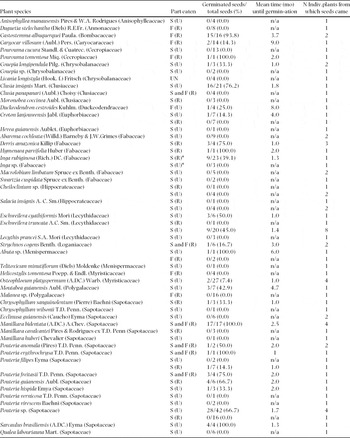
During the C. chiropotes germination study (January–April 2006), the monkeys discarded items during feeding from 84 individual trees and lianas from 49 species (35 genera, 20 families: Appendix 2), and 33.2% of the discarded items had at least one intact seed remaining. Of the 84 trees and lianas, 63% were consumed for unripe seeds, 35% for ripe seeds, 29% for pulp, arils and sarcotestas, and 2% were unknown (percentages total more than 100% because some species had multiple parts consumed).
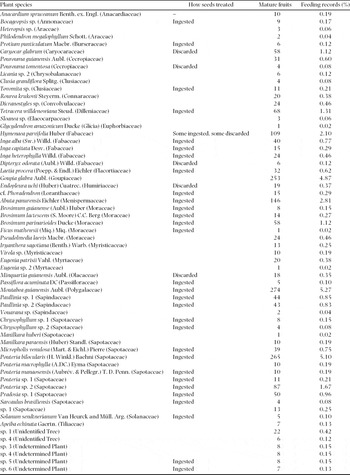
Chiropotes albinasus was recorded consuming 125 plant species from 38 families. These cuxiús ate mature fruits of 62 species in 32 families (Appendix 3), the most important being: Moutabea guianensis (Polygalaceae: 13.5%, N = 274 feeding records), Pouteria bilocularis (Sapotaceae: 13%) and Goupia glabra (Goupiaceae: 12.4%). Of the 62 species eaten in the mature state, 51 (82.3%) were eaten only for their pulp, with the ripe seeds either swallowed whole (30 species, including Abuta panurensis: Menispermaceae), or discarded (six species, including Caryocar glabrum: Caryocaraceae).
Incidences of dispersal
Germination from ripe and unripe fruit
Germination success was not uniform across plant species, but it did occur in 30.7% of the pooled data (C. m. ouakary: 26.4% of 276 seeds germinated within 3 mo; C. chiropotes: 32.7% of 398 seeds germinated within 6 mo, and 24.9% germinated within 2 mo). In the C. m. ouakary study, the 73 germinating seeds came from seven species (seven genera, five families); all seven species were consumed for their seeds (Appendix 1). In the C. chiropotes study, the 130 germinating seeds came from 36 individual plants, which represented 26 species (19 genera, 14 families); 16.7% were consumed for their fruit only, 11.1% for their fruit and seeds, and 72.2% for their seeds only (Appendix 2). Germination did not occur in any of the seeds that had been damaged (partially masticated) by the monkeys.
Examining the pooled data, germination occurred in 29.3% and 42.7% of the undamaged seeds from unripe and ripe fruit, respectively. In the C. m. ouakary study, 17.9% of the 67 seeds from unripe fruit germinated (two of four species had some germination), and 55.0% of 111 seeds from ripe fruit germinated (all six species had some germination). In the C. chiropotes study, 32.9% of 216 seeds from unripe fruit germinated (13 of 31 species had some germination), and 34.7% of 170 seeds from ripe fruit germinated (14 of 26 species had some germination). Germination of seeds from unripe and ripe fruits was significantly different for the C. m. ouakary data (χ2 = 23.7, df = 1, P < 0.001), but not for the C. chiropotes data (χ2 = 0.14, df = 1, P = 0.71).
Impacts of handling on the fruits
Although partially masticated seeds did not germinate, removal of the pericarp or sarcotesta did not negatively impact germination in terra firme habitats. Chiropotes chiropotes fully removed the pericarp from 19.3% of the 398 seeds that were dropped, and partially removed the pericarp from 35.9% seeds. Germination success was greatest in seeds with no remaining pericarp (41, 53.2%), followed by seeds with intact pericarp (64, 36.0%), and seeds with partially removed pericarp (25, 17.5%); these differences in germination success were significant (χ2 = 30, df = 2, P < 0.001). A comparison of Inga rhynchocalyx seeds dropped during C. m. ouakary feeding bouts found that ex situ 17 of 21 (81.0%) of sarcotesta-less seeds from under the C. m. ouakary feeding tree germinated, while 23 of 25 (92%) of sarcotesta-retaining seeds died from fungal infection within 7 d. Although it was not directly observed, it appeared that the uacaris sucked away the sarcotesta and then spat out the seeds.
In igapó habitat, the removal of aril or pericarp impacts the buoyancy of the seeds. Cacajao m. ouakary opened Swarzia laevicarpa, removed the aril, and jettisoned the seed and pericarp. These seeds sank; however, of the nine immersed seeds that were part of the inundation trials, 100% were unrotted after 60 d. Although C. m. ouakary ate only the aril of Swarzia acuminata, jettisoning the pericarp and seed; 4 of 23 (17.3%) seeds that were jettisoned by the monkeys had so little pericarp remaining that the seeds immediately sank. Buoyancy trials found 100% of S. acuminata seeds sank when ≥ 40% of the pericarp was removed. With Licania heteromorpha, C. m. ouakary scraped off the pulp with its incisors in 13 of 41 (32%) behavioral observations. Of these 13 items, 9 (69%) had 50–95% of the pulp removed. Buoyancy trials found that seeds sank when >25% of the pulp was removed.
Faeces
Seeds were found in the faeces of all three primate species, but at overall low quantities. In C. m. ouakary, 37 of 146 (25%) of faecal pellets contained whole Duroia velutina seeds. In germination trials with 19 of these seeds, 74% germinated. There was no difference in germination success between seeds that had passed through the digestive system of C. m. ouakary and seeds that had not be consumed by the monkeys (χ2 = 0.53, df = 1, P = 0.47). No other seeds were found intact in C. m. ouakary faeces. Nineteen faecal samples from C. chiropotes had small fragments of seeds, plus very small intact seeds. When placed in soil none of these seeds germinated during the subsequent 3–6 mo. Few C. albinasus faecal pellets were encountered, but the majority of these contained intact seeds of Abuta panurensis (Menispermaceae), Brosimum sp. (Moraceae) and two species of Sapotaceae.
Distances from the parent tree
All three primate species at times moved from the parent tree to eat the fruit or seed. In 97 of the 183 (53%) times C. m. ouakary was seen feeding on E. tenuifolia, the monkeys moved away from the feeding tree with the opened pyxidium in hand, feeding on it up to 20 m from the original tree. For Inga rhynchocalyx, C. m. ouakary fed from one location where broken pods with seeds retaining their sarcotesta were found in the leaf litter, as well as seeds lacking sarcotestas. The seeds lacking sarcotestas were found up to 30 m away from the feeding location. In 65% of the feeding events on Caryocar villosum (Caryocaraceae), C. chiropotes carried the fruits 20–30 m to a new tree, where some or all of the pericarp was removed, and the seed dropped. As with both C. m. ouakary and C. chiropotes, C. albinasus commonly carried fruits for tens of metres from the parent tree before eating the fruits. The wind-dispersed Couratari guianensis and C. stellata were opened by C. albinasus by being battered against tree trunks until the lid of the pyxidium broke away, and seeds became accessible. Mature Couratari seeds are light, and frequently large quantities of them were carried by the wind while C. albinasus handled them.
Frequency of dispersal
The potential number of seed dispersal events by C. m. ouakary during a fruiting cycle was large for Duroia velutina (6586 events, potentially 11 760 seeds dispersed) and Eschweilera tenuifolia (6161 events, potentially 12 321 seeds dispersed), though much less for Inga rhynchocalyx (16 events, potentially 68 seeds dispersed) and Macrolobium acaciifolium (1 event, potentially 3 seeds dispersed; Table 1).
DISCUSSION
We consider it likely that three pitheciin species (C. m. ouakary, C. chiropotes and C. albinasus) that have been deemed primarily as seed predators, may be considered ‘effective seed dispersers’ (Schupp Reference SCHUPP1993, Schupp et al. Reference SCHUPP, JORDANO and GOMEZ2010), at least for some plant species. We found evidence that these primates routinely drop intact seeds to the ground while feeding, and that such seeds, if they have not been damaged during processing or mastication, can germinate successfully. All three species fed upon unripe and ripe seeds and fruit, and undamaged seeds from both ripe and unripe fruit germinated. In fact, germination success with terra firme species was greatest when the monkeys had removed the pericarp or aril. Furthermore, the three primate species appear to assist with dispersal by dropping seeds away from the parent tree. Some intact seeds were found in the faeces, and germination was successful with Duroia velutina in C. m. ouakary faeces; however, due to the low occurrence of seeds in the faeces, we do not consider faeces to be the prime mode of dispersal for these three pitheciins.
More than 200 seeds from 23 genera germinated after being dropped by C. m. ouakary and C. chiropotes (Appendices 1, 2, respectively), suggesting that the potential for pitheciins to assist with seed dispersal is not trivial. Although the C. albinasus study did not conduct germination trials, behavioural data suggest that this species may also aid in seed dispersal, especially of larger, multi-seeded fruits. The number of seeds that were dropped by the monkeys and later germinated could be great for one individual tree: e.g. one Castostemma albuquerquei tree had 15 of its large seeds dropped by C. chiropotes during 3 d of observations of these monkeys in January 2006. All 15 of the seeds germinated in 2–10 mo (mean: 3.7 mo). In addition, C. chiropotes dropped seeds from 84 individual plants, and seeds from 43% of these plants germinated. Such seeds may also be available to terrestrial secondary seed dispersers earlier than if they were to fall from the parent tree without aid from primates.
Germination was not restricted to ripe fruits, as immature fruits removed from a tree may continue to mature and the seeds later germinate, a much-neglected aspect of dispersal ecology. There was no difference in per cent of seeds that germinated from unripe and ripe fruit for the C. chiropotes data, but seeds from ripe fruit had significantly greater success than seeds from unripe fruit for the C. m. ouakary data. We think that the different findings may be attributed to sample size, as only four plant species were represented in the C. m. ouakary study for unripe fruits. Although it would be great to examine more species in the future, we think that the findings that seeds from unripe fruit can later germinate after being dropped by the monkeys, are important to understanding dispersal ecology.
Mastication of the seeds does appear to damage the seeds, as none of the damaged seeds germinated. We consider it notable that damage broke the testa (thus facilitating pathogen ingress) and did not simply scarify it (as reported by Janzen Reference JANZEN1971 for tapir). Furthermore, removal of the pericarp or aril by the monkeys did not negatively impact germination in terra firme species, suggesting that pericarp removal does not always prejudice seed germination possibilities: consequently, pitheciins could disperse such seeds. In addition, fungus infested nearly all I. rhynchocalyx seeds from which the sarcotesta was not removed. In igapó species, it is important that the natural buoyancy of viable seeds or fruits is not compromised, permitting natural germination. The dispersal of hydrochorous species may be limited if the primates remove substantial amounts of pulp.
Seeds that are ingested but not masticated sufficiently to kill them can germinate if expelled in faeces, as supported by germination of Duroia velutina seeds from C. m. ouakary faecal pellets. Some seed fragments were found in C. chiropotes faeces, and though none germinated in the experimental time period, a positive result might have occurred with more time, as some tropical species require extended periods to germinate (Vázquez-Yanes & Orozco-Segovia Reference VÁZQUEZ-YANES and OROZCO-SEGOVIA1993). Intact seeds of Abuta panurensis (Menispermaceae), Brosimum sp. (Moraceae), and two Sapotaceae species were found in C. albinasus faeces. Although jettisoned seeds and faecal pellets were not collected in the C. albinasus study, these observations indicate that the potential exists for C. albinasus to disperse seeds. Overall, seed dispersal via faeces can occur, but its occurrence in pitheciins may not be great.
Primates commonly feed while moving, accounting, for example, for up to 18.4% of monthly feeding activity of C. m. ouakary (Barnett Reference BARNETT2010). All three pitheciine primates frequently moved to a different site to eat a plucked fruit (e.g. 73% of all C. m. ouakary feeding events on E. tenuifolia and 65% of all C. chiropotes feeding events on Caryocar villosum, of which 14% of the collected seeds germinated). In Inga rhynchocalyx, seeds that were spat out were found at greater mean distances from the parent tree than were seeds that had not been handled by the monkeys. Such actions may be significant in igapó where floating fruits suffer substantial levels of predation (Correa et al. Reference CORREA, WINEMILLER, LÓPEZ-HÉRNANDEZ and GALETTI2007, Kubitzki & Ziburski Reference KUBITZKI and ZIBURSKI1994). In igapó, dehiscent species, such as Eschweilera tenuifolia, risk predation from freshwater chelonia (Pérez-Emán & Paolillo Reference PÉREZ-EMÁN and PAOLILLO1997), and large frugivorous/granivorous fish such as Collosoma macropomum G. Cuvier (Characidae), Heros spp. (Cichlidae) and doradid catfish (Doradidae), whose molariform teeth crush seeds (Correa et al. Reference CORREA, WINEMILLER, LÓPEZ-HÉRNANDEZ and GALETTI2007, Goulding et al. Reference GOULDING, LEAL CARVALHO and FERREIRA1988). Such predation is greatest when fruits/seeds are dropping below a parent tree: C. macropomum, for example, hold station beneath such trees for several days, consuming many hundreds of seeds during the period (Araújo-Lima & Goulding Reference ARAÚJO-LIMA and GOULDING1998, Goulding et al. Reference GOULDING, LEAL CARVALHO and FERREIRA1988). Clearly, C. m. ouakary feeding movements could potentially move seeds beyond such predator concentrations. Both Chiropotes species may also assist with dispersal by providing tapirs and terrestrial rodents with seeds which they secondarily disperse (Adler Reference ADLER1995, Galetti et al. Reference GALETTI, KEUROGHLIAN, HANADA and MORATO2001, Jorge & Peres Reference JORGE and PERES2005), while avoiding not only large seed predators such as peccaries which often gather under fruiting trees (De Steven & Putz Reference DE STEVEN and PUTZ1984), but also bruchid beetles and other density-dependent micro-predators (Rios & Pacheco Reference RIOS and PACHECO2006, Salm Reference SALM2006).
Although pitheciins are likely to assist with some seed dispersal, it seems unlikely that any plant species has strong dispersal links to them. For example, during fieldwork at Jaú National Park, a variety of mammals (Cebus albifrons Humboldt (Cebidae), Saimiri sciurieus Linnaeus (Cebidae), Eira barbara Linnaeus (Mustelidae)), and birds (Amazonas festiva Linnaeus (Psittacidae), Brotogeris sanctithomae Müller (Psittacidae), Pionites melanocephala Linnaeus (Psittacidae)) were observed consuming the pulp of D. velutina: and seed-containing remnants falling to the water were eaten by fish and chelonia. Consequently, C. m. ouakary may be but one in a suite of vertebrate dispersers for this common riverside understorey tree. It is also possible that pitheciins reduce the potential of superior dispersers to be attracted to the tree, thereby increasing the cost to the tree and potentially decreasing its fitness.
In summary, it seems that, because the primates studied here regularly triturate ingested seeds rather than swallowing them whole, neither Cacajao nor Chiropotes will have as extensive or important a seed disperser role as those Neotropical primates which ingest and excrete complete seeds (e.g. Alouatta, Ateles, Lagothrix species: Chaves et al. Reference CHAVES, STONER, ARROYO-RODRÍGUEZ and ESTRADA2010, Julliot Reference JULLIOT1997, Stevenson et al. Reference STEVENSON, CASTELLANOS, PIZARRO and GARAVITO2002). However, the simple calculations presented in Table 1 yield impressively high values for potential dispersal events by C. m. ouakary. While post-germination mortality (which can be substantial, Chambers & MacMahon Reference CHAMBERS and MACMAHON1994, Vallejo-Marín et al. Reference VALLEJO-MARÍN, DOMÍNGUEZ and DIRZO2006) would doubtless diminish the numbers substantially, these pitheciins commonly travel in groups of up to 40 animals in the fruiting sessions of the species considered (Barnett Reference BARNETT2010, Boyle et al. Reference BOYLE, LOURENÇO, DA SILVA and SMITH2009), consequently a single group has substantial potential for seed dispersion at the local level.
Our observation that immature pitheciin-dispersed seeds germinated after being separated from the parent plant is an important one; although such maturation has been recorded elsewhere (Butler et al. Reference BUTLER, HAY, ELLIS and SMITH2009, Fenner & Thompson Reference FENNER and THOMPSON2004), it appears to have been an overlooked possibility when analysing pitheciin seed-disperser potential. Clearly, this capacity greatly enhances the potential of these immature seed predators as seed dispersers.
The data presented here are preliminary. The key observation is that, even within species as highly morphologically specialized for seed predation as the three analysed here, viable and regular dispersal of seeds does occur. Therefore the potential for pitheciins as seed dispersers may be greater than we originally thought. The predictions of Norconk et al. (Reference NORCONK, GRAFTON and CONKLIN-BRITTAIN1998) are supported: species of both Cacajao and Chiropotes, as seed-predating primates, can (and do) disperse seeds.
Future studies should investigate whether secondary dispersers move discarded fruit, to what distance, to what extent the seeds germinate in the field, and the extent of subsequent mortality. The relevance of these results to parrots and squirrels should also be considered, as both are predators of mature and immature seeds (parrots: Berg et al. Reference BERG, SOCOLA and ANGEL2007, Galetti Reference GALETTI1997, Renton Reference RENTON2006, Simão et al.1997; squirrels: Heaney Reference HEANEY1978, Paschoal Reference PASCHOAL1995). Given the potential demonstrated in the current study for immature seeds to mature and subsequently germinate away from the parent tree, the roles of squirrels and parrots may also have to be revised and considered, at least partially, to serve as dispersers, for some species.
ACKNOWLEDGEMENTS
The three studies all complied with the laws of Brazil, and the authors have no conflict of interest with any of the funding organizations. The Cacajao study is part of the Igapó Study Project, and was supported by: American Society of Primatologists, Columbus Zoo Conservation Fund, LSB Leakey Foundation, Leakey Foundation (UK), Linnean Society (Percy Sladen Memorial Fund), Margot Marsh Conservation Foundation, MIL Foundation, Pittsburgh Zoo Conservation Fund, Primate Conservation Inc., Roehampton University, Sophie Danforth Fund, and the Wildlife Conservation Society. AAB thanks field guides E. Souza, M. de Bom Jesus, and R. Moreira; E. Andrade for logistics and general support; Fundacao Vitoria Amazonica for help and advice. The Chiropotes chiropotes study is part of the Biological Dynamics of Forest Fragments Project (BDFFP). It received funding from BDFFP, Smithsonian Tropical Research Institute, Arizona State University, Fulbright, American Society of Primatologists, Margot Marsh Conservation Foundation, and Primate Conservation Inc. SAB thanks A.M. dos Reis and O.F. da Silva for field assistance, and C. Zartman and P. A. Assunção for help with plant identification. The Chiropotes albinasus study has been supported by: FAPESP, Fundação O Boticário de Proteção à Natureza and Primate Action Fund. LPP thanks project advisor, E. Setz, and field guides Harrisson, Adailson and Agnaldo. The Cacajao study was undertaken under CNPq-IBAMA Protected Area Study License 138/2006. The Chiropotes chiropotes study was undertaken under CNPq License CMC 002/2004-010405/2007-7 and IBAMA License 02001.002551/2004-65. The Chiropotes albinasus study was conducted under IBAMA License 07/05-FNT. The manuscript for this paper was written while AAB was a Visiting Scientist at the Instituto National de Pesquisas da Amazônia (under PCI-INPA initiative and CNPq Bolsa de Curta Duracao [BEV] grant, number 680.004/2009-2). We also thank Dr Ian Turner and two anonymous reviewers for their comments and suggestions. This is publication number [603] of the BDFFP technical series, and contribution number 14 from the Igapó Study Project.
Taxonomy and germination success for seven plant species consumed and dropped by Cacajao melanocephalus ouakary during feeding bouts at Jaú National Park, Amazonas, Brazil. The part eaten was categorized as seed (S), fruit (F), unripe (U), ripe (R) or unknown (UN). Seeds that fell during feeding were classified as unripe or ripe, and intact or non-intact (partially masticated by a monkey). *Indicates sarcotesta consumed instead of the entire seed.

Taxonomy and germination success for a sample of plants consumed by Chiropotes chiropotes at the Biological Dynamics of Forest Fragments Project, Amazonas, Brazil. The part eaten was categorized as seed (S), fruit (F), unripe (U), ripe (R) or unknown (UN). *Indicates sarcotesta consumed instead of the entire seed. A full list of the 244 plant species consumed is available in Boyle et al. (Reference BOYLE, ZARTMAN, SPIRONELLO and SMITH2012).

Taxonomy and treatment of mature fruit recorded in the diet of Chiropotes albinasus at Tapajós National Forest, Pará, Brazil, during 11 mo between August 2004 and January 2006 (n = 38 complete days).