Over the past decade, Edward D. Mansfield and Jack Snyder have argued for a qualification to the democratic peace theory.Footnote 1 Mansfield and Snyder contend that while mature democracies may be more pacific in their relations with each other, incompletely democratizing states with weak central institutions are more likely to initiate external wars than stable regimes or fully democratizing and autocratizing states. Using regression analysis, Mansfield and Snyder show that this specific class of states is roughly eight to ten times more likely to be involved in war than a stable state undergoing no transition.Footnote 2 These statistical findings are bolstered by a series of case studies illustrating the causal mechanisms of incomplete democratization and war initiation.
This finding has been cited across the academic and foreign policy world as a crucial caveat to the democratic peace theory and has been posited as a robust relationship across the pages of such influential media as the New York Times, Foreign Affairs, Foreign Policy, National Public Radio, and even Slate Magazine.Footnote 3 By Google Scholar's count, articles and books put forth by Mansfield and Snyder about the dangers of democratization and war have been cited more than 500 times. It has informed debates about the wisdom and sequencing of attempting democracy promotion in countries such as Iraq and the broader Middle East.Footnote 4 It has been cited as a key reason why the United States should be careful about promoting democracy in China, where “greater political freedom … could at worst empower more aggressive leaders in a nuclear-armed economic powerhouse.”Footnote 5
The Mansfield and Snyder argument has gained plenty of high-profile traction but does the empirical evidence support the argument? We find in our study that it does not. In particular, we find few observations involving incomplete democratization, weak institutions, and war between 1816 and 1992. Furthermore, we show that the purported relationship between incomplete democratization and war rests entirely on a cluster of unrepresentative observations involving the dismemberment of the Ottoman Empire prior to World War I. Finally, we discover that the cases selected to support the hypothesis rarely involved incomplete democratization with weak institutions. This is not to say that incomplete democratizers face no risks—indeed, scholars have recently shown that these states face a serious increased propensity for state failure or internal conflict.Footnote 6 But while incomplete democratizers may face a heightened risk of imploding, we show that there is scant empirical support for the argument that these states are at risk of exploding and becoming more belligerent members of the international system.
The Scholarly Debate
Mansfield and Snyder's theory focuses on a version of the diversionary war hypothesis in a very specific class of states. In particular, they argue that both old and new elites in incompletely democratizing states with weak institutions “have the motive and the opportunity to resort to the rhetoric of nationalism, which mobilizes mass support through the language of popular sovereignty while evading the accountability that would be provided by free and fair elections and the rule of law. The nationalist politics that this unleashes often embroils the country in military conflict with other states.”Footnote 7 A critical implication of the theory is that incomplete democratizers should initiate war as a product of the belligerent foreign policies of the elites; these states should not be the targets of war, which would suggest that transitioning states simply make attractive prey for opportunistic predators in the international system. Some of the cases used to illustrate the theory include Wilhelmine Germany as the initiator of World War I, Argentina in 1982 initiating the Falklands War, and Pakistan in 1965 initiating war against India.
In the academic literature, there have been various challenges over the years to the Mansfield and Snyder argument concerning the relationship between democratization and war. Critiques of the statistical evidence originally presented in Mansfield and SnyderFootnote 8 focused on their chosen definitions of democratic transitions, examined different kinds of conflict, or were later corrected for by Mansfield and Snyder.Footnote 9 Braumoeller highlighted a methodological error in how Mansfield and Snyder originally interpreted interaction terms, but Mansfield and Snyder subsequently corrected for this mistake.Footnote 10 Other criticisms have focused on the plausibility of the causal mechanisms or on the inapplicability of the theory to the post–Cold War cases, especially in Russia and the Balkans.Footnote 11
Mansfield and Snyder have withstood these sometimes fierce assaults on the basis of their statistical results, which they claim demonstrate a systematic and significant empirical relationship between incomplete democratization and war.Footnote 12 As a result, in addition to its popularity in policy-debates, their democratization and war finding has become an important part of the democratic peace theory canon. For example, Bueno de Mesquita and colleagues cite the increased likelihood of transitional democracies to wage war as one of the key empirical regularities related to democracy and war proneness.Footnote 13
We argue that the purported positive relationship between incomplete democratization and the outbreak of war is not supported by the data. We find that when regime change is measured over a five-year interval by any indicator prior to the year in which the outbreak of war is measured, there is just a single instance of an incomplete democratizer with weak institutions initiating war between 1816 and 1992. Conceding that assigning responsibility for the initiation of war is difficult, we further show that the more general relationship between incomplete democratization and war participation is highly sensitive to the coding of just a couple of clustered outlier observations centered on the amputation of the Ottoman Empire in the series of Balkan Wars. Finally, we highlight discrepancies between the case studies examined by Mansfield and Snyder and the coding of these cases by quantitative measures, confirming concerns that the case selection is not representative of the democratization and war hypothesis.Footnote 14 We conclude that the sheer empirical dearth of incomplete democratizers with weak institutions involved in the outbreak of war makes the Mansfield and Snyder claim about any relationship between the two nonrobust and dependent on modeling assumptions.Footnote 15 Based on their data, the causal inferences made by Mansfield and Snyder concerning the relationship between democratization and war are spurious.
Our findings bear on the debate concerning the fate of incomplete democratizers in international politics, where there is currently significant tension between two competing arguments. On the one hand, Mansfield and Snyder argue that incomplete democratizers with weak domestic political institutions are more likely to be belligerent members of the system due to the diversionary war incentives that plague such transitioners. On the other hand, the state failure literature argues that incomplete democratizers with diffuse centralized institutions are simply too weak to initiate or participate in interstate wars.Footnote 16 Instead, these states are more prone to imploding, not exploding. This finding has been shown to be relatively robust and focuses on the domestic political unrest unleashed by political change in so-called intermediate democracies that results in a significant risk of internal conflict.Footnote 17 These two views are almost mutually exclusive, since it is hard to conceive of a state with weak institutions that is simultaneously so strong that it can wage an interstate war, yet so weak at the center that it fails. Our finding that incomplete democratizers are no more likely to initiate or participate in external war than other types of regimes suggests that one oft-cited concern about the democratization process is empirically unfounded.
Identifying Belligerent Democratizers in the Data
Mansfield and Snyder's central argument is that states with weak domestic institutions undergoing incomplete democratization are more likely than other states to initiate external wars. An incomplete democratization is defined as a shift from an autocratic regime to a mixed regime (an anocracy) over a five-year time-period;Footnote 18 these are states that are moving toward democracy but, for whatever reason, stall along the way.Footnote 19 Because the claim centers on incomplete democratizers with weak institutions, Mansfield and Snyder interact the indicators of regime transition with a measure for the strength of domestic institutions (domconcentration) to operationalize the logic of its theory.Footnote 20 They then examine the relationship between this class of states—incomplete democratizers with weak institutions—and war.
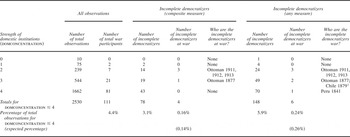
Here, we examine the Mansfield and Snyder data to answer the question, “Who are these belligerent democratizers with weak institutions?” Table 1 shows the number of country-year observations at each level of low domestic concentration (0 ≤ domconcentration ≤ 4) and how many of those observations participated in war. This breakdown is presented for: (1) all states between 1816 and 1992, (2) the states coded as incomplete democratizers by the widely used Polity composite measure, and (3) the states coded as incomplete democratizers by any of the four measures of regime change.Footnote 21
Descriptive statistics for incomplete democratization, weak institutions, and war

Notes: Summary statistics by each level of low domconcentration for (1) the full universe of observations, (2) the incomplete democratizers as measured by the Polity composite score, and (3) the incomplete democratizers as measured by any indicator. The “expected percentage” is the percentage of the total observations we expect to see if incomplete democratization with weak institutions and war participation are completely independent events. Note that the observed percentage of incomplete democratizers with weak institutions that participated in war is roughly equal to, or less than, what we would expect if the two phenomena are totally independent.
1. Only Chile in 1879 was a war initiator. Peru and the Ottoman Empire were targets of war.
Three critical points become immediately clear after examining the observations in Table 1. First, the number of incomplete democratizers with weak institutions that participated in war is actually quite low: six total observations by any of the four indicators between 1816 and 1992. That is, only 1.5 percent of the 398 total war-participants in the post-Napoleonic era have been incomplete democratizers with weak institutions. Further, these observations consist of just three different countries: Peru in 1841, Chile in 1879, and the Ottoman Empire in 1877, 1911, 1912, and 1913.Footnote 22 While both incomplete democratization and war are relatively rare events, their joint observed occurrence (four to six observations) is less than the 6.5 events one would expect if the two phenomena were completely independent of each other.Footnote 23
Second, between 1816 and 1992, there has only been one instance of an incomplete democratizer with weak institutions initiating an external war: Chile in the 1879 War of the Pacific. In this case, however, only one subindicator of regime change, constraints on the executive, classifies Chile as an incomplete democratizer five years prior to initiating war against Bolivia and Peru over a disputed territory in the Atacama desert. The other three measures of regime change—the competitiveness of political participation, the openness of executive recruitment, and the most reliable indicator, the composite index—code Chile as a stable regime that experienced no regime transition in the previous five years.Footnote 24 Indeed, by the composite measure of regime change, there has not been a single instance of an incomplete democratizer with weak institutions initiating war between 1816 and 1992.
Third, there are no instances of an incomplete democratizer with weak institutions participating in, let alone initiating, an external war since World War I. To the extent that the configuration of the international system post–World War I, and certainly post–World War II, is different from the pre–World War I era, these six empirical observations suggest little about the likelihood of incomplete democratizers with weak institutions either participating in or initiating wars in the contemporary international era. This is particularly noteworthy because, of the seventy-eight instances in which states with weak institutions have experienced an incomplete democratization between 1816 and 1992 as measured by the composite index, sixty-three of these, or 80 percent, have occurred between 1945 and 1992, after decolonization and during the so-called third wave of democratization.Footnote 25 Out of these sixty-three states with weak institutions that have undergone incomplete democratic transitions since 1945, not a single one has either initiated or participated in the outbreak of an external war.Footnote 26 Indeed, some cases that are prime candidates for logic of the theory, such as Russia in 1991–92, which is coded as an incomplete democratizer with weak institutions, were plagued by fragmentation; but none initiated or participated in external wars.
Thus, according to the empirical data, wars initiated by, or even involving, democratizing states with weak institutions are hardly a “chronic danger in history;”Footnote 27 instead, wars involving incomplete democratizers occur extremely rarely, both in absolute numbers and relative to other types of states, whether transitioning or stable. So how do Mansfield and Snyder find such strong correlations between incomplete democratization and war participation? It is to this question that we now turn.
Reexamining the Statistical Models
The Statistical Evidence for Democratization and War
Mansfield and Snyder test the relationship between incomplete democratization, weak institutions, and war on every country-year observation in the international system between 1816 and 1992 (N = 10,618).Footnote 28 Mansfield and Snyder use two different measures of war.Footnote 29 First, because their theory strictly requires incomplete democratizers with weak institutions to initiate external wars, Mansfield and Snyder estimate the probability that such states start a war in any given year.Footnote 30 However, Mansfield and Snyder find that the evidence for war initiation is weak.Footnote 31 They then argue that the nature of international politics and diplomacy often renders it difficult to assign responsibility for which state initiated a war and turn to estimating the probability of a state simply participating in war. War participation is a less direct test of the theory because it includes states that were both the initiators and targets of war. But since the crux of the statistical tests in Mansfield and Snyder focus simply on war participation, we too focus on the empirical finding that incomplete democratizers with weak institutions are more likely to participate in wars.
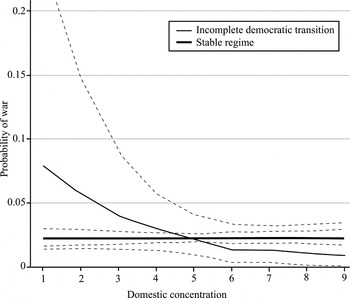
By every measure of regime type, Mansfield and Snyder find a statistically significant relationship between incomplete democratizers with weak institutions and an increased probability of participation in war.Footnote 32 The predicted probability plot, with the addition of 95 percent confidence intervals, for incompletely democratizing states as measured by the composite index is presented in Figure 1.Footnote 33
Probability of war participation based on the Mansfield and Snyder Reference Mansfield and Snyder2005 analysis
Note: Based on the original Mansfield and Snyder Reference Mansfield and Snyder2005 analysis, incompletely democratizing states with low levels of domestic concentration (weak institutions) are more likely to participate in war than stable regimes. The composite index of regime type is used to measure regime change, and dashed lines represent 95 percent confidence intervals.

Figure 1 illustrates Mansfield and Snyder's most important finding: incomplete democratizers with low levels of institutional strength are several times more likely to be involved in war than regimes undergoing any other type of transition or no transition at all.
Reexamining Participation in the Outbreak of War
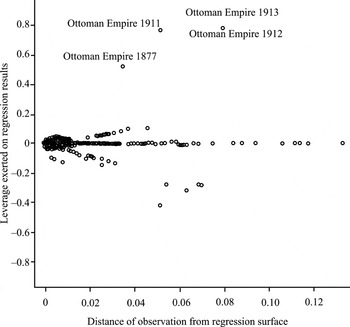
Given that most of the wars involving incomplete democratizers with weak institutions involved attacks against a single state, the Ottoman Empire, the critical question is: to what extent are the Mansfield and Snyder results being driven by a cluster of observations involving the dismemberment of the Ottoman Empire? Using the full data set, we analyze (1) how far the Ottoman Empire observations are from the rest of the data, and (2) how much leverage these few observations have on the statistical results in a simple plot in Figure 2.Footnote 34 Observations in the upper right quadrant of this plot represent data points that are extreme outliers that exert disproportionate influence on the empirical analysis.
Leverage plot identifying outliers
Note: The observations representing the dismemberment of the Ottoman Empire and 1911—1913 are outliers. These data points are both far from the regression surface an exert high influence on the regression coefficients, and may therefore bias the regression results.

Figure 2 illustrates that the Ottoman Empire observations in 1877 and 1911–13 are extremely far from the regression surface. More troubling, these observations also exert high leverage on the statistical results; that is, these observations pull the regression surface away from the mass of data. The statistical reality is that, not only are there just four nonindependent observations of incomplete democratizers with weak institutions that have ever participated in war as measured by the Polity composite score, but these are extreme outliers compared to the other 10,614 observations and exert disproportionate influence over the regression coefficients. Whether it is measurement error or simply empirical peculiarities, these Ottoman Empire outliers are not being generated by the same process as the rest of the 10,614 observations. Substantively, it is critical to note that these observations are inconsistent with the Mansfield and Snyder theory, since in each case the Ottoman Empire, which was undeniably in the throes of domestic political upheaval, was being repeatedly attacked and amputated by other powers; in none of these cases did the Ottoman Empire initiate war for diversionary reasons.
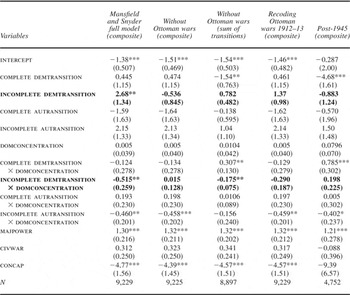
So to what extent are the Mansfield and Snyder results driven by these outliers? We find that the empirical relationship between incomplete democratization and war hinges entirely on the inclusion of this unrepresentative cluster of observations. By all measures of regime transition, the significance of incomplete democratization to war participation disappears when these four observations concerning the dismemberment of the Ottoman Empire are removed.Footnote 35 In addition, we asked what happens if one simply considers the most extreme Ottoman Empire war observations in 1912 and 1913 to be a continuation of the dismemberment campaign begun by Italy in 1911. Treating the dismemberment of the Ottoman Empire prior to World War I as a single war rather than a series of three independent wars, at least as far as the Ottoman Empire is concerned, seems like a perfectly reasonable historical interpretation.Footnote 36 Italy exploited the Ottoman Empire's declining power position following the Young Turk Revolution to invade Libya in 1911; the Italo-Turkish War ended in a relative loss for the Ottoman Empire in fall 1912. Smelling blood in the water, the Balkan states, which had historical grievances against the Ottoman Empire (including from the 1877 Russo-Turkish War), further exploited the Italian victory and attempted to dismember the empire in a series of brief campaigns in 1912 and 1913, known as the First and Second Balkan Wars respectively (the Ottoman Empire did not actually fight any major battles in the Second Balkan War).Footnote 37
When just the Ottoman Empire war observations in 1912 and 1913 are recoded to be a continuation of the war initiated against it in 1911,Footnote 38 we find that incomplete democratizers with weak institutions are no more likely to go to war than other types of states, regardless of which individual measure of regime change is used.Footnote 39Figure 3 plots these results for the composite measure of regime change, which illustrates that the likelihood of war participation for incomplete democratizers is statistically indistinguishable from that of stable regimes.
Probability of war participation after recoding the two extreme outliers
Note: After recoding the 1912–1913 Ottoman Empire observations as a coninuation of the 1911 war, the likelihood of war participation for incomplete democratizers is statistically indistinguishable from that of stable regimes. The composite index of regime type is used to measure regime change, and dashed lines represent 95 percent confidence intervals.

We thus find that the reported relationship between incomplete democratization and participation in the outbreak of war is highly sensitive to just a few unrepresentative observations involving the dissolution of the Ottoman Empire prior to World War I. By each of the individual indicators, whether incomplete democratization heightens the probability of war participation relative to stable states turns on whether one interprets the Balkan Wars as a single or multiple independent dismemberment campaigns against the Ottoman Empire. Both interpretations seem to be certainly plausible, but the fact that the substantive relationship between democratization and war hangs on which interpretation is chosen seriously undermines the robustness of the Mansfield and Snyder results. More generally, it is troubling that the statistical evidence for a theory concerning incomplete democratization and diversionary war initiation hinges on the inclusion of a few observations where the country of interest was under attack.
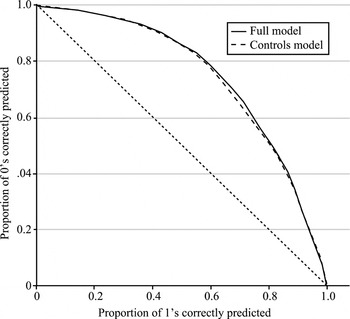
As a final piece of evidence disputing the relationship between incomplete democratization and war, we asked: without recoding or disputing a single observation, what would happen if one simply dropped all the regime transition variables? Would it make any difference in an analyst's ability to correctly predict which states participated in war? We find that the answer is no. Having information about a state's regime transition does not at all improve one's ability to predict whether it participated in war compared to a basic controls model. Graphically, this is achieved by presenting receiver-operator curves (ROC) that compare two models: one with just the control variables (major power, civil war, concentration of capabilities) against the Mansfield and Snyder model that includes the controls plus all nine additional regime transition variables.Footnote 40 In the ROC plot, a better model—one that correctly predicts more observations—should produce a curve that lies above the curve of the competing model. Figure 4 shows that this is not the case and that a parsimonious model consisting of simply control variables is just as good at predicting which states in the data set participated in war. That is, including the nine regime transition variables provides no additional power in predicting which states participated in the outbreak war. This suggests that there are simply few states participating in war as a result of regime transitions that are otherwise unaccounted for by standard control variables.
ROC plot comparing the predictive accuracy of war participation models

Hence, statistically we find that (1) the Mansfield and Snyder results concerning war participation are uniquely driven by the dismemberment of the Ottoman Empire, and (2) even leaving aside historical quibbles, the addition of the regime transition variables adds no statistical power to a model of war participation that includes just standard control variables. Therefore the claim that incomplete democratizers with weak institutions are at chronic “risk of … intense nationalism and war” is simply not supported by the empirical data.Footnote 41
Belligerent Democratizers in the Case Studies
The attractiveness of the Mansfield and Snyder argument has, in large part, been sustained by a series of case studies that attempt to trace how incomplete democratizers with weak domestic political institutions initiate external war—Wilhelmine Germany initiating World War I being a quintessential case. Mansfield and Snyder explore thirty case studies of wars initiated by incomplete democratizers since 1816.Footnote 42 But do these case studies really capture the mechanism of incomplete democratization that so critically underpins the theory? Not only do all of these cases select on the dependent variable by ignoring cases where incomplete democratizers did not go to war, here we additionally show that serious discrepancies exist between the universe of cases in Mansfield and Snyder and their characterization as incomplete democratizers with weak institutions.
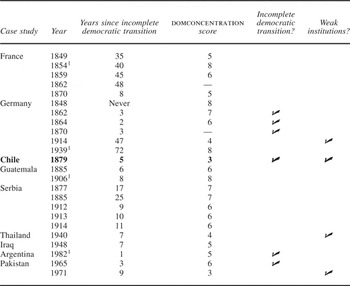
Mansfield and Snyder examine nine incomplete democratizers that initiated a total of twenty-three wars between 1816 and 1992, and seven additional wars of incomplete democratization post-1992. Some, such as McFaul, have found the selection and characterization of cases by Mansfield and Snyder perplexing.Footnote 43 Tables 2 and 3 show that this confusion is not unfounded. For the cases prior to 1992, Table 2 highlights the number of years prior to the outbreak of war that the country in question underwent an incomplete democratization by any measure, as well as its strength of domestic institutions. We then identify whether the state in question was in fact a domestically weak incomplete democratizer in the five years prior to war participation.Footnote 44
Incomplete democratization, weak institutions, and war in the cases 1816–1992

Notes: Instances in which the historical case studies in Mansfield and Snyder Reference Mansfield and Snyder2005 are coded as incomplete democratizers by at least one measure of democratization in the five years prior to the outbreak of war and have weak institutions (domconcentration ≤ 4) in year t − 1. Cases that meet both criteria are in bold.
1. These states underwent complete autocratizations several years prior to these wars as measured by the composite index.
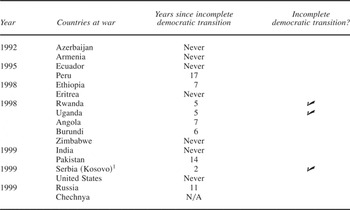
Incomplete democratization, weak institutions, and war in the 1990s

Notes: Instances in which the 1990s case studies in Mansfield and Snyder Reference Mansfield and Snyder2005 are coded as incomplete democratizers by the composite measure in the five years prior to the outbreak of war. Polity IV does not update the strength of institutions variable (domconcentration) for this time-period.
1. Serbia autocratizes several years prior to the war against Kosovo (composite score goes from −5 to −7 in 1993); in 1997 it moves from an autocracy to a mixed regime (−6), two years before the 1999 NATO intervention.
Of the twenty-four cases detailed in Mansfield and Snyder,Footnote 45 eighteen are not coded by any measure as having undergone an incomplete democratization in the five-year interval prior to the initiation of war in the data set. Instead, these cases mostly transitioned substantially more than five years prior to the outbreak of war by only one or two of the subindicators for regime type; not a single one is coded as an incomplete democratizer by the widely used Polity composite index, and some were even autocratizing. In the supposedly paradigmatic case of Wilhelmine Germany prior to World War I, Germany was a stable regime for almost fifty years by 1914 by every measure of regime transition. Although Mansfield and Snyder contend that “the legacy of Germany's incomplete democratization continued to exert its lethal power in World War II,”Footnote 46 that is a curious interpretation of causality, given that Weimar Germany is unsurprisingly coded as having undergone a swift and total autocratization after the rise of Hitler in 1933. Additionally, although Argentina in the 1982 Falklands War—another classic case—is coded as having undergone an incomplete democratization in the year prior by the competitiveness of political participation subindicator, this indicator is picking up interim “president” General Roberto Viola's loosening of military rule for several months in 1981; he was then overthrown in a coup by the harder-line and autocratic General Leopoldo Galtieri in December 1981, who then led Argentina's invasion of the Falklands.Footnote 47 Argentina in 1982 was still ruled by a ruthless military junta that had completely autocratized the state in 1976; its composite score was still a firm and unequivocal autocracy prior to the Falklands War.
Additionally, of the twenty-four cases, only a handful are classified as having weak institutions. Germany's purportedly paradigmatic wars of unification all involved a state with relatively strong domestic concentration scores.Footnote 48 Only one case study, Chile in 1879, meets both requirements of incomplete democratization and weak institutions according to the data set. Even in this case, Chile is only coded as an incomplete democratizer by the tightening of executive constraints subindicator; the other indicators, including the composite index, code Chile as a stable anocracy for more than thirty years. Without presenting and weighing alternative explanations, it is thus difficult to isolate the impact of incomplete democratization on Chile's decision to use force in the Atacama desert against Bolivia, which threatened to seize critical mining assets.Footnote 49
Mansfield and Snyder went on to examine seven case studies from the 1990s to demonstrate the theory's applicability to contemporary cases, as listed in Table 3.Footnote 50 The extent to which these wars are external wars is debatable, as the Chechen War and the Central African wars were largely internal conflicts. Nevertheless, using the updated Polity IV data set, we check to see which of these states were undergoing transitions from autocracy to anocracy in the five years prior to the outbreak of the war by the composite index.Footnote 51 Uganda is the only state that clearly underwent an incomplete democratization five years leading up to the outbreak of war, while Rwanda was on the cusp score for an incomplete democratization in 1993. Serbia underwent an autocratization prior to the war against Kosovo in the late 1990s but incompletely democratized during that conflict before North Atlantic Treaty Organization's 1999 air campaign. Other states were either stable in the five years prior to the conflict or actually undergoing autocratic transitions.Footnote 52 Polity IV does not update data on the strength of domestic institutions, but an examination of the regime transition data alone raises questions about the degree to which the contemporary cases validly illustrate the argument that incompletely democratizing states are more war prone than other states.
We note two serious methodological problems in this case-selection procedure. First, there are few, if any, cases of war involving incomplete democratizaters with weak institutions as coded by the Polity measures over a reasonable timeframe. If Chile in 1879 is the only case of a war initiator undergoing incomplete democratization with weak institutions, while the rest of the cases were largely stable regimes or autocratizers by most if not all measures of regime type, it is difficult to sustain an argument about a systematic relationship between democratization and external war initiation. Second, Mansfield and Snyder's selection on the dependent variable obscures the fact that some prime candidates of incomplete democratization did not go to war. The most glaring example of this is Russia in 1991–92, which was an incomplete democratizer with weak institutions and, by the Mansfield and Snyder model, has the highest predicted probabilities (22.1 percent) of participating in an external war in the post-1945 period.Footnote 53 However, not only did Russia not participate in external war at the end of the Cold War, but it literally dissolved without firing a shot. The second highest predicted probability of war for an incomplete democratizer in this time period was the tiny island nation of Comoros in 1991; Comoros, too, has extremely weak institutions and has been beset by a series of coups and has been persistently at risk of total implosion.Footnote 54
The lack of correspondence between weak incomplete democratizers in the cases and the Polity data set raises serious concerns about the method of case-selection and whether any inferences drawn from them can provide meaningful insight into the relationship between democratization and war. In all of these cases of war initiation, there certainly may have been domestic political pressures that pushed a state to be belligerent. But there is little evidence that war initiation was specifically a result of a strident nationalism unleashed by the supposedly explosive cocktail of incomplete democratization and weak institutions.
Conclusion
Based on Mansfield and Snyder's chosen measures for regime change and war, we therefore argue that there is no empirical basis for the claim that incomplete democratizations systematically unleash a wave of belligerent nationalism that results in external war. Not only is there a severe dearth of observations involving incomplete democratization, weak institutions, and war, but we find that the main results hinge entirely on several unrepresentative observations clustered around the dismemberment of the Ottoman Empire. Partly as a result, when we compare the full Mansfield and Snyder model to a parsimonious controls model, we find that the former adds no predictive power over the latter. We note that it is entirely possible that the indicators that Mansfield and Snyder employ do not exactly operationalize the logic of the theory. Certainly, changes in the various Polity measures may not capture what they consider to be incomplete democratization, and the Correlates of War data set may be a blunt measure for “belligerence,” especially when the chosen measurement is simply war participation. But given the best available measures for the phenomena of interest, we find no systematic empirical support for the theory that incomplete democratizers with weak institutions are more war-prone toward other states.
Given the high-profile prominence and persistence of the Mansfield and Snyder claim, these results bear on both academic and policy debates. Academically, our findings help provide some intellectual housekeeping in the debate between whether incomplete democratizers implode or explode. In showing that there is a marked lack of empirical support for the relationship between these states and war participation, let alone initiation, our conclusions strengthen the findings of the state-failure project which argues that this class of states is particularly vulnerable to internal—not external—conflict. Though there can certainly be spill-over effects from internal conflicts, there is no empirical evidence that incomplete democratizers pick fights with other states. Indeed, the Ottoman Empire observations that provide the entire statistical support for the Mansfield and Snyder results are more consistent with the state-failure hypothesis since the series of wars launched against the Ottoman Empire were primarily about dismembering it and parceling out its spoils, not about an incomplete democratizer with weak institutions engaging in diversionary external wars. Furthermore, the most salient contemporary cases of incomplete democratization—such as post-Cold War Russia, Rwanda, and Yugoslavia—tended to invariably result in disintegration rather than external belligerence.
Our findings are also relevant to policy debates concerning the consequences and management of democracy promotion abroad. Policymakers have invoked the finding that democratizing states are more likely to become war-prone members of the international system as a compelling argument against promoting democracy internationally. In The National Interest, Mansfield and Snyder caution that a democratizing China, with its nationalist “demand to incorporate Taiwan in the People's Republic of China, [and] its animosity toward Japan” could pose serious threats to regional and international security.Footnote 55 They suggest that the international community should be extremely wary of a democratizing China and may need to take measures to contain potential Chinese belligerence during such a phase. However, the empirical evidence implies that concerns that democracy promotion will trigger international conflict are misplaced since, historically, movements towards democracy have not unleashed belligerent foreign policies. As such, adopting containment policies toward incomplete democratizers—whether it be China or others such as potentially Russia or Pakistan—in anticipation of aggression may be unnecessary and even possibly counterproductive since they risk triggering conflict through the creation of security dilemmas or other pathways completely independent of democratization.
We have thus shown that one concern about democracy promotion, that incomplete democratizers have a higher propensity to instigate external wars, is empirically unfounded. This is not to say that democratization is at all a smooth process; we do not dispute that such transitions may be fraught with risks, and that the proper sequencing and pacing of the process is critical for full democratic consolidation. But there is simply no empirical basis to think, or adopt policies predicated on the fear, that incomplete democratizers will be more belligerent members of the international system.
Appendix
Regression results for war participation

Notes: Logistic regression estimates for war participation, with country-clustered robust standard errors in parentheses. Estimates for incomplete democratization and the corresponding interaction term with domestic concentration are in bold. There is no statistically significant relationship between incomplete democratization and war across any level of domconcentration for the models in columns (2) through (5). These results illustrate the lack of robustness of the Mansfield and Snyder Reference Mansfield and Snyder2005 findings. *p ≤ 0.1, **p ≤ 0.05, ***p ≤ 0.01.