Introduction
This paper presents micro finance as one of the traditional mutual help networks in East Asia. These are called Rotating Savings and Credit Associations (ROSCAS) and can be seen not only in East Asia, but also in other areas (Bouman Reference Bouman1977, Reference Bouman, von Pischke and Donald1983). Micro finance means that invested money is small and managed by members of the group or community. Mutual help actions are divided into three categories. One is reciprocity in helping to plant rice and re-roof houses by exchanging labor. The second is redistribution. In exchange for the right to get goods from a common store, local people have the obligation to maintain a common pool of resources. Finally, unidirectional help refers to support in funeral and wedding ceremonies requiring no monetary exchange. The content of redistribution is labor, goods, and money. ROSCAS are the distributional action of money. It was called tanomoshi or mujin in Japan. In the case of having less money local people would often give rice or other goods instead of money. Micro finance encompasses money for buying cows and digging wells was gathered among local people.
ROSCAS in East Asia have different names according to each country and areas. South Korean ke, Chinese kai (huì), and Taiwanese hyokai (biāo huì) can be compared with the already well-studied Japanese case. Each micro finance would be characterized through nationalities. The purpose of this paper presentation is to show that ROSCAS are important not only in economic meaning, but also socially in terms of mutual friendship and bonds. Micro finance as mutual help is based on confidence among members. Although these customs have almost disappeared from modern life, they can still be clearly identified in each country.
This paper discusses the results of an interview survey and fact-finding fieldwork study of South Korean, Chinese, and Taiwanese ROSCAS (Onda Reference Onda2012, Reference Onda2013b, Reference Onda2014). Local people helped a troubled person by collecting money, as well as donating goods and labor. The social meaning is important for sustainable community from the viewpoint of economic sociology. The economy is embedded in social institutions and relations (Polanyi Reference Polanyi1977). The social system of mutual help arising from indigenous conditions contributed to sustainable communities. The paper concludes that modern societies might do well to reconsider ROSCAS as mutual help networks in search of ways of solving both public and private social problems and reconstructing communities in East Asia.
Japanese ROSCAS
Types of mutual help actions
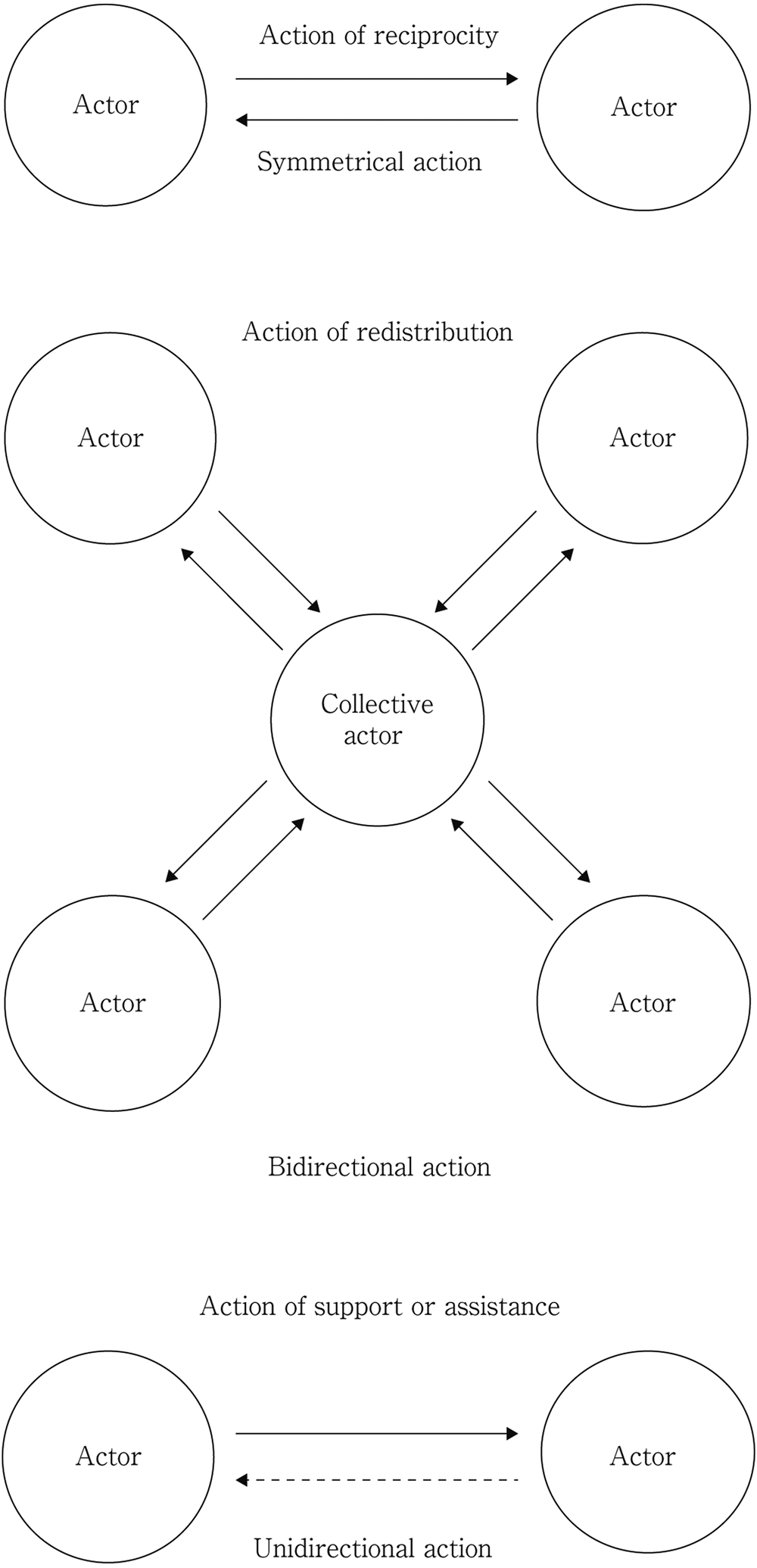
Mutual help action was traditionally divided into three types in Japan (Onda Reference Onda2005, Reference Onda2006, Reference Onda2013a, Reference Onda2015, Reference Onda2019). One is yui, which mainly refers to the exchange of labor in helping to plant rice, cut rice, and re-roof houses. Laborers participated on the condition of later receiving help themselves. The labor unit was a family. It was a rational exchange in that the givers always got the same volume and quality of labor in return. When one family needed a lot of labor, another family helped by providing it. That family then got the right to return labor from the family it helped. Yui is reciprocity where one gives labor to another and reaps the reward of the other's labor at another time (Gouldner Reference Gouldner1960) (Fig. 1).
Direction of mutual help action.

The second is moyai, which refers to redistribution to assemble manpower, goods, and money and to divide among local people. Distribution-of-labor mutual help in Japan is termed moyai. Historically, those who had commons of mountain, forest, and sea distributed the resources among themselves (Acheson Reference Acheson2003; Baden Reference Baden, Baden and Noonan1998 [1977]). They were bound by the rule of villages to be engaged in village-mandated public works (mura shigoto, literally “work of the village”) to clean roads and canals, as well as remove grass from the roads. Local people could then use the roads and canals as a reward for public or communal service through mura shigoto. The commons were indispensable to their lives and were not only the symbol of protecting environment from destruction and economic resources (Feeny, Berkes, McCay and Acheson Reference Feeny, Berkes, McCay, Acheson, Baden and Noonan1998 [1990]; Hardin Reference Hardin, Baden and Noonan1998 [1968]), but also of social solidarity (Hechter Reference Hechter1987). The vectors of the action are toward the center from the periphery and vice versa (Fig. 1). The practice covered not only the labor that local people had to provide to maintain the commons, but also goods. In another form of moyai, such commodities as harvested crops, household goods and Japanese pampas grasses for roofing would be gathered to give to people who could not otherwise afford them. This might be called “goods moyai.” Villagers further supported the life of the poor by providing them land of the commons preferentially so that every family could maintain its livelihood independently. In a further variation, rather than supplying labor or goods, money was sometimes collected among local people to help the poorest. This “financial moyai” became more common after the spread of currency in villages. It is known as the rotating credit system (Geertz Reference Geertz1962) or Rotating Savings and Credit Associations (ROSCAS) (Bouman Reference Bouman1977, Reference Bouman, von Pischke and Donald1983). In addition, a “financial moyai” would often be collected simply to accumulate funds for some future unstated need. This institution has played a role of insurance.
Finally, tetsudai refers to unidirectional support in wedding or funeral ceremonies in lieu of labor or monetary exchange, which otherwise would have been expected under yui rules of reciprocity (Fig. 1). This mutual help system is structured as one-way aid in which people do not expect reciprocal help from either the chronic poor or people in temporary trouble. However, even people in these categories would often still try to give goods or labor in return. For this purpose, many people who were helped would record the nature and amount of what they received and would sometimes reciprocate these efforts, occasionally giving tetsudai a reciprocal cast. However, in principle it refers to help without the expectation of reciprocity. Although the first and the second types operate through equal social relationships, tetsudai is done both horizontally and vertically. The latter operated as a patron–apprentice (client) relationship. Although there are few traditional examples remaining, we can still see them in some Japanese areas.
Organization of mutual help
Formal standing organizations: kumi
In Japan, there were two types of organizations, formal and informal (Onda Reference Onda2005, Reference Onda2006, Reference Onda2013a, Reference Onda2019). A kumi might be called a formal organization in which participation was obligatory as members of a regional society to maintain the commons or support funeral ceremonies, although it was autonomous from local government. It was a communal organization for mutual help as a spontaneous social phenomenon and was manifested in autonomous organizations for self-reliance, self-help, and self-determination in local life. These are convivial organizations. A kumi was organized by family, age, and sex. Active participation was almost mandatory. This was the basic unit for all forms of yui, moyai, and tetsudai. A yui gumi (“g” replaces “k” in common verbal usage), for example, was a work unit for planting and harvesting rice and re-roofing houses. The wakamono-gumi (a male youth group) played an important role in public works as well as taught village rules, turning boys into men.
Another type of kumi was directed by either the central or local government and had the purpose of helping to maintain control of local people who were already used to have voluntary mutual help structures. The gonin-gumi (the standard group of five households) and the tonari-gumi (the group of ten households) were examples. The former was the unit of mutual help with cooperative responsibility in the Edo era (1603–1867) for mutual protection among farmers and paying tribute. The latter was the unit with the same responsibility during the Pacific War (1941–1945) in the Showa era (1926–1989) for assisting and controlling individuals during emergencies. These are compulsive organizations. In general, there are now relatively few such compulsory organizations by the central or local government. Spontaneous organizations for mutual help continue.
Ad hoc (privately constituted) organizations: kou
The second kind of mutual help organization, a kou, would be organized to fulfill a specific purpose. Kous originated in the religious activity of reading Buddhist scriptures (Fukuba Reference Fukuba1934; Takeuchi Reference Takeuchi1990 [1984]). These organizations at temples realized the spirit of local and indigenous religions. The group of believers who gathered to study the spirit became an organization of mutual help at the same time. Villagers would help a troubled person by donating goods and labor or collecting money. The organization first raised money to establish their own economic foundation, and later to contribute to the relief of the poor materially as well as emotionally. A group of believers who gathered to study evolved into an organization for mutual help included fundraising for specific purposes beyond temporary charity. Kou used to be associated with the raising of funds to help people.
A kou differed from a kumi. An organization tended to be called a kou if it had a religious or an economic purpose. Although the unit of kumi is family and formal, that of kou is individual and informal. As an informal organization, participation was not always obligatory. Historically, mutual help was carried out through two organizations called kumi, standing formal institution and kou, an ad hoc organization focused on a specific purpose (Onda Reference Onda2005; Reference Onda2006, Reference Onda2013a, Reference Onda2019). Even nowadays there are still some kous existing as religious organizations that support pilgrimages or believers in indigenous land gods such as Ise kou (funding trips to the most sacred shrine of Shintoism) or Fuji kou (funding trips to climb Mt. Fuji) as not only economic organization, but also religious organization.
Origin of Tanomoshi
Japanese ROSCAS are mainly called tanomoshi in west Japan and mujin in east Japan. Tanomoshi means reliance of not children on mother but mother on children. The leader who wants to get money was called oya as mother. The mother calls members as children to gather money. The word of tanomoshi was found as an organization of borrowing from members in some archives at the Kamakura era (1185–1333) (Miura Reference Miura1918; Norinshokeizaikouseibu 1935). Mujin means pawnshop, originated from warehouse (dozo) especially keeping goods and money. The word of mujin was also found at the same age as pawnshops in old documents and later used to be an organization of borrowing money at the Muromachi era (1336–1573).
As mentioned above, kou became to help poor people by collecting and lending money. Focused not only on religious activity, but they were also vehicles for micro finance. This is Japanese ROSCAS. The organization of kou and the meaning of lending money as small finance was connected. Economic organization as lending and borrowing money between close friends (a rotating credit association) was born from religious organization. The organization of kou for religion became that of economy (Michibata Reference Michibata1934; Najita Reference Najita2009). However, the institutions of tanomoshi and mujin were made from spontaneous social order (Onda Reference Onda2006, Reference Onda2013a, Reference Onda2019). ROSCAS as spontaneous social order adopted the organization of kou (Ikeda Reference Ikeda1930). Therefore, tanomoshi and mujin were called tanomoshi kou and mujin kou. Japanese often called tanomoshi or mujin without saying kou in many cases.
Tanomoahi was the institution of borrowing money without interest while mujin was that with interest. However, later the term tanomoshi was also used to refer to borrowing with interest. Therefore, the two concepts were connected and used arbitrarily. Mujin developed as a small bank in the Meiji era (1868–1912). It has the tone of meaning of treasures from a warehouse (dozo) and tanomoshi that of reliance from the origin of relation between parent and child. Thus, Japanese ROSCAS have the two meanings of treasure and reliance from the origin of the words. This paper uses the term of tanomoshi as Japanese ROSCAS because the word exhibits the essential meaning of mutual help.
Way of Tanomoshi
How do ROSCAS function? In the Japanese rotating credit system, contributing of additional money in the form of bidding to receive an immediate payment was and is popular (Onda Reference Onda2006, Reference Onda2013a, Reference Onda2019). For example, if there are ten members, each may pay 10,000 yen per month. Any member who wants money immediately because of current problems can get the total (100,000 yen). After that, how is the order of payout determined? There are two methods of paying a fee for the privilege of immediate access for this purpose. One is adding some money to the standard 10,000 yen in a form of bidding. Whoever adds the highest amount over 10,000 yen in a particular month can receive the month's total contribution, including any additional funds bid by others trying for that month's payout. The recipient must then continue future payments at the higher rate that won him the payout, until the end of the 10 (1 month per member) month cycle.
The other method is to receive a less-than-full-payout but continue to pay the standard amount (10,000) until the end of the cycle. Because all ten members will receive a payout sooner or later, those who wait stand to get larger sums by paying less money. These are interest-directed methods. As the way of helping the poor, the first receiver often does not have to pay interest or money. This would be called oya tanomoshi. Oya refers to a person who would be in urgent need and would ask other members as children to gather a sum of money. Tanomoshi without oya would be organized from the first with the sole purpose of getting monthly interest.
Some part of the accumulated interest was used for drinks and food through which member's deepened friendships with each other. Local people in Okinawa Prefecture islands say not moyai but moai. The word is different from each island. A man participates in several organizations of ROSCAS. Even small-to-medium-sized enterprises do moai because they cannot borrow some money from banks. However, there is no moai in smaller Okinawan islands because local people are afraid that human relations would be destroyed for money. When a resident in Hatoma island with a small population of about sixty want to do ROSCAS, he attends moai over a telephone not to be known to another person. A result of ROSCAS collapse is a big socio-economic problem.
It should be reiterated here that this economic organization was sustained by mutual trust and reliance as a societal organization at the same time. Social solidarity in such an organization is strong and not always based on economic rationality (Hechter Reference Hechter1987; Olson Reference Olson1965), but rather social rationality. The functioning of ROSCAS is economic, but the management is social from the viewpoint of economic sociology (Granovetter Reference Granovetter2017; Smelser and Swedberg Reference Smelser and Swedberg2005 [1994]; Zelizer Reference Zelizer2010). Both tanomoshi and mujin can still be found in local societies with even the names of the practices remaining intact according to some interview surveys and fact-finding fieldwork studies.Footnote 1 These ROSCAS have been playing complementary roles of the normal bank or other organizations in some local societies and not only getting some money but also giving communication chances.
ROSCAS of South Korea, China, and Taiwan
Korean and South Korean ke
Korean ke
Korean ke functions as an organization of mutual help. There were and are a variety of many ke in Korea (Zensho Reference Zensho1926). Suzuki described them as similar to Japanese kou (Suzuki Reference Suzuki1958). Based on Confucianism ethics, ke particularly respects the hierarchy of age and manifests itself in many organizations such as “relative ke” consisting of an agnate family group, “amusement ke,” “public service ke,” “funds accumulation ke,” and “ceremonial ke.” The fund accumulation ke is one of ROSCAS. Not only money, but also goods were supplied and distributed among members. Rice was gathered to get money. The turn taken, and amount received were determined not by bidding. Furthermore, each farmer gave some money to buy common land (ke rice paddy) and cultivated it jointly or distributed farm rent by lending the land. This is the same as Japanese “moyai land” using the commons.
Mutual help was done through kes that give labor, goods, and money preparing for future (Onda Reference Onda2012). There were a ke for purchasing goods by a group that an individual member could not afford. For example, “cow ke” was formed by paying some money and a cow was awarded by lottery. We found similar kes formed to purchase fertilizer, tableware, and agricultural machinery. Japanese jitensha tanomoshi was formed to purchase a bicycle. Regional ke has functioned as organizations for public or social service among local people. There was also ke in which villagers had to participate in maintaining forest commons, water supplies, and riverbanks. “Yangban (Yanpan) ke” was the organization for the former governing classes and “agnate group ke” for descent through the male line. “Ceremonial ke” functioned to support the chief mourner by giving labor or rice from each household and often lent commonly owned funeral paraphernalia. In Japan, an “unhappy gumi” worked for the chief mourner. There was also the ke for weddings. Traditional ke disappeared, but some of ke remain preparing for future uncertainty in South Korea (Campbell and Ahn Reference Campbell and Ahn1962).
Although “monetary ke” was popular, Japanese government introduced mujin as people's bank in the period of Japan's rule by the annexation of Korea. It was meaningful for Korean people to borrow money when formal banks did not lend money (Lee Reference Lee2006). The borrowers were small and medium sized commerce and industry persons who were missing in rights of the mortgagee. However, the role of ke was more important for local people than mujin as a small bank.
Modern South Korean ke
Now South Korea has two types of ke.Footnote 2 The one is “friendship ke” to save money to prepare for uncertainty in the future. The other is “monetary ke” to get interest. Although the latter among friends of the class reunion, co-workers, and resident of the apartments is common and a speculative spirit is strong in the big cities such as Busan, people sometimes participate in the former kes to give gifts for wedding and funeral ceremonies and to travel (interview, September 2006, May 2008). High school students take part in kes for buying clothes and bags. “Auction ke” accumulating money is a rotating credit system. The purpose of the monetary ke is to get more funds through gathering a large amount of money and lending money unknown members at higher interest like money game. It can be found in the large city such as Seoul today.
According to a woman in her eighties in Gangdong-myeon, Gyeongju-si, Gyeongsangbuk-do, Yangban as traditional ruling class and landowner did kes, but peasants did not participate in them because they were poor and could not prepare money (interview, September 2014). Although cooperative substitute for ke, people use the system to keep a certain living standard. Ke as ROSCAS has been popular in agricultural areas to live together for preparation for sudden expenditure although ke was declined through Saemaul Movement of the new village movement in 1970s. There were some mutual help networks in agricultural areas. In contrast to ke for amusement or play in a city, that of a village was carried out for relief or mutual help for living together. Not “monetary ke” but “rice ke” was popular in land areas in the 1950s in Okcheon-myeon, Haenam-gun, Jeollanam-do (interview, September 2011). Material gold had been gathered for wedding, disease, or injury as ke. There was also “rice ke” in Nagan- myeon, Suncheon-si (interview, March 2012). A man in his nineties in Cheongan-myeon, Hadong-gun said that local people welcomed to prepare food for newcomers by doing ke (interview, September 2014). They helped poor people by giving rice and wheat. However, as farmers' cooperative substituted for ke or money was supplied with by children who left former villages and worked in a city, “monetary ke” declined. Ke in a village of the inland near a city disappeared quickly as lifestyles have modernized.
“Familiar ke” for the ceremonies of funeral, wedding, and others are popular in island communities. Although any kes are done in Jisan-myeon, Jindo-gun, Jeollanam-do, bidding ke is now few because some members fled without paying into funds (interview, September 2011). Urbanization through a bridge between Jindo and the peninsular has progressed rapidly. Therefore, some kes such as funereal ceremony disappeared. After people died in a hospital, they ordered funeral ceremonies through ceremonial enterprises. There remains “travel ke” in Uisin-myeon (interview, March 2012). In Heuksando, Sinan-gun, there are several kes for ceremony, friendship, and travel (interview, March 2012). Ceremonial ke was traditional and succeeded. Although fishermen who caught abalone had joined in bidding ke, it wasn't done. However, “financial ke” called “Saemaul ke” and “ring ke” that gathers material gold are popular. According to a woman in her sixties, the reason why some kes beside ceremonial ke disappeared was the good interest of banks. There is “grain ke” among farmers in Dochodo (interview, March 2012).
According to a former women's society's president in her sixties in Haui-myeon, Sinan-gun said that there was “spring and autumn ke” providing crops after harvesting garlic and onion in spring and rice in autumn (interview, August 2012). A man in his eighties in Bigeum-do said that local people donated 20 kg of rice to each family for a wedding and expenditure of school, later gave money in 1970–1980. Now “hope ke” is done among young people. In Cheongsan-myeon, Wando-gun, a former chief of a village said that there was “public ke” provided with paste and seaweed in festival and funeral ke but no “monetary ke” (interview, September 2014). According to a man in his sixties in Narodo, Bongnae-myeon, Goheung-gun there are “ring ke” and “travel ke,” but no “funeral ke” because the ceremony was held in a city.
In Sa-du, Yeosu-si there is no ke (interview, September 2011). This shows that they are anxious for the loss of reliability among local people as in the same case of Japanese Okinawa small islands. In smaller island, there is no ke because local people are afraid that human relations among islanders would be destroyed for money. According to a man in his seventies in Dolsan-eup, Yeosu-si, “monetary ke” had disappeared as some people fled without paying and the rate of interest became higher 30 years ago (interview, March 2012). A man in his nineties in Hwajeong-myeon, Yeosu-si said that “friendship ke” supported unhappy or poor people, but no “monetary ke” (interview, September 2014). In Jeju-do, people participated in “monetary ke” 20 years ago (interview, August 2007). There are some kes for purchasing ships and villas, “women ke” for beauty care, “friendship ke,” “travel ke,” and kes among women divers (interview, March 2012). However, many people save money to banks. According to a man in his sixties in Nam-myeon, Yepus-si, local people had used the term tanomoshi of Japanese (interview, August 2012). This indicates the connection between Korea and Japan through mutual help customs.
Chinese kai (huì)
Before the appearance of the People's Republic of China
The Chinese mutual help rotating credit system before the birth of the People's Republic of China was variously called hé huì, qián hue, jiǎng huì, or qián shè (Smith Reference Smith1899; Shimizu Reference Shimizu1939; Fukutake Reference Fukutake1976 [1946]). Some local people often said just huì or shè in Jiāngnán villages (Fukutake, ibid.; Shimizu Reference Shimizu1951). Simply speaking, financial association or monetary society was called huì (association) or shè (organization). Although ROSCAS in a city tended to be interest-oriented, that in a village did mutual help. There would be three methods by which financial assistance was gained. The first was the case of a determined order to receive funds by certain interest. The second was the lottery decided by rolling dice or drawing paper. The third was bidding. A person who had the most urgent need could get money in some cases. Money was used for funeral or wedding ceremonies and keeping a maintenance of living. According to Japanese researches (Reports on Chinese and Manchurian Customs by scholars and researchers of Chugoku Noson Kankou Chosakai <Association of Chinese Village Customs> or Research reports in Manchuria by the South Manchuria Railway Company) before the end of the Pacific War, there were many ROSCAS (Shimizu and Cho, 1944). If huí continued for a long term, some farmers felt trouble because they had to wait for the receipt of aid for such a long time. Therefore, formal organizations to lend money to farmers were established (Fukutake Reference Fukutake1976 [1946]). This was the reason why ROSCAS declined.
People who used the organization were middle class farmers. Korean people in Manchuria who had lived near the Korean Peninsula had ke for purchasing agricultural tools. The custom was transferred from their home country. ROSCAS had also the purpose of getting such daily goods as candles, as well as pigs, cows, or land. The cow bank had the system that calves birthed by parent cows were distributed.Footnote 3 Some people also gave money to use and maintain a common well. ROSCAS consisted of an average ten to thirty persons without proposer who organized to assemble. The research on Huizhou district of money association from the sixteenth century through the twentieth century showed that it consisted of about ten members and continued for 10 years (Xiong Reference Xiong2003). These ROSCAS had already found in the Tang era (618–907) as the reasonable custom of assembling money among consanguinity for longer time than Japan (Shimizu Reference Shimizu1951).
After the establishment of the People's Republic of China
There are very few ROSCAS in agricultural villages in modern China (Onda Reference Onda2013b). In Fuyu County, Qiqihar city, Heilongjiang Province during the era of Mao Tse-tung, hé huì without interest had existed and already disappeared (interview, March 2009).Footnote 4 A man in his eighties in Yushu County, Changchun city, Jilin Province said that local people gave money to those in financial distress, but there was no systematic hé huì (interview, September 2012). In Huánán, there are few workers who leave from home because everyone can work here for wages. Therefore, local people do not have hé huì. Local people borrow money from villagers, but there is no hé huì in Chendongcun village, Qingpu ward in the suburb of Shanghai. According to a man in his seventies, hé huì existed in the 1970s in Shapuzhen district, Fuqing County, Fuzhou city, Fujian Province. Nowadays, the standard of living is higher for farmers who harvest wheat, vegetables, and peanut than the past. Therefore, there are now few rotating credit systems among local people. A woman in her sixties in Qiancuncun village of the same city said that local people had hé huì to supply rice to the poor 40 years ago when food was short. However, now that the government is supposed to assume responsibility for the very poor, hé huì has disappeared. Local people eventually discontinued the practice because some borrowers fled without repaying the money.
A traditional Chinese village is said to have more the character of separation than that of connection (Fukutake Reference Fukutake1976 [1946]; Hatada Reference Hatada1973 [1949]). However, there is another argument that both characteristics exist (Shimizu Reference Shimizu1951). Conversely, other people say that many people have maintained friendship and done the practice of hé huì especially in cities. The character of cohesiveness is shown in ROSCAS. Hé huì membership, either territory or sanguinity based typically, numbers between ten and fifty persons. The scale and specific purposes differ from district to district. Members invest money and one by one on a given occasion they may take what they need for such expenses as funeral or wedding ceremonies, school fees, house construction, and other means of life. Another type of hé huì has the purpose of saving or getting more money for self-interest in cities. This purpose become popular because banks did not provide loans to local people and small- and medium-sized companies.
Although the network of Chinese ROSCAS is large, the relationship of reliance is said to be weak (Granovetter Reference Granovetter1975). This might show the character of separation. In agricultural areas, the way to get money was determined by word of mouth among members who had strong reliability. However, the consciousness of financial opportunities and incentives is much stronger in cities. The organization is temporal, and it dismiss after all the members get the fund in order. Since the Reform and Opening at late 1970 the latter type of getting more money has spread and strengthen. The interview survey results suggest that there are few hé huì groups in the northern agricultural villages of China, but many in southern areas such as Fujian, Zhejiang, Jiangsu and Guangdong Provinces where Taiwanese people came from (Chin Reference Chin2004; Namihira Reference Namihira2006; Xiong Reference Xiong2003).
Taiwanese hyokai (biāo huì)
Taiwanese (Han Chinese) ROSCAS
On the Island of Formosa as it was known at the time, reports on old customs of Taiwanese at the age of Japanese occupation did not describe ROSCAS (Rinji Taiwan Kyukan Chosakai 1903–7). However, there were many mutual help institutions. One of them was the use of a cemetery donated for persons who had no relatives. The rice paddy nearby the land was lent and the rent was used for maintaining land and building medical facilities. Consanguinity group provided land to their descendant’ s children and the profit from rental was used for study (ibid., 1906). Rice and money gathered by certain members was used for funeral ceremonies (ibid., 1907). The report showed that because a member did not pay in huì, his furniture was confiscated as a fine (ibid., 1910). They call huì when they assemble.
ROSCAS is widespread in contemporary Taiwan because people (Min tribe) immigrated from Fujian and Guangdong Provinces where ROSCAS were very popular (Onda Reference Onda2014).Footnote 5 Not only Min tribe, but also Hakka tribe used to take part in a rotating credit system as a micro finance (biāo huì).Footnote 6 There are many ROSCAS in Han Chinese Society (Besley and Levenson Reference Besley and Levenson1996). Local people participate in many mutual help associations paying 5,000 yuán (new Taiwan dollar) per month with about twenty members who are friends, neighbors, and relatives (interview, September 2013). The purpose of many ROSCAS is more the pursuit of money than the preparation of unhappiness or happiness (Besley and Levenson Reference Besley and Levenson1996). In fact, in the case that people need money, they borrow from relatives. In Su'ao Township, Yilan County, a woman in her seventies said that there was a huì gathering 1,000 or 2,000 yuán (interview, September 2013). This is the type by the way of bidding the highest amount over certain installment. This is the way of collecting additional funds. In a fishing village, according to a man in his sixties, he joined in ROSCAS, but it disappeared because some people fled without paying back money. This is a collapse of association embezzled. Now fishermen can borrow money from fishery cooperative.
In Xinpu Township, Hsinchu County, a man in his sixties takes part in a ROSCAS that each member pays 10,000 yuán among twenty members. The way is the same described above (interview, September 2013). The members such as relatives, friends, and classmates who have certain property are creditable and each member must be careful to avoid a collapse of the association. According to a woman in her seventies, 50 years ago local people participated in ROSCAS by providing rice. Now they do so by cash. There are two ways (interview, September 2013). The one as mentioned above is the way of bidding the highest amount over certain installment; the other is receiving a less-than-full-payout but continuing to pay the standard amount. Members consist of ten to thirty and average numbers are twenty. The tendency of strong speculation can be traced to the fact that they fled from communism after the birth of the People's Republic of China.
In coastal areas, Xiyu Township, Hoko Island, according to a village mayor in his sixties, there are ROSCAS that request to give 5,000 to 10,000 yuán as an installment among twenty to thirty persons at each month by receiving a less-than-full-payout (interview, March 2014). Some fishermen join in ROSCAS for repairing houses or ships. Another village mayor said that local villagers got money by giving 10,000 yuán among forty to fifty persons. In spite of the existence of many banks, the reason why local people have ROSCAS is that it is very easy for them to get money and more interest. Although some people fled without paying money, they used to do ROSCAS with reliable relatives and neighborhood. The institution did not have the aim to help the poor elderly people because they can get certain money or free pass of bus from the government as public help.
A man in his sixties in Green Island, Taitung County said that they pay 1,000 yuán at least among twenty-four relatives or friends of an agricultural cooperative by the way of a less-than-full-payout (interview, March 2014). The first receiver is the person who needs money most. He gets less money than an installment and continues to pay a fixed amount. They select members for protection of stealing. According to a village mayor, there was a stealing in his wife's ROSCAS. No law of biāo huì as the institution has made the system uncertain. However, the easiness to access money and get more interest than bank, and no troublesome procedures for utilization that banks request security have made local people fascinated by ROSCAS. A former junior high school teacher in Wang'an Township, Penghu County said that fishermen took part in ROSCAS for repairing ships (interview, August 2014). After a representative as the first receiver called to participate in an association and gather 200 to 300 yuán among twenty to thirty persons, the second person got the money by bidding through a less-than-full-payout.
Natives' ROSCAS
There was no description on ROSCAS among indigenous people at the time of Japanese occupation (Rinji Taiwan Kyukan Chosakai 1918). They were cooperative and had each mutual help society. After they hunted in forests as the commons, their game was distributed among members depending on achievement and sometimes local people who did not go hunting got the game (Mori Reference Mori1917). In such a society, it was not necessary to do ROSCAS.
In modern Taiwanese society, there are some ROSCAS among Ami tribe in Yuli Township, Hualien County (interview, September 2013). A chief in his seventies of a village said that they used Japanese Tanomoshi as ROSCAS and pay 10,000 yuán at each month among twenty members to get daily commodities by biding with reliable neighbors or people from the same town. Now six members provide twenty bags of rice harvested two times in a year. Especially, the Ami tribe who had accepted mandatory and conciliatory measures by Japanese government before the end of the Pacific War adopted Japanese customs. A former pastor of another Taroko tribe in Xiulin Township, Hualien County, said that he knew the word of tanomoshi and they participated in biāo huì paying 3,000 to 4,000 yuán (interview, August 2014). According to a woman in her sixties of Thao tribe in Yuchi Township, Nantou County, she knew the system of rotating credit system but did not participate in it because of poor life. A chief of Yami tribe village in Orchid Island said that there was no huì because local people save money by themselves (interview, March 2014). It might be said that ROSCAS of Taiwanese natives had been influenced by Han Chinese or Japanese customs through word of mouth.
Social meaning of ROSCAS in East Asia
Common points and differences of ROSCAS in the surveyed nations
The fundamental common is that ROSCAS as traditional mutual help customs exist in all four countries. ROSCAS is one of the three actions of distribution through labor, goods, and money. Providing them in the case that poor persons could not do so on their own, local people helped each other through cooperation. One version of distribution as mutual help provides money through a rotating credit system as financial support. In Japan, it was called tanomoshi or mujin. The Korean term for this is ke, although the term also refers to organizations. The Chinese term for rotating credit is huì as cash-based mutual help, although, like South Korea, that also covers other kinds of organization. Taiwanese ROSCAS is biāo huì that is popular among people from mainland China and their ancestors. The tribes have adopted Han Chinese or Japanese customs of ROSCAS to help each other among members.
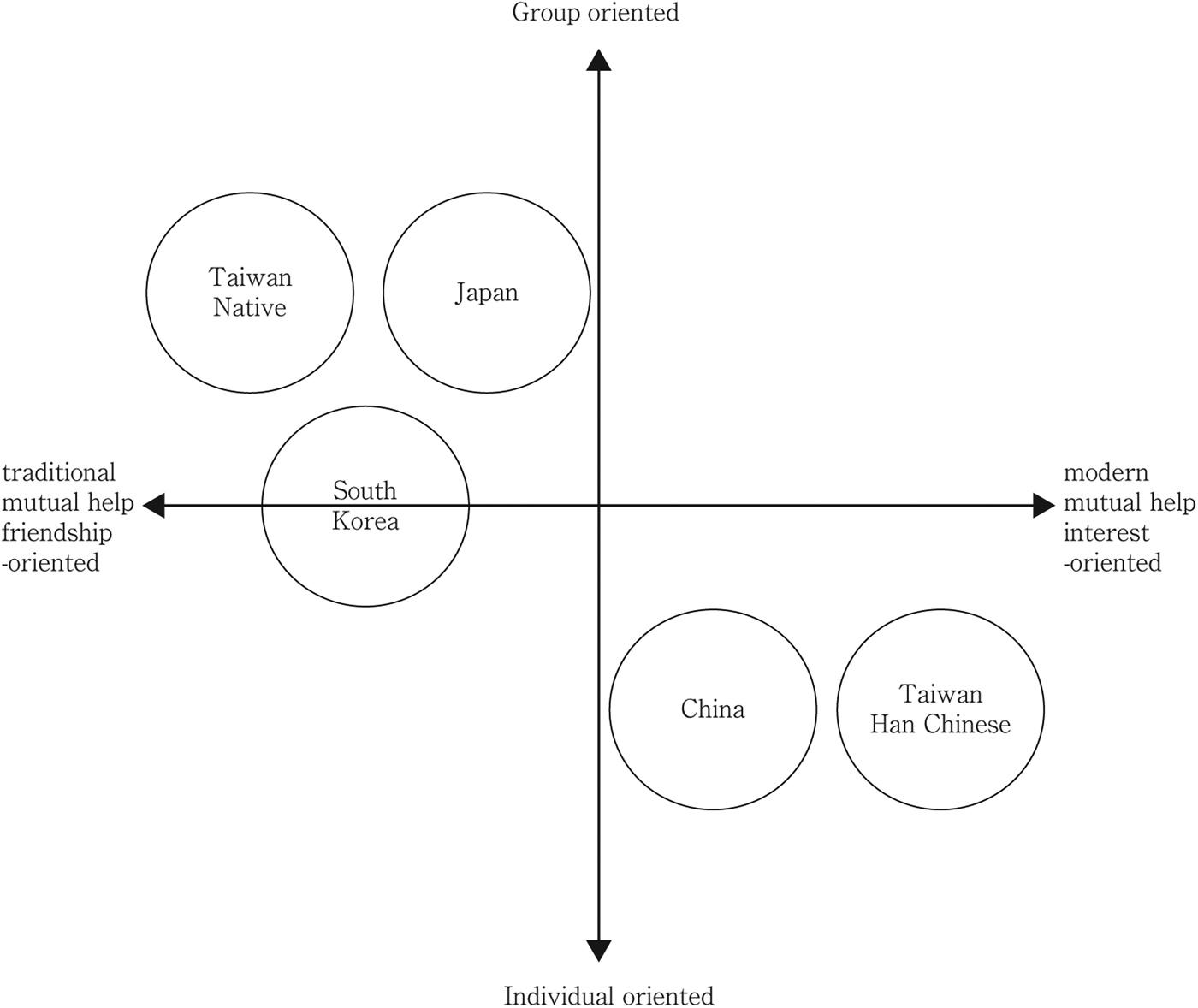
Differences of mutual help among the four nations reflect the ethos of community spirit in each culture (Fig. 2). The spirit of mutual help society can, therefore, be divided into three types. It seems to provide a new field and to be all right to consider the types of social relationships from the geographical aspects. The ideal type of “peninsular spirit,” “continental spirit,” and “island spirit” are might be an unrealistic assumption.
Mutual help networks in ROSCAS of Japan, South Korea, China, and Taiwan.

Salient characteristics of Japanese society could be understood through the two principles (ie and mura) together with the principle of shima (island) society (Onda Reference Onda2013a, pp. 545–6). “The closeness of living in isolation as a condition of nature influences the souls of people on an island and produces the spirit of mutual help through identification even when the population is in the millions. Strong relationships of mutual help can be found among the people. An island is an entire common itself and naturally suggests a communal life. This might be called mutual help through ‘islandism.’ Japanese historical attitudes have sustained ie, mura, and shima principles in producing the current Japanese social system. These attitudes remain strong despite the influence of foreign countries. In the context of the modern world not all features of the ie, mura, and shima system are necessarily benign. However, the spirit of mutual help has been successful in the creation of modern Japanese society.”
The principle of shima (island) society means that Japan has the characteristics of openness and closeness that islands have. In other words, it shows social inclusion and exclusion. The Japanese exhibit an “island spirit” that is groupism and not particularly based on religion or philosophy. Paradoxically, it encompassed both a powerful sense of exclusion toward outsiders but a remarkable openness toward adopting ideas and systems of outsiders at the same time (Onda Reference Onda2015). The former is seen as the strong cohesion of mutual help networks especially in villages (Suzuki Reference Suzuki1968 [1940]). The latter is evident in the adoption and adaptation of several institutions of foreign countries in the past.
South Korea has what can be termed a “peninsular spirit,” defined by strong agnate group cohesion together with individual connections as expressed in ke relationships (Goson Shakaishi Kenkyukai 1996; Lee, Jang, and Lee Reference Lee, Jang and Lee1991 [1983]). It displays characteristics of both groupism and individualism. Confucianism has controlled mutual help networks as vertical relationships and individualism characterizes the horizontal mutual help networks. People tend to participate in several kes to prepare for an unpredictable future. The character of South Korea is one of both groupism and individualism. In this context, the South Korean sense of community is situated between Japan and China. This country shows conservatism toward the penetration of Confucianism (Bird Reference Bird1905).
China can be said to exhibit a “continental spirit,” which reflects a relatively weaker cohesion in its village communities. Although traditional mutual help customs persist, the village unit has been superseded by the sense of communities of extended families and greater individualism in the village. This sense has been reinforced by the imposition of the artificial institutions of socialism, veiling the traditional mutual help networks.Footnote 7. Paradoxically, it appears that imposed socialist groupism has made strengthened, rather than weakened, individualism and weakened, rather than strengthened, the sense of community because people depend on not communal help but on public help. Social support has removed the need for these informal networks, and socialists would see this as a sign of social progress. Furthermore, traditional ROSCAS have been weakened through capitalism since Chinese economic reform as a socialist market economy because people pursue more individual interest. Chinese continentalism based on family is defined as individualism contrasting with Japanese community that is oriented toward groupism.
Taiwan has a peninsular spirit of individualism from Mainland China and groupism from tribes like South Korea. This is the character of “quasi-island spirit.” The former is based on Han Chinese people who are individualism oriented in ROSCAS by bidding. The latter is exhibited in the tribes as aborigines who are groupism oriented to help each other in villages through living together (Mori Reference Mori1917) and they have succeeded in traditional mutual help. Taiwan might be said to be “quasi-islandism” in this sense.
Possibility of reconstructing community through ROSCAS as traditional mutual help
The concept of community shows an ideal type of human life. People who have self-reliance are independent, but still have to live together helping each other in case of need. Community has been developed and sustained through mutual help networks that exhibit and serve traditional social structures. As survey results show, the mutual help networks of Japan, South Korea, China, and Taiwan exhibit similar characteristics of community through ROSCAS, with the differences that Japanese community is group oriented, South Korean community has both individual and group-oriented features, Chinese community is individual oriented, and Taiwan has both individual and group features.
Although modernization has been influencing and transforming the communities of all four countries, the results of the influences are different for each country. In Japan self-help has become stronger with economic growth and communal help has been weakened (Putnam Reference Putnam2000). However, the Great East Japan Disaster led Japanese people to realize that communal help from everyday acquaintances is important (Onda Reference Onda2013a, Reference Onda, Waugh and Han2017). Some Japanese organizations have adopting the name of Yui or moyai of the custom in traditional mutual help. These organizations are nonprofit organizations, that is organizations traditionally dedicated to furthering a particular social cause or advocating a shared point of view. These organizations act with the names of traditional costumes. This shows that Japanese traditional actions are conscious.
In South Korea with its vigorous capitalism, self-interest has seemed to strengthen. Conversely, people are likely to seek the revival of traditional Confucianism. In China, a socialist market economy has engendered not groupism but individualism through the pursuit of self-interest with adverse consequences. Overdependence on government aid has led to the neglect of the value of communal help. In Han Taiwan, individualism was succeeded from the spirit of capitalism refusing socialism by Chinese people meanwhile the tribes maintained their traditional customs of communal help.
In all four nations, the spirit of communal help has become narrow and weakened. Communal help is indispensable for community empowerment (Etzioni Reference Etzioni1996; Friedmann Reference Friedmann1992). However, public help and self-help are also necessary. Sustainable communities are possible through the balance of the trinity of public help, communal help, and self-help (Smiles Reference Smiles1859). ROSCAS as individual action need self-help by especially bidding. There are some ROSCAS that exist as a money game. ROSCAS originated in mutual help should be reconsidered in modern society because the concept has the purest expression of the very essence of mutual help. It might be emphasized that ROSCAS is not only an economic institution but also social institution as communal help.Footnote 8 If we recognize ROSCAS as mutual help action, it means not only money credit but also labor or goods credit of the meaning to help each other except money. ROSCAS should regain the character of communal help.
East Asia, comprised of Japan, South Korea, China, and Taiwan retains traces of the common mutual help customs described in this paper. Therefore, the possibility for developing a sense of East Asian community would be considerable (Okakura Reference Okakura1986 [1903]). At the same time, political, historical, and economic differences present formidable obstacles to the realization of such a notion. However, the populace of these countries could find common ground based on shared notions of traditional communal help to connect as East Asian citizens.
The information society has brought the connection on the Internet and the technology may also hasten the development of a sense of global citizenship among the people of four nations in the future. Mutual gains as East Asian citizens through the spirit of reciprocity could be realized. The organization of Asian Development Bank might be a type of ROSCAS. East or South Eastern Asian fund is considered to establish through the way of ROSCAS among countries. Although crowdfunding is not ROSCAS, a certain fund is a good example of connecting people worldwide through mutual help networks. It is the practice of funding a project or venture by raising small amounts of money from many people, typically via the Internet. The COVID-19 pandemic has affected people all over the world. Japanese supported not only essential workers such as healthcare workers, public health workers, and employees of public utilities and transportation, but also performing musicians and artists who had few businesses after widespread stay-at-home orders by collecting some money. Crowdfunding might be said to be a type of ROSCAS.
Conclusions
Each nation has the name of a traditional organization such as kou in Japan, ke in South Korea, huì in China, and Taiwan. People have exhibited the action of gathering money by putting a certain name before the organization or only calling them by the organizational names itself. We can still see the traditional institutions functioning for private purposes of not only economic finance and insurance in spite of modern financial organizations such as banks, post offices, or cooperatives but also social bonds and relationships. The ways of organizing ROSCAS differ among localities. Because the indigenous system has been inherited according to the “wisdom of life” of local people. ROSCAS could contribute to building and maintaining sustainable community (Ardener Reference Ardener, Ardener and Burman1995; Burt Reference Burt1992). Any community consists of independent individuals, but in a changing world, when the power of individual is weak, and he does not know what to do, the regional residents' assistance of a group is indispensable (Hechter Reference Hechter1987; Olson Reference Olson1965; Onda Reference Onda, Waugh and Han2017). ROSCAS through mutual help should be respected as spontaneous social order based on the sympathy of individuals.
It is necessary to keep mutual help networks alive in the modern society (Cahn Reference Cahn2000; Crow Reference Crow, Phillipson, Allan and Morgan2004; Kropotkin Reference Kropotkin1902; Rawls Reference Rawls1999 [1971]). Sustainable communities adapt themselves not only to modern circumstances surrounding regional societies, but also with a sometimes-unconscious sense to the unchanged, enduring history of their culture. The unification of archaic and neo-archaic trends is necessary for sustainable community life. This is the universal model of human life. It informs the connection of tradition to modernity, which, when consciously employed, would help communities to reconstruct and remain sustainable. ROSCAS as a mutual help institution is such a traditional system. Although the qualities and quantities of mutual help networks differ among the four countries, an East Asian community might be possible through the recognition of the common points. Younger people who acknowledge traditional customs use moai in Okinawa prefecture and ke in South Korea. They who do not participate in ROSCAS will learn the actions of parents or other adults and understand them as necessary means. It might be seemed to be indispensable not as interest-oriented means, but one of communal help means or communication tools. Therefore, we hope that ROSCAS possibly might become a base for future community reconstruction in East Asia.
These modern and modernizing societies would do well to acknowledge such mutual help networks and incorporate them into official strategies as they search for solutions to both public and private social problems.Footnote 9 For example, if the four nations make the fund as ROSCAS managed by them, each nation can rotate and use the fund when a nation needs it. In addressing private problems, international exchanges of citizens among the four countries could contribute to the improvement of the oppositional consciousness among them. We should review the original meaning of ROSCAS and revitalize them as the traditional mutual help system. Local people participate in ROSCAS despite the existence of many financial organizations. It might be underlined that each person of the four nations would recognize the possibility of sustainable communities through ROSCAS in a regional society and understand the commonality of ROSCAS in East Asia.
Financial support
The research project “International Comparative Study on Mutual Help Networks from the Viewpoint of Folk Sociology” was funded by the Japan Society for the Promotion of Science (JSPS), Grant-in-Aid for Scientific Research(C), 2011–2014, research number: 23530679.
Conflict of interest
The author has no conflicts of interest to disclose.