The coronavirus disease (COVID-19) pandemic has caused an unprecedented public health disaster to human society, and people have experienced worsening mental health and increased distress associated with COVID-19. Reference Pfefferbaum and North1 Besides, the long-term persistence of COVID-19 increases the frequency of multi-disaster scenarios, that is, the overlap between the pandemic and other disasters (eg, climate hazards), which could jeopardize public health response and compromise post-disaster recovery. Reference Phillips, Caldas and Cleetus2 Following disasters, the experience of mental health recovery can vary by age. Older age has been found to be associated with better psychological health at the initial stage of the pandemic response, Reference Klaiber, Wen, DeLongis and Sin3,Reference Vahia, Jeste and Reynolds4 but it is unclear whether the age-related advantages can be maintained after multiple experiences of COVID-19 and other disaster types.
In addition to the increased risk of cumulative disasters, the COVID-19 pandemic has resulted in profound impacts on multiple life domains, including physical and mental health, employment, health care, housing, and social interactions. 5 The chronic and complex COVID-19 impacts tend to increase the risk for long-term psychological outcomes, especially among older adults Reference Grasso, Briggs-Gowan and Carter6 ; however, there is a dearth of longitudinal research examining how the age differences in post-disaster mental health recovery are affected by the multidimensional COVID-19 impacts. Using the 2-wave panel data collected from individuals who had experienced tornadoes and the COVID-19 pandemic, the present study aimed to examine the age differences in psychological distress after multiple disaster exposures. Besides, latent class analysis was used to explore the typologies of negative COVID-19 impacts across economic, health, social, and emotional domains, based on which we further investigated how the identified class membership moderated the aforementioned age differences.
Theoretical Frameworks
This study was guided by 3 theoretical frameworks: (1) Life course perspective, (2) socioemotional selectivity theory (SST), and the (3) Strength and Vulnerability Integration (SAVI) model. According to the life course perspective, older adults often have more experience with disasters or other stressful life events that allow them to take a comparative view of the current situation and become more optimistic about disaster recovery; also, social roles in late adulthood determine that older adults do not face multiple responsibilities following disasters and thus experience less psychological distress in the recovery process. Reference Adams, Kaufman, Van Hattum and Moody7 SST posits that, as people age, they tend to perceive future time as limited and have an increased preference for emotionally meaningful goals. Reference Carstensen, Isaacowitz and Charles8 As a result, older adults are generally more skilled at emotion regulation, which enables them to avoid experiencing negative emotions in stressful contexts. Reference Carstensen, Fung and Charles9 Based on SST, the SAVI model suggests that the age-related enhancement in emotion regulation may be attenuated when older adults experience high levels of sustained and unavoidable stress, which will lead to prolonged psychological distress and delayed recovery from the event. Reference Charles10 Overall, these theoretical frameworks assume that older adults generally have greater psychological resilience than their younger counterparts after stressful events, including cumulative disaster exposures, but the age-related strengths may be diminished in the face of some stressors that are complex, chronic, and rare in previous life experiences, such as the multidimensional COVID-19 impacts.
Age and Mental Health Following Disasters
Empirical studies have identified the unique strengths of older adults in mental health recovery from disasters, including the COVID-19 pandemic. Although people of all age groups experience some increases in mental health problems at the beginning of the pandemic outbreak, older adults tend to develop fewer problems than younger and middle-aged adults. Reference Klaiber, Wen, DeLongis and Sin3,Reference Daly, Sutin and Robinson11 In the early months of the pandemic response, older adults can gradually recover from initial problems and maintain good mental health, Reference Pierce, McManus and Hope12 whereas younger people are more likely to experience psychological distress and related symptoms. Reference Fernández, Crivelli and Guimet13,Reference McPherson, McAloney-Kocaman and McGlinchey14 Even though some younger adults have faster improvements than older people in certain mental health issues, the age differences still persist over time. Reference Fancourt, Steptoe and Bu15
Although the old-age strengths in post-disaster mental health have been well documented, existing studies primarily focused on the age differences after experiencing a single disaster, with limited research on multiple disaster exposures. Acierno et al. examined the residents in Florida counties who experienced the 2004 hurricanes, reporting that older adults had fewer symptoms of post-traumatic stress disorder (PTSD), anxiety, and depression than younger and middle-aged adults. Reference Acierno, Ruggiero and Kilpatrick16 Cherry et al. also found that compared to older adults, the storm-related stressors were more disturbing for younger and middle-aged adults after Hurricanes Katrina and Rita. Reference Cherry, Brown and Marks17 These works suggest that older adults could maintain the age-related advantages in mental health after exposure to cumulative natural hazards, beyond which little is known about the overlap of other disaster types, especially the multi-disaster scenarios during the COVID-19 pandemic.
Multidimensional COVID-19 Impacts and Mental Health Outcomes
The COVID-19 pandemic has dramatically affected human life across a range of domains. Due to the COVID-19 economic crisis, people are facing serious problems with finances, employment, and housing. 5 In the health domain, health insurance coverage has been severely disrupted, and health care utilization has dropped significantly during the pandemic. Reference Moynihan, Sanders and Michaleff18 With regard to social life, the COVID-19 pandemic caused various problems with transportation systems, Internet access, and social interactions. 5,Reference Kessel, Baronavski, Scheller and Smith19 The economic, health, and social impacts of COVID-19 can further lead to widespread emotional vulnerability and mental illness. Reference Pfefferbaum and North1 Given these intertwined impacts, existing studies have used latent class analysis to capture the full dimensions and underlying patterns of negative COVID-19 impacts, as well as have found the associations between class memberships and mental health outcomes. Reference Grasso, Briggs-Gowan and Carter6,Reference Goldstein, Brown, Lennon and Zgierska20 For example, Frounfelker et al. explored the typologies of positive and negative aspects of experiencing social distancing and identified 5 classes; they further reported that individuals in Hardships class were more likely to report a significant impact of COVID-19 on mental health than those in Low Impact class. Reference Frounfelker, Li and Santavicca21 Likewise, Luk et al. explored the multidimensional impact of COVID-related stressors and yielded 4 classes; compared to those in Minimal COVID-related Impact class, people in Serious Financial Stress class reported higher levels of perceived stress, anxiety, and depressive symptoms. Reference Luk, Stangl and Schwandt22 These studies suggest that individuals experiencing a more severe level of COVID-19 impacts are at higher risk for psychological distress than those who are less affected by the pandemic. As the pandemic persists, negative COVID-19 impacts may further increase the incidence of mental health conditions, Reference Vahia, Jeste and Reynolds4 and their long-standing effects can vary across the adult life span.
Older Adults in Response to Multidimensional COVID-19 Impacts
In general, older adults exhibit greater psychological resilience than their younger counterparts in response to stressful situations. Reference Charles10 However, the COVID-19 pandemic has provided a stressful disaster context with long-lasting impacts on nearly every aspect of personal life, which may compromise the age-related strengths and lead to prolonged psychological distress among older adults. Reference Scott, Sliwinski and Blanchard-Fields23,Reference Wrzus, Müller and Wagner24 In response to the multidimensional COVID-19 impacts, Grasso et al. found that older adults who reported cumulated adverse COVID-19 experiences in work, home life, and emotional and physical health domains had higher rates of PTSD, anxiety, and depression than the older subpopulation who was less affected in multiple life domains. Reference Grasso, Briggs-Gowan and Carter6 To sum up, theoretical frameworks and existing studies suggest the diminished age-related advantages in coping with the complex and chronic COVID-19 impacts, but the differences between older people and their younger counterparts in experiencing multidimensional COVID-19 impacts and associated long-term mental health effects after cumulative disaster exposures remain unclear.
Study Hypotheses
Based on the above discussions, some hypotheses on age differences in mental health in the multi-disaster scenario of tornadoes and the COVID-19 pandemic were developed, with a focus on negative COVID-19 impacts. First, older adults will report a lower level of psychological distress than their younger counterparts after experiencing tornadoes and the COVID-19 pandemic, and they can maintain this advantage over time. Second, there are latent classes of multiple COVID-19 impacts that reflect varying degrees of negative experiences, and people who experience more severe COVID-19 impacts will report greater psychological distress. Third, in face of severe and complex COVID-19 impacts, the age-related strengths in mental health will diminish, and older adults may exhibit greater psychological distress than their younger counterparts in the long run.
Methods
Sample
A 2-wave panel study was conducted to examine participants’ vulnerability and resilience to multiple disaster exposures (ie, tornadoes and the COVID-19 pandemic) in Texas, Tennessee, and Alabama, USA. The first wave of data collection took place between October 2020 and August 2021 (T1). In Texas, address-based random sampling was adopted to choose around 25 000 addresses from selected zip codes affected by the Dallas tornado of October 2019. Since the Tennessee (Nashville–Cookeville) tornado of March 2020 and Alabama tornadoes of March 2021 occurred in relatively population-sparse areas, approximately 10 000 addresses were identified centering on each tornado track. The recruiting mails were sent to the selected addresses, with options to participate in the study via an online platform, mail-in-survey, and telephone interview. A total of 1297 participants completed the baseline survey. Participants who agreed to be contacted again for follow-up surveys were sent an email or mail between May and August 2022 (T2), resulting in 655 respondents who completed the baseline and follow-up surveys with an attrition rate of 49.50%. In the present study, 101 respondents with missing values in analytical variables were excluded, so the working sample for a 2-wave panel analysis consisted of 554 participants. Respondents to the Texas survey contributed to the major missingness (N = 100), as the planned missing was used at T1 to avoid overburdening respondents, Reference Little and Rhemtulla25 and thus 29.78% of the participants were not presented COVID-19-related questions. Since the planned missing data are missing completely at random, listwise deletion was used to handle missing values.
Measures
Age
Age was categorized into 4 groups based on the continuous age at T1: 0 = “65 and over (older age, reference)”; 1 = “18–34 (young age)”; 2 = “35–49 (early middle-age)”; and 3 = “50–64 (late middle-age).”
Psychological distress
Psychological distress was measured at T1 and T2 by the 6-question Kessler Psychological Distress Scale. Participants were asked to rate how often in the past 4 weeks they felt: (1) so sad nothing could cheer you up, (2) nervous, (3) restless or fidgety, (4) hopeless, (5) everything was an effort, and (6) worthless, with answers from 0 = “None of the time” to 4 = “All of the time.” The sum of the 6 items ranged from 0 to 24, and a higher score indicated a higher level of psychological distress. Cronbach’s alphas for the scale were 0.89 at T1 and 0.91 at T2.
Indicators of negative COVID-19 impacts
At T1, participants were asked about how much difficulty they had as a result of the COVID-19 pandemic in (1) disrupted working, (2) financial problems, (3) disrupted transportation, (4) Internet access and bandwidth problem, (5) loss of health insurance, (6) shortage of food, water, clothing, or other necessities, (7) problems getting medicines or medical attention for conditions related to COVID-19, (8) problems getting medicines or medical attention for conditions other than COVID-19, (9) crowded or unsanitary living conditions, (10) family arguments, (11) embarrassment or humiliation, (12) fear of crime, (13) inadequate information from the authorities, (14) feeling insecure, (15) feeling vulnerable, (16) feeling isolated, and (17) insufficient social support. The answers ranged from 0 = “none”; 1 = “a little”; 2 = “some”; 3 = “a lot”; to 4 = “extreme.” Because of the skewness of item measures, the answers 1–4 were combined into “Have difficulty.” Therefore, 17 dichotomous indicators of negative COVID-19 impacts were created (0 = “No difficulty”; 1 = “Have difficulty”).
Covariates
Several critical demographic variables, tornado-related home damage, and survey location were controlled. Gender was a dichotomous variable (0 = “Male”; 1 = “Female”). Education was categorized into 3 groups: 0 = “Some college or below (reference)”; 1 = “Undergraduate degree”; and 2 = “Graduate or professional degree.” Marital status was a binary variable (0 = “Unmarried”; 1 = “Married”). Ethnicity was measured by the question: “Are you of Hispanic, Latino, or Spanish origin?” (0 = “No”; 1 = “Yes”). Race was a dichotomous variable (0 = “Others”; 1 = “White”). Tornado damage to respondents’ homes was a binary variable (0 = “No damage”; 1 = “Have damage”). Survey location included: 0 = “Texas (reference)”; 1 = “Tennessee”; and 2 = “Alabama.”. All the covariates were measured at T1.
Analysis Strategy
First, latent class analysis (LCA) was used to explore the typologies of negative COVID-19 impacts. LCA is a person-centered data analytic approach to categorize latent population groups based on their answers to observed categorical indicators. Reference McCutcheon26 LCA was performed based on 1134 out of 1297 respondents at T1 for greater generalizability, who provided valid answers regarding all the 17 items of COVID-19 impacts. Mplus 8.3 was used to obtain (1) LCA model fit indices based on which optimal number of classes was identified, and (2) posterior probabilities of class membership that were used to assign the respondents into different classes. Second, univariate analyses were used to describe the characteristics of the working sample. Third, a regression-based approach for cross-sectional and longitudinal data was used to test the hypotheses. Since the outcome variables, psychological distress at T1 and T2, were not normally distributed, and the conditional variance exceeded the conditional mean (ie, overdispersion), negative binomial regression was chosen. Reference Taylor, Taylor, Nguyen and Chatters27 Cross-sectional analysis was first conducted with psychological distress at T1 as the outcome variable to examine the initial age differences. Then, 2 models were performed with psychological distress at T2 as the outcome variable while controlling for psychological distress at T1. This approach allows us to predict the residualized change between panel waves and produces stronger evidence for the long-term effects of variables at T1. Reference Blair, Raver and Berry28 Model 1 included the key variables and control variables. The interaction between age and latent classes was added in Model 2. The univariate and regression analyses were performed using Stata 15.
Results
LCA Result
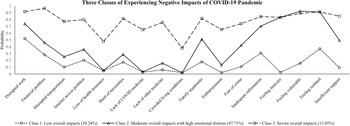
Fit indices for different LCA models were presented in Table 1. The 3-class model had the highest entropy score, indicating that it exhibited better class separation than other models. The Lo-Mendell-Rubin likelihood ratio test showed that a 3-class model had a better fit than a 2-class model, and 4 classes were not really needed. The 3-class model also demonstrated reasonable class proportions and great interpretability, as illustrated in Figure 1. Therefore, a 3-class model was chosen as the optimal class solution.
Fit indices for potential latent class models (N = 1134)

AIC, Akaike Information Criterion; BIC, Bayesian Information Criterion; aBIC, Adjusted Bayesian Information Criterion; LMR, Lo-Mendell-Rubin likelihood ratio test.
Three classes of experiencing negative impacts of the COVID-19 pandemic.

Among a sample of 1134 respondents at T1, class 1 “low overall impacts” consisted of 39.24% (N = 445) of the respondents. People in this group had generally lower probabilities of experiencing all the negative COVID-19 impacts than the other 2 classes (range 0.02–0.52, less than 0.30 in most items). Class 2 “moderate overall impacts with high emotional distress” comprised 47.71% (N = 541) of the respondents. This group had moderate probabilities of experiencing most COVID-19 impacts and a high rate of feeling insecure (0.83), feeling vulnerable (0.92), and feeling isolated (0.91). Class 3 (N = 148, 13.05%) was characterized as “severe overall impacts,” which represented the respondents with the highest probabilities of experiencing most COVID-19 impacts compared to the other 2 classes (range 0.38–0.97, more than 0.70 in most items).
Working Sample Characteristics
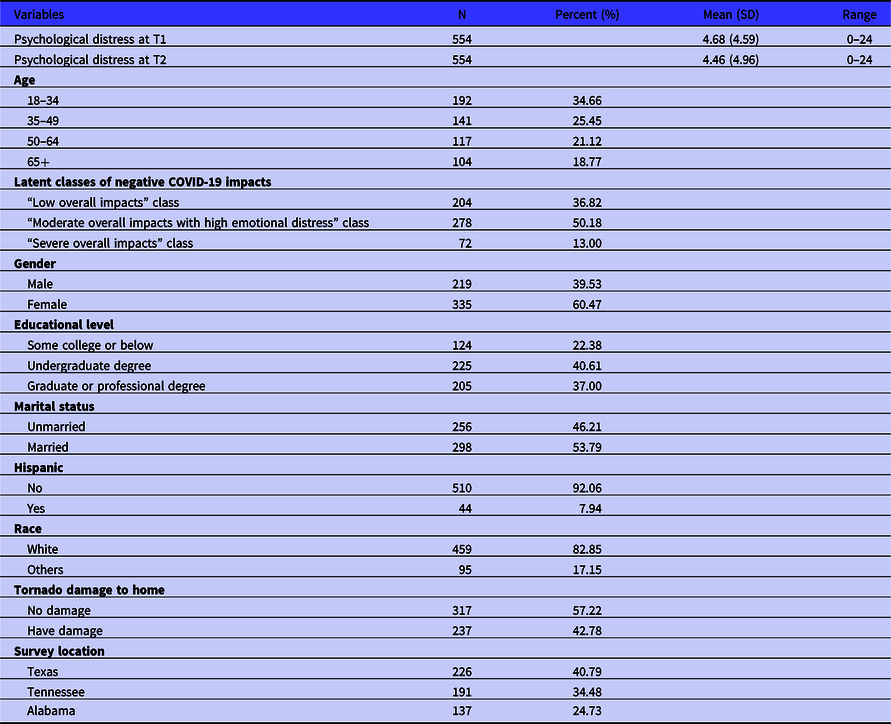
Table 2 summarized the characteristics of the working sample (N = 554). The average scores of psychological distress were 4.68 (SD = 4.59) at T1 and 4.46 (SD = 4.96) at T2. People ages 18–34 made up 34.66% of the sample, followed by those ages 35–49 (25.45%), 50–64 (21.12%), and 65 and over (18.77%). Class 1 “low overall impacts” consisted of 36.82% of the working sample, 50.18% of the working sample were in class 2 “moderate overall impacts with high emotional distress,” and 13.00% of them were in class 3 “severe overall impacts.”
Characteristics of working sample (N = 554)

Regression Analyses Results
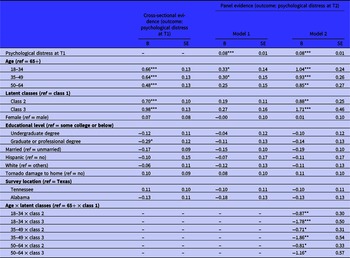
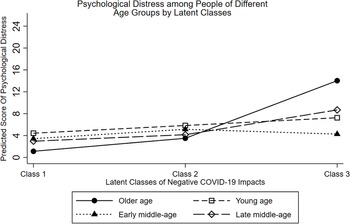
The results of negative binomial regressions were presented in Table 3. The cross-sectional evidence showed that compared to those ages 65 and over, people ages 18–34 (B = 0.66, P < 0.001), ages 35–49 (B = 0.64, P < 0.001), and ages 50–64 (B = 0.48, P < 0.001) had greater psychological distress at T1. Relative to people in the “low overall impacts” class, those in the “moderate overall impacts with high emotional distress” class (B = 0.70, P < 0.001) and the “severe overall impacts” class (B = 0.98, P < 0.001) had a higher level of psychological distress at T1. The panel analyses examined the predictors of T2 psychological distress with baseline psychological distress controlled. Model 1 showed that compared to those ages 65 and over, individuals ages 18–34 (B = 0.33, P < 0.05) and those ages 35–49 (B = 0.30, P < 0.05) had a higher level of psychological distress at T2 with covariates and T1 psychological distress controlled. The interaction between age and latent classes was added in Model 2 and reached statistical significance. As shown in Figure 2, older adults showed the greatest increases in T2 psychological distress than their younger counterparts when they were in the “moderate overall impacts with high emotional distress” class and the “severe overall impacts” class.
Predicting psychological distress: negative binomial regressions (N = 554)

Class 1 “low overall impacts”; class 2 “moderate overall impacts with high emotional distress”; class 3 “severe overall impacts”; *P < 0.05, **P < 0.01, ***P < 0.001.
Psychological distress among people of different age groups by latent classes.

Discussion
As hypothesized, older adults had better mental health than their younger counterparts after experiencing tornadoes and the COVID-19 pandemic. This finding is in line with prior literature Reference Daly, Sutin and Robinson11,Reference Acierno, Ruggiero and Kilpatrick16 and may be explained by the life course perspective and socioemotional selectivity theory. It is noteworthy that our finding extends previous research by focusing on multi-disaster scenarios during the COVID-19 pandemic. The overlap of the COVID-19 pandemic and other disasters provides a challenging context for post-disaster recovery, because emergency responses frequently conflict with COVID-19 restrictions, and the pandemic also strains health care and the economy. Reference Phillips, Caldas and Cleetus2 Even under such circumstances, older adults’ advantages over those ages 18–34 and 35–49 in mental health can be maintained over time, which provide strong evidence for resilience in older adults and suggest that post-disaster mental health services should focus more on people under age 50 who are more likely to experience delayed recovery. Reference Fancourt, Steptoe and Bu15 Although people ages 50–64 reported more psychological distress at T1, they were not significantly different from those ages 65 and over at T2, which may be because the coping strategies and resources of people in late middle-age allow them to gradually recover over an extended process. Reference Pierce, McManus and Hope12,Reference Cherry, Brown and Marks17
Consistent with prior studies, Reference Goldstein, Brown, Lennon and Zgierska20,Reference Luk, Stangl and Schwandt22 3 distinct latent classes of negative COVID-19 impacts and their associations with psychological distress were identified. A detailed discussion of the 3 latent classes can be found elsewhere. Reference Chen and Cong29 This study suggested that respondents who experienced moderate or severe overall COVID-19 impacts had more pronounced psychological distress at T1 relative to those with low impacts, which may be due to abrupt disruptions and resource losses in multiple life domains. Reference Frounfelker, Li and Santavicca21 It is noted that the latent classes did not predict psychological distress at T2, but a further examination revealed the age differences in experiencing the long-term mental health effects of multidimensional negative COVID-19 impacts, as discussed below.
Although older adults were generally more resilient than their younger counterparts after exposures to tornadoes and the COVID-19 pandemic, they reported the greatest increases in T2 psychological distress after experiencing moderate or severe overall COVID-19 impacts. This finding is in line with the SAVI model. Reference Charles10 In response to the chronic COVID-19 impacts across multiple domains, age-related enhancement in emotion-focused coping strategies tends to be attenuated or even dissipated over time, and thus older adults exhibited worse mental health relative to their younger counterparts. Reference Scott, Sliwinski and Blanchard-Fields23,Reference Wrzus, Müller and Wagner24 During the long process of recovery from tornadoes and the COVID-19 pandemic, younger and middle-aged adults may be less affected by pandemic-related stressors, and their overall higher levels of psychological distress relative to older adults might be attributed to the age-related vulnerability to ongoing non-pandemic stressors, such as interpersonal conflicts and daily stressors related to work and family. Reference Klaiber, Wen, DeLongis and Sin3
Limitations and Implications
First, the subsamples in Texas, Tennessee, and Alabama may experience different degrees of multiple disaster exposures, because (1) the tornado in Texas occurred in urban areas, and the outbreaks in Tennessee and Alabama occurred in population-sparse areas; (2) COVID-19 confirmed cases, death toll, and public health responses vary among these states; and (3) the tornado in Texas occurred before the outbreak of COVID-19 while the tornadoes in Tennessee and Alabama occurred during the pandemic. Besides, the time intervals between the tornado outbreak and first data collection in Texas and Tennessee were approximately a year, but that for Alabama was 4 months, which may cause some nuanced differences in baseline measures. Accordingly, even if survey location, tornado damage, and baseline psychological distress were controlled in data analysis to reduce potential bias from those limitations, we should interpret the results with more caution. Second, some possible confounders, such as pre-existing mental health conditions, exposure to threat, and risk perception, Reference Brooks, Dunn and Amlôt30,Reference Rahman, Hoque and Alif31 were not taken into account due to the lack of relevant variables in the data set. Third, this study merely declared the observation of psychological resilience in older adults after experiencing tornadoes and the COVID-19 pandemic without empirically explaining the mediating process of resilience, due to the lack of relevant variables. Based on existing literature and theoretical frameworks, more mediation analyses are needed to identify the real reasons for the age-related strengths in rebounding from and adapting to multiple disaster exposures, with important confounders controlled.
Regardless of the limitations, this study is the first to examine the age differences in psychological distress following cumulative exposures to the COVID-19 pandemic and other disasters and how such age differences are contextualized by multidimensional COVID-19 impacts. Our findings highlight the strengths of older adults in post-disaster recovery and have important implications for public health policymaking and practice. Instead of predominantly focusing on older adults’ vulnerabilities and excluding them from disaster-response activities, current disaster-related policy and intervention efforts should recognize the age-related strengths in mental health and engage experienced and resilient older adults in community recovery work and capacity building for disaster risk reduction. For instance, resilient older adults can provide emotional support to others in the post-disaster recovery process, and this kind of voluntary work will allow older adults to feel greater competence and self-esteem as helpers in stressful disaster contexts. Reference Shrira, Palgi and Hamama-Raz32 It should be noted that, despite the resilience of older adults in mental health recovery, older adults are still at higher risks for COVID-19 and for long-term psychological distress if experiencing multidimensional COVID-19 impacts. Therefore, for those vulnerable older adults, disaster-related practitioners ought to assess their difficulties and special needs in multiple life domains and provide tailored social services and mental health programs on a long-term basis. The COVID-19 pandemic is not the last global public health disaster we shall confront, and there will be more complex disaster scenarios as global warming and climate change continue. It is important to develop new public policy and mental health intervention strategies tailored to multi-disaster scenarios, Reference Leppold, Gibbs and Block33 with the multidimensional disaster impacts and age-related differences in long-term recovery taken into account.
Author contributions
Z Chen conceptualized the study, performed data analysis, and wrote the paper. Z Cong helped plan the study, supervise data analysis, and revise the manuscript.
Funding statement
This work was supported by the National Science Foundation (CMMI 1839516) and the National Institute of Standards and Technology (70NANB19H061).
Competing interests
The authors declare no conflicts of interest.
Ethical standards
This study received approval from the University of Alabama at Birmingham, Institutional Review Board (IRB# 300010593). All participants provided consent for the study. The manuscript is part of a publicly defended PhD dissertation Reference Chen34 .