The failure of social science expectations that several Arab states would democratize in the 1980s and 1990s forced a reappraisal. The belief that chronic fiscal crisis and waning popular support would lead regimes to loosen authoritarian controls and thus possibly lead to democratization proved disappointingly unfounded.1
See John Waterbury, “From Social Contracts to Extraction Contracts: The Political Economy of Authoritarianism and Democracy,” Lisa Anderson, “Prospects for Liberalism in North Africa: Identities and Interests in Preindustrial Welfare States,” and Clement M. Henry, “Crisis of Money and Power: Transitions to Democracy?” in Islam, Democracy, and the State in North Africa, ed. John P. Entelis (Bloomington, Ind.: Indiana University Press, 1997); Anoushiravan Ehteshami and Emma C. Murphy, “Transformation of the Corporatist State in the Middle East,” Third World Quarterly 17 (1996): 753–72.
See Eberhard Kienle, “More than a Response to Islamism: The Political Deliberalization of Egypt in the 1990s,” Middle East Journal 52 (1998): 219–35; Laurie A. Brand, “The Effects of the Peace Process on Political Liberalization in Jordan,” Journal of Palestine Studies 28 (Winter 1999): 52–67; Quintan Wiktorowicz, “The Limits of Democracy in the Middle East: The Case of Jordan,” Middle East Journal 53 (1999): 606–20; Daniel Brumberg, “Authoritarian Legacies and Reform Strategies in the Arab World,” in Political Liberalization and Democratization in the Arab World: Theoretical Perspectives, ed. Rex Brynen, Bahgat Korany, and Paul Noble (Boulder, Colo.: Lynne Rienner, 1995), 229–59; and Glenn E. Robinson, “Defensive Democratization in Jordan,” International Journal of Middle East Studies 30 (August 1998): 387–410.
See Marsha Pripstein Posusney and Michelle Penner Angrist, ed., Authoritarianism in the Middle East: Regimes and Resistance (Boulder, Colo.: Lynne Rienner, 2005); Jason Brownlee, “… And Yet They Persist: Explaining Survival and Transition in Neopatrimonial Regimes,” Studies in Comparative International Development 37 (Fall 2002): 34–63; Michael McFaul, “The Fourth Wave of Democracy and Dictatorship: Noncooperative Transitions in the Postcommunist World,” World Politics 55 (January 2002): 212–44; Gerardo Munck, “The Regime Question: Theory Building in Democracy Studies,” World Politics 54 (October 2001): 119–44; Michael Herb, All in the Family: Absolutism, Revolution, and Democracy in the Middle Eastern Monarchies (Albany, N.Y.: State University of New York Press, 1999); and Michael L. Ross, “Does Oil Hinder Democracy?” World Politics 54 (April 2001): 325–61.
To begin, this essay joins the recent literature by shifting from a focus on political outcomes among the Arab states as constituting a single bivariate outcome—democratization or authoritarianism—to assessing important political change short of democratization. This we ideally conceptualize as contestation and coordination in relations4
This typology derives from Robert Dahl's, Polyarchy (New Haven, Conn.: Yale University Press, 1971).
By focusing analysis on association–state relations, we also move beyond the debate that Arab civil society constitutes a force for democratization versus the argument that civil society has been used to preserve regime power.5
See, respectively, Richard Augustus Norton, ed. Civil Society in the Middle East, vols. 1 and 2 (Leiden: E. J. Brill, 1995, 1996); and Quintan Wiktorowicz, “Civil Society as Social Control: State Power in Jordan,” Comparative Politics (October 2000): 43–61.
Although conceptualizing association–state interactions as constituting coordination or contestation does not exhaust the variety of possible outcomes, it does allow structured comparison within and between cases, and, as this article presents, it does fit the historical record well. Coordination in the associational sense recalls Peter Gourevitch's observation that “state action is frequently corporatistic, in that state and groups borrow from each other the authority to do what they cannot do alone.”6
Peter Gourevitch, Politics in Hard Times: Comparative Responses to International Economic Crises (Ithaca, N.Y.: Cornell University Press, 1986), 230.
Missing the variance between contestation and coordination and coding such disparate cases as Jordan, Kuwait, and Syria under the generic rubric of nondemocratic may make methodological sense in pursuing certain questions, but there are costs (Table 1). Lost is an appreciation of the varying patterns of local political struggles between state and society. Through professional associations and their relations with political authority are ways to observe and theorize about political change under authoritarian regimes. To make the point in another way, authoritarian Arab regimes have weathered two decades of crisis differently, and these differences, particularly in the areas of state–association relations, are important to the prospects of future regime shifts. For scholars studying modern Arab politics, this means “paying attention to the diverse ways a common outcome can be reached.”7
Charles C. Ragin, “Tuning the Tables: How Case-Oriented Research Challenges Variable-Oriented Research,” Comparative Social Research 16 (1997): 27–42.

In the cases under review, nondemocratic regimes survived the 1980s and 1990s through different routes. Coordination to formulate and implement policy reform in the face of chronic fiscal crisis and the postinvasion reconstruction best describes Kuwait's association–state relations in this period. By contrast, consistent and mobilized resistance to state policies by Jordan's professional associations is one of the clearest examples of contestation in the Arab world. Syria's experience falls somewhere in between. Contestation by professional associations prior to the onset of fiscal pressures in the middle 1980s prompted state actions to crush associational autonomy and voice. Coordination has been selective and limited, and policy-reform implementation has involved only those actors closest to the regime and deemed “safe.”8
Of course as ideal types there is no claim here that contestation and coordination are mutually exclusive. The judgment on outcome is an assessment of which best describes association–state relations over the past two decades.
To explain these outcomes requires attention to how and why state–association relations evolved prior to the 1980s and 1990s. Across the region, regime elites formed states with the participation and support of strategic social bases. Likewise, professional associations sometimes in existence before political independence came to be defined by their own social bases. The argument is that the political relevance of these respective social bases determined patterns of state intervention into associational life. In turn, the character of state intervention shaped associations' institutional capacities to engage political authority.
In both Syria and Jordan, professional associations came to represent social groups that were different and at times opposed to their regimes' base of political support. Thus periodic and at times significant state manipulation of associational autonomy in Syria and Jordan (albeit to a lesser extent and historically later in Jordan) served to weaken associational capacities over time. By contrast, the Kuwaiti regime and its professional classes shared common historical origins and social linkages. This resulted in less direct state intervention in associational life and more associational autonomy and capacity. In the 1980s and 1990s, consideration of these sociopolitical antecedents and institutional capacities explains contestation and coordination. Thus, in Syria and Jordan evolution of contrasting social bases led to contested association–state relations, albeit of different intensities and with varying consequences to state–society relations. In Kuwait, a less divergent social base supported coordinated relations in which more capable and more autonomous associations worked closely with state elites.
These three cases represent typical Arab countries enduring fiscal and political crises in the 1980s and 1990s. Jordan, Kuwait, and Syria also present typical regime types in the region: two types of monarchial rule in the former cases and single-party, populist rule in the latter. However, because the analysis relies on the three cases to develop both the outcome (contestation or coordination) and the explanations of those outcomes, there is no claim that this study provides a test of the arguments. Instead, the hope is that this study will lead to more empirically accurate considerations of state–society changes short of democratization9
Thomas Carothers, “The End of the Transition Paradigm,” Journal of Democracy 13 (January 2002): 5–21.
The paper proceeds by first addressing the importance of associational politics in the Arab world. The next sections systematically review crisis politics in each case to isolate the contestation–coordination patterns. Section three discusses the connection between social bases and institutional capacities to explain these outcomes. The concluding section generalizes about shifts within the region's professional associations and how they may figure in future political change.
THE NEW ASSOCIATIONAL POLITICS
Although professional associations are not new in the Arab world, their role in domestic politics has changed in the past decades. As a prelude to case discussions, this section first argues for the relevance of new associational politics; second, it discusses what constitutes a professional association and how associations differ; and third, it addresses the issue of formal versus informal views of state–society relations.
One of the more influential claims in the literature on associational politics, governance, and regime transition holds that associations are generally more important for the type of democracy consolidated than the actual transition from authoritarianism.10
Philippe Schmitter, “The Consolidation of Democracy and Representation of Social Groups,” American Behavioral Scientist 35 (March–June 1992): 422–49.
See Zayd Hamza, “al-Infitah al-Siyasi wa adaء munazzamat al-niqabiyya wa-l-mihaniyya,” in al-Masar al-dimuqrati al-Urduni…ila ayn?!, ed. Hani Hourani (Amman: Al-Urdun al-Jadid Research Center and Sindbad Publishing House, 1996), 157–63; “ʿUdwiyat al-niqabat,” paper presented at the Conference on Professional Syndicates, Urdun al-Jadid Research Center, Amman, 1998; Ninette S. Fahmy, “The Performance of the Muslim Brotherhood in the Egyptian Syndicates: An Alternative Formula for Reform?” Middle East Journal 52 (1998): 551–62; Carrie Rosefsky Wickham, “Islamic Mobilization and Political Change: The Islamist Trend in Egypt's Professional Associations,” in Political Islam, ed. J. Beinin and J. Stork (Berkeley, Calif.: University of California Press, 1997); Mustapha K. El Sayed, “Professional Associations and National Integration in the Arab World, with Special Reference to Lawyers Associations,” in Beyond Coercion: The Durability of the Arab State, ed. Adeed Dawisha and I. William Zartman (London: Croom Helm, 1988); Nina Sovich, “Palestinian Trade Unions,” Journal of Palestine Studies 24 (Summer 2000): 66–79; and Sami E. Baroudi, “Economic Conflict in Postwar Lebanon: State-Labor Relations Between 1992 and 1997,” Middle East Journal 52 (Autumn 1998): 532–50.
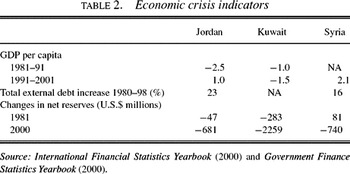
First, Arab regimes take their professional associations seriously and invest considerable resources toward their management and containment. The rank and file of associations comprises the professional and middle classes so crucial to regime coalitions and survival. The fiscal and economic crises of the 1980s and 1990s threatened previous decades' populist commitments designed to placate these groups (Table 2). According to the logic of these commitments, regimes provided a minimum of social-welfare services—education, health care, subsidies on primary food products—in exchange for political support and acquiescence from strategic sectors of the population.12
For examples see Brumberg, “Authoritarian Legacies,” and Ehteshami and Murphy, “Transformation of the Corporatist State,” 753–72; Nazih N. Ayubi, Over-stating the Arab State: Politics and Society in the Middle East (London: I. B. Tauris, 1995), chaps. 6 and 7; and Raymond A. Hinnebusch, “The Political Economy of Economic Liberalization in Syria,” International Journal of Middle East Studies 27 (August 1995): 305– 20.

Second, state formation across the region entailed weakening, coopting, or simply outlawing political parties. Consequently, and in the absence of the kind of deeply rooted political systems that long cushioned authoritarianism in countries like Taiwan, Mexico, Zambia, Kenya, and Indonesia,13
Stephan Haggard and Robert R. Kaufman, “Economic Adjustment and the Prospects for Democracy,” in The Politics of Economic Adjustment, eds. Stephan Haggard and Robert R. Kaufman (Princeton, N.J.: Princeton University Press, 1992), 327.
With what John Waterbury has termed “extraction contracts.” Waterbury, “From Social Contracts to Extraction Contracts.”
As a category of institutions, professional associations in the Arab world and the developing world in general share similar functional characteristics—such as information gathering, member services, product or professional standardization, and engaging state officials regarding member concerns. A crucial distinction, however, regards professional syndicates (al-niqābāt al-mihaniyya) such as lawyers, engineers, and the like, versus peak business associations or chambers of commerce (ghuraf al-tijāra).15
There is some confusion in terms in the case of Kuwait where professional associations lack strict legal status and, hence, Kuwaiti associations are labeled nawādin (clubs) and jamʿiyyāt (societies).
Charles Lindblom, Politics and Markets: The World's Political-Economic Systems (New York: Basic Books, 1977).
Claus Offe, “Political Authority and Class Structure: An Analysis of Late Capitalist Societies,” International Journal of Sociology 1 (1972): 73–105; and Disorganized Capitalism: Contemporary Transformations of Work and Politics (Cambridge: Polity Press, 1985).
Philippe C. Schmitter and Wolfgang Streeck, “The Organization of Business Interests: Studying the Associative Action of Business in Advanced Industrial Societies,” Max-Plank-Institut für Gesellschaftforschung, Discussion Paper 99/1 (March 1999).
Business associations were generally established before other associations and benefited politically and economically during the period of European domination. The region's first business association was founded in 1841 in Aleppo, Syria. However, the Damascus chamber and its Damascene merchant elites evolved as the peak representative and played the most overt political roles in national politics. The largest and historically most important business association in Jordan, the Amman Chamber of Commerce, was founded in 1923. Although Kuwait's peak business representative was not established until 1961 (the date of Kuwait's independence), its elite merchant leadership had experience in creating parliamentary and municipal organizations since the 1920s.
Owing in part to this early organization, Arab business associations played distinct roles during the European Mandate period through the early phases of postcolonial state formation. On the one hand, British influence in Kuwait and Mandate Transjordan offered the respective ruling families external resources that decreased reliance on domestic business elites who controlled these associations. On the other hand, British and French control of regional trade during World War II significantly enriched those same business elites through provision of monopoly trading rights.19
Robert Vitalis and Steven Heydemann, “War, Keynesianism, and Colonialism: Explaining State–Market Relations in the Postwar Middle East,” in War, Institutions, and Social Change in the Middle East, ed. Steven Heydemann (Berkeley, Calif.: University of California Press, 2000).
Martin W. Wilimington, The Middle East Supply Centre (Albany, N.Y.: State University of New York Press, 1971); and Abla Amawi, “State and Class in TransJordan: A Study of State Autonomy” (PhD diss., Georgetown University, 1993).
Professional syndicates have been no less important, however, in ways that distinguish them from private-sector associations. In much of the Arab world, nonbusiness professional associations were formed after political independence. By virtue of their membership density, urban middle-class socioeconomic profiles, representation of diverse professions, and intra-electoral processes, the syndicates have emerged as the most politically salient social associations in the region. Given the weakness of political-party systems, it has been the syndicates who have played the role of proxy political parties in Jordan, Kuwait, and Syria.
These general historical experiences contrast with other parts of the developing and developed world where “the social classes that formed the historic base for parties have fragmented into specialized sectoral and professional clienteles that have sought new forms of collective expression.”21
Philippe C. Schmitter, “Transitology: The Science of the Art of Democratization?” in The Consolidation of Democracy in Latin America, ed. Joseph Tulchin (Boulder, Colo.: Lynne Rienner, 1995), 24.
It is worth noting that in none of our cases have Islamist organizations challenged for the leadership of a peak business association.

Finally, as a critical response to this discussion, one should ask why we focus on formal associations when informal patron–client networks may prevail and be more important. Although the intent here is not to impose a model of formal state–society relations, one should be wary about dismissing formal associations and institutions. Indeed, there is a scholarly history to the epiphenomenal view of domestic associations. Modernization theorists of the 1950s and 1960s commonly concluded that Arabs lacked “the skill” to join professional associations or that such institutions were simply irrelevant.23
A. J. Meyer, Middle Eastern Capitalism: Nine Essays (Cambridge, Mass.: Harvard University Press, 1959), 41. See also Robert Springborg, “Patterns of Association in The Egyptian Political Elite,” in Political Elites in the Middle East, ed. George Lenczowski (Washington, D.C.: American Enterprise Institute, 1975), 83.
Terry Lynn Karl put it this way: “Simply stated, the revenue a state collects, how it collects them, and the uses to which it puts them define its nature.” In The Paradox of Plenty: Oil Booms and Petro-States (Berkeley, Calif.: University of California Press, 1997), 13.
For a critique of this argument see Gwenn Okruhlik, “Rentier Wealth, Unruly Law, and the Rise of Opposition: The Political Economy of Oil States,” Comparative Politics 31 (April 1999): 295–315.
The precipitous drop in commodity prices and aid in the 1980s generated the scholarly response that a reversal of fortune, so to speak, should engender a reversal in politics. Although not explicitly addressed in these reactions, there was the palpable expectation that once-muted social associations would resuscitate themselves in ways that would challenge political authority and potentially bring about regime change. The diversity of association–state relations supports the larger observation that rentier-crisis outcomes have not been uniform. Consequently, one response to the (formal) associations versus (informal) patronage question acknowledges that forms of associational contestation may involve rent demands or that coordination may carry a patronage/cooptation price tag. However, professional associations in the Arab world are far more than rent-seeking venues.26
This conviction is supported by conclusions in other regions that rent-seeking accompanies both patterns of underdevelopment as well as development. See Mushtaq H. Khan and Jomo K.S., ed., Rents, Rent-Seeking and Economic Development: Theory and Evidence in Asia (Cambridge: Cambridge University Press, 2000).
The next three case studies examine the crisis decades and how associational contestation and/or coordination shaped state–society relations under authoritarianism.
JORDAN
The majority of Jordan's professional syndicates (doctors, dentists, journalists, engineers, pharmacists, and nurses) were founded during the kingdom's politically tumultuous decades, the 1950s and 1960s. The country's peak business representative, the Amman Chamber of Commerce, was founded first in 1923. Established by members of the social and educated elite, the objective of al-niqābāt was to organize professional practice, oversee standards, defend the rights of professionals in the public or private sectors, and provide services for needy members. Internal organization, funding, and regular leadership elections were generally free from state interference until the late 1990s. Although initially weak and low profile in the 1950s, professional syndicates ultimately filled the vacuum in Jordanian political life created by the banning of political parties in 1957, the loss of the West Bank in 1967, and the bloody clashes between the regime and the Palestinian organizations in 1970–71. They gradually emerged as “the real political parties in the country.”27
Bassel F. Salloukh's interview with Ibrahim ʿIzziddine. Former Ambassador, Minister of Information, and Minister of State for Prime Ministerial Affairs. Amman, 14 December 1998.
Jordan's crisis decades began with fiscal and economic problems and unfolded within a context of periodic regional crisis. By the early 1980s, the first tremors of fiscal crisis and economic downturn were being felt in Amman. In 1980, aid comprised 40 percent of state revenue; by 1984 it had declined to 16 percent. The stupendous annual 10 percent GDP growth of the 1970s had been cut in half by 1982, and in the late 1980s, per capita GDP actually declined. By November 1988, the Jordanian dinar had lost two-thirds of its value against the dollar in only a few months. The liberation of Kuwait in 1991 resulted in the return of several hundred thousand Jordanian-Palestinians, swelling the ranks of professional syndicates. Successive governments appointed in the 1980s failed to respond to the early stages of crisis much past rhetoric. The turn came in 1985 with the appointment of the government of Zayd al-Rifaʿi. This administration pursued a two-track policy that endured into the next century: economic reform with the (hoped-for) cooperation of business associations along with an attack on the political activities of other professional syndicates. What followed was a haphazard process of announced economic adjustment, followed by fitful implementation and calls for more private-sector investment.
The prime minister's office created a number of policy-consultation committees with business–association representation and selected one former president of the Amman Chamber of Commerce to a cabinet position. Actual policy coordination remained shallow as the large and unwieldy Amman Chamber lacked the leadership coherence and capacities to take advantage of the openings whereas the government desired only consultation and little policy input.28
For a similar situation of uncoordinated business–state relations and failed reform in Chile, see Eduardo Silva, “Capitalist Coalitions, the State, and Neoliberal Economic Restructuring,” World Politics 45 (July 1993): 529–59.
See Mustafa Hamarneh, Mashruʿ al-mujtamaʿ al-madani wa-l-tahawwul al-dimuqrati fi-l-watan al-ʿArabi: al-Urdun (Cairo: Markaz Ibn Khaldun li-l-Dirasat al-Inmaءiyya, 1995), 85–87.
Salloukh interview with Zayd al-Rifaʿi, former chief of the royal court and prime minister and current speaker of Majlis al-Aʿyan and Majlis al-Umma, Amman, 14 December 1998.
In April 1989, after riots and protests against austerity measures, nine syndicates representing some 40,000 doctors, lawyers, and other professionals led protestors in demanding the resignation of then Prime Minister al-Rifaʿi. The Hashemite regime responded with a controlled process of political liberalization: ending marshal law, expanding the parameters of political participation, and easing press restrictions.31
See Malik Mufti, “Elite Bargains and the Onset of Political Liberalization in Jordan,” Comparative Political Studies 32 (February 1999): 100–129.
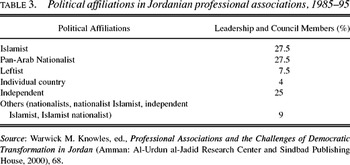
By the early 1990s, Islamist groups began taking control of some of the syndicates through electoral victories to executive committees. This was most evident in the 1994 elections for the high-profile engineers' syndicate.32
Of interest, leftist parties, represented by the “green list,” voted for Islamist Layth Shbeilat. See al-Sabeel, 1 March 1994. On the same theme, see also al-Sharq al-awsat, 30 March 1993.
Insulated business–state negotiations on the proposed sales tax took place in the aftermath of Kuwait's liberation in 1991. These talks resulted in little agreement, and all business associations came out of the talks in opposition to the draft law. Professional syndicates backed by Islamist parties orchestrated a coordinated campaign against the tax. A key demand from all associations was that any future tax be resubmitted to parliament for approval, an ingredient to decentralize political authority. Debate over the draft sales tax was unprecedented for an economic-policy issue. Gradually state extension of exemptions for certain business sectors weakened business opposition. The Amman Chamber was the first to defect and accept the draft law without provision for future parliamentary approval. The eventual sales tax required a number of revisions, and its success in generating greater domestic revenue has been uneven.33
Pete W. Moore, Doing Business in the Middle East: Politics and Economic Crisis in Jordan and Kuwait (Cambridge: Cambridge University Press, 2004).
Resistance to economic policies spilled over to political issues; specifically, Jordan's relations with the United States and Israel and the regime's role in “the war on terror” have galvanized association contestation. The easing of press restrictions and the end of martial law after 1989 emboldened association leaders to voice greater opposition to the monarchy's regional policies, particularly after the 1991 liberation of Kuwait. When the Israeli–Jordanian peace treaty was signed in October 1994, ten syndicates issued a statement condemning it. Following increased violence between Israelis and Palestinians in 1996, all professional associations (including business) banned together to resist normalization with Israel. The resulting Professional Syndicates Committee to Resist Normalization with Israel (PSCRN, Lajnat al-Niqabat al-Mihaniyya li-Muqawamat al-Tatbiʿ maʿ Israel) protested trade fairs with Israeli businesses, circulated lists of companies working with Israeli interests, and voted to ban any contact with associational counterparts in Israel. In the last years of his life, King Hussein moved aggressively to deny professional syndicates the right of political expression. Through speeches and interviews, Hussein personally raised the idea of professionalization of syndicates, signaling that syndicates should concern themselves with purely professional matters and steer away from political activity. Jailing of journalists supportive of association rights followed, as well as the arrest of the well-known president of the engineers' syndicate, Layth Shbeilat. In a clear message to both palace and parliament, the engineers' syndicate responded defiantly by reelecting Shbeilat for a second term while he was still incarcerated.34
See al-Safir, 11 December 1995; and Lamis Andoni, “Walking a Tightrope,” Middle East International, 15 March 1996, 10.
Upon taking the throne in 1999, King Abdullah delivered speeches suggesting change was coming; however, the campaign against the syndicates continued. The eruption of the al-Aqsa intifada in September 2000 was occasion for a renewed anti-American and antinormalization campaign. The syndicates spearheaded a drive to boycott American products and organized two Pan-Arab antinormalization conferences.35
See al-Hayat, 18 November 1999 and 22 August 2000. On the eve of the Camp David negotiations between Yasser Arafat and Ehud Barak, the syndicates campaigned in support of the repatriation of Palestinian refugees to their homeland, and denounced their settlement in host countries. See al-Hayat, 18 July 2000.
These were Ali Abu Sukkar, the president of the syndicates' antinormalization committee and secretary-general of the engineers' syndicate, Badi al-Rifayʿa, president of the engineers' antinormalization committee, and Maysara Malas, president of the engineer syndicates' public freedoms committee. See al-Sharq al-awsat, 25 and 27 October 2002.
See Jillian Schwedler, “Don't Blink: Jordan's Democratic Opening and Closing,” Middle East Report Online, 3 July 2002, PIN 98.
King Abdullah's Jordan First Commission concluded, “The practices of professional associations and nongovernmental associations may not in any case be tinged with any specific political or ideological colour.” Jordan Times, 25 December 2002.
In 2004 and 2005, Interior Minister Samir Habashneh intensified the campaign by asking that syndicates “completely halt” all political activities. The governor of Amman followed by announcing that “any kind of event, gathering or meeting, save for weddings, should obtain prior approval.”39
Shadi Hamid, “Jordan: Democracy at a Dead End,” Arab Reform Bulletin, Carnegie Endowment for International Peace, May 2005.
Stephen Glain, “Letter from Jordan,” The Nation, 30 May 2005, and Neil MacFarquhar, “Heavy Hand of the Secret Police Impeding Reform in the Arab World,” New York Times, 14 November 2005.
Democracy in Jordan, 2005, Center for Strategic Studies, University of Jordan (September 2005).
By 2000, it was clear that Jordan's experiment with liberalization had been decidedly reversed; however, the professional associations have not gone quietly. Sustained contestation has meant the Jordanian regime has little to show for nearly two decades of professed political and economic reform whereas the associations and their leaders have clearly become the enemy of an increasingly besieged Hashemite monarchy.42
Massive increases in U.S. aid and implementation of a number of international economic enterprises has allowed state officials to try to bypass formal business representation in pursuit of ad hoc networks of select entrepreneurs. For instance, King Abdullah's new Economic Consultative Council was created with little of the business association representation of its 1980s and 1990s predecessors.
KUWAIT
Kuwait's economic dislocations and political crises have been among the most dramatic in the region, yet the Kuwaiti state was able to move ahead with economic-adjustment packages and achieve national unity in the aftermath of the Iraqi invasion while limiting political openings beyond a reinstitution of elected parliament. Kuwait's history with elected parliaments parallels the Jordanian experience. In the midst of internal and external turbulence, the emir suspended parliament in 1986. Because of demands by opposition figures and association leaders, the emir promised to restore parliament after liberation from Iraq. However, political parties remained illegal and the legislative powers of parliament remained as limited as its 1960s precursors. Thus, although deeper liberalization has not occurred, change has been evident in the degree to which the Kuwaiti state and its professional associations coordinated at key points to address political and economic crises. In particular, Kuwait's abrupt and massive fiscal crisis in the early 1980s paved the way for institutionally intense coordination between the country's most powerful professional association, the Kuwait Chamber of Commerce and Industry, and state officials. The Iraqi invasion and aftermath provided the opportunity for Kuwait's other associations to coordinate with the al-Sabah monarchy to rebuild the country.43
This section draws on, Jill Crystal, Oil and Politics in the Gulf: Rulers and Merchants in Kuwait and Qatar (Cambridge: Cambridge University Press, 1990); Jacqueline S. Ismael, Kuwait: Social Change in Historical Perspective (Syracuse, N.Y.: Syracuse University Press, 1982); and Shafeeq Ghabra, “Voluntary Associations in Kuwait: The Foundation of a New System?” Middle East Journal 45 (1991): 199–215.
Although municipal and independent social associations had been in existence since the 1920s, Kuwait's formal professional associations came into being during the oil-financed expansion of the Kuwaiti state beginning in the 1950s. In contrast to the Jordanian experience, Kuwaiti associations formed independent from state license in this period and thus took the form of societies and clubs such as the Cultural Nationalist Club (al-Nadi al-Thaqafi al-Qawmi), the Guidance Society (Jamʿiyyat al-Irshad), and the Teacher's Club. Also in contrast to the Jordanian experience, many of these associations were headed by elites who shared social origins with the ruling al-Sabah family. Shared origins, however, did not dissuade these associations from championing the Arab nationalist sentiment of the day, leading to frequent critiques of the ruling family's association with British authorities and foreign oil interests. By the late 1950s, the emir had banned a number of these associations in response to their growing criticism. Merchant-dominated organizations (like the municipality) were likewise pushed aside, either through ruling-family appointments to their leadership or outright sequestration.
With Kuwait's independence in 1961, an assembly (al-Majlis al-Taءsisi) was formed by election and emir appointment to write the constitution. The eventual document guaranteed free association and ensured there would be no attempts to corporatize or make associational memberships obligatory. Clubs and societies that had been shut down in the 1950s were allowed to reform. The emir reserved the right to suspend associational activities, however (which he did following the suspension of parliament in 1976).44
The Constitution of Kuwait, Part III, Articles 43 and 44; Part IV, Articles 69 and 74; and Ghabra, “Voluntary Associations in Kuwait.”
The merchant elite created their own association, the Kuwait Chamber of Commerce and Industry. These same elites had experience in creating municipal, educational, and parliamentary institutions since the 1920s. As a number of observers of Kuwaiti politics have noted, a history of social linkages between these elites and the ruling family fostered a sense of equality.45
Crystal, Oil and Politics in the Gulf; and Ismael, Kuwait: Social Change in Historical Perspective.
The 1982 crash of the informal stock market, the Suq al-Manakh, crippled Kuwait's financial system. Throughout the 1980s and much of the 1990s, debates about resolving debt and charting economic reform dominated Kuwait's domestic politics. As backdrop to these issues, the emir reinstated parliament in the early 1980s (subsequently suspended in 1985) and again in the wake of liberation from Iraq. These parliaments reflected the growing electoral power of the Islamists.46
Ahmad Daher and Faisal Al-Salem, “Kuwait's Parliamentary Elections,” Journal of Arab Affairs 3, no. 1 (1984).
Kuwait's cooperatives are essentially grocery-store strip malls located in every district of the country. An elected board governs the cooperative's operations. Control of the cooperative affords a mini electoral base, access to profits from the cooperative's operations, and important market control over consumer-goods distribution.
Pete W. Moore, “What Makes Successful Business Lobbies? Business Associations and the Rentier State in Jordan and Kuwait,” Comparative Politics (January 2001): 127–47.
At every turn, Islamist deputies backed by associational mobilization resisted these policies as unfair to the lower classes (small debtors) and beneficial to the few. Although chamber officials could not marshal comparable political mobilization in their favor, they did wield advantages that privileged their interactions with state elites. The administrative weakness of the Kuwaiti state in gathering information on debts, assessing damage, and implementing reform meant that the chamber, with its developed administrative skill set, was crucial to any solution. The leadership elites of the chamber were no strangers to the ruling family, high-level government policymaking, or lobbying with parliamentary committees responsible for debt legislation. The president of the chamber, Abdul Aziz al-Sagr, commanded widespread respect as the first speaker of Kuwait's parliament in 1961, and his decades-long leadership of the chamber placed him as leader of the loyal opposition. Finally, the growing political power of Kuwait's Islamists helped forge a common front between business elites and state officials. Over and above the fiscal crisis, state strategies in the 1980s and 1990s overtly shifted toward backing nationalist and merchant elements to counteract Islamist opposition.49
Throughout this period, prominent businessmen, although failing to win parliamentary election, were nevertheless appointed to important ministry positions, in some cases directly from leadership positions in the chamber.
In the end, business–state proposals for economic reform prevailed, as well as a number of reforms to bring the Kuwait Finance House, Kuwait's leading Islamist bank, under control of the central bank and to increase state supervision over food cooperatives. By the late 1990s, Islamist control of parliament had weakened, and for the first time since the 1960s a prominent businessman was chosen as speaker of parliament.50
Pete W. Moore, “Rentier Fiscal Crisis and Regime Stability in the Middle East: Business and State in the Gulf,” Studies in Comparative International Development 31 (Spring 2002): 34–56. The appointment of aṣīl merchants to cabinet positions has been a consistent feature of Kuwait governments. It has afforded the chamber elite a number of learning experiences with government service.
It would be a mistake, however, to characterize associational politics as divided strictly between Islamist and merchant interests. After the 1985 suspension of parliament, the chamber leadership and Islamist-controlled associations worked in tandem to persuade the emir to reinstate parliament.51
This same alliance came together in the 1990s to resist any normalization with Israel.
Mary Ann Tetreault, Stories of Democracy: Politics and Society in Contemporary Kuwait (New York: Columbia University Press, 2000), 76–100; and Steve Yetiv, “Kuwait's Democratic Experiment in Its Broader International Context,” Middle East Journal 56 (Spring 2002).
SYRIA
Unlike other patronage-based authoritarian systems that succumbed to the destabilizing effects of economic and political reforms, the Syrian regime has managed to keep its “political enterprise” going.53
Steven Heydemann, “The Political Logic of Economic Rationality: Selective Stabilization in Syria,” in The Politics of Economic Reform in the Middle East, ed. Henri Barkey (New York: St. Martin's Press, 1992).
As in Jordan and Kuwait, professional associations in Syria have a rich history, but they have been far less fortunate than their counterparts since the 1980s. Prior to the ascendancy of the Baʿth party, Syria's professional syndicates were decentralized and enjoyed a substantial degree of autonomy to administer their internal affairs. Separate syndicates representing the same profession were often formed in different provinces. In 1943, two separate doctors' syndicates were founded in Damascus and Aleppo, followed in 1952 by another two in Latakia and Homs. In 1951, three engineers' syndicates were formed in Damascus, Aleppo, and Latakia. In 1952, two dentists' syndicates were established in Damascus and Aleppo. The same year two pharmacists' syndicates were founded in Damascus and Aleppo, and in 1953, three lawyers' syndicates were established in Damascus, Aleppo, and Latakia. These syndicates represented the interests of the urban middle classes and were unsympathetic to the Baʿth populist agenda.
At the top of this social group of associations was the Damascene merchant elite, who, like their Kuwaiti counterparts, claim a long and storied history. Anchored in the Damascus Chamber of Commerce, the merchant elite had long involved their association in domestic and even regional issues before the rise of the Baʿth.54
Steven Heydemann, Authoritarianism in Syria: Institutions and Social Conflict, 1946–1970 (Ithaca, N.Y.: Cornell University Press), 120.
The Alawis are a compact tribal/religious sect from the northern parts of Syria. They dominate government positions and account for less than 20 percent of the population.
Upon assuming power through a coup in 1963, the Baʿth regime proceeded to install a populist authoritarian system of rule based on the organization of state–society relations along strict corporatist channels, yet in parallel with already established associations. The ensemble of corporatist institutions organizing and controlling active sectors of the population ultimately stretched throughout society. Labor, peasants, students, youth, women, teachers, and a host of other social groups were organized into Baʿth-dominated, compulsory, noncompetitive, functionally differentiated corporatist institutions.56
For details, see Bassel F. Salloukh, “Organizing Politics in the Arab World: State–Society Relations and Foreign Policy Choices in Jordan and Syria” (PhD diss., McGill University, 2000).
For the teachers' syndicate, see George Jabbour, Al-Fikr al-siyasi al-muʿasir fi Suriya (London: Riad al-Rayyes lil-Kutub wa-l-Nashr, 1987), 119–26; Itamar Rabinovich, Syria under the Baʿth 1963–66: The Army-Party Symbiosis (New Brunswick, N.J.: Transaction Books, 1972), 175; and Middle East Journal 18 (1964): 345.
The rise of the Baʿth and its post-1963 efforts to transform Syrian society and politics were immediately contested by the country's leading professional associations. After a tense summer and fall in 1963, the Damascus Chamber of Commerce directly challenged the regime's policies of centralizing economic decisionmaking. Nationwide protests and strikes were organized. Other associations (including the Baʿthists' own teachers' syndicate) quickly joined the protests, making it “the most substantial challenge yet faced by the Baʿthist regime.”58
Heydemann, Authoritarianism in Syria, 183.
Regime defeat of protests meant business associations met the same fate as Syria's other associations. Over the next decade reorganization of business representation entailed the creation of an umbrella Federation of Syrian Chambers, Baʿth party representation in all regional chamber leadership, and encompassing membership. Chambers still held elections for their executive board, but these were now closely monitored by the regime. Whereas Kuwaiti and Jordanian state officials failed to create a fully loyal state capitalist class, Syrian officials were more successful in encouraging a class of businessmen (the so-called infitāḥ bourgeoisie) wedded to state enterprises yet distinct from the traditional Damascene merchant base. These state capitalists gradually came to dominate associational leaderships.59
Volker Perthes, “Economic Liberalization and the Prospects of Democratization: The Case of Syria and Some Other Arab Countries,” in Democracy without Democrats: The Renewal of Politics in the Muslim World, ed. Ghassan Salemé (London: I. B. Tauris, 1994), 259.
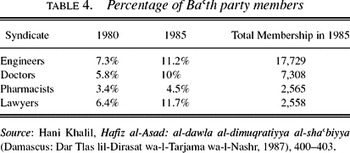
Nevertheless, prior to 1980, Syria's professional associations remained the primary venues of open and vocal opposition to Baʿth rule. Although their loose, provincial organization and institutional autonomy clashed with Baʿth ideology, the regime respected their distance. Leadership elections were among the most heated and publicized domestic events, despite the dominance of the Baʿth party. Indeed, in most syndicates, professionals with dual membership in the Baʿth party were a minority (Table 4).

All of this changed after 1980. Despite escalating attacks against the regime throughout 1978 and into 1979, which culminated in the massacre of scores of Alawi officer cadets at the Aleppo Artillery School on 16 June 1979, associations continued to be outspoken. The lawyers' syndicate, for example, pressed its demands for lifting of the 1963 emergency law, independence of the judiciary, and disbanding of special courts.60
See Middle East Watch, Syria Unmasked: The Suppression of Human Rights by the Asad Regime (New Haven, Conn.: Yale University Press, 1991), 13–14, 85–87, and 158–60; Ibrahim Hassan, “La Syrie de la guerre civile,” Peuples Méditerranéens 12 (Juillet–Septembre 1980): 103.
The syndicates had crossed the line, however, and henceforth the regime smashed their organizational autonomy, denying them institutional opportunity for autonomous collective action and contestation. In contrast to the similar Jordanian effort exactly twenty-five years later, the Baʿthist effort was more successful and brutal. On 9 April 1980, the lawyers', doctors', pharmacists', and engineers' syndicates were dissolved by government decree and their leaders arrested; their executive committees and general congresses were also dismissed. The next day the government formed new syndicates and appointed new leaders and executive committees. Membership in syndicates was made compulsory, yet selective benefits were few. The security services hounded members of the recalcitrant syndicates. Some were incarcerated or executed; others succeeded in fleeing the country. By mid-April 1980, close to 100 doctors, 100 engineers, about fifty prominent lawyers, and ten pharmacists had been imprisoned.61
Alan George, Syria: Neither Bread nor Freedom (London: Zed Books, 2003), 104; Patrick Seale, Asad of Syria: The Struggle for the Middle East (Berkeley, Calif: University of California Press, 1989): 328 and 300; and Hanna Batatu, Syria's Peasantry, the Descendants of Its Lesser Rural Notables, and Their Politics (Princeton, N.J.: Princeton University Press, 1999), 270, for the figure for the pharmacists. Batatu, using figures provided by the Committee for the Defense of Freedom and Political Prisoners in Syria and its Geneva-based organ, al-Minbar, provides lower numbers: 79 engineers, 57 doctors, and 25 lawyers. See Batatu, Syria's Peasantry, 270 and fn. 49, 383.
Because associational autonomy was crushed prior to the fiscal crises of the 1980s and 1990s, Syria's experiences diverged sharply from the other cases. In addition, Syria's economic position in the 1980s stood in sharp contrast to other parts of the region. Even when the regime faced external payment obligations, it was able to access new external venues of revenue. For instance, repayment of Soviet debts was facilitated through a barter scheme whereby state officials paid selected exporters to ship to the USSR, thereby repaying some of the loans while tying state capitalists and chamber leaderships more tightly to the regime.62
Hinnebusch, “The Political Economy of Economic Liberalization in Syria,” 312.
For the views of the main architect of economic liberalization, see Muhammad al-ʿImadi, Dawr al-qitaʿ al-khass wa-l-mushtarak fi ʿamaliyyat al-tanmiya (Damascus: Wizarat al-Iqtisad wa-l-Tijara al-Kharijiyya, 1986); and Syria's Experience in Trade Liberalization and Policies of Economic Reform (Damascus: Ministry of Economy and Foreign Trade, 1994).
For details, see al-Hayat, 26 April 2000; Hinnebusch, “The Political Economy of Economic Liberalization in Syria” and “Syria: The Politics of Economic Liberalisation,” Third World Quarterly 18 (1997); Heydemann, “The Political Logic of Economic Rationality,” 11–39; Eberhard Kienle, ed., Contemporary Syria: Liberalization between Cold War and Cold Peace (London: British Academic Press, 1994); and Hans Hopfinger and Marc Boeckler, “Step by Step to an Open Economic System: Syria Sets Course for Liberalization,” British Journal of Middle East Studies 23 (November 1996): 183–202.
Together with these declarations, Damascus Chamber of Commerce involvement in policy formulation was expanded. Since 1980 its representatives have sat on the Committee for the Guidance of Import, Export, and Consumption. In 1990 state officials delegated licenses for industrial investment to the Chamber of Industry. In that same year, two executives from the Damascus chamber were elected to parliament.65
Heydemann, “The Political Logic of Economic Rationality,” 20.
Clampdown through managed associational engagement has not crushed all voice, however. During the short-lived “Damascus Spring” (June 2000–February 2001), dissidents and opponents of Baʿth rule managed to gather in so-called salons to voice their opposition; however, this was done outside any associational or institutional format.66
One of the prominent leaders has been independent industrialist Riad Seif, a businessman not connected to any of the business associations.
STATE ACTION AND SOCIAL BASES
This section argues that the precrisis social bases of the regimes determined incentives for contestation/coordination, whereas precrisis patterns of state formation shaped the institutional and political capacities of professional associations to engage state authority. The argument blends a top-down perspective (state action over time) with a bottom-up approach (the social bases of associational agency). Postcolonial Arab regimes fashioned ruling coalitions on the foundations of particular social bases and ascriptive divisions.67
One could add that regimes desired so called “minimal winning coalitions.” See David Waldner, State Building and Late Development; and John Waterbury, Exposed to Innumerable Delusions: Public Enterprise and State Power in Egypt, India, Mexico, and Turkey (Cambridge: Cambridge University Press, 1993).
Patterns of state formation and varieties of corporatism are well studied in Middle East politics. In his examination of corporatist arrangements of state–society relations in Egypt, Robert Bianchi argues that the heterogeneous systems of interest representation in the Middle East and Asia are neither the “state corporatism” of Latin America nor the “societal corporatism” of Western European political systems. Instead they are eclectic systems of interest organization, combining a mixture of corporatist, pluralist, and hybrid structures depending on specific contextual characteristics.68
See Robert Bianchi, Unruly Corporatism: Associational Life in Twentieth Century Egypt (New York: Oxford University Press, 1989). See also the updated argument in “Interest Groups and Politics in Mubarak's Egypt,” in The Political Economy of Contemporary Egypt, ed. Ibrahim M. Oweiss (Washington, D.C.: Center for Contemporary Arab Studies, 1990), 210–21.
Marsha Pripstein Posusney, Labor and the State in Egypt: Workers, Unions, and Economic Restructuring (New York: Columbia University Press, 1997), 93.
Through this perspective Syria's professional associations were clearly the most adversely affected. They were once politically salient and able to mobilize members in the 1964 demonstrations, but the 1980 crackdown ushered in high levels of state control, crippling associational autonomy and opposition activity. Professional associations came to resemble other Baʿth-dominated government corporatist organs. Incentives for syndicate leaderships to invest in collective-action capacities, information gathering, or structural diversification were greatly weakened. In Jordan, less radical change followed the 1970 civil war. The regime introduced a number of changes to the existing syndicate laws, including cabinet power to dissolve professional syndicates and cabinet approval of further syndicate creation, all without an appeals process.70
See Hamarneh, al-Urdun, 81.
Kuwait's associations came into being as voluntary societies and clubs with independent budgets. In the case of business in particular, state officials from the outset devolved important functions (import–export licensing, public works bidding, and trade-dispute adjudication) to the chamber of commerce, making it unique among Kuwait's professional associations.71
Ghurfat Tijarat wa Sinaʿat al-Kuwait, Al-Qanun wa-l-nizam, 1993.
Beginning in the 1970s, however, a wide range of state licensing, financing, and organizational policies came to favor creation of Islamist associational interests to rival Kuwait's nationalist left and, particularly, the elite business tied to the chamber of commerce. Eventually state support resulted in the creation of three different Islamist controlled associations, the Social Reform Society (Jamʿiyyat al-Islah al-Ijtimaʿi), the Ancestral Islamic Group (Salaf), and the Heritage Society (Jamʿiyyat al-Turath). In addition, state investment and licensing inaugurated the Kuwait Finance House (an Islamist-run bank). These institutional foundations facilitated Islamists' ability to win elections to the executive board of other associations.72
Islamist candidates took control of the state-employee labor unions. Throughout the 1980s and 1990s, Islamist candidate lists consistently ran for election to all associations, save the chamber of commerce. See Ghabra, “Voluntary Associations in Kuwait.”
To understand why states intervened in these differing ways necessitates switching to a bottom-up perspective; that is, ruling regimes and professional associations are embedded within their own social bases. The historical–institutionalist literature argues that formative regime choices and actions structure political opportunities and possibilities available for social groups, like professional associations, to emerge, develop, and successfully (or not) defend their autonomy.73
See Kathleen Thelen and Sven Steinmo, “Historical Institutionalism in Comparative Politics,” in Structuring Politics: Historical Institutionalism in Comparative Analysis, ed. Sven Steinmo, Kathleen Thelen, and Frank Longstreth (Cambridge: Cambridge University Press, 1992), 13.
Ibid., 10.
Adam Przeworski, “Some Problems in the Study of the Transition to Democracy,” in Transitions from Authoritarian Rule: Comparative Perspectives, ed. Guillermo O'Donnell, Philippe C. Schmitter, and Laurence Whitehead (Baltimore, Md.: Johns Hopkins University Press, 1986), 52.
On the one hand, there is the claim that shared ascriptive factors can help groups overcome problems of collective action and imperfect information that commonly plague any associational project.76
Janet Landa, “Culture and Entrepreneurship in Less-Developed Countries: Ethnic Trading Networks as Economic Organization,” in The Culture of Entrepreneurship, ed. Brigitte Berger (San Francisco, Calif.: ICS Press, 1991); and Susan Greenhalgh, “Networks and Nodes: Urban Society in Taiwan,” The China Quarterly 99 (September 1984).
Mahmud Faksh, “The Alawi Community of Syria: A New Dominant Political Force,” Middle Eastern Studies 20 (April 1984): 529–52.
The revolt was spearheaded by the urban Sunni Muslim Brotherhood.
In Jordan, the issue of social origins is most poignant. Waves of Palestinian refugees and returnees in 1948, 1967, and 1991 have refashioned the rank and file of professional associations at each stage. For instance, Jordan's 1923 Amman Chamber of Commerce was composed of elites from the major urban areas of Syria and Palestine. They forged close relations with the Hashemite monarchy. Gradually, however, successive generations of Palestinians came to dilute and ultimately diversify this traditional leadership. Jordan's professional syndicates likewise evolved into majority Palestinian institutions whereas the state remained largely staffed with Jordanians of East Bank tribal and urban backgrounds. The common quip was that only Palestinians went to work for the Arab Bank (Jordan's largest private bank) and only East Bankers went to work for the state. Therefore, the aftermath of the 1970 civil war meant associations could not overtly build political opposition on identity grounds nor would the legitimacy of the monarchy be questioned. Conversely, the early 1970s taught syndicate leaderships that collective action on political issues best shielded them from regime pressures. That such collective action was built upon a somewhat homogenous Palestinian rank and file has remained an enduring, although quiet, feature of Jordanian domestic politics.79
The “Jordan First” campaign reflected this underlying motif.
In contrast to Jordan and Syria, Kuwait's associational elite, especially business, was cut from the same social fabric as the ruling al-Sabah family. Although the emir could shut down or curb the autonomy of the associations, this was comparatively rare. The nationalist leaderships of Kuwait's associations prior to the 1970s were not strangers to the monarchy's support base nor to the oil state's rapidly expanding government bureaucracies. Needless to say, Kuwait did not suffer from the political necessity to accommodate foreign labor or refugees. Even as Kuwaiti associations began to reflect Islamist trends after the 1970s, there was little alienation from the regime, given that Islamist institutions grew in part from state support.
To summarize, professional associations are artifacts of how regimes built their states and secured support from particular social bases. Yet, associations were also agents of change during decades when these regimes were under pressure.
CONCLUSION
This essay has argued for the salience of professional associations in the Arab world as an institutional lens to conceptualize change in authoritarian state–society relations. Aside from an appreciation of political change under authoritarian contexts, these findings suggest the need to examine more closely how regimes are connected to their societies and how previously institutionalized state and society relationships are responding to external and internal pressures. Patterns of association–state relations reveal some of the dynamics in these relations in the past several decades, but we have an incomplete view. Continued research is needed on changing patterns in other areas of state–society relations, formal and informal. Ultimately any transition from authoritarianism hinges on antecedent conditions. Explaining endurance and change in authoritarianism in the Arab world is thus basic to envisioning ways out. Two final points remain.
First, the argument privileging social bases and state formation should not be viewed as exclusively determinative for future change. Although the 1980 crackdown in Syria and the Kuwaiti regime's more inclusive social base are decisive factors in how association–state relations unfolded during subsequent crises, the Arab professional class is not static. Across the region new groups and minorities, not part of a given regime's social base nor part of any traditional opposition, for that matter, are entering the business and professional middle class. In the Gulf, Shiʿa, bedouin, and nonelite Sunni have gained entry to sectors normally reserved for regime clients. In the Levant, professionals composed of East Bank residents, Alawis, nonelite Christians, and post-1967 Palestinians, just to name a few, are greatly complicating previously neat distinctions between regime social bases and outsiders. What has traditionally constituted the private sector and the comparatively closer relations between regime and business associations is also undergoing change. Will professional associations accommodate these new groups? How will state manipulations of associational autonomy and expression affect the political fate of these new groups? These are open questions that future research needs to address.
Second, the findings here invite speculation beyond the scope of this paper that in cases where crisis outcomes comprised coordinated association–state responses, future transitions under or away from authoritarianism will likely be instances of pacted or negotiated change. Where state elites and association leaders have developed institutional norms and expectations of close relations, there is less room for misperception and miscalculation. For example, the emir succession crisis in Kuwait and its quick resolution was due in part to the presence of well-institutionalized state–society relations and previous success in coordination. The subsequent 2006 elections and “peaceful politics” to resolve electoral disputes80
Mary Ann Tetreault, “Kuwait's Annus Mirabilis,” Middle East Report Online, 7 September 2006.
By contrast, in cases where contestation has been dominant, the speculation is that future shifts are more likely to be less deliberate, less negotiated, and more accentuated. With oppositional associational actors demobilized out of corporate structures and restricted to tighter political spaces, the room for misperception and miscalculation is much greater. Although the Syrian and Jordanian regimes are quite different in a number of respects, both regimes find themselves in similar standoffs with opposition elements bereft of meaningful political parties. Regardless of the speculation, professional associations and intra-Arab political variation merit greater study.
Authors' note: An earlier draft of this paper was presented in 2003 at the Mediterranean Social and Political Research Meeting at the European University Institute. The authors acknowledge helpful criticisms and suggestions from Rex Brynen, F. Gregory Gause III, Ellen Lust-Okar, Jason Brownlee, David Waldner, and Marie-Jöelle Zahar. The Interuniversity Consortium for Arab and Middle Eastern Studies in Montreal provided support for this research.