Sorghum [Sorghum bicolor (L.) Moench] is the fifth most important cereal crop in terms of area (44.80 m-ha) and production (70.83 million tonnes) (FAO, 2014, accessed during January 2016). It is, grown in about 100 countries by resource-limited farmers in the Semi-Arid Tropics (SAT). Globally, India, Nigeria, Mexico, USA, Argentina and Ethiopia are the major sorghum producing countries. In South Asia, it is grown over a total of 6.53 m-ha, in India (5.82 m-ha), Pakistan (0.17 m-ha), Sri Lanka (96 ha) and Bangladesh (70 ha) (FAO, 2014). It is mainly grown for food and fodder in Africa, Asia and Central America, while it is an important animal feed in the Americas and Australia. Alternative uses include production of beer, alcohol, syrup, bakery items, industrial starch, etc.
Diverse populations and species rich ecosystems have greater potential to adapt to climate change. Therefore, access to a wide genetic base is the key for a sustainable crop improvement programme, especially under a climate change scenario. To ensure the availability of a wide genetic base for crop improvement programmes both in the present and in the future, there is a need to assemble and conserve as many crop genetic resources as possible before we lose them forever due to replacement of landraces by improved cultivars besides several other factors (Upadhyaya and Gowda, Reference Upadhyaya and Gowda2009a). The existing global collections in international genebanks are large and represent the wide diversity in different crops, including sorghum. However, a critical assessment of these collections for diversity, identifying gaps and launching germplasm collection missions in unexplored and underexplored areas is important to further enrich the variability and achieve near completion of assembling species diversity to support future crop improvement programs. Unfortunately, international efforts to collect plant genetic resources in general have declined in recent years (FAO, 2009). Geographic Information Systems (GIS) have enabled better understanding of species distribution, crop cultivation and the representativeness of germplasm collections. Using GIS software, remote sensing images, passport information and characterization data of existing germplasm collections, several geographical, trait-diversity and taxonomic gaps were identified in different crops (Jones et al., Reference Jones, Beebe, Tohme and Galwey1997; Maxted et al., Reference Maxted, Dulloo, Ford-Lloyd, Iriodo and Jarvis2008; Upadhyaya et al., Reference Upadhyaya, Reddy, Irshad Ahmed, Gowda and Bettina2009b, Reference Upadhyaya, Reddy, Irshad Ahmed and Gowda2010, Reference Upadhyaya, Reddy, Irshad Ahmed and Gowda2012, Reference Upadhyaya, Reddy, Pundir, Singh, Gowda and Irshad Ahmed2013, Reference Upadhyaya, Reddy, Singh, Gowda, Irshad Ahmed and Kumar2014, Reference Upadhyaya, Reddy, Irshad Ahmed, Gowda, Thimma Reddy and Ramachandran2015). Spatial information derived from satellite imagery is critical to find geographical gaps in areas where the crop is cultivated. It is a known fact that crop geographies express local climate based traits for crop improvement.
The genebank at ICRISAT, India that serves as a world repository for sorghum germplasm conserves 39,234 accessions from 93 countries including 6249 from South Asian countries. South Asia represents the southern region of the Asian continent comprising Afghanistan, Bangladesh, Bhutan, India, the Maldives, Nepal, Pakistan and Sri Lanka. A critical assessment for gaps in the existing sorghum collection from South Asian countries is yet to be done. Therefore, the aim of the present paper is to assess the status, diversity and identify geographical and taxonomic gaps in the sorghum collection from South Asian countries.
Materials and methods
Passport information and characterization data of collections from South Asian countries, including Afghanistan (6), Bangladesh (9), India (6101), the Maldives (10), Nepal (8), Pakistan (90) and Sri Lanka (25), were used in this study. Bhutan has no representation in the sorghum collection at ICRISAT.
Identification of gaps
A total of 5340 landraces assembled from Afghanistan (1), Bangladesh (5), India (5259), Pakistan (52) and Sri Lanka (23) for which there is georeferenced data, were considered to identify geographical gaps in the collections from these countries. Passport data, particularly, information on the precise location of the collecting site and the corresponding geographic coordinates was updated by referring back to all related records, collection reports and catalogues. Using Microsoft EncartaR, an electronic atlas (MS EncartaR Interactive World Atlas, 2000), the geographic coordinates were retrieved for accessions with location information. The accuracy of the coordinates was verified by plotting accessions on the political map of each country. The Moderate Resolution Imaging Spectroradiometer (MODIS) is a satellite-based remote sensing platform, which acquires imagery on a daily basis composited to 8 and 16 d at a spatial resolution of 250 and 500 m. This study used imagery at 16 d intervals over the 2014–2015 cropping season. A vegetation index (NDVI – Normalized Difference Vegetation Index) estimated based on the red and infra-red bands acquired by the satellite were used to identify the crop domains. The NDVI is a direct indicator of vegetation vigour during the cropping season. The 16 d interval stack of imagery provided a profile of vegetation cover based on its growth condition during the cropping season indicating a specific vegetation type (dominant crop) (Gumma et al., Reference Gumma, Pyla, Thenkabail, Reddi, Naresh, Mohammed and Rafi2014). A rigorous validation was also carried out at the field level to maintain the accuracy of the information extracted. Major crops in the South Asian region including sorghum were mapped using the method described above (Gumma et al., Reference Gumma, Thenkabail and Nelson2011). Sorghum crop extent was extracted from this layer and used for the present study. The sorghum collection that had georeferenced data (5340 accessions) was overlaid on the present sorghum area (2014–2015) and the gaps in the collection were identified. Districts (gaps) were identified using crop map and germplasm collection sites. Districts where less than five germplasm samples had been collected about 30 years ago were identified as a potential gap.
Characterization of germplasm
A total of 5322 accessions were characterized in different years during 1977–2013, in batches of 500–1000 in vertisols in the rainy (June–November) and postrainy (October–March) seasons at ICRISAT, Patancheru, India (17°25′N latitude, 78°00′E longitude and 545 m a.s.l.). Each accession was sown in one 4 m long row with a spacing of 75 cm between rows. The crop was thinned after 2 weeks leaving approximately 10 cm distances between plants so as to accommodate about 40 plants in a row. Fertilizers were applied at the rate of 80 kg/ha N and 40 kg/ha P2O5 in both the seasons. Every year, landraces were grown in an augmented design using one of the three checks (IS 2205, IS 18758 and IS 33844) repeated for every block of 20 test accessions. Life-saving irrigations were provided in the rainy seasons while the crop was irrigated at regular intervals to provide sufficient moisture to the growing crop in the postrainy seasons. The crop was protected from weeds, pests and diseases for a good crop.
Observations on eight quantitative traits (days to 50% flowering, plant height, number of basal tillers per plant, panicle exsertion, panicle length and width, seed size and 100 seed weight) and ten qualitative traits (plant pigmentation, midrib colour, panicle compactness and shape, glume colour, glume covering, seed colour, seed lustre, seed sub-coat, endosperm texture and threshability) were recorded following descriptors for sorghum (IBPGR and ICRISAT, 1993). Observations on days to 50% flowering and plant height were recorded in both the rainy and postrainy seasons, whereas observations on all other traits were recorded only during the postrainy season. Number of days from sowing to when 50% plants start flowering in an accession was recorded as days to 50% flowering. Mean height of five representative plants from the base to the tip of the panicle was recorded as plant height. Length of the peduncle from the ligule of the flag leaf to the base of the inflorescence was recorded as panicle exsertion. The mean length of five panicles selected randomly from base to tip and mean width of panicles in natural position at the widest portion was recorded in centimetres. Width of the seed at the broadest point was recorded in millimeters. Weight of 100 seeds drawn from the plot yield was recorded in grams.
Data analysis
The mean, range and variances were calculated for eight quantitative characters for all races and countries. The means for different traits were compared using the Newman–Keuls procedure (Newman, Reference Newman1939; Keuls, Reference Keuls1952) and homogeneity of variances was tested by Levene's test (Levene, Reference Levene and Olkin1960). Principal component analysis (PCA) of eight quantitative traits was performed using GENSTAT 13.1. (VSN International, 2010). The Shannon–Weaver diversity index (H′) (Shannon and Weaver, Reference Shannon and Weaver1949) was used to measure and compare the phenotypic diversity for each trait, race and country. Phenotypic proportions were estimated for ten qualitative traits (Snedecor and Cochran, Reference Snedecor and Cochran1980).
Results
Status of the collection
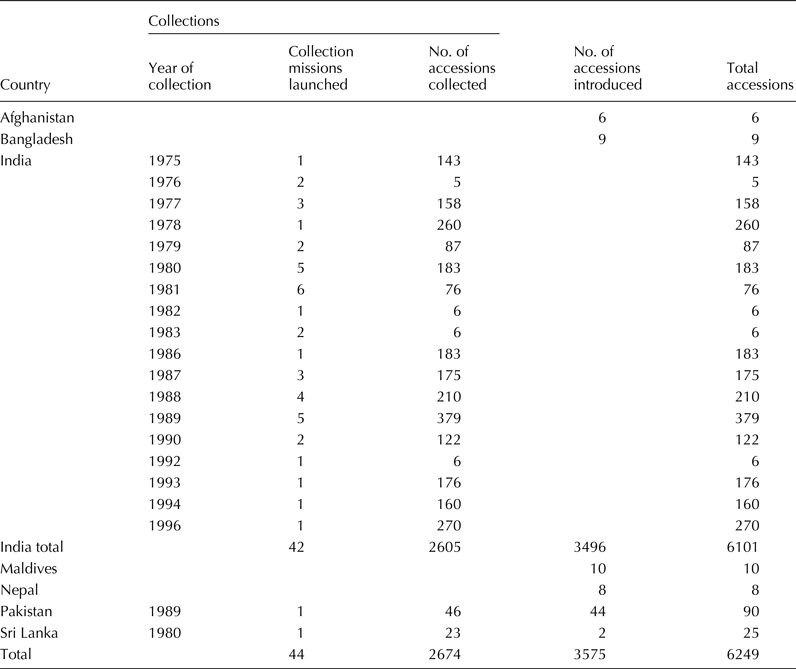
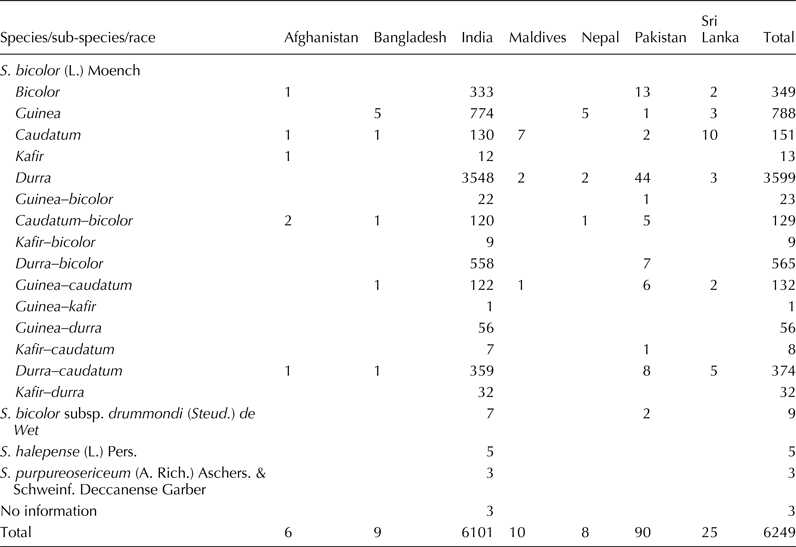
The sorghum germplasm collection from South Asian countries conserved at the genebank at ICRISAT, India, includes 6101 accessions from India, 90 from Pakistan, 25 from Sri Lanka, ten from the Maldives, nine from Bangladesh, eight from Nepal and six from Afghanistan (Table 1). The collection is from a wide range of latitudes ranging from 6 98°N (Sri Lanka) to 36 71°N (Afghanistan). The collection includes 5737 landraces, 452 breeding materials, 40 improved cultivars and 20 wild accessions belonging to S. bicolor subsp. drummondii (9), S. halepense (5) and S. purpureosericeum (3) and three wild accessions that have no species information. Sorghum germplasm at ICRISAT was assembled by introducing germplasm that had already been collected from various organizations located in different countries and by subsequently launching systematic germplasm collection missions in South Asian countries.
Status of sorghum germplasm assembled from South Asia at ICRISAT genebank, India

Germplasm introduced
A total of 3575 accessions were introduced from 38 organizations located in eight countries (Table 1). Organizations located in India were the major donors of sorghum germplasm to ICRISAT (3393 accessions). The Rockefeller Foundation, New Delhi, India, was an important donor providing 2723 accessions originating in Afghanistan (5), India (2697), Nepal (7) and Pakistan (14). Other donors in India included Andhra Pradesh Agricultural University, Hyderabad (136); Dr Punjabrao Deshmukh Krishi Vidyapeeth, Akola (83); G B Pant University of Agriculture and Technology, Pantnagar (6); National Botanical Research Institute, Lucknow (12); Gujarat Agricultural University, Surat (4); Haryana Agricultural University, Hisar (1); Indian Agricultural Research Institute (IARI), New Delhi (33); Kerala Agricultural University, Palghat (2); Mahatma Phule Krishi Vidyapeeth, Mohol (5); Marathwada Agricultural University, Parbhani (83); National Bureau of Plant Genetic Resources (NBPGR), New Delhi (90); National Research Center for Sorghum, Rajendranagar (186); Tamil Nadu Agricultural University, Coimbatore (21) and University of Agricultural Sciences, Dharwad (8).
Outside India, Bangladesh Agricultural Research Institute (BARI), Sher-E-Banglanagar, Bangladesh (9 accessions); National Agricultural Research Centre (NARC), Islamabad, Pakistan (9); International Rice Research Institute (IRRI), Los Banos, Philippines (2); International Plant Genetic Resources Institute (IPGRI)/APO, Singapore (10); University of Peradeniya, Peradeniya, Sri Lanka (2); Royal Botanical Gardens, Kew, UK (10); Colorado State University, Fort Collins (3), Mayaguez Institute of Tropical Agriculture, Mayaguez (107); USDA-ARS-Tropical Agriculture Research Station, Mayaguez (1) and United States Development Agency (USDA) and ARS Plant Genetic Resources, Griffin (29), USA, had donated sorghum germplasm to ICRISAT. All accessions originating in Afghanistan, Bangladesh, the Maldives and Nepal were introductions in the collection at the ICRISAT genebank (Table 1).
Germplasm collected
During 1975–1996, ICRISAT and its partners had launched 44 collection missions in South Asian countries for its mandate crops and collected 2674 samples of sorghum (Table 1). Forty-two collection missions were launched in India alone and one mission each in Pakistan and Sri Lanka and 2605, 46 and 23 accessions respectively were collected. In India, ICRISAT collaborated with NBPGR, New Delhi for 18 collection missions, with Tamil Nadu Agricultural University, Coimbatore for four missions (Gopal Reddy et al., Reference Gopal Reddy, Mathur, Prasada Rao and Mengesha1993; Gopal Reddy and Verma, Reference Gopal Reddy and Verma1996), one mission each with C.S. Azad University of Agriculture and Technology, Kanpur and Indian Grassland and Fodder Research Institute, Jhansi; Haryana Agricultural University, Hisar (Pundir, Reference Pundir1980); Andhra University, Visakhapatnam; All India Coordinated Research Project on Oil Seeds (AICORPO), Akola (Ramanatha Rao and Rajagopal Reddy, Reference Ramanatha Rao and Rajagopal Reddy1981); Andhra Pradesh Agricultural University, Hyderabad (Remanandan Reference Remanandan1983); Rajasthan Agricultural University, Durgapura (Appa Rao, Reference Appa Rao1978); University of Agricultural Sciences, Hebbal and Orissa University of Agriculture and Technology, Bhubaneswar. ICRISAT had collaborated with the National Agricultural Research Centre (NARC), Islamabad in Pakistan during 1989 and in Sri Lanka with the Central Agricultural Research Institute during 1980 (van der Maesen, Reference van der Maesen1980).
Sources of germplasm
Sorghum germplasm samples were assembled from different sources. In the entire collection of 6249 accessions, the maximum of 3570 samples were received from various institutes, 2624 samples were collected from farmer's fields, 20 samples from threshing floors, 15 from farm stores and 20 were taken from wild habitats.
Intensity of the collection
The cultivated sorghum collection which has georeferenced data (5340) represents 763 geographical sites of germplasm collection in India, 31 in Pakistan, 16 in Sri Lanka, four in Bangladesh and one in Afghanistan. The average number of samples per geographical site was one in Afghanistan, Bangladesh and Sri Lanka and two in Pakistan and seven in India. FAO statistics for area of sorghum cultivation during the year 2014 and the representation in the world collection at ICRISAT revealed one collection site per 18 ha of sorghum cultivation in Bangladesh, per 7628 ha in India, per 5516 ha in Pakistan and per 6 ha in Sri Lanka (FAO, 2014). These results indicate a low intensity of collection in all the countries under study suggesting the identification of gaps and exploration to fill the gaps.
Taxonomy of the collection
The sorghum germplasm collection from India represents S. bicolor subsp. bicolor and subsp. drummondii (Steud.) de Wet; S. halepense (L.) Pers. and S. purpureosericeum (A. Rich.) Aschers. & Schweinf. Deccanense Garber (Table 2). All basic (bicolor, guinea, caudatum, kafir and durra) and intermediate races (guinea–bicolor, caudatum–bicolor, kafir–bicolor, durra–bicolor, guinea–caudatum, guinea–kafir, guinea–durra, kafir–caudatum, durra–caudatum and kafir–durra) were found in the collection. The collection from India represented all basic and intermediate races with predominance of durra (3548), guinea (774), durra–bicolor (558), durra–caudatum (359), bicolor (333), caudatum (130), guinea–caudatum (122) and caudatum–bicolor (120). All other races and intermediate races represented less than 60 accessions. The collection from Pakistan represented S. bicolor subsp. drummondii (2 accessions).
Geographical distribution of sorghum races and wild relatives germplasm from South Asia at ICRISAT genebank, India

Diversity in the collection
Qualitative traits
Plant pigmentation is very useful in differentiating accessions and a high proportion of the collection (98.3%) had pigmentation (Table S1). Only 1.7% of the accessions had tan plant colour, which is said to be associated with resistance to leaf diseases and grain weathering (Frederiksen and Duncan, Reference Frederiksen, Duncan, de Milliano, Frederiksen and Bengston1982; Duncan et al., Reference Duncan, Bramel-Cox, Miller, Shands and Weisner1991). Out of three midrib colours observed in the collection, the white midrib colour was predominant (69.8%). Ten panicle types (panicle compactness and shape) with predominance of the semi-compact elliptic type were observed in the collection. Other types observed in considerable proportion include compact elliptic (29.5%) and semi-loose stiff branches (14.3%). Grains of more than 50% of the accessions were half covered with glumes. Only 5.8% of the accessions produced uncovered grains. Eleven seed colours were observed in the collection of which straw seed colour was found in large proportion (45.4%) followed by white colour (31.5%). More than 90% of the accessions produced lustrous seeds with a sub-coat. Only 4.5% of the accessions produced completely corneous seeds and 28% produced mostly starchy seeds. Only 5.4% accessions were found as difficult to thresh.
Quantitative traits
Range
A high range of variation was observed for different quantitative traits of basic and intermediate races as groups, individual races and for the collections from different countries (Table S2). Accessions of basic races varied widely than those of intermediate races for plant height in both seasons, days to 50% flowering, panicle exsertion, length and width and seed size and 100 seed weight in the postrainy season. Promising sources for various quantitative traits were race specific. Among the basic races, bicolor (45 d) and caudatum (33 d) were found as promising sources for early flowering, durra for short height (95 cm) and guinea (655 cm) for tall height in the rainy season, durra for long panicles (90 cm) and large seeds (7.3 g 100 seeds−1) and guinea for stout panicles (51 cm). Landraces belonging to intermediate races varied more widely for days to flowering in the rainy season and number of basal tillers per plant, than basic races (Table S2). Among the intermediate races, the promising sources were guinea–durra for flowering in the rainy season; guinea–caudatum for flowering in the postrainy season, durra–bicolor for plant height in both seasons, basal tillers per plant, panicle exsertion and length and seed size; guinea–bicolor for panicle width and durra–caudatum for 100 seed weight. Landraces from India varied widely for all the traits under study.
Means
The Newman–Keuls test was performed to compare mean values of all the traits for basic and intermediate races as groups, individual races and countries (Table S3). The basic and intermediate races were significantly different for all the traits, except plant height in the postrainy season. Among the races, guinea and guinea–caudatum flowered later than other races in both seasons. Bicolor in postrainy, guinea in the rainy season and guinea–durra in both seasons grew taller than other races. Basal tillering per plant and panicle exsertion was highest in bicolor and differed significantly from all other races. Guinea produced significantly longer and stouter panicles than all other races. The races durra and guinea–durra produced larger seeds. Landraces from Bangladesh flowered late in the rainy season, grew tall in the postrainy season and produced highly exserted long and thick panicles. Landraces from India were late, tall and produced stout panicles and larger seeds. Landraces from Pakistan flowered early in both seasons and produced stout panicles and those from Sri Lanka were late and tall in both seasons, produced more basal tillers and stout panicles.
Variances
Levene's test of significance for variances revealed highly significant variances for all the traits under study, except days to flowering in the rainy season, which was significant at the 5% level of probability suggesting significant differences among the landraces under study.
Phenotypic diversity
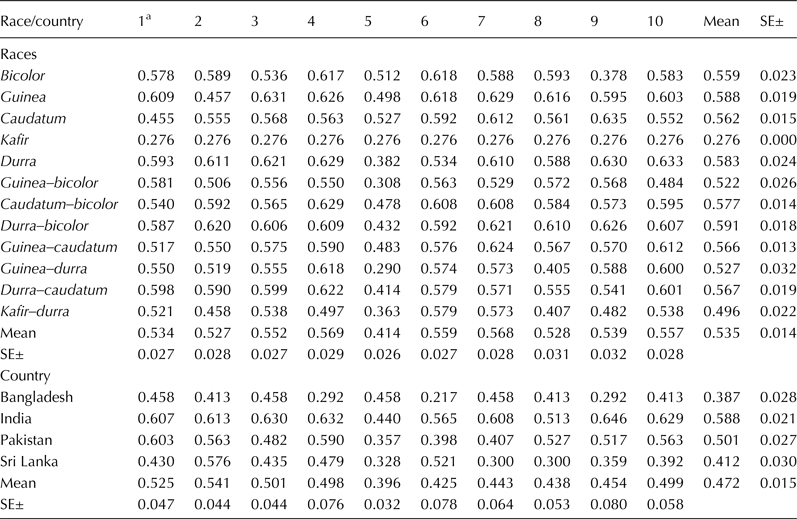
PCA was carried out using standardized data of eight quantitative traits; the first three PCs captured 65.64, 66.49 and 72.89% of the total variation in the entire collection, basic and intermediate races, respectively. The Shannon–Weaver diversity index (H′) was calculated for the entire South Asian collection and for each race and country of origin to compare phenotypic diversity for ten quantitative traits (Table 3). A low H′ indicates extremely unbalanced frequency classes for an individual trait and lack of genetic diversity in the collection. The diversity index values (H′) were variable among traits. In the entire collection, the diversity index (H′) ranged from 0.414 ± 0.026 for basal tillers per plant to 0.569 ± 0.029 for plant height in the postrainy season (Table 3). The mean diversity across the traits was maximum in durra–bicolor (H′ = 0.591 ± 0.018) and lowest in kafir (H′ = 0.276 ± 0.001). The mean diversity over countries varied from 0.396 ± 0.032 for basal tillers per plant to 0.541 ± 0.044 for days to flowering in the postrainy season. The guinea race was highly diverse for days to flowering and plant height in the rainy season, panicle exsertion, length and width. Among the countries, India was highly diverse for all traits except panicle width and basal tillers per plant.
Shannon–Weaver diversity index (H′) for agronomic traits of sorghum germplasm from South Asia at ICRISAT genebank, India

a 1 = Days to 50% flowering-rainy, 2 = Days to 50% flowering-postrainy, 3 = Plant height (cm)-rainy, 4 = Plant height (cm)-postrainy, 5 = Number of basal tillers per plant, 6 = Panicle exsertion (cm), 7 = Panicle length (cm), 8 = Panicle width (cm), 9 = Seed size (mm) and 10 = 100 Seed weight (g).
Geographical gaps
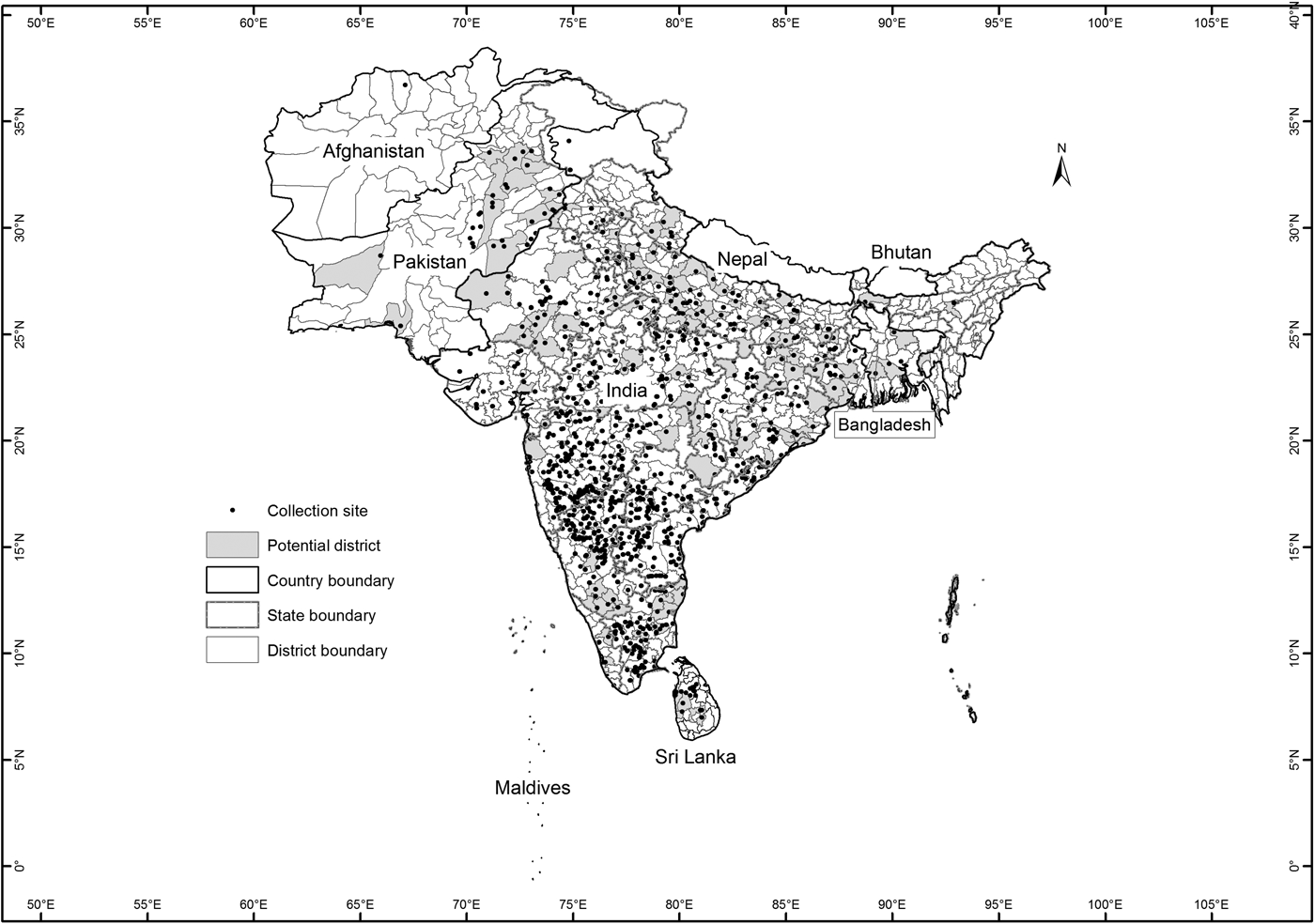
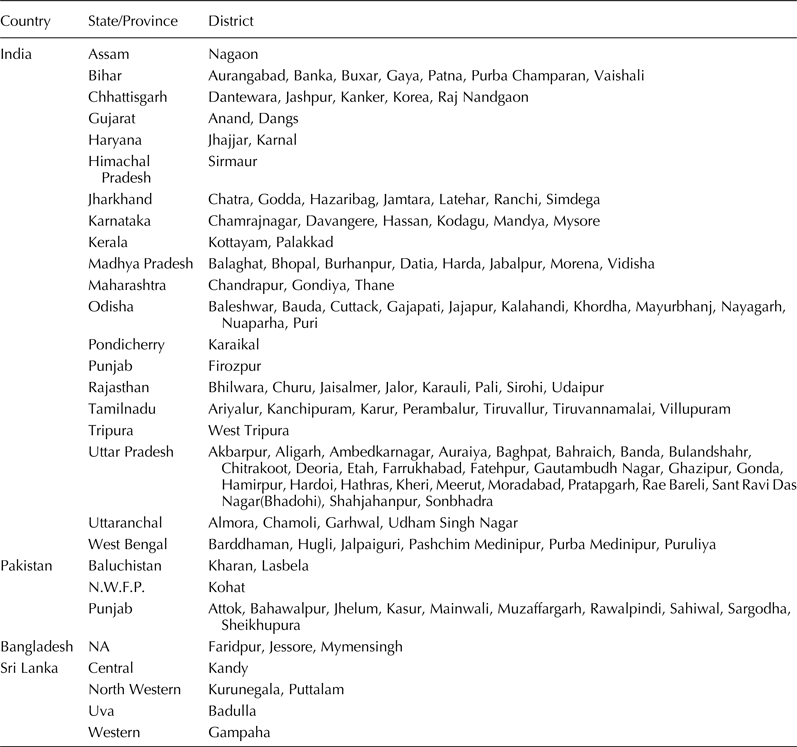
In South Asian countries, sorghum is grown either as sole crop or mixed with chickpea, green gram, black gram, soybean, groundnut, safflower, linseed, cucumber, watermelon, etc., in the rainy and postrainy seasons. A total of 131 districts located in 27 provinces of four South Asian countries were found as the geographical gaps (Fig. 1, Table 4). Country wise, 110 districts located in 20 provinces of India, 13 districts located in three provinces of Pakistan, three districts in Bangladesh and five districts located in four provinces of Sri Lanka were the gaps. Uttar Pradesh in India with relatively low representation (238 accessions) in the collection had 27 districts as gaps in sorghum germplasm. Other provinces showing more than five districts as gaps include Bihar, Madhya Pradesh, Rajasthan, Odisha, Tamil Nadu and West Bengal.
Geographical distribution and the gaps (districts shaded) identified in the sorghum collection from South Asia at ICRISAT genebank, India.

Geographical gaps identified in sorghum germplasm from South Asian countries at ICRISAT genebank, India

Taxonomic gaps
The wild relatives’ collection from South Asian countries at the ICRISAT genebank includes S. bicolor subsp. drummondii (Steud.) (9 accessions) of primary genepool, S. halepense (L.) Pers. (5 accessions) of secondary genepool and S. pururiosericeum (A. Rich.) Aschers. & Schweinf. Deccanense Garber (3 accessions) of tertiary genepool (Acheampong et al., Reference Acheampong, Murthi and William1984) (Table 2). Kamala et al. (Reference Kamala, Mourya, Dwivedi, Upadhyaya, Wang, Upadhyaya and Kole2014) reported the distribution of S. bicolor subsp. drummondii, S. bicolor subsp. verticilliflorum and S. halepense in India and S. propinquum in India and Sri Lanka. Therefore, S. bicolor subsp. verticilliflorum and S. halapense, S. propinquum and other wild relatives may be considered as important taxonomic gaps in the collection.
Discussion
The extent of coverage of the total diversity of different crops in ex situ collections is difficult if not impossible to estimate with any real precision, but it varies considerably according to the crop and several other factors. There are still sizeable gaps in the ex situ collections of many major crops including sorghum. The collection of germplasm is not the only way to fill gaps. In recent years, we have made extensive efforts at ICRISAT, by comparing databases of ICRISAT mandate crops with collections at other important genebanks globally. Based on the comparison we added more than 4000 unique accessions of mandate crops from 12 countries, including 2052 samples of sorghum from nine countries. Afterwards, we have identified gaps in the collections of mandate crops. Exploring the gaps identified in this study will enrich the diversity of sorghum collection at ICRISAT genebank.
The adequacy of the collections to provide useful genes for current and future programmes will be dependent on how successful the collecting efforts have been in obtaining good representation of the existing genetic diversity within crop species and close relatives and on the quality of preservation procedures and facilities. Many species are threatened by the vagaries of the climate as well as other changes. Therefore, the goal of collection missions should be to preserve the highest level of useful genetic diversity that is feasible through identification of gaps in the collections and exploring the areas identified as gaps.
The success of gap analysis depends on the quality of the input data. In many genebanks, most of the older germplasm collections do not have complete passport information, particularly, the georeferenced data (latitude and longitude) of the collection sites. This poses a problem while assessing the geographical completeness of collections (Upadhyaya et al., Reference Upadhyaya, Reddy, Irshad Ahmed and Gowda2010). The inaccuracy of georeferenced data is an additional constraint. Updating passport data for location information and georeferenced data and their validation is essential for the identification of gaps using spatial analysis. As is seen in the present study, the usefulness of satellite images with temporal resolution to map the distribution of seasonal crops is well established.
Extraction of spatial information on the vegetative cover, specifically Land Use Land Cover (LULC) using remote sensing has paved the way for the availability of such information accurately and economically. It has the advantage of providing information over large areas which are inaccessible. Studying crop diversity and identifying in situ conservation areas requires land use information, specifically crop domain maps, which can be prepared using satellite imagery at regular intervals, as well as long-term changes. Any collection mission requires readily available information on crop cultivation for planning germplasm collection missions. The production domains of crops will help in prioritizing locations for phased collection. A satellite imagery which provides the accurate location as well as the area can help in optimizing trips for germplasm collection. Realizing the potential of these new science tools, premier scientific organizations like the National Aeronautics and Space Administration (NASA) – https://earthdata.nasa.gov/about/daacs/daac-lpdaac and the United States Geological Survey (USGS) have opened up their data repositories at no cost (http://earthexplorer.usgs.gov/, https://lpdaac.usgs.gov/) (NASA, 2014; USGS, 2014). This type of spatial information can be used for multiple purposes such as identification of crop domains, identification of gaps in germplasm collections, zones of adaptation, introduction of improved cultivars and intensification of domains.
Representation of sorghum germplasm from South Asia for wide latitudes (from 6.98° N in Sri Lanka to 36.71°N in Afghanistan), indicates adaptation of landraces to diverse climates in this region. Srinivasa Rao et al. (Reference Srinivasa Rao, Reddy, Nagaraj, Upadhyaya, Wang, Upadhyaya and Kole2014) reported that sorghum can be grown up to 40° latitude on either side of the equator. Espinoza and Kelley (Reference Espinoza, Kelley, Espinoza and Kelley2002) reported sorghum as being a versatile crop capable of growing well under contrasting climatic conditions. Therefore, there is a suggestion to increase the variability for adaptive traits by filling the gaps in the sorghum collection from South Asian countries.
The sorghum collection from South Asian countries at the ICRISAT genebank indicates low representation from all countries except India. However, as per the FAO statistics for sorghum cultivation and the number of collection sites, there is one collection site for 7628 ha in India and for 5516 ha in Pakistan suggesting exploration of the gaps identified in the present study (FAO, 2014). As the remote sensing images indicate the area under sorghum cultivation in South Asia during 2014–2015, the identified gaps can be considered as potential areas for sorghum germplasm. Low representation of bicolor and caudatum races, which were identified as sources for early flowering also emphasize the need to collect these races during future collection missions. Among the intermediate races, except for durra–bicolor and durra–caudatum, all other races need to be collected for good representation in the world collection. Landraces from Pakistan flowered early and those from Sri Lanka flowered late in both seasons indicating reduced sensitivity to climate related traits. Landraces of the guinea race were highly diverse for flowering, plant height and panicle number in the collections from all countries except India. These need to be collected to enrich the world collection at the ICRISAT genebank for diversity.
Unlike the cultivated species, which tend to have lower levels of diversity, the Crop Wild Relatives (CWR) forms an important source for higher levels of stress resistance and useful adaptive and nutritional traits. Kamala et al. (Reference Kamala, Mourya, Dwivedi, Upadhyaya, Wang, Upadhyaya and Kole2014) reported S. halepense as a good source for a higher level of downy mildew resistance. Mote (Reference Mote1984) reported S. purpureosericeum of Indian origin as a source for higher levels of resistance to the shoot fly. A total of 458 wild accessions belonging to 13 species accounting for 1.2% of the total collection (39,234 accessions) are being conserved at the ICRISAT genebank. The existing wild relatives’ collection from South Asian countries at the ICRISAT genebank indicated the presence of very few accessions of S. bicolor subsp. drummondii (Steud.) (9 accessions), S. halepense (L.) Pers. (5 accessions) and S. pururiosericeum (A. Rich.) Aschers. & Schweinf. Deccanense Garber (3 accessions). The collection indicated conservation of only a fraction of the total genetic variability that exists in wild relatives of sorghum and much collecting of diversity is still required. Kamala et al. (Reference Kamala, Mourya, Dwivedi, Upadhyaya, Wang, Upadhyaya and Kole2014) reported the occurrence of S. bicolor subsp. drummondii as a weed wherever sorghum is cultivated in Asia; S. halepense, a rhizomatous perennial in Eurasia east of India; S. propinquum in Sri Lanka and eastern India to Myanmar and further east to the islands of South East Asia and S. purpureosericeum in Asia. Lazarides et al. (Reference Lazarides, Hacker and Andrew1991) reported the distribution of parasorghum species in Asia. Globally, genetic resources have primarily been conserved using ex situ methods, with most attention having been given to collecting and maintaining landraces; the collection of wild relatives has not been a priority (Frankel and Hawkes, Reference Frankel and Hawkes1975; Smith et al., Reference Smith, Dickie, Linington, Pritchard and Probert2003; Maxted and Kell, Reference Maxted and Kell2009). ICRISAT had launched only a few collection missions exclusively for wild relatives. Therefore, there is a need to launch collection missions in the region under study, exclusively for wild relatives of sorghum and other mandate crops, to fill taxonomical gaps in the collection at the ICRISAT genebank, before we lose them forever due to fast urbanization, irrigation projects, natural calamities, over grazing, etc. (Upadhyaya and Gowda, Reference Upadhyaya and Gowda2009a).
India being the secondary centre of diversity for sorghum, the geographical gaps identified in South Asia may be considered as the potential areas for diverse sorghum (Fuller, Reference Settar and Korisettar2002). Figure 1 indicates the reduction in traditional growing areas of sorghum and new areas of cultivation, where there is less collection. The gaps identified in the present study can be prioritized for exploration. Generally, prioritization is done by the collecting team at the time of actual launch of the collection mission depending upon the threat to diversity, availability of resources and accessibility to the target region in consultation with local government officials, NARS scientists, extension officers and non-governmental organizations, who will have a knowledge of sorghum cultivation in the districts. All reports and other publications on past collections should be considered while preparing route maps for exploring the identified gaps. While collecting germplasm, it is important to collect complete passport information including georeferenced data facilitating future mapping efforts. The passport and characterization data for the collection under study can be accessed at www.genesys-pgr.org. Seeds of all accessions under study are available at ICRISAT genebank, Patancheru, India, following the Standard Material Transfer Agreement (SMTA) of International Treaty on Plant Genetic Resources for Food and Agriculture (ITPGRFA).
Supplementary material
The supplementary material for this article can be found at http://dx.doi.org/10.1017/S147926211600023X.
Acknowledgements
Authors sincerely acknowledge the contribution of all former and present staff of genebank at ICRISAT, Patancheru, India in collection, assembly, conservation, characterization and documentation of sorghum germplasm.