National strategy
In deciding on what any national institute's research should be, one must bear in mind that institutes differ from universities in undertaking research that is of a more strategic nature, is longer term and is more closely related to national needs. Institutes sit on the spectrum in between applied research in industry and fundamental research in universities. They are funded in the national interest because universities do not have the capacity for the kind of long-term commitment required, and industry does not have the interest because of its focus on short-term gains. Examples of polar research institutes might include, for instance, the British Antarctic Survey (BAS), the Alfred Wegener Institute for Marine and Polar Research (AWI), the Polar Research Institute of China (PRIC), the Korean Polar Research Institute (KOPRI), the Indian National Centre for Antarctic and Ocean Research (NCAOR), among many others.
Most polar research requires institutes, because once governments have decided they need to obtain knowledge about the polar regions as the basis for understanding processes and using that understanding as the basis for improving prediction, a suitable infrastructure has to be provided and managed to carry out the work for the long term. There is a need for ships, aircraft, vehicles, accommodation, and communications, as well as laboratories at home for the analysis of materials and production and publication of results. As a first step in any one polar area, ‘basic-strategic’ research will be required to establish the nature of this largely unexplored area. After a time, as the environment becomes explored and understood, more ‘core strategic’ research should evolve. Alternatively, the basic-strategic phase may be extended, by expanding the geographical area of research.
Universities should be encouraged to become involved in institute work as a means of encouraging young scientists to consider polar research as a career. This may require a significant allocation of resources from an institute to the university sector. In addition, university researchers should be encouraged to apply for national grants to allow them to carry out their own research using an Institute's facilities.
Strategic focus
Because of location and environment, the polar sciences are difficult, time consuming and expensive. It is therefore imperative that polar scientific research be focused on goals that are intellectually challenging, address major issues, and fit with national priorities. Institute projects should relate to long-term national strategic requirements like quality of life, food security, energy security, and wealth creation. They should focus on addressing key strategic questions and the production of useful outcomes, to ensure that decision makers in government, business and society have the knowledge, foresight and tools to address strategic challenges: for instance to mitigate, adapt to and benefit from environmental change. The evidence base must be developed to support policy.
To the extent possible, institute projects should address what the international community has accepted as the major research challenges, which are often referred to as ‘grand challenges’. The general consensus is that the interlinked major challenges of the day lie in:
• Climate change (affecting global security through migration);
• Biodiversity loss (affecting ecosystem functions and services);
• Food security (ability to feed growing populations);
• Water security (ability to supply people with fresh water and sanitation);
• Energy security (ability to provide growing populations with cheap power);
• Economic security (for example growth of wealth through application of new technologies like biotechnology);
• Human health (improving peoples’ health and well being).
The sustainable development of human society depends on meeting all of these grand challenges. The focus for much of the natural sciences is on global change, which can be seen as embracing all of these to some degree (for example as spelled out by the International Council for Science (ICSU) at www.icsu-visioning.org/, and the European Biodiversity Research Strategy at www.epbrs.org/PDF/EPBRS_StrategyBDResearch_May2010.pdf). Polar research can address many of these challenges to some extent, as shown in the science plan of ICARP (International Conference on Arctic Research Planning) (http://aosb.arcticportal.org/icarp_ii/science_plans/).
Setting long-term strategic goals requires:
• Acceptance by staff of strategic frameworks and key challenges;
• Development of long term strategic collaborations between the research, policy, and business communities (including international);
• Significant focus on delivery of results and outcomes;
• Promotion of development opportunities (for example via patents and collaborations and via design of technologies for manufacture) and growth of the right (strategic) kind;
• Engaging with a range of external sectors (not being inward looking);
• Recognizing and describing the impact of research on the economy and society;
• Maintaining flexibility to respond to changes of government, of funding, and of the research landscape.
Developing a comprehensive strategic research programme may thus require a change of culture in the way research is designed, supported and implemented.
Grand challenges as a framework for future research
As noted by Kennicutt in a paper presented by the Scientific Committee on Antarctic Research (SCAR) to the 2009 meeting of COMNAP (the Council of Managers of National Antarctic Programs):
Predicting future directions in Antarctic science is difficult at best, as investment in science is often decided by each nation in very different ways. However, one can analyze trends and extrapolate where these trends may lead in the future. The questions being asked by scientists and society are becoming more complex, requiring integrated and interdisciplinary approaches. This reflects a holistic view of Earth system science and the recognition that, far from being isolated, Antarctica and its surrounding ocean are integral parts of the Earth system. Equally, studies within Antarctica recognize the co-dependence of and linkages amongst physical and living systems. Trans-continental observations and experiments have become an increasing feature of many programs, and access to all corners of the continent is desirable, if not required. In many instances large multi-national teams of scientists are involved, the range of disciplines and the supporting technologies are diverse, the volume of data and information collected is immense, and real-time internal and external communications are essential (Kennicut Reference Kennicutt2009).
National institutes have a significant opportunity to contribute fully to these international activities.
In November 2010, ICSU set out a suite of 5 grand challenges (listed below):
to mobilize the international global change scientific community around an unprecedented decade of research to support sustainable development in the context of global change. The pace and magnitude of human-induced global change is currently beyond human control and is manifest in increasingly dangerous threats to human societies and human wellbeing. There is an urgent need for the international scientific community to develop the knowledge that can inform and shape effective responses to these threats in ways that foster global justice and facilitate progress toward sustainable development goals (Reid and others Reference Reid, Chen and Goldfarb2010).
The focus was on global change to understand the functioning of the Earth system and the human impacts on that system. Polar research can contribute to meeting the first 3 of these Grand Challenges, and perhaps also on aspects of number 5.
 Forecasting: improving the usefulness of forecasts of future environmental conditions and their consequences for people;
- Observing: developing, enhancing and integrating the observation systems needed to manage global and regional environmental change;
- Confining: determining how to anticipate, avoid and manage disruptive global environmental change;
- Responding: determining what institutional, economic and behavioural changes can enable effective steps toward global sustainability;
- Innovating: encouraging innovation (coupled with sound mechanisms for evaluation) in developing technological, policy, and social responses to achieve global sustainability.

The ICSU document also recommends a shift from:
Research dominated by disciplinary studies to a more balanced mix of disciplinary research and research that draws disciplinary expertise into an integrated approach that facilitates inter- and transdisciplinarity.
It also called for research priorities to be shaped with the active involvement of potential users of research results.
Strategic approaches of major polar institutes
Analysis of the strategic plans of (i) the main polar research institutions [the UK's BAS, the Australian Antarctic Division (AAD), Germany's AWI, and Antarctica New Zealand], (ii) the European Science Foundation (ESF) and European Polar Board, and (iii) SCAR and IASC (the International Arctic Science Committee) (the latter informed by ICARP-II), can be used to show how different polar institutions propose to address these grand challenges, and demonstrates a commonality of approach between them. The strategic research plans of these institutions focus primarily on (i) climate change; (ii) biodiversity loss; (iii) earth system science (which recognises the connections between the atmosphere; the oceans; the deep Earth; snow, ice and permafrost; freshwater systems; and living organisms, all of which depend on changes in other parts of the system); and (iv) development of technologies (including numerical models) needed for enhanced environmental science.
Technology development is critical, as research advances depend heavily not only on new ideas but also on the application of novel technologies. These may include remote sensing with sensors based on satellites, aircraft, or drones in the air; autonomous underwater vehicles (AUV)s, remotely operated vehicles (ROVs), gliders, floats and moorings in the oceans; and deployment on land of intelligent field sensors that work independently using wireless and other forms of data transmission. Reliability in the field is a key challenge in remote locations. Novel laboratory instruments are needed to analyse environmental samples. A new generation of molecular tools in fields of genetics, such as genomics and proteomics, will be critical to our understanding of the environment.
Sophisticated models are required of environmental processes to provide foresight of the future state of the environment. Rapid advances in software engineering, and information and communication technologies are revolutionising the way researchers are working to use computing power and scientific data repositories. These new technologies will need data management and support in terms of power supplies, data acquisition, transmission devices and platforms. There exists the potential to develop world-leading technologies. It is critical to strengthen data management, including supporting new data products.
Development of technologies implies employment of the technical staff capable of technology development, or alternatively the purchase of leading edge equipment or model code.
The major national polar science institutions responsible for strategic research incorporate studies of:
- The present climate system (atmosphere, ocean, ice and their physical and chemical interactions) and coupling between its elements (numerical modelling);
- Past climate change;
- Observing systems and for detecting change and as the basis for predicting future conditions;
- Polar terrestrial and oceanic ecosystems and their response to change, including identification of indicators and risks;
- Biodiversity at all levels including microbial, and invasive species;
- Biogeochemical cycles, impacts and feedbacks, including ocean acidification;
- The behaviour of ice sheets, especially in relation to sea level rise;
- The solid Earth and associated risks (earthquakes, volcanoes, hot vents, permafrost);
- Resources (conservation, fisheries, biotechnological potential, energy);
- Geospace from the upper atmosphere (mesosphere, thermosphere, ionosphere) to the magnetosphere and the sun (e.g. solar storms and communication and satellite disturbance)
They may also include astronomy, astrophysics, and the collection of meteorites etc., which tend to be the province of university researchers.
The influence of the IPY
The outcomes of the International Polar Year 2007–2008 (IPY) are helping to determine the future directions of Arctic and Antarctic science. The IPY portfolio of science projects (http://ipy.arcticportal.org/) provides a unique ‘window’ on the future of polar science; many projects begun during the IPY are continuing well beyond it. IPY scientific planning and outcomes have set a course for polar science for years to come, notably with a legacy of (i) developing and implementing observing systems, (ii) improving data and information management and exchange, and (iii) developing the next generation of researchers. For a comprehensive review see Krupnik and others (Reference Krupnik, Allison and Bell2011).
IPY's scientific projects focused on the status of polar systems, change in polar systems, global linkages, new frontiers, the poles as vantage points, and the human dimension. Major scientific topics addressed by IPY projects included the same broad topics as those listed above; major themes were the grand challenges of climate change and biodiversity loss. Recognising the academic nature of much IPY research, topics included sub-ice hydrological systems and astronomy and astrophysics.
Ideally, following a proposal from the World Meteorological Organization (WMO 2011), polar institutes should work together to address grand scientific and technological challenges that require a decadal effort in the polar regions, notably:
- developing and maintaining the polar components of the global Earth observing system; and
- developing a global integrated polar prediction system for weather and climate change.
Implementing WMO's proposal would lead to better services outcomes, for instance by integrating all Antarctic meteorological networks into an Antarctic observing network (AntON) to produce climate messages; defining the scope of Arctic and Antarctic regional climate centres, and increasing the number and improving the quality of their climate products; improving understanding of climate processes in the Antarctic; and implementing the global cryosphere watch. Given WMO's interests, the focus would be on atmosphere, ocean, ice and climate measurements. Implementing this proposal would mean polar institutes re-orienting some of their work to contribute to developing and implementing observing systems like iAOOS (the integrated Arctic ocean observing system)(classic.ipy.org/development/eoi/AOSB-CLIC short plan v4.pdf), and SOOS (the Southern Ocean observing system)(www.soos.aq). The idea is for the international whole to become greater than the sum of its national parts. If institutes are to work together to improve observing and forecasting systems, there will have to be vast improvements by all institutes in the collection, management, archiving and exchange of data and information - especially in meteorology and oceanography. The objective is win-win; you give me your data and I give you mine; we can then both make our own forecasts tailored to meet our own needs.
Generic factors in developing a strategic plan
A strategic plan is an institute's roadmap for the future. It should be the product of extensive consultation with staff and with key stakeholders. Experience suggests that devising a leading edge strategic research programme should involve interaction between an institute's board of directors and an external advisory board. Such groups would utilise techniques like ‘horizon scanning’ (as used recently by SCAR (see www.SCAR.org/horizonscanning) to identify emerging trends, opportunities and directions for the most appropriate allocation of research effort (for example Kennicutt and others Reference Kennicutt2014a, Reference Kennicutt, Chown and Cassano2014b).
An institute's strategic plan should be designed to:
• set broad objectives and strategies for the organization and provide a framework for decision-making;
• provide a view of priorities, and guidance for formulating the work programme and budget;
• set out the thinking on programme activities and deliverables, having considered the possible impacts on activities of foreseeable scientific, technological, social and economic developments in the polar regions and elsewhere;
• optimise the programme structure and use of available resources;
• provide staff with the longer-term framework within which to plan and manage activities;
• give management a benchmark against which to monitor progress and performance in the implementation of the scientific programmes;
• describe infrastructure and management operations and aim to make them transparent;
• provide guidance for management, staff, funders, and other stakeholders including the public.
The plan should help to foster in management and staff a strong sense of commitment to the actions necessary for implementation. It should aim to help the organisation to exploit its comparative advantages to make strategic choices about future directions. It should provide the basis for a detailed implementation plan with project-by-project milestones and targets. Progress against the implementation plan should be examined through annual performance reviews, allowing directions to be revised where necessary (see more detail below).
The strategic plan should set out the organisation's vision, mission, and major objectives, addressing what the organisation is, does, and should do, and the reasons why it does it. Ideally, the focus should be on creating new knowledge, improving understanding of natural processes, and combining knowledge and understanding to improve predictive capabilities and other useful outcomes related to national strategic requirements.
Ideally, institutes should aim to develop a focused and integrated programme by picking no more than 3–5 major objectives in science and logistics, and making sure (to the extent possible) that they are connected. The goal is to develop major high quality national and international science programmes addressing key issues of global importance in an integrated way. To make an impact nationally and internationally it is better to have a few important strands than many disparate ones. The major scientific and infrastructure objectives would be underpinned by cross-cutting objectives common to all organisations: (a) to continually improve the effectiveness, efficiency and flexibility of the structure, working mechanisms and practices; and (b) to increase funding to match requirements, and to maintain a healthy funding stream. Building partnerships is an essential aspect, recognising that no one nation can ‘do it all’. There are many prospective partner organisations (SCAR, IASC, for example), not forgetting those with a global remit but having local polar interests (WCRP for example).
Links to universities
An institute's prestige can be enhanced through strong formal linkages to key national universities. Such links would lead to institute scientists giving some lectures at the university and perhaps being accorded visiting professor status, as well as exposing students more to the lure of the polar sciences.
University scientists at all levels from undergraduate to professor should be encouraged to become involved in polar science programmes, either as assistants or as joint investigators. Undergraduate and graduate students could be invited to spend summer seasons working at institute's research stations or on institute ships, as a means of exposing them to polar science excitement and opportunities. Institutes could encourage universities to offer course credits for such field activities.
Shared facilities
Institutes may possess facilities such as bases or ships that could become platforms for international research. Icebreakers, for example, are in short supply. More may be gained from sharing them than from keeping them just for national use. Following that philosophy, AWI, for example, makes available the facilities of the RV Polarstern.
Productivity
Institute managers will need to ensure that scientific productivity is high – meaning ideally an average of at least 2 SCI (science citation index) papers per head per year for permanent science plus support staff, and preferably 3 for just the permanent science staff. However, managers must recognise that different sciences have a natural tendency to produce SCI papers at different rates – for example because of the relative ease with which microbiological and genetic papers can be produced from laboratory work in the life sciences, compared for example with the rate of publication in Earth system sciences in which extended field work under harsh conditions is required to gather the data. To achieve such demanding goals requires that management (i) makes minimal administrative demands on scientists’ staff time, and (ii) recognises that properly trained and permanent mechanical and electrical engineering support staff are needed to develop, maintain and deploy in the field the sophisticated equipment required to produce data for scientists to work on. Expensively trained scientists should not be used as equipment technicians. It is a false economy.
The planning process
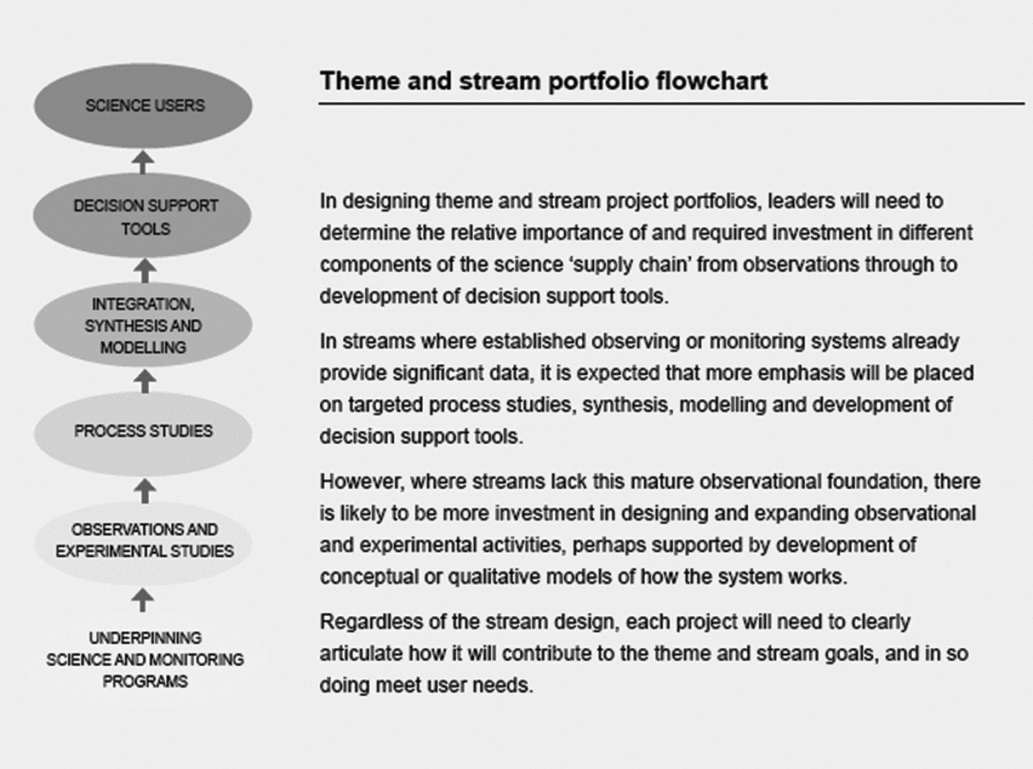
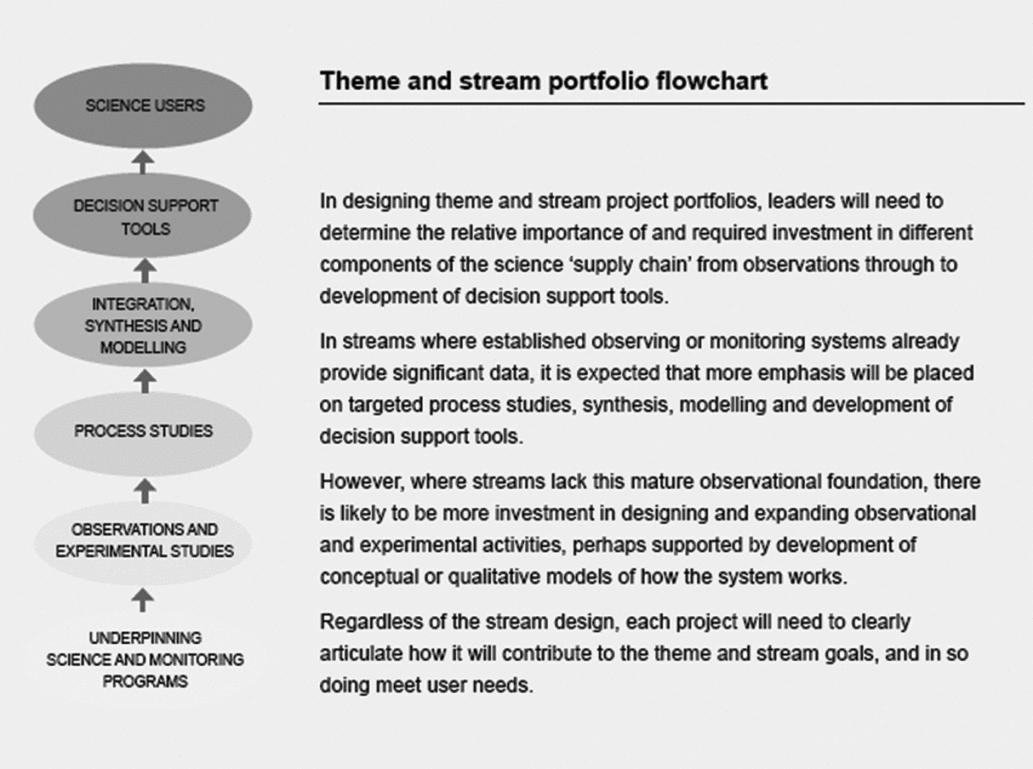
All institutes need a strategic planning process. An example comes from the Australian Antarctic Science strategic plan (Australian Antarctic Division 2011) (Fig. 1).
Example of strategic planning process (Australian Antarctic Division 2011).
Planning processes should focuses on:
(i) carrying out leading edge scientific research;
(ii) improving national capabilities for polar research, by: developing and sharing polar infrastructure to enhance the scope of the science, and by developing the next generation of polar researchers through collaborative research with universities and other institutions, and through education and training programmes;
(iii) improving scientific standards: through national and international collaboration and training at the highest level with partner institutions; through increasing publication in high impact international scientific journals; and through attempting to increase participation and leadership in major international polar science programmes and logistical and advisory structures.
(iv) managing data and information in such a way as to make results widely available, and to exchange them with other polar research institutions.
The planning process should engage external advisors and/or stakeholders in considering what the institute's priorities ought to be for the decade ahead, where it is important to engage in ‘horizon scanning’ to detect future trends and opportunities as part of a 10-year planning process.
Planning should make the most of an institute's several disciplines, for example by encouraging the development of research proposals across divisional boundaries. Divisional heads must be encouraged to think beyond their immediate work plans to consider the development of their science areas in a10-year time frame, and in the context of what is happening at the international level.
The research focus
SCAR's recent horizon scanning process (www.scar.org/horizonscanning) offers a good example of identifying where the big polar challenges lie for the next decade (for example Kennicutt and others Reference Kennicutt2014a, Reference Kennicutt, Chown and Cassano2014b). But aside from that there are some obvious pressure points:
Climate science
Climate science is needed for a full understanding of the Earth's climate system so as to underpin accurate forecasts of weather and climate, nationally and globally. Climate research must address the fact that many aspects of the climate system at both poles are grossly under-sampled, despite the fact that the climate signal is amplified and having its greatest effect there (see reports of the global climate observing system (GCOS) at www.wmo.int/pages/prog/gcos/index.php?name=Publications). Continued investment is needed in the network of automated weather stations on land (for example in under-sampled West Antarctica). Sustained measurements are required of changes in the cryosphere; and in the ocean, not least in especially remote areas like the Amundsen Sea, but also en route to and from the polar regions, following the published design plans for an integrated Arctic Ocean observing system (by IASC) and SOOS (by SCAR: (www.soos.aq/resources/publications?view=publications). The requisite data collection is dual use, on the one hand providing new observations to test scientific hypotheses about the operation of the polar oceans and climate, and on the other hand providing the monitoring needed by the user community for weather and climate forecasts. Routine radiosonde measurements should be an integral part of observations to understand climate change.
To understand climate change, measurements are also required of ‘geospace’, comprising the upper atmosphere (mesosphere, thermosphere and ionosphere) and the magnetosphere. These measurements are important in indicating the occurrence of magnetic storms and associated disturbances that may interfere with electronic systems in satellites and at the Earth's surface. Changes in the upper atmosphere may propagate down to the Earth's surface affecting the climate there.
Observations of past climate change, from offshore piston cores and drill cores, and from onshore ice cores and rock cores, are also need to provide an accurate paleoclimate perspective on climate change.
Life sciences
Life Sciences contribute significantly to knowledge of biodiversity on land and in the ocean, thereby contributing to the Antarctic Treaty's and Arctic Council's ability to practice conservation in the face of issues such as climate change and the invasion of species (for example via the Committee on Environmental Protection (CEP) in the south, and the Conservation of Arctic Flora and Fauna (CAFF) in the north). Research is moving toward ascertaining the effects on, and responses of, organisms to climate change, and working with remote sensing specialists to study biological variability with time in geographical space. As pointed out by Chown and others (Reference Chown, Lee and Hughes2012) a great deal more effort is required by national programmes to ascertain the variability of Antarctic biological systems, as the basis for an effective conservation strategy.
Comprehensive studies are needed of the ways in which both marine and terrestrial plants and animals have adapted to living in the cold environments of the polar regions, where the extreme conditions provide extra selection pressure leading to unique features of biochemistry and biology in endemic species; some of these cold adaptations (for example antifreeze proteins - AFPs) may have commercial application. Science is needed to build polar genomic databases. We also continue to need more comprehensive information on Antarctic fish and their food, all the way from the base of the food chain. Studies of the physical, chemical and biological oceanography of polar seas will contribute directly to the IGBP's Integrated marine biogeochemistry and ecosystem research programme (IMBER), the Southern Ocean part of which is the Integrated climate and ecosystems dynamics programme (ICED), and would support the work of such groups as CCAMLR (the Convention on Circum-Antarctic Marine Living Resources) in the south and the FAO (Food and Agriculture Organization) for its fisheries area 18, (the Arctic) and the Arctic Council (for example its Arctic Monitoring and Assessment Programme – AMAP). In addition marine research will contribute to environmental protection programmes like the Arctic environmental protection strategy (AEPS), and the Arctic contaminants action programme (ACAP) of the Arctic Council. Continuous plankton recorders (CPRs) can be used more widely to sample the upper water column and contribute to SCAR's international circum-Antarctic CPR database, which will enable decadal variations in Southern Ocean plankton (the base of the food web) to be assessed in relation to climate change (a strategic benefit to CCAMLR).
Earth sciences
Ideally, earth sciences should be organised in such a way as to contribute to understanding past climate change through integrated studies of core samples from both onshore and offshore. Historically the collection of such data and their analysis has been carried out by separate marine and terrestrial groups, which is unwise. National efforts should be designed to contribute to international efforts such as the international trans-Antarctic scientific expedition (ITASE), SCAR's shallow ice coring programme on land, which plans to study recent climate variability in detail over the past 2000 years so as to better understand Antarctica's climate evolution. The goal should be to test climate change hypotheses on the relatively short time-scale (a few thousand years). The over-riding question to be asked of ice cores is ‘how has climate changed with time and how has that affected the environment’. Key (important) climate change questions include – (i) how has sea ice changed through time? – which may be reflected in ice cores in dimethyl sulphide or its derivatives through time; (ii) from which direction were the winds blowing through time? This may be indicated from sea salt proxy analyses. Combining ice core and sediment core studies into one project will create a powerful, integrated palaeoclimatic and palaeoceanographic research approach that could lead to major breakthroughs in understanding regional climate history in the global context.
Antarctica offers the prospect of studying active geological processes (volcanoes), active glaciological processes (behaviour of the glaciers draining the polar plateau), and neotectonics. Offshore there are exciting opportunities to find and study new hydrothermal vent fields on the mid-ocean ridge system around Antarctica.
Technology development
Technology development is critical to the success of much ocean and Antarctic science, where much scientific data comes from measuring or observing phenomena remotely, using instruments. The institutes with the best and most novel equipment are able to make the biggest breakthroughs in scientific understanding. To get the most out of technologies requires investment in engineering support teams like those at the Woods Hole Oceanographic Institution (WHOI), BAS, AWI, or the UK's National Oceanography Centre, which enable the development of novel technologies needed for scientific breakthroughs. This helps to keep the science at the leading edge. Technology development should follow the philosophy of ‘design for manufacture’. This can be achieved by ensuring that new technologies are designed by a team comprising the scientists who need the answers, a technologist/engineer capable of converting the scientists’ ideas into a design for a piece of equipment, and someone from a commercial company who can advise on what needs to be built into the design so as to make it easy to manufacture and sell if it should prove to be successful. It may prove profitable to sell equipment designed in this way to others lacking the engineering facility to make their own. This is a great way to establish scientific leadership by comparative technological advantage.
Data and information management
Data and Information Management is not an optional ‘add on’ to the science. It is fundamental to success. Meeting the increasingly complex, multidisciplinary and multinational challenges of today's polar science, especially in the global context, requires access to an extensive base of scientific data and information. One of the most useful services institutes can provide to the wider scientific community and their own staff is comprehensive and integrated high level data and information management to facilitate high quality, interdisciplinary science. This will add value to data that were extremely costly to collect, by making them available to the wider community for multiple investigations (the principle should be ‘collect once; use many times’). Data sharing is also a requirement of the Antarctic Treaty. Ideally, data should be managed through a national Arctic or Antarctic or polar data centre along lines recommended in the SCAR data and information management plan (Finney Reference Finney2013). Metadata should be entered into the SCAR Antarctic master directory, and national groups should contribute (for Antarctic work) to SCAR's Standing committee on data and information management (SCADM). Marine data from the Southern Ocean can be contributed to SCAR's MarBIN (Marine biodiversity information network).
International scientific linkages
No matter what the country, the international ideas pool is far larger than the national ideas pool. To encourage researchers to aim for the leading edge of science it is important for them to communicate widely, which means visiting and spending time at overseas institutions, then returning with new ideas, networks and collaborative programmes. It also means to engage directly in leading edge research internationally, and publishing more in top quality international journals, so as to make a bigger impact both nationally and internationally. An outward-looking approach is essential, with incentives for national polar researchers to work jointly with individuals in other institutes and universities nationally and with overseas scientists, for example through an exchange programme. Equally, national researchers should be encouraged to become engaged in SCAR and IASC projects and programmes and meetings. For example, in the Antarctic, existing and future research efforts on King George Island (KGI) have the potential to significantly contribute to SCAR science, as pointed out in a SCAR document - King George Island and SCAR science by M.C. Kennicutt, SCAR President, an invited paper for the COMNAP meeting in Punta Arenas, 3 August 2009.
Capacity building, education and training
In-house mentoring is required for the development of young scientists. International scientists can also play a role in providing mentoring for individuals. In addition institutes might find it useful to devise a strategy for capacity building, education and training (CBET), so as to raise individuals’ capabilities to the desired level. This could be based, for example, on the SCAR CBET strategy (SCAR report 27, www.scar.org). It should suggest targets for 2, 5, and 10-year periods, and recommend a set of possible performance measures to ensure that the programme is both efficient and effective.
Organisation and management
Effective management of an institute requires application of leadership, encouragement of excellence, development of basic management skills, effective communication, and application of techniques like ‘management by results’. Ideally institute managers down to and including division chiefs should been trained in management. It should not be assumed that good scientists may be good managers without management training. Management training is win:win in that the individual benefits but so too does the institute, from the improved performance of trained individuals. Investments in training are all too often overlooked as a kind of ‘window dressing’. That is a fatal flaw in the high performance stakes.
In selecting science managers, it is wise not to give them full-time administrative responsibility, as that would constitute a misuse of scientific talent. A non-scientist administrative assistant hired for each division, or shared between them, would take the administrative load off PhD division chiefs, enabling them to retain oversight of the activities of their divisions while at the same time maintaining an involvement in research and so exerting both scientific and managerial leadership. There is always the danger that administrative tasks commonly seem to take on a greater urgency, to the detriment of the science, which requires a longer lead time.
Institutes should ensure to the extent possible that most of the available money is going into science and operational support for science rather than into administration. It should be remembered that administrative effort can often expand to fill the time available (a sort of self-justification).
Managers should, nevertheless, attend regular science reviews by scientific staff, so that they can keep a finger on the pulse. Equally, managers should involve principal investigators in the design of the annual science plans. There is always going to be a natural dynamic tension between control (doing what management wants, which may not be creative) and creativity (doing what the scientist wants, which may not be strategic). These tensions can best be resolved through dialogue between management and staff.
Responsibilities for implementation should be devolved to the lowest reasonable level, for example first to principal investigators (PIs) in charge of teams, and then to individuals within those teams. Great advances frequently come from work at the interfaces between disciplines, so these interfaces should be regularly explored. To ensure that maximum use is made of opportunities for interdisciplinary research across division boundaries, there should be annual meetings between all division heads and PIs, attended by the research director, with the objective of developing interdisciplinary cross-linkages. The idea is to encourage cross-fertilisation of ideas, and to avoid becoming stuck in research silos.
All Divisions should engage routinely in scanning the horizon for new ideas or technologies that might be incorporated into the project to expand its capabilities. This is part of the search for comparative advantage that will keep projects as close as possible to the leading edge within their particular scientific niche.
Developing new strategic directions demands flexibility. It commonly means either (i) finding new money to employ new staff on a new topic, or (ii) redeploying current staff from some other (lower priority) topic area onto the new topic, or (iii) reassigning to the new area staff posts that become vacant in a topic area no longer considered high priority. Staff who find themselves in, or managing, what are determined by management to be lower priority areas will not be pleased. That is partly why it is important to demonstrate that the decisions have been made with advice from a knowledgeable and respected external advisory board.
Science managers must always remember that it is difficult to get all of their scientists working together and planning ahead, not least because of the widely recognised problem that ‘managing physicists is like herding cats’ (reputed to be from US Nobel physicist Richard Feynman). Institute scientists need to appreciate that the institute exists with the taxpayers money and at the behest of a government that wants to see results for its investments. Institute scientists are not free to do as they wish, only what the structure permits. That does not mean they are not free to do good science, only that the good science that they do should fit certain pre-selected strategic research themes. There is a difference between what they are employed to do and what is done in a university.
To control that impulse, the challenge is to set specific top-down directions (research frames or themes) within which research will be encouraged to meet pre-selected grand challenges in science that meet the urgent needs of society. The next step is to encourage the development of (preferably interdisciplinary) bottom-up proposals that address the key challenges and issues within the confines of the frames or themes and over a 10-year time scale. The third step is to have those proposals externally reviewed to ensure that the best science is being done and that the proposers are not reinventing the wheel. Inviting proposals from the bottom up without that top down constraint will lead to disintegration rather than integration.
The discipline of proposal writing is a tool to aid decisions about funding allocations, provided that this does not lead to disintegration rather than integration of the science programme. Proposals should be short, so as not to direct potentially creative science effort into sterile administrative channels. Most scientific effort should go into writing research papers, not proposals. The standards by which institute proposals are vetted should as tough as those for the award of funds to researchers in universities. Proposers must express clearly what they want to do, why they want to do it, how they propose to do it, what the milestones will be, what the outcomes will be, in what time frame, and what the overall significance of the work is in the longer-term (10-year) context. A clear 10-year view of science development is essential for indicating probable growth trends in staff numbers and equipment needs.
Performance reviews
To facilitate management's engagement with staff, and the process of ‘management by results’, each science group within an institute should annually produce a written plan indicating the activities it expects to carry out, the results that it expects to achieve, the time frame in which they should be reached, and the strategic rationale for the work. Mature plans should be reviewed by an advisory board comprising in-house management and external scientific advisors, and only approved if key criteria are addressed (including addressing key strategic goals) and key outputs are anticipated.
Progress against approved plans should be monitored regularly by annual formal project review, so that problems can be identified and corrective actions taken in a timely fashion. Formal reviews should follow an established procedure with paper input indicating stated goals, achievements against those goals, publications, other measures of success, and indications of where and why targets have not yet been met, supported by face-to-face presentations to senior management by the research teams, and discussions between senior management and research teams on progress and plans. The process offers opportunities to shift direction if needed.
As mentioned above, informal reviews should take place within divisions and involve presentations by staff on their progress and immediate plans. The reviews are designed to enable the teams to work better together, to enable individuals to get advice on how to improve their performance, and to keep senior management appraised of progress. They also offer an opportunity for regular feedback up and down the management chain.
Wider reviews, of an institute as a whole, from outside, should focus on
• what the institute's objectives are;
• what it has to do to meet those objectives;
• what its progress has been towards those objectives and how to measure that progress; and
• what its achievements and issues are - including how to measure and remedy them.
Evaluation is a primary task for management, not least to ensure that research effort is not wasted. In the UK it has been found that some 26% of 621 environmental research grants awarded by the Natural Environment Research Council (NERC) in 2002–2004 was considered wasted because publication did not feature in the Web of Science (http://thomsonreuters.com/products_services/science/science_products/a-z/web_of_science/). Asking key questions helps to identify where efforts may be wasted, for example:
• Are relevant and high priority questions being posed for research solutions to policy-related questions?
• Are potential stakeholders involved in deciding on the relevance of the questions to be addressed, to ensure that, to the extent possible, the questions do address key strategic goals?
• Are qualified external scientists involved in evaluating the questions posed, to ensure that they are at the leading edge and not mundane.
• Are the methods proposed appropriate? Do the proposed studies take account of existing effort? Do they contain biases?
• Has consideration been given to engaging partners to improve solutions?
• Are the results published (in high impact journals) to maximise the benefits of the research? Are all results reported including negative outcomes?
• Are the reports unbiased and usable? Are the studies clearly and comprehensively described?
• Is best use made of data collected (data should be captured and stored in a way that makes it easily exchangeable and shareable as a national (and international) resource, following the principle of ‘capture once, use many times.
All too often, when reporting, scientists simply set out their objectives and describe what actions they took. What they should focus on is saying what results they found and explaining the significance of those results. Writers of scientific papers, of scientific reports, and of illustrated presentations should follow the template for a typical abstract for a scientific paper, with sections on:
1. why you did the work (what hypothesis were you testing; or what research question were you trying to answer?);
2. how you did it (what methods did you use; how accurate are they?);
3. what the main results were;
4. how you interpret them (what do they mean?);
5. what the implications are.
One aspect affecting the rate of publication is the ability of the science staff, or their attitudes. Every attempt should be made to recruit the highest possible calibre staff, and to ensure that they know what rate of output is expected. There are various means to encourage an increase in performance, notably a rigorous internal annual appraisal of individual performance, followed by appropriate training and development. Training should also encompass how to deal with the extreme hazards of working in the polar environment. In addition, there has to be a mechanism for ‘letting people go’ if they are no longer performing adequately, and it has to be used rigorously. No modern science institute can afford to be ‘carrying passengers’.
Summary
Polar science operations at land and sea are both unusually expensive and potentially hazardous. Extra care in management is therefore needed to ensure that the best possible results are obtained safely and at the most appropriate cost. Polar research institutes should follow clearly defined national strategies focussed on long-term goals that are intellectually challenging, address major issues, and fit with national priorities. They should address what the international community agrees are major challenges, and should produce useful outcomes. Best use should be made of novel technologies that amplify the limited abilities of human researchers. Most major polar challenges are beyond the capabilities of individual national institutes, and can only be met by working in partnership with the university sector and with external partners internationally. Sharing and exchanging data are essential, especially in the case of making polar observing systems work for the benefit of all. Sharing of facilities such as bases, ships and aircraft is also essential for full efficiency and effectiveness. Institutes should focus their work on a limited number of challenging objectives, following implementation plans with clear milestones and targets. Every effort should be made to ensure that institute staff are as productive as university staff and produce papers of the same quality, and that the administrative burden is kept to an absolute minimum. Interdisciplinary research should be encouraged wherever possible, recognising the interdependence of organisms and their environment. The poles are the world's freezers. Institutes play a key global role in expanding and managing the supply of information about how those freezers operate, for the benefit of all. It is critical that those institutes are managed well.
Correspondence
Both the author and the Editor would welcome correspondence on the issues raised in this paper. Such contributions might be intended for publication in this journal or be private.