Traditionally, in the alpine area only milk from cows that are not fed any silage is used for the production of raw milk semi-hard and hard cheeses. In Switzerland, milk from silage-free producing farms accounts for one third of the total milk production. The intention of this strategy is to exclude the risk of contaminating the milk with germs and spores of butyric acid bacteria (e.g. Clostridium tyrobutyricum, Bacillus cereus and Listeria spp.) from poorly conserved silages. Cheeses prepared from silage-free raw milk production consequently do not exhibit the undesired late swelling during ripening and are not spoiled by butyric acid leading to odour and taste defects (Wyss and Goy, Reference Wyss and Goy2012). The Swiss government currently supports production without using silages with 0.03 Swiss Franks/kg, a subsidy which might be doubled from 2022 onwards (BLW, 2018).
Recently, this strategy has been extended to merchandise milk labelled as ‘hay milk’. This form of production has acquired a prestigious image in a certain consumer segment, in a relatively short time. The products are labelled and sold at a clearly higher price by small and large retailers in several countries of central Europe (e.g. Austria, Germany, Switzerland, France and Italy). In 2016, the term ‘hay milk’ has been included in the European register of the guaranteed traditional specialties (g.t.S.) and it is thus protected throughout the EU (European Commission, 2016). The product specification of hay milk prescribes that the annual diet of the dairy herds consists of grass-based feeds to at least 750 g/kg dry matter (DM) and does not contain more than 100 g concentrate/kg DM (Verein Heumilch Schweiz, 2017). Permitted and prohibited forages and concentrate ingredients are specified. As a principle, apart from hay and fresh grass, green and dry or artificially dried forms of feeds are allowed, whereas the use of all humid by-products of the feed industry is prohibited. Previous studies on the influence of feeding dairy cows with or without silage on milk coagulation properties and milk quality at herd level have focused on nutritional, sensory as well as technological aspects (e.g. Schaeren et al., Reference Schaeren, Maurer and Luginbühl2005; Baars et al., Reference Baars, Schröder, Kusche and Vetter2012; Laguna Paredes et al., Reference Laguna Paredes, Werteker, Rossmann, Keplinger, Olschewski and Schreiner2018). For example, Schaeren et al. (Reference Schaeren, Maurer and Luginbühl2005) analysed bulk milk samples from eighteen farms with comparable production conditions (12 farms with silage feeding and 6 farms without silage feeding) and found a higher prevalence of C. tyrobutyricum spores in milk from silage-feeding farms, but no differences in the milk gross composition. Baars et al. (Reference Baars, Schröder, Kusche and Vetter2012) found a lower content of phytanic acid in bulk milks from farms with hay-based diets in comparison to farms feeding grass silage. Laguna Paredes et al. (Reference Laguna Paredes, Werteker, Rossmann, Keplinger, Olschewski and Schreiner2018) reported that commercial pasteurised milk labelled as ‘hay milk’ has higher contents of alpha-linolenic acid (+ 37%) and conjugated linoleic acid (+ 22%). However, such studies included milks produced under various dietary situations, for instance with different forage:concentrate ratios and therefore different nutrient and fatty acid supply. Other studies, carried out at the individual animal level, investigated physiological as well as nutritional and technological properties of milk (Coulon et al., Reference Coulon, Pradel and Verdier1995; Ferlay et al., Reference Ferlay, Martin, Pradel, Coulon and Chilliard2006; Halmemies-Beauchet-Filleau et al., Reference Halmemies-Beauchet-Filleau, Kairenius, Ahvenjärvi, Toivonen, Huhtanen, Vanhatalo, Givens and Shingfield2013; Villeneuve et al., Reference Villeneuve, Lebeuf, Gervais, Tremblay, Vuillemard, Fortin and Chouinard2013) derived from hay- compared to grass and/or maize silage-fed cows. For example, Coulon et al. (Reference Coulon, Pradel and Verdier1995) found no differences in the rennet coagulation properties of individual milks from cows of three different breeds (Holstein, Montbéliarde and Tarantaise) fed either ryegrass silage, cocksfoot hay or maize silage in isocaloric and isonitrogenous diets. However, in that study the forage:concentrate proportion was relatively lower (0.70 : 0.30) compared to our experiment. To our knowledge, so far no study exists that investigates the effects of different forage types on the milk yield, composition, and coagulation properties at equal forage to concentrate ratio in the diet.
In parallel, especially in farms with year-round silage feeding, novel forms of silage preparation are of interest, which also may affect milk properties. One example is an alternative harvest method for the production of whole-plant maize silage, the so-called Shredlage®, first introduced in the USA at the beginning of the 2000s and now in use in Europe for several years. This technology aims at a longer theoretical chop length of 26 to 30 mm as compared to the common length of 10 mm in order to increase physically effective fibre, enhancing chewing behaviour and thus improving buffering by saliva, which is useful especially in diets with low forage proportion (Vanderwerff et al., Reference Vanderwerff, Ferraretto and Shaver2015). This measure is combined with cross-grooved rollers (so-called ‘corncracker’) mounted in the harvester (Claas, 2018) which is intended to open the grains and disrupt the surface of the straw particles increasing starch and fibre accessibility to the rumen microbes (Chase, Reference Chase2015; Morel et al., Reference Morel, Rothacher, Arrigo and Wyss2018). A higher theoretical chop length would otherwise lead to a reduced starch and fibre digestibility (Cook and Bernard, Reference Cook and Bernard2005). The optimal chop length and shredding of maize to be ensiled and fed to dairy cows has been the subject of research already in the 1960s (Buck et al., Reference Buck, Merrill, Coppock and Slack1969; Miller et al., Reference Miller, Polan, Sandy and Huber1969) and was reviewed by Johnson et al. (Reference Johnson, Harrison, Hunt, Shinners, Doggett and Sapienza1999), but only few studies dealt with the effects of this processed long-chopped maize silage. Vanderwerff et al. (Reference Vanderwerff, Ferraretto and Shaver2015) showed a slightly increased milk yield when replacing conventional maize silage by this type of long-chopped maize silage in a diet with 400 g concentrate/kg diet DM. Possible drawbacks of this technology include that packing density is lower by 10% compared to short-chopped maize silage in bunker silos, increasing the risk of low aerobic stability of the silage during conservation and feedout which may lead to self-heating and spoilage (Johnson et al., Reference Johnson, Harrison, Davidson, Mahanna and Shinners2003; Morel et al., Reference Morel, Rothacher, Arrigo and Wyss2018). Furthermore, the larger particle size of the maize silage might decrease the DM intake and increase the sorting behaviour of the cows (e.g. Buck et al., Reference Buck, Merrill, Coppock and Slack1969; Kononoff et al., Reference Kononoff, Heinrichs and Lehman2003). Eventually, the novel technology is slower at harvest, more expensive and requires more fuel (Chase, Reference Chase2015). Little is known if and how long-chopped processed maize silage affects feed intake, milk yield and milk composition as well as cheese-making properties of the milk in a forage-based diet. This information is needed to be able to comprehensively assess its value against conventional maize silage.
Overall, the aim of the present study was to compare within one experiment the effects of four different forage types in forage-based diets. The following hypotheses were tested in individual cows: (1) Properties of milk produced from hay-fed cows differ from that of silage-fed cows. (2) Milk from grassland-based diets differs from that of maize-silage based diets irrespective of type of maize silage. (3) Feed intake, milk yield and quality from cows receiving long-chopped processed maize silage differ from that of cows fed with conventional maize silage.
Materials and methods
The experimental procedures followed the regulations of the Swiss Federal Law on Animal Protection and were approved by the veterinary office of the Canton Zurich, Switzerland (license no. ZH085/17).
Experimental forages
The first experimental forage was warm-ventilated hay from the first cut of a grass-dominated permanent meadow harvested at full ear emergence of the ryegrass. The second forage was wilted grass silage obtained from a ryegrass-clover ley harvested at the second and third cut at the beginning of ear emergence of ryegrass. The third and fourth forages consisted of whole-plant maize silage both harvested at one-half milkline stage from the same field and either chopped to theoretical lengths of 10 mm (standard) or 30 mm with the latter being subjected to cross-grooved roller treatment (Shredlage®). Similar amounts of short and long-chopped maize silages were stored in the same silo container, with the short-chopped maize silage on top of the long chopped silage. All silages were harvested in 2017 and stored in bunker silos.
Animals, housing and sampling
Twenty-four mid- to late-lactating dairy cows were included in this study, which comprised two consecutive experimental runs. In each run, animals were divided into four groups (n = 6), which were each subjected to one out of the four treatments. After the first run, animals were shuffled to form new groups with each animal receiving a different treatment than in the first run, resulting in an incomplete Latin square design with twelve observations per treatment. During the week before the experiment, the cows were on average 209 ± 68 d in milk and produced 27.3 ± 6.2 kg/day of energy-corrected milk (ECM) with 45.5 ± 6.4 g fat and 36.2 ± 3.0 g protein per kg milk. Allocation to treatments was done in a randomised design but balanced concerning breed (five Brown Swiss, five Holstein and two Red Holstein cows per treatment) and number of parities (seven primiparous, five multiparous cows per treatment) and milk yield. Each run consisted of 12 d of adaptation to the diet and 10 d of data recording and sampling.
Hay and grass silage were complemented with artificially dried grass pellets in a ratio of 0.74 : 0.26 to compensate for the lower content of net energy for lactation (NEL) compared to the maize silages. In turn, the latter were complemented with the warm-ventilated hay previously described in a ratio of 0.8 : 0.2 (in terms of DM) to ensure a sufficient structural property of fibrousness. To reach a milk production potential of 26 kg ECM/day, the four diets were furthermore adjusted with wheat flakes or soybean meal or both according to the Swiss feed recommendations (Agroscope, 2019) and with molasses (1 kg/head/day) in the hay diet only. The resulting forage:concentrate ratio of 0.85 : 0.15 was maintained in all four diets. Finally, cows received daily 50 g of NaCl and 120 g of a vitaminised mineral premix (composition in g/kg): Ca, 80; P, 160; Mg, 50; Na, 45, Zn, 4; Mn, 2; Cu, 0.5; Se, 0.02; I, 0.02; Co, 0.015 as well as, per kg, vitamin A, 1 200 000 I.U.; vitamin D3, 200 000 I.U., vitamin E, 2 g. Prior to the experiment, cows had received a total mixed ration containing grass silage, maize silage, hay, a soybean meal-based protein supplement, a similar premix, and up to 5 kg/d of concentrate according to milk yield. All cows were housed in a single pen within a free-stall barn.
The six cows per treatment per run had access to six individual troughs with access being electronically controlled and equipped with automatic scales (Waagen Döhrn, 46485 Wesel, Germany). The diets were supplied at 6.00 h and 17.00 h with a mixing-feeding wagon into the troughs in amounts that allowed for ad libitum feed intake. Cows always had access to fresh water and were milked at 5.00 h and 16.00 h in a 7-place tandem milking parlour equipped with milk recording and milk collection devices (Metatron MB, GEA Farm Technologies, 59199 Bönen, Germany).
Sampling and laboratory analyses
Feed samples were collected weekly throughout the experiment and divided into two subsamples each. One of the subsamples was dried at 60°C during 48 h and milled to pass a 1-mm screen. The second subsample of the forages was immediately frozen at −20°C. The dried feed samples were analysed for DM and total ash with a thermogravimetric determinator (TGA 701; Leco Corporation, 49085 St Joseph, MI, USA; AOAC (1997) index no. 942.05). Organic matter (OM) was calculated as DM minus total ash. The N content of the feeds was analysed with a C/N analyser (TruMac CN; Leco Corporation, 49085 St. Joseph, Michigan, USA; AOAC index no. 968.06). Crude protein (CP) content was calculated as 6.25 × N. Neutral detergent fibre (NDF), acid detergent fibre (ADF) and acid detergent lignin (ADL) were analysed on a Fibretherm System (FT 12; Tecator, 3488 Höganäs, Sweden). For NDF, heat stable α-amylase was used. The ADF and ADL were determined according to the procedure described by Van Soest et al. (Reference van Soest, Robertson and Lewis1991), and all fibre values were corrected for ash content. Hemicellulose and cellulose were calculated as the differences of NDF and ADF as well as ADF and ADL, respectively. The feeds were also analysed for ether extract (EE) with an extraction system (B-811, Büchi, 9230 Flawil, Switzerland; AOAC index no. 963.15). The content of non-fibre carbohydrates was calculated as OM minus CP, NDF and EE. Furthermore, the fermentation quality of the silages was evaluated according to the protocols of VDLUFA (2018) for pH (method III–18.1), acetic, butyric and lactic acid (method III–18.2) and ammonia-N (method II–3.2.6). The DLG (German Agricultural Society) key (DLG, 2006) was applied to estimate silage fermentation quality. Contents of NEL and absorbable protein at the duodenum (PDI; with PDIE = PDI calculated from the supply with fermentable organic matter and rumen-undegradable protein, and PDIN = PDI calculated from the supply with rumen-degradable and rumen-undegradable protein) for the specific feed types were estimated using the equations of Agroscope, (2019), which are based on proximate contents.
On days 1, 3, 6 and 10 of each experimental run, individual representative milk samples were collected at morning and evening milking and pooled to one daily sample according to milk yield. An aliquot was kept at 4°C until being analysed for fat, protein, lactose, urea, casein and acidity by infrared spectroscopy (MilkoScan FT1, Foss, 3400 Hilleroed, Denmark) on the day of collection. Milk coagulation properties were determined on days 1 and 10 of each sampling period with a Lattodinamografo (Foss Italia S.r.l, 35127 Padua, Italy) in triplicates of 10 ml milk incubated at 36°C with 100 μl of 0.03 ml/ml rennet solution (Pacovis Premium, 215 IMCU/kg, Pacovis Amrein AG, 3123 Belp, Switzerland diluted in distilled water). Variables measured included rennet coagulation time (RCT; min from adding rennet), curd firming rate (k 20; min from start of coagulation until 20 mm of amplitude in curd firmness were reached), and curd firmness (amplitude in mm) 30 min after rennet addition (a 30) and after twice the RCT (a 2R).
Calculations and statistical analysis
The ECM was calculated as milk yield (kg) × [0.038 × g fat/kg + 0.024 × g protein/kg + 0.017 × g lactose/kg]/3.14 (Agroscope, 2019). For the statistical analysis, somatic cell count was transformed to somatic cell score by the formula log2 (somatic cell count/100) + 3. Data were subjected to analysis of variance with the MIXED procedure of SAS (version 9.4, SAS Institute Inc., 27513 Cary, NC, US) considering treatment, experimental run and their interactions as fixed effects, lactation stage as a covariate and the individual animals as random factor. Breed and parity were not included as effects in the model as they were equally distributed across treatments and runs. Milk yield and milk composition data from the pre-experimental period were used as covariates when the respective variables were analysed. Multiple comparisons among least square means were performed with Tukey–Kramer's method. Differences between treatments were considered significant at P < 0.05 and as trends at 0.05 ≤ P < 0.10. The data of two cows in both periods (one receiving short-chopped maize silage and one grass silage during the first experimental run as well as one each receiving short- and long-chopped maize silage in the second experimental run) were excluded from the analysis of the coagulation properties since their milk did not coagulate. Least-square means of the treatments, standard error of the mean (sem) and P-values for the treatment effects are reported in the tables.
Results
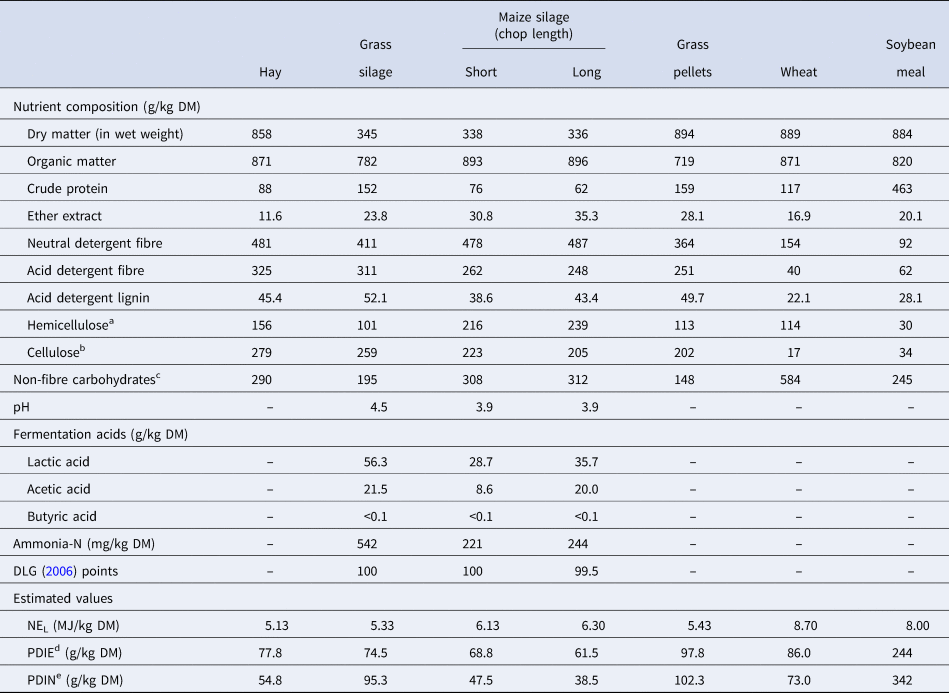
The hay contained markedly less CP, less ADL but more NDF than the grass silage (Table 1). The main difference between grass-based forages and the two maize silage types was the higher ADF content. The fermentation quality of all silages was graded as excellent (90-100 DLG-points), with sufficiently low pH at the DM content measured. The concentration of lactic acid was lower in the short-chopped maize silage, but concomitantly the undesirable acetic acid was also low in concentration compared to the other silage types. Butyric acid content was below the detection limit of 0.1 mg/kg of DM in all silages. As expected from the higher CP content, the concentration of ammonia-N was higher in the grass silage than in the two maize silage types.
Chemical composition, fermentation quality (silages), and estimated contents of net energy for lactation (NEL) and absorbable protein at the duodenum of the feeds used for the preparation of the experimental diets (g/kg of dry matter (DM), means of analyses of four independent samples each)

a Difference of neutral detergent fibre and acid detergent fibre.
b Difference of acid detergent fibre and acid detergent lignin.
c Calculated as organic matter minus crude protein, ether extract and neutral detergent fibre.
d Absorbable protein at the duodenum available according to the supply with fermentable organic matter and rumen undegraded protein.
e Absorbable protein at the duodenum available according to the supply with rumen degraded protein and rumen undegraded protein.
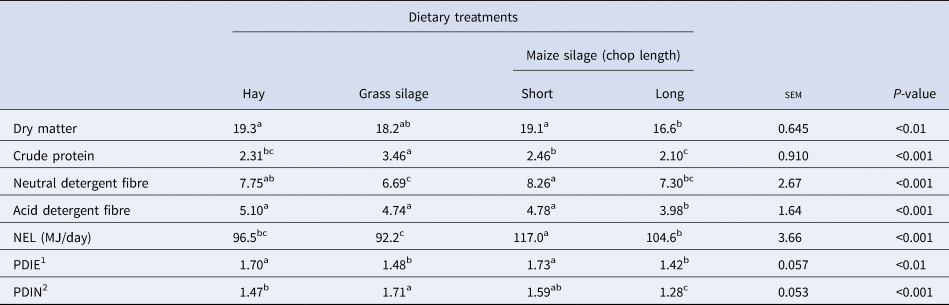
The DM intake was lowest with long-chopped processed maize silage (P < 0.05 compared to hay and short-chopped maize silage; Table 2). The CP intake was highest (P < 0.05) with grass silage and lowest with long-chopped processed maize silage (not significantly different from hay). The intakes of NDF and ADF were lowest (mostly P < 0.05) with grass silage and long-chopped processed maize silage, respectively. The calculated NEL intake was highest with short-chopped maize silage, followed by long-chopped processed maize silage, hay and grass silage (mostly P < 0.05). The calculated intake of PDIE was higher (P < 0.05) with hay and short-chopped maize silage than with grass silage and long-chopped processed maize silage. Different from that, the calculated PDIN intake was highest with grass silage and lowest with long-chopped processed maize silage (mostly P < 0.05).
Realised average intakes (kg/day) of dry matter, nutrients and calculated intakes of net energy for lactation (NEL) and absorbable protein at the duodenum as affected by the dietary treatments

Means not carrying a common superscript differ at P < 0.05.
1 Absorbable protein at the duodenum available according to the supply with fermentable organic matter and rumen undegraded protein.
2 Absorbable protein at the duodenum available according to the supply with rumen degraded protein and rumen undegraded protein.
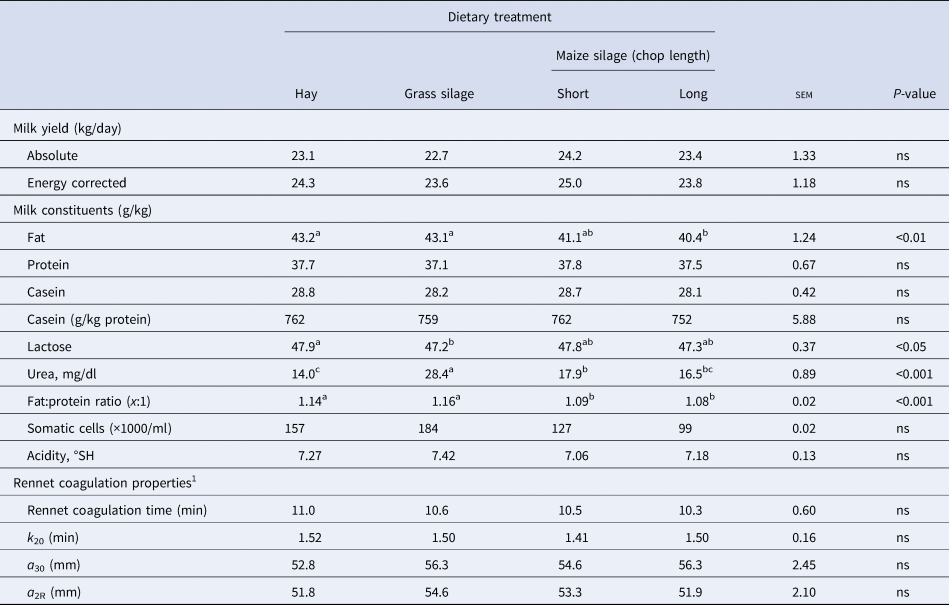
The absolute milk yield was numerically but non-significantly lower with grass silage compared to the short-chopped maize silage (P > 0.05, Table 3). However, the ECM did not differ among treatments. The milk fat content was lowest with long-chopped processed maize silage (P < 0.05 compared to hay and grass silage). Contents of milk protein and casein as well as the ratio of casein-to-total milk protein were not affected by the treatments. The lactose content was higher (P < 0.05) in milk from hay- compared to grass-silage fed cows. The milk urea content was highest (P < 0.05) with grass silage, amounting to values being twice as high as with hay and almost as much compared to the maize silage diets. The milk fat:protein ratio was similarly affected by the diets as the milk fat content. Somatic cell count and acidity of the milk did not differ among treatments. Likewise, the different forages affected none of the rennet coagulation parameters.
Milk yield, milk composition and rennet coagulation properties as affected by the dietary treatments

Means not carrying a common superscript differ at P < 0.05.
1 k 20, curd firming rate in min from start of coagulation to 20 mm of amplitude in curd firmness; a 30 and a 2R, curd firmness (amplitude in mm) either 30 min after rennet addition or after twice the rennet coagulation time.
Discussion
Effects of feeding hay vs. feeding grass silage
The batches of hay and grass silage differed to some extent in proximate composition (less CP, more fibre in the hay). Even though they had not been harvested from the same field, most of these differences are typical as hay is usually harvested at a later stage of vegetation than the grass silage resulting in the described compositional differences. The higher milk urea concentration in the grass-silage fed cows compared to the hay-fed cows is consistent with their higher intake of CP at similar energy supply not allowing rumen microbes to utilise more dietary N for growth. Coulon et al. (Reference Coulon, Pradel and Verdier1995) also show that in comparison to hay-fed cows, grass-silage fed cows have a higher milk urea content. Milk protein (casein) synthesis is strongly dependent on the NEL supply once amino acid supply is not limited. Hay and grass silage were quite similar in NEL and PDIE content, which explains the unchanged content and daily amount of milk protein. Even though changes in the casein:protein ratio are not necessarily proportional to the changes in protein content (Kroeker et al., Reference Kroeker, Ng-Kwai-Hang, Hayes and Moxley1984; Coulon et al., Reference Coulon, Hurtaud, Rémond and Vérité1998), casein content and as proportion of total protein were similar in the two groups as well. The main determinants of the rennet coagulation properties include casein content and casein proportion of total protein (Schaar, Reference Schaar1984; Macheboeuf et al., Reference Macheboeuf, Coulon and D'Hour1993). As milk protein and casein contents as well as milk acidity did not differ between the hay-based milk and the grass-silage based milk, the finding of similar milk coagulation properties in the present study was expected. Coulon et al. (Reference Coulon, Pradel and Verdier1995) also describe equal protein and casein contents of the milk from cows fed hay- and grass-silage based diets. In contrast, Verdier-Metz et al. (Reference Verdier-Metz, Coulon, Pradel, Viallon and Berdagué1998) report a shorter firming time in bulk milk from a group of hay-fed cows compared to milk from a group of cows fed grass silage harvested on the same day from the same plot of perennial grassland. This finding is associated with the slightly lower pH of the hay-based milk in that study. The allele frequency of the κ casein is also decisive for rennet coagulation (Schaar, Reference Schaar1984; Macheboeuf et al., Reference Macheboeuf, Coulon and D'Hour1993) but the κ casein genotypes of the animals in the present experiment were not determined. The conservation quality of the grass silage was very good, without butyric acid being detectable after fermentation. This shows that in the present study no adverse effects of silage feeding like late swelling of the cheeses or off-odour and off-tastes were to be expected. It was not tested if other silage-dependent odours and tastes may have occurred, but these have also not been recorded in sensory evaluations of other authors (Villeneuve et al., Reference Villeneuve, Lebeuf, Gervais, Tremblay, Vuillemard, Fortin and Chouinard2013).
Effects of grassland-based diets vs. maize-silage based diets
At quite similar NDF content, the diets based on hay and grass silage had higher contents of ADF than the maize-silage based diets. This might explain the higher milk fat content and, at unaffected milk protein content, the higher fat:protein ratio of the milk of the two groups receiving grass-based diets. The rennet coagulation properties were also very similar between these two diet groups. Coulon et al. (Reference Coulon, Pradel and Verdier1995) report a slightly longer curd firming rate in milk when cows are fed hay- and grass-silage based diets compared to a maize silage diet.
Effects of harvesting method used for maize silage preparation
Silage fermentation characteristics are affected by mechanical processing (Johnson et al., Reference Johnson, Harrison, Hunt, Shinners, Doggett and Sapienza1999). Despite the greater difficulty to compress long-chopped processed maize, in the present experiment the resulting silage was of similar fermentation quality as the short-chopped maize silage. Ensiling the long-chopped processed maize silage below the short-chopped maize silage in the same bunker silo might have contributed to that as it was, therefore, well compressed. The proximate composition and estimated NEL, PDIE and PDIN contents were similar, but still DM intake was reduced when offering long-chopped processed instead of short-chopped maize silage. Schwab et al. (Reference Schwab, Shaver, Shinners, Lauer and Coors2002) found a decreased maize silage intake as well, when increasing the chop length from 5 to 19 mm and 32 mm, this with and without ‘corncracker’ treated kernels. Also Spiekers et al. (Reference Spiekers, Ettle, Preissinger, Pries, Schwarz and Meyer2009) describe this phenomenon for chop lengths increased from 5 to 22 mm, but others (Bal et al., Reference Bal, Shaver, Jirovec, Shinners and Coors2000; Beauchemin and Yang, Reference Beauchemin and Yang2005) do not report this reduction in DM intake with increased chop length. However, in the latter two studies the maize silage proportion was lower than in our and the first mentioned studies, indicating that the effect of chop length is likely more pronounced with high proportions of maize silage in the diet. Reductions of DM intake with long-chopped maize silage might be explained by a longer retention time of the longer particles in the rumen (Kononoff et al., Reference Kononoff, Heinrichs and Lehman2003) which could decelerate rumen emptying and thus limit the intake capacity. Despite the lower feed intake, milk yield was not affected by feeding the long-chopped maize silage. However, a decreased milk yield is observed at longer exposure, as shown by Mahlkow et al. (Reference Mahlkow, Thaysen and Thomsen2005) who fed long-chopped maize silage for 7 months. The trend towards a lower milk fat content found with the long-chopped processed vs. the short-chopped maize silage contradicts the expectation that the long-chopped processed maize silage was richer in physically effective fibre than the short-chopped form (this was not measured). Concerning milk protein, casein and cheese-making properties, no significant differences were found between the two maize silage types.
In conclusion, there were no indications for characteristic physico-chemical properties of milk from a silage-free diet in the measured variables of milk quality. Future investigations should focus on other aspects of the global product quality such as the sensory quality to show if there is an added value of ‘hay milk’ for consumers. In case an added value can be demonstrated, it is important that authentication of ‘hay milk’ and the derived products and fulfilment of producers' specifications according to the EU regulation can be guaranteed. Using grassland-based forages instead of maize did not affect the milk properties measured, either. However, it might give added value by the more favourable fatty acid profile of the milk fat and lipophilic vitamins (Ferlay et al., Reference Ferlay, Martin, Pradel, Coulon and Chilliard2006, Kliem et al., Reference Kliem, Morgan, Humphries, Shingfield and Givens2008, Coppa et al., Reference Coppa, Chassaing, Sibra, Cornu, Verbič, Golecky, Engel, Ratel, Boudon, Ferlay and Martin2019). The maize harvest processing technology investigated did not turn out to be advantageous, but milk quality was not compromised.
Acknowledgements
We would like to thank the staff of AgroVet-Strickhof for their support and assistance during the experiment, P. Bucher for determining the cheese-making properties as well as C. Kunz and M. Mergani for the feed analysis. This study was financially supported by the H. Wilhelm Schaumann Foundation, Hamburg, Germany.