


Christian nationalism: what’s in a name?
The literature on Christian nationalism has grown up in a hurry. Though the general ideas are older, the specific articulation that has drawn the most interest first emerged in the mid-2010s. Attributed largely to the prolific scholarship of Andrew Whitehead and Sam Perry, the work is built on items from the Baylor Religion Survey (BRS) data (Perry and Whitehead, Reference Perry and Whitehead2015a, Reference Perry and Whitehead2015b; Whitehead and Perry, Reference Whitehead and Perry2015). Over the past decade, attention to the concept has exploded well beyond academic work; Christian nationalism has infiltrated mass-market books (e.g., Tyler, Reference Tyler2024; Wolfe, Reference Wolfe2022), grabbed the attention of religious elites (e.g., Lance Wallnau) and politicians (e.g., Marjorie Taylor-Greene), and become the agenda of organizations explicitly dedicated to fighting it (e.g., American Values Coalition and Christians Against Christian Nationalism).
With all of this attention, it is surprising how little work has been dedicated to measurement of the worldview. At this point, the rapidly growing literature mostly uses the Whitehead and Perry (Reference Whitehead and Perry2020) measures taken from the BRS. Still, other efforts include a set of reports from the Public Religion Research Institute (PRRI) (whose items have modest overlap with the BRS items), as well as works using a melange of other, usually singular items. The few pieces that have focused on measurement have wielded sizable influence in academic circles; they include works by Davis (Reference Davis2023), Smith and Adler (Reference Smith and Adler2022), and Li and Froese (Reference Li and Froese2023). However, the use of the different items produces potential inconsistencies and sometimes clashes with the discussion and advice offered in these pieces.
Ultimately, existing scholarship raises several important questions about the measurement of Christian nationalism—questions that matter for our understanding of how Christian nationalism continues to affect American democracy. First, given that Christian nationalism appears to overlap—and perhaps subsume—other concepts (civil religion, Christian statism, etc.), are the Christian nationalism measures capturing a single concept? Second, Whitehead and Perry’s work (e.g., Reference Whitehead and Perry2020) has had the effect of pushing the 6-item measure, but what should we do with other recommendations (e.g., Davis, Reference Davis2023; PRRI, 2023)? More specifically, how does the choice of measurement instrument affect observed relationships with other variables?
In the next section, we begin by providing an overview and critiques of the most prominent takes on the measurement of Christian nationalism. We then proceed with three analyses that consider the factor structure of 10 datasets, followed by an analysis that considers all 330 combinations of four Christian nationalism items from a list of 11 possible items.
Conceptualization and operationalization: agreements and disagreements
Christian nationalism is a worldview that has been described in various terms (including as an ideology). Whitehead and Perry call it a “cultural framework—a collection of myths, traditions, symbols, narratives, and value systems—that idealizes and advocates a fusion of Christianity with American civic life” (Reference Whitehead and Perry2020: 10). Djupe, Lewis, and Sokhey (Reference Davis2023: 3) refer to a set of Christian nationalist beliefs that the US is “of, by, and for Christians.” Others use their own words to reach the same conclusions that the nation is rightfully reserved by God for Christians, and that America can only be saved by Christians exercising dominion over the nation. Thus, while there appears to be a lot of agreement over the general conceptualization of CN, there is substantial disagreement in the movement toward its operationalization, and more specifically, in terms of what exact beliefs and attitudes need to be included to make for a valid measure.
Davis’ (Reference Davis2023) critique and suggestions
Davis (Reference Davis2023) offers comprehensive criticisms of the BRS measures. His primary argument—which is supported—is that the six-item BRS scale was never subject to analysis to see if it is unidimensional. The results of a factor analysis using the 2017 BRS data suggest that it is not, with the constitutional items (separation of church and state, prayer in schools, and religious symbols in public spaces) standing on their own. In the end, Davis recommends using the first two items: agreement with the statements “The federal government should declare the United States a Christian nation” and “The federal government should advocate Christian values.”
Davis’ analysis has become the basis of many a reviewer’s comments, suggesting—if not mandating—that authors either switch to the two-item scale or at least check whether the results hold using his proposed variant. We have found three pieces that have such comparisons available, and these generally appear in appendices. Broeren and Djupe (Reference Broeren and Djupe2024) and Djupe and Walker (Reference Djupe and Walker2026) report the results of the full BRS scale in the paper but test the Davis variant in their appendices. Though the coefficients are not identical, these authors find the same patterns of results regardless of tack. Djupe, Lewis, and Sokhey (Reference Djupe, Lewis and Sokhey2023: 11) report comparisons of a single item, two-item scale, four-item scale, and the six-item scale in their book. The effects are quite similar, though there are distinguishable differences that result from the difficulty of moving multiple items. That is, it means something more to move six items a full scale point than it does to move one item a scale point.
“Conceptual splitting”: Smith and Adler’s approach (Reference Smith and Adler2022)
Smith and Adler (Reference Smith and Adler2022) come at the Whitehead and Perry conceptualization and operationalization from a different angle, arguing that everything conservative cannot be a result of Christian nationalism; they call for what we might term a different strategy of conceptualization (Gerring, Reference Gerring2012), specifically “conceptual splitting.”Footnote 1 Instead of a factor analysis, they pursue a latent class analysis of the BRS items to create distinct response categories. And, their categories are assigned a variety of labels from “radical secularists” who wholly disagree with the BRS items (far left),Footnote 2 to gradations of “civic republicans,” the “undecideds,” the “religious conservatives,” and “Christian nationalists” on the far right.
None of these groups are confirmed with affirmative measures—they result from different scoring on the BRS Christian nationalism measures. Therefore, it is not surprising that these groups align in a roughly linear fashion relative to Christian nationalists (see their Figure 3; Smith and Adler, Reference Smith and Adler2022: 10). Smith and Adler emphasize that not all of the respondents in their groupings take distinguishable stands in terms of all Christian nationalist positions. The key question is whether it is reasonable to think that, for example, civic republicans are just lower-scoring Christian nationalists, versus whether they have beliefs and values that are orthogonal to Christian nationalism. Unfortunately, there’s no way to answer this question without affirmative items.
Li and Froese’s (Reference Li and Froese2023) focus on constitutional items
In a similar vein, other work presumes, a priori, that there are two factors that can be pulled from the original Christian nationalism items (Li and Froese, Reference Li and Froese2023). That is, they take the constitutional items from the BRS scale (“The federal government should allow prayer in public schools; and “The federal government should allow the display of symbols in public spaces”) and suggest that, while conservative, people who agree with these “religious traditionalism” items “envision a Christian civil society separate from the profanities of politics” and constitute a bulwark against Christian nationalism. The two measures Davis selects (Christian nation and Christian values) constitute their “Christian statism” measure. And the other two BRS measures are “uncategorized.” Their approach “assumes there are two ideals of CN, CS [Christian statism] and RT [religious traditionalism]. Each ideal is not only theoretically meaningful but conceptualized as different realities in American popular nationalism” (Reference Li and Froese2023: 781).
As with Smith and Adler’s work, Li and Froese’s key conceptual distinction does not hinge on affirmative measures to capture the intended concept of those who take a “live and let live” position about religion. While the constitutional item scale is labeled “religious traditionalists,” it is not confined to religious conservatives but loops in anyone in the sample. We appreciate the authors’ ideas, but find it curious to use constitutional measures affecting government entities to capture a “societal” dimension of Christian nationalism. Perhaps it is stating the obvious to note that high values on this subscale capture a greater integration of religion and the state, which is incompatible with “maintain[ing] cultural dominance through religious competition” (Reference Li and Froese2023: 775). Therefore, permitting organized prayer by school districts is clearly a problematic measure of pluralism, especially when private prayer is already constitutional, and it seems clear that consideration of Christian prayer would dominate most school districts.
That said, perhaps the most problematic aspects of their approach are that they list the most direct measure of pluralism (support for separation of church and state) as “uncategorized,” and that the factor analysis they rely on provides evidence that is traditionally too weak (eigenvalue under 1) to establish an independent factor (Reference Li and Froese2023: 783). Finally, there is little evidence that those who want school prayer and religious symbols in public places reject the dominionism that is at least implicit in the other measures. That is, those items are consistently and strongly correlated—at r = .55 or higher—with the other Christian nationalist items (“Christian statist” items, in their framework). The factor analysis may be able to distinguish them, but are they substantively distinct?
Moving forward
In raising this issue of correlation across items (particularly with respect to Li and Froese’s [Reference Li and Froese2023] work), we are, of course, not trying to suggest that everything conservative or religious is Christian nationalist. There are distinct concepts about the intersection of religion and politics in the world and the U.S. that are worthy of discussion and empirical investigation. Some candidates might include civil religion (Bellah, Reference Bellah2005; Gorski, Reference Gorski2017; Vegter et al., Reference Vegter, Lewis and Bolin2023), Christian reconstructionism (Ingersoll, Reference Ingersoll2015), the prosperity gospel (Calfano et al., Reference Calfano, Carey, Djupe and Martinez-Ebers2027; Gaskins and Jacobs, Reference Gaskins and Jacobs2022), seven mountains dominionism (e.g., Taylor, Reference Taylor2024), and apocalypticism (Adkins et al., Reference Adkins, Djupe and Neiheisel2023; Djupe et al. Reference Djupe, Neiheisel and Lewis2027), to name but a few. Whether individuals actively subscribe to these ideas is another matter, as is their relationship to worldviews like Christian nationalism.
That said, the critical point is this: presently, the dominant mode of researching Christian nationalism uses one scale composed of the BRS items, and we have conflicting evidence about whether that choice is appropriate. Much of that evidence hinges on analyzing one data collection mode (the BRS releases), which is not reassuring. And, those items are not all Christian-specific—some refer to religion in general while others refer to Christianity in particular. Meanwhile, other approaches, such as from PRRI, take related but different tacks to capture the worldview—theirs includes an identity measure as well as a seven-mountain mandate-style belief. With so much at stake with respect to Christian nationalism and the future of American democracy (for discussions see Djupe et al. Reference Djupe, Lewis and Sokhey2023; Gorski and Perry, Reference Gorski and Perry2022), it is important to understand if this literature is fundamentally flawed or on firm footing. Christian nationalism threatens the (religious) pluralist framework that has long been forwarded as a cornerstone of a liberal democratic state and the U.S. in particular (e.g., Christians Against Christian Nationalism, 2019; Ladner, Reference Ladner2024; Whitehead, Reference Whitehead2023). Gauging support for deviations from this norm throughout the American public is therefore of the utmost importance. Fortunately, we are able to assess the literature that has grown up around the concept of Christian nationalism with a wide range of data gathered from different sources and using different data collection modes.
CN measurement literature, to date, raises several important questions. How consistent is the factor structure of CN across time and data collection efforts? How do the competing CN measures (BRS and PRRI) compare? And to what extent does reliability depend on the selection of specific items across these measures? In what follows, we examine the factor structure of many datasets from 2007 to 2024 with the BRS Christian nationalism scale. We then assess the factor structure of the 2024 data that has a much wider range of putative Christian nationalism questions, before going on to test all four-item combinations of those 11 items against two dependent variables.
Data and analyses
Roughly 10 years into the literature on CN, we find ourselves in good shape to examine a wide range of data that bear on related questions. The BRS has multiple waves to examine, and we have administered a handful of surveys between 2020 and 2024 that have the BRS items in them, including a module on the 2022 Cooperative Election Study. The BRS surveys were run by Gallup, which collected most of the survey data by mail. Our surveys were run mostly through Qualtrics Panels, though two of them were gathered through the Lucid platform, while the CES was administered by YouGov. One switch is noteworthy—starting in March 2023, we made the BRS items more exclusive to Christianity, addressing one of the noted flaws of that battery. So, for instance, instead of asking about generic “prayer in public schools,” we asked about “Christian prayer in public schools.” In addition, we included a wider range of items on our October 2024 survey—specifically, we included the modified BRS items as well as items patterned on the PRRI scale. Table A1 in the Appendix presents the exact wording of the items on each survey. With these different data sources, we are able to examine the factor structure of Christian nationalism across time and mode. All were scaled to the same 0–1 range. See the Appendix for further design details for each survey.
In our assessment of predictive validity, we examine the relationship of Christian nationalism to the two-party Trump vote (0–1) and to attitudes toward immigrants (“We should round up all immigrants who are in the country illegally, even if it takes setting up encampments guarded by the US military,” the response options to which run from strongly disagree to strongly agree). Major themes within the Christian nationalism literature consider the concept’s relationship to partisan (Baker et al., Reference Baker, Perry and Whitehead2025; Whitehead et al., Reference Whitehead, Perry and Baker2018) and racial/ethnic group attitudes (Al-Kire et al. Reference Al-Kire, Pasek, Tsang, Leman and Rowatt2022, Reference Al-Kire, Miller, Pasek, Perry and Wilkins2024; Perry et al., Reference Perry, Schleifer, Whitehead and Frantz2024; Walker and Haider-Markel, Reference Walker and Haider-Markel2024b), implicating both ideology and identity-based mechanisms (see Walker et al., Reference Walker, Djupe, Sokhey and Haider-Markel2026); these dependent variables allow us to test the reliability of Christian nationalism measures across those themes. Our models control for education, age, race, gender, worship attendance, and partisanship and employ weights (specified in the Appendix).
Do the Christian nationalism measures capture a single concept?
The Baylor religion survey items
We start with factor analyses because they seem to underlie the disjuncture between six-item approaches and the alternatives. Even though the alpha scores for the six-item BRS Christian nationalism scales are acceptable that does not preclude different components from emerging from those items (we agree with Davis [Reference Davis2023] on this point). Recent reevaluations of Christian nationalism have found multiple factors or multiple categories hiding among the six items. We are not necessarily opposed to the search for different categories from the measures in principle but do not see much evidence justifying a categorical approach.
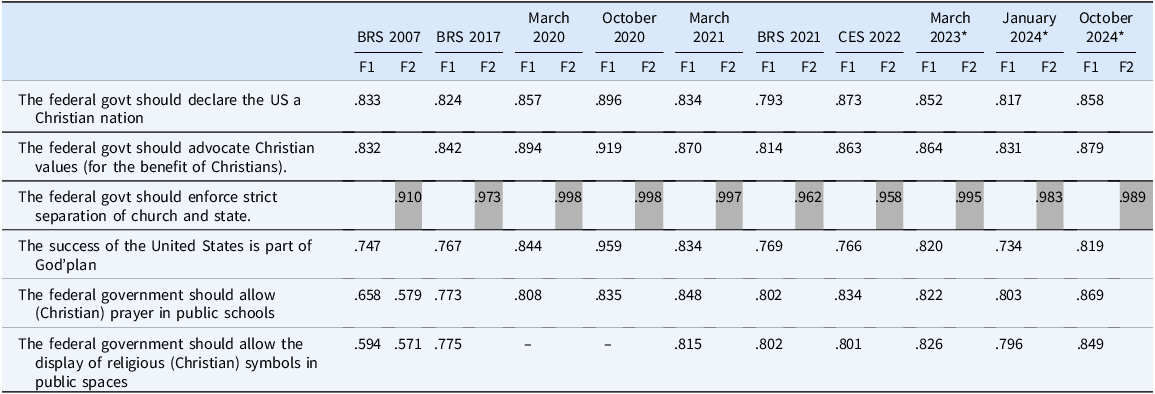
For each of the 10 datasets we have at our disposal, we subjected the available BRS Christian nationalism items chosen by Whitehead and Perry to a factor analysis using the Psych package in R (see Table 1). We specified nfactors = 2 and used varimax rotation.Footnote 3 To be clear about some (minor) differences, we wish to stress that in a few of our early datasets we did not include the “religious symbols” question that the January 2024 dataset only included Christians, and, that beginning in March 2023, we used the exclusive version of the questions—these mention Christians in particular as the beneficiaries of different actions (e.g., Christian prayer in public schools; Appendix Table A1 has the question wording of all items).
Factor loadings for BRS Christian nationalism items, 2007–2024

Table 1. Long description
The table presents factor loadings for six statements related to Christian nationalism in the United States, measured across different years from 2007 to 2024. The table has six rows and twelve columns. Row 1: The federal govt should declare the US a Christian nation. Row 2: The federal govt should advocate Christian values (for the benefit of Christians). Row 3: The federal govt should enforce strict separation of church and state. Row 4: The success of the United States is part of God’s plan. Row 5: The federal government should allow (Christian) prayer in public schools. Row 6: The federal government should allow the display of religious (Christian) symbols in public spaces. The columns are labeled with different years and survey types: BRS 2007, BRS 2017, March 2020, October 2020, March 2021, BRS 2021, CES 2022, March 2023, January 2024, and October 2024. Each column is further divided into F1 and F2 factors. The table shows the factor loadings for each statement across these years and factors.
* In this survey, the parenthetical language in the question wording identifying Christians as the beneficiaries was employed instead.
These variations did not matter, however, because every dataset save one had the same factor structure. Specifically, only the BRS 2007 dataset struck off in a different direction, with three items (separation, prayer in schools, and symbols in public spaces) loading together on a separate factor (though two items were split about evenly between the two factors). In all datasets, the reverse-coded item about the separation of church and state loaded strongly on its own factor. We doubt this had much to do with the content, and that it was likely a result of being the only reverse-coded item. However, the results are clear on this point: do not use the reverse-coded separation item in a Christian nationalism scale. In all of the datasets—save BRS 2007—the other five items loaded together strongly. From this evidence, there seems to be no problem with using the BRS Christian nationalism scale (minus the separation item).Footnote 4 And our analysis suggests that scholars should be careful about putting too much conceptual weight on the 2007 BRS data.
Adding in additional items
One critique of the six BRS items is that they may not capture the full range of Christian nationalism (Smith and Adler, Reference Smith and Adler2022). In an October 2024 survey of adult Americans gathered on the Cint platform, we asked a wider range of items that we considered to be plausibly linked to Christian nationalism. Those included the six-item BRS items updated to be Christian-specific (see Djupe et al., Reference Djupe, Lewis and Sokhey2023), items patterned on the PRRI scale items, and one other item we thought should be included: “I consider founding documents like the Declaration of Independence and US Constitution to be divinely inspired.” We sought to take advantage of this measurement largesse to address questions at the heart of this investigation: Are there divergent tracks in measuring Christian nationalism? Does it matter which items we use?
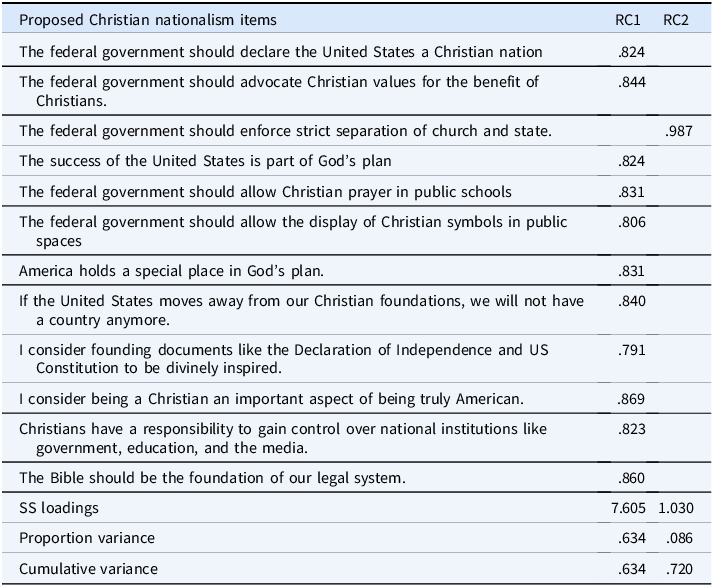
We started with a factor analysis using all 12 items. As Table 2 shows, those items all loaded highly on a single factor with the exception of the separation of church and state item, which stands off by itself (it’s also the only item that is reverse-coded, which makes a difference).Footnote 5 The Cronbach’s alpha score for all 12 items is .94, and .96 if we leave out the separation of church and state item. The six-item scale used by Whitehead and Perry achieves an alpha of .78, which bumps up to .89 if we leave out the separation of church and state measure. Our version of the PRRI scale has an alpha of .91. All of these are highly acceptable scores, suggesting by this standard that they are capturing much the same thing.
The factor structure of all 12 Christian nationalism items

Table 2. Long description
A table titled The factor structure of all 12 Christian nationalism items with proposed Christian nationalism items and their factor loadings. The table has 12 rows and 3 columns. The columns are labeled ‘Proposed Christian nationalism items’, ‘RC1’, and ‘RC2’. The rows list statements about Christian nationalism and their corresponding factor loadings. Row 1: The federal government should declare the United States a Christian nation, RC1: .824. Row 2: The federal government should advocate Christian values for the benefit of Christians., RC1: .844. Row 3: The federal government should enforce strict separation of church and state., RC1: .987. Row 4: The success of the United States is part of God’s plan, RC1: .824. Row 5: The federal government should allow Christian prayer in public schools, RC1: .831. Row 6: The federal government should allow the display of Christian symbols in public spaces, RC1: .806. Row 7: America holds a special place in God’s plan., RC1: .831. Row 8: If the United States moves away from our Christian foundations, we will not have a country anymore., RC1: .840. Row 9: I consider founding documents like the Declaration of Independence and US Constitution to be divinely inspired., RC1: .791. Row 10: I consider being a Christian an important aspect of being truly American., RC1: .869. Row 11: Christians have a responsibility to gain control over national institutions like government, education, and the media., RC1: .823. Row 12: The Bible should be the foundation of our legal system., RC1: .860. The table also includes SS loadings, proportion variance, and cumulative variance for RC1 and RC2.
Does the choice of Christian nationalism measure affect results?
While these measurement findings are important, we also believe that testing their relative efficacy in practice is useful. To an extent, this has been done before, with the results suggesting that the variously composed measures (from among the BRS items) have equivalent effects (see Broeren and Djupe, Reference Broeren and Djupe2024; Djupe et al., Reference Djupe, Lewis and Sokhey2023; Djupe and Walker, Reference Djupe and Walker2026). Here, we take advantage of our long list of 11 items (leaving out the separation of church and state measure) to test all of the combinations of variables in a four-item scale—that is, 330 combinations of 4 items.
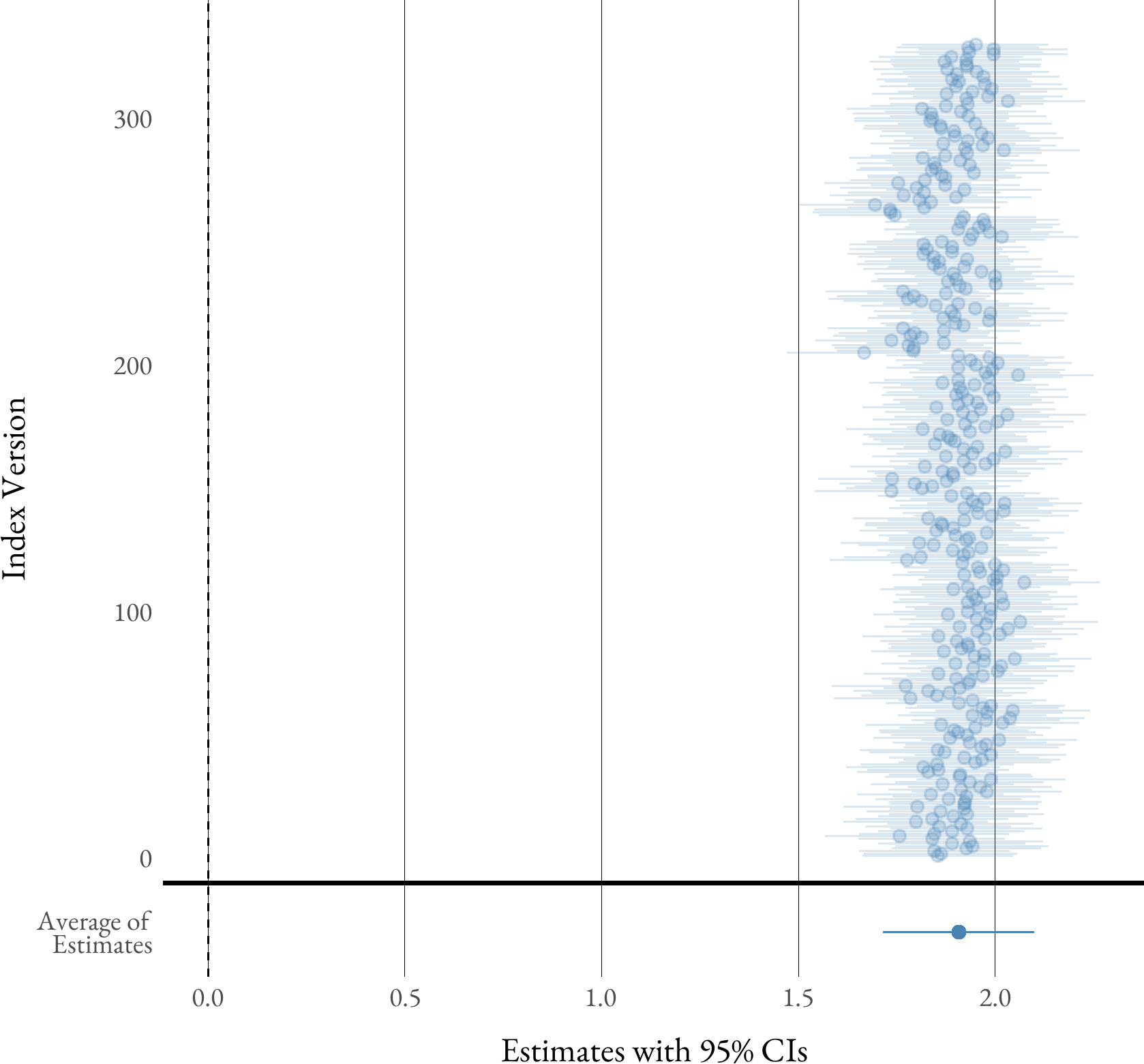
Given the factor analysis results that all items load on the same factor, we would expect to see equivalent effects for randomly composed indices. And, that is what Figure 1 shows in predicting a vote for Trump in the October 2024 data. The logit coefficients are not exactly the same, but neither are they differentiable. Instead, they are consistent in predicting a much higher probability of voting for Trump in 2024 as expected (Baker et al., Reference Baker, Perry and Whitehead2025).
Distribution of logit estimates of effects of random four-item Christian nationalism indices on the Trump vote.
Source: October 2024 Survey.
Note: Logit models included education, age, gender, race, partisanship, and worship attendance.

Figure 1. Long description
Panel A: A scatter plot representing the relationship between the index version and the estimates with 95 percent confidence intervals. The horizontal axis represents the estimates with 95 percent confidence intervals, while the vertical axis represents the index version. The plot includes hundreds of data points, with a central vertical reference line around the estimate value of 2. The data points are scattered around this reference line, showing some clustering and spread. The average of the estimates is indicated with a horizontal line at the bottom.
We repeated this exercise with another dependent variable capturing immigration attitudes (see Figure 2). There is even less variation here across the 330 combinations of items. All predict sizable increases in agreement with the extreme position that, “We should round up all immigrants who are in the country illegally, even if it takes setting up encampments guarded by the US military.” And, again, none of the estimates are distinguishable.
Distribution of OLS estimates of effects of random four-item Christian nationalism indices on immigration attitudes.
Source: October 2024 Survey.
Note: Ordinary least squares (OLS) models included education, age, gender, race, partisanship, and worship attendance.

It is worth assessing how the estimates tend to shift when specific measures are included. To address this question, we attached the scale coefficients from the estimates shown in Figures 1 and 2 to each included measure. Figure 3 shows the results of a model that estimates the size of the coefficient that is associated with the scale given the inclusion of different measures. For instance, when “The federal government should declare the United States a Christian nation” is included, the scale has a modestly larger coefficient for both immigration attitudes and Trump voting.
Average shift in the estimated effects of the randomly composed Christian nationalism scales when different items are included for both DVs.
Source: October 2024 Survey.

Looking across the items, it would be hard to predict the effect of individual items on the scale estimates. Some are associated with a stronger relationship with the Trump vote and a weaker relationship to immigration attitudes, but others show the opposite pattern. It is particularly interesting that the “religious traditionalism” measures that Li and Froese (Reference Li and Froese2023) identify are linked to a stronger relationship with the Trump vote when they are included. From this quick analysis, we do not perceive an easy decision rule that would govern the composition of a Christian nationalism scale.
If pressed, however, it seems that the first item (declaring the US a Christian nation), the seventh and eighth items (won’t have a country anymore and the Declaration is divinely inspired), and the last item (responsibility to gain control) all boost the coefficient sizes, on average, of the indexes of which they were a part for both dependent variables. One nice feature of these four statements is their coverage. They include statements that are assertive and avertive, historical and modern, and that portray the US’s Christian character as providential and contested. That is, choosing items across multiple facets is a sound strategy. Still, it is important to remember that this analysis comes from one dataset in 2024 with two dependent variables. These results may hold into the future, but it is easy to imagine drift over time as new issues, threats, and communications emerge.
Our results can also help to form advice about how many measures is sufficient. We replicated the analyses in Figures 1 and 2 to include two-item and three-item comparisons. Those results are available in Appendix Figures A1 and A2 and are predictable. The estimates do not change much depending on the inclusion, but two conclusions are clear. First, the average effect sizes grow with greater numbers of items. The errors associated with estimates shrink modestly as the scale size grows. In a pinch, two items can capture the essence of Christian nationalism, but that risks “selling ourselves short” (Bakker and Lelkes, Reference Bakker and Lelkes2018). That is, it is harder to find relationships with smaller and hence weaker scales that we would find with larger, more robust scales. Our analysis here does not set a floor for the number of measures to capture Christian nationalism, but four appears to work well, and we recommend as many as can be budgeted.
Conclusion: a foundation we can build on
The past decade has witnessed a massive infusion of research on Christian nationalism. In the midst of this, a select few researchers from across the social sciences have stepped back to assess the conceptualization and measurement of the worldview (e.g., Davis, Reference Davis2023; Djupe et al., Reference Djupe, Lewis and Sokhey2023; Li and Froese, Reference Li and Froese2023; Smith and Adler, Reference Smith and Adler2022). Much of that work has gone forth piecemeal, examining one dataset and working with existing measures (e.g., the BRS 2007 items) rather than pursuing a more comprehensive and inclusive approach. Of course, as research is published that systematically checks multiple measurement schemes (e.g., Broeren and Djupe, Reference Broeren and Djupe2024; Djupe et al., Reference Djupe, Lewis and Sokhey2023; Djupe and Walker, Reference Djupe and Walker2026), we have started to build confidence about measurement choices.
The BRS Christian nationalism measure has weathered its fair share of critiques, but our analyses in this note suggest that anxiety about that Christian nationalism measure is overblown. The BRS measure would seem to be a core of the concept along with a handful of other, highly related measures (such as the ones used by PRRI). Davis’s (Reference Davis2023) important paper makes some fair points using 2017 BRS data. But one set of his key recommendations about the BRS measure appears only in one dataset (i.e., the 2007 BRS) in our analysis. In our look across many datasets, we find that the BRS items in 2017 and 2021 have different factor structures—structures that comport with other data we have collected since 2020. Specifically, we find time and time again (outside of the 2007 BRS) that five of the six BRS items load together strongly. The reverse-coded measure of support for the separation of church and state should not be used in a scale with the other items. While a good case can be made that it is theoretically sound to include it, the statistics simply are not supportive of that decision.
In addition, rather than just testing two possible scales, we compared all of them—that is, every combination of four items from a purposely comprehensive list of 11. That analysis shows considerable consistency no matter what combination of items is used to predict a Trump vote and immigration attitudes. We can find items that contribute to modestly larger coefficients, but they vary across dependent variables and do not match up well with other proposed categorizations.
So what does all this tell us about how to think about Christian nationalism? How is it that we can “grab bag” a functional scale? First, it’s not as if researchers have put no thought into composing the measures used for their scales, even if it is true that the authors of the BRS 2007 items were not necessarily thinking of Christian nationalism as it eventually emerged a la Whitehead and Perry (Reference Whitehead and Perry2020). From our perspective, the 11 items we examined capture concepts that fit into a reasonably well-structured definition. Christian nationalism is a worldview about how society and government are and should be composed for Christians to exercise dominion.
By these measures, Christian nationalist adherents believe that the US has a special role to play, as ordained by God, such that America should be declared a Christian nation to benefit Christians. In this worldview, Christianity is at the core of American citizenship, the Bible is the foundation of American law, and Christians should gain and keep control over American institutions. Remove any of those pieces and “we will not have a country anymore.” If true, and our analyses here suggest that to be the case, then picking any measures that capture beliefs about the special, exclusive Christian character of the US, as well as aspirations that Christians should be in charge without constraint, should work equally well as a measure of Christian nationalism. Footnote 6
Still, it is also important to note what we cannot say from these measures. A growing number of pieces find a tight link between Christian nationalism as conventionally measured and various forms of threat. In several cases, the specter of cultural change, whether due to religious change (Al-Kire et al., Reference Al-Kire, Pasek, Tsang and Rowatt2021; Walker and Haider-Markel, Reference Walker and Haider-Markel2024a) or due to racial change (Al-Kire et al., Reference Al-Kire, Pasek, Tsang, Leman and Rowatt2022; Walker, Reference Walker2025; Walker and Haider-Markel, Reference Walker and Haider-Markel2024b), fuels greater adherence to Christian nationalism. No one has made the case that threat of cultural shift is the only reason for Christian nationalism, while other work finds that the kind of anti-social and anti-democratic attitudes and behaviors that Christian nationalism has become famous for is almost only found in the presence of threat (Djupe et al., Reference Djupe, Lewis and Sokhey2023). These patterns raise the specter that there are two types of Christian nationalism—an assertive versus an avertive variant. The latter suggests that Christian nationalism is a response to avoid loss and persecution (a response to threat), whereas the former is motivated to value Christian dominion as an end in itself. The trick is that the ‘assertive’ variant of Christian nationalism exists in low numbers, and its adherents are not apparently motivated to act to achieve their worldview (Djupe et al., Reference Djupe, Lewis and Sokhey2023). So, is Christian nationalism largely just avertive ingroup protection (Broeren and Djupe, Reference Broeren and Djupe2024; Walker et al., Reference Walker, Djupe, Calfano, Lewis and Sokhey2025; Wilkins et al., Reference Wilkins, Wellman, Toosi, Miller, Lisnek and Martin2022)?
Another current debate concerns whether Christian nationalism is more about politics than it is about religion (e.g., Tyler, Reference Tyler2024; Whitehead, Reference Whitehead2023; Whitehead and Perry, Reference Whitehead and Perry2020). Our perspective, which is admittedly not informed by a theological orientation, is that none of the Christian nationalism measures we employ cut against religious, and especially Christian, prescriptions. They call for recognizing territory as promised to believers, which is consistent with many passages in the Old Testament. They call for Christians to exercise dominion, which is also consistent with several passages from both Testaments—for instance, “occupy until I come” (Luke 19:13) and “let them have dominion” (Genesis 1:26–28). Christian nationalists may behave in ways that some deem unChristian (e.g., Ladner, Reference Ladner2024; Whitehead, Reference Whitehead2023), but there are multiple streams of Christian thought that strongly motivate a robust Christian nationalism (e.g., Djupe et al., Reference Djupe, Neiheisel and Lewis2027; Taylor, Reference Taylor2024).
Lastly, we would note that it is an open question as to what these measures will correlate with in the future. On some other timeline, it is possible that the worldview is benign and is understood to have substantial bounds that maintain a common set of rights and liberties. Today is likely not that day, given the overwhelming conclusions of the literature and explicit calls from groups like the reconstructionist “Theobros”—calls that involve confiscating the property of non-Christian and apostate Christian churches (Mantyla, Reference Mantyla2025). It is true that many of the findings in the Christian nationalism literature have their roots in the BRS measure. Our conclusion, drawn from a wide range of datasets and research designs, is that researchers would have found the results they did if they had used alternate measures, as long as they combined appropriate dominion values endemic to the worldview.
Supplementary material
The supplementary material for this article can be found at https://doi.org/10.1017/S175504832610056X.
Competing interests
We declare no competing interests.



 Open access

