Introduction
The bluefish Pomatomus saltatrix (Linnaeus, 1766) (Perciformes: Pomatomidae) can weigh up to 14.4 kg and reach a maximum body length of 130 cm, although sizes between 50 and 60 cm are more common. It has high commercial and sport value, is used in aquaculture and is found in tropical and subtropical waters throughout the world (Figueiredo & Menezes, Reference Figueiredo and Menezes1980; Froese & Pauly, Reference Froese and Pauly2015).
According to Moravec (Reference Moravec2004), dracunculoid nematodes comprise 36 genera with 166 recognized species. Of these, 31 genera consisting of 150 species are parasites of at least 300 species of fresh, brackish and saltwater fish. In the life cycle of dracunculoids, fish are not only hosts to the adult forms but can also host larval stages, thus serving as both definitive and paratenic hosts, while aquatic crustaceans serve as intermediate hosts. Members of the superfamily Dracunculoidea are frequent parasites of many body tissues and cavities in fish. Within this group, one of the five families that parasitize fish is Philometridae Baylis & Daubney, 1926, which contains 12 genera and 115 species.
Species of the philometrid genus Philometra occur in marine fish and are known for the large size of their females, which possess a very uniform morphology, while males are small and only occur rarely or temporarily in hosts. Because of the difficulty in studying these parasites due to their morphological and biological peculiarities, most philometroids remain poorly known (Moravec, Reference Moravec2004).
Studies have shown that species of Philometra interfere with the reproduction of perciform fish that are used in marine fish farming, by causing histological changes to the ovaries, such as atrophy, fibrosis, inflammatory reactions and haemorrhaging (Hesp et al., Reference Hesp, Hobbs and Potter2002; Moravec et al., Reference Moravec, Glamuzina, Marino, Merella and Di Cave2003).
Luque et al. (Reference Luque, Aguiar, Vieira, Gibson and Santos2011) listed the known nematode parasites of fish in Brazil and cited species of Philometra parasitizing marine fish: P. katsuwoni in Katsuwonus pelamis and P. lateolabracis in Haemulon plumierii (both parasitizing the gonads); and Philometra sp. in the intestine of Caranx hippos and the gonads of Lutjanus synagris, Paralonchurus brasiliensis and Pomatomus saltatrix.
The aims of the present study were to identify the nematode Philometra saltatrix and describe its occurrence in the gonads of bluefish off the coast of the state of Rio de Janeiro, Brazil.
Materials and methods
Collection and examination of fish for nematodes
In April 2015, 55 specimens of bluefish, P. saltatrix (Pomatomidae, Perciformes), comprising 16 males and 39 females (mean length, 51.7 ± 5.5 cm; mean weight, 688.6 ± 294.2 g) were obtained from professional fishermen, who had caught them off the coast of the state of Rio de Janeiro, Brazil. The fish were then transported in isothermal containers with ice to the Laboratório de Inspeção e Tecnologia do Pescado, Universidade Federal Fluminense (Fishery Inspection and Technology Laboratory of the Fluminense Federal University), in order to investigate the presence of helminths. The fish were identified as P. saltatrix in accordance with Figueiredo & Menezes (Reference Figueiredo and Menezes1980) and Froese & Pauly (Reference Froese and Pauly2015).
To investigate the presence of nematodes, gonads (testicles and ovaries) were removed during necropsy via an opening made in the visceral cavity. The gonads were then placed separately in Petri dishes with 0.65% NaCl solution and observed under a stereomicroscope. Only females were found to be parasitized, and the nematode specimens were removed from the ovaries for further investigation. Some of these helminths were fixed in AFA (alcohol–formaldehyde–acetic acid) and preserved in 70% ethanol. The nematodes were collected, fixed, clarified and preserved in accordance with Knoff & Gomes (Reference Knoff, Gomes, Molinaro, Caputo and Amendoeira2012).
The parasite indexes used were those described by Bush et al. (Reference Bush, Lafferty, Lotz and Shostak1997); the abbreviations used were P = prevalence, MI = mean intensity, MA = mean abundance and RI = range of infection. Voucher specimens were deposited in the Helminthological Collection of the Oswaldo Cruz Institute (CHIOC), FIOCRUZ, Rio de Janeiro, RJ, Brazil.
Morphological, molecular and histological analysis.
For morphological identification, the anterior and posterior parts of the nematodes were provisionally mounted between slides and coverslips using Amann's lactophenol. The nematodes were also sectioned at the cephalic end, and the sections clarified in glycerin, as described by Moravec et al. (Reference Moravec, Magi and Macchioni2008). Measurements of the specimens were made by means of bright-field microscopy using an Olympus BX 41 microscope (Olympus, Tokyo, Japan) and are presented in micrometres (μm), unless otherwise indicated, as the range followed by the mean in parentheses.
For genetic analysis, four specimens of Philometra sp. from four different fish were investigated. These were placed in phosphate-buffered saline (PBS) and frozen individually in microtubes at −20°C until the time of DNA extraction, which was done using a MasterPure™ DNA purification kit (Epicentre, Madison, Wisconsin, USA). A region of the cytochrome oxidase I (COI) gene was amplified using the Sigma Genosys taxon-specific polymerase chain reaction (PCR) primers 5PNemCOI (CATTTRTTTTGRTTTTTTGG) and NemCOI 3P (ACYACATRATAAGTATCRTG) as described by de Buron et al. (Reference de Buron, France, Connors, Roumillat and Tsoi2011).
PCR was carried out in a final volume of 50 μl containing a mixture of 2 μl of DNA isolate, 1.25 U of Taq polymerase (Ludwig Biotec™, Alvorada, Brazil), 1× PCR buffer (10 mm of Tris–HCl, pH 8.0; and 50 mm of KCl), 2 mm of MgCl2, 0.2 mm of deoxynucleoside triphosphate (dNTP) mixture and 0.2 mm of forward and reverse primers. A negative control (ultrapure water) was included in all PCR reactions. The amplification of adult worm DNA was performed using a MyCycler thermocycler (Thermo™, Foster City, California, USA). The procedure comprised an initial denaturation step at 94°C for 2 min, followed by 15 cycles of denaturation at 94°C for 30 s, primer annealing at 45°C for 30 s and extension at 72°C for 30 s. This was followed by 45 cycles of 30 s at 94°C (denaturation), 30 s at 55°C (annealing) and 30 s at 72°C, with an additional final elongation for 10 min at 72°C. The PCR products were stained using GelRed™ and were viewed by means of electrophoresis on 1% agarose gel. After screening using the COI gene, positive samples were subjected to another PCR with primer pairs for amplification, and the expected amplicon size was purified by means of the Wizard® SV Gel and PCR Clean-Up kit (Promega™, Madison, Wisconsin, USA). Forward and reverse nucleotide sequences were determined in a DNA sequence analyser (ABI3730xlv; Thermo Fisher Scientific, Waltham, Massachusetts, USA). In order to determine similarities to other Philometra species, nucleotide sequence similarity was established by consulting the National Center for Biotechnology Information (NCBI) BLASTn network service (www.ncbi.nlm.nih.gov/BLAST).
Partial P. saltatrix sequences (RJ isolate) were trimmed for quality and assembled in a contig. The resulting consensus sequence was used as a query for BLASTx analysis (Altschul et al., Reference Altschul, Gish, Miller, Myers and Lipman1990; Korf et al., Reference Korf, Yandell and Bedell2003; Pruitt et al., Reference Pruitt, Tatusova and Maglott2005) against the NCBI nr database, for sequence confirmation. Closely related COI sequences from P. carolinensis isolates S11 (JF894232) and S13 (JF894231), P. cynoscionis isolate S6 (JF894234), P. rubra isolate S36 (JF894236) and P. saltatrix isolate S19 (JF894235) (Palesse et al., Reference Palesse, Meadors, de Buron, Roumillat and Strand2011) were selected from GenBank (Benson et al., Reference Benson, Clark, Karsch-Mizrachi, Lipman, Ostell and Sayers2015) and were used in multiple alignment together with the COI sequence from Cylicocyclus auriculatus (KP693416), which was chosen as the outgroup. A phylogram was generated using the neighbour-joining method with bootstrapping of 10,000 replications. All the sequence analyses were performed using the CLC Main Workbench software, version 7.6.4 (Qiagen, Aarhus A/S, Denmark).
Tissue samples from the ovaries containing parasites were collected for histopathological examination. These samples were fixed in 10% buffered formalin and were processed for embedding in paraffin. Sections of 5-μm thickness were cut and stained using haematoxylin and eosin (HE), as described by Behmer et al. (Reference Behmer, Tolosa and Freitas-Neto1976). The slides thus produced were analysed under an optical microscope in order to describe possible lesions.
Results
Among the 55 bluefish that were necropsied for parasite evaluation of the gonads, only 19 females possessed ovaries parasitized by P. saltatrix, from which a total of 50 parasites were collected.
Philometra saltatrix Ramachandran, 1973
General description
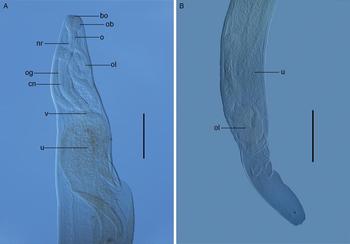
Subgravid female (three specimens) (fig. 1A, B). Filiform, brown-coloured body with smooth cuticle; length 31–32 (31.3) mm, maximum width 231–352 (272); posterior part of body narrower than anterior part. Cephalic end rounded. Buccal opening large and circular to oval, surrounded by four pairs of submedian cephalic papillae of external circle and six single papillae (two lateral and four submedian) of internal circle. Pair of small lateral amphids present. Total length of oesophagus 0.75–0.84 (0.78) mm long; oesophageal bulb 85–94 (88) long and 95–104 (98) wide. Oesophageal gland well developed 423–620 (491) long, with a large, central cell nucleus. Nerve ring measuring 204–245 (219.7) from anterior end of the body. Small ventricle 27–41 (32.7) long and 54 wide. Oesophagus opening into intestine through distinct valve. Intestine ending blindly, its posterior end narrow, attached by long ligament ventrally to body wall near caudal end. Vulva and anus absent. Ovaries long, situated near ends of body. Uterus occupying most space of body, filled with numerous eggs. Caudal extremity rounded, with two very small, hardly visible, lateral papilla-like projections.
Philometra saltatrix subgravid female, lateral view. (A) Anterior end, showing buccal opening (bo), large cell nucleus (cn), oesophagus (o), oesophageal bulb (ob), oesophageal gland (og), nerve ring (nr), ovarian loops (ol), uterus (u) and ventricle (v). (B) Posterior end, showing ovarian loops (ol) and uterus (u). Scale bars: 250 μm.

Taxonomic summary
Host. Bluefish, Pomatomus saltatrix.
Infection site. Ovaries.
Locality. Niterói, state of Rio de Janeiro, Brazil.
Parasite indices. P = 48.7%, MI = 2.63, MA = 1.28, RI = 1–10.
Deposition of voucher specimens. CHIOC nos. 36799, 36800, 38101.
Molecular, macroscopic and histological analyses
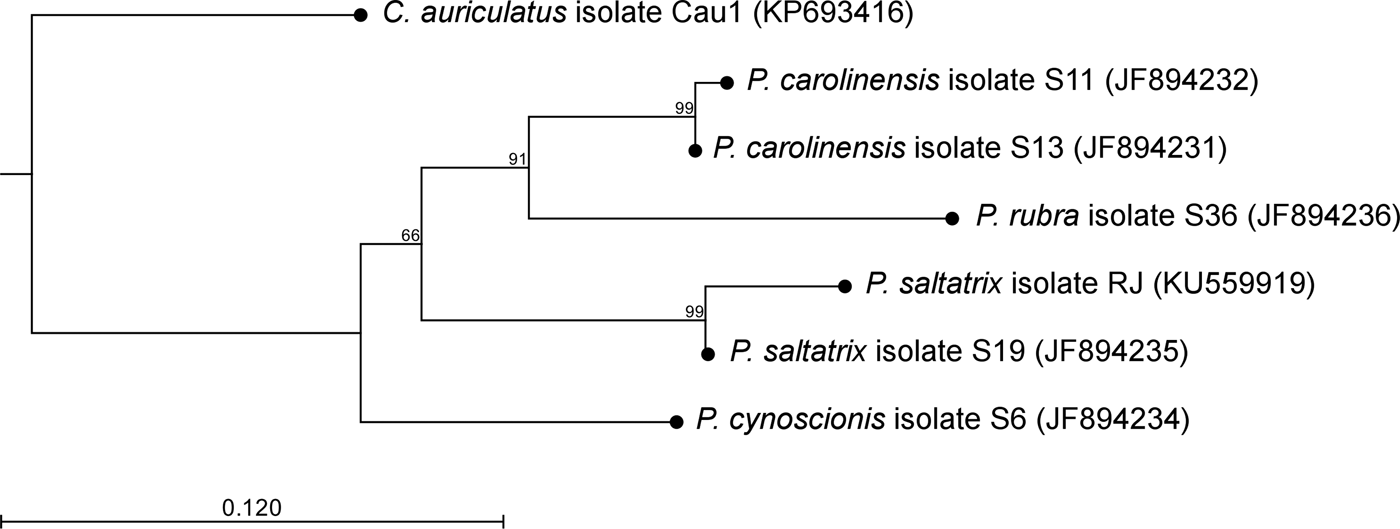
A partial sequence of 425 nucleotides (GenBank KU559919) was obtained in the present study and is represented in fig. 2. BLASTx analysis showed that this sequence was similar to other COI sequences available in NCBI GenBank and contained a partial COI domain (data not shown). Multiple alignment was performed using sequences from Philometra species and C. auriculatus (S1), and a phylogram was generated (fig. 2).
Phylogram of COI partial sequences of Philometra species. Branches for each COI sequence with species names are indicated followed by corresponding GenBank accession numbers; bootstrap values are indicated at the phylogram nodes. Scale bar represents the expected number of substitutions per nucleotide.

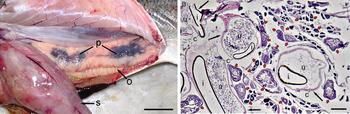
Macroscopic examination of the gonads in the present study showed ovaries containing large numbers of brown-coloured philometroids between 3 and 7 cm in size, diffusely distributed in the parenchyma and sometimes forming volvuli (fig. 3A).
The ovary of Pomatomus saltatrix infected with Philometra saltatrix (p) to show (A) the ovary (o) and stomach (s); and (B) a section of the ovary with P. saltatrix (black arrows) between the oocytes (red arrows) in various stages of development, and structures of P. saltatrix shown as (c) cuticle, (i) intestinal lumen and (u) uterus; note the lack of inflammatory responses. Scale bars: (A) 4 cm; (B) 900 μm.

Histological examination of the parasitized ovaries showed parasites sliced either transversally or longitudinally, between the oocytes at different stages of development (fig. 3B). Even in individuals with a relatively high prevalence of infection, the number of parasites was low and did not result in any significant pathological changes. Furthermore, no reduction in the number of oocytes in the ovaries of parasitized fish was observed.
Discussion
The morphology and morphometry of the parasite specimens analysed in the present study were identical to those of the specimens of P. saltatrix redescribed by Moravec et al. (Reference Moravec, Magi and Macchioni2008), which were collected from the ovaries of bluefish from the Tuscan Sea.
A partial sequence of 425 nucleotides (GenBank KU559919) that was obtained in the present study showed high similarity to P. saltatrix (GenBank JF894235), thus confirming the presence of infection by this species in bluefish (P. saltatrix) off the coast of Rio de Janeiro, Brazil. Rêgo et al. (Reference Rêgo, Vicente, Santos and Wekid1983) recorded Philometra sp. in the same host in Rio de Janeiro, Brazil, but did not determine the species involved, and therefore the present report provides the first record of this species in Brazil.
Our data showed that the P. saltatrix COI gene sequence obtained from Rio de Janeiro is closely related to the one identified previously from P. saltatrix isolate S19, with a bootstrap value of 99%. Additionally, P. carolinensis isolates are closely related, with a bootstrap value of 99%. The phylogram showed that the COI gene sequences of P. carolinensis isolates S11 and S13 were virtually identical. Interestingly, the P. saltatrix COI gene sequence obtained from the Rio de Janeiro isolate was closely related to an isolate identified previously in North America, also with a high bootstrap value, thus supporting the morphological identification presented in this work (Palesse et al., Reference Palesse, Meadors, de Buron, Roumillat and Strand2011). This finding corroborates the report by Moravec et al. (Reference Moravec, Magi and Macchioni2008), which suggested that P. saltatrix is a parasite specific to bluefish throughout its distribution.
Comparisons were made between the parasite indexes found in the present study for P. saltatrix caught in April 2015 (P = 48.7%; MI = 2.63 parasites per ovary) and those from two other studies. In a study by Clarke et al. (Reference Clarke, Dove and Conover2006), 244 bluefish were caught off the coast of the states of North Carolina and New York, USA. They reported that the ovaries were parasitized with P. saltatrix and that the peak prevalence and intensity of infection occurred at the beginning of July, both in 2002 and in 2003. This finding corresponded with the time of spawning, with prevalences of 79% and 83%, respectively, and intensities of infection greater than 100 parasites per ovary in the fish caught off the coast of New York. These indices decreased over subsequent months, until the end of September in both years, when all fish captured were found to be completely free of parasitism by this nematode. In another study by Moravec et al. (Reference Moravec, Magi and Macchioni2008), 500 bluefish (200 males and 300 females) caught off the coast of Tuscany, Italy, were examined. The prevalence of P. saltatrix infection among these fish was 24% (40% in females and 0.5% in males), with ‘from about 10 specimens in small gonads to many more in bigger ones’.
The differences in the findings of these three studies can be ascribed to the influence of the different ecoregions in which they were conducted (eastern Brazil, eastern United States and western Mediterranean, respectively). Although the American and Italian locations are within the same biogeographic realm (temperate northern Atlantic), they are in different biogeographical provinces, cold temperate north-west Atlantic and Mediterranean Sea, respectively (Spalding et al., Reference Spalding, Fox, Allen, Davidson, Ferdaña, Finlayson, Halpern, Jorge, Lombana, Lourie, Martin, McManus, Molnar, Recchia and Robertson2007).
Unlike the present study, histological changes in the ovaries have been correlated with parasitism by Philometra spp. in different species of fish, and may range from being absent or mild (Oliva et al., Reference Oliva, Borquez and Olivares1992; Hesp et al., Reference Hesp, Hobbs and Potter2002) to being severe (Genc et al., Reference Genc, Genc, Genc, Cengizler and Can2005; Clarke et al., Reference Clarke, Dove and Conover2006). For example, Genc et al. (Reference Genc, Genc, Genc, Cengizler and Can2005) observed that the ovaries of the grouper (Epinephelus aeneus) were parasitized by P. lateolabracis, which caused obstruction of the ovarian ducts, oedema and hyperaemia. Dead or degenerating specimens of P. lateolabracis were observed encapsulated by fibrous tissue in the ovaries of the fish Glaucosoma hebraicum, which presented an inflammatory infiltrate composed of numerous eosinophils (Hesp et al., Reference Hesp, Hobbs and Potter2002). Oliva et al. (Reference Oliva, Borquez and Olivares1992) found a moderate inflammatory infiltrate and atrophy in the gonads of specimens of the fish Paralabrax humeralis that were infected by Philometra sp. Clarke et al. (Reference Clarke, Dove and Conover2006) observed an inflammatory reaction, oedema, fibrosis, haemorrhage, necrosis and follicular atrophy in the ovaries of bluefish parasitized by the nematode P. saltatrix. According to these authors, these histological changes may impair oocyte development, thus probably leading to reduced fecundity among the parasitized fish. The absence of histological changes in the present study may be due to the low intensity of infection observed, which corroborated the findings of Hesp et al. (Reference Hesp, Hobbs and Potter2002) for the ovary of the fish G. hebraicum parasitized by P. lateolabracis. Furthermore, the inflammatory reaction associated with the nematode Philometra spp. in the ovaries of parasitized fish seems to be triggered by female worms that had expelled larvae and had subsequently died (Hesp et al., Reference Hesp, Hobbs and Potter2002; Clarke et al., Reference Clarke, Dove and Conover2006), which was not observed in the present study. According to the results of Hesp et al. (Reference Hesp, Hobbs and Potter2002) and Clarke et al. (Reference Clarke, Dove and Conover2006), as well as those of the present study, adult and live specimens of the nematode Philometra spp. do not seem to be antigenic, in contrast to their larvae, but further studies are needed to confirm this hypothesis.
In addition to ovarian lesions, another negative aspect of infection by the nematode P. saltatrix in the ovaries of the bluefish is the repugnant appearance of these fish, which constitutes a fish hygiene problem. This may lead to rejection of fish by consumers, especially if the prevalence encountered is high.
Acknowledgements
The authors would like to thank Ricardo Baptista Schmidt (Image Production and Processing Service of the Oswaldo Cruz Institute, FIOCRUZ) for processing the figures; the National Council for Scientific and Technological Development (CNPq) and the Coordination Office for Improvement of Higher-Education Personnel (CAPES) for partial financial support.
Financial support
This work was supported by three fellowships: CNPq grant number 308048/2013-0 (for S.C.S.C.) and 309522/2015-3 (for R.C.M.); and CAPES grant number EXPPD000020 (for N.N.F.).
Conflict of interest
None.