On March 11, 2020, the World Health Organization (WHO) declared a pandemic of the highly transmissible severe acute respiratory coronavirus 2 (SARS-CoV-2) that triggered an alarming global health crisis 1–4 In many countries, governments have set severe restrictions on daily life, mandated social distancing and health protection policies, and locked down nonessential businesses. Reference Balwin and Weder di Mauro5–Reference Wiedemann and Dorl8 Wiedemann and Dorl (2020) analyzed what and how the scientific community communicates about coronavirus disease 2019 (COVID-19) risks to the general public, media, and politics.
The regulations and managing efforts differed from country to country—these included lockdown, isolation, quarantine, travel ban, and/or closing of the nonessential business. The scale, pace, and depth of government actions varied at the federal, regional, and local levels. Despite their efforts, every country in the world has been experiencing the harsh impact of the pandemic; some countries have been hit harder than others. The perception of stress may influence the pathogenesis physical diseases by causing anxiety, headache, insomnia, and depression, which then exert direct effects on physiological processes, behavioral patterns, and overall health. Reference Baloran9–Reference Cohen and Janicki-Deverts11 The perception of an individual’s health and accompanying health-related expenses can affect care-seeking behavior. Therefore, learning about perceptions associated with COVID-19 can provide ground for early detection and treatment of various health conditions and for the development of targeted interventions to improve the preventative behavioral patterns and health outcomes of different population groups. Understanding the anticipated need for health services and the expected cost would help to assess the prospective use patterns and mitigate financial barriers that could interfere with care-seeking behavior.
High morbidity and mortality rates related to COVID-19, which WHO estimates to be close to 4%, 2 its highly contagious nature, and its broad and quick spread caused confusion, fear, and anxiety among the general public, including the United States. These perceptions are associated with COVID-19, and any perceptions related to any risk can influence people’s behavior. Reference Vaughan12 Betsch et al. Reference Betsch, Wieler and Habersaat13 wrote about the importance of behavioral insights for the COVID-19 pandemic. It includes knowledge of how people perceive the stress associated with the risk of COVID-19 and how these perceptions impact their health, protective behavior, and health-related expenses. Risk perceptions are among the core features of protection-motivation theory Reference Floyd, Prentice-Dunn and Rogers14 and, as such, can help to determine the public’s demands for the healthcare services during and after the pandemics, as well as health-protective behavior. However, the research that provides and analyses evidence about public perceptions of stress and health as it related to pandemics is somewhat limited. The majority of this research evidence has come from studies during the H1N1 swine flu pandemic that took place in 2009 Reference Rudisill15,Reference Prati, Pietrantoni and Zani16 and the Ebola outbreak. Reference Yang and Chu17 According to Wise et al., Reference Wise, Zbozinek and Michelini18 while some of these studies emphasized the role of risk perception, they often took place in anticipation of an outbreak or long after its emergence. A few studies that have surveyed individuals during the early stages of a pandemic have suggested that perceived personal risk of infection and how this risk affects people’s health can lead to engagement in protective behavior during and after the pandemic Reference Wise, Zbozinek and Michelini18 as well to changes in care-seeking behavior among patients.
This observation above determined the 4 research questions of this study: (1) What was the perceived stress during the early stages of the COVID-19 pandemic?; (2) What was the perception of the impact of stress on the health status of respondents during the COVID-19 pandemic?; (3) What was the respondents’ perception on the changes in their health status?; and (4) What was the respondents’ perception on the cost of their healthcare services as it relates to COVID-19?
This study provides insights for medical professionals, healthcare managers, and other stakeholders into the healthcare needs of different population groups, their perceived financial impact on healthcare costs associated with COVID-19, particularly during this pandemic’s first months (April-May, 2020). It helps evaluate the perceived stress and healthcare issues each group may exhibit, the perceived access to healthcare services, as well as the kind of attention each of these groups may require.
The study proceeds as follows: the first section provides methods of analysis. The next section focuses on the data and results, followed by a discussion of key research findings. The final section concludes the study and provides suggestions for future research.
Methods
Data and Sample Characteristics
Our survey was created based on the modification of the survey named Stress Management for Law Enforcement Officers Questionnaire (SMLEOQ). Reference Ermasova, Cross and Ermasova19 The study was reviewed and approved as an exempt study by the Institutional Review Board (IRB Approval by the Governors State University: IRB-FY2019-40). The survey was distributed through social network sites (SNS) among the general population in different social network groups. Informed consent, the procedure of maintaining confidentiality, detailed instructions on how to complete the questionnaire, the title of the study, a brief description including study purpose, inclusion criteria, and the survey link were included. To achieve broader representation, address biases, and to follow the paper topic of the general population SNS engagement, researchers worked with 41 Facebook groups with diverse and not specifically affiliated membership, such as, for instance, “Costcomans”, “IsoIsolacia”, Social Media sites of different cities, and similar. Facebook groups were open to people across the United States. Each groups’ language was English. Researchers approached group administrators with the request to post the survey, and 26 groups’ administrators approved this request. All participants read an online consent form and consented by checking “I read consent and agree to participate.” The data were collected in the time-frame from April to May, 2020. These posts generated 336 responses, of which there were 315 completed questionnaires that qualified for the analysis. For questionnaires completed through the Web link, the data were automatically saved and converted into a database in an excel format file for analysis. The information about sample characteristics in terms of gender, age, ethnicity, educational level, and marital status are illustrated in Table 1.
Demographic variables (N = 315)

As a part of the survey, respondents provided personal information regarding their age, gender, marital status, working experience, ethnicity, management experience, and current educational level. Among the 315 respondents who completed the survey, 85 (27%) were males and 230 (73%) were females (Table 1). Education was coded in 7 categories. One-third of participants had Bachelors’ degree. One-fourth of respondents had Masters’ degree. There were 31 respondents with a high school diploma (10.1%), 23 respondents with an Associate degree (7.49%), 6 respondents with M.D. or D.O. degrees (1.9%), and 4 respondents with certificates (1.26%).
Over half of the respondents were married. Individuals who were single/never married made up 1/3 of the sample, followed by divorced, separated, and widowed. Most participants in this study were 30-39 y old (1/4 of respondents), which was followed by the age group 40-49 and 18-29 age group, age group 50-55, and age group 56-60. The age group of 61+ had 25 participants.
Measures and Analysis Strategy
Respondents were asked to indicate the perceived stress during the COVID-19 crisis as well as to identify the perceived impact of stress on their health during the COVID-19 pandemic, and the following need for healthcare services and the cost of healthcare services.
In this survey, the 4-item Perceived Stress Scale was used to assess the degree to which situations in life are perceived as stressful. Reference Ceka and Ermasova20 The study was constructed based on the framework created by McCreary and Thompson. Reference McCreary and Thompson21 The study by McCreary and Thompson Reference McCreary and Thompson21 was tested in studies by Ceka and Ermasova Reference Ceka and Ermasova20 and Ermasova et al. Reference Ermasova, Cross and Ermasova19 For the purpose of this study, we used the 4-item Perceived Stress Scale, that was created by McCreary and Thompson, Reference McCreary and Thompson21 to measure psychological stress perceptions of respondents during the COVID-19 pandemic. Analysis of stressors and stress relieving tactics during the COVID-19 outbreak questionnaire had the following Questions: “Has the COVID-19 made an impact on your stress level?” Please rate them on a scale of 1 to 4, where 1 - “caused no stress,” 2 - “a little stress,” 3 - “mid-level stress,” 4 - “high stress.” Higher scores are indicating a higher level of perceived stress. A total of 8 items (eg, “Has COVID-19 increased your level of stress, as it relates to social media?”; … “Has COVID 19 increased your level of stress, as it relates to nonsocial media news channels?”) were measured on a 4-point scale, ranging from 1 (“caused no stress”) to 4 (“high stress”).
To test our hypotheses, first, we analyzed whether gender, ethnicity, and age had an effect on the perceived stressors, using an analysis of variance (ANOVA) test to compare groups. Second, we provided descriptive statistics on the perceived impact of stress on health, perceptions of the need for medical services, and perception of changes in the cost of health-care services, as the result of the COVID-19 pandemic.
Results
Perceptions of Overall Stress During the COVID-19 Crisis
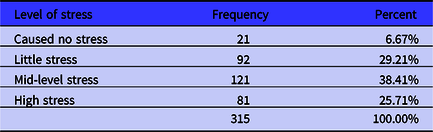
The higher mean demonstrated that the respondents viewed COVID-19 as impacting their stress level by increasing it. More than half of the participants (64.12%) perceived stress associated with COVID-19 as “moderate” (38.41%) or “high” (25.71%) (Table 2).
Perceived stress level during COVID-19 pandemic

Gender and Stress During COVID-19
The ANOVA test revealed that the average mean values of the male respondents in ranking the impact of stressors during COVID-19 are lower than the mean values of females, suggesting that in average female respondents (mean = 2.95) are impacted by the stressors at a higher degree than male respondents (mean = 2.44) (Table 3).
ANOVA comparison for perceived stress by gender

Notes: Bartlett’s test for equal variances: chi2(1) = 0.85; Prob>chi2 = 0.356.
Significant at **** P < 0.001; *** P < 0.01; ** P < 0.05; * P < 0.10.
Age and Stress During COVID-19
The ANOVA test revealed no significant difference between the average mean values of the different age groups of respondents in ranking the impact of COVID-19. However, the mean of perceived stress increased with age (from mean = 1.66 for adults 18-29 y to mean = 1.8 for adults 61 and older) (Table 4).
ANOVA comparison for perceived overall stress by age

Notes: Bartlett’s test for equal variances: chi2(5) = 1.5080; Prob>chi2 = 0.912.
Significant at **** P < 0.001; *** P < 0.01; ** P < 0.05; * P < 0.10.
Ethnicity and Stress During COVID-19
The ANOVA test revealed that there is no significant difference between the average mean values of the different ethnic groups of respondents in ranking the impact of stressors during COVID-19. However, the COVID-related stress perceptions were higher among Hispanic respondents than among Asian respondents (Table 5).
ANOVA comparison for perceived stress by ethnicity

Notes: Bartlett’s test for equal variances: chi2(4) = 1.2755; Prob>chi2 = 0.866.
Significant at **** P < 0.001; *** P < 0.01; ** P < 0.05; * P < 0.10.
Perceived Impact of COVID-19 Related Stress on Health Status
The survey included a question “If COVID-19 increased your level of stress, did it also impact your health status?” Around 40% of respondents—121 respondents (38.4%)—answered that stress during COVID-19 affected their health status. The analysis of the answers to this question is presented in Table 6.
Perceived impact of stress on health status during COVID-19 pandemic

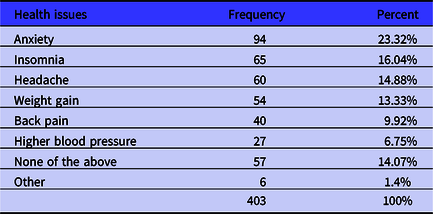
The survey had the follow-up question: “If COVID-19 impacted your health, did it manifest itself in…” and included a list of potential health manifestations and an option for comments. Respondents could select more than 1 answer and provide comments. Anxiety, insomnia, headaches, and weight gain were among the most often selected health concerns. The results of the survey’s answers are provided in Table 7.
Reported health issues (more than 1 option)

Among respondents, 17 people also offered comments to this question. The majority of comments discussed various health issues and what caused health issues as they relate to COVID-19. The comments are grouped by issues and self-reported causes of these issues, as they relate to COVID-19 (Table 8).
Additional health issues of respondents that related to COVID-19

Gender and Perceived Impact of Stress on Health Status During COVID-19
The ANOVA test revealed that the average mean values of the male respondents in ranking the perceived impact of stress on health status during COVID-19 are higher than the mean values of females, suggesting that in average female respondents (mean = 1.66) had lower level of perceived impact of stress on health status during COVID-19 than male respondents (mean = 1.8) (Table 9).
ANOVA comparison for the perceived impact of stress on health status by gender

Notes: Bartlett’s test for equal variances: chi2(1) = 5.45; Prob > chi2 = 0.020.
Significant at **** P < 0.001; *** P < 0.01; ** P < 0.05; * P < 0.10.
Age and Perceived Impact of Stress on Health Status During COVID-19
The ANOVA test revealed no significant difference between the average mean values of the different age groups of respondents in ranking the perceived impact of stress on health status during COVID-19. However, the mean of perceived stress increased with age (from mean = 1.66 for adults 18-29 y to mean = 1.8 for adults 61 and older) (Table 10).
ANOVA comparison for the perceived impact of stress on health status by age

Notes: Significant at **** P < 0.001; *** P < 0.01; ** P < 0.05; * P < 0.10.
Bartlett’s test for equal variances: chi2(5) = 5.21; Prob > chi2 = 0.391.
Ethnicity and Perceived Impact of Stress on Health Status During COVID-19
The ANOVA test revealed that there is no significant difference between average mean values of the different ethnic groups of respondents in ranking perceived impact of stress on health status during COVID-19 (Table 11).
ANOVA comparison for perceived impact of stress on health status by ethnicity

Notes: Significant at **** P < 0.001; *** P < 0.01; ** P < 0.05; * P < 0.10.
Bartlett’s test for equal variances: chi2(4) = 5.3560; Prob>chi2 = 0.253.
Perceived Needs for Healthcare Services and Changes in Healthcare Cost as a Result of COVID-19
The respondents were asked “Do you think COVID-19 will increase your need for medical services?” Sixty-six respondents (20.9%) answered that stress during COVID-19 will impact their need for medical services. (Table 12).
COVID-19 related perceived need for medical services and perception of changes in the cost of healthcare services

The respondents were also asked “Do you think COVID-19 will increase the cost of your health-care services?” Over 40% of respondents—129 respondents (40.95%)—believed that the COVID-19 would lead to an increase in the cost of health-care services (Table 12).
Limitations
There are several limitations that may affect the generalizability of the findings in this study. One of the limitations is the limited population of respondents. Thus, the generalizations of this study’s results are limited because it is not necessarily representative of the US population. Future studies should expand the sample to include more respondents from other cities and regions in the United States. The second limitation is that more women participated in the survey than males. It can be attributed to the fact that 54.3% of the Facebook audience in the United States are females, and 45.7% are males. Females also tend to be more active and frequent in their use of Facebook: 69% of female users engage with Facebook at least once a day, compared with 54% of male users. Reference Tankovska22 Participants’ education level could also be attributed to the fact that 74% of adults with a college degree or more use Facebook, compared with 61% of those who have a high school diploma or less. Reference Gramlich23 Future studies could collect data through a longitudinal or time-series studies that would provide a depiction of stress throughout the COVID-19 pandemic instead of an examination of stress in a short period of time, as done in this study.
Discussion
Based on the data analysis and finding related to the COVID-19 pandemic and stress, our study suggests that the COVID-19 pandemic leads to increased stress levels among adults of all genders, age groups, and ethnicities. This result is similar to the findings from the studies conducted in different countries among diverse population groups. 1,Reference Baloran9,Reference Burke, Midgley and Dratch24–Reference Wang, Pan and Wan27
All population groups reported being stressed by the COVID-19 pandemic; however, females were significantly more stressed by the COVID-19 pandemic than males. These finding are consistent with the majority of research about stress as well as research about stress during the COVID-19 pandemic. Different studies proved the impact of family, personal, professional, financial problems on health concerns. 28–Reference Liu, Zhang and Wei30 Women appeared to be more susceptible to stress caused by social isolation. Reference Senst, Baimoukhametova and Sterley31–Reference Spagnolo, Manson and Joffe33 However, available sex-disaggregated data for COVID-19 pandemic from Italy, China, South Korea, and the United States demonstrates that, although there is an equal number of COVID-19 cases between genders, the death rate among men is higher than among women. Reference Spagnolo, Manson and Joffe33,Reference Sharma, Volgman and Michos34 In our study, the ANOVA test revealed that females are more impacted by the COVID-19 pandemic stress than males. Additionally, it could encourage health professionals and social workers to develop gender-targeted information and behavioral interventions.
Various studies identify older people as particularly vulnerable to COVID-19. According to statistics from the CDC, 8 of 10 COVID-19 deaths reported in the United States have been in adults 65 years old or older. Adults 65 and older account for 16% of the US population, but for 80% of COVID-19 death in the United States. Reference Freed, Cubanski and Neuman35 These facts suggest that older people may be worse affected by the psychological distress caused by the COVID-19 pandemic, which is supported by prior research that identifies older age as the factor contributing to the stress level. Reference Martin, Grünendahl and Martin36,Reference Wilson, Begeny and Boyle37 However, our study demonstrates that, although older adults had a slightly higher stress level than other age groups, the stress level was similarly high among all age groups.
Our data also indicate that there were no significant differences in the levels of stress among different ethnic groups in first 2 months of pandemic, even though in May 2020, during the time of this study, the mortality rate among African-Americans was 73 per 100,000 compare with 36 per 100,000 among Latino persons and 22 per 100,000 among white residents. Reference Webb Hooper, Nápoles and Pérez-Stable38
This study’s data also revealed that stress associated with the COVID-19 pandemic, manifested itself in the feelings of anxiety, depression, insomnia, headache, and similar conditions. The United States Census Bureau reported that the COVID-19 pandemic had tripled the depression rate among adults in the United States. In some cities that were harder hit by the COVID-19 pandemic, these numbers were higher. Reference Boyraz and Legros39,Reference Twenge and Joiner40
Study participants also were stressed about and anticipated that the COVID-19 pandemic would impact their health in the future. This result falls into the theoretical framework of the correlation between self-reported stress and its negative effect on health status Reference Watson41–Reference Selye43 and is congruent with the recent opinions and findings by Moreno et al. Reference Moreno, Wykes and Galderisi44 and Mviena et al. Reference Mviena, Fanne and Gondo45 Respondents connected their health issues with various COVID-19 related problems and restrictions, among them inability to access medical services due to mandated restrictions on the majority of medical procedures, transitions to an online working environment, and social isolation. Many other surveys conducted in the United States and other countries described a similar cause and effect paradigm. Reference Li, Yang and Qiu46,Reference Fullana, Hidalgo-Mazzei and Vieta47
On the 1 hand, this study’s participants anticipated an increase in the need for healthcare services, connecting it to postponed diagnoses, delayed care, changes in the lifestyle, and other COVID-19 related stressors. On the other hand, they also anticipated an increase in the cost of health-care services. The perceptions related to the increase in cost of healthcare services could have stemmed from different factors, such as changes in the overall economy, information about expensive hospitalizations and treatment of COVID-19 patients, particularly in the pandemic’s early stages, and expectations that delays in diagnoses and in receiving medical services could result in more expensive procedures. Indeed, the American Hospital Association 48 estimated a March-June financial impact of the COVID-19 pandemic at $203 billion in losses. Patients are aware of these economic changes and financial demands and may conclude that these demands may increase the cost of health-care services.
These perceptions—anticipated increases in the need for healthcare services and in the cost of healthcare services—are components of the healthcare-seeking behavior model. Healthcare-seeking behavior has been defined as any action undertaken by individuals who perceive themselves to have a health problem for the purpose of finding an appropriate remedy Reference Ihaji, Gerald and Ogwuche49 According to Oberoi et al., Reference Oberoi, Chaudhary and Patnaik50 healthcare-seeking behavior is preceded by a decision-making process that is further governed by individuals, community norms, and expectations as well as behavior. The healthcare-seeking behavior model includes several decision-making forces that influence the individual’s healthcare–seeking behavior: patients (recognition of the need, beliefs, cultural norms, age, gender, and perceived outcomes), as well as providers (behavior’s influencer), and resources that enable healthcare-seeking behavior (finances, access). Reference Andersen51,Reference Lauver52
Conclusions
Health professionals may consider focusing on addressing 2 areas of the COVID-19 pandemic stress perceptions. First, learning about people’s COVID-19 perceptions about their health condition can provide ground for detecting and treating various health conditions, addressing fears, and improving access to health services. This knowledge would allow health professionals to develop targeted interventions for different population groups, including strategies that can influence COVID-19 preventative behavioral patterns. Second, studying the anticipated need for health services and the expected cost of healthcare services associated with the COVID-19 pandemic can help understand the utilization patterns, and mitigate financial barriers that could interfere with patients’ care-seeking behavior.