Therapeutic options for patients with congenitally malformed hearts have improved dramatically since MacMahon et al.,Reference Macmahon, Mckeown and Record1 in 1953, stated that only one-fifth of children born with such malformations would grow into adulthood. Advances in diagnosis, surgery, catheter-based interventions, and pharmacological treatment have led to a dramatic improvement in survival of these patients. In the year 2000, the number of adults with congenitally malformed hearts exceeded the number of children with these lesions, and the number of adults is predicted to increase still further in the years to come.2–Reference Williams, Pearson and Barst8
A problem facing doctors treating these adults is that a significant number is lost for follow-up.Reference Williams, Pearson and Barst8–Reference Wacker, Kaemmerer and Hollweck10 Some are lost in the transition from paediatric to adult care, some have been discharged in the past because they were presumed to be cured, or their residual defects were thought to be benign,Reference Azar, Hardesty, Pontius, Zuberbuhler and Bahnson11 and others have dropped out of follow-up because of psychological problems as a result of the hospital experience in childhood.
Clinical information about this lost population has not previously been published, but a questionnaire study from Germany suggests that patients lost for follow-up have increased morbidity, and that a substantial number of these patients has complex malformations.Reference Wacker, Kaemmerer and Hollweck10
Information about the number of patients lost for follow-up, their diagnosis, and their clinical state is needed in order to plan the future service required for adults with congenital heart disease.
In December, 2005, the Danish National Television and the major Danish newspapers all ran a front page story about adults with congenitally malformed hearts who were lost for follow-up. The message was that patients previously declared healthy, and discharged from further follow-up, could have significant residual defects, with the risk of morbidity and death. All adults with congenitally malformed hearts who did not receive regular out patient follow-up were encouraged to contact a specialist centre. Those patients who contacted the Center for Congenital Heart Disease at Rigshospitalet were seen in the out patient clinics over a period of four weeks. In this study, we present the medical history, clinical, and paraclinical findings in this group of adults with congenital heart disease that was lost for follow-up. We describe the number of patients needing specialist care, and whether any clinical or paraclinical findings were predictive of the need for further follow-up.
Methods
All patients who contacted Rigshospitalet, deemed to be responders, were seen in the outpatient clinic during a period of 4 weeks in January and February, 2006. The Rigshospitalet has a catchment area of 2.5 million people.
Estimates of the prevalence of congenital cardiac malformations in adults older than 16 years were made from birth rate, the incidence of congenital cardiac malformations, and the survival rate of the common lesions, using the same methods as those employed at the Bethesda conference held in 2000.Reference Warnes, Liberthson and Danielson12 Classification of congenital defects as complex, moderate, or simple were adapted from the recommendations made at this conference.Reference Warnes, Liberthson and Danielson12
The patients were seen by one of the authors, who all work in the Center for Congenital Heart Disease. Old patient files and operation notes were examined when available for study. A structured interview, a clinical examination with measurement of blood pressure and transcutaneous arterial oxygen saturation, an electrocardiogram, and echocardiography were done. Patients were defined as symptomatic if they had either palpitations, oedema, chest pain, or were in the second class, or higher, of the system developed by the New York Heart Association. Blood samples were taken for measurement of N-terminal pro brain natriuretic peptide. N-terminal pro brain natriuretic peptide was analyzed using the ECLIA assay from ROCHE. Normal values were adapted from our laboratory, and correspond to the 97.5 centile, at 9.9 pmol/l, for men younger than 50 years, 18.3 pmol/l for women younger than 50 years, 22.9 pmol/l for men older than 49 years and 26.2 pmol/l for women older than 49 years. After the examination it was decided whether further follow-up was needed according to the guidelines from the European Society of Cardiology.Reference Deanfield, Thaulow and Warnes4 The results and conclusion from the examination were entered into a database.
Analysis of data
We treated age, years since last out-patient visit, heart rate, systolic blood pressure, diastolic blood pressure, oxygen saturation and QRS duration on electrocardiogram as continuous variables, and have presented these values as the mean, with the standard error of the mean in brackets. Dichotomous variables included sex, previous surgical procedure, oedema, palpitations, New York Heart Association class more than I, systolic murmur, diastolic murmur, other than sinus rhythm, elevated N-terminal pro brain natriuretic peptide and further follow-up, and these values are presented as numbers, with the percentage value in brackets. Univariate comparisons were made with unpaired Student t-tests for continuous data, and with chi square for dichotomous data. For multivariate analysis, we used multiple regression analysis using further follow-up as the response variable. The model included all variables, and manually excluded the variable with the highest p-value at each step, until all variables in the equation had p-values below 0.05. Sensitivity and specificity is calculated with standard methods. All statistical tests are two-tailed, and p-values below 5% are considered significant. Statistical analyses were done using statistical analysis software, specifically the SPSS version 12.00.
Results
Characteristics of the patients
Examinations were performed on the 147 responders. Median age was 38, and 54 (36.7%) were men. Surgery had previously been performed on 136 (92.5%) of the responders between 1950 and 1999. None of the responders received any regular follow-up for their disease, with median time since last hospital stay or follow-up being 27 years, and the range from 5 to 51 years. All patients had a clinical examination and an echocardiography performed. We measured N-terminal pro brain natriuretic peptide in 136 (92.5%) of the patients. Of the others, 11 had “anxiety for needles”, and would not permit the drawing of a blood sample.
The primary diagnoses of responders are presented in Figure 1. In 2 responders, there were 2 primary defects, namely atrial and ventricular septal defects, and pulmonary valvar stenosis and atrial septal defect. According to their previous known diagnosis, no patients had complex defects, with 43 (29%) having defects of moderate severity, and 104 (71%) having simple defects.
Diagnosis of patients included in the study. TOF: Tetrology of Fallot, AVSD: Atrioventricular defect, CoA: Coarctatio of the aorta, VSD: Ventricular septal defect, ASD: Atrial septal defect, PS: Pulmonary stenosis, PAD: Persistently patent arterial duct, TAPVC: Totally anomalous pulmonary venous connection, MR: Mitral regurgitation, AR: Aortic regurgitation, AS: Aortic stenosis.

Of the 147 responders, 52 (35.4%) were scheduled for renewed follow-up, either based on their diagnosis, in 20, or because of residual defects in 32. Differences in clinical variables between patients who were or were note scheduled for follow-up are presented in Table 1.
Demographic and clinical data of patients scheduled for follow-up, and patients not scheduled for follow-up.

NT-proBNP: N-terminal pro brain natriuretic peptide.
Patients needing renewed follow-up were more often male, more often had murmurs, had a higher frequency of palpitations, had higher blood pressure, and more often showed elevated levels of N-terminal pro brain natriuretic peptide. Symptoms were present in 36.5% of patients scheduled for follow-up, and 10.5% of patients not scheduled for follow-up. The diagnosis of the patients we chose to follow is presented in Figure 2.
Diagnosis of patients scheduled for follow-up. TOF: Tetrology of Fallot, AVSD: Atrioventricular defect, CoA: Coarctatio of the aorta, VSD: Ventricular septal defect, ASD: Atrial septal defect, PS: Pulmonary stenosis, PAD: Persistently patent arterial duct, TAPVC: Totally anomalous pulmonary venous connection, MR: Mitral regurgitation, AR: Aortic regurgitation, AS: Aortic stenosis.

Prevalence of adults with congenitally malformed hearts in Denmark
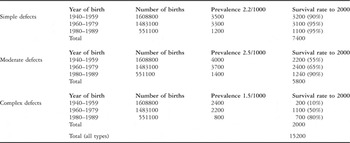
Estimates of the prevalence of these adults are presented in Table 2. The Rigshospitalet is a tertiary centre, with a catchment area for congenital cardiac disease of about 2.5 million people, 45% of the Danish population. Based on our estimates, the number of adults with congenitally malformed hearts in this catchment area is about 6800, with 900 having complex defects, 2600 with moderate defects, and 3300 with simple defects. The patients lost for follow-up found in this study comprised 1.7% of adults with moderate defects, and 3.2% of those adults with simple defects.
Estimates of prevalence of adults with congenitally malformed hearts in Denmark.

Characteristics of the individual defects
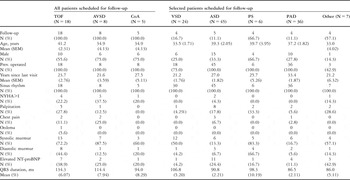
Clinical characteristics of the different congenital defects are presented in Table 3. Of the 18 patients with tetralogy of Fallot, all had been surgically corrected, and all were in sinus rhythm. Moderate and severe pulmonary valvar regurgitation was found in 10 (55.6%), but none of the patients had significant valvar or infundibular pulmonary stenosis. None of the patients had QRS duration above 0.180 seconds. N-terminal pro brain natriuretic peptide was elevated above 50% of the upper normal limit in 5 (27.8%) patients, with four of these patients having moderate or severe pulmonary regurgitation, and one having reduced left ventricular ejection fraction, between 20 and 25%. All the patients with teratology of Fallot were scheduled for regular follow-up according to current guidelines.
Diagnosis and clinical data on patients scheduled for follow-up and patients not scheduled for follow-up.

TOF: Tetrology of Fallot, AVSD: Atrioventricular septal defect, CoA: Coarctatio of the aorta, VSD: Ventricular septal defect, ASD: Atrial septal defect, PS: Pulmonary stenosis, PAD: Persistently patent arterial duct, NT-proBNP: N-terminal pro brain natriuretic peptide.
We found 8 patients with atrioventricular septal defect and common atrioventricular junction. Prior to surgery, ventricular and components of the septal defect had been present in 3 (37.5%) patients, and only an atrial component in the remaining 5 (62.5%). Mild-to-moderate regurgitation across the left atrioventricular valve was found in 2 patients (25%), and moderate-to-severe regurgitation in the remaining 6 (75%). None of the patients had pulmonary hypertension. All patients were scheduled for regular follow-up.
We found aortic coarctation in 5 patients. Of these, 2 had systemic arterial hypertension (40.0%), both with systolic blood pressure above 170 mmHg. There were no echocardiographic signs of additional lesions, including signs of bicuspid aortic valve or aortic aneurysm. Significant recoarctation were present in one (20%) of the patients. N-terminal pro brain natriuretic peptide was only elevated in the patient with recoarctation, but not in the others. All patients were scheduled for regular follow-up according to current guidelines.
A ventricular septal defect had been present in 24 patients. Of these, 6 had not undergone surgical closure, and 2 of these were scheduled for further evaluation because of the mild-to-moderate nature of the defect. The other 4 patients had either very small defects, or the defects had closed spontaneously. Among those undergoing surgical closure, only small residual ventricular septal defects were found. None of the patients had pulmonary arterial hypertension based on the echocardiographic examination. A previously unrecognized moderately large defect within the oval fossa was founding 1 patient, and another patient had moderate pulmonary valvar regurgitation. N-terminal pro brain natriuretic peptide was elevated in a woman aged 37 years with a surgically closed ventricular septal defect, no symptoms but borderline systemic arterial hypertension. Regular follow-up was offered to the patients with the borderline ventricular septal defects not previously closed at surgery, and to the two patients with additional lesions.
Interatrial communications had been present in 45 patients, within the oval fossa in 43, and of sinus venosus type in the other 2. The echocardiographic examination showed that one patient had a residual defect in the oval fossa of 3 centimetres, one patient had mild pulmonary hypertension, one patient had previously unrecognized severe pulmonary valvar regurgitation, and one patient had mild-to-moderate mitral valvar stenosis. The N-terminal pro brain natriuretic peptide was elevated in 11 (24.4%) patients. Of these patients, 2 were known to have systemic arterial hypertension, with one being the patient with the large residual defect, and the other the patient with mitral valvar stenosis. Regular follow-up was offered to patients with additional defects, to the patients with the sinus venosus defects, and to the patient with the residual atrial septal defect.
Pulmonary valvar stenosis had been present in 6 patients. Echocardiography demonstrated moderate or severe pulmonary valvar regurgitation in four of these, and one also had residual moderate valvar stenosis. The patient with elevated N-terminal pro brain natriuretic peptide had severe pulmonary valvar regurgitation, but the other patients with significant pulmonary valvar regurgitation had normal levels of N-terminal pro brain natriuretic peptide. Follow-up was planned in the 4 patients with pulmonary valvar regurgitation.
There had been persistent patency of the arterial duct in 36 patients. Echocardiography revealed that only one (2.8%) of these had a residually patent duct, which was small and without haemodynamic importance. None of these patients had pulmonary arterial hypertension. Previously unknown moderate aortic regurgitation was found in 1, 1 patient had moderately reduced left ventricular ejection fraction, and 1 patient had a dilated aorta root. N-terminal pro brain natriuretic peptide was elevated in 4 patients. Of these, 1 had systemic arterial hypertension, 1 was the patient with moderate aortic regurgitation, and 2 had no clinical or echocardiographic signs of cardiac disease. The 3 patients with additional defects, and the patient with the small residual duct, were scheduled for follow-up.
In 7 patients, there had been other types of defect. Of the 4 patients with aortic stenosis, 1 had a bicuspid aortic valve and dilation of the aortic root, and was scheduled for follow-up. All the patients had normal levels of N-terminal pro brain natriuretic peptide. The patients with mitral regurgitation and aortic regurgitation both had moderate regurgitation fractions and elevated levels of N-terminal pro brain natriuretic peptide. Both were scheduled for follow-up. The patient with anomalous pulmonary venous connection had undergone surgical correction. The patient had no symptoms but had elevated levels of N-terminal pro brain natriuretic peptide, and was scheduled for further follow-up.
Patients with simple defects
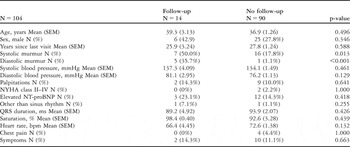
Of the 147 responders, 104 patients had simple defects and 14 were scheduled for further examinations or renewed follow-up. A comparison between the 14 patients selected, and 90 not selected, for follow-up is presented in Table 4.
Determination of follow-up on patients with simple defects.

NT-proBNP: N-terminal pro brain natriuretic peptide.
Only murmurs were more frequent in the group of patients scheduled for renewed follow-up. In a multivariate analysis including all the variables in the table, both systolic murmur (odds ratio 4.21, 95% confidence interval 1.05–16.11) and diastolic murmur (odds ratio 44.6, 95% confidence interval 4.34–458.29) remained independent predictors of follow up. Sensitivity and specificity for the presence of a systolic murmur in finding patients for follow-up was 0.50 (95% confidence interval 0.24–0.76) respectively 0.82 (95% confidence interval 0.74–0.90) and for the presence of a diastolic murmur 0.36 (95% confidence interval 0.11–0.61) respectively 0.99 (95% confidence interval 0.97–1.01).
Discussion
To our knowledge, ours is the first study systematically to describe and make clinical examinations in a group of adults with congenitally malformed hearts lost for follow-up. We made 3 important observations. Firstly, a campaign in the media has some effect in finding these patients with congenitally malformed hearts lost for follow-up. Secondly, one-third of patients lost for follow-up have defects that warrant continued specialist care. Thirdly, only one-third of the patients needing further follow-up have symptoms.
Rigshospitalet has a catchment-area of about 2.5 million people, so the 147 responders probably only represents a small part of the cohort of adults with congenitally malformed hearts lost for follow-up. A Canadian study calculated that about one-quarter of patients transferred from paediatric to adult care are lost to follow-up,Reference Reid, Irvine and McCrindle9 and a study from Munich reports that an estimated 8000 patients are lost for follow-up in the Munich catchment-area.Reference Wacker, Kaemmerer and Hollweck10 It is unknown what percentage of congenital heart patients in the Rigshospitalet catchment area heard or read the story brought in the press, but if estimates from the Canadian study can be used on the Danish population, only a minority of the patients lost for follow-up responded. Our study shows, nonetheless, that a campaign in the press has some effect in identifying patients with congenitally malformed hearts lost for follow-up, and it is possible that a more ambitious and repetitive campaign could have an even bigger effect. It is not known if the responding patients in the present study were more or less symptomatic than non-responders.
Most of the 147 responders had trivial defects, such as atrial or ventricular septal defect or persistent patency of the arterial duct, where routine post operative follow-up is not recommended according to present guidelines. Clinical examination and echocardiography, however, identified one-tenth where further follow-up was indicated, primarily because of residual lesions or previously unknown additional defects. Although it is known that patients with repaired lesions of this kind without pulmonary arterial hypertension have a good long term prognosis,Reference Murphy, Gersh and McGoon13–Reference Ali Khan, al Yousef, Mullins and Sawyer15 it is possible that residual lesions were overlooked in the past due to the lack of modern diagnostic tools such as echocardiography and magnetic resonance imaging. Our experience shows that symptoms were of limited value in detecting these patients. Auscultation was significantly more useful, but although heart murmurs had a high specificity, the sensitivity was rather poor. It appears to be worthwhile to re-examine even patients diagnosed with trivial defects if they have not previously been examined with echocardiography or magnetic resonance imaging. N-terminal pro brain natriuretic peptide was not a reliable test to rule out need for a subsequent cardiac follow-up. The peptide is more elevated in symptomatic patients, and only a few patients with significant lesions in our study had symptoms. Complex defects were present in onethird of responders, but most of these patients had no symptoms at all, and had therefore not felt any reason for contacting a doctor.
The nature of our population does not allow extrapolation of our data to all adults with congenitally malformed hearts. Since patients had to respond to the press campaign, it is possible that responders were more symptomatic than those who did not respond. On the other hand, we found that many patients were very reluctant to contact the hospital despite symptoms, and that it was a family member that persuaded the patients to respond. This means that lonely patients probably are very difficult to reach, even if they are symptomatic.
Our study clearly shows that it is worthwhile to consider renewed examination of patients with congenitally malformed hearts lost for follow-up. Furthermore, we found that even patients with simple defects not uncommonly had significant residual defects subsequent to correction, or an additional previously undiagnosed defect. It is therefore worthwhile to consider that all patients, even with simple defects, should be discharged to tertiary centres with experience in congenital heart disease. Our study shows that patients with congenitally malformed hearts lost for follow-up to some degree can be found by working together with the press. This method could however be less effective in other countries with different size and infrastructure. Other methods, such as encouraging general practitioners to refer patients with congenital heart disease, or to build up at network with tertiary centres with experienced congenital cardiologists who have close contact with peripheral cardiologists and general practitioners, could potentially increase the possibilities for, and attention to find, patients with congenitally malformed hearts lost for follow-up.