Introduction
Alzheimer’s Dementia (AD) is characterized by deterioration in one or more cognitive domains, including memory, which interfere with independence in performance of activities of daily living (APA, 2013; McKhann et al., Reference McKhann2011). Effective screening of individuals with cognitive complaints is critical for early detection and optimal management of AD (Black et al., Reference Black2019; Borson et al., Reference Borson2013; Fronza and Dissanayaka, Reference Fronza and Dissanayaka2020). The Mini Mental State Examination (MMSE) and the Montreal Cognitive Assessment (MoCA) are widely used tools in clinical settings to screen for AD (Ismail et al., Reference Ismail, Rajji and Shulman2010; Roalf et al., Reference Roalf, Moberg, Xie, Wolk, Moelter and Arnold2013). The MoCA is more comprehensive, is better at assessing executive function, language and visuospatial skills, and in detecting Mild Cognitive Impairment (MCI) compared to the MMSE (Folstein et al., Reference Folstein, Folstein and McHugh1975; Nasreddine et al., Reference Nasreddine2005). Further, it has a lower likelihood of producing a ceiling effect (Nasreddine et al., Reference Nasreddine2005). Limitations of the MoCA include sensitivity to cultural background, language, level of education, and requirement for paper and pencil administration (Rossetti et al., Reference Rossetti, Lacritz, Cullum and Weiner2011). Thus, there is a clear need to develop more efficient and effective screening tools for AD, which are free from abovementioned biases and can be easily administered in a variety of settings and populations. This is even more important in situations like the current COVID-19 pandemic when there is increasing need for virtual care for the elderly with AD (Brown et al., Reference Brown, Kumar, Rajji, Pollock and Mulsant2020; Webster, Reference Webster2020).
Paired Associate Learning (PAL) tasks, originated as object-location memory tasks, were extensively studied in animal models (Barnett et al., Reference Barnett, Blackwell, Sahakian and Robbins2016). Studies in animal models demonstrated the ability of PAL to activate key regions associated with memory (Barnett et al., Reference Barnett, Blackwell, Sahakian and Robbins2016). Subsequently, adaptations were made to administer the PAL tasks digitally to allow for ease of access and administration (Sakai and Miyashita, Reference Sakai and Miyashita1991). Further, visual PAL tasks do not depend on language competency and are applicable to a more diverse population (Baker et al., Reference Baker2019). Performance on PAL tasks was shown to correlate significantly with performance on “traditional” cognitive tasks such as the Wechsler Adult Intelligence Scale–Revised and the Wechsler Memory Scale–Revised that are considered standard for assessing cognition and memory (Fowler et al., Reference Fowler, Saling, Conway, Semple and Louis2002). The Cambridge Neuropsychological Test Automated Battery (CANTAB) is a fully computerized, neuropsychological test battery that (Egerhazi et al., Reference Egerhazi, Berecz, Bartok and Degrell2007) includes a digital PAL task (CANTAB PAL) to assess associative memory (de Rover et al., Reference de Rover2011; Parkinson et al., Reference Parkinson, Murray and Mishkin1988; Smith and Milner, Reference Smith and Milner1981).
Performace on the PAL task depends on intact functioning of the hippocampus and associated medial temporal lobe, regions that are commonly involved in AD pathology (Spaan, Reference Spaan2015). One study compared healthy controls and participants with MCI who completed an adapted PAL task while undergoing functional Magnetic Resonance Imaging (fMRI). Individuals with MCI had impaired activation of the bilateral hippocampus during the PAL task, which also correlated with structural abnormalities of the hippocampus (de Rover et al., Reference de Rover2011). In another study, lower hippocampal volume was associated with increased number of errors during the PAL task (Nathan et al., Reference Nathan2015).
Some studies have looked into the ability of the PAL task to detect future cognitive decline and detect dementia in combination with other tasks. Two publications reported on the ability of neuropsychological tasks including the PAL task to detect dementia and predict cognitive decline at 8-month (Swainson et al., Reference Swainson2001) and 32-month follow-up (Blackwell et al., Reference Blackwell, Sahakian, Vesey, Semple, Robbins and Hodges2004). The first publication reported that in a logistic regression model the PAL task outcome measure “Number of errors at the 6 Pattern stage” was able to classify participants into AD or a combined healthy control and major depression group with 98% accuracy (Swainson et al., Reference Swainson2001). However, authors did not examine the PAL task’s psychometric properties such as sensitivity and specificity to detect AD. Moreover, the AD patients in this study were older and had a lower Intelligence Quotient as compared to the combined healthy control and depression group (Swainson et al., Reference Swainson2001). Further, baseline scores at the PAL task outcome “Number of errors at the 6 pattern stage” in combination with the CANTAB Delayed Matching to Sample Test were able to predict global cognitive decline at 8-month follow-up (Swainson et al., Reference Swainson2001). The second publication reported that a combination of baseline scores from the PAL task and Graded Naming Test can accurately predict conversion from the cohort of “questionable dementia” to “probable dementia” at 32-month follow-up (Blackwell et al., Reference Blackwell, Sahakian, Vesey, Semple, Robbins and Hodges2004). Another study followed a group of healthy control individuals and individuals with early AD to observe the pattern of the PAL task performance over a period of 2 years (Fowler et al., Reference Fowler, Saling, Conway, Semple and Louis2002). At baseline, the PAL task Total Error score was significantly higher in individuals with AD compared to healthy controls. Additionally, using the PAL task, authors were able to correctly identify a subgroup of patients with questionable dementia, who later met the criteria for dementia at the end of the 2-year study (Fowler et al., Reference Fowler, Saling, Conway, Semple and Louis2002).
To summarize, while the existing studies provide support for association of performance on the PAL task with certain neuropsychological testing, to the best of our knowledge, no studies have investigated the relationship between the PAL task and the MoCA, which is one of the most commonly used screening test for cognitive disorders. Further, the psychometric properties of the PAL task as a standalone screening tool for AD have not been investigated. The primary objective of this study was to examine the association of performance on the PAL task with global cognition, assessed using MoCA in participants with AD and healthy comparators (HC). We also studied the psychometric properties of the PAL task as a standalone screening tool for AD. We hypothesized that (1) performance on the PAL task will be strongly associated with MoCA total score, and (2) the PAL task will succesfully distinguish participants with AD from HCs.
Methods
Study population
Participants included in this study were from two studies at the Centre for Addiction and Mental Health (CAMH) in Toronto, Ontario. Both studies were approved by the CAMH research ethics board, and all participants provided written informed consent prior to study enrollment. All research was completed in accordance with the Helsinki Declaration.
Inclusion criteria for participants included: age 55 years or older, an ability to understand and speak English, willingness and ability to provide informed consent, and correct visual acuity enough to read newspaper headlines. Inclusion criteria specific to AD participants included: a confirmed diagnosis of probable-AD by the National Institute on Aging and Alzheimer’s Association (NIA-AA) criteria (McKhann et al., Reference McKhann2011), and being on a stable dose of cognitive enhancers for the past 3 months.
Exclusion criteria for AD participants included: MoCA total score score less than 10, Diagnostic and Statistical Manual of Mental Disorders, 5th Edition, Text Revision (DSM-5) diagnosis of any active mood, anxiety, substance use or other psychiatric disorder within the past 3 months or diagnosis of intellectual disability or neurodevelopment disorder (APA, 2013). Exclusion criteria for HC group included: diagnosis of any DSM-5 disorder, other than simple phobias or adjustment disorders, diagnosis of any neurological disorder that affects the central nervous system and interferes with cognition, and the use of psychotropic medications.
Participants with AD were referred by the clinicians after they were assessed clinically and diagnosed with AD. The diagnosis was confirmed in the study using NIA-AA criteria (McKhann et al., Reference McKhann2011). HC participants were enrolled by word of mouth, advertisements, or from a database at our center. They were assessed using the Structured Clinical Interview for the DSM-5 (First, 2014), medical history and cognitive evaluation to confirm eligibility.
Cognitive measures
MoCA
The MoCA assesses global cognition and cognitive subdomains including executive function, memory, attention, abstraction, visuospatial skills, orientation, and language fluency (Nasreddine et al., Reference Nasreddine2005). The MoCA is scored out of 30, with a lower score indicating worse performance. In our study, MoCA was administered by trained research analysts, and scored based on the standardized scoring instructions.
The PAL task
The CANTAB-PAL task was employed (Cognition, 2020). This task employs an acquisition and recall phase. In the acquisition phase 1, 2, 3, 6, or 8, patterns are shown consecutively in a series of boxes. This is followed by the recall phase, which requires the participant to correctly identify the original location of the patterns displayed. If the participant correctly identifies the locations of the patterns, the test proceeds to the next stage, but if an error is made, both the acquisition and recall phases are repeated. For each stage, 10 attempts are allowed, after which the test automatically ends and calculates an overall score. The PAL task assesses visuospatial learning and memory. Outcome measures analyzed include PAL Total Errors (adjusted) score, PAL Stages Completed, and PAL Number of Errors at the 6 Pattern stage, which was previously demonstrated to be a potential tool for identifying early cognitive decline (Swainson et al., Reference Swainson2001). The PAL task was administered using a tablet and was completed on the same day as the MoCA. Trained research analysts administered the PAL task and used CANTAB cognition standardized for administration of the task.
Statistical analyses
Data was analyzed using the Statistical Package for the Social Sciences (SPSS) package (IBM SPSS Statistics for Windows, version 24 [IBM Corp., Armonk, NY, USA]). Study population demographics and other clinical characteristics were compared between the two groups using t-test, chi-squared, or Mann–Whitney as appropriate. As a preliminary step, to select the appropriate measure for the PAL task, we calculated Pearson correlations between the three PAL task measure scores (PAL Stages Completed, PAL Total Errors (adjusted), and PAL 6 Pattern Errors) and the MoCA total score. In these correlation analyses, the PAL Total Errors (adjusted) score and the PAL 6 Pattern Errors showed strong correlation with MoCA total score (r = −0.9). We chose PAL Total Errors (adjusted) score as the primary PAL task measure for further analyses as it does not depend on the number of stages completed and thus is more widely applicable. Then we assessed the relationship between the PAL task Total Errors (adjusted) score and the MoCA subdomain scores using the Spearman’s correlation as the MoCA subdomain score data were non-continuous and did not follow a normal distribution. Then we conducted a linear regression with the PAL task Total Errors (adjusted) score as the independent variable, the MoCA total score as the dependent variable, and age, gender, and total years of education as co-variates. Finally, we examined the ability of the PAL task Total Errors (adjusted) score to differente between HC and AD groups using a Receiver Operating Characteristic (ROC) analysis. The positive actual state was assigned as AD. We determined the optimal cut-off point using Youden Index.
Results
Demographics and clinical characteristics
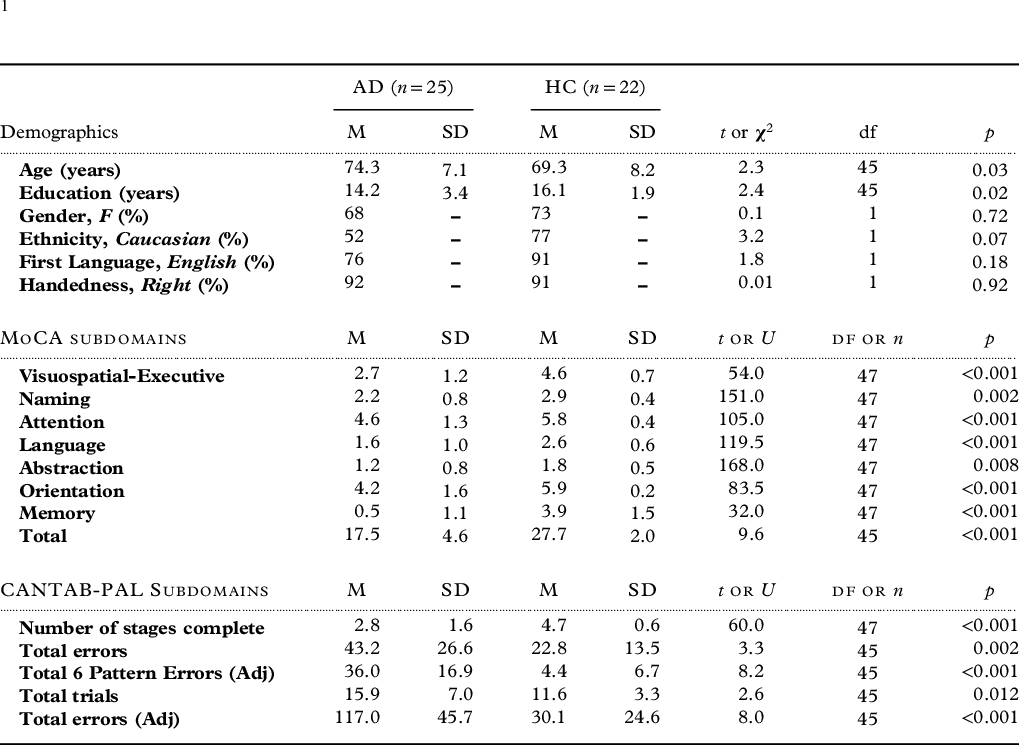
Sixty individuals (35 AD and 25 HC) were recruited, out of which 10 AD and 3 HC participants were excluded because of missing data. The final analysis was based on 47 participants (25 AD, age; mean (SD) = 74.3 (7.1), range = 59–86 years and 22 HC, age; mean (SD) = 69.3 (8.2), range = 61–89 years). Among the participants with AD, 17 (68%) were female, 13 (52%) were Caucasian, and 19 (76%) spoke English as their first language, and had mean (SD) = 14.2 (3.4) years of education. Among the HC participants 16 (73%) were female, 17 (77%) were Caucasian, and 20 (91%) spoke English as their first language, and had mean (SD) = 16.1 (1.9) years of education. There were significant differences between the groups by age (t(45) = 2.3, p = 0.03) and total years of education (t(45) = 2.4, p = 0.017). There were no differences between the groups on gender (χ2 = 0.1, df = 1, p = 0.72), first language (χ2 = 1.8, df =1, p = 0.18), or ethnicity (χ2 = 3.2, df = 1, p = 0.072).
See Table 1 for complete breakdown of demographic information, distribution of MoCA subdomain scores, and the PAL task scores among the sample population, as well as performance differences among diagnostic groups. As expected, the HCs performed significantly better on all MoCA subdomain scores compared to participants with AD; similarly, the HC group performed better on the PAL task.
Demographic and clinical characteristics of the study population

Values are displayed in the unit of measure indicated on the left. Level of significance was set at α = 0.05.
Abbreviations: AD, Alzheimer’s Dementia; HC, Healthy Comparators; n, number of participants; MoCA, Montreal Cognitive Assessment; CANTAB-PAL, Cambridge Automated Neuropsychological Test Battery – Paired Associative Learning; M, Mean; SD, Standard Deviation; df, Degrees of Freedom.
Association between the PAL task and Global Cognition
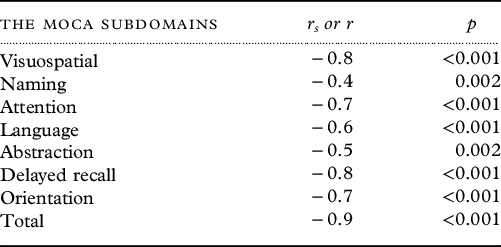
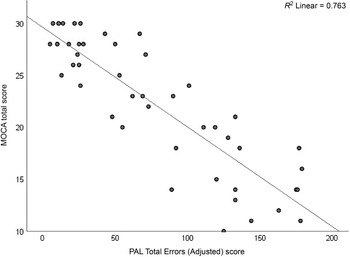
MoCA total score showed a strong positive correlation with the the PAL task Stages Completed score (r = 0.8, p < 0.001), and a strong negative correlation with both PAL Total Errors (adjusted) (r = −0.9, p < 0.001) and PAL 6 Pattern Errors (r = −0.9, p < 0.001) scores. The PAL task Total Errors (adjusted) score was chosen as the primary outcome measure for subsequent analyses. See Table 2 for a summary of the Pearson and Spearman correlations between MoCA total and subdomain scores and PAL Total Errors (adjusted) score. See Figure 1 for a scatterplot of individual PAL Total Errors (adjusted) score and MoCA total Score.
Table showing the correlation between MoCA Subdomain Scores and Cambridge Automated Neuropsychological Battery Paired Associative Learning outcome measure Total Errors (Adjusted)

Level of significance was set at α = 0.05 (2-tailed).
Abbreviations: MoCA, Montreal Cognitive Assessment; r, Pearson’s correlation coefficient; r s, Spearman’s rho; p, significance value.
Scatterplot showing correlation between the Cambridge Automated Neuropsychological Test Automated Battery Paired Associative Learning Task Total Errors (Adjusted) Score and the Montreal Cognitive Assessment Total Score. R 2 = 0.763. Abbreviations: PAL, Paired Associative Learning; MoCA, Montreal Cognitive Assessment.

Ability of the PAL task to predict global cognitive function and cognitive subdomains
Our linear regression analysis demonstrated the ability of the PAL task Total Errors (adjusted) score to predict MoCA Total Score, with a significant regression equation (R 2 = 0.78, F 4, 46 = 37.2, p < 0.001). For a change of one unit in the PAL task Total Errors (adjusted) score, the MoCA Total Score decreased by 0.09 (Standardized β = −0.8, p < 0.001) (Table 3).
Results of linear regression assessing the utility of the Cambridge Automated Neuropsychological Test Battery Paired Associative Learning (PAL) task Total Errors (adjusted) score to predict Montreal Cognitive Assessment (MoCA) total score

Dependent variable: MoCA total score; Independent variable: PAL Total Errors (adjusted) score; Covariates: age, gender and total years of education.
Abbreviations: PAL, Paired Associative Learning; Std, Standard Error; t, t-statistic; p, significance value.
Usefulness of the PAL task as a standalone screening tool to detect AD
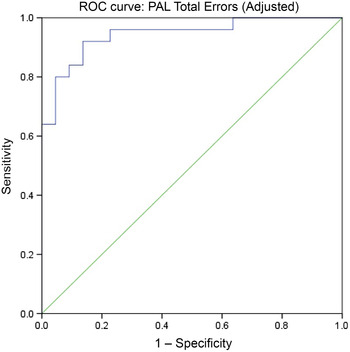
On the ROC analyses PAL task Total Errors (adjusted) score showed an excellent ability to differentiate between groups with an area under the curve = 0.94 ± 0.033 (95% CI: 0.88–1.00, p < 0.001). We chose an optimal cut-off point of the PAL Total Errors (adjusted) score of 54 errors that maximized the Youden index (sensitivity = 92%, specificity = 86%, and Youden index = 0.78) (Figure 2).
Receiver operating characteristic curve evaluating the ability of Cambridge Automated Neuropsychological Test Automated Battery Paired Associative Learning Task in distinguishing individuals with Alzheimer’s Dementia from healthy comparators. Area under the curve = 0.944 ± 0.033 (95% CI: 0.888–1.00), p < 0.001). An optimal cut-off of 54 errors was chosen, with 92% sensitivity and 86% specificity. Abbreviations: ROC, Receiver Operating Characteristic; PAL, Paired Associative Learning.

Discussion
To our knowledge, this is the first study to investigate the relationship between the commonly used cognitive screening tool, the MoCA, and the PAL task. As hypothesized, performance on the PAL task showed a strong association with performance on the MoCA. Further, the PAL task Total Errors (adjusted) score successfully predicted MoCA total score and distinguished patients with AD from HCs with a high sensitivity (92%) and specificity (86%).
The strong correlation of the PAL task performance with MoCA total score (r = −0.9, p < 0.001) suggests that the PAL task is sensitive to global cognition. This is further supported by findings from our linear regression model, where the PAL task accurately predicted MoCA total score after adjusting for age, gender, and total years of education. These findings are in line with previous studies that demonstrate the utility of the PAL task for assessing global cognition (Chandler et al., Reference Chandler2008; Egerhazi et al., Reference Egerhazi, Berecz, Bartok and Degrell2007; Fowler et al., Reference Fowler, Saling, Conway, Semple and Louis2002; Smith et al., Reference Smith, Need, Cirulli, Chiba-Falek and Attix2013). In our study, all MoCA subdomain scores were associated with the PAL task performance. We found a strong association between the PAL task and MoCA on both visual (r s = −0.8, p < 0.001) and Verbal Memory (r s = −0.8, p < 0.001). This suggests that the PAL task may assess both visual and verbal memory, and that it may be sensitive to impairment in key areas of the brain related to encoding and retrieval of information (Chetelat et al., Reference Chetelat2003). This is important from the diagnostic perspective as verbal memory impairment is the most characteristic impairment in patients with AD, and predicts conversion from MCI to AD (Kaur et al., Reference Kaur, Edland and Peavy2019; McKhann et al., Reference McKhann2011). The MoCA visuospatial and executive subdomain scores assess the ability to plan and execute, problem solving skills, and cognitive flexibility (Nasreddine et al., Reference Nasreddine2005). In our study, there was a significant negative correlation between the PAL task performance and the MoCA visuospatial and executive subdomain (r s = −0.8, p < 0.001). Furthermore, the PAL task performance was strongly associated with the MoCA attention subdomain score (rs = −0.7, p < 0.001), whereas the association with language (rs = −0.6, p < 0.001), naming (rs = −0.4, p < 0.01), and abstraction (rs = −0.5, p < 0.01) subdomain scores were relatively weaker. Finally, performance on the PAL task correlated to the MoCA orientation subdomain score (rs = −0.7, p ≤ 0.001). Impairment in orientation has been shown to be the most significant standalone predictor of activities of daily living in patients with dementia (Razani et al., Reference Razani2007; Reference Razani2009).
Our results suggest that the PAL task may be relevant for AD screening, as shown by its ability to differentiate HCs from participants with AD with a high degree of sensitivity (92%) and specificity (86%). This is comparable to other commonly used screening tests. Using a cut-off score of 26, the MoCA can detect AD with 90% sensitivity and 87% specificity (Nasreddine et al., Reference Nasreddine2005). Using a cut-off score of 24, the MMSE is able to detect AD with a sensitivity of 85% and a specificity of 90% (Trivedi, Reference Trivedi2017). The PAL task is easy to administer and is free of cultural and language biases (Bosco et al., Reference Bosco2017; Rossetti et al., Reference Rossetti, Lacritz, Cullum and Weiner2011). The sensitivity and specificity of the PAL task is superior to other shorter screening tests such as Mini-Cog and clockdrawing test (Lin et al., Reference Lin2013; Milian et al., Reference Milian, Leiherr, Straten, Muller, Leyhe and Eschweiler2012). Because of the broad range of the PAL Total Errors (adjusted) score, the sensitivity and specificity can be easily adjusted by changing the cut-off score. In our study, a PAL Total Errors (adjusted) cut-off score of 45.5 had a 96% sensitivity and 77% specificity, whereas a score of 72 had 80% sensitivity and 96% specificity (Figure 2). The results of our study are consistent with previous studies of the PAL task that have demonstrated the ability of the PAL task to differentiate AD from HC (Fowler et al., Reference Fowler, Saling, Conway, Semple and Louis2002; Swainson et al., Reference Swainson2001) in combination with other cognitive tasks. However, this is the first study to report the detailed psychometric properties of the PAL task using a ROC analyses. The PAL task requires little training for administration and can be implemented into clinical practice with ease (Barnett et al., Reference Barnett, Blackwell, Sahakian and Robbins2016).The PAL task measures have a wide range of possible scores, with no ceiling effect, and due to the essentially unlimited number of combinations of patterns, practice effects are unlikely (Barnett et al., Reference Barnett, Blackwell, Sahakian and Robbins2016). Further, it is administered in digital format, which is helpful for data collection and storage for clinical or research purposes. Finally, the PAL task has signficant potential for further adaptations, such as applications for mobile devices that would allow the test to be self-administered at home, through following simple, on-screen instructions or while waiting in a physician’s office. The circumstances surrounding the COVID-19 pandemic have already caused a significant shift to virtual medical care for vulnerable populations such as patients with AD (Webster, Reference Webster2020). Thus tools like the PAL task, that have the capacity to be delivered virtually, are likely to be in increasing demand (Brown et al., Reference Brown, Kumar, Rajji, Pollock and Mulsant2020). Our findings will hopefully promote research into further validation of PAL task as a screening tool for AD in community samples and development of generic, user friendly versions that can be used free of cost. This can help improve screening and diagnosis for cognitive impairment that are essential to address longstanding barriers to care for people with dementia (Parker et al., Reference Parker, Barlow, Hoe and Aitken2020).
PAL tasks are likely to be valuable for research studies looking into mechanisms or treatment interventions for AD as performance on PAL taps into specific cortical regions and associated connections (Barnett et al., Reference Barnett, Blackwell, Sahakian and Robbins2016). Previous studies have demonstrated that the hippocampal formation is fundamental in successful completion of spatial memory tasks, and that impaired performance on the PAL task correlates with the extent of the lesion (Parkinson et al., Reference Parkinson, Murray and Mishkin1988; Smith and Milner, Reference Smith and Milner1981). Whole brain functional MRI showed widespread activation of cortical areas during the encoding and retrieval stages of PAL. Specifically, the inferior and middle frontal gyri, superior temporal gyrus, middle occipital, and cingulate gyri were activated during encoding and posterior cingulated, and left cuneus were activated during the retrieval stage (de Rover et al., Reference de Rover2011). Lesions in the entorhinal cortex have been shown to correlate with poor performance on associative memory tasks (Rosene and Van Hoesen, Reference Rosene, Van Hoesen, Jones and Peters1987), a region that is commonly affected in individuals with AD (Hyman et al., Reference Hyman, Van Hoesen, Damasio and Barnes1984). Thus future studies should examine association of PAL task performance with other biomarkers and in relation to treatment interventions targeting these regions.
Our study has several limitations, first, we had a relatively small sample size and a selective cohort with a high prevalence of AD; however, our cohort did include a diverse population from a cultural and language perspective. Replication of these findings in a larger population-based cohort is required before definitive conclusions can be established. Second, the HC group was younger and had greater number of years of education compared to the AD cohort; however, we controlled for these variables in our analyses. Third, we used the MoCA, rather than a comprehensive neuropsychological battery for our measure of global cognitive function. However, our participants were diagnosed with dementia using the core NIA-AA criteria, a standard in the field. Moreover, the MoCA has a high sensitivity and specificity to detect AD and is used commonly in clinical practice. Fourth, we did not study biomarkers of AD pathology, so our diagnosis of AD was based on clinical presentation. Fifth, we did not include a population with MCI. Future studies should examine the ability of the PAL task to distinguish patients with MCI from healthy cohorts and those with dementia. Finally, we did not include participants with dementia other than AD. Future studies are needed to determine if the PAL task can help differentiate between dementia subtypes.
Conclusion
Findings from this study suggest that performance on the PAL task may be used to assess global cognition and several other cognitive domains in addition to memory. Further, the PAL task may be able to differentiate between healthy individuals and patients with AD with high degrees of sensitivity and specificity, thus raising the potential for the PAL task to be used as a standalone screening tool for AD. This may have significant implications for clinical practice and research studies. Further research is required to validate and develop the PAL task into a patient and clinician-friendly standalone screening tool.
Conflicts of interest
None.
Description of authors’ roles
Study concept and design: EBH, SK.
Acquisition of data: AB, ZG, BGP, SK.
Analysis and interpretation of data: EBH, NA, AB, ZG,WW, BGP, TKR, SK.
Preparation, review and approval of final manuscript: EBH, NA, AB, ZG,WW, BGP, TKR, SK.
Acknowledgements
This study was supported in part by NARSAD Young Investigator Grant from the Brain & Behavior Research Foundation to SK. Grant Number: 22293, and by internal funding from CAMH.
In addition the authors report the following acknolwedgements:
BGP research support from the Peter & Shelagh Godsoe Endowed Chair in Late-Life Mental Health, CAMH Foundation and Discovery Fund, National Institute of Aging, Brain Canada, the Canadian Institutes of Health Research, the Alzheimer’s Drug Discovery Foundation, the Ontario Brain Institute, the Centre for Aging and Brain Health Innovation, the Bright Focus Foundation, the Alzheimer’s Society of Canada, the W. Garfield Weston Foundation, the Weston Brain Institute, the Canadian Consortium on Neurodegeneration in Aging and Genome Canada. Honoraria from the American Geriatrics Society. He holds United States Provisional Patent No. 16/490,680 and Canadian Provisional Patent No. 3,054,093 for a cell-based assay and kits for assessing serum anticholinergic activity.
TKR research support from Brain Canada, Brain and Behavior Research Foundation, BrightFocus Foundation, Canada Foundation for Innovation, Canada Research Chair, Canadian Institutes of Health Research, Centre for Aging and Brain Health Innovation, National Institutes of Health, Ontario Ministry of Health and Long-Term Care, Ontario Ministry of Research and Innovation, and the Weston Brain Institute. He also received in-kind equipment support for an investigator initiated study from Magstim, and in-kind research accounts from Scientific Brain Training Pro.
SK research support from Brain and Behavior Foundation, National institute on Ageing, BrightFocus Foundation, Brain Canada, Canadian Institute of Health Research, Centre for Ageing and Brain Health Innovation, Centre for Addiction and Mental Health, University of Toronto. He receives equipment support from Soterix Medical Inc.