Introduction
Taking the throne after his father Ardashir, Shapur I launched an attack on the Romans at Hatra (AD 242) during the first years of his kingdom and succeeded in capturing it. Rome defines the fall of Hatra as casus belli persici, meaning in other words that they considered it a cause for war with the Sasanians.Footnote 1 In the following years, under the leadership of Shapur I a series of battles (Misikhe, Barbalissos and Edessa-Karrhae) took place between the Sasanian and Roman empires, and the Sasanians gained a very important victory over the Romans in all of them. As a result of these battles, the Sasanians fortified their borders with Rome in the west and Rome was forced to pay tribute.Footnote 2 In fact, these wars do not imply that Sasanians settled in Roman lands up to the EuphratesFootnote 3 but it is clear that Sasanians got prestige as a result of the wars. To perpetuate his victories, Shapur I carved rock reliefs upon his return to Iran.Footnote 4 These reliefs were the symbols to represent Sasanian superiority over Rome.Footnote 5 The reliefs in different parts of the Persian province—one at Darabgird, three at Bishapur and one at Naqsh-i Rustam—were carved in honor of his victory, and the two Roman emperors were depicted as bowing before him.Footnote 6 Besides this, in the relief at Bishapur, Shapur is shown riding his horse with Valerianus kneeling before him. At the same time the symbols depicted in these reliefs were also used on coins and cameos. These scenes were reproduced on gold coins minted by Shapur and also on the reverse of the bronze coins of the king of Merv which were minted with the permission of Shapur.Footnote 7 Also, the crown Shapur is depicted as wearing in these reliefs (except for the relief at Darabgird) is the same as the crown used in some types of Shapur coins.Footnote 8
Meanwhile, Shapur also represents his superiority by describing himself differently from his father Ardashir in some of his inscriptions, using the expression Ērān ud Anērān—“the king of the kings of Iranians and non-Iranians.”Footnote 9 In the literature, it is stated that no drachm coins minted in Shapur’s time includes the term Anērān. However, we have recently found that a new silver drachm of Shapur I in the Elazığ Museum of Archeology and Ethnography in Turkey has this term as part of its legend. This article aims to introduce this unique silver drachm of Shapur I with its stylistic and typological properties and most importantly it will discuss the implications of using the expression Anērān on the coin by establishing a chronological sequence.
Shapur I and Anērān
Shapur had his trilingual “dastkart” res gestae written on the ŠKZ (Ka’be-ye Zardosht), which was built in the Achaemenids’ time in Naqsh-i Rustam near Persepolis.Footnote 10 In the inscription of Ka’be-ye Zardosht, Shapur describes himself, like his father, as Shahanshah but also adds another expression. This is the concept of Ērān ud Anērān “the king of the kings of Iranians and non-Iranians.”Footnote 11 The term Anērān included the territories outside the region of Iranshahr that his ancestors made theirs, and which had previously also been resided on by the Parthians.Footnote 12 During the reign of Shapur I, the boundaries of the Sasanian Empire reached their maximum permanent extension both in the west and in the east. Although it is not exactly possible to determine what the expression Anērān (non-Iran) meant for the Sasanians, it can be asserted that Anērān was a concept referring to how the Sasanian Empire governed the outlying territories (outside Iranshhar), which indicates that this concept has a political as well as a religious aspect.Footnote 13 The lands which were directly dependent on the king and ruled by the Sasanians, such as Syria, Armenia, Cilicia, Iberia, Albania and Balasagan, were regarded as Anērān. Footnote 14 During the time of Narseh, the Sasanians were defeated by the Romans, and consequently the expression of Anērān was omitted from some of King Narseh’s coins.Footnote 15 No coins minted in Shapur’s time including the term Anērān have been found (except for a gold dinar). Thus, it is supposed that this term was used for the first time on the coins of Ohrmazd I, who was the first son of Shapur.Footnote 16
In ŠKZ Shapur I defines himself as follows:
An, mazdēsn bay Šābuhr, šāhān šāh Ērān ud Anērān, kē čihr az yazdan, pus mazdēsn bay Ardašīr, šāhān šāh Ērān, kē čihr az yazdan, nab bay Pābag šāh, Ērānšāhr xwadāy hēm … Footnote 17
the Mazda worshipping divine Shapur, King of Kings of Iranians and non-Iranians, whose lineage [seed/image/splendor] is from the gods, son of the Mazda worshipping divine Ardashir, king of kings of Iran, whose lineage [seed/image/splendor] is from the gods, grandson of king Papak, am ruler of Iranshahr …
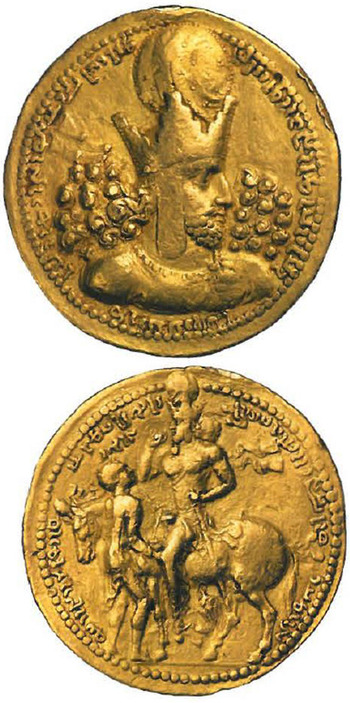
As far as can be surmised from these expressions, Shapur presents his father, Ardashir, as “the king of the kings of Iranians” and himself as “the king of the kings of Iranians and non-Iranians.” In the same way, in the bilingual inscription in ŠKZ, Shapur mentions Pabag only as a “king,” Ardashir as “the king of kings of Iran,” and himself as “the king of kings of Iran and non-Iran. Likewise, Shapur is mentioned as the king of Ērān ud Anērān in ŠNRb, ŠKZ, ŠH, ŠTBq and ŠVŠ inscriptions.Footnote 18 Shapur’s coins that are known so far do not include the term Anērān used in these inscriptions; only the expressions “The King of Kings of Iranians” and “the king of Iran” are used. However, a gold dinar (gold coin) of Shapur (see Figure A1 in the Appendix) on which the term Anērān is written has been found by Alram et al.Footnote 19 The obverse of this gold dinar is as follows:Footnote 20
mzdysn bgy šhpwhry MLKAn MLKA ’yr’n MNW ctry MN yzd’n; mazdēsn bay Šahpuhr šāhān šāh Ērān kē cihr az yazdan.
the Mazdayasnian (divine) majesty, Shapur, King of Kings of Iranians and non-Iranians, whose “lineage” is from the gods.Footnote 21
After the death of Gordianus III, Philippus Arabs had to agree to a peace treaty against the interests of Rome with Shapur in 244. On the reverse of this gold dinar, Shapur is depicted on horseback facing left and Philippus Arabs kneels before the king with outstretched arms. We see the same depiction on the Naqsh-i Rustam and Bishapur reliefs. This is an obvious iconographic reference to the superiority of the Sasanian king over the Roman Emperor.Footnote 22 The presence of this gold dinar can be read as an implication that Shapur might have used the term Anērān not only on his reliefs but also on his other coins in circulation.Footnote 23
Based on the inscriptions and coins, we can classify the titles used on Shapur’s coins as the following:
-
1. mzdysn bgy šhpwhry MLKA ’yr’n MNW ctry MN yzd’n; mazdēsn bay Šahpuhr šāh Ērān kē cihr az yazdan: “The Mazda-worshipping divine Shapur, King of the Iranians, whose lineage [seed/image/splendor] is from the gods.”
-
2. mzdysn bgy šhpwhry MLKAn MLKA ’yr’n MNW ctry MN yzd’n; mazdēsn bay Šahpuhr šāhān šāh Ērān kē cihr az yazdan: “The Mazda-worshipping divine Shapur, King of Kings of the Iranians, whose lineage [seed/image/splendor] is from the gods.”
-
3. mzdysn bgy šhpwhry MLKAn MLKA ’yr’n ud ’nyr’n MNW ctry MN yzd’n; mazdēsn bay Šahpuhr šāhān šāh Ērān ud Anērān kē cihr az yazdan: “The Mazda-worshipping divine Shapur, King of Kings of the Iranians and non-Iranians, whose lineage [seed/image/splendor] is from the gods.”
Also, K. Mosig-Walburg adds another title to Shapur’s and claims that the coins, like the inscriptions, include the term “ud Anērān.”Footnote 24 However, this claim is not accepted as convincing by R. Gyselen. She proposed that these expressions were not encountered in any example, and the coin which K. Mosig-Walburg claims includes this expression is not legible.Footnote 25 Also, such a drachm coin is not recorded in the works of scholars on Sasanian coins, such as F. D. J. Paruck, R. Göbl, M. Alram, R. Gyselen, N. Schindel, A. Gariboldi and others.
A new silver drachm of Shapur I
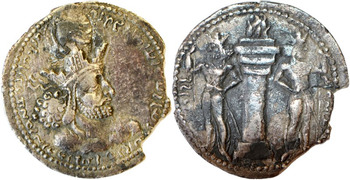
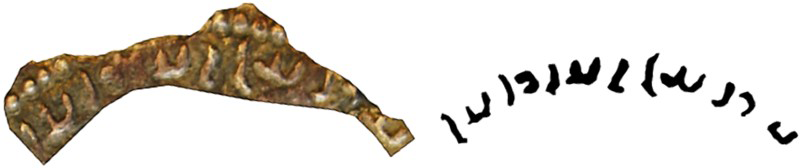
There is a silver drachm of Shapur I in the Elazig Museum of Archaeology and Ethnography (in Eastern Turkey). It was recorded in the inventory of this museum in 1975. Since the museum acquired this coin through purchase, where it was found is unfortunately unknown. This drachm may shed light on a controversial point since we have found the expression Anērān in the legend of this coin.
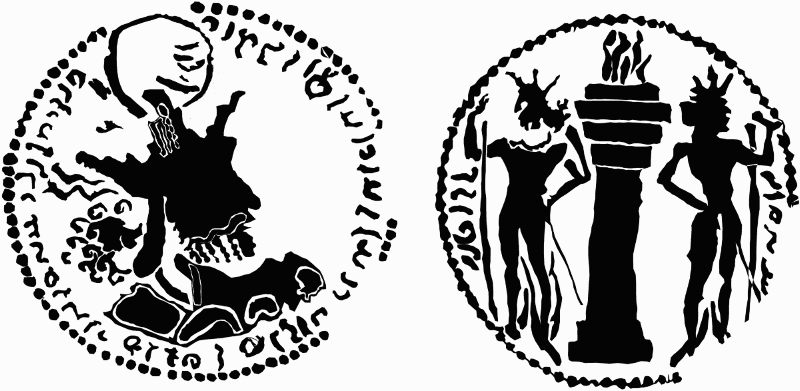
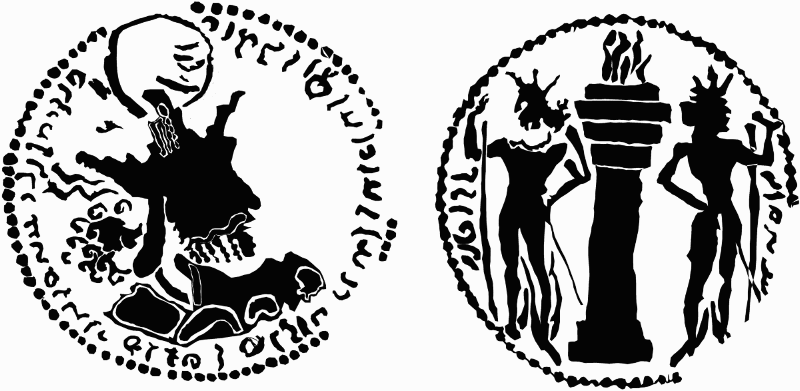
In the coin shown in Figures 1 and 2, Shapur I is portrayed facing to the right. As in other coins of Shapur I, he is depicted wearing a mural crown, with curly hair and a beard. However, one can easily see that the king’s beard (imperial) is shorter on this coin compared to all his other coins. In fact, it could be asserted that the imperial beard disappeared because of corrosion, but since the coins did not corrode too much this is quite unlikely. Besides, a korymbos is located at the top of the crown and the crown engraved on the obverse of this coin continues down to the king’s neck, with the portion that covers his ears bent backward.
AR. Silver drachm 4.05 g. 26.62 mm. Elazig Museum of Archaeology and Ethnography. Inv. No: 75/12.1 (3h. broken).

Drawings of the obverse and reverse of the coin.
Source: Author.
Stylistic and Typological Analysis
When we look at the types and styles of Shapur I’s coins in Sylloge Nummorum Sasanidarum (SNS-1), we see that there are two styles of coins along with their variations. The coins minted in the first years of Shapur I’s reign are accepted as type I. On the obverse of the type I coins, the king is depicted with an eagle cap like a kolah on his head.Footnote 26 On the other hand, starting from the battles with Romans until the end of Shapur’s reign, generally coins of type II are issued. When compared to the coins of type II, we see that the current coin also has the mural crown that Shapur I regularly used in his type II coins.Footnote 27 The crown of the king on the obverse of type IIb coins in SNS-1Footnote 28 and the crown on the current coins carry some similar properties.
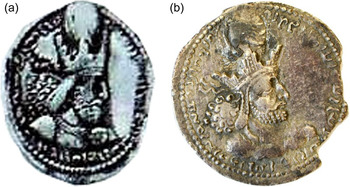
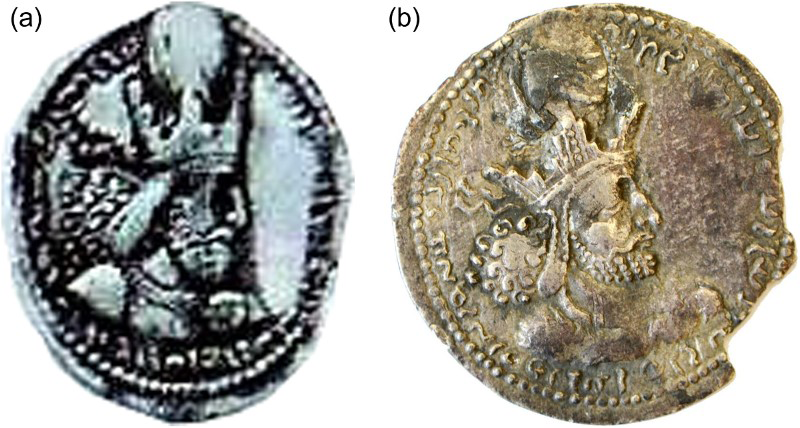
The drawing of type IIb coin from SNS-1 shown in Figure 3a shows the crown of the king on the obverse. When Figures 3a and 3b are compared, one can easily realize the differences as well as similarities. First of all, the shapes of diadem on the coins are different: the diadem of type IIb is thicker and ribboned while the diadem of the current coin is thinner and without ribbons. Second, the merlons of the crown on the current coin are more open than the ones on type IIb. Third, the position of the korymbos on the top of mural crown is different. Moreover, the crown on the current coin is probably ornamented with pearls. On the other hand, on both coins, the portion of the crown covering the king’s ears is bent slightly backward in a similar way. This type of crown is exceptional and peculiar to specially issued coins such as type IIb. Since type IIb coins are associated with the style A, the current coin might be typologically accepted as a different variation of type IIb and style A.
(a) The crown depicted in type IIb; (b) The crown depicted on the current coin.
Source: Alram and Gyselsen Sylloge Nummorum Sasanidarum, Pl. 21, A11.
In addition, the king is probably wearing a pearl necklace. Also, the depiction of the king with curly hair and beard on the obverse of the current coin is similar to the properties that we see on the coins classified as type IIc. Despite their typological similarities, the king’s beard (imperial) is not long and tied, which in turn makes this coin different from all other coins. The diadem on the current coin is similar to the one on the coins of type-IIc. In fact, as a specially issued coin, the current coin is not totally similar to any of the types of Shapur I’s coins classified so far even though it has some commonalities with IIb and IIc. The type of the crown, the hair and beard as well as the legend make this coin different from other coins. Therefore, making a stylistic classification of this coin with respect to certain types and groups might be misleading.
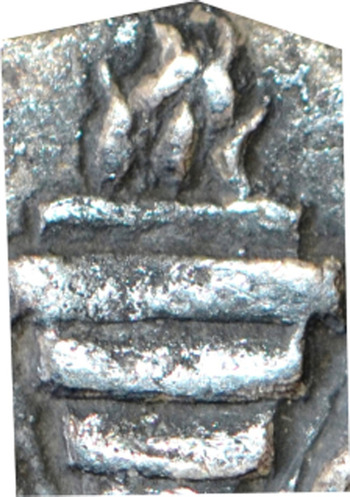
On the reverse of the coin, on the other hand, the fire altar and the two attendants are represented as turning their back to the altar,Footnote 29 and they are portrayed wearing mural crowns or else there is a dual image of the king who is the protector of the holy fire.Footnote 30 However, although there is a korymbos on the mural crown of the king on the obverse, the attendants on the reverse have only mural crowns without korymbos. This makes us think that the figures on the reverse represent just two attendants (maybe protectors of the holy fire) rather than the dual image of the king. Thus, evaluating one of the figures which stands next to the altar as the king and the other as the deityFootnote 31 does not seem reasonable because in order to make such division, the figure which is accepted as the deity (generally the one on right side of the altar) must have a distinctive characteristic from the other, yet there is a small chance of one of the figures being a king and the other god, presuming they are delineated in the same way. Furthermore, when compared to the reverse of the other coins, the type of crown depicted on the current coin is more similar to the one on the type 1b, but one cannot see the cloth hanging down from the arms of the attendants facing back to the fire altar. Although the position of the attendants is similar to the position of the attendants on the reverse of type IIa2/1(b) coins, it is not totally the same. Also, the way the flames on the fire altar are represented on this coin differs (see Figure 4), being peculiar to this current coin.
Flames on the fire altar of the current coin. Detail of Figure 1.

Although the reverse of the current coin has properties similar to type 1a and 1b, it cannot be classified as either 1a or 1b since it exhibits some basic differences from both types. Therefore, we also need to consider the reverse of the current coin as distinguished from the reverse of Shapur’s other coins. When compared to the position of legend types classified in the SNS-1,Footnote 32 the reverse of this coin can be accommodated into group “a.”
Besides, Gyselen states that there are eleven mints during Shapur’s reign, and his special issued coins such as type I and IIb were probably minted in the principal mint, which was known as Weh-Ardashir mint located in the capital city, Ctesiphon.Footnote 33 Since the current coin is a specially issued coin and it is typologically and stylistically similar to the coins minted in the Weh-Ardashir mint, we think that this coin was also minted in the Weh-Ardashir mint.
The legends
Let us turn the legend on the obverse of this coin:
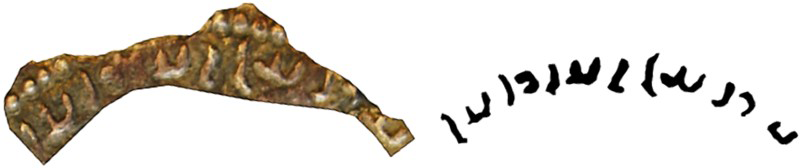
11 h. mzdysn bgy Šhpwhry MLKAn MLKA <’>yr’n W ’nyr’n MNW ctry <MN yzd’n?>; Mazdēsn bay Šābuhr šāhān šāh Ērān ud Anērān kē cihr <az yazdan>.
The Mazda-worshipping divine Shapur, King of Kings of the Iranians and non-Iranians, whose lineage [seed/image/splendor] is from the gods.Footnote 34
The term ’yr’n ud ’nyr’n; Ērān ud Anērān clearly appears on the legend (Figure 5). Another interesting point is the common use of “ā (’)” at the beginning of “A” and at the end of ’yr’n in the expression MLKAn MLKA. Such legend is seen for the first time on Shapur’s drachm coins, which means that this part of the legend can be read as: MLKAn MLK-A-<’>yran (Ērān) ud ānērān (šāhān šāh Ērān ud Anērān.Footnote 35
The expression “Ērān ud Anērān” in the legend. Detail of Figure 1.
The circle legend on the reverse is:
10 h. NWRA [ZY], 4 h. šhpwh[ry]; adūr ī Šabuhr “the fire of Shapur.”
Chronology
As mentioned before, the term “the king of kings of Iranians and non-Iranians” written on the inscriptions but not on the coins has become a controversial topic. It is interesting that the variety of Shapur’s coins in museums around the world do not include such a term. That is why taking this coin as an example of a special issue is quite fascinating. The king is depicted as wearing a mural crown on the obverse of this coin and Göbl classified Shapur’s coins with a mural crown as type I.Footnote 36 Likewise, we argue that when compared to the coins classified in SNS-1 by Gyselen, this coin should also be evaluated within type IIb and style A. Gyselen claims that the coins of type IIb style A coincide with the first years of Shapur I. Although it has some commonalities with style A (type IIb), which continued to be minted for at least thirteen years,Footnote 37 we need to consider this coin separate from this style, as they are not totally alike. Despite the fact that the current coin has some typologically common properties with both IIb and IIc, it is distinct from both as it has a new coin die.
Meanwhile, it is not possible to predict the exact minting date of these coins. We can propose three claims based on the typological and stylistic analysis and the legend of this coin. First, Shapur might have minted this coin after he captured the new lands (i.e., Anērān) with his victory in the battle of Misikhe (AD 244). Second, Shapur could have had this coin minted after his great victory over Romans in the battle of Barbalissos (AD 252/253) when he captured very important regions. He might have deliberately added the expression Anērān on his coins as a reference to these important new captured regions. Third, he could have minted this coin simultaneously with ŠKZ after the battle of Edessa-Karrhae (AD 259/260) as a result of which the Roman Army was defeated and the Emperor Valerian was taken captive. In fact, the first possibility is weak because when the typological, stylistic as well as graphological properties of this coin are considered, it is understood that this coin could not have been minted in the first years of Shapur’s reign. However, the second and third possibilities both seem to be plausible because chronologically it is reasonable to place this coin sometime between the battle of Barbalissos and the battle of Edessa-Karrhae in 261 or in a time period just after this battle (after 261).
As a result of the battle of Barbalissos, Shapur captured important regions such as Antiokheia, Hierapolis, Sura, Zeugma, Dura Europos and Doliche in the Syrian provinces,Footnote 38 thus we can assert that the concept of Anērān might have emerged as a result of this military and political victory. With reference to this hypothesis and concerning the stylistic and typological properties of this coin, we can claim that the minting date of the coin coincides with a period after the battle of Barbalissos. The most important aspect of this coin is the expression Anērān in its legend. Considering the perspective of King Shapur and Sasanian policy, it is reasonable to assume that Shapur started to use the expression Anērān after his great victory over Romans. Accepting this hypothesis implies that we see the appearance of Anērān first on his coins rather than in his inscriptions. However, we know that Shapur used this same expression in his inscriptions carved after 261, which in turn brings up the question of why Shapur waited until 261to re-use the term Anērān in his inscriptions.
In fact, a group of Shapur’s coins found in Gaziantep (southeastern Turkey) and Cilicia (southern Turkey) also gives us an idea about Sasanian’s campaigns in eastern Anatolia and the routes of these invasions.Footnote 39 Pfeiler associates some of these coins with the battle of Barbalissos and others with the battle of Edessa.Footnote 40 Although it is difficult to determine the exact minting date of the current coin, we know that during their campaigns against Rome in 252, Sasanians captured many lands in northern Anatolia including Satala (in the region of Gümüşhane-Kelkit in Turkey). Footnote 41 After the battle of Barbalissos, which took place a very short time after these invasions, Sasanians strengthened their political existence in these territories. Indeed, Shapur waged a war with Valerianus after capturing a significant part of these lands in this region; thus the campaign of Rome under the leadership of Valerianus against Sasanians was an attempt to retake the lands captured by Sasanians. Also, Shapur captured the lands that were considered as Anērān not after but before holding Valerianus captive, hence he just reinforced his authority in these lands with his victory over Valerianus. In this case, the possibility of using the expression of Anērān after the Sasanian invasions and the victory at Barbalissos in 252 is more plausible than the possibility of proposing that the term Anērān first appears after 260. This, in turn, strengthens the view that the current coin might have been minted after the battle of Barbalissos and before 260.
Note that the gold dinar which features the term Anērān for the first time is evaluated as terminus post quem and Alram dates it after the battle of Edessa.Footnote 42 However, Shavarebi develops a different argumentation about its minting date, arguing that this gold dinar must have been minted before 260 because on the reverse of the gold dinar Philippus Arabs is depicted kneeling before the king. If the gold dinar was minted after 260, then it should be Valerianus not Philippus Arabs who is depicted on the reverse as Shapur’s victory over Valerianus is a more recent and prominent event.Footnote 43 His proposal in a way provides further support for our claim such that Shapur used his long title before 260 and the current coin is dated after the battle of Barbalissos as terminus post quem.
Conclusion
This drachm shows that the term Anērān is not only restricted to Shapur’s inscriptions. It seems that the title (Šāhān šāh Ērān ud Anērān) used on the obverse of this drachm becomes an inspiration for other Sasanian kings after Shapur; thus it is more reasonable to propose that the successor Sasanian kings who used this title on their coins were inspired by Shapur’s coins rather than his inscriptions. We have argued that this silver drachm was a special issue and it is a representative sign of Shapur’s victory against the Roman Empire after capturing Mesopotamia in particular and other countries as well. Thus, this coin is the sign of the Sasanians ruling over those countries taken from the Romans, as mentioned in the Ka’be-ye Zardosht inscription.
Appendix
A gold dinar from Shapur I.
Source: Alram, Blet-Lemarquand and Skjærvø, “Shapur, King of Kings,” fig. 18.