Introduction
Nasal airway filters humidify and warm inspired air and account for 50 per cent of respiratory tract resistance. Nasal congestion (discomfort caused by inadequate airflow through the nose or increased airflow resistance in the nostrils) can indicate anatomical anomalies, inflammatory diseases (such as rhinitis), nasal polyps and tumours.Reference Yepes-Nuñez, Bartra, Muñoz-Cano, Sánchez-López, Serrano and Mullol1 Of the many causes, the most common is nasal septum deviation, for which the definitive treatment is surgery.Reference Gandomi, Bayat and Kazemei2
Nasal congestion can be assessed both objectively and subjectively. Objective methods include endoscopy, computed tomography, measurement of nasal mucociliary transport time, rhinomanometry, magnetic resonance imaging, rhinostereometry and acoustic rhinometry.Reference Hilberg3 Subjective assessments are made using a visual analogue scale (VAS) combined with the Nasal Obstruction Symptom Evaluation questionnaire, which has been validated in patients with various health conditions.Reference Stewart, Witsell, Smith, Weaver, Yueh and Hannley4 The Nasal Obstruction Symptom Evaluation is used to analyse the following issues: (1) nasal congestion (stuffy nose), (2) nasal obstruction (blockage), (3) difficulty in nasal breathing, (4) sleep difficulty and (5) insufficient nasal airflow during exercise.Reference Stewart, Witsell, Smith, Weaver, Yueh and Hannley4
All items are rated on a 5-point Likert scale ranging from 0 to 4 (0 = no problem, 1 = minor problem, 2 = moderate problem, 3 = fairly serious problem, 4 = serious problem). A Nasal Obstruction Symptom Evaluation score of equal to or more than 10 reflects subjective nasal congestion. Anterior rhinomanometry is used to objectively measure nasal airflow, and the pressure difference and resistance between the nasal inlet and the choana. Anterior rhinomanometry (the most widely used form of rhinomanometry) can be applied to analyse the functional consequences of anatomical malformations.Reference Lara-Sánchez, Álvarez Nuño, Gil-Carcedo Sañudo, Mayo Iscar and Vallejo Valdezate5 Anterior rhinomanometry also shows the effects of nasal hyperactivity. Nasal airflow is measured from one nostril while the other is closed with a pressure probe.Reference Hsu, Tan, Chang, Chu, Chiu and Pan6 Acoustic rhinometry analyses sound waves reflected from the nasal cavity. A sound wave is sent into the nose, and the reflection creates a two-dimensional image of the nasal cavity, from which the cavity volume and the geometrical shape can be determined. Acoustic rhinometry is useful for determining the minimum cross-sectional area (the narrowest part of the nasal cavity), which usually lies at the beginning of the inferior nasal concha or in the nasal valve area.Reference Grymer, Hilberg, Pedersen and Rasmussen7
We assessed correlations between objective (anterior rhinomanometry, acoustic rhinometry) and subjective (Nasal Obstruction Symptom Evaluation) tests that were used to evaluate nasal patency in patients undergoing septoplasty to treat nasal septum deviation. The tests were administered pre- and post-operatively.
Materials and methods
Study design and patient selection
This prospective study was conducted in the otorhinolaryngology department of a tertiary university hospital. We enrolled 80 consecutive patients aged 18–54 years who underwent septoplasty to treat nasal septum deviation because they had experienced chronic nasal obstruction symptoms for at least 3 months.
Patients exhibiting inflammatory or infectious sinus disease, nasal polyps (polyposis), nasal valve collapse, adenoid hypertrophy, severe systemic disease (asthma, congestive heart failure, liver cirrhosis, chronic obstructive pulmonary disease or chronic kidney failure) and those who had a history of rhinological surgery were excluded.
All nasal septum deviations were rhinoscopically diagnosed by the same investigator (an ENT physician), and the extent of nasal cavity obstruction caused by septum deflection was graded as 0 (septum in the midline and did not obstruct the passage), 1 (septum obstructed one third of the passage), 2 (septum obstructed two thirds of the passage) or 3 (septum obstructed the entire passage). In total, 44 cases (55 per cent) were graded as 2, and 36 cases (45 per cent) were graded as 3. The validated Nasal Obstruction Symptom Evaluation questionnaire was completed pre-operatively and at three months post-operatively. The Nasal Obstruction Symptom Evaluation includes five questions on perceived nasal breathing problems over the last month, scored on a scale ranging from 0 to 4 (from no problem to serious problems). The raw values range from 0 (no complaints) to 20 (major complaints). The values are typically multiplied by 5 because most scales assessing health-related quality of life yield percentage scores (i.e. from 0 to 100).
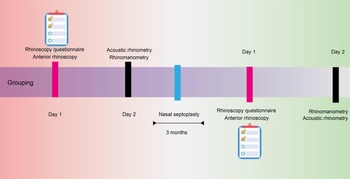
Anterior rhinomanometry was used to objectively assess nasal obstruction (Rhinospir Pro, Sibel, Barcelona, Spain); airflow and resistance were recorded during inspiration and expiration (both nostrils). The minimum cross-sectional area and nasal volume (0–6 and 0–12 cm; V0–6 and V0–12, respectively) of both nostrils were measured via acoustic rhinometry (Ser 2000; RhinoMetrics, Lynge, Denmark). Acoustic rhinometry recordings were obtained in an air-conditioned room maintained at 23°C and 70 per cent humidity, with each patient upright in a comfortable chair after at least 30 minutes of rest. When one nasal cavity was occluded, the other was left open during measurement of resistance. An adapter was connected to a pressure transducer. The face was covered with a tight-fitting anaesthetic face mask, and the patient was asked to close their mouth and breathe calmly through the nose for 16 seconds. Measurements were obtained for each nostril and averaged. The pre- and post-operative data were compared (Figure 1).
Diagram showing study design.

Surgical technique
All surgical procedures were performed by the same surgeon using Killian incision or hemi-transfixion. Mucosa-periosteal and mucoperichondrial flaps were lifted on both the right and left sides of the septum; the affected portion of the nasal septum was then removed, reshaped and repositioned. Care was taken to spare cartilage and bone for structural support. After transseptal suture, an intranasal septal splint (with an airway) was applied.
Statistical analysis
SPSS® software (version 21.0) was used for all analyses. Descriptive data were compared using the paired-sample t-test or Wilcoxon test as appropriate. A p-value less than 0.05 was considered significant. Spearman and Pearson correlation analyses of numerical data were performed. Correlation coefficients (rho values generated by the Spearman test) less than 0.2 were classified as very weak, values of 0.2–0.4 were classified as weak, 0.4–0.6 were classified as moderate, 0.6–0.8 were classified as strong and 0.8–1.0 were classified as very strong.
Results
Eighty nasal septum deviation patients were included in this study. There were 40 (50 per cent) males and 40 (50 per cent) females with a mean age of 29.75 ± 10.72 years (Table 1). The pre-operative and third post-operative inspiratory total resistance, inspiratory total airflow, expiratory total resistance and airflow and rhinomanometry data were compared.
Demographic information of patients

*n = 40; †n = 40; ‡n = 80. SD = standard deviation
The median pre- and post-operative inspiratory total resistance values were 0.277 Pa/l/second (range: 0–3.58 Pa/l/second) and 0.28 Pa/l/second (range: 0–1.53 Pa/l/second), respectively (p = 0.313). The median pre- and post-operative inspiratory total airflow values were 339.65 l/minute (range: 0–1990.5 l/minute) and 521.95 l/minute (range: 0–1578 l/minute), respectively (p = 0.202). The median pre- and post-operative expiratory total resistance values were 0 Pa/l/second (range: 0–4.059 Pa/l/second) and 0.24 Pa/l/second (range: 0–4.059 Pa/l/second) (p < 0.05), respectively. The median pre- and post-operative expiratory total airflow values were 261.45 l/minute (range: 0–2117.4 l/minute) and 312.1 l/minute (range: 0–2145.8 l/minute), respectively (p = 0.164) (Table 2).
Comparison of pre-operative and post-operative rhinomanometry values

ARM = anterior rhinomanometry
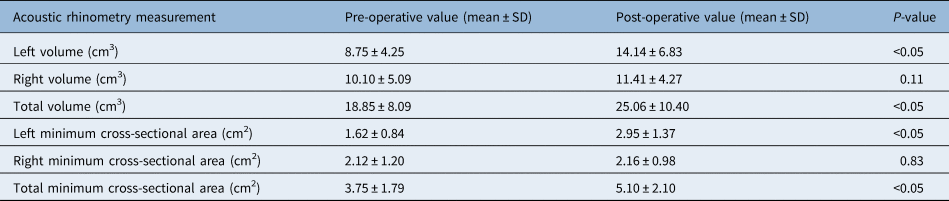
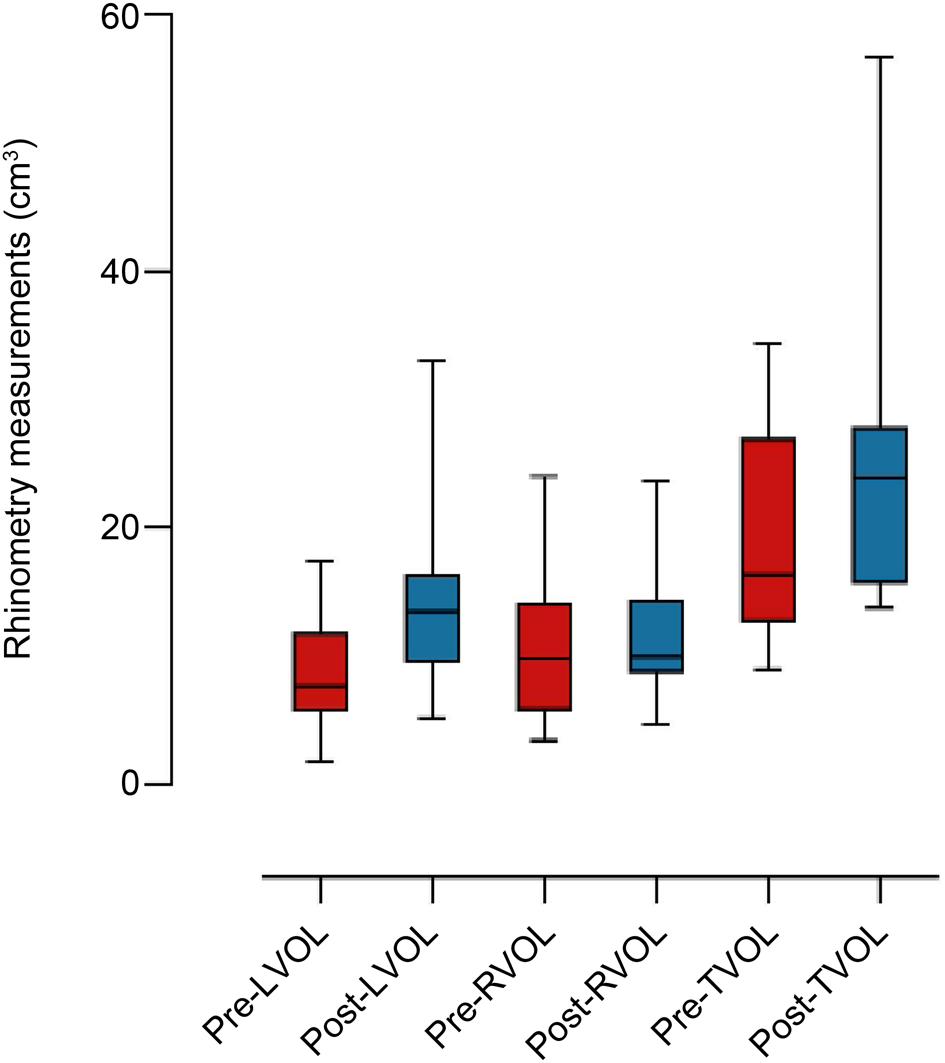
The pre- and post-operative mean left volumes were 8.75 ± 4.25 and 14.14 ± 6.83 cm3, respectively (p < 0.05). The pre- and post-operative mean right volumes were 10.10 ± 5.09 and 11.41 ± 4.27 cm3, respectively (p = 0.11). The pre- and post-operative mean total volumes were 18.85 ± 8.09 and 25.06 ± 10.40 cm3, respectively (p < 0.05). The pre- and post-operative mean left minimum cross-sectional areas were 1.62 ± 0.84 and 2.95 ± 1.37 cm2, respectively (p < 0.05). The pre- and post-operative mean right minimum cross-sectional areas were 2.12 ± 1.20 and 2.16 ± 0.98 cm2, respectively (p = 0.83). The mean total minimum cross-sectional areas were 3.75 ± 1.79 and 5.10 ± 2.10 cm2, respectively (p < 0.05) (Table 3).
Comparison of pre-operative and post-operative rhinometry values

SD = standard deviation
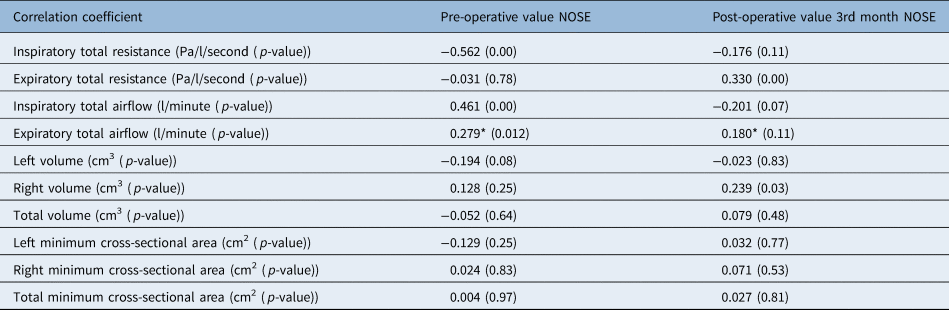
Thus, post-operatively, the acoustic rhinometry left passage and total volumes increased in size, as did the mean surface cross-sectional areas (Figures 2 and 3). The pre- and post-operative median Nasal Obstruction Symptom Evaluation scores were 9 (range: 5–19) and 1 (range: 1–10), respectively (p < 0.05). In terms of percentages, the median Nasal Obstruction Symptom Evaluation values before and after surgery were 45 per cent (range: 25–95 per cent) and 5 per cent (range: 5–50 per cent), respectively (p < 0.05) (Figure 4). We found no correlation between the objective and subjective measurements (Table 4).
Pre- and post-operative acoustic rhinometry volume data. Pre-LVOL = pre-operative left volume; post-LVOL = post-operative left volume; pre-RVOL = pre-operative right volume; post-RVOL = post-operative right volume; pre-TVOL = pre-operative total volume; post-TVOL = post-operative total volume

Pre- and post-operative acoustic rhinometry minimum cross-sectional area data. Pre-LMCSA = pre-operative left minimum cross-sectional area; post-LMCSA = post-operative left minimum cross-sectional area; pre-RMCSA = pre-operative right minimum cross-sectional area; post-RMCSA = post-operative right minimum cross-sectional area; pre-TMCSA = pre-operative total minimum cross-sectional area; post-TMCSA = post-operative total minimum cross-sectional area

Pre- and post-operative Nasal Obstruction Symptom Evaluation scores. Pre-NOSE = pre-operative Nasal Obstruction Symptom Evaluation; post-NOSE = post-operative Nasal Obstruction Symptom Evaluation

Correlations between objective and subjective test data

All values are Rho value for Spearman's test. NOSE = Nasal Obstruction Symptom Evaluation
Discussion
The nasal septum is normally straight and symmetrical. Nasal septum deviation can be caused by genetic and environmental factors, as well as by trauma,Reference Salihoglu, Cekin, Altundag and Cesmeci8 but it is usually present at birth and worsens with age. Moshfeghi et al. found that the nasal septum deviation rate increased by 32 per cent every 10 years, with no gender difference seen in the rate.Reference Moshfeghi, Abedian, Ghazizadeh Ahsaie and Tajdini9 We also found no difference between males and females. Nasal breathing, which is a complex function, is affected by humidity, nasal resistance and contact between inhaled air and the nasal surface. After pure septoplasty, subjective complaints of nasal congestion are alleviated without any change in the internal nasal volume. Septoplasty corrects defects that cause nasal blockage and improves turbulent airflow.Reference Kahveci, Miman, Yucel, Yucedag, Okur and Altuntas10 Patient perceptions of nasal congestion are affected by many physiological and psychological factors. The results of surgery are influenced by the surgical technique, affected veins and nerves, degree of nasal obstruction, and patient expectations. The combination of allergic rhinitis or sino-nasal disease with nasal septum deviation may cause dissatisfaction after surgery.Reference Jessen, Ivarsson and Malm11 Surgeons require objective nasal septum deviation indications; we assessed correlations between objective and subjective test results and found that the Nasal Obstruction Symptom Evaluation score and acoustic rhinometry results improved significantly after surgery. However, the anterior rhinomanometry results did not improve, and were not correlated with any other parameter.
Many studies have evaluated the results of septoplasty; most reported high levels of patient satisfaction, used non-validated questionnaires and were retrospective.Reference Kahveci, Miman, Yucel, Yucedag, Okur and Altuntas10 In the study by Haye et al., the early (first year) and late (fourth year) nasal obstruction values of 604 patients who underwent septoplasty were evaluated using the VAS scale, which is a subjective test. It was reported that there was a significant improvement in the early and late post-operative periods.Reference Haye, Døsen, TarAngen, Gay, Egeland and Shiryaeva12 Jones et al. studied 250 patients and found no significant relationship between subjective nasal congestion and anterior rhinomanometry parameters.Reference Jones, Willatt and Durham13 Güngör et al. found no significant correlation between acoustic rhinometry parameters and VAS scores.Reference Güngör, Moinuddin, Nelson and Corey14 Stewart et al. compared objective and subjective test results for patients with nasal septum deviation and chronic rhinosinusitis but found no significant correlation.Reference Stewart, Witsell, Smith, Weaver, Yueh and Hannley4 Kahveci et al. found that the Nasal Obstruction Symptom Evaluation scores and acoustic rhinometry measurements obtained before and after septoplasty differed significantly, and the two datasets did not correlate.Reference Kahveci, Miman, Yucel, Yucedag, Okur and Altuntas10 van Egmond et al. evaluated nasal obstruction with objective and subjective methods in patients who underwent or did not undergo septoplasty because of nasal septum deviation. Nasal airflow measured by Glasgow Health Status Inventory, Nasal Obstruction Symptom Evaluation scale, Sino-Nasal Outcome Test-22 and peak nasal inspiratory flow was found to be significantly higher in patients who underwent septoplasty. The increase in Glasgow Health Status Inventory was more pronounced. Post-operative follow up continued for 24 months, and the difference between the two groups was greater at 6 months post-operatively.Reference van Egmond, Rovers, Hannink, Hendriks and van Heerbeek15 On the other hand, André et al.Reference André, Vuyk, Ahmed, Graamans and Nolst Trenité16 found that the degree of nasal obstruction correlated significantly with anterior rhinomanometry and acoustic rhinometry parameters, unlike in our study.
• When pre- and post-operative anterior rhinomanometry measurements were examined, no significant differences were observed between measurements
• For acoustic rhinometry measurements, there was a significant increase in volume and minimum cross-sectional area values post-operatively
• When Nasal Obstruction Symptom Evaluation scores were compared pre- and post-operatively, there was significant improvement in symptoms
• The authors concluded that subjective tests are more valuable in evaluating the effectiveness of surgery and patient satisfaction
Døsen et al. studied 126 patients who underwent nasal septoplasty; peak nasal inspiratory flow and VAS data obtained pre-operatively and at 4 months post-operatively were compared, and a significant unilateral correlation was observed.Reference Døsen, Kvinnesland, TarAngen, Shiryaeva, Gay and Haye17 Similarly, in a study on 60 patients, Şahin found a significant correlation between the peak nasal inspiratory flow and Nasal Obstruction Symptom Evaluation scores of 60 patients with nasal septum deviations, both pre-operatively and at 14 days post-operatively.Reference Şahin18
Eren et al. evaluated patient satisfaction according to nasal septum deviation type. Nasal Obstruction Symptom Evaluation, VAS, peak nasal inspiratory flow, acoustic rhinometry and anterior rhinomanometry data for 86 patients were compared between the pre-operative and 6-month post-operative timepoints, and the most significant changes were seen for the VAS and Nasal Obstruction Symptom Evaluation scores.Reference Eren, Tugrul, Dogan, Ozucer and Ozturan19
Unlike the measures described above, the Nasal Obstruction Balance Index, a new instrument developed by Kaura et al., considers unilateral measurements, which produce more meaningful results. A combination of the peak nasal inspiratory flow and acoustic rhinometry data, and a VAS score for nasal obstruction yielded more meaningful results, with objective and subjective correlations being observed, especially on the side of obstruction.Reference Kaura, Pendolino, Navaratnam, Andrews and Leung20
Mondina et al. used two subjective methods (the Nasal Obstruction Symptom Evaluation and Rhinosinusitis Quality of Life Questionnaire) to evaluate patients with nasal septum deviation; the scores correlated strongly.Reference Mondina, Marro, Maurice, Stoll and de Gabory21 Hsu et al. used a VAS, the Nasal Obstruction Symptom Evaluation, and anterior rhinomanometry data to evaluate 50 nasal septum deviation patients pre-operatively and at 3, 6 and 12 months post-operatively; the VAS and Nasal Obstruction Symptom Evaluation scores correlated strongly at all timepoints.Reference Hsu, Tan, Chang, Chu, Chiu and Pan6
Many studies have used computed tomography (CT) to evaluate the effects of septal deviation on nasal obstruction. However, CT does not measure subjective effects. Mamikoğlu et al. compared clinical and CT data and found that they were in partial agreement.Reference Mamikoğlu, Houser, Akbar, Ng and Corey22 Siegel et al. found no significant relationship between clinical symptoms and CT findings.Reference Siegel, Gliklich, Taghizadeh and Chang23 CT is the only objective method for assessing deviation but may be unnecessary. Moreover, it is expensive and exposes patients to radiation. Both subjective and objective tests yielded reliable measurements of treatment efficacy in many studies.Reference Seden, Araz Server, Yigit and Misir24 We suggest that nasal congestion should be evaluated using at least one subjective and one objective method.
Conclusion
Nasal obstruction symptoms recovered according to both objective and subjective measures at three months after septoplasty. We found no correlation between objective and subjective parameters pre- or post-operatively. Nevertheless, we suggest that the subjective Nasal Obstruction Symptom Evaluation is useful for identifying complaints and post-operative patient satisfaction.
Competing interests
None declared