Introduction
Following the lifting of martial law in 1987, Taiwan's labour rose up to claim long overdue rights and a share of the economic growth. Previous studies have shown that the Kuomintang (KMT) government's decision to liberalize gave impetus to labour militancy as workers seized the opportunity to launch their protests.Footnote 1 By making strategic use of the legalized opportunity to organize and demonstrate and by forming an alliance with the political opposition, the Democratic Progressive Party (DPP), workers were able to mount a sustained movement that succeeded in obtaining more favourable legal treatment in terms of working hours, labour protection and policy participation.Footnote 2
But how did labour unions function under the protracted period of KMT authoritarianism? Existing literature indicates that the KMT party branches at workplace level effectively manipulated labour unions so that the latter were prevented from representing the workers' collective interests.Footnote 3 Such negative assessments largely reflect the personal experiences of the first-generation union activists in the post-martial law era. Kang Yiyi 康義益, the first non-KMT Taiwan Petroleum Workers' Union president (1988–1993), characterized the woeful status of the union prior to his presidency as follows:
The union was voiceless. It was nothing but a springboard for career promotion. Members did not know where the union was or who the president was. At that stage, the union was no more than a good-looking but useless ‘vase’. The only mission it accomplished was to preserve the labour union itself.Footnote 4
There exists, therefore, a dichotomous perspective of the role of Taiwan's labour unions before and after 1987. In terms of historical institutionalism, such a polarized image of labour acquiescence and insurgency corresponds to the so-called path dependence explanation that has been increasingly questioned. The path dependence theory assumes that once an institutional design is selected at a particular historical moment, it tends to reproduce itself through a variety of positive feedback mechanisms. It usually takes an external shock of certain magnitude to throw an institution out of its equilibrium and the ensuing crisis opens up the space for institutional innovation.Footnote 5 This dualistic understanding undergirds the current scholarly view of Taiwan's labour unionism. In brief, once the KMT successfully established Leninist control in the aftermath of its ruthless suppression of native resistance, subservient labour unions were formed and perpetuated until democratic opposition rose to challenge the KMT political hegemony in the mid-1980s.
James Mahoney and Kathleen Thelen argue that an uncritical path dependence perspective fails to consider the role of endogenous and incremental changes that can lead to institutional evolution beyond the original purpose. A given institutional design is better characterized as “ambiguous compromise” because the defeated party is always ready to exploit the loopholes to advance their interests even with seeming compliance to the rules.Footnote 6 Particularly helpful to this research is their theorization of “conversion” as a mechanism for institutional change. Conversion takes place when the same rules are “interpreted and enacted in new ways” so that how an institution functions is radically altered from within. More specifically, two conditions conducive for conversion are a “weak veto power of status quo defenders” and a “high level of discretion in interpretation and enforcement” so that “opportunists” are likely to emerge as agents of change.
In this article, I apply this insight in an attempt to understand the gradual evolution of Taiwan's unions from being Leninist front organizations to de facto complaint centres for grassroots workers. As the institution framer and the subsequent status quo defender, the KMT was unable to prevent this process of conversion because unionization was precisely a complement to its party-state control. By providing services and welfare to workers, labour unions operated as the human face of KMT authoritarianism. In addition, although union officers were appointed by their KMT party branch, they had to satisfy the demands of the rank-and-file members who were paying their monthly union dues. It follows that, over the years, union officers had to adopt a flexible interpretation of existing rules in favour of their constituencies. The majority of workers played the role of opportunists in that they practised a “wait-and-see approach” and “exploit[ed] whatever possibilities that exist[ed] within the prevailing system to achieve their ends.”Footnote 7
Prior to political liberalization, labour unions were nominally under the direction of their KMT party branch, but beneath the façade how they actually operated was substantially altered. Under the pattern of what I call “petty bargaining,” a plethora of competitive interest claims were advanced by union officers and duly processed by the management. Thus, in contrast to being “a useless token,” labour unions had surreptitiously set aside the ideological tasks imposed upon them by the KMT and took on the tasks of channelling demands and complaints instead, albeit in a highly distorted fashion. With hindsight, it can be seen that such an incremental change facilitated the rise of the independent labour movement in the late 1980s. As political opportunity opened up, dissident workers took advantage of this existing practice to seize the leadership of their unions.
Given the paucity of scholarly works on the pre-1987 labour unions, I shall adopt a bottom-up approach here. In particular, I focus on workers at the Taiwan Sugar Corporation (TSC) and the China Petroleum Company (CPC). Both state-owned enterprises were formed in 1946 by merging the confiscated industrial properties previously owned by the Japanese. Both followed the pattern of party-state penetration, unionization and labour protests.
The Federation of Industrial Unions of the Taiwan Sugar Corporation (FIUTSC) was organized in 1955 to represent all TSC workers. At that time, the FIUTSC had 30 affiliated unions and 12,827 members.Footnote 8 The Taiwan Petroleum Workers' Union (TPWU) was formed in 1959, initially with five local branches and 4,654 members.Footnote 9 In the 1960s, Taiwan's sugar exports began to decline and the TSC was forced to diversify and downsize. By 2000, the FIUTSC had shrunk to 12 affiliated unions and 4,193 members. In contrast, the state promoted petrochemical industrialization and invested heavily in the CPC in the 1970s. Hence, the TPWU grew and, by 1998, had six local branches and more than 18,000 members.Footnote 10 In this study, most of the discussion focuses on the TPWU Local Branch One, whose jurisdiction covers three subsidiaries in the Kaohsiung metropolitan area and represents roughly one-third of all TPWU members.
A caveat must be added here. The institutional conversion of labour unions identified in this article is applicable only to state-owned enterprises and not to the private sector. The KMT's attempts to penetrate private business met with little success.Footnote 11 With the virtual non-existence of party branches and labour unions in the private sector, the post-1987 activism of those workers followed a different path. More often than not, they began by organizing new labour unions, rather than seizing existing ones, and their tactics were more disruptive (using wildcat strikes rather than negotiation) and targeted employers (instead of asking the state to intervene). Thus, although there was a simultaneous explosion of labour activism in both sectors in the wake of the lifting of martial law, a closer look reveals a different institutional trajectory for private workers. The remarkable and yet little noticed institutional resilience of labour unions was absent in the private sector.
The data for this research come from archival sources, published documents and in-depth interviews. I have consulted the archives collected by the KMT Central Committee History Commission, the Institute of Modern History of Academia Sinica, the TPWU, and the TSC Shanhua善化 Archives. Documents used in this research are published by the CPC, the TSC, the KMT, the TPWU, the FIUTSC as well as other journalistic agencies. Beginning in 2002, I also conducted interviews with workers, union leaders and staff in both companies.
Limited Successes of the Party-State Penetration
The KMT decided to launch a reorganization movement in July 1950, with the avowed aim being to build a broader membership base composed of “intellectual youth, peasants and workers.” In January 1951, the Central Reorganization Commission put in motion its unionization campaign with the ratification of A Guidance Plan for Labour Movement in the Current Stage. Why did the KMT initiate two rounds of reorganization targeting the same groups within such a short span of time? The reorganization was basically an attempt to recruit party members, but why did the KMT find it necessary to complement party branches within the nationalized industries with labour unions?
The simple answer to these questions is that few workers responded to the KMT recruitment campaign. Disillusioned by ethnic discrimination, alienated by the suppression of the 1947 uprising, and traumatized by the subsequent “White Terror” persecution of pro-communist sympathizers, party membership held little appeal for Taiwanese and whilst the fervent anti-communist rhetoric might have resonated among mainlanders forced into exile, it seldom found a receptive audience among Taiwanese workers.
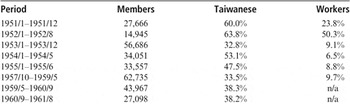
Even though the explicit goal to recruit “producers” (shengchanzhe 生產者) to the party was announced from the outset, the KMT was unable to generate “a high tide of support for our party among the labouring masses.”Footnote 12 An internal report in 1953 openly acknowledged the party's limited progress in recruiting Taiwanese and worker members.Footnote 13 Table 1 shows the makeup of new recruits from the available sources. Recruitment of Taiwanese and workers was highest during the reorganization period (1950–52). After that, the KMT continued to face difficulties in recruiting from these two target groups.
New Recruits to KMT (1950–61)

Note:
Author's calculation of data based on KMT Central Committee Historical Commission 1998, 4–6, 181, 182, 285, 402, 435, 452.
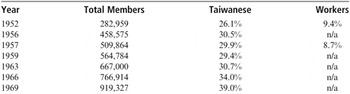
Table 2 further shows that the KMT failed to transform itself into a genuine mass organisation that encompassed producers. Prior to the 1970s, the party was largely made up of public servants and mainlanders as membership at the state-owned enterprises grew slowly. In 1960, roughly only one-third of the TSC employees possessed party membership.Footnote 14

Even among those Taiwanese workers who did join the KMT, political apathy prevailed. Since the recruitment campaign was conducted along the company management lines, rank-and-file worker members were “few and far between even with the protection of a quota system” when it came to party work.Footnote 15 The KMT political workers were frustrated by the workers' apathy, as one TSC cadre revealed:
In the early period of reorganization, the emphasis was placed upon quantity rather than quality. Too many people joined the party reluctantly. Some of our comrades became a burden at the basic level. Because they had less faith in the party, they were frequently absent from meetings without asking for a leave of absence.Footnote 16
Another observation was more forthright:
Worker comrades were less educated. In the beginning, they joined the party en mass without knowing the Three Principles of the People. Their primary motive for joining was just to keep their jobs. After [joining], they did not receive rigorous training and were not placed under the proper leadership or correction. Over time, they became weary and desultory.Footnote 17
In brief, the KMT's attempt to build up its membership base from among the masses was laborious and produced limited success. The majority of Taiwanese workers remained unconvinced by its recruitment campaign, and those who did obtain party membership did so mostly in order to ensure job security. Clearly, the KMT lacked the positive incentives to attract rank-and-file workers and party branches had little influence over a workforce of which only a minority was made up of members who lacked political commitment. It was in this context that labour unions, with their explicit recognition of workers' interests, were seen as vital in facilitating the party-state control and reaching non-partisan workers.
Using “Service” to Win Workers' Loyalty
KMT cadres realized that political indoctrination was not enough to win the hearts and minds of the workers: the key to “successful leadership is to make the masses feel that they are being served rather than being led.”Footnote 18 But the concept of “service” (fuwu 服務) can take on many forms. Taiwan's labour unions were essentially viewed as a means to provide positive incentives to workers. Hence they began to adopt a practice of what could be termed “maximum output by minimal input.”
First, in order to provide services to worker members, the management transferred a number of welfare matters to the labour unions or to the joint supervision of union and welfare committees. In 1981, the TPWU Local One provided training courses, leisure activities, personal services for wedding ceremonies, and transportation for employees' children.Footnote 19 Basically, the union's service covered almost all the needs of the workers and their families.
Secondly, the upkeep of labour unions was purposively kept to a minimum in order to reduce the financial burden to members. Labour unions were treated as if they were an auxiliary unit in the company structure: full-time leaders and staff came from the same pool of employees and continued to receive their regular salaries, whilst the company owned the union offices and underwrote the union's operating expenses.Footnote 20
When the Taiwan Petroleum Workers' Union was set up in 1959, its leaders obtained a loan of NT$500,000 from the company to pay for the first year's expenses.Footnote 21 The worker members at the CPC Kaohsiung Refinery did not have to pay union fees (NT$3) until 1974 as union leaders gained management consent to use a special bonus to pay for the legally-required members' contributions. After that time, the union dues were automatically deducted from the workers' monthly salaries.Footnote 22 However, the monthly dues for labour unions were kept at a ridiculously low level. As late as 1991, unions in Taiwan's state-owned enterprises adopted a flat rate of 20, 30 or NT$35.Footnote 23 Although the majority of union expenses were borne by the company, such low membership fees were still insufficient to support a working labour union.Footnote 24
Finally, with the support of management, the labour unions often operated profit-making businesses in order to generate additional welfare and services for their members. In 1962, the welfare committee of CPC Kaohsiung Refinery “invested” in an oxygen factory, which grew to become a registered company with NT$250,000 in capital and 128 employees at its zenith.Footnote 25 The oxygen-producing facilities were sold by the Kaohsiung Refinery to the welfare committee at a concessionary price.Footnote 26 The same arrangement took place between the TSC and the FIUTSC. The FIUTSC persuaded the management to outsource some business to a company that it operated.Footnote 27 This company provided job opportunities for retired workers and family members of workers.Footnote 28
In short, by providing their members with a plethora of services, labour unions in essence functioned as the human face of the KMT party-state. Labour unions were fashioned to generate maximal benefits and welfare without at the same time stimulating class consciousness among workers. Worker members were encouraged to be the passive recipients of a number of perquisites with the aim of fostering loyalty to the KMT ideology. They had to contribute only a token amount to the financial costs of the union precisely because it was designed to be an organization run for them, but not by them. However, the workers began to view the benefits used to draw them closer to the KMT as an entitlement. There was a fundamental ambiguity surrounding the “service,” and a flexible interpretation of it made possible the process of institutional conversion, as the following analysis will indicate.
Union Officers as KMT Cadres
The KMT agenda was to create a “trinity of party, factory, and labour union” (dang chan hui de sanweiyiti 黨產會的三位一體).Footnote 29 In contemporary literature, labour unions, together with welfare committees and women's mutual help societies (funü huzhuhui 婦女互助會), are often referred to as “external organizations” (waiwei tuanti 外圍團體), with the barely disguised message that party branches functioned as command centres.Footnote 30 But how was the KMT able to achieve the seemingly self-contradictory mission of organizing workers without empowering them? How did the KMT keep the labour unions firmly under its control?
The 1951 Guidance Plan for Labour Movement in the Current Stage laid out the basic procedure. Party branches should be installed first so that they “directed and mobilized (cedong 策動) workers to unionize in order to ensure that the party and labour unions were fully integrated at the basic level.”Footnote 31 The KMT's labour union policy derived from its Leninist principles. Legal organizations were established and penetrated by a party nucleus that operated above legal constraint. Party branches operated using “secret direction and mobilization (mimi cedong 祕密策動) and by exerting leadership from the centre. Open commands and written statements [were to] be avoided so that everything was executed by the [legal] organizations.”Footnote 32 The intention was to use the labour unions as a ‘white glove’ in order to mobilize workers to take part in a series of patriotic rituals.Footnote 33
However, the sensitive nature of class politics meant that the KMT had to employ more elaborate control techniques to ensure submissive labour unionism. Legally required voting procedures were not followed. Prior to 1985, workers at the CPC Kaohsiung Refinery were unable to cast ballots anonymously and many members were unaware of how their union representatives were selected.Footnote 34 In order to create a legitimate façade, the personnel department used workers' personal seals to fabricate voting records.Footnote 35 With the virtual non-existence of rank-and-file participation, the KMT was able to decide upon the candidates for union positions unilaterally, and when it came to the elections, the party branch acted as the de facto campaigning centre for its own candidates.Footnote 36 Who was elected as TPWU president was determined in advance, and there even developed a customary practice of rotating the presidency among the different CPC subsidiaries.Footnote 37
As a result, it became extremely difficult for rank-and-file workers to advance up the union structure and fill the top positions. Unsurprisingly, the union leadership tended to be very loyal to KMT ideology. For example, Zhang Hanmin 張漢民 (TPWU president in 1961–63) was originally a policeman who joined the KMT for military training in 1934. He met the CPC top executives in Shanghai and was able to secure a managerial position in Taiwan in 1947.Footnote 38 Zhang Renlong 張仁龍 is another example of a security agent who obtained a leadership post. He was posted to the Kaohsiung Refinery in 1962 after finishing his training at the Bureau of Investigation. In 1970–72, he served as the TPWU standing director. When his union tenure ended, he was promoted to head up the party work.Footnote 39 The security agents authorized to monitor employees' behaviour were not popular figures among the workers and their promotion to top union positions demonstrates the extent of political manipulation.
In addition, labour union meetings were not allowed to proceed without close monitoring by party cadres. Agendas were always meticulously prepared to prevent dissidents from taking over the meetings, and party branches would even hold meetings in advance in order to prepare for unexpected events.Footnote 40 The KMT party branch leaders as well as company managers were invited to participate in union meetings, and frequently issues related to party work were discussed. Sometimes, delegates were confused about which organization – party or union – should be responsible for a certain project, say the selection of model workers.Footnote 41 Among the KMT cadres at the TSC, it was even suggested that they should reduce the number of party meetings by merging them with union meetings, in order to “achieve more with less effort.”Footnote 42
Finally, the president, standing directors, directors and representatives had fixed tenure, and thus they were necessarily less informed than the permanently employed union staff (huiwu renyuan 會務人員). Frequently, it was the staff rather than their nominal superiors who were effectively managing the unions. As union staff members (for example, section chiefs (zuzhang 組長) and secretaries (ganshi, shuji or mishu 幹事, 書記, 祕書)) were usually the employees dispatched by the company, rather than independently hired by the union, they were more subservient to the KMT. Mainlanders, whose loyalties were more likely to lie with the KMT, were reported to be overrepresented among union staff.Footnote 43 In 1978–83, 9.5 per cent of the FIUTSC union representatives were mainlanders, but among the FIUTSC staff, the ratio was 57.1 per cent.Footnote 44 In fact, the same KMT cadre who oversaw the treasury of the party branch at Kaohsiung Refinery also took charge of the TPWU Local One treasury.Footnote 45 Thus, the KMT was able to keep the union leadership firmly in the hands of its cadres.
Converting Labour Unions from Below
According to Leninist theory, labour unions fall into the category of “front organizations,” which are undogmatic, flexible and “sensitive to the shifting requirements of local and temporary conditions, but firmly guided in whatever they [a]re doing by the party's leaders.”Footnote 46 In other words, they were designed to organize the workers into a mobilizable source of power. Ideally, the command centre issues orders from above, and the periphery is allowed to raise suggestions only insofar as they improve the workings of the whole system but not exclusively for its own “narrow” self-interests. The KMT's 1951 Guidance Plan exemplified this principle by declaring that workers' “historical mission and supreme interest” was the struggle for national independence from communist aggression. “The protection of workers' interests” was mentioned as a goal, but it was placed behind anti-communism, “political democracy” and “economic efficiency.”Footnote 47
Thelen suggests that conversion is likely to occur with “the incorporation of new or previously excluded groups … into a pre-existing institutional framework.”Footnote 48 In the case of Taiwan's state workers, it was the compulsory unionizing that incorporated them into the party-state control structure. They were “losers” in the immediate post-war turmoil, and remained marginal in the KMT's reorganization campaign. Union membership provided them with a sense of stakeholdership. Union-provided benefits and welfare were no longer seen as a free gift by the generous management, but rather their legitimate share that had been deducted and withheld from their monetary payment.
Contrary to what the KMT might have expected, a pragmatic attitude towards labour unionism emerged rather early, as revealed in a 1958 survey of KMT members. More than half of the respondents thought that the primary tasks of the labour union were “protecting members' interests” and “taking care of members' welfare,” while less than 10 per cent chose the politically correct option of “promoting members' political understanding.”Footnote 49 It could be safely argued that such an instrumental perspective would be more prevalent among non-KMT members.
To enable it to penetrate every workplace, the KMT implemented a cell system (xiaozu 小組) within the union structure. A cell normally comprised 10–15 members and a leader (xiaozuzhang 小組長). Cell leaders were supposed to convey orders to the rank-and-file members and ensure the latter's compliance. Over the years, a sort of capillary action took place as cell leaders began to relay the grassroots grievances to higher level union officers, who then had to take measures to satisfy their constituencies.
Chen Xiqi 陳錫淇, who served as the FIUTSC president in 1972–76, described how he tried to improve the members' benefits:
I persuaded the TSC to earmark money to hold recreational activities, such as a singing contest. I was often in a fight with our general manager, and he bitterly complained to the KMT secretary Mr. Cai that the party should have not selected a demanding person like me to be the union president. Mr. Cai supported me. He said, “Chen Xiqi is a good union leader. He reports the real situation of rank-and-file members to us. He is our eye.”Footnote 50
Mr. Cai's explanation underscores the fact that labour union leaders had space to manoeuvre. To work as the party's eye, they had to win the hearts and minds of the rank-and-file members and so, although the KMT did not allow for the democratic election of union leaders, it was crucial for the latter to maintain a minimum level of popularity. Consequently, the KMT connived with the union leaders to advocate for benefits and welfare for the workers, often in confrontation with the management.
The Emergence of Petty Bargaining
Under normal circumstances, the key role of labour unions is to bargain collectively on behalf of their members in order to reach collective agreement with employers. In Taiwan, labour unions had in the past signed collective agreements with managements of state-owned enterprises, and in fact the FIUTSC was the first labour union to experiment with this system in 1965.Footnote 51 However, collective agreement reached without the proper process of collective bargaining is, at best, of ritual value and fails to address the main concerns of members. Without the possibility of public contention, workers in Taiwan's state-owned enterprises had little choice but to resort to the strategy of what I call “petty bargaining” to promote their interests.
Petty bargaining had the following features: (1) the primacy of sectoral interests over collective interests; (2) a focus on wages and benefits and consequently the relative neglect of employment and union representation issues; and (3) justification by comparison rather than by principle. Different categories of workers advanced a series of competitive claims for more pay and welfare, and they tended to legitimize their demands with reference to a particular group of employees within or without the company. Class interest as well as the collective interests of union members as a whole were obscured and downplayed. An extremely divisive politics of petty interests gradually emerged under the KMT's party-state domination.
Initially, petty bargaining took place within the small circles of the KMT members. A party member was in theory obliged to perform a “social investigation” (shehui diaocha 社會調查) and to report the findings to the cadres periodically. However, this system of espionage was subverted from below as the would-be informants became claimants themselves. Social investigation, then, became a means through which to raise workers' demands.
Between 1959–68, the KMT publication at the TSC (Tangye dangwu 糖業黨務, Party Affairs in the Sugar Industry) regularly published selected reports of social investigations, and the majority of them were related to pay and welfare. The fact that the party branch went to the effort of publishing them as well as the management's responses showed that the practice of petty bargaining had crept in. Workers' demands included:
-
The TSC employees' children should enjoy the same education subsidy as that of public servants and teachers. (1963)
-
The TSC should adopt the practice of province government enterprises to pay one-month's salary as the annual bonus. (1964)
-
The TSC should increase the special promotion fee for those procurement workers. (1965)
-
The TSC should increase the subsidy for farming workers who use private motorcycles. (1965)
-
The TSC workers who study in private colleges should be subsidized in the same way as those who study in public colleges. (1966)
-
The TSC school employees should be remunerated in the same way as the regular employees. (1967)
The narrowness of these demands indicates that workers were fragmented into a multitude of mutually competing groups which were based on trivial distinctions and justified by particularistic standards. To borrow a phrase from Hobsbawm, petty bargainers here were “working the system to their advantage.”Footnote 52 Rather than challenging the fundamental structure of classification, they simply focused on its technical application. It should be noted that most of these demands did not elicit positive responses from the management for the simple reason that these claims were not backed by an effective labour union.
Petty bargaining spread from party branch to labour union. The compulsory membership fee, no matter how nominal it was, encouraged the members to expect tangible results from their union leadership. A sense of entitlement took root among members; it was increasingly difficult to limit union services within the given parameters. An analysis of the propositions put forward in the TPWU meetings of standing directors and directors (1982–91) reveals almost the same pattern.
Table 3 shows that the workers were using the labour unions to raise demands even before the lifting of martial law in 1987. Union representatives formally tabled propositions which, if adopted, would be executed by the union officers. Consequently, a content analysis of these propositions not only reveals the actual workings of the labour unions, but also sheds light on what was expected of the labour unions by the members and officers themselves. The “propositions unrelated to members' interests” were very rare. They made up 8.5 and 7 per cent of the all propositions in 1982–84 and 1985–87 respectively. These propositions, such as “the TPWU should promote the frugal dining campaign” (1982) and “the TPWU should mobilize members for charity donations” (1984), were a curious historical survival of the KMT's Leninist definition of labour unionism. According to the 1951 Guidance Plan, a labour union was primarily “altruistic” in that the goals of anti-communism, “political democracy” and “economic efficiency” were placed before “workers' interests.” As table 3 demonstrates, the majority of TPWU union leaders did not subscribe to such outdated notions, at least not in practice.
Propositions Put Forward in TPWU Meetings (1982–91)

Note: Sources based on various proceedings of the 3rd, 4th, 5th Board of Standing Directors and Board of Directors at the TPWU Archives. I have not included the routine propositions advanced by the union secretary. The figures are based on author's classification and calculations.
The explosion of interest-related propositions shows that the function of the labour union had changed. To advance their interests, workers chose to focus on issues related to wages and welfare (defined as non-cash payment and benefits), which was often expressed in forms of better treatment for a particular group of workers according to a given standard. By contrast, the issues in employment and union representation that had a direct bearing on the workers as a class as well as a collective of union members were less frequently raised. In 1982–87, wages and welfare accounted for 30.8 per cent and 22.7 per cent in the interest-related propositions, whereas employment and union representation only represented 23 per cent and 19 per cent respectively.
By the mid-1980s, the TPWU had become a complaints centre that processed and forwarded a plethora of demands to the company, no matter how trivial or ridiculous they might appear to be: for instance, a motion was passed to make a formal suggestion to the government to incorporate a clinic operated by the son of a retired member into the labour insurance scheme.Footnote 53
As well as occasionally being trivial, petty bargaining could also be biased towards the more privileged stratum of union members. In Taiwan's state-owned enterprises, there was a big distinction between staff (zhiyuan 職員) and workers (gongyuan 工員). Staff were usually white-collar managers or engineers, who enjoyed better treatment in terms of salary, welfare and social prestige. During the era of unionization, many staff resented being obliged to join the union as they did not consider themselves as being part of the labouring workforce (laogong 勞工).Footnote 54 However, the KMT tended to appoint staff rather than workers to head the labour unions. According to my calculation, in 1976–83, staff made up 42.3 per cent of the TSC employees, but they constituted 51.3 per cent of the FIUTSC union representatives. The rarity of a worker gaining a top leadership post within a labour union is demonstrated by the amount of propaganda generated when Chen Xiqi, a humble sugar-boiling worker, was appointed FIUTSC president.Footnote 55
The passing of the 1984 Labour Standard Law triggered a new wave of activism among the staff in state-owned enterprises as they saw their retirement benefits being cut. It was scandalous for them that a manager should receive a smaller pension than a foreman,Footnote 56 and following the pattern of petty bargaining, they demanded treatment on a par with public servants. During the mid-1980s, the TPWU's newsletter (Shiyou laogong 石油勞工, Petroleum Workers) was filled with angrily-written articles by senior staff members criticizing government officials and looking back on the Chiang Kai-shek era with nostalgia. Unsurprisingly, the TPWU, led by its staff members, conducted a vigorous lobbying campaign to address the issue.Footnote 57 By comparison, the pressing concerns of the majority of workers were largely ignored.
Nearly 30 years after their installation by party cadres, the labour unions still remained firmly under KMT influence. However, they had evolved from being a KMT front to a genuine complaints centre for workers. Admittedly, the politics of petty bargaining was unprincipled, trivial and naturally biased towards the higher stratum of company employees, and although labour unions were increasingly paying more attention to members' demands, they were still largely unable to address them. However, the accepted view of the unions under martial law as being merely “decorative” and “non-functioning” is not entirely accurate as this view fails to take note of the widespread explosion of petty bargaining. Expectations had been raised but almost no tangible gains had been achieved – a risky situation for the KMT cadres who struggled to retain their hold on the labour unions.
Mobilization of the Grassroots Workers and Labour Union Independence
The mid-1980s witnessed the emergence of Taiwan's civil society, with many disenfranchised sectors taking part in protests. The formation of a viable opposition party in the form of the DPP in September 1986, and the end of martial-law rule in July 1987, further stimulated the nascent wave of popular dissent. In sync with this zeitgeist, labour activism surged. Workers in state-owned enterprises began to organize their own associations, usually called “labour clubs” (laofang lianyihui 勞方聯誼會) or “labour link” (laofang lianxian 勞方聯線), in an attempt to take control of the official unions. The independent labour union movement at this time was focusing on grassroots workers' grievances and forming an alliance with the political opposition.
The TPWU, which fell into the hands of independent unionists within six months of the lifting of martial law, staged a large-scale demonstration on 15 July 1988 – the first street protest staged by workers from a state-owned enterprise. In place of unprincipled petty bargaining, the demonstrators raised demands that grassroots workers cared about, such as “fair wage adjustment by raising the income of workers at the bottom level,” “removal of the 50 per cent quota restriction in annual evaluations,” and “a unitary personnel system by abolishing the worker–staff dualism.”Footnote 58 In other words, the independent labour union movement adopted a broader approach when defining members' interests. Emphasis was laid upon the needs of the majority of members who were placed at the lower tier (jiceng 基層), and unions sought to promote changes that could be applied across the board, rather than to the particularistic interests of a few. In the case of FIUTSC, even though independent unionists ultimately failed to take control of the union machine, its leadership became more responsive to grassroot demands. Its negotiations with the company management in July 1988 raised almost the same issues regarding the personnel system, annual evaluations and promotion.Footnote 59
Eventually, the independent labour union movement was able to secure the allegiance of the workers because its aggressive approach brought about tangible results, whereas KMT-led unionism inflated members' expectations unproductively. Within a year of its ground-breaking demonstration, the TPWU won the following concessions from the CPC management:
-
(1) the quota restriction in annual evaluations was raised from 50 per cent to 75 per cent;
-
(2) rostered workers on the evening and the night shifts were compensated with NT$125 and NT$250 respectively;
-
(3) the quota restriction for the top workers' ranks was lifted from 5 per cent to 20 per cent.
It was estimated that the wages of a worker on the lower rungs increased from NT$5,000 to NT$10,000 per month.Footnote 60 According to the data on personnel expenditure in the CPC Kaohsiung Refinery, the average annual wage rise before the advent of independent unionism was 13.4 per cent (1982–88); after that the figure rose to 19.5 per cent (1989–92).Footnote 61 Weaker independent unionists at the FIUTSC, however, brought about fewer material gains for its members. The TSC compensation for evening and night shifts was NT$70 and NT$120 in 1989,Footnote 62 roughly half of the rate that the CPC workers enjoyed.
Although independent unionists failed in their avowed goal to abolish the staff–worker dualism – a persistent grievance that had troubled workers since the early post-war years – they still gained the trust of the rank-and-file workers. The opportunity to air their grievances against this discriminatory practice openly and the protest activities that followed brought with them a new sense of efficacy as workers grew more confident of their strength.Footnote 63
The independent labour union movement assumed a salient anti-KMT identity and was inclined to work with the political opposition. In December 1986, Chen Xiqi, then the president of the Chinese Federation of Labour, was unexpectedly defeated in the Worker Group Legislator election. Chen was a veteran of these elections having won twice under KMT sponsorship in 1980 and 1983. His worker credentials as well as his intensive involvement with the 1984 passage of the Labour Standard Law were widely viewed as winning assets. However, a little-known candidate nominated by the DPP edged Chen out of the race. It was clear that Chen lost the election not because of his poor performance, but rather owing to a mass defection from the KMT among the working classes.
It might be asked why the grassroots workers' pursuit of their own interests involved such intensive partisanship. The opposition party's appeal among Taiwan's working class was certainly a pull factor, but from the perspective of the internal evolution of the labour unions there was also a push factor in that the KMT was no longer able to exert a dominating influence over the already “converted” unions. As noted above, the KMT allowed its unionists to lobby on behalf of the workers without being ready to concede to their demands, so that the gap between expectation and reality had widened. The election of Kang Yiyi to the TPWU presidency in March 1988 was historically significant in that he was the first non-mainlander, non-staff member (he was a worker) and non-KMT representative to take over such a prominent leadership position. To borrow an expression from Marx, the development of petty bargaining, hastened by the rise of political opposition, had become “incompatible with the Leninist integument.” This integument was burst asunder, and the knell of the KMT's dominance over labour unions had sounded.
In 1989, as another round of Legislator elections approached, independent unionists at the CPC and the TSC were ready to mount a greater electoral challenge to the KMT. The DPP had nominated the TPWU secretary-general, Su Fangzhang 蘇芳章, as their candidate. The Workers' Party – a party organized by some ex-DPP members and other labour activists in 1987 – had nominated the TPWU president, Kang Yiyi, and one TSC leader, Chen Jinming 陳進明, as its candidates. Su, Kang and Chen were all unsuccessful in this election, partly because the voters against the KMT were divided. However, the political alliance between dissident workers and political opposition had come into being. In hindsight, it was an inevitable evolution since two camps were challenging the KMT in political seats and in labour unions.
In terms of historical institutionalism, the flourishing of the post-1987 activism constituted a “critical juncture”Footnote 64 which determined the basic tenor of the labour movement in the years to come. However, the advent of open protest did not come as a total break with the past, but rather proceeded upon the basis of a “converted labour union.” As shown in table 3, the propositions related to members' interests in the TPWU steadily increased from the KMT period (1982–87), and the trend continued even under the non-KMT leadership (1988–91). In other words, long before the KMT lost its influence over the labour unions, the unions' role as a control mechanism had already been converted by the wave of bottom-up demands.
Conclusion
As James Scott points out, the accumulation of everyday, petty acts of resistance can generate tremendous consequences, just like “snowflakes on a steep mountainside set off an avalanche.”Footnote 65 This paper argues that, prior to 1987, Taiwanese workers in state-owned enterprises practised petty bargaining, which effectively converted the functions of the labour unions. Hence, the received notion of voiceless workers and token unionism during that period fails to encompass the imperceptible institutional change that took place.
Historically, labour unions in Taiwan's state-owned enterprises were essentially a complementary device to consolidate the KMT's party-state control. The KMT had to unionize the workforce because Taiwanese workers showed little enthusiasm for its anti-communist mission. In order to secure conformist unionism, a series of preventive checks and positive incentives were specifically employed.
As the ‘human face’ of the KMT party-state apparatus, Taiwan's labour unions served to provide a variety of services and welfare benefits to their members and at the same time prevent the formation of class consciousness. Over the years, the service ideology as well as compulsory membership brought about a sense of entitlement. As early as the 1960s, a wave of petty bargaining began to emerge and labour unions had to process the rising expectations of their members. The KMT's continuous control denied the unions the opportunity to practise collective bargaining on behalf of their members, and the unions were then overloaded with the trivial, particularistic and unprincipled demands of those in positions of authority, namely high-ranking staff, rather than addressing the pressing grievances that concerned the majority of the workers.
The opening of a political space in the mid-1980s and disappointment with ineffective petty bargaining gave rise to a powerful stream of independent labour unionism. Dissident workers seized workplace unions and transformed them into the mobilizing basis for their movement. The ability to secure substantial gains for grassroots membership helped independent unionists to obtain a foothold, and thus ushered in an era of labour mobilization.
By focusing on incremental change in the period of so-called labour acquiescence, this paper follows the recent call among institutional analysts to pay more attention to “slow-moving and invisible” processes.Footnote 66 I challenge the conventional explanation of Taiwan's labour movement as merely being a by-product of the lifting of martial law. This explanation neglects the long-term institutional evolution under the seemingly stable KMT dominance and assumes a dubious before-and-after dualism. Nevertheless, given the fact that party branches and labour unions existed in state-owned enterprises only, my conclusion is restricted to the public sector. Taiwan's private workers followed a different pathway of insurgency because there was no pre-existing labour union to be converted. It remains to be explored whether the absence of prior petty bargaining and greater discontinuity among the private workers resulted in their more radical tactics.