INTRODUCTION
Religion is a system of beliefs and practices relevant to sacred things or God (Durkheim Reference Durkheim and Swain1964; Fox Reference Fox2013). Attributed to a direct supernatural source, religion offers a framework for human beings to understand the world and influences their behavior (Fox Reference Fox2013; Turner Reference Turner1991). Throughout history, different religions in a state clashed with each other or co-existed without engaging in deadly violence. Some countries suffered religious civil war, which the Religion and Conflict in Developing Countries (RCDC) dataset defines as armed conflict in which protagonists are polarized along religious lines or contend over religious ideas (e.g., introduction of religious law) (Basedau et al. Reference Basedau, Fox, Pierskalla, Strüver and Vüllers2015; Basedau, Pfeiffer, and Vüllers Reference Basedau, Pfeiffer and Vüllers2016). In Central African Republic and Sudan, for instance, violent conflicts between Christians and Muslims degenerated into massacres and other atrocities, wreaking tremendous havoc on the lives of many citizens (Ali, Elbadawi, and El-Batahani Reference Ali, Elbadawi, El-Batahani, Collier and Sambanis2005; Baptiste Reference Baptiste2014; Cadman Reference Cadman2015; Thyne Reference Thyne, DeRouen and Heo2007). The secular government in Algeria waged an internecine war against Islamist insurgents who agitated for the enforcement of Sharia or Islamic law (Bercovitch and Fretter Reference Bercovitch and Fretter2004; Kalyvas Reference Kalyvas1999).
By contrast, other countries were not engulfed by religious civil war. In Tanzania, for instance, since independence from Britain in 1961 Christians, Muslims, and animists have co-existed peacefully, not engaging in violence against each other (Mbogoni Reference Mbogoni2004; Mwakikagile Reference Mwakikagile2010). Malaysia and Singapore have enjoyed religious peace among Buddhists, Hindus, Muslims, and Christians (Abubakar Reference Abubakar2013; Channel News Asia 2015). In post-revolutionary Tunisia, political competition between secularists and Islamists has not escalated into violent conflicts (BBC 2015; Haugbølle and Cavatorta Reference Haugbølle, Cavatorta, Knudsen and Ezbidi2014).
This article explores variation in the occurrence of religious civil war. We employ restriction on religions (religious restriction) as an explanatory variable and investigate its effect on religious civil war. To gauge the level of religious restriction, we use the Religion and State (RAS) Project. In examining the relationship between religious restriction and religious civil war, we confine our attention to autocratic or non-democratic states. The reason for this is that autocratic or non-democratic regimes display wider variation in religious civil war and religious restriction than democratic regimes. To recapitulate, this research seeks to answer the question of “How does the level of religious restriction account for religious civil war in autocratic or non-democratic states?”
The extant literature on religious violence tackles the government's religious policy and regime type separately. Scholars who analyzed the linkage between the government's religious policy and religious conflicts did not pay close attention to the type of government. Conversely, those who addressed the relations between regime type and religious violence did not consider what kind of religious policy the government carries out. Furthermore, the existing literature that deals with levels of religious repression in non-democracies did not explore their consequences. This study synthesizes the government's religious policy and regime type to investigate the causes of religious civil war.
The next section reviews existing literature on religious restriction and religious civil war. After evaluating earlier works, we formulate a theoretical argument and derive hypotheses from it. The research design section explains how variables are operationalized and hypotheses are tested. Then, we present and discuss statistical results and illustrate cases of Eritrea and Myanmar. The conclusion section summarizes this research, addresses policy implication, and proposes a future research agenda.
LITERATURE REVIEW
The existing literature discusses various factors that account for the onset of religious violence. They are categorized into (1) characteristics of religion, (2) the government's religious policy, and (3) regime type.
Characteristics of Religion
Characteristics of religion or religious identity play a crucial role in igniting religious violence. One characteristic is that religion is highly exclusive in that people can have only one religion. For instance, one cannot be half Muslim and half Christian (Reynal-Querol Reference Reynal-Querol2002). The exclusiveness of religious identity makes religious disputes intractable, which gives rise to violent conflict between religions (Gryosby Reference Gryosby1994; Reynal-Querol Reference Reynal-Querol2002; Sambanis Reference Sambanis2001; Van Evera Reference Van Evera2001). That is, issues relevant to religion are indivisible and hard to resolve through negotiation, which clears the way for violent conflict (Svensson Reference Svensson2007; Toft Reference Toft2006). The exclusive nature of religious identity is reflected in in-group/out-group dynamics. Horowitz (Reference Horowitz2000) and Wellman, Jr. and Tokuno (Reference Wellman and Tokuno2004) argue that religious groups' desire to develop or consolidate their own identity generates violent conflict among them.
The other characteristic is that religion itself justifies or sanctions violent actions (Fox Reference Fox2004; Reference Fox2013; Juergensmeyer Reference Juergensmeyer2000; Reference Juergensmeyer2008; Pearce Reference Pearce2005; Toft Reference Toft2006). Hence, to obey or impose God's will, religious leaders are willing to incite violence. Religion also places an emphasis on life after death or eternal existence, which makes religious adherents willing to join in violent activities at the risk of their lives (Juergensmeyer Reference Juergensmeyer2000; Reference Juergensmeyer2008; Pearce Reference Pearce2005; Toft Reference Toft2006). Furthermore, religion creates an environment conducive for violent conflicts by conferring legitimacy on warring parties and stimulating mobilization for changing or supporting the status quo (Fox Reference Fox2004; Reference Fox2013; Gill Reference Gill2008). Gill (Reference Gill2008) claims that religious organizations are able to mobilize collective action with relative ease because they possess established networks of communication, secure financial resources, and followers with shared values.
Government's Religious Policy
Earlier works also address the effect of the government's religious policy on religious conflicts. Instrumentalist arguments that focus on elites' behavior to explain ethno-religious violence conform to these studies. Political leaders manipulate religious identity and inflame animosity toward a rival religious group in an attempt to maximize their political interests, which sets the stage for religious violence (Fox Reference Fox2013; Sambanis Reference Sambanis2001). Relatedly, Toft (Reference Toft2007) formulates a theory of religious outbidding. Elites seek to outbid each other as a strategy for enhancing their religious credentials and drawing or reinforcing support from their co-religionists (Toft Reference Toft2007). This religious outbidding plays a key role in the outbreak of religious civil wars.
Numerous studies identify threat perception as the main determinant of the government's religious policy. Rulers restrict or repress religion when they perceive that religion is challenging their authority and jeopardizing their political survival. Conversely, governing elites do not enforce religious restriction but allow citizens to exercise religious freedom and rights when religions steer clear of politics and pose little threat to the government (Bloom, Arikan, and Sommer Reference Bloom, Arikan and Sommer2014; Finke Reference Finke2013; Finke and Martin Reference Finke and Martin2014; Henne Reference Henne2013; Sarkissian Reference Sarkissian2012; Reference Sarkissian2015). The source of threat perception includes religion's ability to proffer ideological or political alternatives (e.g., religions in communist countries) and globalization (Bloom, Arikan, and Sommer Reference Bloom, Arikan and Sommer2014). State capacity, religious divisions, and institutional arrangements also influence the government's religious policy. Weak or fragile states are not capable of ensuring religious freedom or restricting religion (Finke Reference Finke2013; Finke and Martin Reference Finke and Martin2014; Sarkissian Reference Sarkissian2015). A high level of religious division incentivizes the government to enforce religious restriction, whereas low religious division deprives the rulers of the incentive to manipulate or repress religion (Finke and Martin Reference Finke and Martin2014; Grim and Finke Reference Grim and Finke2011; Sarkissian Reference Sarkissian2015). In terms of institutional arrangements, open political competition (Finke Reference Finke2013; Sarkissian Reference Sarkissian2015) and independent judiciary (Finke Reference Finke2013; Finke and Martin Reference Finke and Martin2014) are indispensable to engendering the protection of religious freedom and rights.
Scholars have addressed the linkage between the government's religious policy and religious conflicts. Religion exercises an influence on conflict behavior when religion forges close ties with the state (Henne Reference Henne2012). Fox, James, and Li (Reference Fox, James and Li2009) reveal that state support for a single religion to the exclusion of others result in higher levels of repression against ethno-religious minorities. Religious restriction or discrimination also generates grievances among minorities and urges them to unleash violence against the religious majority (Akbaba and Taydas Reference Akbaba and Taydas2011; Basedau, Pfeiffer, and Vüllers Reference Basedau, Pfeiffer and Vüllers2016; De Soysa and Nordås Reference De Soysa and Nordås2007; Fox Reference Fox2000; Reference Fox2013; Grim and Finke Reference Grim and Finke2011). That is, states that either restrict or marginalize religious actors or do not provide them with sufficient autonomy are vulnerable to religious civil war (Philpott Reference Philpott2007; Toft, Philpott, and Shah Reference Toft, Philpott and Shah2011). In this context, Grim and Finke (Reference Grim and Finke2011) contend that religious freedom staves off religious violence by eliminating grievances and constraining a certain religion from wielding undue political power. Religious grievances, however, do not necessarily beget religious violence. Basedau et al. (Reference Basedau, Fox, Pierskalla, Strüver and Vüllers2015) and Muchlinski (Reference Muchlinski2014) find that opportunities for mobilization connect religious grievances to religious conflicts. Furthermore, Neuberg et al. (Reference Neuberg, Warner and Mistler2014, 198) maintain that disadvantaged groups resort to violence against their superior enemy if their religious rituals and discourse permeate the everyday activities of the groups and their members.
Regime Type
Lastly, the existing literature tackles the relationship between regime type and religious civil war. Some scholars support the deterring effect of democracy on religious violence. Fox (Reference Fox2004; Reference Fox2013) argues that in democracies, violent religious conflict is not likely to break out because dissents find it difficult to organize violence and have a reasonable possibility of redressing their grievances through peaceful mobilization. Hasenclever and Rittberger (Reference Hasenclever and Rittberger2000) maintain that democracy inhibits religious violence by reducing the political salience of religious faith. Thus, they propose democratization as a way of de-escalating religious conflict and generating religious peace.
Other scholars, however, dispute the pacifying effect of democracy on religious conflicts. Muchlinski (Reference Muchlinski2014) claims that anocratic regimes or semi-democracies are vulnerable to religious violence because they lack the capacity to fully repress their domestic populations or offer credible political commitments. Democratization can also trigger religious violence by propelling competing religious groups to manipulate religious identity and foment animosity toward each other (Fox Reference Fox1998; Mansfield and Snyder Reference Mansfield and Snyder2004; Snyder Reference Snyder2000; Toft, Philpott, and Shah Reference Toft, Philpott and Shah2011). Basedau et al. (Reference Basedau, Fox, Pierskalla, Strüver and Vüllers2015) reveal that countries in which discriminated and aggrieved groups do not project violence are either Muslim authoritarian or Communist authoritarian. This suggests that by eliminating the opportunity to rebel, autocracies succeed in reducing the risk of religious conflicts. Furthermore, Akbaba (Reference Akbaba2009) and Fox and Akbaba (Reference Fox and Akbaba2015) observe that in Western democracies, discrimination against Muslim minorities has increased since September 11 attacks in 2001. This may raise the risk of religious violence in Western democracies.
Contribution
Earlier works on religious conflicts address the government's religious policy and regime type as explanatory variables. They treat these two variables separately and do not examine their combining effects on religious civil war. Furthermore, experts who dealt with religious policy and regime type together did not extend their interests to religious conflicts. Sarkissian (Reference Sarkissian2015), for instance, delved into varieties of religious policies in non-democracies, but did not explore their consequences. Henne (Reference Henne2013) argued that in non-democracies religious restriction incentivizes the rulers to capitalize on religious appeals for political gain, but did not study religious civil war. To summarize, scholars have not analyzed how religious policies implemented by a certain type of regime account for the occurrence of religious civil conflicts.
This article synthesizes the government's religious policy and regime type and investigates the combining effects of these two variables on religious violence, which provides some insights to the dynamics of religious civil wars. We zero in on religious restriction by autocracies and explore how the level of religious restriction influences religious civil wars in autocratic states. Non-democratic regimes manifest wider variation in religious restriction and religious civil conflicts than democratic regimes, which justifies our focus on autocratic states.
THEORETICAL ARGUMENT
Our main argument is that under autocratic political system, the relationship between religious restriction and religious civil war assumes the form of an inverted U-shaped curve. Civil war between different religions is likely to erupt when autocratic rulers restrict religion at an intermediate level (moderate restriction), whereas religious war is not likely to occur when the autocratic regime imposes little religious restriction (religious laissez-faire) or restricts religion tightly (tight restriction). This suggests that the probability of religious civil war in autocracy increases as the government changes its policy from (1) religious laissez-faire to moderate restriction or (2) tight religious restriction to moderate restriction.
Autocratic rulers seek to restrict religion tightly and thus to neutralize or subjugate religion when they perceive that religion poses a significant threat to their authority (Bloom, Arikan, and Sommer Reference Bloom, Arikan and Sommer2014; Finke Reference Finke2013; Finke and Martin Reference Finke and Martin2014; Fox Reference Fox2015; Henne Reference Henne2013; Gill Reference Gill2008; Sarkissian Reference Sarkissian2012; Reference Sarkissian2015). The government, for instance, prohibits the clergy from forming political parties or delivering a political speech and regulates religious education at schools. Rulers who agitate for communism or extreme secularism outlaw religions and enforce a total ban on religious activities. Citizens who resist the government's attempts to ban or control religion are subject to harsh punishment such as lengthy jail term, torture, and extra-judicial killings. Autocratic leaders are able or willing to mobilize all available resources to impose tight religious restriction. This raises the costs of joining in anti-government protest or revolution (Basedau et al. Reference Basedau, Fox, Pierskalla, Strüver and Vüllers2015; Tilly Reference Tilly1978). Furthermore, tight restriction debilitates religions to the extent that they have little capability of organizing collective actions. Therefore, when the autocratic government enforces tight religious restriction, the aggrieved religionists are not able to launch armed insurgency. This argument is consistent with the political opportunity hypothesis, which suggests that violent collective action is difficult when a government suppresses organizational opportunities for dissident groups (Davenport Reference Davenport1995; Lichbach Reference Lichbach1998; Muller Reference Muller1985; Tullock Reference Tullock1971).
For example, communist leaders in Vietnam imposed tight restriction on religions because they feared that religion could endanger their political survival by serving as political, social, and spiritual alternatives to their authority (U.S. Department of State 2002). They kept a close watch on religious activities and prohibited the clergy from engaging in politics and holding religious worship or events outside of the recognized facilities (U.S. Department of State 2002; 2007; 2012). Those who defied the government's religious policy suffered harsh punishment (Fox Reference Fox2011; Taylor Reference Taylor2007). By increasing the costs of initiating rebellion and crippling the mobilization capacity of religions, tight religious restriction helped Vietnamese rulers stave off violent conflicts between majority Buddhists and minority Roman Catholics or between atheists and religionists.
In contrast, autocratic leaders do not enforce religious restriction when they perceive that religion do not challenge their authority nor jeopardize their survival (Bloom, Arikan, and Sommer Reference Bloom, Arikan and Sommer2014; Finke Reference Finke2013; Finke and Martin Reference Finke and Martin2014; Fox Reference Fox2015; Gill Reference Gill2008; Sarkissian Reference Sarkissian2012; Reference Sarkissian2015). The government refrains from meddling in religious affairs and allows religious authorities to engage in politics. Citizens exercise religious freedom and rights with little fear for the government's repression. Religious laissez-faire prevents religious grievances from germinating, which deprives religionists of the incentive to rise up against the government (Grim and Finke Reference Grim and Finke2011). The absence of religious restriction also stimulates interactions among different religions, which can promote the understanding of each other (Finke Reference Finke2013). As a result, religious civil war is not likely to break out. Of course, religious laissez-faire may generate competition between religions so intense as to degenerate into violent conflict. Autocratic rulers, however, are able or willing to use force to inhibit this adverse effect of religious laissez-faire, fearing that violent conflict can endanger their firm grip on power. This increases the costs of organizing rebellion and deters the intense competition from translating into religious violence.
Burkina Faso and Gabon, African states in which Christians, Muslims, and animists co-exist, epitomize this argument. Enforcing autocratic rule, Blaise Compaore of Burkina Faso and Omar Bongo of Gabon did not feel threatened by religions. Thus, they imposed little restriction on religious activities, authorizing religions to operate freely (Fox Reference Fox2011; U.S. Department of State 2001; 2005; 2012). Citizens were entitled to exercise religious freedom and rights with little constraint (U.S. Department of State 2001; 2005; 2012). This policy stemmed the emergence of religious grievances and thus contributed to restraining religious violence in these two countries.
Religious civil war is likely to erupt when autocratic rulers impose religious restriction at an intermediate level. Instability in these regimes may arise from their unique combination of religious grievances and organizational opportunities. Moderate religious restriction signifies that governing elites attempt to discourage religion from being politicized and posing a threat to their authority, while ensuring religious freedom and rights in private domains. This policy can provoke a backlash from religionists. They are not satisfied with the government's attempt to control religion and call for more religious freedom and rights. Because autocratic political system does not provide these dissidents with non-violent means for redressing their grievances, they have little alternative but to resort to violence (Gleditsch, Hegre, and Strand Reference Gleditsch, Hegre, Strand and Midlarsky2009; Sambanis Reference Sambanis2001). Intermediate religious restriction creates an environment for religions to thrive to a certain extent. They are able to regularize rites and meetings, secure financial resources, and establish networks of communication, which helps to bind the faithful together (Fox Reference Fox2004; Gill Reference Gill2008). Therefore, by manipulating religious identity the religionists can overcome the collective action problems and galvanize mobilization for rebellion (Basedau, Pfeiffer, and Vüllers Reference Basedau, Pfeiffer and Vüllers2016; Gurr Reference Gurr1993; Gurr and Moore Reference Gurr and Moore1997; Lichbach Reference Lichbach1998). In response, autocratic rulers exercise force in an attempt to subdue these insurgents, which generates religious civil war.
Iraq under Saddam Hussein illustrates this argument. His Ba'ath party agitated for secular Arab nationalism and was suspicious of all religions (Sassoon Reference Sassoon2012). Saddam Hussein restrained religious leaders from engaging in politics and exacted heavy punishment on the dissident clergy. Further, he sought to subjugate religions by taking measures such as monitoring religious sermons and restricting religious education (Fox Reference Fox2011; Sassoon Reference Sassoon2012; U.S. Department of State 2001; 2002). Simultaneously, Hussein showed religious tolerance in that he permitted citizens to practice religion freely in a private sphere (Fox Reference Fox2011; Wanniski Reference Wanniski2005). Hussein's moderate restriction on religion enabled Shia Islam to prosper to a certain degree, but antagonized devout Shia Muslims who were eager to exercise more religious freedom and rights. The dearth of non-violent means for addressing grievances impelled these Shias to rally around the Supreme Council for the Islamic Revolution in Iraq (SCIRI) and launch insurgency. SCIRI leaders succeeded in mobilizing Shia populations by stressing Shia identity and inflaming animosity toward Sunni Islam to which most governing elites belonged. In response, the Hussein government sought to suppress the rebels ruthlessly.
HYPOTHESIS 1:
Religious civil war is likely to erupt when autocratic rulers enforce moderate restriction on religion.
Building on the argument leading to H1, we claim that the government's change of religious policy that culminates in moderate religious restriction raises the probability of religious civil war. First, the transition from religious laissez-faire to moderate religious restriction is likely to ignite religious civil war. Perceiving that religion has been posing a threat to their authority, autocratic rulers renounce religious laissez-faire and impose some restrictions on religion. This policy change provokes an outcry from religionists who had enjoyed a great deal of religious freedom and rights. The absence of non-violent means for rectifying grievances propels them to organize violence. Religious laissez-faire provides religions with the opportunity to enhance their capacity. They are able to inculcate common values in their adherents and hold them together, to obtain sufficient financial resources, and to institute networks of communication (Fox Reference Fox2004; Gill Reference Gill2008). Therefore, by taking advantage of religious grievances the religionists succeed in mobilizing collective action, which is necessary to wage insurgency (Basedau, Pfeiffer, and Vüllers Reference Basedau, Pfeiffer and Vüllers2016; Fox Reference Fox2013; Gurr Reference Gurr1993; Gurr and Moore Reference Gurr and Moore1997; Sambanis Reference Sambanis2001; Toft Reference Toft2007). In response, autocratic rulers seek to neutralize the rebellious religionists through force, which engenders religious civil war. This argument leads to the following hypothesis:
HYPOTHESIS 2:
The probability of religious civil war increases as autocratic rulers change their policy from religious laissez-faire to moderate religious restriction.
Second, the transition from tight religious restriction to moderate restriction is likely to trigger religious civil war. Autocratic rulers carry out this change, perceiving that religion has been presenting less threat to their grip on power. At the onset, religious groups that were suppressed or persecuted are gratified that they are able to exercise religious freedom and rights even in a limited fashion. As time elapses, however, religious leaders may aspire to increase their leverage, which prompts them to call for more religious liberalization. As the government's deviation from tight restriction provides a greater opportunity for collective action, aggrieved groups may seek to mobilize potential supporters by manipulating religious identity. Confronting this insurrection, autocratic rulers feel the need to restrain religion from demanding more freedom and challenging their authority. Therefore, the dictators strive to subdue the rebellious religionists through violent means, which produces religious civil war. Based on this argument, we postulate the following hypothesis:
HYPOTHESIS 3:
The probability of religious civil war increases as autocratic rulers shift their religious policy from tight restriction to moderate restriction.
RESEARCH DESIGN
This study uses country-years as the unit of analysis. The conflict data comes from the RCDC dataset that records the onset of inter-religious and theological civil wars in 130 developing countries for the period 1990 to 2008 (Basedau, Pfeiffer, and Vüllers Reference Basedau, Pfeiffer and Vüllers2016). Our theory pertains to the relationship between religious restriction and civil war in autocratic states. Hence, we restrict the sample only to non-democratic countries — including monarchic, military, or civilian dictatorships — as defined by Cheibub, Gandhi, and Vreeland (Reference Cheibub, Gandhi and Vreeland2010)’s Democracy-Dictatorship index. This leaves us with about 70 countries per year or a total of 1,315 country-years, with 45 conflict onsets.Footnote 1 The dependent variable (Religious War) is a dichotomous indicator of religious war onset that equals 1 if the state is involved in either an inter-religious or theological armed conflicts that reach a threshold of 25 battle-related deaths within a given year. An inter-religious armed conflict is one wherein warring parties are polarized along religious lines (Basedau, Pfeiffer, and Vüllers Reference Basedau, Pfeiffer and Vüllers2016, 10). Examples are civil conflicts between Muslims and Christians in Azerbaijan (1991–1994), Ivory Coast (2002–2004), and Senegal (1990–2003). According to Basedau, Pfeiffer, and Vüllers (Reference Basedau, Pfeiffer and Vüllers2016, 10), a theological war is defined as “an incompatibility over religious ideas between the state and the rebel group, such as regarding the introduction of religious law or over a particular state religion.” Examples are Islamist insurgencies in Algeria (1991–2008) and Tajikistan (1992–1998), and war against Lord's Resistance Army in Uganda (1994–2008). To focus on the risk of religious war onset in peacetime, observations of ongoing war are dropped from the analysis.
Data on religious restriction come from the second round of the RAS Project, which provides 29 indices of religious restriction “on the majority religion or all religions” (Fox Reference Fox2011).Footnote 2 None of these indices are explicitly coded with reference to religious violence, allowing us to avoid the problem of tautology. These indices can be combined to create a composite measure of religious restriction which ranges from 0 to 56. For ease of interpreting results, this is converted to the scale of 0 to 10 and referred to as Religious Restriction.Footnote 3 Figure 1 shows the distribution of Religious Restriction in dictatorships and democracies, as coded by Cheibub, Gandhi, and Vreeland (Reference Cheibub, Gandhi and Vreeland2010). For each regime type, the box contains the interquartile range of Religious Restriction, while open circles represent actual data points. There is a significant association between the two variables, with the median value of religious restriction being lower in democratic countries. But, the figure also highlights substantial variation in the level of religious restriction among non-democratic countries. This suggests that there is indeed variance in dictators' religious policies that calls for an empirical investigation.
Distribution of Religious Restriction by Regime type. (Note: Overlapping points are jittered for visibility.)

In addition, we evaluate an increasing rate of religious restriction with a Restriction Increase dummy variable, which indicates whether a country that previously had low levels of religious restriction (Religious Restriction < 5) has experienced a 10% or greater increase in Religious Restriction score during the previous three years. Unfortunately, only one country, Mexico, experienced a corresponding “decrease” in religious restriction during our sample period. Consequently, it is impossible to estimate the effect of decreasing restriction on religious war. We are thus not able to test H3 in this study.
Control variables include the natural log of the total religious Population, the natural log of a country's gross domestic product (GDP), Ethnic Heterogeneity and Religious Heterogeneity indices, the size of discriminated ethnic population (Discrimination), and the natural log of the percentage of Mountainous Terrain. We include GDP and Population as indicators of socio-economic development and demographic conditions. Both of these variables have been found to be significant predictors of civil war in previous research (Fearon and Laitin Reference Fearon and Laitin2003; Sambanis Reference Sambanis2001; Wimmer, Cederman, and Min Reference Wimmer, Cederman and Min2009) and are taken from the Ethnic Power Relations dataset (Cederman, Wimmer, and Min Reference Cederman, Wimmer and Min2010). The Ethnic Heterogeneity variable is taken from Alesina et al. (Reference Alesina, Devleeschauwer, Easterly, Kurlat and Wacziarg2003) and captures the probability that two randomly selected individuals in a country will not belong to the same ethnic group. We use the same formula to compute a measure of Religious Heterogeneity from the percentage of all religious groups in the World Religion Dataset (Maoz and Henderson Reference Maoz and Henderson2013). While ethnic diversity is significantly associated with civil war onset in previous research (Sambanis Reference Sambanis2001; Wimmer et al. Reference Wimmer, Cederman and Min2009), a high level of religious division is believed to foster religious restriction (Grim and Finke Reference Grim and Finke2011; Sarkissian Reference Sarkissian2015).
Discrimination indicates the proportion of ethnic groups who are intentionally and systematically excluded from the state's executive branch (Cederman, Wimmer, and Min Reference Cederman, Wimmer and Min2010); countries with larger excluded populations were found to be more conflict prone (Wimmer Reference Wimmer2013; Wimmer, Cederman, and Min Reference Wimmer, Cederman and Min2009). Following Fearon and Laitin (Reference Fearon and Laitin2003), we also control for the percentage of Mountainous Terrain, a geographic condition that potentially facilitates insurgency by providing hideouts to rebels. Finally, a standard logit model is used to test our hypotheses. We include the number of years since the last religious conflict (Peace Years) and three cubic splines to account for time dependence (Beck, Katz, and Tucker Reference Beck, Katz and Tucker1998). All models are estimated with robust standard errors clustered by country. Table 1 provides summary statistics for all variables used in the analysis.
Summary statistics for all model variables

RESULTS
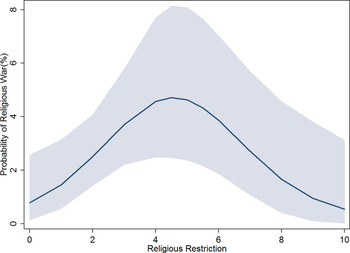
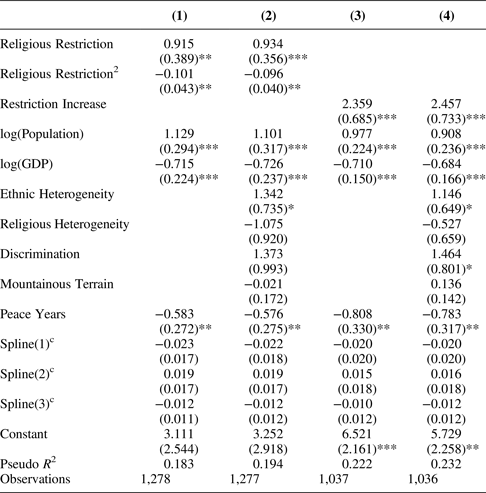
Table 2 reports the results of testing the effects of religious restriction on the risk of religious war onset. To test for a non-linear effect of religious restriction, we introduce a quadratic formulation of the Religious Restriction variable. Model 1 is a baseline specification that only includes the restriction variables and controls for GDP, population size, and temporal dependence. The positive and statistically significant coefficient of 0.915 for Religious Restriction with the statistically significant negative coefficient of -0.101 for Religious Restriction2 suggest the inverted U-shaped relationship between the level of restriction and the onset of religious civil war (H1).Footnote 4 As illustrated in Figure 2, regimes that score in the middle range on the religious restriction index have a significantly higher probability of religious war than those of either religious laissez-faire or tight restriction. The probability of war reaches its highest point (4.74%) when the restriction score is about 4.5. As the level of restriction increases to 9, the probability of war decreases to 0.95 %.
Predicted probability of religious war onset by Religious Restriction. Probability and 95% confidence intervals were generated using the Clarify program (King, Tomz, and Wittenberg Reference King, Tomz and Wittenberg2000). (Note: All other variables are held at their means.)

Religious restriction and religious civil war onset in non-democracies

Robust standard errors in parentheses. *p < 0.1, **p < 0.05, ***p < 0.01. “c” stands for cubic.
In Model 2, we estimate the effect of religious restriction among autocratic countries with a full set of control variables. We do not find any major differences in the effect of explanatory variables: the coefficients for Religious Restriction and Religious Restriction2 remain powerful and significant in the expected direction when additional control variables are added to the equation. Moreover, the control variables provide additional insights. Higher levels of GDP significantly decrease the likelihood of religious conflict in autocratic countries. This implies that poverty can contribute to violent collective action by stimulating a deeper sense of grievances (Gurr Reference Gurr1970; Reference Gurr1993; Gurr and Moore Reference Gurr and Moore1997). A larger Population size has significant, positive effects on religious civil war in autocratic countries. Higher levels of Ethnic Heterogeneity tend to increase the risk of religious war, although this effect is not significant at the 0.05 level. In addition, the negative and significant coefficients on the Peace Years variable suggest that the probability of religious war onset decrease as the number of years since the last religious conflict increases. Religious Heterogeneity, Discrimination, and Mountainous Terrain do not exhibit any significant effects.
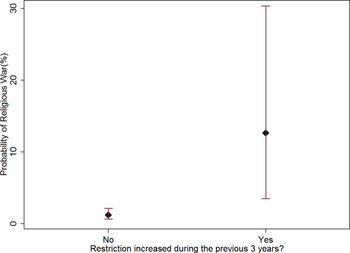
Model 3 investigates whether increases in religious restriction in autocracies, which previously employed religious laissez-faire, lead to religious war. The coefficient for Restriction Increase has the expected positive sign and is highly significant at the 0.01 level. Figure 3 displays the predicted probabilities of religious war onset by Restriction Increase, holding all other variables at their mean values. It is notable that countries that underwent an increase in religious restriction during the recent 3 years are 10 times more likely to initiate religious war as compared with countries that did not experience such a change. Finally, Model 4 augments the baseline model with additional control variables. The results from Model 4 confirm the significant effect of increasing restriction on religious civil war. These findings lend strong support to H2 that the probability of religious civil war increases as the autocratic government abolishes religious laissez-faire and adopts moderate restriction.
Predicted probability of religious war onset by Restriction Increase. Probability and 95% confidence intervals were generated using the Clarify program (King, Tomz, and Wittenberg Reference King, Tomz and Wittenberg2000). (Note: All other variables are held at their means.)

CASE ILLUSTRATION: ERITREA AND MYANMAR
Cases of Eritrea and Myanmar illustrate (1) how moderate religious restriction generates religious civil war and (2) how the transition from religious laissez-faire to moderate restriction increases the probability of religious civil war. In other words, these two cases lend support to the statistical results. Both Eritrea and Myanmar are multi-ethnic and multi-religious countries. Their rulers (Isaias Afewerki of Eritrea and Than Shwe of Myanmar) enforced autocratic rule. In terms of religious policy, Afewerki and Shwe abandoned religious laissez-faire and imposed moderate religious restriction when they perceived that religion had been posing a threat to their authority. This policy instigated religionists' animosity toward the government and prompted them to resort to violence. Afewerki and Shwe sought to subdue the rebellious religionists through violent means, which generated religious civil conflict.
Eritrea
In the late 1990s and early 2000s, Eritrea suffered armed conflicts between governing elites many of whom were Christians and Islamists rallying around the Eritrean Islamic Jihad Movement (EIJM). Eritrea is a multi-ethnic and multi-religious state. Tigrinya and Tigre ethnic groups comprise 85% of the total population and minority groups including Saho, Kunama, and Rashaida make up 15% (CIA World Factbook 2015b). In terms of religious composition, Eritreans are divided roughly in half. One half is Christians with various denominations and the other half is Sunni Muslims (CIA World Factbook 2015b; Hepner Reference Hepner2014). In Eritrea, ethnicity and religion overlap to some extent. For example, the majority of members of Tigrinya group are Orthodox or Catholic Christian, whereas the majority of members of Tigre, Saho, and Rashaida groups are Muslim (U.S. Department of State 2002; 2006).
Eritrea gained independence from Ethiopia in 1993 after waging an internecine 30-year war that claimed the lives of 150,000–350,000 people.Footnote 5 Isaias Afewerki, former guerrilla leader, seized power and instituted an autocratic regime. He monopolized political power, exerting tight control over government institutions including the legislature and the judiciary. He also sought to regulate every facet of the economy (Ogbazghi Reference Ogbazghi2011). Furthermore, Afewerki ruthlessly repressed anyone who criticized or challenged his rule. Hundreds of dissidents were jailed, tortured, and even killed in an extra-judicial way. Even he relentlessly purged his (potential) rivals from the ruling party and the military (Ogbazghi Reference Ogbazghi2011). The international community is accusing Eritrean leaders of establishing a police state and committing grave human rights violations (Hepner Reference Hepner2014; Ogbazghi Reference Ogbazghi2011).
Autocratic Eritrea manifests variation in its level of religious restriction in that the government shifted its religious policy from religious laissez-faire to moderate restriction. At the beginning of the independence, Afewerki, an Eritrean Orthodox Christian, imposed little religious restriction, allowing his citizens to exercise religious freedom and rights to a large extent. In 1995, however, he started restricting or regulating religion by issuing Proclamation No. 73/1995 that aimed to “legally standardize and articulate religious institutions and activities” (Hepner Reference Hepner2014). This Proclamation constrained religious authorities from engaging in politics (U.S. Department of State 2002; 2006; 2012). The clergy were prohibited to form religious political parties, deliver a political speech, and hold political office (Fox Reference Fox2011). In 2002, Afewerki elevated the level of religious restriction. He officially recognized the Eritrean Orthodox Christianity (Tewahedo Church), Roman Catholicism, Evangelical Lutheran Church, and Sunni Islam and tolerated adherents of these four religions unless they operated outside of the state-sponsored ecclesiastical framework (Fox Reference Fox2011). The reformed or radical versions of Christianity and Islam such as Jehovah's Witnesses and Wahhabism were banned and their adherents were persecuted (Hepner Reference Hepner2014; U.S. Department of State 2002; 2006; 2012).
The increase of the level of religious restriction results from the ruler's perception of religion as a destabilizing force. During the War of Independence, Afewerki and his EPLF (Eritrean People's Liberation Front) comrades endeavored to bring Muslims and Christians together by promoting secular Eritrean nationalism (Hepner Reference Hepner2014). After achieving independence, new leadership did not have strong motive for clinging to nationalism. Hence, the ruling elites did not enforce religious restriction. Religious laissez-faire, however, stimulated the activities of Islamic extremists, Jehovah's Witnesses, and Pentecostals to the extent to augment the government's threat perception. Afewerki feared that the rise of these reformed or radical Islam and Christianity would sabotage religious or social harmony and plunge Eritrea into turmoil. The fact that Islamic extremists and Jehovah's Witnesses rejected compulsory military service exacerbated this fear (Hepner Reference Hepner2014). Furthermore, Afewerki suspected Eritrean diasporas and foreigners of capitalizing on domestic religions in an attempt to destabilize his rule (Hepner Reference Hepner2014). As a result, since 1995 the government has discarded religious laissez-faire and imposed some restrictions on religion.
By enforcing religious restrictions, Afewerki and his loyalists sought to subjugate religion and prevent it from jeopardizing their grip on power. This policy, however, exacerbated grievances among Muslims who endorsed and promoted Islamic extremism. They perceived that Christians had occupied the majority of leadership positions and marginalized them from politics (Hepner Reference Hepner2014; START 2015). Elevating the level of religious restriction would not only cement Christian hold on power but also infringe upon Muslim identity. The EIJM capitalized on this fear and organized rebellion in an attempt to build a government based on the principles of Sharia (Islamic law). The EIJM launched insurgencies against the Afewerki regime in 1997, 1999, and 2003. In response, the government sought to suppress them violently. These religious civil conflicts produced battle-related deaths of 48–95 (in 1997) and 25–999 (in 1999 and 2003) (Lacina and Gleditsch Reference Lacina and Gleditsch2005; START 2015).Footnote 6
Myanmar
This case study focuses on the recurring violence between Buddhist majorities and Christian/Muslim minorities that have characterized Myanmar's political and religious life since the country's military coup d’état in 1988. Myanmar is a multi-ethnic country where ethnic categories are largely distinguished by religion. Although there is no official state religion, the Myanmar government has supported and associated itself with Theravada Buddhism that is practiced by about 89 % of the population. Other minority religions include Christianity (4%), Sunni Muslim (4%), Hinduism, and Animist (CIA World Factbook 2015a). The Kachin and Chin ethnic groups in the northern and western region, respectively, are predominantly Christian, while the Rohingya ethnic group in Rakhine State on the western coast practice Islam widely (U.S. Department of State 2007).
The Socialist Constitution, which was endorsed in 1974, provided for the limited freedom of religion, with the principle of non-discrimination on the grounds of religious belief (Ling Reference Ling, De Silva, Duke, Goldberg and Katz1988, 173). Believers of the most recognized religion have been generally allowed to participate in worship, observe religious holidays, and run religious schools. Although Buddhist education is mandatory in public schools, some schools allowed Christian or Muslim students to opt out of religious education (Fox Reference Fox2008, 204).
Starting in August 1988, there were a series of popular pro-democracy protests led by Buddhist monks and university students. These uprisings were brutally suppressed by a new military junta that came to power in September though a bloody military coup. The new military regime, the State Peace and Development Council (SPDC), viewed religious freedom as a vital threat to regime survival and national unity (U.S. Department of State 2007). This led to a substantial increase in government restrictions on both the religious majority and minorities, infringing upon the freedom of speech and association of all religious groups. For example, everyone in Myanmar was issued with a new identification card that noted each person's religious affiliation. All religious organizations, Buddhist and non-Buddhist, were obligated to register with the state (U.S. Department of State 2007). Moreover, Buddhist religious activities were subject to interference by the state-sponsored State Monk Coordination Committee, which was established in 1990 with power to try monks for “activities inconsistent with and detrimental to Buddhism” (Fox Reference Fox2008, 204). Under the SPDC's control, religious figures were not allowed to deliver political sermons, join a political party or run for political office. Further, the government routinely censored religious publications and sermons while constantly monitoring the meetings and activities of religious organizations (Fox Reference Fox2008, 204).
Adherents of minority religion, in particular, have been the target of systematic restrictions under the military dictatorship. Christian groups in Chin State and Muslims in Rakhine State have had trouble in obtaining the government permission to build new churches or mosques. Christians and Muslims were not only excluded from upper-level positions in the Myanmar government, but were also forced to convert to Buddhism before they were promoted to major or higher rank in the military (U.S. Department of State 2004). In addition, the local authorities of Chin and Kachin States exercised a unique level of discrimination against Christian ethnic groups. For example, in January 2015, they ordered churches to remove a cross from church buildings and brought charges against Christian men who erect it (Mizzima News 2015). As a response, Rohingya Muslims in Rakhine State staged anti-Buddhist riots in June 2012, resulting in the deaths of about 200 people (BBC 2014). In January 2014, Rakhine Buddhists responded with anti-Muslim riots that killed at least 40 people and wounding more than 50 (U.S. Department of State 2015).
The Buddhist majority also has faced greater levels of restriction in recent years. This policy prompted a backlash from Buddhist monks who were craving for full religious rights and democratic transition. During the September 2007 “Saffron Revolution,” for example, Buddhist monks were at the forefront of popular demonstrations against the military regime (U.S. Department of State 2008). Government forces, along with several pro-government militia groups, violently cracked down on participating monks and students. This resulted in at least 30 deaths, although the actual number of deaths could be even higher. Thousands of monks were arrested and detained following the crackdown, and 200–300 monks were imprisoned because of their role in organizing the September demonstrations (BBC 2008).
CONCLUSION
This article investigates the relationship between religious restriction and the onset of religious civil war in the context of autocracy. That is, we examine how under autocratic political system the level of religious restriction exercises an influence on religious civil wars. We argue that under autocracy, the relationship between religious restriction and religious civil war is characterized by an inverted U-shaped curve. Religious civil war is likely to erupt when autocratic rulers enforce moderate restriction on religion. In addition, the probability of religious civil war increases when the autocratic government changes its policy (1) from religious laissez-faire to moderate restriction and (2) tight religious restriction to moderate restriction.
We compile the data on religious civil war, religious restriction, and regime type and test our argument empirically. The statistical analyses substantiate that (1) under autocracy moderate religious restriction is likely to trigger religious civil wars and (2) the probability of religious war increases as the autocratic government shifts its policy from religious laissez-faire to moderate restriction. The hypotheses were tested with time-series cross-sectional data from the RCDC project (1990–2008), controlling for GDP, population size, mountainous terrain, ethnic discrimination, as well as ethnic and religious heterogeneity. They were also supported by the cases of Eritrea and Myanmar. Overall, this study suggests that within autocracies, different levels of religious restriction exert different effects on religious civil war. Further, it shows that once religious grievances are properly operationalized and measured, it is indeed possible to clarify the conditions that are most (or least) conducive to religious civil wars.
From the policy perspective, this study implies that (1) religious laissez-faire prevents multi-religious autocratic states from suffering religious civil war and (2) autocrats' attempt to desist from religious laissez-faire and impose restrictions fractures religious peace. Perhaps, the most reliable path to achieve religious peace is to protect religious freedom as much as possible. In the short run, the transition from tight religious restriction to moderate restriction is likely to produce religious violence. In the long run, consolidating religious freedom after the dangerous period of moderate restriction will produce a more durable peace, even for autocratic regimes. In the future, we will explore the relationship between religious restriction and religious protest in the context of democracy. In democracies, variation in the level of religious restriction exists, which can account for the amount of popular protest against the government's policy. It would be interesting to juxtapose the effect of religious restriction on religious war under autocracy and protest under democracy.
APPENDIX: ANALYSIS USING A RARE EVENTS LOGISTIC REGRESSION
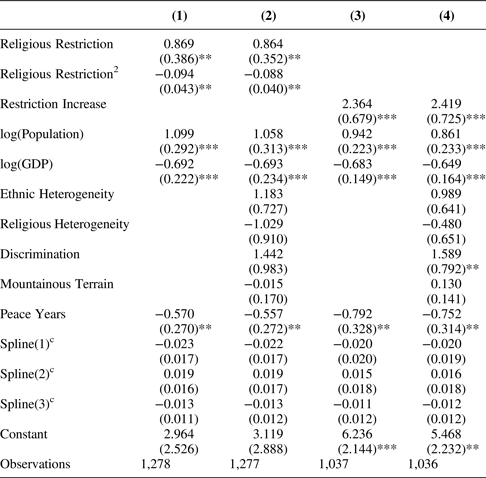
Because religious war is a rare event, running a regular logistic regression may bias our estimates (King and Zeng Reference King and Zeng2001). Therefore, as a robustness check, we test our hypotheses with a rare-events logistic regression. The results of rare events estimates in Table A1 confirm that the inverted U-curve defines the relationship between religious restriction and religious civil war onset among autocratic regimes. We do not find any major differences in the effect of explanatory variables: the coefficients for Religious Restriction and Religious Restriction2 remain significant in the expected direction. The coefficient for Restriction Increase also has the expected positive sign and is highly significant at the 0.01 level.
Religious restriction and religious civil war onset in non-democracies