Introduction
The Neotropical genus Mezia Nied. comprises mostly lianas; only M. huberi is a shrub or small tree. Sterile material can often be placed to genus by the distinctive pair of large glands sunken into crypts at the base of the lamina. The flowers, arranged in 4-flowered umbels, have narrow elongate sepals and large yellow petals. Most striking, and diagnostic, is the pair of large cymbiform bracteoles, which terminates the well-developed peduncle; the bracteoles subtend a rudimentary pedicel and enclose the flower bud. The orbicular to oblate samaras, 3–11.5 cm in diameter, have large lateral wings that, with one exception (Mezia mariposa), are confluent at the base; the nut bears one small central dorsal wing, which in many species is flanked by an array of winglets and/or crests.
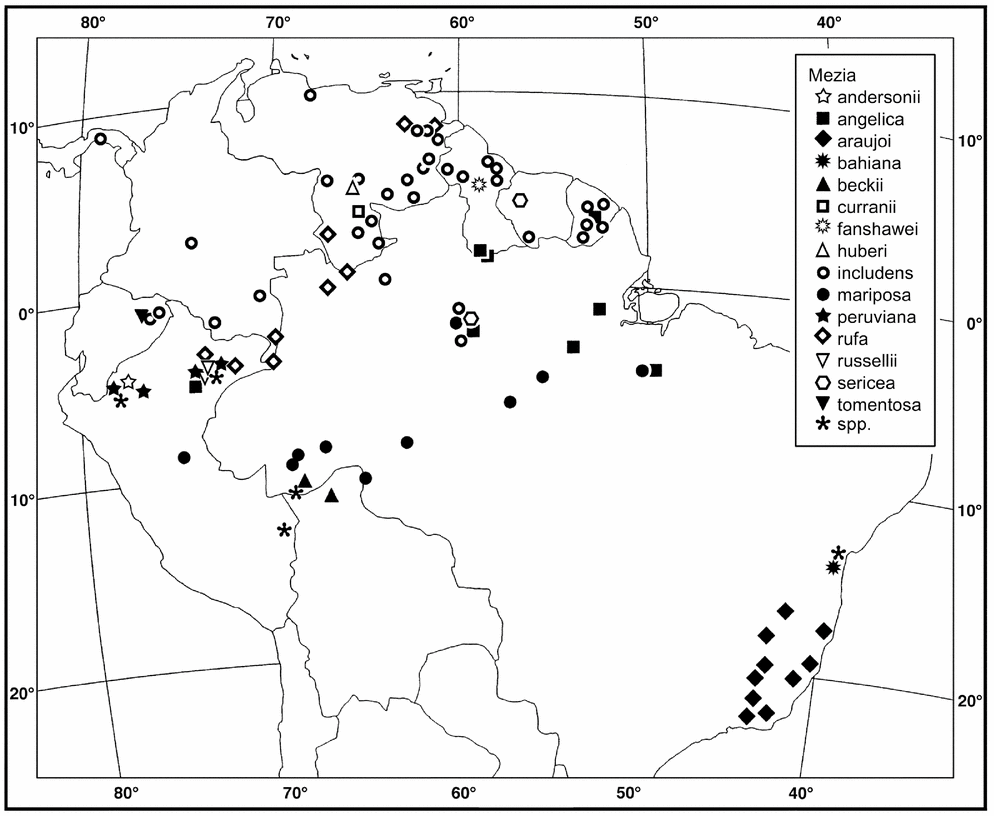
Mezia is most common in Amazonia but ranges north to Panama; two species are disjunct in eastern Brazil, from Bahia south to Rio de Janeiro and adjacent Minas Gerais (Fig. 1). Most species are known from wet or moist forest. Mezia huberi is found in savannas and adjacent gallery forests, and M. andersonii is reported from dry tropical forest. Because most species are treetop lianas, they are infrequently collected; some are known only from the type or very few collections. The exceptions are Mezia araujoi of south-eastern Brazil, and the widespread M. includens, whose range extends from Panama to Ecuador and Brazil. Mezia andersonii, M. bahiana and M. peruviana are known only in flower, and M. curranii only in fruit. Until the late William R. Anderson added eight species, beginning with his study of the Malpighiaceae of the Guayana highland (Reference Anderson1981), Mezia was known only from M. araujoi and M. includens, and even they were often thought conspecific. This revision is based in part on W. R. Anderson's notes for a projected monograph of Mezia. With the five novelties proposed here, Mezia now comprises 15 species. Future fieldwork likely will discover more undescribed species and provide additional collections that will be a source for amplified descriptions and distribution ranges.
Distribution of Mezia. See Undetermined Records for notes on collections marked ‘Mezia spp.’

Taxonomic History
The earliest description of a species now recognised as Mezia is Banisteria macrophylla A.Juss. (Reference Jussieu1843) [non B. macrophylla Colla, Reference Colla1833], based on a sterile specimen collected by Claussen in south-eastern Brazil. The specimen is a leafy branch, and Jussieu in his monograph of the family placed it in Banisteria L. with great doubt. Neither Grisebach (Reference Grisebach and Martius1858) nor Niedenzu (Reference Niedenzu1901, Reference Niedenzu and Engler1928) saw the type, and both listed Banisteria macrophylla A.Juss. as of doubtful affinity in their treatments of Banisteria. When W. R. Anderson studied the holotype, housed at P, he realised that Jussieu's Banisteria macrophylla is a synonym of Mezia araujoi Nied.
Five years following Jussieu's publication, Bentham (Reference Bentham1848) proposed Tetrapterys includens [= Mezia includens], based on a Martin collection in flower from French Guiana. Bentham expressed his considerable hesitation in assigning his novelty to Tetrapterys Cav., given the absence of fruits and the “several peculiarities” exhibited by the inflorescence and stamens not found otherwise in Tetrapterys. In Reference Turczaninow1858, Turczaninow described the same species, based on a flowering Funck & Schlim collection from northern Venezuela, in a new genus, Stenocalyx, as S. involutus; however, his generic name is preoccupied by Stenocalyx O.Berg (Reference Berg1856; Myrtaceae).
In Reference Niedenzu, Engler and Prantl1890, Niedenzu published the genus Mezia with M. araujoi as the type species. The description was based on a collection with flowers and fruits from south-eastern Minas Gerais, Brazil. The specific epithet was proposed by C. A. W. Schwacke to honour the collector of the type, Francisco de Paula Leopoldino Araújo (1830–1908; fide Imigrantes Italianos, 2000), who lived in Rio Novo and collected for Schwacke in that region (Loesener, Reference Loesener1906). Schwacke and Niedenzu spelled the epithet araujei, which must be corrected to araujoi according to Article 60.12 of the International Code of Botanical Nomenclature (McNeill et al., Reference McNeill, Barrie, Buck, Demoulin, Greuter, Hawksworth, Herendeen, Knapp, Marhold, Prado, Prud'homme van Reine, Smith, Wiersema and Turland2012).
In one of his reviews of American genera of Malpighiaceae, Niedenzu (Reference Niedenzu1912) expanded Diplopterys A.Juss. by including Mezia and also Jubelina A.Juss. at the level of section and transferred M. araujoi to Diplopterys. In his monograph of the Malpighiaceae, Niedenzu (Reference Niedenzu and Engler1928) maintained Mezia as a section. He now cited Stenocalyx Turcz. as a synonym and published the combination Diplopterys involuta (Turcz.) Nied. In a footnote, he quoted Bentham's detailed protologue for Tetrapterys includens to bolster his assertion that this name applied to a species of Diplopterys sect. Mezia and proposed the combination Diplopterys includens (Benth.) Nied. Because he now included Stenocalyx in sect. Mezia, he chose to cite the only recognised species as Diplopterys involuta; yet, by modern rules of nomenclature, Bentham's name has priority. Niedenzu (Reference Niedenzu and Engler1928) treated Diplopterys involuta and Mezia araujoi as conspecific. His species description is based on specimens from Minas Gerais and Rio de Janeiro and matches the current interpretation of Mezia araujoi. He also listed the type of Stenocalyx involutus among the specimens he saw, but that collection is now assigned to Mezia includens.
Cuatrecasas (Reference Cuatrecasas1958), in his treatment of Malpighiaceae for the Flora of Colombia, returned Mezia to generic rank and, recognising the priority of Bentham's name, published the combination M. includens (Benth.) Cuatrec. Cuatrecasas also considered Mezia araujoi and M. includens as conspecific, but his description is based on collections from Colombia and fits the current interpretation of M. includens.
During his study of Mezia for the flora of the Guayana highland, W. R. Anderson (Reference Anderson1981) recognised the distinction between the two species and excluded M. araujoi from the synonymy of M. includens. In this work, he added Mezia curranii and M. rufa. In later publications, he expanded the genus to include Mezia huberi (Reference Anderson1993); M. angelica, M. mariposa and M. tomentosa (Reference Anderson1997); M. beckii (Reference Anderson1999); and M. russellii (Reference Anderson2001). Four new species are described here: Mezia andersonii, M. bahiana, M. fanshawei and M. sericea. Niedenzu's variety Diplopterys involuta var. ovata is raised in rank to species with the new name Mezia peruviana.
Morphology
Habit
All but one species are large, woody vines; Mezia includens has been reported to reach 40 m. The exception is Mezia huberi, a shrub or small tree to 8 m tall. The young shoots and inflorescence axes are flattened or quadrangular. In most species, the vegetative branches become terete or nearly so with age. In Mezia rufa, the quadrangular aspect is retained for a longer period, and branches bearing mature leaves often are narrowly 4-winged.
Leaves and stipules
As is typical for the family, the leaves are opposite. The laminas are elliptical to ovate or obovate, and also sometimes lanceolate (e.g. Mezia peruviana). The apex in most species is acuminate, with the acumen to 2 cm long. It is apiculate in Mezia bahiana and varies in M. araujoi from apiculate to acuminate to rounded and even retuse. The base of the lamina varies from attenuate to cuneate to truncate or rounded. The margin may be thickened or slightly so, and flat to recurved.
The lamina is adaxially sericeous only at the earliest stages and soon becomes glabrous. Most species show the same pattern abaxially, although the hairs are more tardily lost. The abaxial surface may appear glabrous to the naked eye although minutely sericeous or scattered with isolated hairs; the epidermis is always evident. Of the four exceptions, Mezia huberi, M. rufa and M. sericea have the laminas abaxially persistently and densely sericeous; the epidermis is obscured. The hairs are straight, up to 0.4 mm long, and brown; however, the colour may fade with age, and the hairs become translucent. This is seen in Mezia rufa, for which collections with young as well as very large, old leaves are available. Mezia tomentosa is unique in the genus in its abaxially densely velutinous or tomentose vesture; the dark or reddish brown hairs are V-, Y- or T-shaped and persistent.
As a rule, each lamina bears a large gland at the base on either side of the costa, sunk in crypts in fully mature leaves but may be flat in earlier stages. Yet, the presence of such glands is variable, and they may be absent. In Mezia bahiana, the large glands are borne at the apex of the petiole, and in M. araujoi these glands are sometimes placed halfway on the petiole. In Mezia rufa and M. sericea, the basal glands may number four or occasionally up to six. Mezia tomentosa has eglandular leaves; however, this species is known from only two collections.
In addition to the basal glands, the abaxial surface of the lamina may also bear one to many smaller impressed glands in a line within each margin, often towards the apex. The presence or absence of these smaller glands is also variable within each species and even individuals. Only Mezia bahiana, known only from the type, and M. tomentosa lack such surface glands.
The stipules are minute triangular rudiments to 0.2 mm long, borne on an interpetiolar ridge and often hidden by stem hairs. They are caducous and therefore rarely seen, but they leave interpetiolar scars to 0.5 mm wide.
Inflorescence
The large, multibranched, axillary and terminal inflorescences are covered by a dense vesture of appressed brown hairs and contain many greatly reduced bract-like leaves. The lateral branches may be subtended by one or rarely even two smaller subsidiary axes (e.g. Fig. 7D), these sometimes terminating in only one umbel. The bilaterally symmetrical flowers are ultimately grouped in 4-flowered umbels, which are borne on a short stalk with usually one pair of deciduous sterile bracts placed from near the base to near the apex. Each well-developed peduncle is subtended by a floriferous bract and terminates in a pair of large cymbiform bracteoles that in turn subtend a rudimentary pedicel. In other genera of Malpighiaceae old flowers break off at the joint between peduncle and pedicel, but in Mezia they abscise at the base of the peduncle.
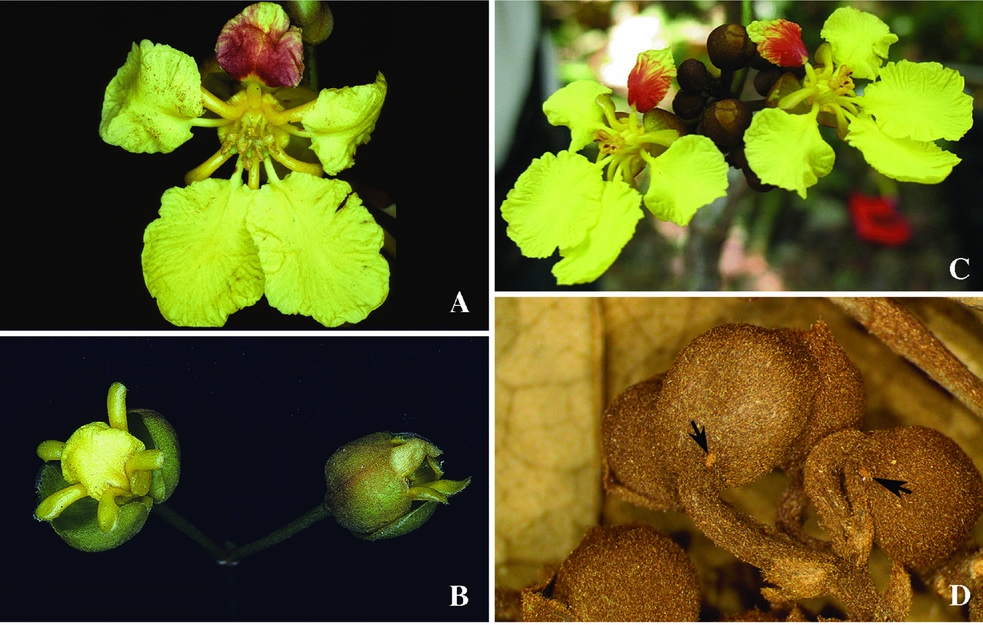
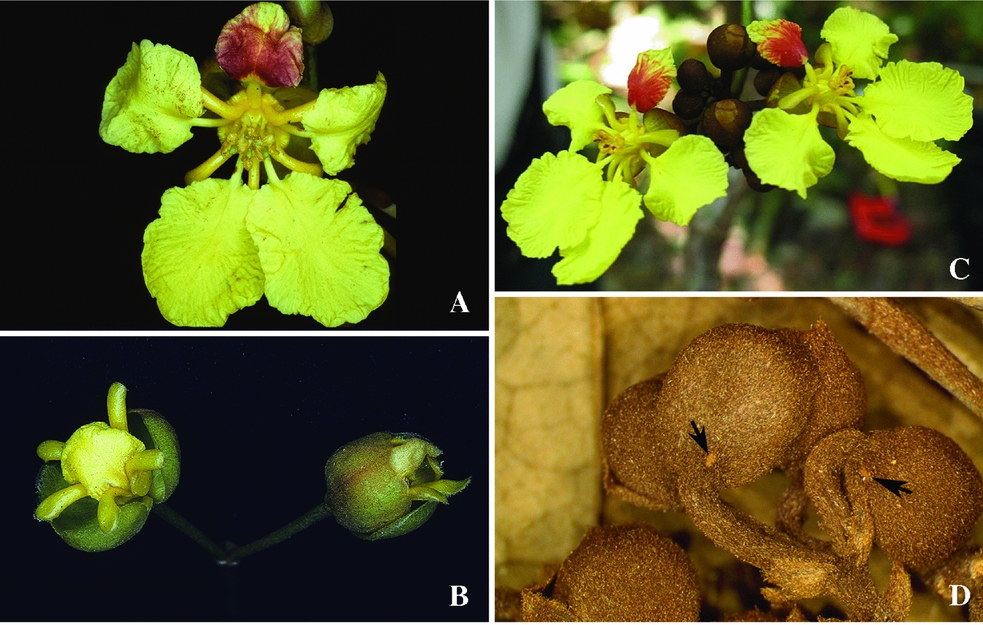
The large bracteoles cover the flower in bud, the inner enclosing the flower bud and the outer partially enclosing the inner bracteole, resulting in a distinctive globose or subglobose ‘bud’. The bracteoles spread during anthesis, but once the petals are shed they again enclose the flower, but now loosely (Fig. 2B,C). They spread again or reflex with the maturation of the fruit. In Mezia bahiana, M. beckii and M. mariposa, the outer bracteole is marked with a prominent gland (Fig. 2D). The floriferous bracts abscise during anthesis, but the bracteoles are usually persistent past the fruiting stage. In most species the floriferous bracts are much smaller than the bracteoles, but they are subequal in Mezia fanshawei and nearly as large in M. russellii. Both bracts and bracteoles may be adaxially sericeous or sparsely so or only distally or near the margin or glabrous. This adaxial vesture may thin or be lost with age, such that bracteoles remaining on fruiting stalks may superficially appear to be glabrous.
Floral aspects of Mezia. A and B, M. angelica. A, Flower. B, Flower bud opening, the bracteoles and sepals spreading (left); flower post anthesis, the bracteoles and sepals becoming erect again (right). C and D, M. mariposa. C, Two open flowers, two buds with the bracteoles beginning to open and revealing enfolded petals (buds in centre), young buds with the bracteoles still closed (buds at left). D, Closed buds borne on peduncles, each peduncle subtended by a bract; each arrow points to a gland on the outer bracteole. Photographs: A and B, Carol Gracie; C and D, Marcelo Pace.
Calyx
The calyx is composed of five narrow sepals with an obtuse apex and often revolute margins. Like the bracteoles, the free part of the sepals spread as the petals expand and return to more erect posture once the petals fall. All sepals are glabrous adaxially, and in all species but one densely brown-tomentose abaxially. The exception is Mezia russellii, in which the sepals have usually plane margins and are abaxially hirsute with straight spreading whitish to stramineous hairs. This species also differs in that the sepals exceed the glands by only 1–2 mm; in other species, the sepals project (3–)4–6(–7.5) mm beyond the glands. The anterior sepal is eglandular, and the lateral four bear a pair of large compressed glands at the base, which may be distinct or partly to completely connate. Rarely, glands are also present on the anterior sepal in aberrant individuals. The calyx is persistent past the fruiting stage.
Corolla
The five petals are yellow, and the posterior petal commonly is marked with red in the centre. In dried specimens, such a red spot may be indicated by a darkened area on the limb. The limb of lateral petals varies from orbicular to obovate and of the posterior petal to elliptical as well; it often has a crumpled appearance. In general, the anterior-lateral petals range from 10 to 16 mm in diameter and are somewhat larger than the posterior-lateral ones; the posterior petal, the ‘flag’, is the smallest, ranging from 5 to 9 mm. In Mezia fanshawei, the lateral petals are subequal and measure 7–8.5 mm in diameter. Only Mezia mariposa has all petals glabrous. In other species the lateral petals are abaxially sericeous, with a patch of white hairs mostly in the centre and sometimes extending to the claw; in Mezia includens such hairs are light brown. The posterior petal is abaxially pubescent as well in Mezia angelica, M. araujoi, M. bahiana and M. beckii. The petals of Mezia curranii and M. tomentosa are unknown.
Androecium
The 10 stamens are heteromorphic and usually persistent through the fruiting stage (the stamens of Mezia tomentosa are unknown). In most species, the stamen opposite the posterior petal is the smallest and that opposite the anterior sepal the largest. The filaments are connate in the basal 1/2 to 2/3 but often in the basal 3/4 in those opposing the posterior petal and posterior-lateral sepals. The anthers are glabrous in Mezia sericea, M. huberi, M. includens and M. rufa; the anthers of M. peruviana usually have a few hairs scattered along the locules. In the remaining species the anthers are tomentose, usually more abundantly in those opposite the sepals, with the vesture concentrated along the locules and/or the apex and/or the base (and then perhaps extending unto the filaments). The anthers of Mezia mariposa are glabrous in stamens opposite the petals but bear hairs in those opposite the sepals. The connective is enlarged and projects beyond the locules (up to 1.5 mm in Mezia includens) in anthers opposing the sepals in all species but M. angelica, M. araujoi, M. bahiana, M. beckii and M. mariposa. In anthers opposing the petals, the connective mostly equals the locules or exceeds them only slightly, although in the variable Mezia includens the connective sometimes extends to 0.4 mm beyond the locules. Two exceptions are Mezia peruviana, with all anthers having the connective exceeding the locules, and M. sericea, with only those opposing the posterior-lateral petals having the connective extended.
Gynoecium
The tricarpellate ovary terminates in three free styles, which have the stigma located at the internal angle at the apex (“internal stigma” in some literature on the Malpighiaceae). The styles of all but five species are straight and erect. In Mezia angelica, M. araujoi, M. bahiana, M. beckii and M. mariposa, the posterior styles are lyrate, and the anterior style is often inclined towards the posterior petal. In these the style apex is dorsally acute or truncate, or sometimes drawn out into a small spur; it is rounded or blunt in Mezia russellii and M. tomentosa.
Fruit
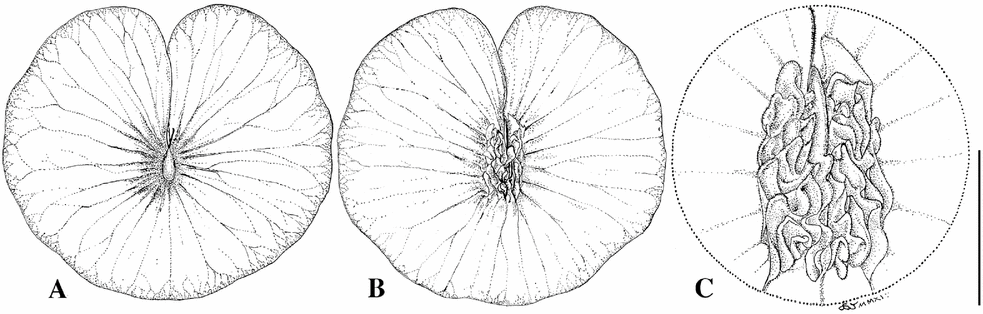
The fruit of Mezia is a schizocarp, which breaks into three round to oblate samaras borne on a pyramidal torus. The largest samaras measure more than 10 cm in diameter (Mezia includens) and the smallest 3 cm (M. huberi). Each samara has two large lateral wings that are confluent, forming a single wing incised only to the apex of the nut, as well as a much shorter dorsal wing. Mezia angelica and M. huberi have one additional winglet or crest between the dorsal and lateral wings, and in the other species that area is filled with a network of intermediate winglets and/or crests. In Mezia curranii and M. russellii, this network is separated from the dorsal wing by an intermediate winglet, and in M. tomentosa the dorsal wing is so short that it is indistinguishable among the ruffles of intermediate winglets. The butterfly-shaped samaras of Mezia mariposa are unique in the genus in that the lateral wings remain separate, and additional ornamentation between the dorsal and lateral wings is absent.
In most species, the adaxial face of the samara is unornamented or may bear shallow horizontal ribs radiating from the nut. In Mezia araujoi, the ribs are prominent and may extend into winglets. In Mezia angelica, each side of the nut has one flat crest or winglet separate and parallel to lateral wing. A more intricate pattern is shown in Mezia beckii, in which some of the ribs radiating from the nut form winglets adnate to the lateral wing and sometimes are also basally connate. In all species, the areole is bordered by two strong ribs, which usually remain on the samara at the time of abscission. Only immature samaras were seen for Mezia fanshawei, but they appear to follow the common pattern. Fruits are unknown for Mezia andersonii, M. bahiana and M. peruviana.
Generic Affinities
Mezia is a very distinctive genus, defined by three derived character states that are unique in the family, namely, very large globose-cymbiform bracteoles that enclose the flower bud until anthesis, reduction of the pedicel to a rudiment, and abscission of old flowers at the base of the peduncle and not between the peduncle and the pedicel. The reddish or dark brown appressed vesture of the inflorescence, although not unique in the family, is another characteristic found in all species of the genus and a helpful field character. On the basis of morphology, the sister genus of Mezia is probably Jubelina, which, like Mezia, has 4-flowered umbels, long narrow sepals, compressed or connate calyx glands, and large mascagnioid samaras. Jubelina also has fairly large bracteoles, but they are not cymbiform and do not enclose the flower buds; this genus is distinguished by an apomorphy of its own, sterile cavities on each side of the fertile locule. In both Mezia and Jubelina, there has been a parallel trend for pairs of compressed calyx glands to fuse into a single large gland, and in both genera the dominant lateral wing of the samara is continuous at the base in all but one species. See W. R. Anderson's revision (Reference Anderson1990) for more information about Jubelina. The most recent phylogeny (Davis & Anderson, Reference Davis and Anderson2010) places Mezia and Jubelina in the Christianella clade, which is strongly supported; however, the structure of the clade is still uncertain and is currently being investigated by the Davis laboratory (C. C. Davis, Harvard University, personal communication).
Taxonomy
Note. Because the large samaras are conspicuous, Mezia is often collected with fruits only; therefore, a separate key to fruiting material is provided. The height/length of lianas cited in the descriptions is quoted from the few herbarium specimen labels that include such information. Measurements of flowers are taken from herbarium material revived with Pohl's solution (Pohl, Reference Pohl1965). An asterisk marks specimens seen only as online images.
Mezia Nied. in Engl. & Prantl, Nat. Pflanzenfam. III, 4: 58 (Reference Niedenzu, Engler and Prantl1890), non Mezia Kuntze, 1891 (Lauraceae). Diplopterys sect. Mezia (Nied.) Nied., Arbeiten Bot. Inst. Königl. Lyceums Hosianum Braunsberg 4: 16 (Reference Niedenzu1912). – Type: Mezia araujoi Nied.
Stenocalyx Turcz., Bull. Soc. Imp. Naturalistes Moscou 31: 393 (Reference Turczaninow1858), non Stenocalyx O.Berg, Reference Berg1856 (Myrtaceae). Type: Stenocalyx involutus Turcz. [= M. includens (Benth.) Cuatrec.].
Woody vines (shrubs or small trees in Mezia huberi). Leaves opposite, the lamina narrowly to broadly elliptical, sometimes slightly ovate or obovate or lanceolate, adaxially glabrous, abaxially glabrous or sericeous or velutinous, usually with a pair of large glands at the base abaxially (or partly at apex of petiole in Mezia araujoi, entirely at apex of petiole in M. bahiana) sunk in crypts or such glands absent, also bearing impressed glands on the surface abaxially or eglandular; petioles eglandular (except in M. bahiana); stipules minute, interpetiolar, caducous, leaving interpetiolar scars c.0.5 mm wide. Inflorescence densely reddish brown to dark brown sericeous throughout, axillary and terminal, containing much-reduced bract-like leaves, with decussate branching, the flowers ultimately borne in an umbel of 4 terminating a stalk bearing (0–)1(–3) pairs of sterile bracts and, at its apex, 4 floriferous bracts subtending the 4 peduncles; floriferous bracts and bracteoles adaxially glabrous or sericeous, abaxially densely sericeous; floriferous bracts smaller than bracteoles (subequal in Mezia fanshawei), deciduous before maturation of fruit, eglandular; peduncle well developed; bracteoles large, cymbiform, usually persistent, the inner enclosing bud until anthesis, the outer enclosing bud and inner bracteole; pedicel very short, to 2(–5) mm long in fruit; old flowers (not setting fruit) deciduous at base of peduncle, not at joint between peduncle and pedicel. Flowers bilaterally symmetrical. Sepals narrowly oblong or spatulate, adaxially glabrous, abaxially tomentose or hirsute, the anterior eglandular, the lateral 4 each bearing 2 large compressed abaxial glands, these distinct or partially to completely connate. Petals yellow, the posterior often red in centre of limb. Stamens 10, heteromorphic, the 5 opposite sepals differing from the 5 opposite petals in size and shape, and sometimes in pubescence. Ovary tricarpellate; styles 3, the apex with a large stigma at the internal angle and dorsally acute or truncate or with a short spur (rounded in Mezia russellii and M. tomentosa), the anterior style shorter and often slenderer than the two posterior styles, all straight and erect, or the anterior style inclined towards the posterior petal and the posterior styles lyrate. Fruit a schizocarp breaking apart into 3 samaras, each samara bearing 2 large lateral wings confluent at the base (distinct in Mezia mariposa), a smaller central dorsal wing, and often additional wings, winglets, and/or crests between them or outside the lateral wings; areole bordered by 2 persistent ribs; torus pyramidal.
The name Mezia honours Carl Christian Mez (1866–1944), a German botanist who published extensively on Lauraceae, Bromeliaceae, Myrsinaceae, Gramineae and other groups (Butzin, Reference Butzin1968).
Key to Mezia
1a. Lamina abaxially densely brown sericeous or velutinous (in M. rufa the hairs fading to translucent in older laminas and then best seen with a lens), the epidermis usually obscured (or evident in the largest leaves but the vesture evenly distributed)__________________________________________2
1b. Lamina abaxially glabrous or sparsely sericeous, the minute hairs barely or not touching (appearing glabrous to the naked eye), the epidermis evident___________5
2a. Lamina abaxially velutinous, the hairs V-, Y- or T-shaped and spreading; Ecuador (Orellana)______________________________15. M. tomentosa
2b. Lamina abaxially sericeous, the hairs straight and appressed________________3
3a. Shrub or small tree; sterile bracts on axis supporting umbel with a pair of glands; acumen at lamina apex 5–9 mm long; mature large laminas with the vesture abraded from the costa and major veins abaxially and these in stark contrast to the sericeous laminar surface; samara with only one additional winglet on each side of dorsal wing; Venezuela (Amazonas)_______8. M. huberi
3b. Woody vines; sterile bracts on axis supporting umbel eglandular; acumen at lamina apex 10–20 mm long; mature large laminas with the vesture present on veins abaxially; samara with a network of many winglets on each side of dorsal wing________________________________________________________4
4a. Bracteoles 6.5–7.5 mm long, adaxially glabrous; floriferous bracts 3–3.5 mm long, adaxially glabrous; limb of posterior petal 5–5.5 mm long, base truncate or slightly cordate; samara 6–7.5 cm wide, nut 7–8 mm long, areole 6.5–7.1 mm long; Brazil (Amazonas)__________________________________14. M. sericea
4b. Bracteoles 10–12 mm long, adaxially sericeous except glabrous at base; floriferous bracts 4–6 mm long, adaxially sericeous along the margin and usually also in the distal 1/2; limb of posterior petal 7–8 mm long, base auriculate; samara c.6 cm wide, nut c.17 mm long, areole c.16 mm long; Brazil (Amazonas), Colombia (Amazonas), Peru (Loreto), Venezuela (Amazonas)____12. M. rufa
5a. Outer bracteole with a large basal gland; posterior styles lyrate________6
5b. Outer bracteole eglandular; posterior styles erect, lyrate in M. angelica, M. araujoi__________________________________________________8
6a. Pair of large leaf glands borne at apex of petiole; apex of lamina apiculate, the apiculum to 2 mm long, base attenuate; floriferous bracts 5–6.5 mm long; peduncle 7–9.5 mm long; Brazil (Bahia)_________________4. M. bahiana
6b. Pair of large leaf glands borne at base of lamina; apex of lamina acuminate, the acumen 5–17 mm long, base truncate or cuneate; floriferous bracts 1.5–4.3 mm long; peduncle 11–18 mm long_______________________________7
7a. Petals abaxially glabrous; limb of posterior petal 7–9 × 5–9 mm; anthers opposite petals glabrous or with a few hairs; samara butterfly-shaped, the lateral wings incised to nut at apex and base, without intermediate winglets between dorsal and lateral wings; Brazil (Acre, Amazonas, Pará, Rondônia) and Peru (Huánuco)_________________________________________________10. M. mariposa
7b. Petals abaxially white-sericeous in centre of limb; limb of posterior petal 6 × 4.7–5 mm; anthers opposite petals tomentose at base; samara circular, the lateral wing incised to nut only at apex, with additional winglets between the dorsal and lateral wings; Bolivia (Pando) and Brazil (Acre)______________5. M. beckii
8a. Posterior petal abaxially white-sericeous in centre of limb; posterior styles lyrate; anthers opposite sepals with the connective not or very slightly exceeding the locules; all filaments connate only in basal 1/4 or less____________________9
8b. Posterior petal abaxially glabrous (unknown in M. curranii); posterior styles erect; anthers opposite sepals with the connective exceeding the locules by 0.5–1.5 mm (not or slightly in M. andersonii); filaments opposite posterior petal and posterior-lateral sepals connate 2/3 to 3/4 and others 1/4 to 1/2 (all 1/2 in M. russellii)_____________________________________________10
9a. Limb of lateral petals orbicular or suborbicular; limb of posterior petal orbicular, margin eglandular; filaments opposite sepals distally tomentose; samara with 1 additional winglet or crest between dorsal and lateral wings; Brazil (eastern Amazonas, Pará), southern Guyana, French Guiana, to be expected in Suriname__________________________________2. M. angelica
9b. Limb of lateral petals obovate or elliptical; limb of posterior petal obovate or elliptical, margin gland-tipped in the proximal 1/4 to 1/3; filaments opposite sepals glabrous; samara with a network of interconnected winglets between dorsal and lateral wings; Brazil (Espírito Santo, Minas Gerais, Rio de Janeiro)__________________________________3. M. araujoi
10a. Anthers glabrous or with a few hairs along locules_____________________11
10b. Anthers tomentose, along locules and/or at base and/or with an apical tuft_12
11a. Sepals 5–6 mm long beyond glands, the glands distinct to partly or entirely connate; limb of posterior petal truncate at base; abaxial vesture of lateral petals white; anthers usually with a few scattered hairs, those opposing petals with the connective exceeding the locules by 0.3–0.6 mm; petioles 0.6–1.2(–2) cm long; stalk supporting lateral umbels 5–8 mm long, bearing 1–3 pairs of caducous bracts, fallen before anthesis; Peru (Loreto)____________11. M. peruviana
11b. Sepals 6.5–9.5 mm long beyond glands, the glands distinct; limb of posterior petal auriculate at base; abaxial vesture of lateral petals light brown; anthers glabrous, those opposing the petals with the connective exceeding the locules by 0–0.2 mm; petioles 1.4–2.5 cm long; stalk supporting lateral umbels 6.5–20 mm long, with 1 pair of bracts, deciduous during anthesis; Panama (Panamá, San Blas), Colombia (Amazonas, Meta, Vaupés), Venezuela (Amazonas, Bolívar, Carabobo), Guyana, French Guiana, Suriname, Brazil (Amazonas), Ecuador (Orellana)__________________________________9. M. includens
12a. Sepals 1–2(–2.4) mm long beyond glands, abaxially hirsute with whitish to stramineous hairs, margin flat; apex of posterior styles rounded; margin of limb of lateral petals glandular-fimbriate; Peru (Loreto)___________13. M. russellii
12b. Sepals 3–6.5 mm long beyond glands, abaxially tomentose with brown hairs, margin revolute or slightly so; apex of posterior styles acute or truncate or extended into a spur; margin of limb of lateral petals subentire to erose (not known for M. curranii)__________________________________13
13a. Peduncle 7–9 mm long; filaments glabrous; stalk supporting umbels 7–9 mm long; Venezuela (Amazonas)______________________6. M. curranii
13b. Peduncle 10–18 mm long; filaments opposite sepals tomentose at apex (M. fanshawei) or those opposite posterior and posterior-lateral petals tomentose (M. andersonii); stalk supporting umbels 5–7 mm long_________________14
14a. Floriferous bracts 8.5–9 mm long, equalling bracteoles, both adaxially glabrous or sparsely sericeous near margin; limb of posterior petal auriculate at base; limb of anterior-lateral petals 7.5–8 mm long, margin of limb of posterior-lateral petals fimbriate to fimbriate-denticulate at apex; connective of anthers opposite sepals exceeding locules by 1–1.3 mm; sepal glands connate but free at apex; Guyana__________________________________7. M. fanshawei
14b. Floriferous bracts 3.7–6.5 mm long, smaller than bracteoles, both sericeous adaxially; limb of posterior petal truncate or slightly cordate at base; limb of anterior-lateral petals c.12 mm long, margin of limb of posterior-lateral petals subentire; connective of anthers opposite sepals not exceeding locules; sepal glands distinct; Peru (Amazonas)______________1. M. andersonii
Key to Mezia in fruit
Note. Mezia andersonii, M. bahiana and M. peruviana are known only in flower. Only immature fruits were seen for Mezia fanshawei; the lateral wing is continuous at base and incised at apex to the nut, interconnected winglets link the dorsal and lateral wings, and the nut lacks adaxial ornamentation. Mezia fanshawei may key out with M. includens; in fruit, its large floriferous bracts (equalling the bracteoles), tomentose anthers, and shorter sepals with mostly connate glands will separate it from that species.
1a. Samara butterfly-shaped in outline; lateral wing incised to the nut at base and apex; without additional winglets between dorsal wing and lateral wings; Brazil (Acre, Amazonas, Pará, Rondônia) and Peru (Huánuco)_____10. M. mariposa
1b. Samara circular or subcircular or oblate; lateral wing incised to the nut only at apex; with one to many additional winglets between dorsal wing and lateral wings__________________________________________________________________2
2a. Nut bearing only a single intermediate winglet or crest between the dorsal and lateral wings, parallel to the dorsal wing__________________________________3
2b. Nut bearing a network of small winglets between the dorsal and lateral wings______________________________________________4
3a. Samara 3–4 cm in diameter, dorsal wing (3–)4–5 mm high; nut adaxially without ornamentation; laminas abaxially densely sericeous; shrub or tree; Venezuela (Amazonas)__________________________________8. M. huberi
3b. Samara 5.5–8 cm in diameter, dorsal wing 7–14 mm high; nut adaxially with 1 flat winglet or crest on each side parallel to lateral wing; laminas abaxially glabrescent to glabrous; woody vine; Brazil (eastern Amazônas, Pará), southern Guyana, French Guiana, Peru (Loreto), to be expected in Suriname__________________________________2. M. angelica
4a. Laminas abaxially densely sericeous or velutinous, the epidermis hidden (in M. rufa the hairs fading to translucent in older laminas and then best seen with a lens)______________________________________________5
4b. Laminas abaxially glabrescent to glabrous or sparsely sericeous, the minute hairs barely or not touching, the epidermis evident__________________________________7
5a. Laminas abaxially velutinous; dorsal wing of samara indistinct from network of winglets; Ecuador (Pastaza)___________________15. M. tomentosa
5b. Laminas abaxially sericeous; dorsal wing distinct and taller than the adjacent network of winglets________________________________________6
6a. Samara c.5 cm in diameter, lateral wings membranous, nut c.17 mm long, dorsal wing 27–30 mm long, areole c.16 mm long; bracteoles 10–12 mm long, adaxially sparsely sericeous; Brazil (Amazonas), Peru (Loreto), Suriname, Venezuela (Amazonas, Bolívar)__________________________________12. M. rufa
6b. Samara 6–7.5 cm in diameter, lateral wings chartaceous, nut 7–8 mm long, dorsal wing 8–9 mm long, areole 6.5–7.1 mm long; bracteoles 6.5–7.5 mm long, adaxially glabrous; Brazil (Amazonas), Suriname_________14. M. sericea
7a. Nut adaxially without a series of prominent ribs or winglets radiating from areole______________________________________________________8
7b. Nut adaxially with a series of prominent ribs and/or winglets radiating from areole___________________________________________________9
8a. Sepals 1–2(–2.4) mm long beyond glands, abaxially hirsute, the hairs whitish to stramineous; anthers tomentose or with tufts of hairs; styles rounded at apex; Peru (Loreto)______________________________________13. M. russellii
8b. Sepals 6.5–9.5 mm long beyond glands, abaxially tomentose, the hairs brown; anthers glabrous; styles acute or truncate at apex; Panama (Panamá, San Blas), Colombia (Amazonas, Meta, Vaupés), Venezuela (Amazonas, Bolívar, Carabobo), Guyana, French Guiana, Suriname, Brazil (Amazonas), Ecuador (Orellana)__________________________________9. M. includens
9a. Nut adaxially only with a series of ribs radiating from areole, winglets absent; bracteoles mostly deciduous before fruits mature; sepals 6–6.5 mm long beyond glands; areole 6–7 mm long; anterior style 2.2–2.3 mm long; Venezuela (Amazonas)__________________________________6. M. curranii
9b. Nut adaxially with a series of ribs radiating from areole, some or all ribs extended into winglets; bracteoles persistent past fruiting stage; sepals 4.5–5.5 mm long beyond glands; areole 10–15 mm long; anterior style 3–3.5 mm long__________________________________10
10a. Outer bracteole with a prominent gland; peduncle 11–18 mm long; Bolivia (Pando) and Brazil (Acre)____________________________5. M. beckii
10b. Outer bracteole eglandular; peduncle 8.5–10.5 mm long; Brazil (Espírito Santo, Minas Gerais, Rio de Janeiro)___________________ 3. M. araujoi
1. Mezia andersonii C.E.Anderson, sp. nov.
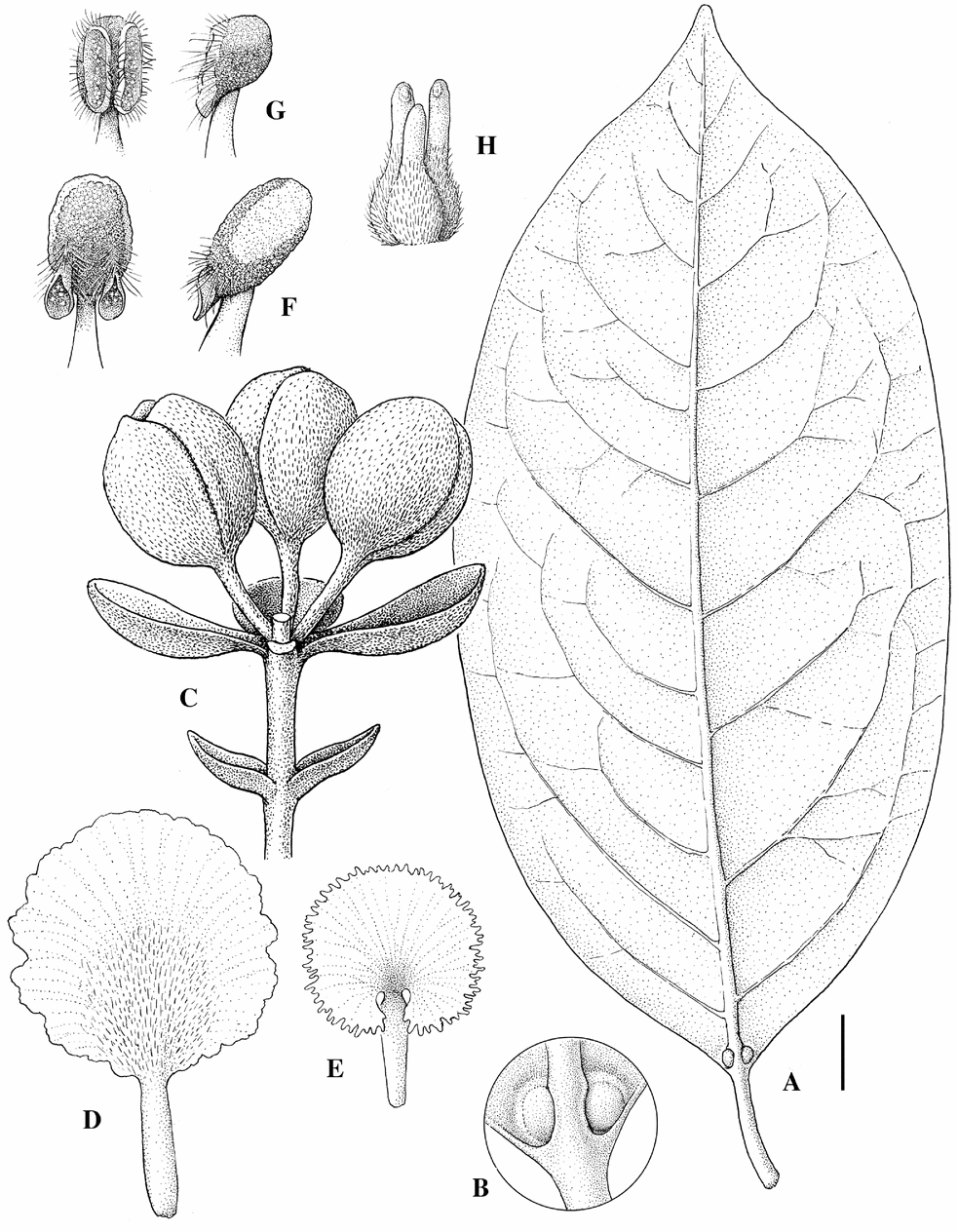
Mezia andersonii differs from M. includens (Benth.) Cuatrec. in its tomentose anthers, with the connective equalling the locules, and adaxially sericeous bracts and bracteoles, and from M. peruviana C.E.Anderson also in its smaller sepals and petals. – Type: Peru, Amazonas: Prov. Bagua, Dtto. Senepa, 250–300 m, 26 i to 18 ii 1967 (fl), Tillett 672-136 (holo US, iso GH). Fig. 3.
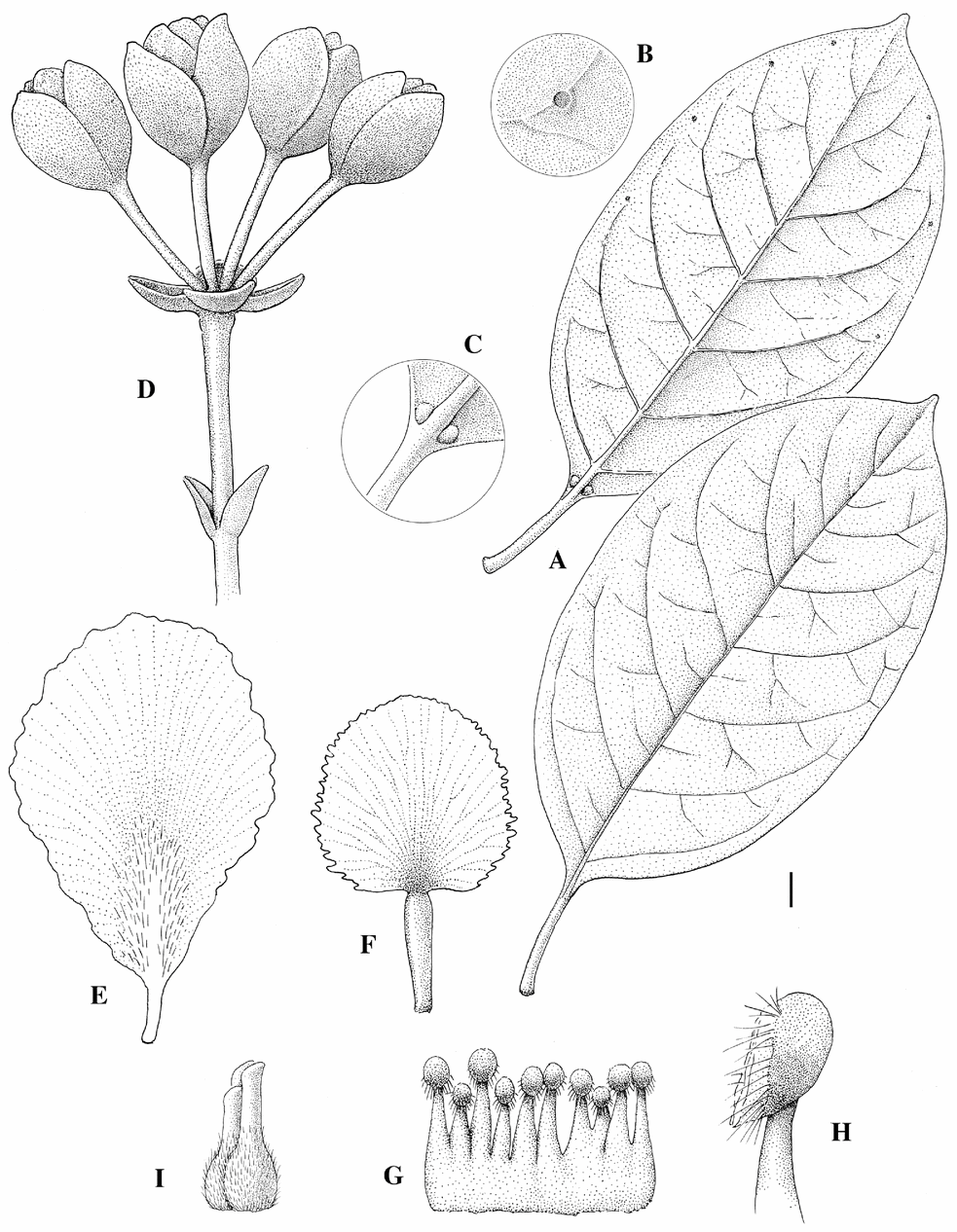
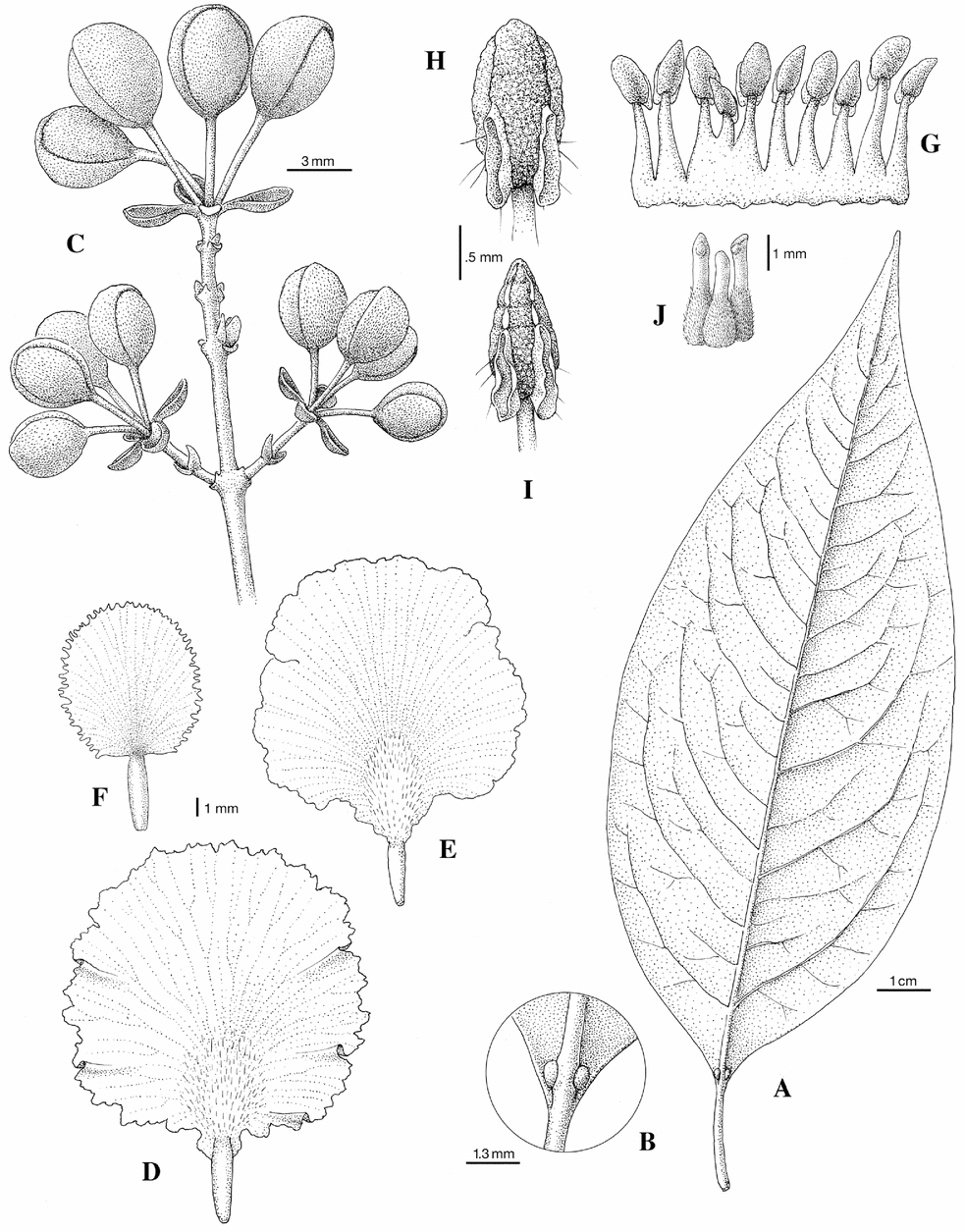
Mezia andersonii C.E.Anderson. A, Leaf, abaxial view above, adaxial view below. B, Detail showing gland inside margin. C, Base of lamina, abaxial view. D, Umbel of four flower buds. E, Lateral petal, abaxial view. F, Posterior petal, abaxial view. G, Androecium, abaxial view, third stamen from right opposing posterior petal. H, Anther and portion of filament. I, Gynoecium, anterior style at left. Scale bar equivalents: A, 1 cm; B, 5 mm; C, 3 mm; D, 1 mm; E–G, 1 mm; H, 0.2 mm; I, 1 mm. Based on Tillett 672-136 (US). Drawn by John Megahan.

Woody vine; stems densely brown-sericeous eventually glabrate, young axes flattened or quadrangular, eventually terete. Lamina of larger leaves 9.5–18 × 5–9.5 cm, elliptical, apex abruptly short-acuminate with the acumen 10–12 mm long, base rounded or cuneate and often somewhat decurrent, margin thickened and flat or recurved in oldest, adaxially glabrous, abaxially probably sericeous when young, when mature appearing glabrous to the naked eye but very sparsely sericeous and eventually glabrescent, hairs straight, appressed, to 0.3 mm long, abaxially bearing a pair of large glands at base sunk into crypts, with a row of 0–5 small impressed glands within each margin, costa and 6 or 7 pairs of principal lateral veins impressed adaxially and prominent abaxially, reticulum slightly prominulous adaxially and prominent abaxially; petiole 15–25 mm long, glabrous; stipules caducous. Inflorescence terminal and axillary, multibranched, lateral axes often subtended by an additional floriferous axis; stalk of the lateral umbels 12–18 mm long, bearing 1 pair of persistent eglandular sterile bracts in basal 1/4; floriferous bracts 3.7–6.5 mm long, obovate, concave, apex rounded, adaxially sericeous, persistent during anthesis; peduncle 10–12 mm long in flower; bracteoles 6–7.5 mm long, adaxially sericeous, apex rounded or bifid and often tearing down the middle, midrib not raised abaxially, eglandular; pedicel 1–1.2 mm long in flower. Sepals 3–4.5 mm long beyond glands, 1.5–1.7 mm wide, spatulate, laterally revolute, abaxially densely brown-tomentose, the anterior eglandular, the lateral 4 biglandular, glands compressed but distinct, each 2.6–2.8 × 1.5–1.7 mm, obovate or elliptical. Lateral petals yellow, claw c.2.5 mm long, limb broadly obovate, base acute, abaxially sparsely white-tomentose or -sericeous in centre, margin subentire or with a few teeth, limb of anterior-lateral petal c.12 × c.9 mm, limb of posterior-lateral petals c.9.5 mm long and wide; posterior petal yellow, glabrous, claw c.3.5 mm long, constricted at apex, limb c.5.5 mm in diameter, orbicular, base truncate or slightly cordate, margin glandular-denticulate-fimbriate. Filaments glabrous or those opposing the posterior-lateral sepals abaxially tomentose in distal 1/3, connate for 1/3 to 1/2 their length except those opposing the posterior-lateral sepal and posterior petal c.2/3 connate, 2.5–3 mm long, shortest opposite posterior petal, longest opposite anterior sepal, those opposite posterior-lateral petals stouter than all others; anthers tomentose, the connective not or slightly exceeding the locules, those opposite the sepals 0.8–1 mm long, those opposite petals 0.7– 0.8 mm long, that opposite the posterior petal the smallest. Ovary c.1.3 mm long; styles straight, terete, the proximal 1/2 sericeous, anterior style c.2 mm long, apex dorsally blunt, posterior styles c.2.3 mm long, apex with a spur to 0.3 mm long. Samara not seen.
Etymology
Mezia andersonii commemorates William Russell Anderson (1942–2013), who devoted his career to the study of Malpighiaceae.
Mezia andersonii is known only from the type, collected in dry tropical forest of Amazonas, Peru (Fig. 1). It is distinctive among species with glabrous leaves and erect styles in its tomentose anthers, the connective not or barely exceeding the locules, and the adaxially sericeous bracts and bracteoles. The habitat is also noteworthy, because most species are found in moist to wet forest.
2. Mezia angelica W.R.Anderson, Contr. Univ. Michigan Herb. 21: 76 (Reference Anderson1997). – Type: French Guiana, Saül, La Fumée Mountain Trail, 03°37′N, 53°12′W, 17 ix 1989 (fl), Mori, Gracie & Rothman 20945 (holo MICH; iso CAY, K, NY, U, US). Figs 2A, B, 4.
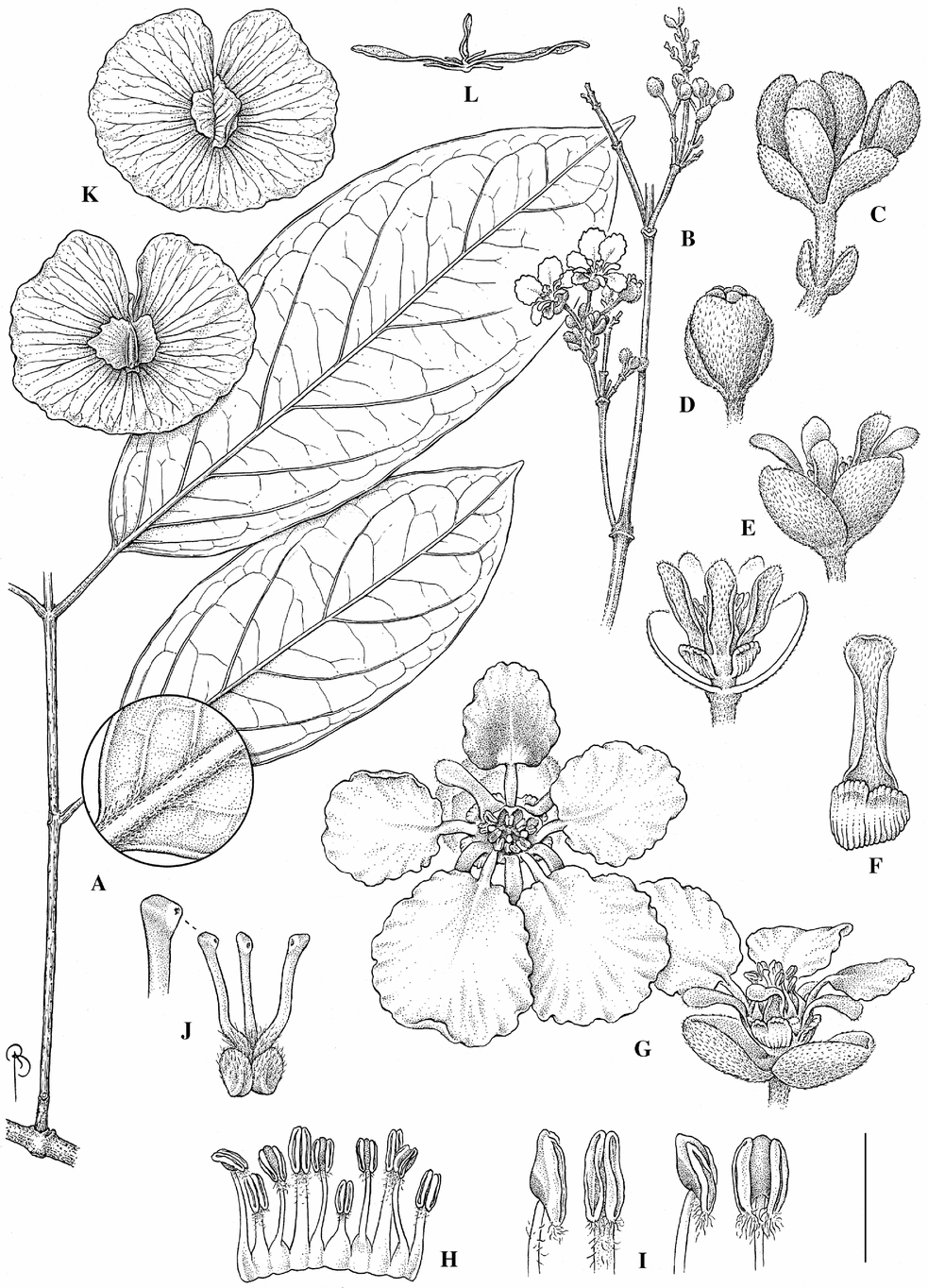
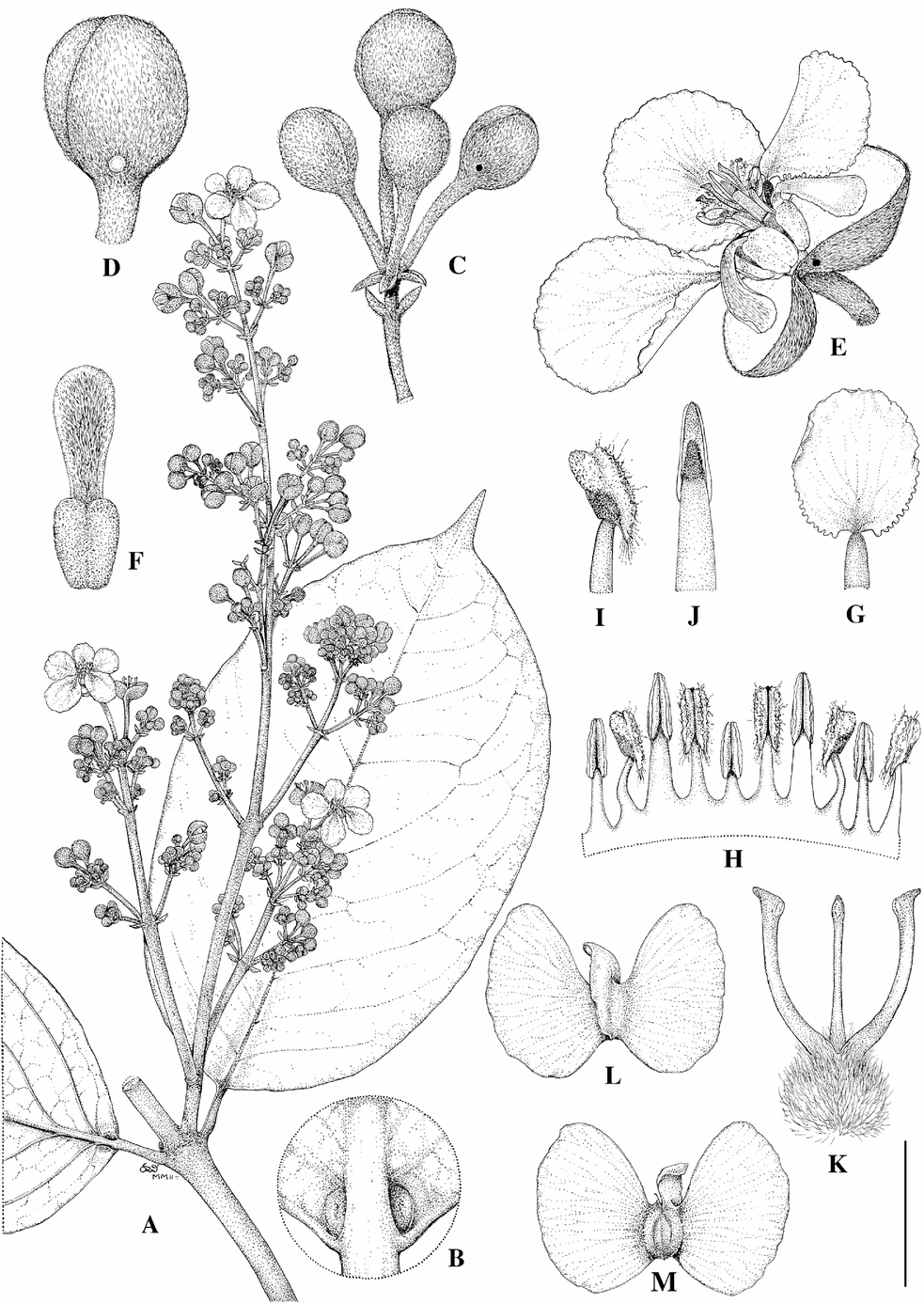
Mezia angelica. A, Leafy stem, with enlargement of abaxial surface to show persistent hairs. B, Portion of inflorescence. C, Umbel of four flower buds. D, Opening flower bud. E, Flower with petals removed, subtended by persistent bracteoles (above), and same with bracteoles half cut away (below), the eglandular anterior sepal in centre. F, Abaxial view of lateral sepal with two nearly connate glands. G, Flower (left) in face view with posterior petal at top; flower (right) in lateral view with two petals removed and posterior petal at right. H, Androecium, adaxial view, stamen fifth from right opposite posterior petal. I, Lateral (far left) and adaxial (near left) views of anthers opposite petals, and lateral (near right) and adaxial (far right) views of anthers opposite sepals. J, Gynoecium, anterior style in centre, and enlargement of style apex. K, Samaras, abaxial view (above) and adaxial view (below). L, Cross-section of samara, showing large lateral wing, smaller dorsal wing, single winglets on each side of dorsal wing, and single winglets outside lateral wings. Scale bar equivalents: A and B, 5 cm; C–E, 1 cm; F, 4 mm; G, 1 cm; H, 4 mm; I, 2 mm; J, 4 mm; K and L, 2 cm. Based on: A–J, Mori et al. 20945 (NY); K and L, Silva 2830 (NY). Drawn by Bobbi Angell.

Woody vine; stems sericeous when young, soon glabrescent, young axes flattened or quadrangular, eventually becoming terete. Lamina of larger leaves 12–20(–24) × 4.5–7.6(–9.8) cm, elliptical or somewhat ovate or obovate, apex abruptly short-acuminate with the acumen 5–10 mm long, base truncate or cuneate, margin not or only slightly thickened and flat, adaxially and abaxially sericeous when young but soon glabrescent to glabrous, older laminas abaxially appearing glabrous to the naked eye but sprinkled with minute widely spaced straight appressed hairs to 0.3 mm long, eventually glabrous, abaxially bearing a pair of large glands at base sunk in crypts or eglandular, occasionally with a row of small impressed glands within each margin distally, costa slightly impressed adaxially and prominent abaxially, 5–8 pairs of principal lateral veins and reticulum prominulous adaxially and prominent abaxially; petiole 15– 30 mm long, sericeous to glabrate; stipules caducous. Inflorescence terminal and axillary, multibranched, some lateral axes subtended by an additional floriferous axis; stalk of lateral umbels 6–16 mm long, bearing 1 pair of deciduous eglandular sterile bracts 2–2.5 mm long in proximal 1/4 to 1/3; floriferous bracts 4–6.5 mm long, broadly obovate, concave, apex broadly rounded, adaxially sparsely sericeous to glabrate, deciduous before or during anthesis; peduncle 7–14 mm long in flower and fruit, thickened in fruit; bracteoles 5–7(–8) mm long, adaxially glabrous to sparsely sericeous proximally, apex emarginate or bifid, midrib usually raised abaxially, eglandular, mostly persistent past maturity of the fruit; pedicel 0–0.8 mm long in flower, to 2 mm long in fruit. Sepals 4–6 mm long beyond glands, 2–3 mm wide, spatulate, strongly revolute along sides, abaxially densely brown-tomentose, the anterior eglandular, the lateral 4 biglandular, glands nearly or completely connate, 2–3 mm long, the pair 1.8–3 mm wide, obovate. Lateral petals yellow, abaxially white-tomentose in centre of limb, margin erose, base truncate, claw of anterior-lateral petals c.4 mm long, limb 11–13 mm in diameter, orbicular to broadly obovate, base truncate, claw of posterior-lateral petals c.3 mm long, limb 9–10 mm in diameter, orbicular; posterior petal yellow, red in the centre, abaxially white-sericeous, claw 3.5 mm long, constricted at apex, limb 6–8 mm in diameter, orbicular, base truncate or slightly cordate, margin proximally dentate or short-fimbriate and distally erose, eglandular. Filaments tomentose distally, connate in the proximal 1/4, 2–4.2 mm long, shortest opposite posterior and anterior-lateral petals, longest opposite anterior-sepals, those opposite posterior-lateral petals somewhat stouter than all others; anthers all tomentose at base, those opposite sepals 1.2– 1.8 mm long, the connective slightly exceeding the locules, anthers opposite petals 1– 1.7 mm long, the connective not exceeding the locules. Ovary c.1.5 mm long; styles nearly terete, apex dorsally truncate, proximally sericeous in proximal 1/4 to 1/2, anterior style 3–3.5 mm long, nearly straight and erect or inclined slightly towards posterior petal, posterior styles 3.5–4 mm long, lyrate or sigmoid. Samara 55–80 mm in diameter, oblate, wings thinly sericeous; nut 11–13 mm long, sericeous, adaxially with 1 flat winglet or crest 1–9(–15) mm wide on each side of nut, outside and parallel to lateral wing; lateral wing 25–34 mm wide, continuous at base, incised to nut at apex, margin entire or repand; central dorsal wing 18–33 × 7–14 mm, semicircular or irregularly repand, with 1 flat winglet 3–7 mm wide on each side of and parallel to dorsal wing; areole 9–13 × 2–4 mm, narrowly ovate or elliptical; torus 1–2 mm high.
Distribution and habitat
Brazil (eastern Amazonas, Pará), southern Guyana, French Guiana, Peru (Loreto), to be expected in Suriname; in moist forest; 50–360 m. Figure 1.
Additional specimens examined. Brazil. Amazonas : Distr. Agropecuário, Reserva 1501 (Km 41) da WWF/INPA Projeto da Dinâmica Biológica dos Fragmentos Florestais, 02°24′26″ to 02°25′31″S, 59°43′50″W, 17 viii 1989 (fr), Lepsch da Cunha et al. 342 (K, MICH, NY); Reserva Florestal Ducke, Manaus–Itacoatiara, Km 26, 02°53′S, 59°58′W, 5 ix 1995 (fl/imm fr), Vicentini 1014 (K, MICH, P). Pará : Rio Jarí, Monte Dourado, 9 xi 1978 (fl/imm fr), Cavalcante 3329 (MG, NY); Tucuruí, margens da PA-149 até o Km 50, 22 viii 1983 (fl), Revilla et al. 8310 (INPA, NY); Santarém, Km 70 da estrada do Palhão, Ramal do Caetetú, 15 ix 1969 (fl), M. Silva & Souza 2604 (MG, MICH, NY, W*); Rio Jarí, estrada entre Planalto A e Tinguelin, Km 13, without date (fr), N. T. Silva 2785 (IAN, UB); Rio Jarí, without date, N. T. Silva 2830 (UB).
French Guiana. Bords de la Rivière du Maroni, Mélinon s.n. in 1862 (P); Saül, La Fumée Mountain Trail, 03°37′N, 53°12′W, 22 ix 1989 (fr), Mori et al. 21012 (CAY, MICH, NY).
Guyana. Kamoa River, Clarence Hill, 01°31′N, 58°50′W, 21 ix 1989 (imm fr), Jansen-Jacobs et al. 1738 (MICH, MO, NY, U, US); Rupununi Distr., between Kuyuwini Landing and Kassikaityu River, 02°00′N, 59°15′W, 20 x 1992 (fl), Jansen-Jacobs et al. 3019 (MICH, MO, P, US).
Peru. Loreto: Maynas Prov., Dtto. Iquitos, Allpahuayo, Estación Experimental del Instituto de Investigaciones de la Amazonia Peruana (IIAP), 04°10′S, 73°30′W, 150–180 m, 23 v 1991, Vásquez & Jaramillo 16345 (MO).
Mezia angelica differs from all other species with circular samaras, except M. huberi, in having one additional winglet on each side and parallel to the dorsal wing as well as adaxially parallel to the confluent lateral wings. It is one of five species in which the posterior styles are lyrate instead of erect. Of those five, only Mezia araujoi also has the outer bracteole eglandular but differs in floral aspects in addition to the samara structure. Mezia angelica has not been reported from Suriname but should be sought there.
The record from Peru is listed with uncertainty. The specimen has only two short, developing inflorescences. Dissections of flower buds showed the bracteoles to be glabrous and the posterior petal and the anthers to be pubescent, aspects that fit Mezia angelica; however, the styles are at too rudimentary a stage to suggest their mature form.
3. Mezia araujoi Nied. in Engl. & Prantl, Nat. Pflanzenfam. III, 4: 58 (Reference Niedenzu, Engler and Prantl1890). Diplopterys araujoi (Nied.) Nied., Arbeiten Bot. Inst. Königl. Lyceums Hosianum Braunsberg 4: 17 (Reference Niedenzu1912). – Type: Brazil, Minas Gerais, Rio Novo [21°25′S, 43°08′W], xii 1887 (fl), Araujo s.n. (holo B†; lecto, designated by W. R. Anderson, Reference Anderson2007: P; iso F, MPU*, P, R*). Fig. 5.
Banisteria macrophylla Adr. Juss., Arch. Mus. Hist. Nat. 3: 418 (Reference Jussieu1843), non Banisteria macrophylla Colla, Reference Colla1833. – Type: Brazil, without locality, Claussen s.n. (holo P).
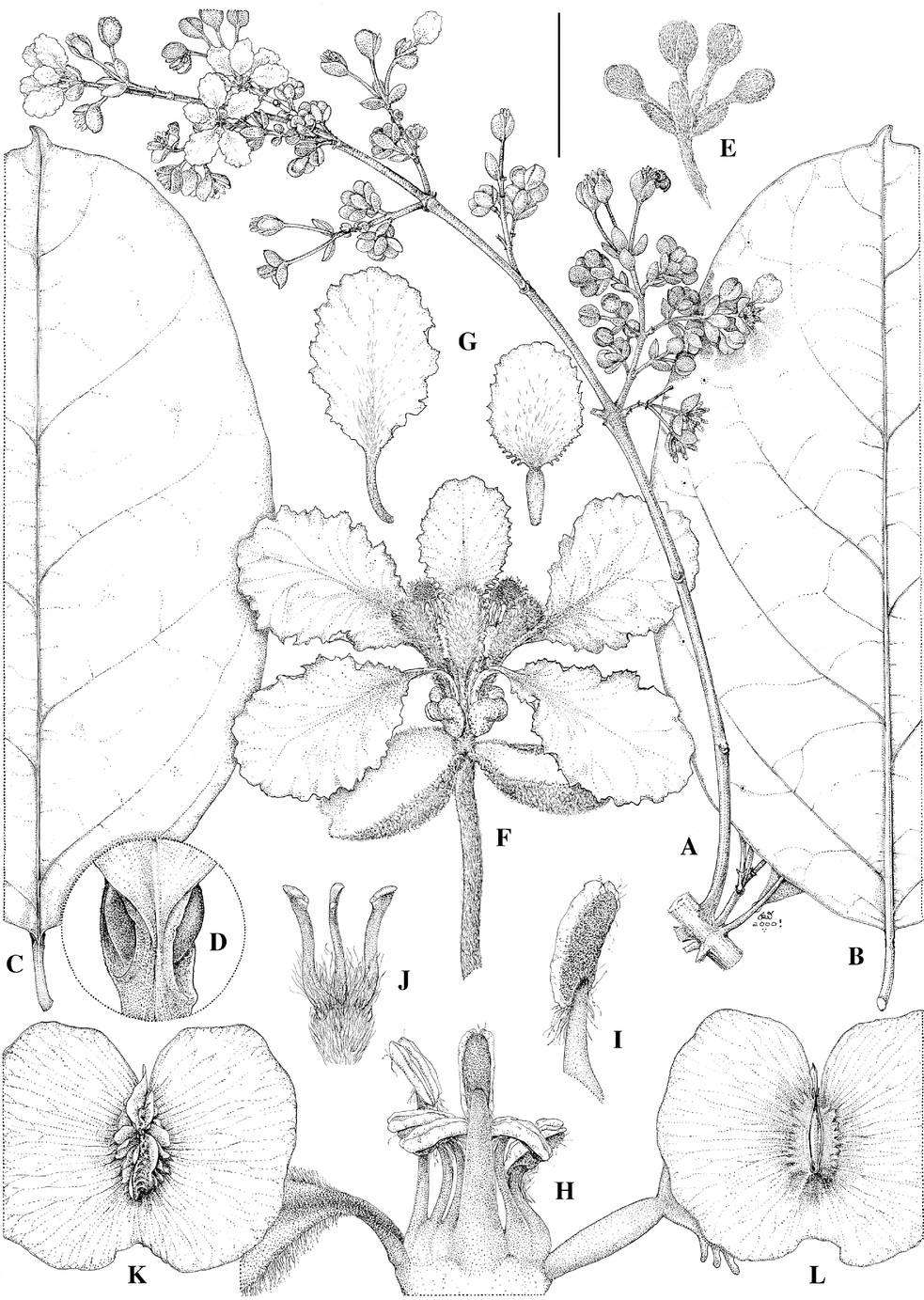
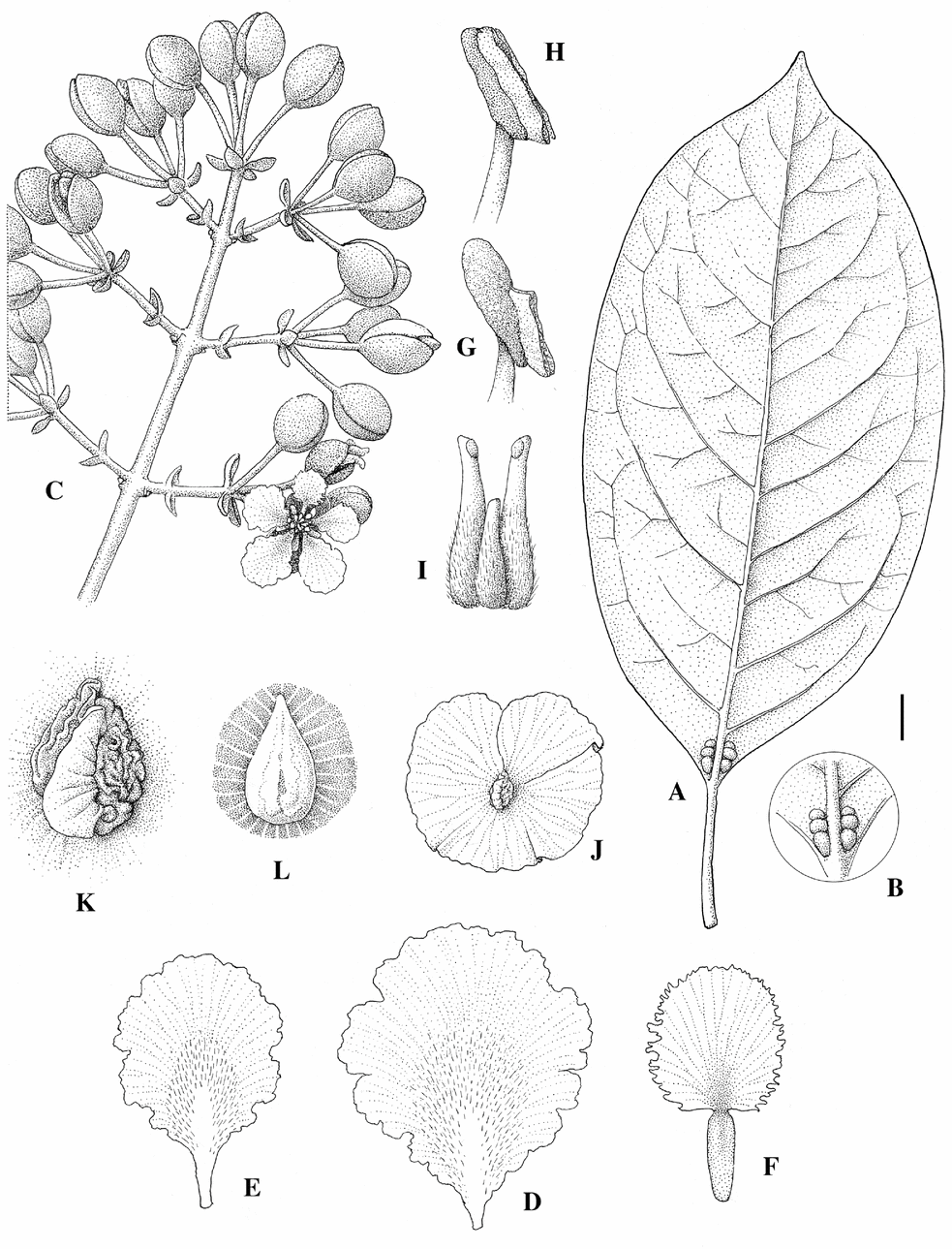
Mezia araujoi. A, Flowering branch. B, Large leaf, abaxial view. C, Large leaf, adaxial view. D, Glands at apex of petiole, adaxial view. E, Umbel of four flower buds. F, Flower subtended by bracteoles, posterior petal at top. G, Lateral petal (left), abaxial view, and posterior petal (right), abaxial view. H, Partial androecium, with claw and base of limb of posterior petal at right and basal portion of anterior sepal at left. I, Anther, lateral-abaxial view. J, Gynoecium, anterior style in centre. K, Samara, abaxial view. L, Samara, adaxial view. Scale bar equivalents: A–C, 4 cm; D, 4 mm; E, 2 cm; F and G, 8 mm; H, 2.7 mm; I, 2 mm; J, 4 mm; K and L, 4 cm. Based on: A–J, Heringer 16050 (MICH); K and L, Magalhães 17528 (IAN). Drawn by Karin Douthit.

Woody vine to 18 m; stems sericeous when young, mostly soon glabrescent, young axes flattened or quadrangular, eventually becoming terete. Lamina of larger leaves 11–26.5 × 5–15 cm, elliptical to broadly so to broadly oblong or somewhat ovate or obovate, apex mostly short-acuminate (acumen to 10 mm long) or apiculate or sometimes rounded or occasionally retuse, base truncate or cuneate, margin not or slightly thickened and flat, adaxially and abaxially sericeous when young but very soon glabrescent to glabrous, often some hairs retained on the costa and near base abaxially, the straight appressed hairs to 0.6 mm long, abaxially bearing a pair of large glands at base sunk in crypts or eglandular or the glands halfway at apex of petiole, commonly with a row of several small impressed glands within each margin mostly in the distal 1/2, costa slightly impressed or flush adaxially and prominent abaxially, 5–7 pairs of principal lateral veins and reticulum prominulous adaxially and prominent abaxially; petiole 14–30 mm long, sericeous to glabrate; stipules caducous. Inflorescence terminal and axillary, multibranched, some lateral axes subtended by an additional floriferous axis; stalk of the umbel 4–11 mm long, bearing 1 pair of deciduous eglandular sterile bracts 3.5–4.5 mm near base to slightly above the middle; floriferous bracts 6–7 × 4.5–6 mm, obovate, concave, apex broadly rounded or bifid, adaxially glabrous, deciduous before or during anthesis; peduncle 8.5–10.5 mm long in flower, not or slightly elongated in fruit and thickened; bracteoles 7–7.5 mm long, adaxially glabrous, apex emarginate or bifid, midrib not or slightly raised abaxially, eglandular, mostly persistent past maturity of fruit; pedicel 0.5–0.8 mm long in flower, to 2 mm long in fruit. Sepals 4.5–5.2 mm long beyond glands, 1.7–2.2 mm wide, spatulate, laterally revolute, abaxially densely brown-tomentose, the anterior eglandular, the lateral 4 biglandular, glands connate, 1.8–2.5 mm long, the pair 1.5–2 mm wide, obovate to square. Lateral petals yellow, abaxially white-sericeous-tomentose in centre of limb and on claw, limb elliptical to obovate, base acute, margin erose to irregularly dentate, claw 3–3.5 mm long, limb of anterior lateral-petals 11–12 × 7–8 mm, limb of posterior-lateral petals 9.5–10.5 × c.7 mm; posterior petal yellow, red in the centre, abaxially white-sericeous in centre of limb and on claw, claw 2.8–3 mm long, constricted at apex, limb 8–8.5 × 5–5.5 mm, elliptical to obovate, base acute, margin denticulate-fimbriate, gland-tipped in the proximal 1/4 to 1/3. Filaments connate in proximal 1/5 to 1/4, those opposite sepals glabrous, those opposite petals distally tomentose, 2–3.5 mm long, shortest opposite posterior petal, longest opposite anterior sepal, those opposite posterior-lateral petals much stouter than all others; anthers tomentose at base and with scattered hairs distally, those opposite sepals 1.3–1.5 mm long, the connective slightly (c.0.1 mm) or not exceeding the locules, those opposite the petals 1.4–1.7 mm long, the connective not exceeding the locules. Ovary 1.2–1.5 mm long; styles nearly terete, apex dorsally acute, the proximal 1/4 sericeous, 3–4 mm long, the posterior slightly longer than the anterior, anterior style nearly straight and erect or inclined slightly towards posterior petal, posterior styles lyrate or sigmoid. Samara suborbicular, (60–)70–80 mm in diameter, wings sparsely sericeous to glabrate; nut 12–13 mm long, sparsely sericeous, adaxially with a series of ribs radiating from areole, with some of these ribs expanded or not into winglets; lateral wing 25–35 mm wide, semicircular, continuous at base, incised to nut at apex, membranous, entire or repand at margin; central dorsal wing 25–35 × c.10 mm, semicircular or irregularly repand, with a network of interconnected shorter parallel and transverse winglets between the dorsal and lateral wings; areole 10–15 × 3–4 mm, narrowly elliptical; torus 2.5–3.5 mm high.
Distribution and habitat
Brazil (Espírito Santo, Minas Gerais, Rio de Janeiro); in moist forest; [sea level to] 550 m. Figure 1.
Additional specimens examined. Brazil. Espírito Santo: Mpio. Marilândia, Liberdade, propr. Sônia (Reinaldo Bautz), 19°20′08″S, 40°32′08″W, 10 xii 2007 (fl), Demuner 4700 (MICH); Estrada de Nanuque, 12 xi 1953 (fr), Duarte 3968 (CEPEC, MICH, RB*); Reserva Florestal de Linhares, Gávea, Km 6.8, 10 x 1993 (fl), Folli 2082 (MICH); Mpio. Linhares, Reserva Florestal da Companhia Vale de Rio Doce, 17 xii 1981 (fr), de Lima 1702 (CEPEC, RB*); Conceição da Barra, Reserva Biológica de Córrego Grande, floresta ala sobre Tabuleiro, estrada Interna Km 4, 20 viii 2011, Ribeiro 574 (VIES*). Minas Gerais: 16–21 km NE of Dionísio on road to Fabriciano, 27 i 1990 (past fruiting), Anderson 13672 (MICH); Marliéria, Parque Estadual do Rio Doce, próximo ao Mirante, 25 x 2006 (fl), Bovini 2631 (RB*); Mpio. Descoberto, Reserva Biológica Represa do Grama, 14 x 2001 (fl), Forzza et al. 1893 (RB*); Mpio. Dionísio, Parque Estadual do Rio Doce, 23 x 1976 (fl), Heringer 16050 (IBGE, MICH, NY, RB*); Mpio. Comercinho, estrada Comercinho para B.R.U. [16°20′S, 41°45′W], xi 1958 (fr), Magalhães 17528 (IAN). Rio de Janeiro: Guapimirim, Estação Ecológica Estadual de Paraíso, Área da parcela 1, 22°02′S, 42°50′W, 19 xi 1991 (fr), de Lima 4283 (RB*); Gávea, without date, Glaziou 7855 (P); without locality and date (sterile), Glaziou 9365 (P); Rio do Ouro at base of Serra da Tinguá, without date (fl), Glaziou 9367 (BR, G, K, MICH, P); without locality and date (fr), Glaziou s.n. (NY); Guapimirim, Estação Ecológica Estadual de Paraíso, Centro de Primatológia do RJ-FEEMA, 200 m, 10 x 1984 (fl), Martinelli 9983 (RB*); Mandiocca [‘Fazenda da Mandioca’, near Magé], x 1823 (fl), Riedel s.n. in 1823, (NY, US); Mata do Rumo, 12 xii 1971 (fr), Sucre 8097 (MICH, RB); Serra de Petrópolis, 12 x 1932 (fl), Victorio s.n. [RB 26326] (MICH, RB); Horto Florestal, 25 ii 1927 (fr), Serviço Florestal do Brasil [RB 26327] (RB).
Mezia araujoi and M. bahiana are disjunct from the mainly Amazonian distribution of the genus. They both belong to the group of five species with lyrate instead of erect posterior styles. Of these, Mezia bahiana, M. beckii and M. mariposa are readily separated by the large gland borne on the outer bracteole. Mezia angelica, of the Guianas and eastern Amazonian Brazil, differs in its samara, lacking abundant winglets between the dorsal and lateral wings, and in aspects of the corolla.
4. Mezia bahiana C.E.Anderson, sp. nov.
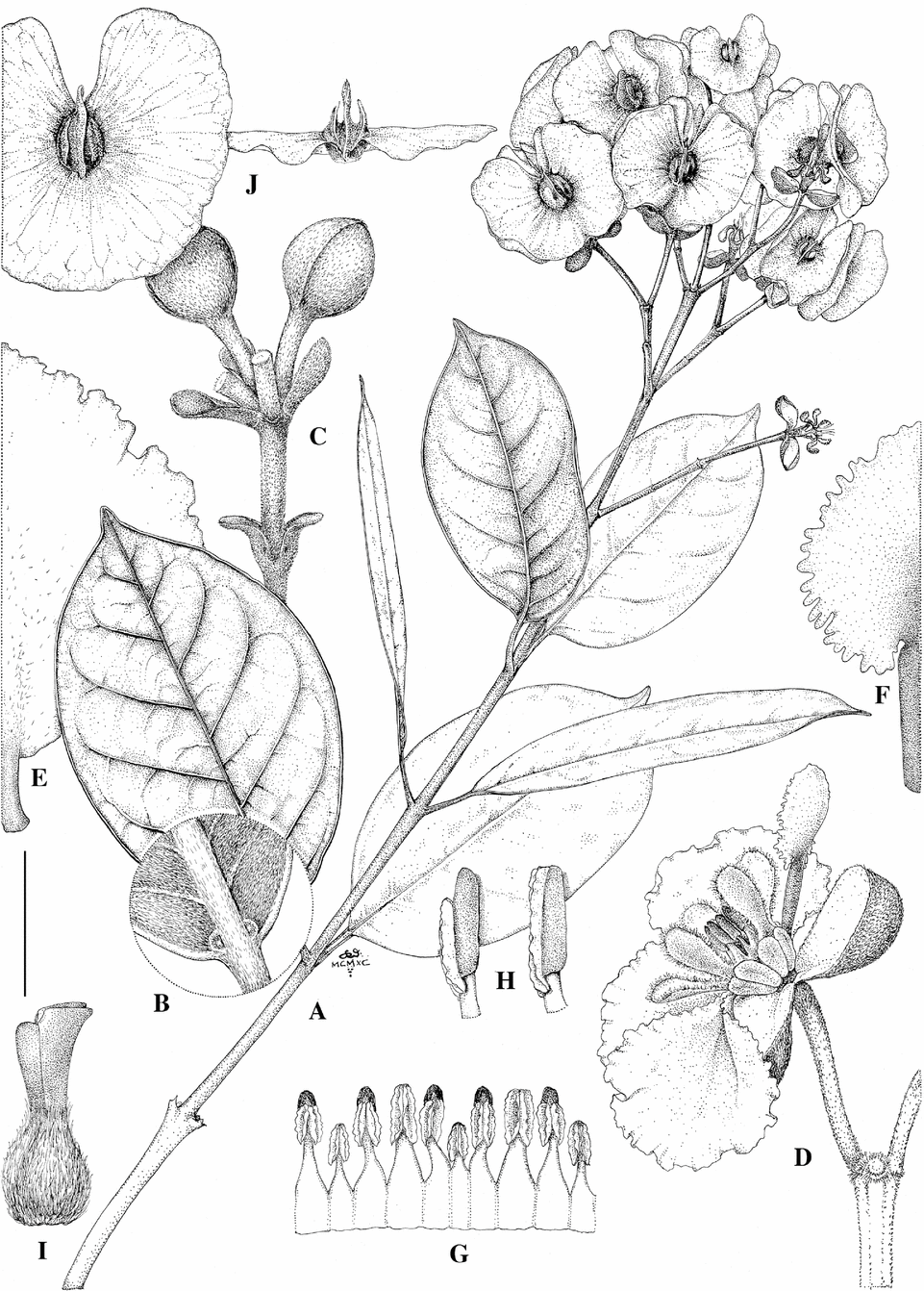
Mezia bahiana differs from all other species in bearing the pair of large leaf glands at the apex of the petiole instead of at the base of the lamina, and from M. araujoi Nied. by the presence of a gland on the outer bracteole. – Type: Brazil, Bahia, Mpio. Itacaré, loteamento da Marambaia, rod. Ilhéus–Itacaré, c.6 km de Itacaré [14°16′S, 38°59′W], 6 i 2000 (fl), Amorim et al. 3226 (holo MICH, iso NY). Fig. 6.
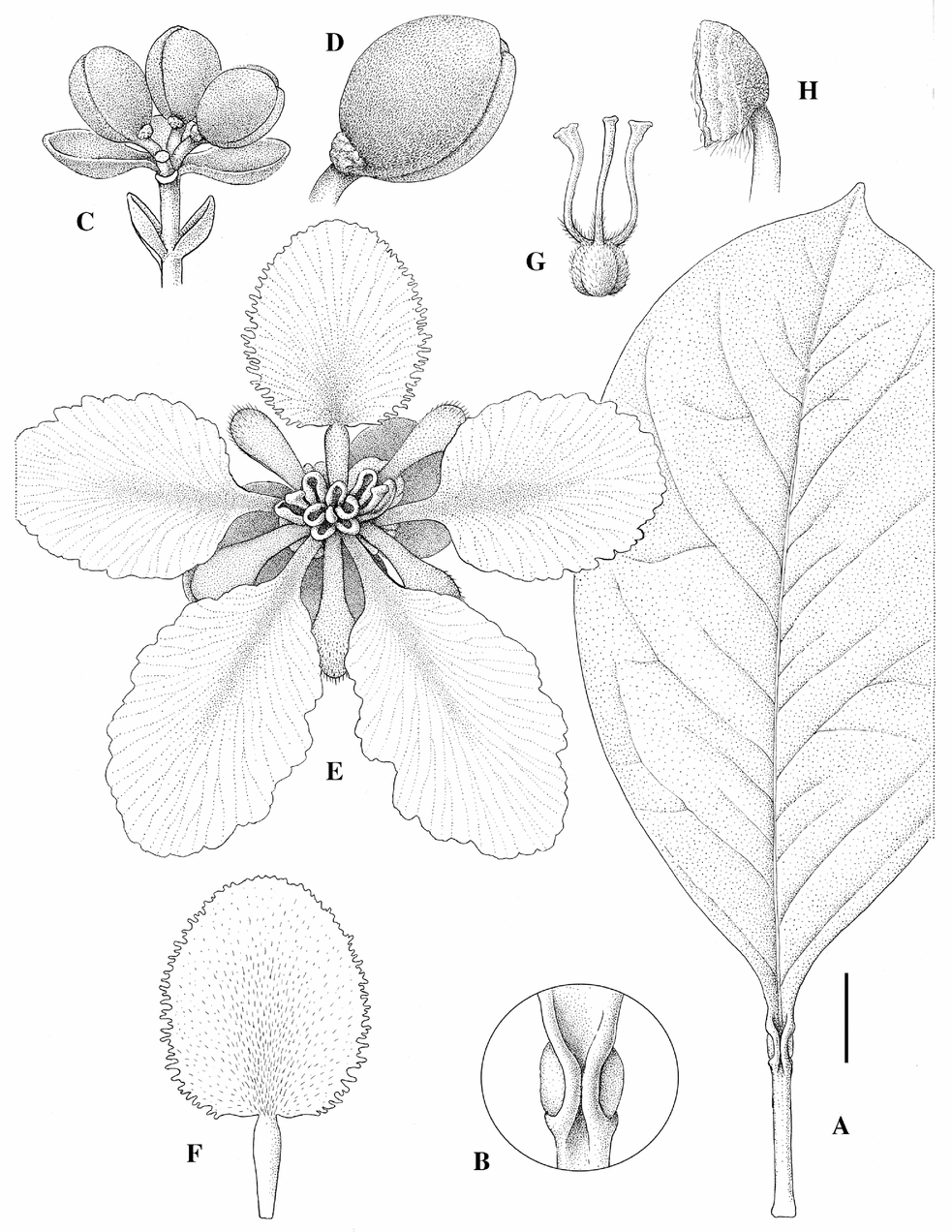
Mezia bahiana C.E.Anderson. A, Leaf, adaxial view. B, Detail of basal glands on petiole. C, Umbel of flower buds (one removed). D, Flower bud enclosed in bracteoles; outer bracteole with large gland. E, Flower in face view, posterior petal at top. F, Posterior petal, showing abaxial vesture. G. Gynoecium, anterior style in centre. H, Anther and portion of filament. Scale bar equivalents: A, 1 cm; B, 4 mm; C, 1 cm; D, 5 mm; E, 4 mm; F, 2.4 mm; G, 2.5 mm; H, 1.3 mm. Based on Amorim et al. 3226 (MICH). Drawn by John Megahan.

Woody vine to 20 m; stems glabrous (only short portion with two nodes seen). Lamina of leaves 11.5–13.5 × 6–7.5 cm, elliptical, apex apiculate, the apiculum to 2 mm long, base attenuate, margin slightly thickened and flat, glabrous at maturity or abaxially with a few scattered brown hairs to 0.3 mm long near base, without impressed glands inside margin, costa impressed adaxially and prominent abaxially, 4 or 5 pairs of principal lateral veins and reticulum slightly prominulous adaxially and prominent abaxially; petiole 2.5–3 cm long, glabrous, bearing a pair of large glands sunk in crypts at apex; stipules caducous. Inflorescence multibranched, lateral axes often subtended by 1 or 2 additional floriferous axes; stalk of the lateral umbels 7–10 mm long, bearing 1 pair of caducous eglandular sterile bracts c.3 mm long in proximal 1/4 to 1/2; floriferous bracts 5–6.5 mm long, obovate, conduplicate, apex broadly rounded, adaxially glabrous, deciduous at onset of anthesis; peduncle 7–9.5 mm long in flower; bracteoles 7–7.5 mm long, adaxially glabrous, apex broadly rounded to emarginate or bifid, the midrib slightly raised abaxially, the outer bearing 1 protuberant circular gland 1.3–1.7 mm long abaxially at base, the inner eglandular, pedicel 0.5–1 mm long in flower. Sepals 4–6 mm long beyond glands, 2–2.5 mm wide, spatulate, laterally revolute, abaxially densely brown-tomentose, the anterior eglandular, the lateral 4 biglandular, the glands connate, 2.3–2.7 mm long, the pair 2–2.3 mm wide, obovate or quadrate. Lateral petals yellow, abaxially white-sericeous-tomentulose in centre of limb and on claw, base acute or briefly truncate, margin erose to irregularly denticulate, claw 3–3.2 mm long, limb of anterior-lateral petals 14–15 × c.11 mm, broadly obovate, limb of posterior lateral petals 11–12 × 10–11 mm, broadly ovate or broadly oblong; posterior petal yellow, red in centre, abaxially densely white-tomentulose, claw 3.6 mm long, thick, constricted at apex, limb 6.5–7 × 5–5.5 mm, elliptical, base truncate, margin fimbriate, the fimbriae longer and narrower distally, the basalmost stout and gland tipped, irregularly dentate at apex. Filaments connate in basal 1/4, tomentose distally, 1.5–3.5 mm long, shortest opposite posterior petal, longest opposite anterior sepal, those opposite posterior-lateral petals much stouter than all others; anthers tomentose at base and with scattered hairs distally and at apex, those opposite sepals 1.7–2 mm long, the connective slightly exceeding the locules, those opposite petals 1.6–2 mm long, the connective not exceeding the locules. Ovary 1–1.8 mm long; styles nearly terete, apex dorsally acute, the proximal 1/3 to 1/2 hirsute, 3.7–4 mm long, the posterior slightly longer than the anterior, anterior style nearly straight and erect or inclined slightly towards posterior petal, posterior styles lyrate. Samara not seen.
Mezia bahiana has been collected only once in disturbed ‘mata higrófila’ of Bahia, Brazil (Fig. 1). It is the only species in which the large leaf glands are placed on the petiole instead of the base of the lamina. The only other species occurring in non-Amazonian Brazil is Mezia araujoi (Espírito Santo, eastern Minas Gerais, and Rio de Janeiro). It shares with Mezia bahiana the lyrate posterior styles and may have the basal leaf glands partly on the petiole but lacks the large gland on the outer bracteole.
5. Mezia beckii W.R.Anderson, Contr. Univ. Michigan Herb. 22: 17 (Reference Anderson1999). – Type: Bolivia, Pando, Prov. Manuripi, trocha entre el campamento Bay y Curichón [11°29′S, 68°53′W], 18 x 1989 (fl/fr), Beck 19513 (holo MICH; iso COL, LPB, M, MICH, NY, SI). Fig. 7.
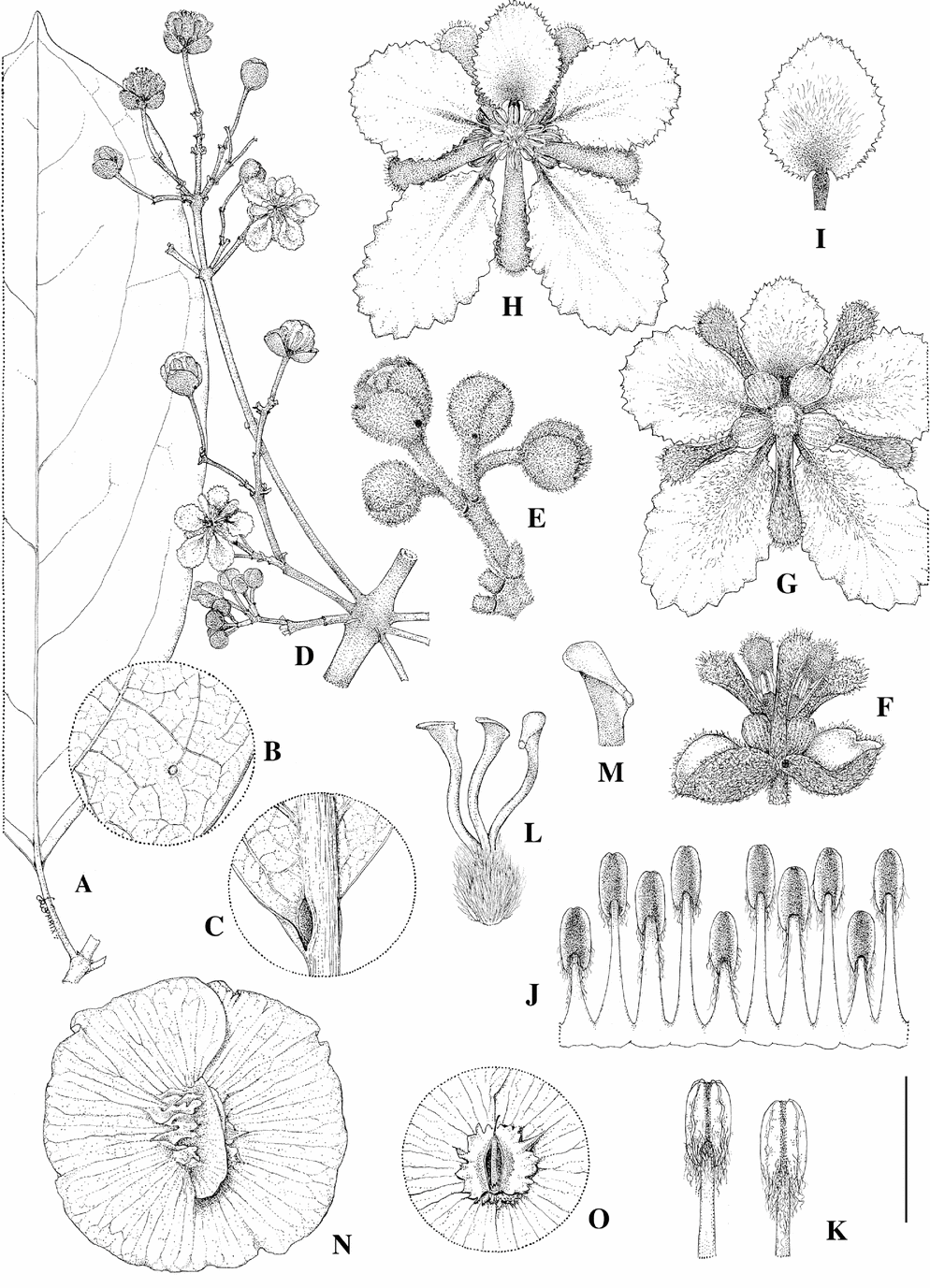
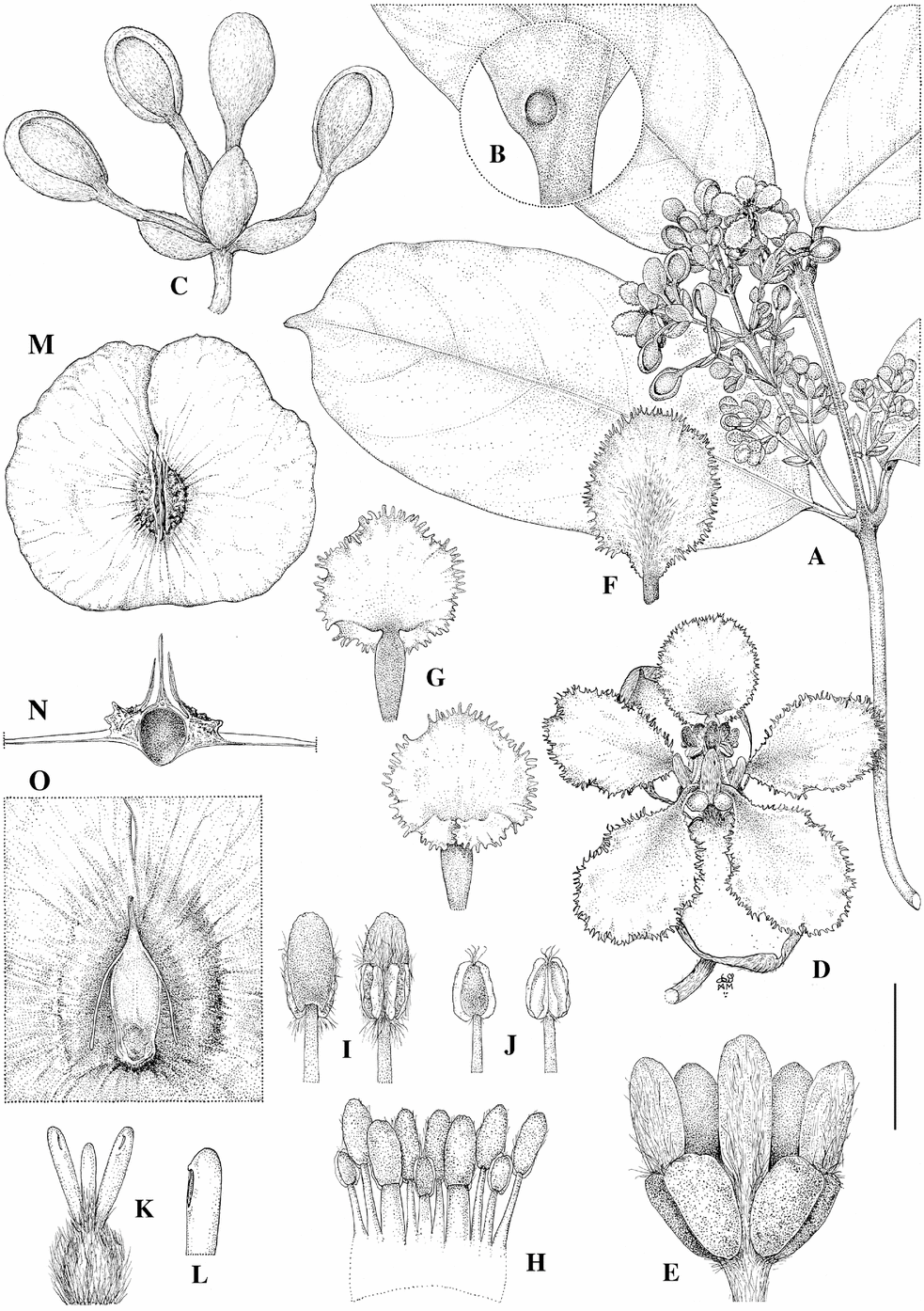
Mezia beckii. A, Large leaf, abaxial view. B, Enlargement of abaxial surface of lamina. C, Glands at base of lamina, abaxial view. D, Portion of inflorescence. E, Umbel of flower buds. F, Flower subtended by bracteoles (note gland on one bracteole), anterior sepal in centre, petals removed. G, Flower seen from below, posterior petal at top. H, Flower in face view, posterior petal at top. I, Posterior petal, abaxial view. J, Androecium, abaxial view, stamen fifth from left opposite posterior petal. K, Anthers, adaxial view, opposite sepal (left) and opposite petal (right). L, Gynoecium, anterior style at left. M, Distal portion of style. N, Samara, abaxial view. O, Detail of adaxial view of samara, showing areole and surrounding winglets. Scale bar equivalents: A, 4 cm; B and C, 8 mm; D, 4 cm; E, 1.3 cm; F–H, 8 mm; I, 5.7 mm; J, 3.3 mm; K, 2.7 mm; L, 3.3 mm; M, 1.7 mm; N and O, 4 cm. Based on: A–M, Beck et al. 19513 (MICH); N and O, Jardim 2397 (MICH). Drawn by Karin Douthit.

Woody vine to 20 m; stems sericeous when young, eventually glabrescent, youngest axes flattened or quadrangular, soon becoming terete. Lamina of leaves 11.5–23 × 7.2– 10.3 cm, elliptical or slightly obovate, apex abruptly short-acuminate with the acumen 5–10 mm long, base cuneate, margin slightly thickened and flat, glabrous at maturity or abaxially seemingly glabrous but with minute scattered hairs to 0.3 mm long, abaxially bearing a pair of large glands at base sunk in crypts or eglandular, with 0–4 small impressed glands within each margin distally, costa and 4 or 5 pairs of principal lateral veins and reticulum slightly prominulous adaxially, prominent abaxially; petiole 15– 26 mm long, glabrate; stipules caducous. Inflorescence multibranched, some lateral axes subtended by 1 or 2 additional floriferous axes; stalk of the lateral umbels 5–14 mm long, bearing 1 pair of caducous eglandular sterile bracts 2–2.5 mm long at or near base; floriferous bracts caducous (only one seen), 4.3 mm long, obovate conduplicate, apex broadly rounded, adaxially glabrous; peduncle 11–18 mm long in flower and fruit, notably thickened in fruit; bracteoles 5–7.5 mm long, adaxially glabrous, apex broadly rounded and often emarginate, midrib not raised abaxially, the outer bearing 1 prominent circular or elliptical gland 0.5–1 mm long abaxially at base near one margin, the inner eglandular, persistent past maturity of fruit, pedicel c.1 mm long in flower, to 2 mm long in fruit. Sepals 4.5–5.5 mm long beyond glands, 2–2.5 mm wide, spatulate, laterally revolute, abaxially densely brown-tomentose, the anterior eglandular, the lateral 4 biglandular, glands completely connate, 2.3–2.5 mm long, the pair 1.8– 2.3 mm wide, obovate or quadrate. Lateral petals yellow, abaxially white-tomentose in centre of limb, margin erose, base of limb acute or truncate, claw of anterior-lateral petals c.3 mm long, limb c.11–12 × 8–9 mm, obovate, claw of posterior-lateral petals c.2.5 mm long, limb 7–7.5 mm in diameter, orbicular; posterior petal yellow, perhaps red in centre, abaxially white-tomentose in centre of limb, claw 1.6–7 mm long, constricted at apex, limb c.6 × 4.7–5 mm, broadly ovate to suborbicular, base cordate, margin dentate or short-fimbriate, eglandular. Filaments connate only in the basal 0.6 mm, tomentose distally, 2–4 mm long, shortest opposite posterior and anterior-lateral petals, longest opposite anterior-sepals, those opposite posterior-lateral petals somewhat stouter than all others; anthers 1.5–2 mm long, tomentose at base and along locules, those opposite the sepals more abundantly so than those opposite petals, the connective not exceeding the locules or very slightly so only in anthers opposite sepals. Ovary 1.5 mm long; styles 3–3.5 mm long, nearly terete, apex pedaliform and extended into a tiny spur, sericeous at base, anterior style nearly straight and erect or inclined slightly towards posterior petal, posterior styles lyrate. Samara 65–85 mm in diameter, suborbicular, wings thinly sericeous; lateral wing 25–35 mm wide, continuous at base, deeply incised at apex to where both lobes fuse with proximal 5–10 mm of central dorsal wing, membranous, nearly flat except near nut, entire or repand at margin; central dorsal wing 23–32 × 7–15 mm, semicircular or somewhat repand, connected to lateral wing on each side by 5–7 interconnected winglets; nut 10–15 mm long, appressed-tomentose, adaxially with a series of ribs radiating from areole, some ribs developing into winglets adnate to underside of lateral wing and sometimes also connate basally with each other to produce a crest or winglet parallel to the lateral wing; areole 11–12 × 4 mm, narrowly ovate; torus c.3 mm high.
Distribution and habitat
Bolivia (Pando) and Brazil (Acre); in wet forest; one collection from 180 m. Figure 1.
Additional specimens examined. Bolivia. Pando: Manuripi Prov., 3 km N of Puerto América, 11°36′01″S, 68°08′55″W, 8 ix 1995 (fr), Jardim 2397 (MICH, MO).
Brazil. Acre: ‘Bom Futuro’, Reserva Extravista Chico Mendes, Km 52 of Brasília–Assis Brasil road, 8 km on Ramal (side road) ‘Tocandeira’, 10°43′07″S, 69°00′17″W, 27 ix 2003 (fr), Daly et al. 11973 (NY).
Mezia beckii is the only species of Mezia reported from Bolivia. The lyrate styles and the outer bracteole with a large gland separate it from all other Amazonian species of Mezia except M. mariposa. The latter differs in its glabrous petals and a butterfly-shaped samara.
6. Mezia curranii W.R.Anderson, Mem. New York Bot. Gard. 32: 236 (Reference Anderson1981). – Type: Venezuela, Amazonas, Culebra [03°45′N, 65°45′W], Curran 253 (holo MICH, iso NY). Fig. 8H,I.
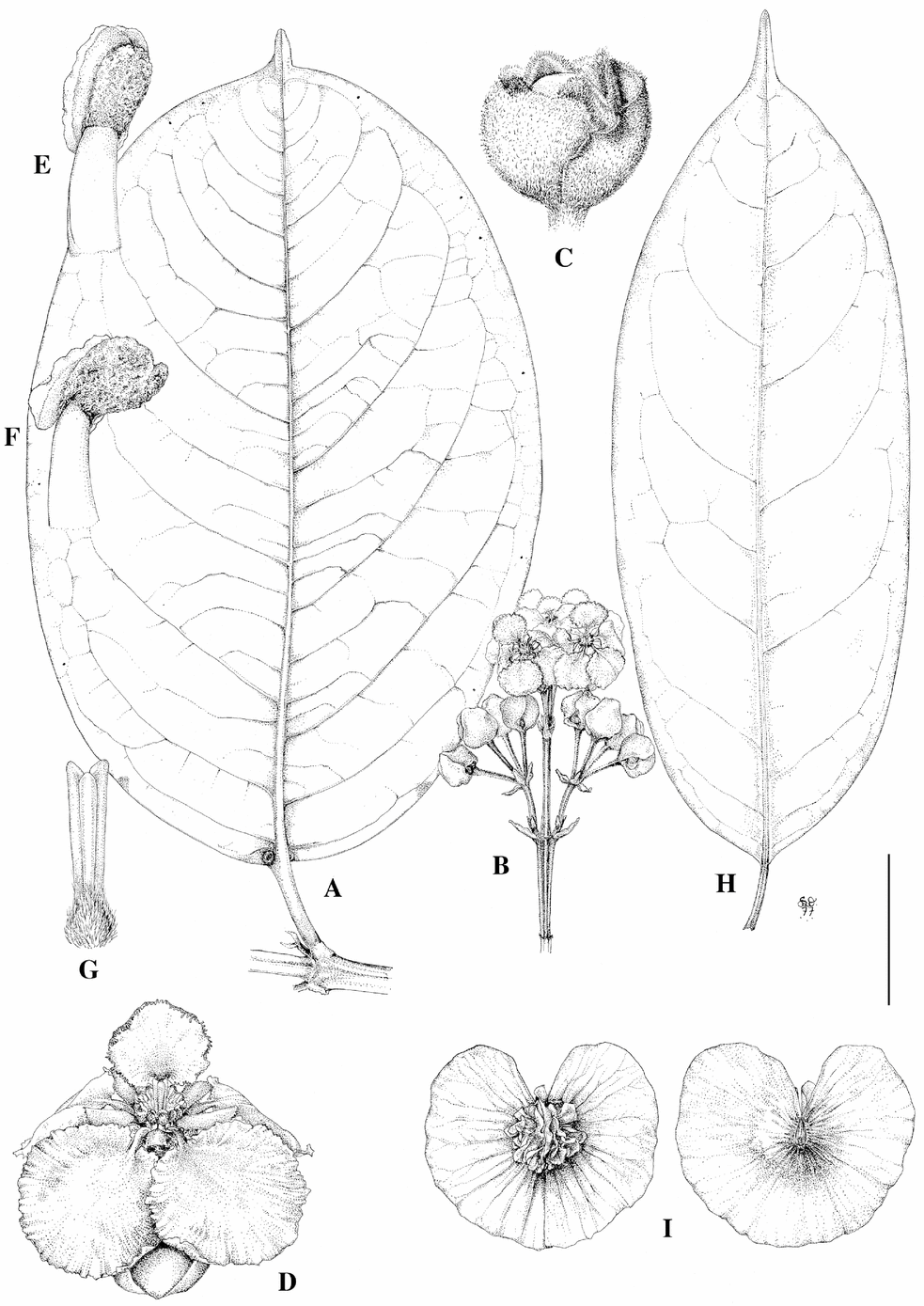
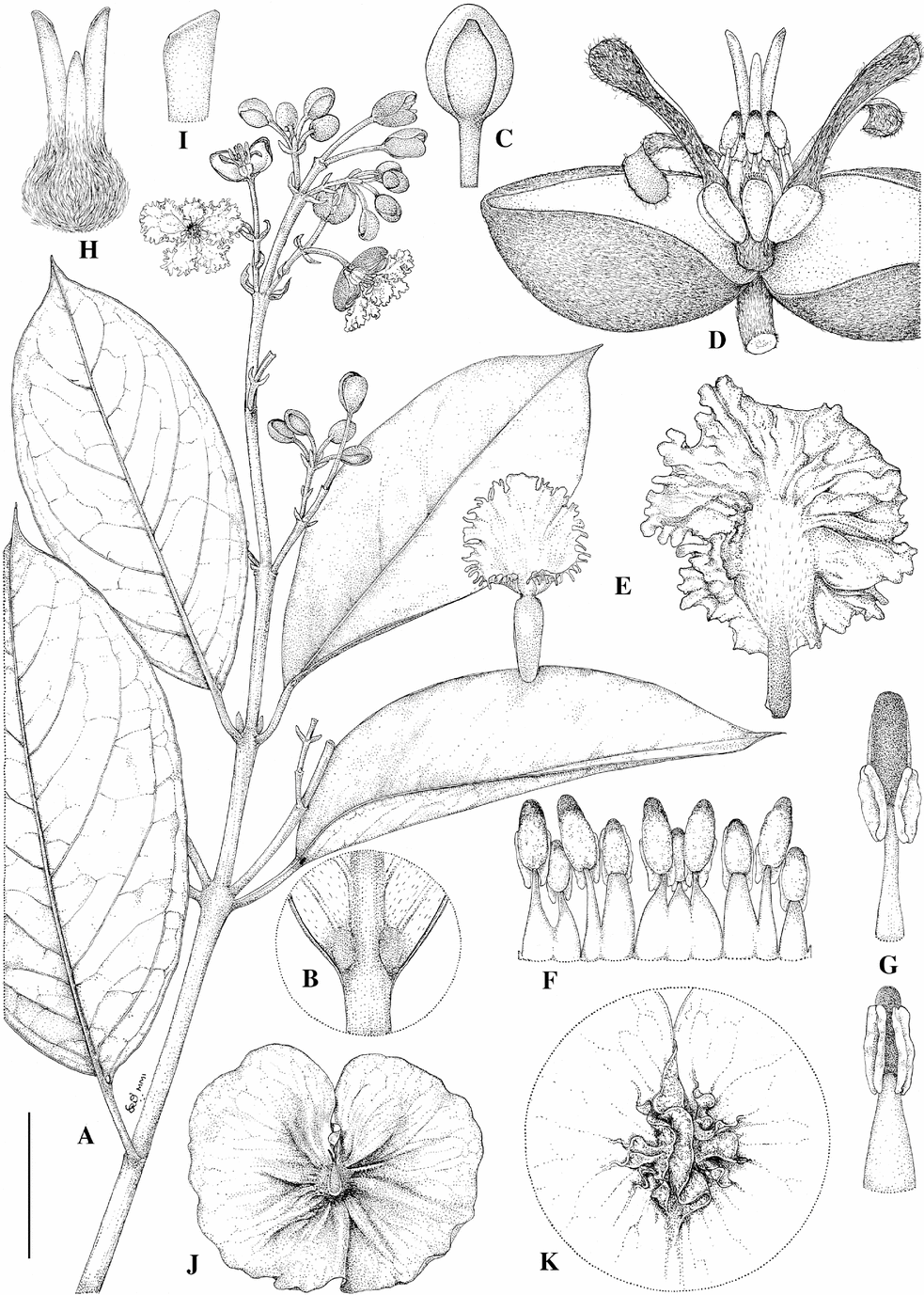
Mezia rufa and M. curranii. A–G, M. rufa. A, Leaf, abaxial view. B, Portion of inflorescence. C, Flower bud enclosed by bracteoles. D, Flower, posterior petal at top. E, Anther opposite petal, lateral view. F, Anther opposite sepal, lateral view. G, Gynoecium, anterior style in centre. H and I, M. curranii. H, Leaf, adaxial view. I, Samaras, abaxial view (left) and adaxial view (right). Scale bar equivalents: A and B, 4 cm; C, 8 mm; D, 1.3 cm; E and F, 2 mm; G, 4 mm; H and I, 4 cm. Based on: A–G, Silva & Brazão 60837 (MICH); H and I, Curran 253 (MICH). Drawn by Karin Douthit.

Woody vine; stems sericeous when young, soon glabrate, young axes quadrangular or flattened, soon becoming terete. Lamina of larger leaves 12.5–23 × 4.5–8.3 cm, elliptical or narrowly obovate, apex acuminate with the acumen 15–20 mm long, base briefly attenuate, margin thickened and flat or slightly recurved, adaxially glabrous, abaxially glabrous or sprinkled with minute straight appressed hairs to 0.4 mm long (glabrous to the naked eye), abaxially bearing 2 large glands at the base sunk into crypts, with a row of 5–10 tiny impressed glands within each margin, costa flush adaxially and prominent abaxially, c.6 or 7 pairs of principal lateral veins and reticulum prominulous adaxially and prominent abaxially; petiole 12–17 mm long, glabrate at maturity; stipules caducous. Inflorescence terminal and axillary, multibranched, some lateral axes subtended by an additional floriferous axis; stalk supporting lateral umbels 5–7 mm long, with 1 pair of caducous sterile bracts (not seen) at about the middle; floriferous bracts not seen; peduncle 7–9 mm long in fruit; bracteoles (only 2 seen) c.6 mm long, adaxially glabrous, apex rounded or bifid, midrib not raised abaxially, eglandular, apparently not persistent past maturity of fruit; pedicel to 1.5 mm long in fruit. Sepals 6–6.5 mm long beyond glands, 1.5–1.8 mm wide, spatulate, laterally revolute, abaxially densely light-brown tomentose, the anterior eglandular, the lateral 4 biglandular, glands compressed but distinct, each 2–2.5 × 1.1 mm, obovate. Petals not seen. Filaments glabrous, connate for about 1/2 their length except those opposing the posterior-lateral and posterior petals c.3/4 connate, 2–2.7 mm long, shortest opposite posterior petal, then progressively longer opposite anterior-lateral petals, lateral sepals and posterior-lateral petals (these 2 much stouter than all the others), longest opposite anterior sepal; anthers opposite sepals densely tomentose, 1.5–2 mm long, the connective exceeding the locules up to 0.5 mm, anthers opposite lateral petals glabrous except for a few hairs at apex, 1.3–1.6 mm long, the connective not exceeding the locules, anther opposite posterior petal not seen, probably much smaller than others. Ovary 1.5 mm long; styles in fruit straight, terete, apex dorsally truncate, sericeous in proximal 1/3 to 1/2, anterior style 2.2–2.3 mm long, posterior styles 3.2–3.3 mm long. Samara 40–60 mm in diameter, suborbicular, wings sparsely sericeous to glabrate; lateral wing 20–30 mm wide, semicircular, continuous at base, incised at apex to the nut, membranous, margin repand; central dorsal wing 19–24 × c.7 mm, semicircular, with 1 lateral dorsal winglet on each side and parallel to central dorsal wing, 5–7 mm wide, with c.5–10 winglets intermediate between lateral wings and dorsal winglet, undulate, sometimes transverse; nut 6–7.5 mm long, sericeous, adaxially with a series of often shallow ribs radiating from the areole; areole 6–7 × 2.3–3 mm, narrowly ovate; torus 2–3 mm high.
Mezia curranii is known only from the two fruiting specimens that constitute the type collection gathered in Amazonas, Venezuela (Fig. 1). It differs from Mezia includens in its pubescent anthers, shorter styles and smaller samaras. The other species recorded from southern Venezuela are Mezia huberi and M. rufa, which differ most notably with their abaxially densely brown-sericeous laminas.
7. Mezia fanshawei C.E.Anderson, sp. nov.
Mezia fanshawei differs from M. includens (Benth.) Cuatrec. in its subequal bracts and bracteoles, shorter petioles, shorter sepals with the glands proximally connate, smaller petals and tomentose anthers. – Type: Guyana, Potaro River, Eagle Mountain [05°13′N, 59°06′W], 5 viii 1947 (fl/imm fr), Fanshawe 2698 [record number 5491] (holo K; iso NY, US). Fig. 9.
Mezia fanshawei C.E.Anderson. A, Leaf, abaxial view. B, Base of lamina, abaxial view. C, Umbel flower buds (one removed). D, Lateral petal, abaxial view. E, Posterior petal, abaxial view. F, Anther opposite sepal, front and side views. G, Anther opposite petal, front and side views. H, Gynoecium, anterior style in centre. A, 1 cm; B, 2.5 mm; C, 3 mm; D and E, 2.2 mm; F and G, 0.6 mm; H, 2 mm. Based on Fanshawe 2698 (NY). Drawn by John Megahan.

Woody vine; young stems sericeous, soon glabrate, young axes quadrangular, becoming terete. Lamina of larger leaves 8.5–c.16 × 3–7 cm, elliptical, apex acuminate with the acumen 7–10 mm long, base briefly attenuate, margin thickened and recurved, adaxially and abaxially glabrous, abaxially bearing a pair of large glands at base sunk into crypts, with 1–3 additional small impressed glands within each margin, costa and c.4–6 pairs of principal lateral veins impressed or flush adaxially and prominent abaxially, reticulum prominulous adaxially and prominent abaxially; petiole 8–11 mm long, glabrous; stipules caducous. Inflorescence terminal and axillary, multibranched, lateral axes apparently not subtended by an additional floriferous axis; stalk supporting lateral umbels 11–14 mm long, with 1 pair of deciduous eglandular sterile bracts 4–5.5 mm at about the middle to distal 1/4; floriferous bracts 8.5–9 mm long, broadly elliptical, concave, apex broadly rounded, adaxially glabrous, deciduous during anthesis; peduncle 11–13 mm long in flower and fruit, thickened in fruit; bracteoles 8.5–9 mm long, adaxially glabrous except for scattered hairs near the margin, apex broadly rounded to bifid, eglandular, midrib not raised abaxially, persistent past anthesis; pedicel to 1.5 mm long, to 3 mm in fruit. Sepals 3–4 mm long beyond glands, 1(–1.3) mm wide, narrowly oblong, laterally somewhat revolute, abaxially densely brown-appressed-hirsute, the anterior eglandular, the lateral 4 biglandular, the glands connate but free near apex, 3–3.5 mm long, the pair c.3 mm wide, obovate to quadrate. Lateral petals yellow, abaxially white-sericeous in centre of limb, subequal, claw c.2.5 mm long, the limb 7.5–8 mm in diameter, orbicular, base briefly truncate, margin of anterior-lateral pair erose, margin of posterior-lateral pair coarsely fimbriate proximally and denticulate-fimbriate towards apex; posterior petal yellow, perhaps tinged with red in centre, glabrous, claw c.3 mm long, thick, constricted at apex, limb c.6 mm in diameter, orbicular, base deeply auriculate, margin glandular-fimbriate, coarsely so at apex, glabrous. Filaments opposite sepals densely tomentose in distal c.1/3, those opposite petals glabrous, connate in basal 1/2 except those opposing posterior-lateral sepals and posterior petal 3/4 connate, 2–2.8 mm long, shortest opposite anterior-lateral and posterior petals, longest opposite sepals, almost as long as those opposite the 2 posterior-lateral petals and much stouter than the others; anthers densely tomentose, those opposite sepals 1.5–1.7 mm long, the connective exceeding the locules by 1–1.3 mm, those opposite petals 0.8–1.2 mm long, the connective barely exceeding the locules or up to 0.2 mm, that opposite posterior petal the smallest. Ovary 1.5 mm long; styles straight, terete or slightly flattened, apex dorsally acute or truncate, sericeous in the proximal 1/2, anterior style c.2 mm long, posterior styles c.2.5 mm long. Samara: mature not seen; immature samara subcircular, the lateral wing continuous at base, incised at apex to the nut, with additional interconnected winglets between central dorsal wing and lateral wing, nut adaxially apparently without ornamentation.
Etymology
Mezia fanshawei is named for the British botanist Dennis Basil Fanshawe (1915–1993), whose many collections from Guyana include the type.
Mezia fanshawei is known only from the type collected in Guyana (Fig. 1). It is unusual in the genus in that the bracts and bracteoles are subequal instead of the bracts being much smaller than the bracteoles. Among species with erect styles and glabrous leaves, it is also notable for having short sepals, with the glands connate but free at the apex. The tomentose anthers separate it immediately from Mezia includens, the species with which it is most likely to be confused.
8. Mezia huberi W.R.Anderson, Contr. Univ. Michigan Herb. 19: 384 (Reference Anderson1993). – Type: Venezuela, Amazonas, Depto. Atures, sandy savanna with rocks, in the region of hills and mountains S and SE of Cerro Camani, 20–25 km W of San Juan de Manapiare, 05°21′N, 66°15′W, 550 m, 8 x 1979 (fr), Huber 4497 (holo MICH; iso K, MYF, NY, U, VEN). Fig. 10.
Mezia huberi. A, Fruiting branch. B, Base of lamina, abaxial view. C, Umbel of flower buds (two buds removed). D, Flower, posterior petal at upper right, one posterior-lateral petal removed. E, Portion of lateral petal, abaxial view. F, Portion of posterior petal, abaxial view. G, Androecium, adaxial view, stamen fifth from right opposite posterior petal. H, Anthers, lateral view, opposite sepal (left) and opposite posterior-lateral petal (right). I, Gynoecium, anterior style at left. J, Samara, abaxial view (left), and in lateral view looking at apical notch (right), showing one winglet on each side of dorsal wing. Scale bar equivalents: A, 4 cm; B–D, 8 mm; E–G, 4 mm; H, 2 mm; I, 2.7 mm; J, 2 cm. Based on: A, B and J, Huber 4497 (MICH); C–I, Huber 449 (MICH). Drawn by Karin Douthit.

Shrub or small tree 2–8 m tall; stems densely and persistently brown-sericeous, young axes quadrangular, eventually terete. Lamina of larger leaves 9–18 × 5–12 cm, elliptical or somewhat obovate, apex abruptly short-acuminate with the acumen 5–9 mm long, base truncate or cuneate, margin notably thickened and slightly revolute, adaxially initially sericeous but soon glabrous (except proximally on and near costa), abaxially densely and persistently sericeous but the costa and major lateral veins glabrescent and sharply set off from surrounding surface, the hairs straight, appressed, up to 0.4 mm long, reddish or dark brown, abaxially bearing a pair of large glands at base sunk into crypts (flush in young leaves), with a row of small impressed glands within each margin, costa and 6–9 pairs of principal lateral veins impressed adaxially and prominent abaxially, the reticulum slightly prominulous adaxially and prominent abaxially; petiole 10–18 mm long, persistently sericeous; stipules caducous. Inflorescence probably terminal and axillary, multibranched, some lateral axes subtended by an additional floriferous axis; stalk of the lateral umbels 18–23 mm long, bearing 1 pair of deciducous sterile bracts at the middle to distal 1/3, each bract with a pair of glands near the base; floriferous bracts 4–5 mm long, obovate, concave, apex rounded, adaxially glabrous, deciduous during anthesis; peduncle 6–14 mm long in flower, to 22 mm in fruit and not or slightly thickened; bracteoles 7–9 mm long, adaxially glabrous or sparsely sericeous near margin, midrib not raised abaxially, eglandular, mostly persistent past maturity of fruit; pedicel 0.5–1 mm long in flower, to 5 mm long in fruit. Sepals 5–6 mm long beyond glands, 1.7–2 mm wide, spatulate, laterally revolute, abaxially densely tomentose, the anterior eglandular, the lateral 4 biglandular, glands compressed but distinct, each 3–3.8 × 1.3–1.7 mm, obovate or elliptical. Lateral petals yellow, abaxially sparsely white-tomentose or -sericeous in centre of limb, margin erose, subequal, claw 1.7–2 mm long, limb 9–11 mm in diameter, orbicular, base acute or truncate; posterior petal yellow, probably tinged with red in centre, glabrous, claw 3.5–4 mm long, constricted at apex, limb 5–7 × 4.5–6 mm, suborbicular, base auriculate, margin glandular-fimbriate or only dentate at apex. Filaments glabrous, connate for about 1/2 their length except those opposing the posterior-lateral sepal and posterior petal c.3/4 connate, 2–2.7 mm long, shortest opposite posterior and anterior-lateral petals, longest opposite anterior sepal, those opposite posterior-lateral petals somewhat stouter than all others; anthers glabrous, those opposite sepals 1.8–2 mm long, with the connective exceeding the locules by 0.3–0.9 mm, those opposite petals 1.2–1.5 mm long, the connective not exceeding the locules, that opposite the posterior petal the smallest. Ovary 1.3–1.5 mm long; styles straight, erect, laterally somewhat flattened, the proximal 1/3 to 1/2 sericeous, anterior style 2–2.5 mm long, apex dorsally truncate, the posterior styles 2.5–3 mm long, apex dorsally acute. Samara 30–40 mm in diameter, suborbicular, wings tomentose to loosely sericeous, more thinly on lateral wing; lateral wing 15– 18 mm wide, semicircular, continuous at base, incised to nut at apex, membranous, margin entire; central dorsal wing 7–11 × (3–)4–5 mm, semicircular, with 1 flat winglet 3– 4 mm high present on each side of and parallel to dorsal wing; nut 6–9 mm long, densely sericeous, without adaxial ornamentation; areole 6–7 × 4 mm, ovate; torus 4–5 mm high.
Distribution and habitat
Venezuela (Amazonas); open rocky savannas on sandstone slopes and in gallery forest; 150–550 m. Figure 1.
Additional specimens examined. Venezuela. Amazonas: drainage of the Río Manapiare, mountains between Cerro Morrocoy to the south and the Serranía Colmena to the north, 05°20′N, 66°10′W, 29 i 1977 (fl/imm fr), Huber 449 (MICH, NY); Depto. Atures, drainage of the Río Manapiare, savannas at the foot of the mountains N of Cerro Morrocoy, near ‘Pozo de la Carlina’, ± 12 km W of San Juan de Manapiare, 05°19′N, 66°06′W, 16 x 1977 (fl/imm fr), Huber 1191 (MICH).
Mezia huberi differs from all other species in its habit and habitat. It is a dominant shrub with a dense crown in open rocky savannas on sandstone slopes and occasionally a small tree in a gallery forests (O. Huber, personal communication). The samara has the central dorsal wing flanked by one additional winglet on each side but lacks the profusion of winglets and crests found in many other species. This species also differs from all others in that the sterile bracts on the axis below the 4-flowered umbel each have a pair of glands near the base.
9. Mezia includens (Benth.) Cuatrec., Webbia 13: 450 (Reference Cuatrecasas1958). Tetrapterys includens Benth., London J. Bot. 7: 133 (Reference Bentham1848). Diplopterys includens (Benth.) Nied. in Engl., Pflanzenr. IV, 141 (Heft 91): 226 (Reference Niedenzu and Engler1928). – Type: French Guiana [‘Cayenne’]: Martin s.n. (holo K-herb. Benth., iso K-herb. Hook.). Fig. 11.
Stenocalyx involutus Turcz., Bull. Soc. Imp. Naturalistes Moscou 31: 394 (Reference Turczaninow1858). Diplopterys involuta (Turcz.) Nied. in Engl., Pflanzenr. IV, 141 (Heft 91): 226 (Reference Niedenzu and Engler1928). – Type: Venezuela, Carabobo, ‘St. Estevan’ [San Esteban, 10°26′N, 68°00′W], 1845–46, Funck & Schlim 518 (holo KW?; iso G, MPU*).
Mezia includens. A, Flowering branch. B, Base of lamina, abaxial view. C, Flower bud enclosed by bracteoles. D, Flower subtended by persistent bracteoles, petals removed, distal portion of anterior sepal cut away. E, Petals, abaxial view, posterior petal (left) and lateral petal (right). F, Androecium, abaxial view, stamen fifth from right opposite posterior petal. G, Stamens, adaxial view, opposite a sepal (above) and opposite a petal (below). H, Gynoecium, anterior style in centre. I, Apex of a posterior style. J, Samara, adaxial view. K, Detail of abaxial view of samara, showing dorsal wing flanked by intermediate winglets. Scale bar equivalents: A, 4 cm; B, 8 mm; C, 1 cm; D and E, 6.7 mm; F, 4 mm; G, 2.7 mm; H, 4 mm; I, 2 mm; J, 4 cm; K, 2 cm. Based on: A–I, Tillett et al. 45136 (MICH); J and K, Mori et al. 23727 (MICH). Drawn by Karin Douthit.

Woody vine to 40 m; stems sericeous when young, soon glabrous; young axes quadrangular, becoming terete. Lamina of larger leaves 13–22 × 6–11 cm, narrowly to broadly elliptical, sometimes slightly ovate or obovate, apex usually abruptly apiculate to short-acuminate with the acumen 5–15 mm long, base rounded to cuneate or slightly attenuate, margin thickened and flat, adaxially sericeous when very young but soon glabrous, abaxially sericeous when young but soon glabrescent, mature laminas appearing glabrous to the naked eye but commonly very sparsely sericeous or with some minute hairs retained especially along major veins and at or near base, the hairs straight, appressed, to 0.3(–0.4) mm long, barely or not touching, old laminas glabrous, abaxially bearing 2 large glands at the base flush or sunk into crypts, with a row or 1–3 tiny impressed glands within each margin, costa impressed adaxially and prominent abaxially, 4–6 pairs of principal lateral veins and reticulum mostly flush to prominulous adaxially and prominent abaxially; petiole 1.4–2.1(–2.5) cm long, sericeous to glabrate; stipules caducous. Inflorescence terminal and axillary, multibranched, some lateral axes subtended by an additional floriferous axis; stalk of the lateral umbels 6.5– 20 mm long, bearing 1 pair of deciduous eglandular sterile bracts 2.5–4 mm long in basal 1/4 to 1/3 or rarely near base; floriferous bracts 3–4.5(–5.5) mm long, obovate, concave, apex broadly rounded, adaxially glabrous or sericeous near apex, eglandular; peduncle 7–16(–20) mm long in flower, 11–25 mm long and notably thickened in fruit; bracteoles 8–12 mm long, adaxially varying from sericeous or only distally so and/or sparsely so or with hairs only near the margin or occasionally glabrous, commonly glabrous towards the centre and base, apex bifid, midrib not or slightly raised abaxially, eglandular, mostly persistent past maturity of the fruit; pedicel up to 2 mm long in flower and fruit, thickened in fruit. Sepals 6.5–9.5 mm long beyond glands, 2– 2.5 mm wide, spatulate, often laterally revolute, abaxially densely brown-tomentose, the anterior eglandular or sometimes biglandular, the lateral 4 biglandular, the glands compressed but distinct, each 2.5–3.5 × 1–1.5 mm, obovate. Lateral petals yellow, limb orbicular or broadly obovate, abaxially light-brown-sericeous in centre, margin erose, claw of anterior-lateral petals 1.5–2 mm long, limb 10–13 × 9–11 mm, claw of posterior-lateral petals 2.5–3 mm long, limb 14–16 × 12–14 mm; posterior petal yellow, tinged with red in centre, glabrous, claw 3.5–4.5 mm long, constricted at apex, limb 5–7.5 × 4–5.5 mm, broadly ovate, base auriculate or cordate, margin glandular-fimbriate. Filaments glabrous, connate for about 1/2 their length except those opposing the posterior-lateral and posterior petals c.3/4 connate, 2–4 mm long, shortest opposite posterior petal, longest opposite anterior sepal, those opposite posterior-lateral petals much stouter than all others; anthers glabrous, those opposite sepals 1.8–2.5 mm long, the connective exceeding the locules by 0.8–1.3(–1.5) mm, those opposite petals 1.1–2.2 mm long, the connective exceeding the locules 0–0.2 mm, that opposite the posterior petal the smallest. Ovary c.1.3 mm long; styles straight, terete or slightly flattened, apex dorsally acute or truncate, anterior style 3–3.5 mm long, the proximal 1/2 sericeous, posterior styles 4–5 mm long, the proximal 3/4 sericeous. Samara 70–115 mm in diameter, suborbicular, wings sparsely sericeous to glabrate; lateral wing 30–45 mm wide, semicircular, continuous at the base, incised to the nut at the apex, membranous, entire or repand at the margin; central dorsal wing 20–30 × 7–10 mm, semicircular, flanked on each side by an intermediate winglet connected to the lateral wing by a series of prominent ribs/crests and/or winglets; nut (8–)10–16 mm long, sericeous, without adaxial ornamentation to slightly ribbed; areole 7–12 × 3–6 mm; torus 2.5–4.5 mm high.
Distribution and habitat
Brazil (Amazonas), Colombia (Amazonas, Meta, Vaupés), Ecuador (Orellana), French Guiana, Guyana, Panama (Panamá, San Blas), Suriname, Venezuela (Amazonas, Bolívar, Carabobo); in moist and wet forest and in clearings; sea level to 900(–1400) m. Figure 1.
Additional specimens examined. Brazil. Amazonas: Km 76 on rd from Manaus to Caracaraí, 17 ii 1990 (buds), Anderson 13784 (MICH); Rio Castanho, afl. del Padauiri, upper Rio Negro basin, 100–140 m, 16–24 ii 1946 (imm fr), Cardona 1387 (US, VEN).
Colombia. Amazonas: La Chorrera, Río Igara-Paraná (affl. Río Putumayo), Correg. La Chorrera, Jitomagaro, 17 km en aval de La Chorrera, 27 vi 1974 (fl), Sastre 3526 (COL). Amazonas-Vaupés: Río Apaporis, Jinogojé (at mouth of Río Piraparaná) and vicinity, 00°15′S, 70°30′W, 700 ft, 27 ii 1952 (fl), Schultes & Cabrera 15691 (A, NY, US). Meta: Sierra de la Macarena, Central Mts North Ridge, 1400 m, 26 xii 1949 (fl), Philipson & Idrobo 1939 (COL, US).
Ecuador. Orellana: Aguarico, Reserva Etnica Huaorani, carretera y oleoducto de Maxus in construcción Km 67–69, 00°49′S, 76°22′W, 250 m, 1–3 xii 1993 (fl), Aulestia et al. 1519 (MICH, MO), Km 108, 00°59′S, 76°12′W, 235 m, 17 i 1995 (fl), Aulestia & Quihiñamo 3204 (MICH, MO), 18 i 1995 (fl), Aulestia & Omehuat 3219 (MICH, MO); Parque Nacional Yasuni, Km 46 on Maxus Road, S of Río Napo, 200–300 m, 22 iii 1997 (fr), Burnham 1511 (MICH), 3 xi 1998 (sterile), Burnham 1796 (MICH); Parque Nacional Yasuni, Km 84 of N-S Petroleum Road, 200–300 m, 1 xii 1997 (fl), Burnham 1864 (F, MICH, MO); Parque Nacional Yasuni, Km 113 of N-S Petroleum Road near Pozo Daimi, 240 m, 3 xii 1998 (fr), Burnham 1906 (MICH); Parque Nacional Yasuni, alrededores del helipuerto de Amo Sur, 00°52′S, 76°05′W, 230 m, 16–19 i 1988 (buds), Cerón 3463 (MICH, MO); Parque Nacional Yasuni, carretera de Maxus en construcción, Km 12–16, 00°32′S 76°31′W, 250 m, 15 iii 1993 (fl), Zuleta 316 (MICH, MO).
French Guiana. Montagnes de Kaw, along route to Montagne Favard, in vicinity of jet to Fourgrassie, 04°38′N, 52°17′W, 200 m, 23 ii 1993 (buds), Croat 74343 (MO); village de Cacao, bassin de al Comté, 04°34′N, 52°28′W, 40 m, 22 iii 2009 (fr), Delnatte 1730 (MICH, P, US); montagnes de la Trinité, zone sud, Bassin de la Mana, 04°34′N, 53°21′W, 100 m, 18 i 1998 (buds), Granville & Crozier 13702 (MICH); Saül and vicinity, S of Eaux Claires on Route de Bélizon, between Eaux Claire and the entrance to the Boeuf-Mort trail, 03°37′N, 53°12′W, 230–280 m, 30 viii 1994 (fr), Mori et al. 23727 (MICH); Nouragues Field Station and vicinity, on trail leading to Pont Neuf on Camp Inselberg side of bridge, 04°05.289′N, 52°40.774′W, 2 iii 2002 (fr), Mori et al. 25504 (MICH, MO, P, U, US); Saut Mapaou, basse Approuague, 21 i 1970 (fl), Oldeman 2816 p.p. (CAY- mixed with Heteropterys); Fleuve Approuague, village St. Esprit, 10 iii 1967 (imm fr), Oldeman B-945 (CAY, P); Haut Oyapock, Mt. St. Marcel, 300–400 m, 28 iii 1976 (fr), Sastre 4580 (CAY, MICH, P, US); Fleuve Approuague, Rivière Arataye, Saut Paparé, 9 xi 1978 (fl), Sastre 6297 (CAY, P); région de Cayenne, Mont Grand-Matouri, Sentier de la Mirande, 04°52′N, 52°21′W, 21 iii 2002 (fr), Tepe et al. 625 (GH).
Guyana. Upper Mazaruni River region, Kamarang, trail W of airstrip, 05°50′N, 60°40′W, 505–545 m, 6 vii 1987 (fl), Boom 8415 (MICH, NY, P, U); Mabura rd, just after OMAI junction, 05°20′N, 58°10′W, 28 iii 1998 (fr), Ek 1248 (MICH); Mazaruni Station [06°24′N, 58°39′W], 20 i 1944 (fl/fr), Fanshawe for Forest Dept. 1550 [record 4286] (K, NY); Cuyuni-Mazaruni, Essequibo River, west bank, Wolga, 1 km S to lower 0.5 km of Kamwatta Creek, 06°27′N, 58°36′W, 0–5 m, 1 iv 1993 (fr), Henkel 1838 (MICH); N.W. Distr., summit of Tiger Hill, Arawau-Yarikita Portage, v 1929 (fl), Martyn 70 (K); SW of Matope, Cuyuni R., Essequibo, 26 ii 1931 (fl), Martyn 245 (K, NY); Cuyuni-Mazaruni, foothills immediately S of Mt. Ayanganna, ± 1 km W of Pong Creek, 05°28′N, 60°04′W, 550–600 m, 26 ii 1987 (buds), Pipoly 10658 (U); Mabura Hill, 180 km SSE of Georgetown; loampit at Km 2, Kurupukari main rd, 05°20′N, 54°40′W, 0–50 m, 14 ix 1988 (fr), ter Steege et al. 531 (K, MICH, NY, U); upper Mazaruni River basin, Mt. Ayanganna, talus from cliffs along NE side, 800–900 m, 15 viii 1960 (fl/fr), Tillett et al. 45136 (F, K, MICH, NY, U, US); upper Mazaruni River basin, Kako River, along river below Camp #3 near falls of Kako, 500 m, 25 ix 1960 (fr), Tillett & Tillett 45538 (F, K, MICH, NY, US).
Panama. Panamá: El Llano–Cartí road, 20.7 km from Inter-American Hwy, 350 m 20 iii 1975 (fl), Mori & Kallunki 5120 (MICH, MO, US). San Blas: El Llano–Cartí road, Km 19.1, 09°19′N, 78°55′W, 350 m, 11 ii 1985 (y fl), de Nevers & Cavagnaro 4817 (MO).
Suriname. Sipaliwini, 9.9 km E from Kwamalasamutu village on the Sipaliwini R., 02°21′48″N, 56°41′52″W, 250 m, 25 vi 2005 (fr), Hoffman 6331 (MICH, US).
Venezuela. Amazonas: Depto. Atabapo, Alto Río Orinoco, 35 km al SE de la Esmeralda, 02°58′N, 65°21′W, 180 m, 16 ii 1990 (fr), Aymard & Delgado 7902 (PORT); Depto. Atures, Serranía Batata, 2 km al NE de Salto Colorado, Caño Colorado, 55 km SE Puerto Ayacucho, 05°33′N, 67°08′W, 550 m, x 1989 (fr), Sanoja et al. 3314-a (MICH, PORT), x 1989 (sterile), Sanoja et al. 3314-b (MICH, PORT); Río Metacuni, Frente Nro. 5, Pica Nro. 2, 180–300 m, 20 i 1990 (fl), Stergios & Velazco 13947 (MICH); Sierra Parima, a lo largo de la frontera Ven.-Bras., a unos 45 km al NW de las cabeceras del R. Orinoco, 02°27′24″N, 63°56′W, 1300 m, 18–23 v 1972 (fr), Steyermark 106064 (MO, NY); 05°41.78′N, 65°38.09′W, 680 m, 11 iii 1996 (fl), Zent & Zent 1491 (MO). Bolívar: Caño Avacapa [?] afl. del Apacara, reg. Urimán, Guayana Ven., 400–500 m, 16 viii 1954 (fr), Bernardi 1469 (NY); región de los ríos Icabaru, Hacha, y cordillera sin nombre a 280° de las cabeceras del Río Hacha, 450–850 m, 12 i 1956 (buds), Bernardi s.n. (NY); campamento ‘La Yagua’ aprox. a 24 km NE del caserío Los Rosos, este último a 17 km de Upata (sobre la carretera Nueva Upata–San Félix), 16–25 vi 1965 (fl), Blanco 132 (MO, NY, US); carretera El Dorado–La Gran Sabana, Km 114–124, 22 ii 1968 (fl), Bunting 3082 (F, VEN); Sierra de Imataca, campto CVG-La Felicidad, 21 ix 1989 (fr), Colella et al. 1491 (MICH); entre Km 88–126, 14 iii 1970 (fl/imm fr), Fernández 1098 (F, NY); Río Caura, 2 km abajo del Caño Guacamaya (Guaya), 04°44′N, 64°01′W, 13–26 iv 1988 (fr), Stergios 12126 (MICH, MO, NY, PORT); S of El Dorado between Km 42 and 65, 230 m, 26 vii 1960 (fr), Steyermark 86702 (NY, US); along Río Ayaiche, between Puerta Lema and cabeceras de Río Chicanán, 80 km (linea recta) al SW de El Dorado, 06°05′N, 62°W, 300 m, 24 viii 1961 (fl), Steyermark 89477 (F, NY, US), 29 viii 1961 (fr), Steyermark 89645 (NY, US); carretera El Dorado–Santa Elena de Uairén, Km 107, 560 m, 15 vii 1957 (fl), Trujillo 3567 (GH). Carabobo: Mora, Cuenca hidrográfica del Río Morón, parte media, carretera entre S. Marcos y La Justa, 10°17–28′N, 68°10–16′W, 220–650 m, 18–19 v 1991 (fr), Díaz & Calderón 379 (MICH, MO); laderas arriba de las cabeceras del Río San Gián, arriba de Los Tanques y La Toma, entre Quebrada No. 2 y Quebrada de los Verros, al sur de Borburata, 750–900 m, 29 iii 1966 (buds), Steyermark & Steyermark 95307 (NY, S, US, VEN, WAG).
Mezia includens is recognised by the combination of glabrous leaves, lateral petals with light brown hairs abaxially, glabrous stamens, stout straight styles, and large samaras with intermediate winglets flanking the central dorsal wing. The young laminas are abaxially sericeous but with expansion soon become glabrescent, and mature laminas are usually glabrous or retain a few hairs, especially near the costa and veins. Occasionally the vesture is more tardily shed, and some larger laminas may be very sparsely sericeous abaxially. Among the glabrous-leaved species with erect straight styles, Mezia includens is immediately separated from M. andersonii, M. curranii, M. fanshawei and M. russellii by its glabrous androecium. The anthers of Mezia peruviana bear a very few hairs that may be overlooked; its shorter sepals have distinct to connate glands, and the hairs on the petals are white. Mezia includens is the most widespread species in the genus, occurring from Amazonia as far north as Panama. It has not been recorded reliably from Peru; however, it is possible that one or more of the sterile gatherings listed below under Undetermined Records belong to Mezia includens.
Bentham's and Turczaninow's epithets refer to the two huge bracteoles enclosing the flower bud until anthesis. Although it is not the type of Mezia, M. includens was the first species described from fertile material that showed those peculiar bracteoles.
10. Mezia mariposa W.R.Anderson, Contr. Univ. Michigan Herb. 21: 80 (Reference Anderson1997). – Type: Brazil, Acre, basin of Rio Purus, near mouth of Rio Macauhan (tributary of Rio Yaco), 09°20′S, 69°W, 11 viii 1933 (fl), Krukoff 5452 (holo MICH; iso A, F, G, K, MO, NY, U, US). Figs 2 C,D, 12.
Mezia mariposa. A, Flowering branch. B, Base of lamina, abaxial view. C, Umbel of flower buds. D, Flower bud enclosed in bracteoles; outer bracteole with gland. E, Flower subtended by bracteoles, posterior petal at upper right, two lateral petals removed. F, Lateral sepal, abaxial view. G, Posterior petal, abaxial view. H, Androecium, adaxial view, stamen fifth from left opposite posterior petal. I, Anther opposite sepal, lateral view. J, Anther opposite posterior-lateral petal, abaxial view. K, Gynoecium, anterior style in centre. L, Samara, abaxial view. M, Samara, adaxial view. Scale bar equivalents: A, 4 cm; B and C, 8 mm; D, 4 mm; E, 8 mm; F, 5 mm; G, 8 mm; H, 4 mm; I–K, 2.7 mm; L and M, 4 cm. Based on: A–K, Prance et al. 6633 (MICH); L and M, Prance et al. 2586 (NY). Drawn by Karin Douthit.

Woody vine to 17 m; stems sericeous when young, very soon glabrate, young axes flattened or quadrangular, soon to eventually becoming terete. Lamina of larger leaves 13–22 × (5–)6–10.5(–12) cm, narrowly to broadly elliptical or somewhat ovate or obovate, apex abruptly short-acuminate with the acumen 9–17 mm long, base rounded or truncate or cuneate, margin not thickened and flat, adaxially and abaxially sericous when very young and soon glabrate to glabrous, abaxially bearing a pair of large glands at base sunk in crypts, with a single row of small impressed glands inside margin on distal 1/2 to 3/4, costa and 5–8 pairs of principal lateral veins and reticulum prominulous adaxially and prominent abaxially; petiole 8–14(–17) mm long, initially sericeous but very soon glabrate; stipules caducous. Inflorescence terminal and axillary, multibranched, some lateral axes subtended by an additional floriferous axis; stalk of lateral umbels 5–13 mm long, bearing 1 pair of persistent or deciduous eglandular sterile bracts well above middle to (usually) near the apex; floriferous bracts 1.5– 3.5 mm long, ovate, often concave or conduplicate, apex rounded, adaxially glabrous, eglandular, deciduous during or past anthesis; peduncle (9–)11–18 mm long in flower and fruit, thickened in fruit; bracteoles 5–8 mm long, adaxially glabrous or sparsely sericeous, apex broadly rounded or truncate, midrib not raised abaxially, the outer bearing 1 sunken or flush gland 0.5–1.1 mm long abaxially at base, the inner eglandular, persistent past maturity of fruit; pedicel 0–1 mm long in flower, up to 3 mm long in fruit. Sepals (4–)5–6.5 mm long beyond glands, 2–3.4 mm wide, spatulate or narrowly oblong, laterally strongly revolute, abaxially densely appressed-tomentose or subsericeous, the anterior usually eglandular (rarely biglandular), the lateral 4 biglandular, the glands distinct or partially to almost completely connate, 2–3.3 mm long, the pair 1.5–2.7 mm wide, quadrate or obovate. Lateral petals yellow, glabrous, base acute, margin erose, claw of anterior-lateral petals 2.5–3 mm long, limb 13–16 × 13–15 mm, obovate, claw of posterior-lateral petals 3–3.5 mm long, limb 9–12 mm in diameter, orbicular; posterior petal yellow, proximally red in the centre, glabrous, claw 2.7–3.5 mm long, constricted at apex, limb 7–9 × 5–9 mm, eliptical to orbicular, base cordate, margin proximally glandular- or eglandular-fimbriate, distally dentate-erose. Filaments connate in the proximal 1/4 except those opposing the posterior-lateral sepal and posterior petal 1/2 connate, those opposite sepals glabrous or sparsely pilose, those opposite petals glabrous, 1.8–4 mm long, shortest opposite posterior petal, longest opposite anterior sepal, those opposite posterior-lateral petals stouter than all others; anthers with the connective not exceeding the locules, those opposite sepals abundantly tomentose, 1.7–2 mm long, those opposing the petals glabrous or with a few hairs, 1.3–1.5 mm long, that opposite the posterior petal the smallest. Ovary 1.5–1.8 mm long; styles flattened distally, apex dorsally extended into a spur 0.1–0.3 mm long, sericeous in proximal c.1/4, anterior style 2.5–3.2 mm long, straight and erect or inclined slightly towards posterior petal, posterior styles 3–4 mm long, lyrate. Samara 56–70 mm in diameter, butterfly-shaped, oblate, wings thinly short-tomentose to subsericeous, often patchily so; lateral wings 22–33 mm wide, dissected to nut at base and apex, roughly trapezoidal but rounded at base and obtuse at apex, relatively firmly membranous or subcoriaceous, margin entire or repand; dorsal wing 18–28 × 7–12 mm, crescent-shaped or triangular or rectangular, usually widest near apex, without winglets or other outgrowths between dorsal and lateral wings; nut 14–17 mm long, densely short-tomentose or subsericeous, without adaxial ornamentation; areole 10–13 × 4–6 mm, elliptical or obovate; torus 2–3 mm high.
Distribution and habitat
Brazil (Acre, Amazonas, Pará, Rondônia) and Peru (Huánuco); in high terre firme forests; to 400 m. Figure 1.
Additional specimens examined. Brazil. Acre: Vizinhança de Sena Madureira, 09°05′S, 68°40′W, 2 x 1980 (fr), Nelson et al. 523 (INPA, MICH, MG, RB*); Colocação Boa União, 24 ix 1991 (fl), Sothers & Santos 8 (MICH). Amazonas: Reserva Florestal Ducke, Manaus–Itacoatiara, Km 26, 02°53′S, 59°58′W, 21 viii 1997 (fl), Assunção 618 (K, MICH, RB, U); Reserva Florestal Adolpho Ducke, Km 26 AM-10 entre Manaus e Itacoatiara, 31 vii 2009 (fl), Pace 72 (MICH, US); track from São Paulo to Terra Firme, Rio Purus, opposite Bôca do Acre, 27 ix 1966 (fl), Prance et al. 2586 (INPA, NY). Pará: Upper Cupari River, plateau between the Xingú and Tapajós Rivers, ix 1931 (fl), Krukoff 1135 (A, G, K, NY, P); Tucuruí, 22 x 1983 (fl/fr), Lima & Silva 83 (INPA, NY); Bôa Vista on the Tapajós River, 1931 (fl), Monteiro da Costa 56 (F); Tucuruí, margem esquerda do Rio Caraipé, 17 viii 1983 (fl), Revilla et al. 8272 (INPA, NY); Tucuruí, PA-149, 3 iii 1083 (fl), Revilla et al. 8425 (INPA, NY). Rondônia: Estrada Belmonte, 12 ix 1975 (fl), Cordeiro 766 (MICH); Rio Jarú, BR-29, Pôrto Velho, Duarte 7158 (MICH, RB); Pôrto Velho, estrada Belmonte, 12 ix 1975 (fl), Mota & Coêlho 100 (INPA); eastern bank of Rio Madeira at Misericórdia between Cachoeiras Madeira and Misericórdia, 30 vii 1968 (fl), Prance et al. 6633 (INPA, MG, MICH, MO, NY); Floresta Nacional do Jamari, Concessão MADEFLONA, 28.7 km do Km 602 da BR 364 em Itapuã do Oeste, 21 viii 2012 (fl) Simão 244 (RB*).
Peru. Huánuco: Prov. Pachitea, Distr. Honoria, Bosque Nacional de Iparia, Río Pachitea cerca del campamento Miel de Abeja (1 km arriba del pueblo de Tournavista o unos 20 km arriba de la confluencia con el Río Ucayali, 21 vi 1967 (fl), Schunke V. 2062 (F, NY, US), 26 ix 1967 (fl) 2179 (F, NY, US), 2 x 1967 (fr), 2186 (F).
Mezia mariposa is unique in the genus in its butterfly-shaped samara, for which it is named. It is also notable for its glabrous petals; in all other species at least the lateral petals are pubescent. It is one of the five species with lyrate posterior styles, and among these has a gland on the outer bracteole, like Mezia bahiana and M. beckii.
11. Mezia peruviana C.E.Anderson, nom. et stat. nov.
Diplopterys involuta var. ovata Nied. in Engl., Pflanzenr. IV, 141 (Heft 91): 227 (Reference Niedenzu and Engler1928). – Type: Peru, Amazonas, Río Marañón, mouth of Río Santiago, Pongo de Manseriche [04°c.30′S, 77°c.35′W], rain forest on terra firme, 160 m [fide Niedenzu, Reference Niedenzu and Engler1928], 1924 (fl), Tessmann 4564 (lecto, here designated: G). Fig. 13.
Mezia peruviana C.E.Anderson. A, Leaf, abaxial view. B, Detail showing basal glands. C, Distal portion of inflorescence with umbels in bud. D, Anterior-lateral petal, abaxial view. E, Posterior-lateral petal, abaxial view. F, Posterior petal, abaxial view. G, Androecium, abaxial view, fourth stamen from left opposing posterior petal. H, Anther opposite sepal, front view. I, Anther opposite petal, front view. J, Gynoecium, anterior style in centre. Based on: A–C and G–I, Revilla 3659A (MICH); D–F, Tessmann 4564 (G). Drawn by John Megahan.

Woody vine; stems sericeous when young, eventually glabrous, young axes flattened, eventually becoming terete. Lamina of larger leaves 9.3–18.5 × 2.8–6.5(–13) cm, lanceolate to narrowly elliptical to broadly elliptical in very large leaves, in the smaller leaves near inflorescence often linear-lanceolate, apex acuminate with the acumen to 15(–20) mm long, base attenuate and shortly decurrent, margin thickened and flat, adaxially glabrous, abaxially appearing glabrous to the naked eye but sprinkled with minute widely spaced straight appressed brown hairs to 0.2 mm long, glabrous at maturity or retaining some hairs on the costa or near the base, large glands borne abaxially at base of lamina varying from 0 to 2, sunk in crypts, with 1–3 or a row of small impressed glands within each margin mostly in the distal 1/2, costa slightly impressed adaxially and prominent abaxially, 5–7 pairs of principal lateral veins and reticulum not or slightly prominulous adaxially and prominent abaxially; petiole 0.6–1.2(–2) cm long, glabrous; stipules caducous. Inflorescence terminal and axillary, multibranched, lateral axes sometimes subtended by an additional floriferous axis; stalk of the lateral umbels 5–8 mm long, bearing 1–3 pairs of caducous eglandular sterile bracts c.0.5 mm long (seen only at the very youngest umbels); floriferous bracts caducous (seen only at the very youngest umbels), 2.2–2.5 × c.1.5 mm, obovate, apex broadly rounded, conduplicate, adaxially glabrous; peduncle 6–13 mm long in flower; bracteoles 8–10 mm long, adaxially sparsely but evenly sericeous, apex bifid, the midrib not or slightly raised abaxially, eglandular; pedicel 1–1.5 mm long in flower. Sepals 5– 6 mm long beyond glands, 1.8–2 mm wide, spatulate, laterally revolute, abaxially densely brown-tomentose, the anterior eglandular, the lateral 4 biglandular, glands distinct or proximally to entirely connate, 2.8–3 mm long, the pair 2.1–2.5 mm wide, obovate or quadrate. Lateral petals yellow, abaxially sparsely white-sericeous in centre of limb and on claw, limb orbicular, margin erose to irregularly denticulate; claw of anterior-lateral petals c.3 mm long, limb c.16 mm in diameter, base acute; claw of posterior-lateral petal c.2.5 mm long, limb c.15 mm in diameter, base decurrent; posterior petal yellow, probably red in centre, glabrous, claw c.2 mm long, thick, constricted at apex, limb 8–9 mm in diameter, suborbicular, base truncate, margin irregularly denticulate-fimbriate, teeth/fimbriae gland-tipped decreasing in size from base of limb towards apex, the distalmost sometimes eglandular. Filaments glabrous, connate for 1/4 to 1/3 their length except those opposing the posterior-lateral and posterior petals 2/3 to 3/4 connate, 1.1–3.5 mm long, shortest opposite posterior petal, longest opposite anterior sepal, those opposite posterior-lateral petals much stouter than all others; anthers usually with a few scattered hairs, those opposite sepals 1–2.1 mm long, the connective exceeding the locules by 0.4–1(–1.3) mm, those opposite petals 0.8–2 mm long, the connective exceeding the locules by 0.3–0.6 mm. Ovary 1.3–2 mm; styles straight, terete or slightly flattened, apex dorsally acute, sericeous in proximal 1/2 to 3/4, anterior style 2–2.9 mm long, posterior styles 2.8–3.3 mm long. Samara not seen.
Distribution and habitat
Peru (Amazonas, Loreto); wet forest, 135–450 m. Figure 1.
Additional specimens examined . Peru. Amazonas: Distr. Imaza, Comunidad de Yamayakat, 05°03′24″S, 78°20′17″W, 450 m, 17 xi 1997 (fl/imm fr), Rojas et al. 587 (MICH, MO); Río Marañón, San Antonio [04°27′S, 74°06′W], near mouth of the Río Pastaza, 135 m, 14 i 1925 (fl), Tessmann 4931 (B†-photograph, G, S*). Loreto: Loreto, vicinity of Iquitos [04°S, 73°W], 120 m, 1977 (fl), Revilla 3659A (MICH, MO); Maynas, Dtto. Iquitos, carretera de Varillal, trocha del caseriro de Varillal, 150 m, 7 vii 1983 (fl), Rimache Y. 6740 (MO).
Mezia peruviana differs from other species with glabrous or very sparsely sericeous laminas by its androecium. The anthers all bear a few scattered hairs, unlike Mezia includens with all glabrous anthers, and M. andersonii, M. curranii and M. russellii, all with abundantly hairy anthers.
The Tessmann collections, cited by Niedenzu in the protologue, were distributed by B in 1926 with a printed label with identical information, “Ost-Peru: Stromgebiet des Maranon von Iquitos aufwärts bis zur Santiago-Mündung am Pongo de Manseriche, ca. 77°30 West”. The photograph (F-negative 12715) of the B duplicate of Tessmann 4931 shows the original label with the data given above. No photograph exists of the original label of the B duplicate of Tessmann 4564. The collection Rimache Y. 6749 is placed here with some hesitation. The inflorescences show major insect damage; however, anthers dissected from buds all show scant hairs. The largest leaf measurements are taken from this specimen.
12. Mezia rufa W.R.Anderson, Mem. New York Bot. Gard. 32: 234 (Reference Anderson1981). – Type: Brazil, Amazonas, forest between Missão Salesiana and Serra Pirapucú, Rio Maturacá, 50–400 m, 15 i 1966 (fl), Silva & Brazão 60837 (holo MG; iso F, K, MICH, NY, US). Fig. 8A–G.
Woody vine to 38 m; stems sericeous when young, eventually glabrate, young and mature axes quadrangular and often bearing 4 narrow winglets, the latter lost with age. Lamina of larger leaves 16–28 × 10–17 cm, broadly elliptical or slightly ovate or obovate, apex abruptly acuminate with the acumen 10–20 mm long, base rounded or short-attenuate, margin thickened and flat or recurved in oldest, adaxially initially sericeous but soon glabrate to glabrous, abaxially densely and persistently sericeous, the hairs straight, appressed, up to 0.4 mm long, reddish or rust-coloured but fading to translucent with age, abaxially bearing a pair of large glands at base sunk into crypts (flush in young leaves) and commonly with 1–4 additional somewhat smaller glands, with a row of small impressed glands within each margin, especially distally, costa and 6–8 pairs of principal lateral veins impressed adaxially and prominent abaxially, the reticulum slightly prominulous adaxially and prominent abaxially; petiole 2– 2.5 cm long, sericeous or eventually glabrate; stipules caducous. Inflorescence terminal and axillary, multibranched, lateral axes often subtended by an additional floriferous axis; stalk of the lateral umbels (8–)1–18 mm long, bearing 1 pair (rarely 2 pairs) of deciducous eglandular sterile bracts in basal 1/4 to 1/3 or at or near base; floriferous bracts 4–6 × 4–4.5 mm, obovate, concave, apex broadly rounded, adaxially sericeous along margin and often also in distal 1/2; peduncle 11–15 mm long in flower, to 20 mm in fruit and notably thickened; bracteoles 10–12 mm long, adaxially sericeous (sometimes sparsely so) but glabrous near base, apex rounded or bifid, midrib not raised abaxially, eglandular, mostly persistent past maturity of fruit; pedicel up to 1 mm long in flower, to 3 mm in fruit. Sepals 6–7.5 mm long beyond glands, 2–3 mm wide, spatulate, laterally revolute, abaxially densely tomentose, the anterior eglandular, the lateral 4 biglandular, the glands compressed but distinct, each 3–4 × 1.5 mm, elliptical or obovate. Lateral petals yellow, claw 1.5–3 mm long, limb 10–16 × 9–14 mm, suborbicular, base acute or briefly truncate, abaxially white-sericeous in the centre, erose; posterior petal yellow, probably tinged with red in centre, glabrous, claw 4–5 mm long, thick, constricted at apex, limb 7–8 × 7–9 mm, suborbicular, base auriculate, margin glandular-fimbriate or distally eglandular. Filaments glabrous, connate for about 1/2 their length except those opposing the posterior-lateral sepal and posterior petal c.3/4 connate, 2.5–3.5 mm long, shortest opposite posterior petal, longest opposite anterior sepal, those opposite posterior-lateral petals much stouter than all others; anthers glabrous, those opposite the sepals 1.5–2.5 mm long, the connective exceeding the locules by c.0.5–1 mm, anthers opposite petals 1–1.8 mm long, the connective not or barely exceeding the locules, that opposite the posterior petal the smallest. Ovary c.1.3 mm long; styles straight, terete or slightly flattened, apex dorsally truncate or acute, the proximal 1/2 to 2/3 sericeous, anterior style 3–3.8 mm long, posterior styles 3.5–4.5 mm long. Samara c.60 mm in diameter, suborbicular, wings sparsely sericeous; lateral wing c.30 mm wide, semicircular, continuous at the base, incised to the nut at the apex, membranous, margin entire or repand; central dorsal wing 27–30 × 7.5–9 mm, semicircular, with a network of interconnected shorter parallel and transverse winglets between the dorsal and lateral wings; nut c.17 mm long, sericeous, adaxially without ornamentation or very slightly ribbed; areole c.16 × 5.5– 6 mm, narrowly ovate; torus c.4 mm high (?).
Distribution and habitat
Brazil (Amazonas), Peru (Loreto) and Venezuela (Amazonas, Bolívar); in moist to wet evergreen forest, along riverbanks; 50–400 m. Figure 1.
Additional specimens examined. Brazil. Amazonas: São Gabriel [da Cachoeira], Rio Negro, 30 xi 1929 (fl), Ducke s.n. [RB 35610] (MICH, RB*).
Colombia. Amazonas: Tarapacá, en la segunda pista de aterrizaje, parcela 56, 02°54′41.616″S, 69°46′3.9″W, 200 m, 23 iii 1999, López C. 5758 (COAH, UDBC); Tarapacá, Correg. departamental de Tarapacá, Km 6, 02°54′41.1″S, 69°46′08.5″W, 113 m, 6 xi 2005 (fr), López C. 10786 (COAH, COL); Leticia, margen izq. qda. El Sufragio, 100 m frontera con Brasil, estación Biológica Zafire, 04°00′9.21″S, 69°53′27.62″W, 90 m, 25 xii 2005, Trujillo 3002 (COAH), 3003 (COAH).
Peru. Amazonas: Loreto, Paucarillo Reserve (Project Amazonas), 2 km from the Río Orosa, 03°41′30″S, 72°24′20″W, 12 xi 2001 (fl), Choo 118 (MO). Loreto: Gamitanacocha [Gamitana Cocha], Río Mazán, 100–125 m, 12 ii 1935 (fl/imm fr), Schunke 245 (A, F, NY, US).
Venezuela. Amazonas: Mpio. Guainía, along rd from Maroa to Yavita, c.7 km from Maroa, 02°54′42″N, 67°26′55″W, 25 ii 1998 (fr), Acevedo-Rodríguez 10454 (MICH, US); along river that flows out of the Canyon Grande of Cerro de la Neblina up river from base camp, 00°49′50″N, 66°05′45″W [base camp], 140 m, 9 ii 1984 (fl), Funk & Liesner 6119 (MICH, US, VEN); Río Mawarinuma, below Cerro Neblina base camp, 00°50′N, 66°11′W, 140 m, 16 iv 1984 (fr), Gentry & Stein 46690 (MICH, MO). Bolívar: Dtto. Piar, Estac. Magdalena, Río Grande, 280 m, 20 ii 1959 (fr), Bernardi 7170 (G, MER, MICH); Mpio. Caroni, camino El Salto hacia Platanal a 4 km, 08°23′N, 62°15′W, 430 m, 27 v 1987 (fl), Sanoja 1648 (NY).
Mezia rufa, like M. huberi and M. sericea, has the abaxial surface of the lamina densely sericeous. The brown hairs apparently fade with age, the vesture becoming translucent but with some brown hairs sprinkled among the rest; to the casual observer, old laminas may appear glabrous. The samara of Mezia rufa is distinctive in the unusually large nut, c.17 mm long. The dorsal wing is not much shorter than the membranous lateral wings and about twice as wide as in Mezia sericea and M. huberi. Mezia sericea differs in its smaller bracts and bracteoles, the latter adaxially glabrous, smaller petals, and samara with chartaceous wings and a smaller nut and areole. Mezia huberi is a shrub or tree of savannas and gallery forests. Its samara lacks the dorsal network of winglets and has only one additional winglet between the central dorsal and the lateral wings.
13. Mezia russellii W.R.Anderson, Contr. Univ. Michigan Herb. 23: 78 (Reference Anderson2001). – Type: Peru, Loreto, Prov. Loreto, Nauta, carretera Nauta–Iquitos, 04°29′S, 73°35′W, 150 m, 9 i 1988 (fl), bosque primario, Vásquez & Jaramillo 10301 (holo MICH, iso MO). Fig. 14.
Mezia russellii. A, Flowering branch. B, Base of lamina, abaxial view. C, Umbel of flower buds, the bracts and bracteoles not yet full sized. D, Flower subtended by bracteoles, the posterior petal at top. E, Calyx, anterior sepal in centre. F, Posterior-lateral petal, abaxial view. G, Posterior petal, adaxial view (left) and abaxial view (below). H, Androecium, abaxial view, stamen at left opposite anterior sepal. I, Anthers opposite sepal, abaxial view (left) and adaxial view (right). J, Anther opposite anterior-lateral petal, abaxial view (left) and adaxial view (right). K, Gynoecium, anterior style in centre. L, Distal portion of style, lateral view. M, Samara, abaxial view. N, Nut of samara in cross-section, with lateral wing truncated, showing one winglet on each side of dorsal wing. O, Ventral areole of nut of samara. Scale bar equivalents: A, 4 cm; B, 4 mm; C, 1.3 cm; D, 8 mm; E, 2.7 mm; F, 8 mm; G, 5.7 mm; H, 4 mm; I and J, 2.7 mm; K, 4 mm; L, 2.7 mm; M, 4 cm; N, 2 cm; O, 1.3 cm. Based on: A–L, Vásquez & Jaramillo 10301 (MICH); M–O, Vásquez & Jaramillo 10429 (MICH). Drawn by Karin Douthit.

Woody vine; stems sericeous when young, soon glabrate, young axes flattened, becoming terete. Lamina of larger leaves 14–18 × 7–10.5 cm, elliptical or slightly obovate, apex rounded and abruptly short-acuminate with the acumen 8–12 mm long, base broadly obtuse or rounded, margin thickened and slightly revolute, adaxially and abaxially glabrous at maturity (or with a few short appressed hairs on abaxial costa), abaxially bearing a pair of large glands at base sunk in crypts, with a row of c.5–7 small impressed glands within each margin on distal 1/2, costa mostly flush and prominent abaxially, c.5 pairs of principal secondary veins and reticulum prominulous adaxially and abaxially; petiole 13–17 mm long, sparsely sericeous to glabrate at maturity; stipules caducous. Inflorescence terminal and axillary, probably multibranched, some lateral axes subtended by an additional floriferous axis; stalk of the lateral umbels 8–12 mm long, sterile bracts apparently absent; floriferous bracts 7–8 mm long, broadly elliptical, deeply concave, apex broadly rounded at apex, adaxially glabrous; peduncle 11–12 mm long in flower, to 14 mm in fruit and thickened; bracteoles 9–12 mm long, adaxially glabrous or with a few scattered hairs, apex broadly rounded and often tearing down the middle in age, midrib raised, eglandular, persistent past maturity of fruit; pedicel c.1.3 mm long in flower, c.2.5 mm long in fruit. Sepals 1–2(–2.4) mm long beyond glands, 1–1.1 mm wide, spatulate, flat or laterally at most slightly revolute, abaxially hirsute, the hairs whitish or stramineous, the anterior eglandular, the lateral 4 biglandular, the glands compressed but distinct, each c.2.5 × 1–1.5 mm, obovate. Lateral petals yellow, limb obovate, base acute, abaxially white-sericeous in centre, margin glandular-fimbriate, claw c.2 mm long, limb of anterior-lateral petals 8–9 × 7–8 mm, limb of posterior-lateral petals 7–8 × 6–7 mm; posterior petal yellow, perhaps tinged with red in centre, glabrous, claw 3.3–3.5 mm long, thick, constricted at apex, limb 5–6 mm in diameter, orbicular, base deeply auriculate with the lobes overlapping abaxially (behind the claw), margin glandular-fimbriate. Filaments glabrous, all connate in the basal 1/2, 2.5–3.5 mm long, shortest opposite posterior petal, longest opposite anterior sepal, those opposite posterior-lateral petals much stouter than all others; anthers opposite sepals densely hirsute on locules, 1.7–2 mm long, the connective exceeding the locules by c.1 mm; anthers opposite petals bearing tufts of a few hairs at apex and/or base, the connective not exceeding the locules, those opposite posterior and anterior-lateral petals 1–1.2 mm long, those opposite posterior-lateral petals 1.8–2 mm long, that opposite the posterior petal the smallest. Ovary 1.5 mm long; styles straight, nearly terete, apex rounded, anterior style c.2 mm long, sericeous in proximal 1/2, posterior styles c.2.5 mm long, sericeous only at base. Samara 67–90 mm in diameter, orbicular or somewhat oblate, wings finely and tightly brown-sericeous; lateral wing 30–40 mm wide, continuous at base, deeply incised at apex to where both lobes fuse with central dorsal winglet, membranous, entire or repand at margin; central dorsal wing 25 × 8–10 mm, roughly semicircular, flanked by 2 parallel dorsal winglets, connected to lateral wing by a mass of irregular ruffles; nut 12–13 mm long, densely brown-sericeous, adaxially without ornamentation; areole 11–12 × 4.5 mm, narrowly ovate; torus c.3 mm high.
Distribution and habitat
Peru (Loreto); primary forest; 122–150 m. Figure 1.
Additional specimen examined. Peru. Maynas: Iquitos, Nina rumi, 03°48′S, 73°25′W, 122 m, 4 ii 1988 (fr), Vásquez & Jaramillo 10429 (F, MICH, MO).
Mezia russellii is distinguished by its short flat sepals with straight whitish hairs and the auriculate posterior petal with the lobes overlapping behind the claw. Also notable are the large bracts; in other species, except Mezia fanshawei, the bracts are much smaller than the bracteoles. The short styles are all apically rounded; the only other species with presumably all styles apically blunt is Mezia tomentosa, which differs in its velutinous abaxial laminar vesture.
Two fruiting specimens, collected by Ducke at Iquitos and deposited at MG (MG7478), are labelled “Mascagnia macrocarpa Huber”, a name that was never published. We saw only photographs (F negative 45546) and online images (Reflora Herbário Virtual, no date). These specimens appear to belong to Mezia russellii, but this determination must be verified.
14. Mezia sericea C.E.Anderson, sp. nov.
Mezia sericea differs from M. rufa W.R.Anderson in its smaller and adaxially glabrous floriferous bracts and bracteoles, its smaller obovate posterior petal, and its samaras with broader chartaceous lateral wings and a much smaller nut. – Type: Brazil, Amazonas: Reserva Florestal Ducke, Manaus–Itacoatiara, Km 26, 02°53′S, 59°58′W, 12 ii 1998 (fl), Assunçao 784 (holo MICH; iso IAN*, K, MO, NY, RB*). Fig. 15.
Mezia sericea C.E.Anderson. A, Leaf, abaxial view. B, Base of lamina, abaxial view. C, Distal portion of inflorescence with one flower open. D, Anterior-lateral petal, abaxial view. E, Posterior-lateral petal, abaxial view. F, Posterior petal, abaxial view. G, Anther opposite sepal. H, Anther opposite petal. I, Gynoecium, anterior style in centre. J, Samara, abaxial view. K, Detail of samara, abaxial view, showing dorsal wing flanked by additional winglets. L, Detail of samara, showing areole. Scale bar equivalents: A, 1 cm; B, 5 mm; C, 1 cm; D, 2.3 mm; E, 2 mm; F, 1.3 mm; G, 0.7 mm; H, 1.1 mm; I, 0.9 mm; J, 1.85 mm; K and L, 3.5 mm. Based on: A–I, Assunçao 784 (MICH); J–L, Ribeiro 1792 (MO). Drawn by John Megahan.

Woody vine to 12 m; stems sericeous when young, soon glabrous, young axes quadrangular, eventually becoming terete. Lamina of larger leaves 12.5–16 × 6– 7.5 cm, elliptical to obovate, apex usually abruptly short-acuminate at apex with the acumen 10–15 mm long, base attenuate and slightly decurrent, margin thickened and slightly recurved, adaxially glabrous, abaxially densely brown-sericeous, the hairs straight, appressed, up to 0.3 mm long, large glands borne abaxially at or near base of lamina varying from 0 to 4 (or 5), mostly sunk into crypts, with a row of small impressed glands within each margin, costa impressed adaxially and prominent abaxially, 4 or 5 pairs of principal lateral veins flush or slightly impressed adaxially and prominent abaxially, reticulum prominulous adaxially and prominent abaxially; petiole 2–3 cm long, sericeous; stipules caducous. Inflorescence terminal and axillary, lateral axes sometimes subtended by an additional floriferous axis; stalk of the lateral umbels 6–7.5 mm long, bearing 1 pair of deciduous eglandular sterile bracts c.1.5 mm long in proximal 1/4 to 1/3 or near base; floriferous bracts 3–3.5 mm long, obovate, concave, apex broadly rounded, adaxially glabrous, deciduous before or during anthesis; peduncle 11–13 mm long in flower and fruit, somewhat thickened in fruit; bracteoles 6.5–7.5 mm long, adaxially glabrous, apex rounded, the midrib not raised abaxially, eglandular, mostly persistent past maturity of fruit; pedicel c.0.5 mm long in flower, to c.2 mm in fruit. Sepals 5.5–5.7 mm long beyond glands, c.2 mm wide, spatulate, laterally revolute or flat, abaxially densely brown-tomentose, the anterior eglandular, the lateral 4 biglandular, glands compressed but distinct, each 2.2–2.3 × 0.8–1 mm, obovate. Lateral petals yellow, abaxially white-sericeous in the centre of limb, base acute or briefly truncate, margin erose; claw of anterior-lateral petals c.2.5 mm long, decurrent, limb c.11–12 mm in diameter, orbicular, claw of posterior-lateral petals c.2 mm long, limb c.8 × c.7 mm, broadly elliptical; posterior petal yellow, tinged with red in centre, glabrous, claw c.3 mm long, thick, constricted at apex, limb 5–5.5 × 4.5–5 mm, broadly obovate, base truncate or slightly cordate, margin glandular-fimbriate to glandular-dentate at apex. Filaments glabrous, connate for c.1/3 their length except those opposing the posterior-lateral and posterior petals c.2/3 connate, 2–3 mm long, shortest opposite posterior petal, longest opposite anterior sepal, those opposite posterior-lateral petals much stouter than all others; anthers glabrous, those opposite sepals 1.2–2.5 mm long, the connective exceeding the locules by 0.2–1 mm, anthers opposite petals 1–2.2 mm long, those opposite the anterior-lateral and posterior petals with the connective exceeding the locules by 0.2–0.3 mm, those opposite the posterior-lateral petals with the connective equalling the locules, that opposite the posterior petal the smallest. Ovary c.1.3 mm long; styles straight, terete or slightly flattened, apex dorsally acute or truncate, anterior style 2.2–2.5 mm long, the proximal 1/2 sericeous, posterior styles 3.5–3.8 mm long, the proximal 1/3 to 2/3 sericeous. Samara 60–75 mm in diameter, suborbicular; wings sparsely sericeous; lateral wing 30–35 mm wide, semicircular, continuous at base, incised to the nut at the apex, chartaceous, margin entire or repand; central dorsal wing 8–9 × 4.5–7 mm, semicircular, with a network of shorter parallel and transverse winglets between the dorsal and lateral wings giving a ruffled appearance; nut 7–8 mm long, sericeous, adaxially slightly ribbed; areole 6.5–7.1 × 4–4.5 mm, ovate; torus c.3 mm high.
Distribution and habitat
Brazil (Amazonas) and Suriname; in forest; 100–200 m. Figure 1.
Additional specimens examined. Brazil. Amazonas: Reserva Florestal Ducke, Manaus–Itacoatiara, Km 26, 02°53′S, 59°58′W, 31 i 1996 (fr), Ribeiro 1792 (IAN*, MICH, MO, NY, RB*).
Suriname. Mts. Bakhuis, concession BMS, Sone 9, centre, 04°25′23″N, 56°53′59″W, 12 iv 2006 (fr), Bordenave et al. 8479 (MICH, U*).
Mezia sericea differs from all other species except M. huberi and M. rufa in its leaves with abaxially sericeous laminas. It is separated from Mezia huberi in its vining habit and samaras bearing numerous winglets between the dorsal and lateral wings. The bracts and bracteoles of Mezia rufa are longer than those of M. sericea and adaxially sericeous, and the petals are larger. The samaras of Mezia rufa have membranous wings and a nut about twice as large as that of M. sericea. The fruiting collection from Suriname presents a considerable disjunction from the type locality; however, the samaras and bracteoles place it with Mezia sericea rather than M. rufa.
15. Mezia tomentosa W.R.Anderson, Contr. Univ. Michigan Herb. 21: 82 (Reference Anderson1997). – Type: Ecuador, Pastaza, Pastaza Cantón, Pozo petrolero ‘Masaramu’ de UNOCAL, 40 km al NE de Montalvo, 00°44′S, 76°52′W, 390 m, bosque húmedo tropical, primario, 1–17 v 1990 (fr), Espinoza 244 (holo MICH; iso AAU, GB, K, MO, NY, QCNE, US). Fig. 16.
Mezia tomentosa. A, Samara, adaxial view. B, Samara, abaxial view. C, Detail of abaxial view of samara, showing network of dorsal wing and intermediate winglets. Scale bar equivalents: A and B, 4 cm; C, 1.3 cm. Based on Espinoza 244 (MICH). Drawn by Karin Douthit.

Woody vine to 20 m; young stems subsericeous or appressed-tomentose, eventually glabrate, young axes quadrangular, soon to eventually becoming terete. Lamina of larger leaves 11.5–17 × 5–9.4 cm, elliptical or slightly ovate or obovate, apex abruptly acuminate with the acumen 7–15 mm long, base cuneate, margin slightly thickened and somewhat revolute, adaxially probably initially hairy but at maturity glabrous (or tomentose proximally on midrib), abaxially densely and persistently velutinous or tomentose, the spreading vesture a mixture of V-, Y- or T-shaped dark brown hairs, sometimes unevenly abraded from oldest leaves, laminar glands apparently absent, costa and 5–8 pairs of principal lateral veins impressed adaxially and prominent abaxially, larger veins of reticulum slightly impressed adaxially and all prominent abaxially; petiole 15–23 mm long, densely sericeous, eventually glabrescent; stipules caducous. Inflorescence known only in late fruit, probably terminal and axillary, multibranched, additional floriferous axes not seen; stalk of lateral umbel 5–11 mm long, bearing 1 pair of deciduous sterile bracts in basal 1/4 or near base; floriferous bracts 4–4.5 mm long, elliptical or obovate, concave, apex rounded, adaxially glabrous, deciduous before maturation of fruit or persistent; peduncle 10–14 mm long in fruit; bracteoles 6–8 mm long, adaxially glabrous, apex truncate or somewhat emarginate, midrib sometimes raised abaxially, eglandular, mostly persistent past maturity of fruit; pedicel 1–2.5 mm long in fruit. Sepals 6.5–7.5 mm long beyond glands in fruit, 2.5– 3 mm wide, spatulate, laterally slightly revolute, abaxially densely brown-tomentose, the anterior eglandular, the lateral 4 biglandular, the glands compressed but distinct, each 1.5–2 × 1–1.3 mm, obovate. Petals not seen. Filaments c.1/2 connate, glabrous; anthers not seen. Ovary not seen; styles in fruit straight, terete or laterally flattened distally, 2.4–3.2 mm long, apex dorsally rounded or obtuse, the proximal 1/2 to 2/3 densely sericeous. Samara 7–9 cm in diameter, oblate to nearly circular, wings tomentose to subsericeous; lateral wing 30–43 mm wide, semicircular, continuous at base, incised to nut at apex, membranous, distally flat but strongly corrugated near nut, repand at margin; central dorsal wing and several intermediate wings indistinguishable, highly dissected and interconnected by transverse winglets, all c.8–10 mm high, together forming a ruffled complex of winglets of diverse orientations; nut tomentose, adaxially without ornamentation or very slightly ribbed; areole 7–10 × 2–3 mm, narrowly ovate; torus 2–3.5 mm high.
Distribution and habitat
Ecuador (Pastaza); wet primary tropical forests; 390–400 m. Figure 1.
Additional specimens examined. Ecuador. Pastaza: Pastaza Cantón, Pozo petrolero ‘Masaramu’ de UNOCAL, 40 km al NNE de Montalvo, 00°44′S, 76°52′W, 400 m, v 1990 (fr), Gudiño 396 (B*, F, MICH, MO).
Mezia tomentosa is immediately separated from all other species by the velutinous abaxial vesture on the lamina. The V-, Y- or T-shaped leaf hairs are unique in the genus; in all other species of Mezia the leaf hairs (if any) are sessile, straight and tightly appressed.
Undetermined Records
Flowering and/or fruiting material is required to determine collections of Mezia with confidence to species. Sterile material can often be assigned to genus, because the pair of large sunken glands at the base of the lamina is distinctive. The unidentified collections noted below are cited here to document the distribution of the genus.
Sterile collections
Brazil. Acre: Mpio. Brasiléia, Seringal Porongaba, Colocação São José, 10°51′S, 68°48′W, Daly 6793 (NY). – This specimen is perhaps Mezia mariposa.
Brazil. Bahia: Mpio. Uruçua, 7.4 km N of Serra Grande on road to Itacaré, 14°25′24″S, 39°03′38″W, 1–12 vii 1991, Thomas et al. 8624 (NY), 8 v 1995, Thomas et al. 10826 (NY), 24 iv 1995, Thomas et al. 10916 (NY). – The leaves do not match Mezia bahiana and perhaps belong to M. araujoi, which is known from Espírito Santo in addition to Rio de Janeiro and adjacent Minas Gerais.
Peru. Amazonas: Prov. Bagua, Dtto. Imaza, Yamayakat, 05°03′20″S, 78°20′23″W, 5 xi 1996, Vásquez et al. 21507 (MO), 21715 (MO). Loreto: Prov. Maynas: Quebrada Yanomono, Explorama Tourist camp, 10 xi 1979, Gentry et al. 27838 (MICH); Dtto. Iquitos, Allpahuayo, 04°10′S, 73°30′W, 25 iii 1992, Vásquez et al. 18194 (MO), Dtto. Iquitos, El Dorado–INIA, 03°57′07″S, 73°24′36″W, 30 iv 1997, Vásquez et al. 23758 (MICH). Madre de Dios: Tambopata: 12°49′S, 69°18′W, 25 ii 1984, Gentry et al. 46153 (MICH); Prov. Tambopata, Región Inka Madre de Dios, 12°50′S, 69°17′W, 23 ix 1994, Vásquez et al. 19210 (MICH, MO). – Because leaves alone are insufficient to distinguish among the several species of Mezia known from Amazonian Peru, these collections remain identified only to genus.
Fertile collections
Revilla 3328, Peru, Prov. Maynas, vicinity of Iquitos, 1977 (“collections data lost”). The specimen, sent to MICH as a gift for identification, consists of five loose individual samaras and a leafy branchlet with barely differentiated inflorescences in some of the axils. The laminas are abaxially densely brown-sericeous, as in Mezia rufa, M. huberi and M. sericea. The samaras do not match any species for which the fruits are known. They are similar to those of Mezia mariposa in that the nut bears only one dorsal central wing but differ in that the lateral wings are united at the base. It is possible that Revilla 3328 is a mixed collection, the branchlet belonging to Mezia rufa and the samaras to an undescribed species.
In correspondence, Alex Popovkin provided W. R. Anderson with images of a large liana found in Bahia, Brazil, and of its leaves and samaras; flowers had never been seen. The leaves have the lamina abaxially densely white-sericeous, which does not match any described species.
Acknowledgements
Bobbi Angell, Karin Douthit and John Megahan drew the handsome illustrations. Carol Gracie, Marcelo Pace and Alex Popovkin generously shared their colour images. I thank Thomas F. Daniel and an anonymous reviewer for their helpful comments. The curators of the following herbaria kindly provided loans and extended many courtesies during visits: A, AAU, BR, CAY, CEPEC, COAH, COL, F, G, GB, GH, IAN, IBGE, INPA, K, MER, MG, MICH, MO, MYF, NY, P, PORT, QCNE, RB, S, U, UB, UDBC, US, VEN and WAG. This study was supported in part by a grant from the from the American Philosophical Society and from the National Science Foundation to the University of Michigan (DEB-0543909).
INDEX TO NUMBERED COLLECTIONS EXAMINED
1. Mezia andersonii C.E.Anderson
2. Mezia angelica W.R.Anderson
3. Mezia araujoi Nied.
4. Mezia bahiana C.E.Anderson
5. Mezia beckii W.R.Anderson
6. Mezia curranii W.R.Anderson
7. Mezia fanshawei C.E.Anderson
8. Mezia huberi W.R.Anderson
9. Mezia includens (Benth.) Cuatrec.
10. Mezia mariposa W.R.Anderson
11. Mezia peruviana C.E.Anderson
12. Mezia rufa W.R.Anderson
13. Mezia russellii W.R.Anderson
14. Mezia sericea C.E.Anderson
15. Mezia tomentosa W.R.Anderson
16. Mezia spp.
Acevedo-Rodríguez 10454 – 12; Amorim et al. 3226 – 4; Anderson 13672 – 3; 13784 – 9; Assunção 618 – 10; 784 – 14; Aulestia & Omehuat 3219 – 9; Aulestia & Quihiñamo 3204 – 9; Aulestia et al. 1519 – 9; Aymard & Delgado 7902 – 9.
Beck 19513 – 5; Bernardi 1469 – 9; 7170 – 12; Blanco 132 – 9; Boom 8415 – 9; Bordenave et al. 8479 – 14; Bovini 2631 – 3; Bunting 3082 – 9; Burnham 1511 – 9; 1796 – 9; 1864 – 9; 1906 – 9.
Cardona 1387 – 9; Cavalcante 3329 – 2; Cerón 3463 – 9; Choo 118 – 12; Colella et al. 1491 – 9; Cordeiro 766 – 10; Croat 74343 – 9; Curran 253 – 6.
Daly 6793 – 16; Daly et al. 11973 – 5; de Lima 1702 – 3; 4283 – 3; de Nevers & Cavagnaro 4817 – 9; Delnatte 1730 – 9; Demuner 4700 – 3; Díaz & Calderón 379 – 9; Duarte 3968 – 3; 7158 – 10.
Ek 1248 – 9; Espinoza 244 – 15.
Fanshawe 2698 [record number 5491] – 7; Fanshawe for Forest Dept. 1550 [record 4286] – 9; Fernández 1098 – 9; Folli 2082 – 3; Forzza et al. 1893 – 3; Funck & Schlim 518 – 9; Funk & Liesner 6119 – 12.
Gentry & Stein 46690 – 12; Gentry et al. 27838 – 16; 46153 – 16; Glaziou 7855 – 3; 9365 – 3; 9367 – 3; Granville & Crozier 13702 – 9; Gudiño 396 – 15.
Henkel 1838 – 9; Heringer 16050 – 3; Hoffman 6331 – 9; Huber 449 – 8; 1191 – 8; 4497 – 8.
Jansen-Jacobs et al. 1738 – 2; 3019 – 2; Jardim 2397 – 5.
Krukoff 1135 – 10; 5452 – 10.
Lepsch da Cunha et al. 342 – 2; Lima & Silva 83 – 10.
Magalhães 17528 – 3; Martinelli 9983 – 3; Martyn 70 – 9; 245 – 9; Monteiro da Costa 56 – 10; Mori & Kallunki 5120 – 9; Mori et al. 20945 – 2; 21012 – 2; 23727 – 9; 25504 – 9; Mota & Coêlho 100 – 10.
Nelson et al. 523 – 10.
Oldeman B-945 – 9; 2816 p.p. – 9.
Pace 72 – 10; Philipson & Idrobo 1939 – 9; Pipoly 10658 – 9; Prance et al. 2586 – 10; 6633 – 10.
Revilla 3328 – 16; 3659A – 11; Revilla et al. 8272 – 10; 8310 – 2; 8425 – 10; Ribeiro 574 – 3; 1792 – 14; Rimache Y. 6740 – 11.
Sanoja 1648 – 12; Sanoja et al. 3314-a – 9; 3314-b – 9; Sastre 3526 – 9; 4580 – 9; 6297 – 9; Schultes & Cabrera 15691 – 9; Schunke V. 245 – 12; 2062 – 10; 2179 – 10; 2186 – 10; Serviço Florestal do Brasil [RB 26327] – 3; Silva 2785 – 2; 2830 – 2; Silva & Brazão 60837 – 12; Silva & Souza 2604 – 2; Simão 244 – 10; Sothers & Santos 8 – 10; Stergios 12126 – 9; Stergios & Velazco 13947 – 9; Steyermark 86702 – 9; 89477 – 9; 89645 – 9; 106064 – 9; Steyermark & Steyermark 95307 – 9; Sucre 8097 – 3.
Tepe et al. 625 – 9; ter Steege et al. 531 – 9; Tessmann 4564 – 11; 4931 – 11; Thomas et al. 8624 – 16; 10826 – 16; 10916 – 16; Tillett 672-136 – 1; Tillett & Tillett 45538 – 9; Tillett et al. 45136 – 9; Trujillo 3567 – 9.
Vásquez & Jaramillo 10301 – 13; 10429 – 13; 16345 – 2; Vásquez et al. 18194 – 16; 19210 – 16; 21507 – 16; 21715 – 16; 23758 – 16; Vicentini 1014 – 2.
Zent & Zent 1491 – 9; Zuleta 316 – 9.