Introduction
Delays in the diagnosis and treatment of head and neck cancer may lead to patient anxiety, a requirement for more extensive treatmentReference Esmaelbeigi, Hadji, Harirchi, Omranipour, Vand Rajabpour and Zendehdel1 and increased mortality.Reference Teppo and Alho2 For this reason, a significant amount of effort has been focused on public information programmes, and pathways for suspected cancer have been defined to expedite diagnosis and treatment of cancer.
In the UK, the Department of Health has defined specific timeframes in which patients with suspected cancer should be seen and treated. New referrals from primary care should be seen within 14 days of receipt of the referral. Treatment for head and neck cancer should be commenced within 62 days of receipt of the referral and within 31 days of agreement as to what treatment should be offered (decision to treat). When a patient is not treated within this time period, a ‘breach’ has occurred and a financial penalty is incurred.
At our institution, it is very infrequent for a patient with suspected cancer not to be seen within two weeks. However, there have been a higher proportion of patients with head and neck cancer who are not treated within the 62-day target. This is an important issue to address as the adverse consequences for delayed treatment in this patient group are greater, as by definition all patients missing this target have a cancer diagnosis. Furthermore, in comparison to the 14-day target, which focuses simply on timing, there are other areas we can address to improve our performance. We therefore audited those patients who experienced a breach in their treatment target, and compared them to a control group who were treated within the defined period. The aim was to identify independent variables associated with treatment delays.
Materials and methods
This audit was conducted as a retrospective case–control series study. Patients who had experienced breaches in treatment targets were identified by our institution's cancer information office. Patients with suspected thyroid cancer and lymphoma were excluded, as they were managed by other multidisciplinary teams (MDTs). The 50 most recently treated patients whose treatment had been delayed were identified and compared with 50 patients who had been treated within the defined period.
The factors analysed included patient age, co-morbidity, tumour site, tumour staging, treatment modality, whether the initial appointment was at another, ‘outlying’ hospital and whether the initial appointment was with a regular MDT member.
Co-morbidities were defined using a modified Kaplan–Feinstein index, with a single score reflecting co-morbidity severity (ranging from co-morbidity absence to severe co-morbidity or morbidities).
The results were analysed using Fisher's exact test to determine independent variables associated with delayed treatment.
Results
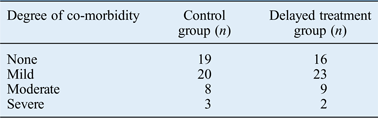
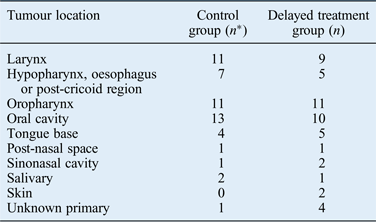
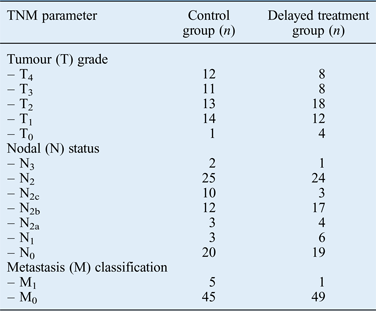
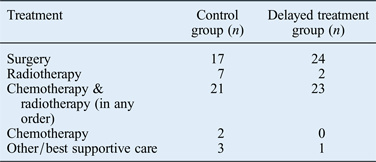
There were no significant differences between patients that experienced delayed treatment and those that experienced no delays in treatment in terms of patient age (mean age, 64.5 years (range, 28.8–84.7 years) vs 65.3 years (37.5–87 years)) and co-morbidity (Table I). In addition, tumour location and staging were not significantly associated with treatment delay, although there was a trend for patients with locally advanced (p = 0.22) or metastatic disease (p = 0.21) to be treated earlier (Tables II and III). Equally, treatment modality was not associated with delay (Table IV).
Co-morbidity index

Tumour locations
*Includes one synchronous primary (oral cavity tumour grade 1).
TNM staging
TNM = tumour–node–metastasis
Treatment modality
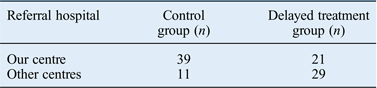
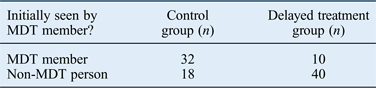
However, administrative issues, such as whether the patient was seen in an outlying hospital (p < 0.001) or whether the patient was initially seen by a regular MDT member (p < 0.001) (even when accounting for the hospital they were seen at (p < 0.01)), were significantly associated with delays in treatment (Tables V and VI).
Referral hospital
Initial consultation
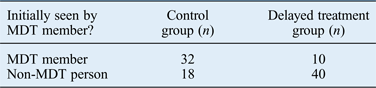
MDT = multidisciplinary team
Discussion
Communication and organisation within an MDT are essential for the timely management of head and neck cancer.Reference Xie, Mills, Magill, Randhawa, Mace and Clarke3 This study emphasises that communication with clinicians outside of the MDT, in individual ENT and maxillofacial units that form the centralised head and neck cancer units, can be even more important for timely care. This is essential to maintain the integrity of the ‘hub and spoke’ model of head and neck cancer service provision.
There are a number of reasons why initial referral to our head and neck centre, and initial consultation with a head and neck MDT member, may be associated with less delay. Firstly, this ensures the provision of relevant clinical information to the MDT, which prevents delaying patient discussion until a later MDT meeting. Secondly, the head and neck team have organisational responsibility for their operating theatre schedules, and are therefore able to triage the highly concerning patients seen in clinic more urgently. Thirdly, regular attendance at the MDT meeting may allow the clinician to expedite imaging and histology for patients with highly suspicious presentations, through improved networking with diagnostic services. Fourthly, holding clinics when other MDT members are available means that reviews and investigations (such as dental, dietetics, plastics and speech and language opinions) can be commenced during the ‘diagnostic period’, expediting the definitive management. Lastly, clinicians working within head and neck team may be more familiar with the appropriate investigations for cancer patients.
In order to address this problem, we have refined the referral pathways to our MDT to ensure that clinical information is communicated. We have refined our policies for performing imaging for cancer staging and secured dedicated slots for these investigations. Given the volume of referrals received across a number of hospital trusts, it is not practical for all suspected head and neck cancer referrals to be seen by MDT members; however, we have encouraged immediate referral of the most concerning patients prior to local diagnostic investigation.
It is interesting that our series did not demonstrate delays in treatment of tumours in particular sites. Previous population-based studies have shown that this was a significant factor,Reference van Harten, de Ridder, Hamming-Vrieze, Smeele, Balm and van den Brekel4 although these studies were not based on UK National Health Service treatment. There was a trend for treatment delay in patients with an unknown primary, which is perhaps not surprising given the numbers of investigations, their defined order and the issues associated with confirming diagnoses.
• Treatment delays are associated with worse outcomes
• Referral to non-head and neck cancer centres is associated with treatment delay
• Initial consultation with a non-head and neck multidisciplinary team member is associated with treatment delay
• It is important to consider potential treatment delays when designing centralised ‘hub and spoke’ service provision models
There was a trend for patients with locally advanced or metastatic disease to be treated more rapidly. This may be because the presentation of locally advanced disease is more clinically obvious and potentially more amenable to biopsy in out-patients. There may be less delay in metastatic disease cases because of the comparative speed at which the best supportive care or palliative chemotherapy can be instituted.
A previous case series in public hospitals in the USA has provided information on delays when there were no defined treatment dates.Reference Patel and Brennan5 The disparities between their series and ours, both of which comprised 100 patients, is quite interesting. The median delay between agreement of a treatment plan and commencing treatment was 33 days in this US study, which would constitute a target breach for the average patient. However, the median time between first appointment and initiating treatment was within target, at 56 days. Furthermore, in this series, the ‘unknown primary’ was the most rapidly treated tumour classification, with a median of 28 days between agreement of a treatment plan and treatment initiation. This indicates that access to diagnostic and staging investigations is much quicker in the UK, but therapeutic intervention is less readily accessible. The authors of that report also found that locally advanced disease was generally treated more slowly than early stage disease, and that patients treated with primary radiotherapy or chemoradiotherapy experienced delayed treatment in comparison to surgical patients. Our findings were very different, with advanced disease generally being treated more quickly, and there being no differences between oncological and surgical management timings.
Conclusion
Delays in the management of head and neck cancer at our centre were associated with administrative factors, but not tumour or patient factors.