Introduction
Dementia is one of the great public health challenges of the current era (World Health Organization, 2012). While there is currently no definitive or effective cure for dementia, timely diagnosis maximizes the opportunity to slow the progression of disease, to maintain the individual's dignity and quality of life, and to alleviate carer burden (Boustani et al., Reference Boustani, Peterson, Hanson, Harris and Lohr2003; Iliffe et al., Reference Iliffe, Manthorpe and Eden2003; Vernooij-Dassen et al., Reference Vernooij-Dassen2005; Salloway and Correia, Reference Salloway and Correia2009; de Vugt and Verhey, Reference de Vugt and Verhey2013; LoGiudice and Watson, Reference LoGiudice and Watson2014). However, only a minority of PWDs receive diagnoses, with 20–50% in developed countries and less than 10% in China correctly diagnosed (Valcour et al., Reference Valcour, Masaki, Curb and Blanchette2000; Boustani et al., Reference Boustani, Peterson, Hanson, Harris and Lohr2003; Boustani et al., Reference Boustani2005; Iliffe et al., Reference Iliffe2009; Chen et al., Reference Chen, Hu, Chen, Ma, Zhang and Wilson2013). Even in developed countries, diagnosis of dementia is often delayed for 1–5 years (Holzer and Warshaw, Reference Holzer and Warshaw2000; Wilkinson et al., Reference Wilkinson, Stave, Keohane and Vincenzino2004; Bamford et al., Reference Bamford, Eccles, Steen and Robinson2007; Speechly et al., Reference Speechly, Bridges-Webb and Passmore2008; van Vliet et al., Reference van Vliet2013). In China, the length of time between first recognition of cognitive symptoms and the seeking of help is unknown.
Studies have found that perspectives of PWDs, families, physicians, memory specialists, and the presentations of dementia contribute to the delay in help seeking. One reason is that PWDs and their families have relatively poor perceptions of normal aging and dementia. They also lack knowledge of the early signs and of available support resources. Shame and stigma also contribute to a reluctance to seek help (Iliffe et al., Reference Iliffe, Manthorpe and Eden2003; Speechly et al., Reference Speechly, Bridges-Webb and Passmore2008; van Vliet et al., Reference van Vliet2011; Chrisp et al., Reference Chrisp, Tabberer, Thomas and Goddard2012; de Vugt and Verhey, Reference de Vugt and Verhey2013). In practice, it usually takes a long time or several appointments for a thorough assessment and examination before a diagnosis is made (Iliffe et al., Reference Iliffe, Manthorpe and Eden2003; Downs and Bowers, Reference Downs and Bowers2008; Iliffe et al., Reference Iliffe2009). Due to a lack of valid biomarkers which preclude definitive diagnosis, individuals with mild cognitive symptoms may be monitored without any active interventions. van Vliet et al. found persons with young-onset dementia (YOD) (onset age was younger than 65 years) had 1.6 years longer more delay than those with late-onset dementia (LOD) (onset age was 65 years old or older) (van Vliet et al., Reference van Vliet2013). Finally, sociodemographic determinants, such as gender and educational level, family history, and the living situation are related to delayed diagnosis (Tijhuis et al., Reference Tijhuis, Peters and Foets1990; Mackenzie et al., Reference Mackenzie, Gekoski and Knox2006; Pentzek et al., Reference Pentzek2009; Ramakers et al., Reference Ramakers, Visser, Bittermann, Ponds, van Boxtel and Verhey2009; Tedstone Doherty and Kartalova-O’Doherty, Reference Tedstone Doherty and Kartalova-O’Doherty2010).
In China, memory clinics have developed in many cities. In the past decade, advocacy campaigns aimed at raising public awareness of dementia have been conducted and led to an increasing number of people with memory problems being referred to memory clinics. However, it remains unclear whether this has shortened the time between the onset of suspected symptoms of dementia and referral to a memory clinic. In addition, the association between clinical features of dementia and delay in seeking medical support has not been explored adequately. Therefore, we conducted a secondary analysis aiming to examine the duration between estimated symptom onset and initial help in a multisite naturalistic study of clinical practice. We also wanted to explore the potential factors associated with the increased delay form onset to help seeking.
Methods
This study reports secondary analyses of baseline data from the CPAD study (NCT01779310), an eight-week multicenter registry study to investigate AD diagnostic pattern in Chinese local and describe everyday clinical practice. Approval to conduct the CPAD study was obtained from a central ethics committee at Peking University Institute of Mental Health (Sixth Hospital) in Beijing, China.
Participants
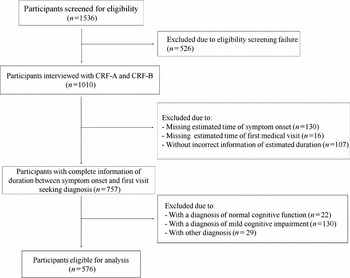
Between November 12, 2012 and January 31, 2013, 1,010 participants with suspected cognitive impairment were consecutively recruited from 28 participating memory clinics at tertiary (level 3) hospitals across broad geographic regions in China (see CPAD investigators in the appendix of supplemental contents). The general inclusion criteria of the CPAD study were: aged 45 years old and above; willing to receive two monthly follow-up visits; having at least one informant or caregiver to attend each visit; and able to provide informed consent. Exclusion criteria were: having no cognitive problems; lacking an informant or caregiver to attend each visit; and participating in other studies during the registry study period. Individuals with a clinical diagnosis of dementia (or their caregiver) who were able to report the estimated time of first symptom onset and first medical visit for cognitive problems were enrolled in this secondary analysis. As shown in Figure 1, 1,536 participants were screened for eligibility, and 1,010 were eligible to be enrolled as research participants of CPAD study. Five-hundred seventy-six had completed the clinical report form (CRF) and were eligible for this study.
Flow diagram of participant recruitment and validation procedure.

Data collection
The clinical report form (CRF) was adapted from the Uniform Data Set (UDS) commonly used in US Alzheimer Disease Research Centers (ADRCs) (available at http://www.alz.washington.edu) (John et al., Reference John, Weintraub, Chui and Cummings2006). We used three major parts: Part A: personal information; Part B: clinical information; and Part C: caregiving outcome. For the purpose of this study, data collected with CRF-Part A and B were used. CRF-Part A collected the demographic information of PWD, including age, gender, occupation, educational level, household registry (“Hukou”), annual income per capita, living situation, the family history of dementia and medical history of PWD, and relevant treatment situation. CRF-Part B documented the cognitive signs, neurological evaluation, motor function, behavioral, functional assessment, and help-seeking behavior information. If the diagnosis of dementia was made, its severity was rated by the physician's clinical general impression, and the subject was categorized as mild, moderate, or severe. When cognitive symptoms were confirmed, the informant was asked to estimate the onset of the first symptoms and when the suspected PWD was referred to medical settings for a cognitive assessment.
Data analysis
All data from the hard-copy CRF were entered into EpiData database by double entry verification. Data analyses were performed with the Statistical Package for Social Sciences (SPSS) version 20.0.
Duration of delay was defined as the interval from estimated symptom onset to first medical visit as measured in months. The time of estimated symptom onset was defined as the month when PWD or informant first noticed the symptoms they suspected to be due to dementia. The time of first medical visit was the month when PWD was referred to see a doctor because of the cognitive problems.
Means with standard deviation, or median with maximum and minimum were used to describe the descriptive data. χ2 tests and Kruskal–Wallis tests were used to compare the characteristics in participants’ demographic characteristics and duration of delay across groups. Kruskal–Wallis tests were chosen for non-parametric tests when the dependent variables showed heterogeneity of variance across the groups or skewed distribution. Univariate analysis of general linear model was used to identify factors that influenced duration of delayed presentation. In the model, duration of delay was rank-transformed because the original data had heteroscedastic variance. Duration of delay was considered the dependent variable, while subtypes of dementia, YOD or LOD, family history of dementia, physical disease, annual income per capita, medical insurance, and living situation were included as fixed factors. In the first step, the dependent variable and one of the fixed factors were put into the model. Second, the dependent variable, fixed factors (subtypes group), and covariates which were hypothesized to be or were significant associated with duration of delay in the first step were put into the model together. Significance level was set at 0.05.
Results
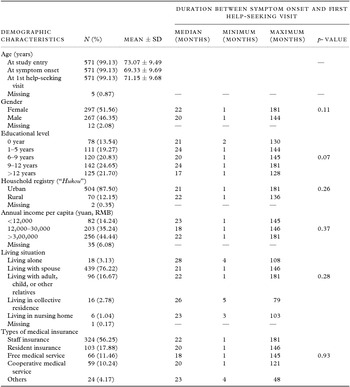
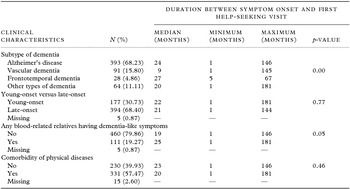
The research participants included: 393 with AD, 91 with VaD, 28 with FTD, and 64 with other types of dementia (e.g. Lewy body dementia, mixed dementia). As summarized in Table 1, the average age of PWD was 73.07 ± 9.49 years old. About half of the PWD were female. More than half had at least nine years of education, and most of them lived with their spouse (see Table 1). As shown in Table 2, the majorities of PWDs were diagnosed with AD (68.23%) and were of late-onset (69%) (see Table 2).
Demographic characteristics and duration between symptom onset and first help-seeking visit among 576 participants

Clinical characteristics and duration between symptom onset and first help-seeking visit among 576 participants

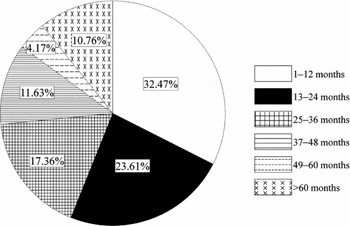
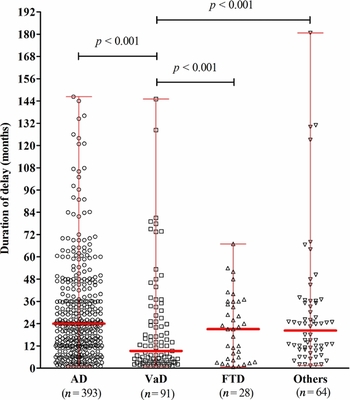
In 67.5% of participants, the duration of delay was longer than 12 months. Over 10% had longer duration of delay than 60 months (see Figure 2). People with negative family history of dementia had a significantly shorter duration of delay than those with positive family history. The duration of delay was longest in the FTD group (median: 27 months), followed by AD (median: 24 months) and other types of dementia (median: 20 months), and shortest in the VaD group (median: 9 months). The duration was significantly different in VaD versus AD (p = 0.00), VaD versus FTD (p = 0.00), and VaD versus other types (p = 0.00, see Figure 3). No difference in the duration was observed between YOD and LOD groups (median: 22 months vs. 21 months, p = 0.77).
The duration between symptom onset and first help-seeking visit among 576 participants.

The duration of delayed help-seeking (months), by subtypes of dementia. AD: Alzheimer's disease; VaD: vascular dementia; FTD: frontotemporal dementia.

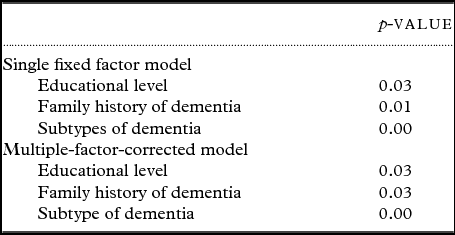
The univariate analysis showed subtypes of dementia (p < 0.001), family history (p = 0.01), and educational level (p = 0.03) were associated with the duration of delay. Adjusted for gender, educational level, family history, and medical insurance, the subtypes of dementia remained significantly associated with the duration of delay (p < 0.001) (see Table 3).
Factors associated with duration between symptom onset and first help-seeking visit

Discussion
Our study is the first to explore the delay in seeking medical services among PWDs in China. It confirms the findings from other countries presentation to medical practitioners is frequently delayed, even if the memory clinic is well established. Subtype of dementia was significantly associated with the duration of delay, even when adjusted for educational level and family history.
Similar to other reports, two-thirds of PWDs presented for evaluation more than 12 months and one quarter more than 36 months after first symptom (Wilkinson et al., Reference Wilkinson, Stave, Keohane and Vincenzino2004; Leung et al., Reference Leung2011). This may partially be explained by the insidious presentations of dementia, since the gradual nature of the cognitive decline might be unrecognized by the family members living with them (Salloway and Correia, Reference Salloway and Correia2009; Dai et al., Reference Dai, Mao, Wu, Mei, Levkoff and Wang2015). In China, the negative perception of dementia may also contribute to the delay. About 76.6% of Chinese had personal fear of AD (Zeng et al., Reference Zeng2015), but cognitive decline is commonly perceived as due to senility and normal aging (McCleary et al., Reference McCleary2013; Zeng et al., Reference Zeng2015). Even in severe cases, families tend to use “senile confusion” (“Lao Hutu” in Chinese pronunciation), rather than “dementia” to describe the clinical presentations. Chen et al. found 93.1% of Chinese older adults with dementia were undetected (Chen et al., Reference Chen, Hu, Chen, Ma, Zhang and Wilson2013).
Our finding highlights the challenge of timely diagnosis of dementia. Timely diagnosis depends on family members bringing suspected PWDs for a medical checkup but families delay medical assessment even when the symptoms are noticed. In addition, few physicians in major hospitals in China know the diagnostic criteria of dementia (Jiang et al., Reference Jiang, Shan, Zhang and Wang2009) and screening for cognitive impairment is not routinely conducted in primary care (Hu, Reference Hu2014). The delay in physician visits is even more prolonged (Iliffe et al., Reference Iliffe, Manthorpe and Eden2003; Hansen et al., Reference Hansen, Hughes, Routley and Robinson2008; de Vugt and Verhey, Reference de Vugt and Verhey2013). It may be interesting to compare the delay in help-seeking behavior in non-dementia group with the dementia group. We found that the duration from symptom being noticed to referring for medical diagnosis was slightly shorter in non-dementia group than dementia group, but the difference did not reach significance level (median: 16 months vs. 21 months, p = 0.099). Due to relative smaller size of non-dementia group, further investigations are warranted on the help-seeking behaviors among individuals without dementia.
Interestingly, our study found that VaD is recognized the earliest, while FTD is brought to medical evaluation the longest after first symptoms. These findings suggest that the manner in which how symptoms develop contributes to the care-seeking behaviors (Wilkinson et al., Reference Wilkinson, Stave, Keohane and Vincenzino2004; van Vliet et al., Reference van Vliet2013), since symptoms of VaD develop acutely with the onset of cerebrovascular events. The dramatic nature of cognitive decline likely impacts both the patient and family dramatically (Al-Qazzaz et al., Reference Al-Qazzaz, Ali, Ahmad, Islam and Mohamad2014) and leads to earlier involvement of the health care system.
In contrast, the initial symptoms of FTD are behavioral, language deterioration, and personality change with relative preservation of memory, even though these symptoms develop at a younger age. These symptoms are more likely to be attributed to maladaptive interpersonal relationships, which others perceive as not requiring medical intervention (Passant et al., Reference Passant, Elfgren, Englund and Gustafson2005). Cases of FTD may be misdiagnosed as obsessive–compulsive disorder, schizophrenia, or personality disorders (Rosness et al., Reference Rosness, Haugen, Passant and Engedal2008). The symptoms of AD, on the other hand, develop insidiously and may not be easily recognized. This may lead to a longer delay of recognition compared with VaD.
The finding that positive family history was associated with delayed help-seeking was contrary to our expectations, especially since the prevalence of dementia-like symptoms among blood-related relatives is relatively higher than a recent observational study conducted in Taiwan, Hong Kong, and Beijing (Yang et al., Reference Yang2014). In contrast, Chen et al. (Reference Chen, Hu, Chen, Ma, Zhang and Wilson2013) observed that positive family histories of mental illness increased chance of detected dementia. The difference might be partly due to the definition of family history and the perception of dementia of participants. We merely inquired the family history of dementia-like symptoms, while Chen et al included dementia, depression, schizophrenia, and other psychiatric diseases (Chen et al., Reference Chen, Hu, Chen, Ma, Zhang and Wilson2013). Awareness of dementia is relatively lower in rural area, and people tend to attribute dementia to something evil transmitted from their blood-related relatives. In contrast, memory clinics in our study tend to serve better educated people who are more likely to understand the nature of dementia. Another possibility is that the recall bias related to an increased propensity of genetic influence might be lower in areas with a less-educated population. In addition, non-dementia patients with subjective memory complaint or mild cognitive impairment delayed seeking an evaluation had a longer delay in seeking evaluation when there was a positive family history of dementia compared to those with a negative family history (median: 31 months vs. 14 months, p = 0.003). These results were counter to our expectations and were not consistent with (Larner, Reference Larner2013). This is probably because the awareness of dementia remains relatively lower in China than other developed countries. In China, the first well-designed study on dementia was only published in late 1980s. As a result, parents of adults older than 60 years did not have access to medical service for dementia, in particular AD, before dementia was concerned by medical professionals in late 1980s.
In China, there is no specific referral or appointment system for memory clinic. Patients and families could visit a tertiary hospital and register for seeing a memory specialist. The decision to seek help for diagnosing dementia is primarily dependent on the awareness and literacy of dementia among older adults and their family members. Our study was conducted in major cities. Campaigns raising awareness of dementia has been carried out for more than five years with the support of Alzheimer's Disease Chinese, the only member of Alzheimer's Disease International (ADI) in mainland China. The participating sites in this study represent the best clinical practice of dementia care in China. However, we did not include primary care settings in our study. Further studies are warranted to examine the need and approaches to improve detection and timely diagnosis in primary care settings.
There are several other shortcomings in this study. The estimated time of symptom onset and seeking of medical help were based on the respondents’ recall. Because symptoms are usually not noticeable at early stage, the estimate time of symptom onset may not be accurate.
Caution should be exercised in generalizing our findings to underdeveloped and remote areas in China. The memory clinics in the present study, located in high-resource tertiary hospitals, represent well-established dementia care service in China. Ongoing educational programs in these clinics may have raised the awareness locally and encourage the families to bring the PWDs for medical checkup sooner. The dementia educational program in underdeveloped and remote areas is quite restricted. Memory clinics are not established as well. The situation of seeking medical care for PWDs may be limited due to lack of specialist availability. However, using an observational study design allows us to examine the real-world practice of dementia care, and should assist in guiding the development of dementia care services.
In conclusion, the multisite observational study suggests that seeking medical care for PWDs is often delayed in China. Dementias with insidious progress and atypical cognitive decline are mostly under-recognized and characterized by delay before referral for medical care. There is a great need for developing disease-specific educational programs, and measures to improve the public awareness of the benefits of timely diagnosis.
Conflict of interest
None.
Description of authors’ roles
H. Wang and X. Yu formulated the research questions. H. Wang, M. Zhao, X. Lv, and X. Yu designed the study and supervised the data collection. All authors contributed substantially to study conduct, and interpretation of data. M. Zhao and X. Lv carried out the statistical analysis. M. Zhao and H. Wang wrote the paper. X. Yu provided critical review and comments on the manuscript.
Acknowledgments
The authors thank all CPAD study participants, members of the CPAD study groups for their cooperation, and data collection and management, and Prof Graham Thornicroft, Samantha Loi, PhD, Marc Wortmann, and Mike Splaine for review and input. This research was supported in part by grants from Novartis China Ltd. and Natural Science Foundation of China (81171018). The data analysis for this study was supported by National Key Technology Research and Development Program of the Ministry of Science and Technology of China (Grant No. 2015BAI13B01). The funding sources did not play any role in the design and conduct of the study; collection, analysis, and interpretation of data; and preparation of the manuscript; or in the decision to submit the paper for publication. The authors thank Dr Peter V. Rabins for editing the revised manuscript.
Appendix: Clinical Pathway for Alzheimer's Disease in China (CPAD) investigators
Scientific Advisory Panel: Xin Yu, Huali Wang, Wei Chen, Jincai He, Qiumin Qu, Kai Wang, Hengge Xie.
Coordinating center: Beijing — Mei Zhao, Maimaitirexiati Tuerxun, Xiaozhen Lv.
Study investigators and participating hospitals (in the alphabetic order of province or administrative city):
Kai Wang (Department of Neurology, the First Affiliated Hospital of Anhui Medical University, Hefei, Anhui, China); Hengge Xie (Department of Neurology, Chinese PLA General Hospital, Beijing, China); Jianhua He, Na Zhang, Jin Yi (Department of Psychological Medicine, Beijing Anzhen Hospital, Capital Medical University, Beijing, China); Jing Zhang (Beijing Shijitan Hospital, Beijing, China); Yide Miao (Department of Geriatrics, Peking University People's Hospital, Beijing, China); Yongan Sun (Peking University First Hospital, Beijing, China); Weizhong Xiao, Dongsheng Fan (Peking University Third Hospital, Beijing, China); Huali Wang, Xin Yu, Tao Li, Mei Zhao, Maimaitirexiati Tuerxun (Peking University Sixth Hospital, Beijing, China); Yanping Wang (The Second Affiliated Hospital of Guangzhou Medical University, Guangzhou, Guangdong, China); Nan Mu (Guangzhou Brain Hospital, Guangzhou, Guangdong, China); Ping Gu (The First Hospital of Hebei Medical University, Shijiazhuang, Hebei, China); Zhihou Liang (Union Hospital Tongji Mecial College, Huazhong University of Science and Technology, Wuhan, Hubei, China); Hailin Li, Rong Lu (Nanjing Brain Hospital, Nanjing, Jiangsu, China); Lijun Xu (The Second Affiliated Hospital of Nanchang University, Nanchang, Jiangxi, China); Qiumin Qu (First Affiliated Hospital of Medical College of Xi’an Jiaotong University, Xi’an, Shaanxi, China); Yongping Feng (Shandong Mental Health Center, Jinan, China); Yifeng Du (Shandong Provincial Hospital, Jinan, Shandong, China); Wenshi Wei (Huadong Hospital Affiliated to Fudan University, Shanghai, China); Shifu Xiao (Shanghai Mental Health Center, Shanghai, China); Liuqing Huang, (Shanghai Changzheng Hospital, Shanghai, China); Lijun Jiang, Weihong Kuang (Mental Health Center, West China Hospital, Sichuan University, Chengdu, Sichuan, China); Yan Cheng, Nan Zhang (General Hospital, Tianjin Medical University, Tianjin, China); Yuying Zhou (Tianjin Huanhu Hospital, Tianjin, China); Xiaohui Zhou (The First Teaching Hospital of Xinjiang Medical University, Urumqi, Xinjiang, China); Benyan Luo (The First Affiliated Hospital of Zhejiang University, Hangzhou, Zhejiang, China); Wei Chen (Sir Run Run Shaw Hospital, School of Medicine, Zhejiang University, Hangzhou, Zhejiang, China); Wenbo Zhu (Ningbo Kangning Hospital, Ningbo, Zhejiang, China); Jincai He (The First Affiliated Hospital, Wenzhou Medical College, Wenzhou, Zhejiang, China)