INTRODUCTION
Although intensive care is accepted as a standard component of the health care system in the Netherlands, psychiatric intensive units (PICU) are still a new phenomenon within the mental health arena. Psychiatric intensive care, according to the United Kingdom Department of Health (2002) is designed for ‘patients compulsory detained usually in secure conditions, who are in an acutely disturbed phase of mental disorder. These patients have an associated loss of capacity for self-control, with a corresponding increase in risk, which does not allow their safe, therapeutic management and treatment in a general open acute ward.’
Despite the long existence of PICUs in countries such as the USA (Rachlin, Reference Rachlin1973), Australia and the UK (Jeffery & Goldney, Reference Jeffery and Goldney1982), there is still little information on their admission criteria, working mechanisms and clinical effectiveness. Bowers et al. (2008) recently concluded in a review that the most common reason for admitting a patient to a PICU is the inability to deal with the patient’s aggression, disruptive behavior and suicide risk on general acute wards, with aggression accounting for 30–50% of the admissions. Consequently, patients in a PICU seem to be three times more likely to be violent than those on acute wards (Brown & Bass, Reference Brown and Bass2004). Although there are no standardized admission criteria, the importance of the dangerousness criteria is confirmed by other authors. ‘Patients whose condition is such that his/her behavior presents a danger either to themselves or others’ (Warneke, Reference Warneke1986, p.835) are especially likely to be admitted to a PICU, as are ‘suicidal or assaultive patients who are acutely disturbed and present serious management problems’ (Allan et al., Reference Allan, Brown and Laury1988, p.81).
Since the patients transferred to the PICU present concerns regarding aggression and dangerousness, it can be expected that the use of coercive measures will be higher in the PICU than in general acute wards. A number of studies (Brown & Bass, Reference Brown and Bass2004; Cohen & Khan, Reference Cohen and Khan1990; Wynaden et al., Reference Wynaden, McGowan, Chapman, Castle, Lau, Headford and Finn2001) have already reported that rapid tranquillization, mechanical restraint and seclusion are indeed more frequently used in a PICU than on general acute wards.
Although Sailas & Fenton (2000) concluded that the intrusiveness and the efficacy of coercive measures have been poorly investigated, some qualitative studies show that such invasive treatments can have serious adverse effects on both patients and staff (Fisher, Reference Fisher1994). Seclusion, can be particularly traumatic for patients, who experience feelings such as anger, depression, helplessness, punishment, loneliness and humiliation during or after the seclusion (Kasander et al., Reference Kasander, Hrachovec and Hutschemaekers2002). For nurses and physicians, the use of seclusion and restraint often involves an ethical dilemma when they are forced to act against the patient's will (Marangos-Frost & Wells, Reference Marangos-Frost and Wells2000; Olofsson et al., Reference Olofsson, Gilje, Jacobsson and Norberg1998). In addition, coercive measures can not only have harmful consequences for the working relationship between the nurse, the doctor and the patient (Berghmans et al., Reference Berghmans, Elfahmi, Goldsteen and Widdershoven2001), they can significantly reduce patients’ satisfaction with care (Iversen et al., Reference Iversen, Hoyer and Sexton2007). Both the higher prevalence of coercive measures in PICUs and their harmful consequences for the treatment of the patient mean that PICUs should be specialized in managing violent behavior and suicidal risk in a less intrusive way than restraining or secluding the patient.
As far as we are aware, only one study has evaluated the impact of opening a PICU on the reduction of seclusion and restraint (Musisi et al., Reference Musisi, Wasylenki and Rapp1989). This found that patient accidents decreased by 60%, seclusion hours fell by 92%, and the numbers of patients in seclusion fell by 83% relative to historical data. However, the core features of the PICU responsible for this decline were not mentioned in this publication. We therefore conclude that there is little documented evidence of the infrastructure and treatment policy needed specifically by a PICU for successful reduction of seclusion and restraint.
In the Netherlands, the mean duration of seclusion episodes registered in psychiatric hospitals is 16 days; maximum length is 595 days (Janssen et al., 2007). This suggests that some patients are held in seclusion for longer than a year, as was the case at the psychiatric hospital where this study took place. Our project was also driven by the unavailability of facilities for the non-coercive treatment of the most seriously disturbed patients. By developing a PICU focused on effective and non-coercive management of disruptive behavior we wanted to eliminate the use of coercive measures, and provide the higher quality of intensive care required by seriously disturbed patients. We therefore investigated whether coercive measures were used less often with admitted participants at the PICU than had been used with the same patients in their earlier stays in psychiatric units.
METHOD
Setting
The study was performed in the Mental Health Care Centre West North Brabant in the southern part of the Netherlands, which provides psychiatric care to a catchment population of around 276,075.
Design of the PICU
Firstly, we designed a model for a four-bed PICU with optimal infrastructure for preventing and managing dangerous behavior at an early stage. Two main components guided us in our development of the model: (1) greater safety and thus less seclusion and fewer restraint measures; (2) the need to speed recovery through more intensive treatment. Both components were reported as being the biggest advantages of PICU in comparison with general acute wards (Bowers et al., Reference Bowers, Jeffery, Bilgin, Jarrett, Simpson and Jones2008). Our theoretical PICU design needed to suit the resources available at an existing unit for chronic-disturbed psychiatric patients.
The reorganization of this unit resulted in a small closed PICU with four beds, higher nursing staff levels, a maximal length of stay of two years and one seclusion room shared with other units. Our unit thus fitted the general definition of a PICU provided by Bowers et al. (2008, p.66): ‘small wards, with higher levels of nursing and other staff, mostly locked and sometimes with facilities of seclusion.’
Admission criteria
The only patients to be transferred to the PICU were those, with involuntary admission status, who had been identified as higher risk either to themselves or to others, who had a history of long seclusion episodes and who had had substantial unsuccessful admissions at different acute or long-stay units at the same hospital. The previous units did not have higher staffing ratios that allowed specialised management of challenging patients, or special intensive monitoring. As a consequence, the staff felt so incapable and hopeless when dealing with these patients, that coercive measures (in particular seclusion) seemed to be the only feasible intervention.
Philosophy of care
Our aim was similar to that suggested by Crowhurst & Bowers (2002) to find a balance between ensuring security needs and creating an environment where patients are offered a level of autonomy in making decisions. Care was focused on rehabilitation and recovery that would offer perspectives for the patients’ future development and for supporting their autonomy. Staff approached patients in an empowering and humane way based on the assumption that each person possesses potential for maturation, learning and growth if an environment is offered that preserves their dignity and fosters mutual respect and acceptance. A high quality of care was offered by a multidisciplinary team with good professional skills; this supported stable working alliances based on trust, mutual cooperation and special treatment policy. A prevention-based approach to care was introduced. Guidelines and protocols described and organized the treatment processes, and safety in the ward.
Staff and attitude
The multidisciplinary team comprised ten nurses with 9.0 full time equivalent (FTE), an occupational therapist (0.1 FTE), a social worker (0.05 FTE) and a part-time psychiatrist (0.1 FTE). There were two full-time nurses on day and afternoon shifts, and one nurse on the night shifts; the ratio of male to female nurses was 3:7. This high staff to patient ratio allowed close monitoring of the patients’ mental status and potentially violent behavior. The permanent physical presence of the staff was necessary to ensure an intensive patient-staff involvement that would facilitate a stable relationship with the suspicious, agitated or very anxious patients. Through close observation, the team was able to respond quickly to patients’ needs and thus prevent aggressive incidents. Sometimes one-to-one supervision was required.
The team members had the knowledge and expertise necessary to deal with seriously disturbed patients with complex needs. In addition, training was provided to improve the professional skills of the team; this focused on changing the staff’s approach from controlling a patient’s behavior to negotiation. The staff were instructed to use a non-authoritarian, non-punitive way of communication that allowed patients to express any anger or confusion. An approach was introduced whereby patients’ individual needs were respected, acutely disturbed patients were engaged using sensitive and respectful communication skills and patients’ autonomy was promoted. This made it possible to maintain contact and commitment with the patient.
The management of the PICU supported the continuity of the nursing staff’s professional development and discouraged the use of restrictive interventions. The operational policies and procedures at the unit were monitored weekly in the context of multidisciplinary staff meetings.
Treatment policy
The treatment was focused on patients’ stabilization and recovery, and offered a structured daily program for all patients. It involved various therapeutic activities, including cognitive behavior therapy with elements of mentalization and elements derived from attachment theory. Mentalization is the developmental achievement of being able to reflect one’s own behaviors and those of others (Fonagy et al., Reference Fonagy, Gergely, Jurist and Target2004); by providing a ‘buffering’ process between emotionally charged behaviors of others and a patient’s emotional reaction (Schore, Reference Schore2003), it allows patients to control their behavior and reattribute the motives of others.
According to the second element, attachment theory (Ainsworth, Reference Ainsworth1969), a patient’s relationship with the caring staff becomes characterized by disturbed patterns of attachment that reflect the patterns of interaction from the past. The PICU staff therefore aimed to replace disturbed, often destructive patterns of interaction with normal ways of relating, thereby establishing a healthy pattern of attachment. Patients were treated according to these therapeutic principles twice a week, once in a group context and once individually. In addition, they were offered psychomotor therapy twice a week and work integration therapy three times per week. Treatment protocols such as care plans (Donat, Reference Donat1998) and personalized crisis-management plans were used as tools for planning therapeutic activities and offering structured crisis-prevention treatment. Patients were able to choose daily activities in collaboration with the nursing staff.
Close observation by staff that leads to early recognition of warning signs (such as aggressive acts, conflicts and dangerous situations) has been shown to be a successful approach to preventing escalations and seclusions on forensic psychiatric wards (Fluttert, in press). For this reason, personalized crisis-management plans were introduced at the PICU. In addition, staff were trained in early recognition of warning signs, thereby improving their risk-assessment skills, and their ability to prevent and manage aggression in early stages. When aggressive situations occurred, the least paternalistic and restrictive approaches were applied to prevent seclusion, such as verbal interventions, personal assistance, offering food, beverages, voluntary medication or other patient-centered activities. When coercive measures proved unavoidable, a special debriefing took place afterwards.
Physical environment
Because the safety of the patients and staff had a high priority in the unit, the staff carried a personal alarm system to alert others if an emergency occurred. Single rooms for each patient were available, each with bathroom facilities in order to maintain privacy. Recreational facilities such as a sitting room equipped with a television and free access to an enclosed garden area, and simple sports facilities were provided to ensure daily occupation. Because aggression and inactivity have been found to be positively related (Lloyd, Reference Lloyd1995), these facilities were expected to contribute to the maintenance of a secure environment.
Study design
This was a retrospective study evaluating the effect of a PICU on reducing seclusion. The follow-up period was 28 months. The length of seclusion episodes and other coercive measures were compared with historical data. Information on restrictive measures, and on sociodemographic and diagnostic characteristics were collected from the patients’ case records of the patients during their stay. Psychiatric diagnoses were assessed by the psychiatrist at the PICU and based on the DSM-IV-TR criteria (American Psychiatric Association, 2000). Reliable data on usage of medication and violent acts were not available for study purposes.
RESULTS
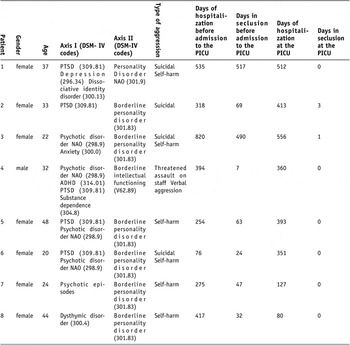
In the period from February 2007 until June 2009, one male and seven female patients were admitted to the PICU. These patients were treated according to the principles of intensive care as described above. The patients’ sociodemographic and diagnostic characteristics are presented in Table 1. All were Dutch natives, who had been admitted involuntarily under the Dutch Mental Health Act. In six cases the status of detention changed from involuntary to voluntary status during treatment at the PICU. The eight patients at the PICU were chronic psychiatric patients with complex co-morbid diagnoses, six of whom suffered from severe borderline personality disorder with dissociative or psychotic characteristics. Most had serious comorbid posttraumatic stress disorder as a result of sexual and physical traumas in childhood. All female patients either had tendency to harm themselves or exhibited suicidal behavior.
Before admission to the PICU, all patients had spent different periods of time in seclusion, the shortest stay being 7 days and the longest 517 days. On average, patients had been kept in seclusion for 156 (SD = 215) days at different psychiatric units, during a mean hospitalization period of 386 (SD = 221) days. After they had been transferred to the PICU, the average seclusion time decreased dramatically to 0.5 (SD = 1) day per patient over a mean stay period of 349 (SD = 167) days. This shows that after patients’ admission to PICU, the use of seclusion was almost completely eliminated, falling from 40% to 0.1% of the seclusion time in historical data. The reduction in seclusion did not result in the use of other coercive measures such as involuntary medication and physical or mechanical restraint. The duration of the seclusion periods per patient before and after the admission to the PICU are shown in Table 1.
Characteristics of patients admitted to the PICU

DISCUSSION
This intensive psychiatric care unit promoted a philosophy of providing care in the least restrictive environment, and succeeded in almost eliminating the use of restrictive measures with seriously disturbed patients. We attribute the great success of the intervention to the introduction of multiple therapeutic approaches at different levels of the ward’s organization. We also believe that five factors were the key to the successful delivery of this seclusion-free type of care: the staff’s therapeutic and de-escalation skills, their close involvement with the patients, the cultural change from control to negotiation, the skilled leadership, and the introduction of personalized treatment and crisis-management plans. This study did not aim to produce evidence of the relative impact of each particular component of the reduction in seclusion, but in their review of interventions for reducing the use of seclusion in psychiatric facilities Gaskin et al. (2007) reported on the effectiveness of some of the core components implemented at the PICU: personalized treatment plan, leadership, higher staff-to-patient ratios and staff education.
Although most studies report that patients with psychotic illness are the largest diagnostic group admitted to a PICU (Wynaden et al., Reference Wynaden, McGowan, Chapman, Castle, Lau, Headford and Finn2001; Brown & Bass, Reference Brown and Bass2004), the majority of our population was diagnosed with a severe form of borderline personality disorder. This group of patients had the highest risk of suicidal and/or self harm and/or aggressive behavior at our hospital, and spent long periods in seclusion. Because coercive measures can have such a negative impact, causing post traumatic stress disorder – and patients with borderline personality disorder have been already traumatized in the past – restrictive interventions should be avoided in this group of patients because of the higher risk of re-traumatization. This can impair their clinical improvement resulting in more unsuccessful admissions and more restrictive measures, as shown by our patients before their transfer to the PICU. By delivering a special intensive care, we managed to transform this vicious circle of clinical regression to a virtuous circle of improvement.
Although this study focuses mainly on reduction of seclusion and did not focus on clinical improvement, our clinical observations suggest that the hospitalization of patients with borderline personality disorder does not have to be always ineffective and counterproductive as suggested by Dawson & MacMillan (1993) – or not when a special high-quality treatment is offered.
This study has several limitations. It is not a randomized controlled trial and the size of study population is small. For this reason, we could not provide any statistical analyses. However, the use of restrictive measures was so enormously reduced that it must be a true effect of the PICU and not simply a natural variation over time.
This study shows, first and foremost, that when the reduction of seclusion and restraint is considered a priority at a psychiatric intensive care unit, it is possible to eliminate restrictive measures, at least amongst patients diagnosed with borderline personality disorder. As already concluded by Hoch et al. (2006, p.181): ‘it is possible to essentially stop using seclusion and restraint to ‘treat’ patients with borderline personality disorder.’ Future research should investigate whether the PICU model we described can lead to the non-coercive treatment of other different categories of patients.
Acknowledgements
This project was funded by a grant from The Dutch Ministry of Health and the Mental Health Center West-North Brabant.