Implications
Nutrition plays a major role in enhancing reproductive efficiency in pigs. This study provides information on the impact of sodium butyrate (SB) supplementation on reproductive performance of gilts. Furthermore, the present data show that SB feeding alters the composition of colostrum and, in turn, improves the growth performance of suckling piglets. The results provide some evidences that SB supplementation may improve the reproductive performance in gilts and enhance the growth rate of piglets.
Introduction
Nutrition has large impact on reproductive performance and efficiency of pigs. Dietary fiber intake is known to improve the reproductive performance of sows (Guillemet et al., Reference Guillemet, Hamard, Quesnel, Pere, Etienne, Dourmad and Meunier-Salaun2007; Loisel et al., Reference Loisel, Farmer, Ramaekers and Quesnel2013). It is readily fermented in the colon into short-chain fatty acids (SCFAs) by gut microbiota (Serena et al., Reference Serena, Jorgensen and Bach Knudsen2009). SCFAs, especially butyrate, have been found to influence the nutrient absorption, growth performance and inflammatory response in pigs (Weber et al., Reference Weber, Ziemer and Kerr2008; Fang et al., Reference Fang, Sun, Wu, Niu and Feng2014). A recent study has demonstrated that butyrate can be used to replace dietary fiber to improve fetal number in rats (Lin et al., Reference Lin, Fang, Che, Xu, Wu, Wu and Wu2014). In sows, butyrate supplementation during gestation enhanced postweaning growth performance of piglets mediated by increased substrate oxidation (Lu et al., Reference Lu, Su and Ajuwon2012). Furthermore, butyrate treatment improves porcine oocyte development and blastocyst formation in vitro (Liu et al., Reference Liu, Liu, Gao, Song, Wen, Guan, Yin, Ma, Tang and Li2012a and Reference Liu, Song, Gao, Guan, Tang and Li2012b). However, the effects of butyrate on reproductive performance of gilts are less clear.
Colostrum intake is a major factor influencing piglet weight gain, immune resistance and survival in early life (Devillers et al., Reference Devillers, Le Dividich and Prunier2011). The composition of colostrum is affected by a variety of factors, especially nutritional factors (Decaluwé et al., Reference Decaluwé, Maes, Cools, Wuyts, De Smet, Marescau, De Deyn and Janssens2014). Dietary fiber given during pregnancy tended to alter porcine lactogenesis mediated by the endocrine system (Quesnel et al., Reference Quesnel, Meunier-Salaun, Hamard, Guillemet, Etienne, Farmer, Dourmad and Pere2009). Moreover, sows fed a high-fiber diet had altered immunoglobulin content in colostrum and beneficial effects on piglet performance (Guillemet et al., Reference Guillemet, Hamard, Quesnel, Pere, Etienne, Dourmad and Meunier-Salaun2007; Loisel et al., Reference Loisel, Farmer, Ramaekers and Quesnel2013). Nevertheless, whether butyrate supplementation during gestation could affect the composition of colostrum in gilts and alter the growth of piglets is unknown.
Sodium butyrate (SB) is commonly used instead of butyrate in animal nutrition because the salts are more stable and less odorous. Accumulated studies have been conducted to investigate the effects of SB on performance in weaned piglets, including feed intake, weight gain and feed efficiency (Lu et al., Reference Lu, Zou and Wang2008; Piva et al., Reference Piva, Morlacchini, Casadei, Gatta, Biagi and Prandini2009; Huang et al., Reference Huang, Song, Fan, Hou, Thacker and Ma2015). Therefore, in this study we used Large White×Landrace replacement gilts as a model to investigate the impact of SB supplementation on reproductive performance of gilts. Also, we sought to determine whether feeding SB during pregnancy would alter the composition of colostrum and, in turn, influence piglet growth during suckling.
Material and methods
Animals and experimental design
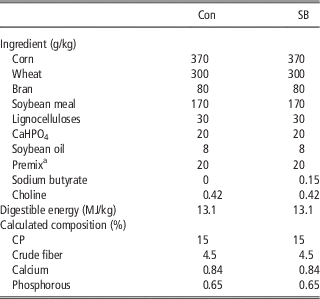
This experiment was conducted on a 5000-sow breeding, gestation, and farrowing facility situated in the south of Jiangsu province, China. A total of 40 Large White×Landrace replacement gilts (at the age of 160 to 175 days) were selected and divided into two groups randomly. The control group (Con, n=20) was fed with basal diet while SB supplementation group (SB, n=20) was fed basal diet (Table 1) supplemented with encapsulated SB at the level of 500 mg/kg from 1 month before mating to 7 days after farrowing. The encapsulated SB (dosing 30% of SB, encapsulated by polyacrylic acid resin) was provided by Zhejiang Kangdequan Biotechnology Company (Hangzhou, China). Gilts were artificially inseminated between 190 and 215 days of age using semen collected from the same Large White boars. All gilts were artificially inseminated twice, at first detection of estrus and 12 h later. The backfat thickness of gilts was recorded at the onset of the experiment and on day 108 of gestation using Lean-Meater (Renco Corp., Minneapolis, MN, USA).
Composition and nutrient content of the experimental diet

SB=sodium Butyrate supplementation group; Con=control group.
a The premix contains (per kilogram): vitamin A: 240 000 IU; vitamin D3: 60 000 IU; vitamin E: 720 IU; vitamin K3: 30 mg; vitamin B1: 30 mg; vitamin B2: 120 mg; vitamin B6: 60 mg; vitamin B12: 360 mg; niacin: 600 mg; pantothenic acid: 300 mg; folic acid: 6 mg; manganese sulfate: 1.0 g; zinc oxide: 2.5 g; ferrous sulfate: 4.0 g; copper sulfate: 4.0 g; sodium selenite: 6 mg; calcium: 150 g; phosphorus: 15 g; sodium chloride: 40 g.
Reproductive measures
Estrus rate was defined as the proportion of gilts detected in estrus out of all gilts in our experiment. The number of gilts that returned to estrus between day 18 and day 23 post-first artificial insemination was identified using fenceline boar contact and recorded as regular returns. Rate of return to estrus was defined as the proportion of gilts returned to estrus out of gilts detected in estrus. Pregnancy status was determined by transcutaneous ultrasonic assessments on day 28 post-first artificial insemination. Gestation length was defined as the interval between the day of the first artificial insemination and the day of parturition. Farrowing duration was defined as the time interval between births of the first and the last piglet. At farrowing, the total number of piglets born, entire litter BW, number of born alive piglets and weak piglets were recorded. The piglets were individually weighed at birth and day 7 of suckling, the ADG were calculated. Moreover, the body height, body length and circumference of all piglets were measured within 24 h of birth.
Colostrum nutrients analysis
Colostrum samples were collected immediately after birth of the first piglet from 19 gilts (eight in control group and 11 in SB group). Colostrum (25 ml) was manually collected from all functional teats and stored at −20°C. The concentrations of protein, triglyceride, cholesterol and lactose in colostrum were assayed. The Pierce BCA Protein Assay Kit (Thermo Scientific, Waltham, MA, USA) was used to measure the total protein concentration. The colostrum concentrations of total- and free-cholesterol and triglyceride were measured by automated enzymatic methods using an automatic analyzer with commercial kits (Triglyceride GPO-POD assay Kit, E1003; Tissue total cholesterol assay kit, E1015, respectively, Applygen, Beijing, China). The concentration of lactose concentration was analyzed using Lactose/Galactose Assay Kit (Rapid) (K-LACGAR; Megazyme, Bray, Ireland).
Colostrum hormonal assays
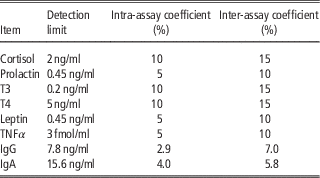
The colostrum cortisol, prolactin, triiodothyronine (T3), thyroxine (T4) and leptin concentrations were measured by commercial radioimmunoassay (RIA) kits (Beijing North Institute of Biotechnology, Beijing, China). All colostrum samples were assayed in duplicate. The detection limit, intra- and inter-assay coefficients of variation are presented in Table 2.
The detection limits, intra-and inter-assay coefficients of different kits used in the study

T3=triiodothyronine; T4=thyroxine; TNFα=tumor necrosis factor α; IgG=immunoglobulin G; IgA=immunoglobulin A.
Lipopolysaccharide assays
The level of lipopolysaccharide (LPS) in colostrum was measured by the limulus test using a commercial Tachypleus Amebocyte Lysate test (Chinese Horseshoe Crab Reagent Manufactory Co., Ltd., Xiamen, China). Briefly, samples were heated at 70°C for 10 min and then diluted with endotoxin-free distilled water. After centrifugation, the supernatant was mixed with limulus amebocyte lysate for 10 min at 37°C. The reaction was detected by Toxinn ometer ET-2000 (Synergy; BioTek, Winooski, USA).
Tumor necrosis factor α and immunoglobulins analysis
The concentration of tumor necrosis factor α (TNFα) in colostrum was measured by commercial RIA kits purchased from Beijing North Institute of Biotechnology, Beijing, China. The contents of immunoglobulin G (IgG) and IgA in colostrum were analyzed by ELISA using commercial quantification kits for porcine IgG and IgA (references E100-104 and E100-102, respectively; Bethyl Laboratories, Montgomery, TX, USA). All colostrum samples were assayed in duplicate. The detection limit, intra- and inter-assay coefficients of variation are presented in Table 2.
Statistical analysis
Data on sow and piglet performance were analyzed for 23 sows: two sows from the SB group had to be removed from the statistical analysis because of a prolonged period of fever during pregnancy. The colostrum composition was analyzed for 19 sows. The data were analyzed using SPSS 16.0 statistical software (SPSS Inc., Chicago, IL, USA). The gilt or the litter represented the experimental unit in the model, which included diet (Con or SB) as the main effect. The χ 2 test was used to compare reproductive performance between groups. Analysis of covariance was used to assess the statistical significance of piglet performance from day 1 to 7 of lactation; the litter size was used as a covariate. Independent-Sample t-test was used to compare the gilts and litter characteristics and colostrum composition between groups. Data in tables are expressed as mean±standard error of the mean. Significance was declared at P⩽0.05.
Results
Gilt performance
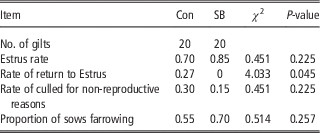
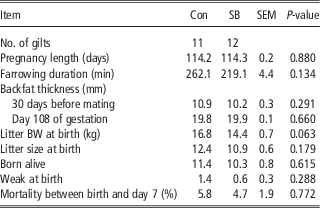
The estrus and farrowing rate of gilts were not significantly affected by the dietary treatments (P=0.225 and 0.257, respectively; Table 3). However, the rate of sows returning to estrus post-insemination was lower in SB group than control group (P=0.045; Table 3). The rate of gilts culled for non-reproductive reasons did not differ between treatments (P=0.225; Table 3). Pregnancy length was similar for the two treatments and amounted to 114.2±0.2 days (P=0.880; Table 4). Farrowing duration ranged from 74 to 323 min and did not differ between treatments (in average 240.6±14.2 min; P=0.134; Table 4). The backfat thickness of gilts was similar for both treatments at the onset of the experiment (P=0.291; Table 4) and day 108 of pregnancy (P=0.660; Table 4).
Reproductive performance of gilts fed control diet or control diet top dressed with SB

SB=sodium butyrate supplementation group; Con=control group; estrus rate=proportion of gilts displaying a normal estrous cycle/total gilts examined; rate of return to estrus=proportion of gilts returned to estrus/total gilts detected in estrus; proportion of sows farrowing=proportion of gilts farrowed/total gilts examined.
Gilts and litter characteristics for gilts fed control diet or control diet top dressed with SB

SB=sodium butyrate supplementation group; Con=control group; weak at birth=piglets observed having either poor locomotion or lying still within ~24 h before observed death.
Litter characteristics
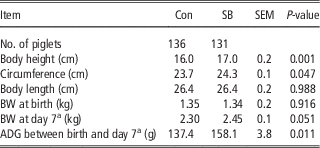
There was no effect of gestation diet (SB v. control) on total litter BW (P=0.063; Table 4), litter size at birth (P=0.179; Table 4), number of born alive (P=0.615; Table 4) or the rate of weak piglets (P=0.288; Table 4). The piglet mortality rate between birth and day 7 was not significantly different between two groups (P=0.772; Table 4). Mean piglet BW at birth did not differ between two groups (P=0.916; Table 5). However, the piglet body height (P=0.001; Table 5) and circumference (P=0.047; Table 5) were greater in SB group than control group. During the first week of life, the piglets nursed by SB-treated gilts had greater ADG compared with the piglets of the control gilts (P=0.011; Table 5). Mean piglet BW at day 7 was greater in SB group (P=0.051; Table 5).
Characteristics of piglets from gilts fed control diet or control diet top dressed with SB

SB=sodium butyrate supplementation group; Con=control group; body height=the distance from the sole of the foot to the crown of the head
a Litter size at birth was introduced as a covariate.
Colostrum composition
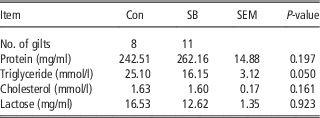
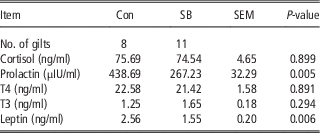
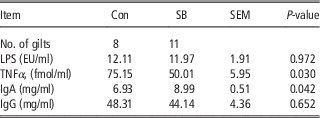
The concentrations of total protein (P=0.197; Table 6), cholesterol (P=0.161; Table 6) and lactose (P=0.923; Table 6) were not affected by the dietary treatment. However, compared with control gilts, colostrum from SB gilts contained 35.7% lower triglyceride (P=0.050; Table 6). The SB-treated gilts produced colostrum with low levels of prolactin (P=0.005; Table 7) and lower leptin (P=0.006; Table 7). No differences were noted for concentrations of cortisol (P=0.899; Table 7), T4 (P=0.891; Table 7) or T3 (P=0.294; Table 7) in colostrum between SB and control groups. The concentrations of LPS in colostrum did not differ between treatments (P=0.972; Table 8). However, colostrum from SB gilts showed a 50% decrease in TNFα (P=0.030; Table 8) and a 30% increase in IgA (P=0.042; Table 8). No difference was noted for concentration of IgG in the colostrum (P=0.652; Table 8).
Colostrum composition of gilts fed control diet or control diet top dressed with SB

SB=sodium butyrate supplementation group; Con=control group.
Hormone concentrations in colostrum of gilts fed control diet or control diet top dressed with SB

SB=sodium butyrate supplementation group; Con=control group; T4=thyroxine; T3=triiodothyronine.
Concentrations of LPS, TNFα, IgA and IgG in colostrum of gilts fed control diet or control diet top dressed with SB

SB=sodium butyrate supplementation group; Con=control group; LPS=lipopolysaccharide; TNFα=tumor necrosis factor α; IgA=immunoglobulin A; IgG=immunoglobulin G.
Discussion
Nutrition plays a major role in enhancing reproductive efficiency in pigs. This study provides information on the effect of SB supplementation on reproductive performance of gilts. Furthermore, the present data show that SB feeding alters the composition of colostrum and, in turn, improves the growth performance of suckling piglets. The results provide fundamental information for further investigations into the function of SB supplementation on reproduction in the pig.
Sows return to estrus after insemination causes a large source of economic loss to pig producers. In general, sows return to estrus at regular interval (21 days) if there is a fertilization failure or early pregnancy loss. In the present study, the rate of gilts return to estrus after insemination was lower in SB group than control group. It may suggest that dietary SB could, to some extent, regulate the fertilization in gilts. Nevertheless, the underlying mechanism for this effect is not clear. Oocyte quality is a key limiting factor in fertilization rates. In vitro studies showed that pre-treating porcine oocyte with SB improved oocyte meiotic competence and increased the blastocyst formation (Liu et al., Reference Liu, Liu, Gao, Song, Wen, Guan, Yin, Ma, Tang and Li2012a and Reference Liu, Song, Gao, Guan, Tang and Li2012b). In our experiment, SB feeding was given through the whole period of oocyte development and maturation. Further investigations are needed to confirm whether there is a direct link between low rate of return to estrus and oocyte development in SB-treated gilts.
In rats, SB supplementation during pregnancy increases the number of fetus (Lin et al., Reference Lin, Fang, Che, Xu, Wu, Wu and Wu2014). However, the effects of SB on sow reproductive performance are not known. Our results did not show any significant effect of the dietary SB treatment on total number of piglets born, number of born alive piglets and weak piglets. Nevertheless, the body height and chest measurement of piglets in SB group were greater than control group. Moreover, piglets from gilts fed SB-added diet showed a greater weight gain during the first week of life.
Colostrum intake by piglets is a major factor influencing piglet weight gain and survival in early life. Colostrum contains both nutrients (proteins, lipids and lactose) and non-nutrients (biologically active substances). In the current study, SB supplementation had no effect on total protein, cholesterol and lactose in colostrum. However, the colostrum triglyceride levels were lower in SB group compared with control group. Triglycerides account for about 98% of the lipid in colostrum. Therefore, the reduction of triglycerides probably reflects lower lipid in colostrum. Colostrum lipids play a major role in piglet thermoregulation, which influences piglet survival (Le Dividich et al., Reference Le Dividich, Herpin, Paul and Strullu1997). Nevertheless, the mortality rate of piglets between birth and day 7 was not significantly different between two groups in our experiment. The origin of the lower lipid concentration in colostrum from SB-treated gilts is not clear. SCFAs such as acetate, propionate and butyrate, can be used by the mammary gland as precursors for synthesis of lipids (Theil et al., Reference Theil, Nielsen, Sørensen and Lauridsen2012). It is strange that feeding gilts with SB-induced reductions of lipid in colostrum. Mechanisms by which SB regulates triglyceride in colostrum need to be investigated.
Leptin was first discovered as a hormone synthesized and secreted by adipose tissue. It regulates BW gain and maintains energy homeostasis by reducing food intake and increasing energy expenditure (Zhang et al., Reference Zhang, Proenca, Maffei, Barone, Leopold and Friedman1994). We found that colostrum leptin levels in SB-treated gilts were lower compared with controls. Previous studies indicate that butyrate regulates leptin expression in adipocytes at the transcriptional level (Soliman et al., Reference Soliman, Ahmed, Salah-Eldin and Abdel-Aal2011). A recently published study indicates that leptin concentration peaks in the colostrum and sow mammary gland is an important source of leptin contained in colostrum/milk (Wolinski et al., Reference Wolinski, Slupecka and Romanowicz2014). It is hard to verify whether SB regulates leptin synthesis in adipose tissue or in mammary gland. Wolinski et al. (Reference Wolinski, Slupecka and Romanowicz2014) showed no correlation between plasma and colostrum leptin concentrations in sows. So we inferred that the reduction of colostrum leptin in SB group could be partly due to decreased leptin synthesis in mammary gland.
Leptin is known to reduce feed intake in many mammalian species (Woodside et al., Reference Woodside, Budin, Wellman and Abizaid2012). Quesnel et al. (Reference Quesnel, Meunier-Salaun, Hamard, Guillemet, Etienne, Farmer, Dourmad and Pere2009) indicated that decreased leptin in colostrum may be responsible for the improved intake of piglets. It is well documented that weight gain of piglets was quite closely related to feed intake. Considering that piglets possess limited potential in endogenous leptin synthesis, plasma leptin in piglets is mainly transferred from sow via colostrum (Wolinski et al., Reference Wolinski, Slupecka and Romanowicz2014). The reduction of colostrum leptin concentration may explain faster growth of piglets in SB group.
The polypeptide hormone prolactin is synthesized and secreted by specialized cells in anterior pituitary gland. Sows fed high-fiber diet during pregnancy tended to have increased prepartum prolactin concentrations on the day of farrowing (Quesnel et al., Reference Quesnel, Meunier-Salaun, Hamard, Guillemet, Etienne, Farmer, Dourmad and Pere2009). In vitro studies show that SCFAs inhibit prolactin gene transcription via cAMP/PKA/CREB signaling pathway in the anterior pituitary cells of dairy cow (Wang et al., Reference Wang, Fu, Li, Hu, Xue, Li, Huang, Lv, Liu and Wang2013). Indeed, we observed that the prolactin concentrations in colostrum were lower in SB group. Colostrum production is under hormonal control. Prolactin was suggested to be essential for the initiation and the maintenance of colostrum production in sows (Farmer et al., Reference Farmer, Robert and Rushen1998 and Reference Farmer, Sorensen, Robert and Petitclerc1999). The colostrum yield was not examined in the present study. So whether the decrease of prolactin could affect the colostrum production cannot be inferred from the present findings.
Previous studies have found that dietary SB alters the inflammatory response in weanling piglets (Weber and Kerr, Reference Weber and Kerr2008; Fang et al., Reference Fang, Sun, Wu, Niu and Feng2014). However, whether SB can affect the immunity of piglet through colostrum/milk is not clear. A previous study conducted in rats found that SB treatment reduced gut-derived endotoxin levels (Endo et al., Reference Endo, Niioka, Kobayashi, Tanaka and Watanabe2013). Indeed, we did not find any effect of SB supplementation on concentrations of LPS in colostrum. However, the concentrations of TNFα in colostrum were decreased in gilts fed SB-added diets compared with control diets. SB has been shown to suppress LPS-induced production of inflammatory cytokines by macrophages (Weber and Kerr, Reference Weber and Kerr2008). More specifically, butyrate inhibited TNFα expression by regulating specific messenger RNA degradation (Fukae et al., Reference Fukae, Amasaki, Yamashita, Bohgaki, Yasuda, Jodo, Atsumi and Koike2005). Therefore, the reduction of colostral TNFα concentration may likely due to the decreased TNFα production in gilts.
Porcine colostrum contains large amounts of immunoglobulins that provide immediate immune protection to newborn piglets (Le Dividich et al., 2005; Devillers et al., Reference Devillers, Le Dividich and Prunier2011). High dietary fiber given during gestation induces high colostrum immunoglobulin concentration in sows (Loisel et al., Reference Loisel, Farmer, Ramaekers and Quesnel2013). In the current study, we found no effect of SB on colostrum IgG concentration. However, the colostrum IgA concentrations were higher in SB-treated gilts. In swine, almost 40% of colostral IgA was derived from serum (Bourne and Curtis, Reference Bourne and Curtis1973). Previous studies have indicated that IgA is transferred from mammary gland to colostrum via polymeric Ig receptor (pIgR) (Le Jan, Reference Le Jan1993; Salmon et al., Reference Salmon, Berri, Gerdts and Meurens2009). The translocation of IgA was limited by the production of pIgR (De Groot et al., Reference De Groot, Van Kuik-Romeijn, Lee and De Boer2000). Therefore, the increased colostrum IgA concentrations observed in SB-treated gilts could be related to the elevation in serum IgA or altered pIgR expression in mammary gland.
In summary, this study provides information on the impact of SB supplementation on reproductive performance and colostrum composition of gilts and its effects on piglet performance. The results indicate that SB supplementation could reduce the rate of gilts return to estrus after insemination, alter the composition of colostrum and, therefore, promote growth of piglets. Moreover, SB could alter the immunity of newborn piglets through decreased production of TNFα and increased IgA concentration in colostrum.
Acknowledgments
This work was supported by the National Basic Research Program of China (2014CB138502), the National Natural Science Foundation of China (31502027) and the Priority Academic Program Development of Jiangsu Higher Education Institutions. The authors are especially grateful to Yanping Huang, Mingfa Ling, Xiaoming Ji, Dangdang Wu, Nana Zhang and Yang Yang (Nanjing Agricultural University) for their assistance during this study.