Introduction
Head and neck cancer treatment may involve surgery and/or chemoradiotherapy. This often results in physical deformities and emotional challenges. This particular cancer (and its treatment) also affects deglutition, speech and breathing. This can greatly disrupt patients’ lives and decrease quality of life.Reference Shepherd and Fisher1 Microvascular surgery is frequently used to reconstruct complex head and neck defects after ablative surgery. Much of the literature has addressed the success of the forearm flap, but the donor site morbidity in this population and how to best measure it, continues to be controversial.Reference Orlik, Horwich, Bartlett, Trites, Hart and Taylor2
Since its introduction in 1981,Reference Yang, Chen, Gao, Liu, Li and Jiang3 the radial forearm free flap has become a workhorse in head and neck cancer reconstruction. It has numerous advantages, including a long pedicle, thin skin and appropriate vessel size, making it ideal for most head and neck soft tissue defects.Reference Evans, Schusterman, Kroll, Miller, Reece and Robb4, Reference Ho, Couch, Carson, Schimberg, Manley and Byrne5 Despite its frequent use, many patients experience functional arm and hand deficits following flap harvest.Reference Evans, Schusterman, Kroll, Miller, Reece and Robb4, Reference Al-Hayder, Elberg and Charabi6, Reference Nehrer-Tairych, Millesi, Schuhfried and Rath7 These deficits are thought to be secondary to vascular, neurological or musculoskeletal injury. During post-operative evaluation, the degree of functional loss at the donor site and need for formal rehabilitation is often difficult to assess on routine examination in this population because other deficits in speech, swallowing and cosmesis take precedence.
Some studies have specifically examined morbidity and quality of life outcomes following radial forearm free flap harvest in the head and neck cancer population.Reference Orlik, Horwich, Bartlett, Trites, Hart and Taylor2, Reference Sardesai, Fung, Yoo and Bakker8, Reference de Bree, Hartley, Smeele, Kuik, Quak and Leemans9 However, a reliable metric to determine subjective donor site morbidity has yet to be identified. There are numerous validated questionnaires to help assess post-operative morbidity in head and neck cancer patients.Reference Tschiesner, Rogers, Harreus, Berghaus and Cieza10 These questionnaires are often divided into site-specific, disease-specific or generic instruments, depending on the types of questions that are included.
Often there is correlation among the surveys, as dysfunction of a particular site or disease leads to changes in overall quality of life. The benefit of a general health survey, such as the Short Form 36 Health Survey (‘SF-36’),Reference McHorney, Ware and Raczek11, Reference Ware, Kosinski, Bjorner, Turner-Bowker, Gandek and Maruish12 is that comparisons can easily be made across different populations. On the other hand, disease-specific or site-specific questionnaires, such as the Short Musculoskeletal Function Assessment questionnaire,Reference Swiontkowski, Engelberg, Martin and Agel13, Reference Hunsaker, Cioffi, Amadio, Wright and Caughlin14 or Disabilities of the Arm, Shoulder and Hand questionnaire,Reference Hunsaker, Cioffi, Amadio, Wright and Caughlin14 are more sensitive to changes in a particular area of concern, and often involve a smaller, more focused set of questions. It would be clinically relevant to examine how donor site dysfunction affects quality of life.
Patients’ general wellbeing is assessed using the Short Form 36 Health Survey. This questionnaire evaluates eight distinct elements, including bodily pain, physical function, general health, vitality, mental health, social function, and role limitations secondary to physical and emotional problems. These can be aggregated into two over-arching categories: mental health (mental component summary) and physical health (physical component summary).Reference McHorney, Ware and Raczek11 In this questionnaire, lower scores demonstrate poorer quality of life.
Both the Short Musculoskeletal Function Assessment questionnaire and the Disabilities of the Arm, Shoulder and Hand questionnaire examine functional outcome. The former evaluates general musculoskeletal function, while the latter specifically focuses on musculoskeletal function of the upper extremity. The Short Musculoskeletal Function Assessment questionnaire has two general indices: the functional index and the bothersome index, indicating the actual physical dysfunction and the extent to which patients are bothered by it, respectively.Reference Swiontkowski, Engelberg, Martin and Agel13 For these questionnaires, higher scores indicate poorer function.
The Disabilities of the Arm, Shoulder and Hand questionnaire is a generic measure of ‘disability and symptoms’ related to any condition of any joint of the upper extremity. It is a 30-item questionnaire (21 physical function items, 6 symptom items, and 3 social or role function items), with 2 optional 4-item modules that measure the impact of upper extremity disability on work (work module) or playing sport or musical instruments (sports and performing arts module).Reference Goldstein, Ringash, Bissada, Jaquet, Irish and Chepeha15 It was designed so that higher scores indicate greater disability.
These questionnaires often differ in their length and completion time, which can greatly affect their clinical utility. In this study, we evaluated the degree of upper extremity functional deficit following radial forearm free flap harvest using these three validated instruments. Additionally, this study involved a comparison between these general, disease-specific and site-specific disability surveys in this patient population.
Materials and methods
A retrospective study was designed, identifying all head and neck reconstruction patients who specifically underwent radial forearm free flap reconstruction. Patients were excluded if they were deceased or failed to complete all questions in the questionnaires. No gender, racial or ethnic, or educational level exclusion criteria were applied, apart from being an English-speaking individual.
All patients were called by the senior author or members of the research staff to assess their willingness to participate in the survey. Surveys were then mailed to all patients in a single packet. If surveys were not returned, the patients were then called and asked to complete and return surveys. Unreturned surveys were completed either over the telephone or at the patient's next follow-up visit.
The study protocol was approved by the Institutional Review Board at the University of Cincinnati College of Medicine (protocol 2013-5488). Between January 2009 and July 2014, 40 patients (aged 21 years or older) were recruited from the University of Cincinnati Medical Center. One of two microvascular surgeons (author YJP and another surgeon) performed all reconstruction procedures.
Surgical technique
Each radial forearm free flap was harvested using a tourniquet and subfascial dissection technique, and no donor site was closed primarily. A split-thickness skin graft was harvested and used at the donor site closure. Vacuum-assisted closure was used on every harvest to assist in securing the skin graft.
Statistical analysis
Demographic variables were summarised using the mean and standard deviation (SD) for continuous variables, while percentages and frequencies were used to summarise categorical variables. All questionnaires and their respective subcomponents were scored as previously described in the literature, to allow comparison with general population mean values. As the SD of the general population survey scores were known, one-sample z-tests were performed to compare the patient means to the US population norms. The Kolmogorov–Smirnov test was used to test for normal distribution of the variables. A t-test for independent samples was performed to determinate if there was a difference in gender for perceived deficits. The statistical analyses were performed using SPSS software (version 20.0; IBM, Armonk, New York, USA).
Results
Forty patients underwent head and neck reconstruction with a radial forearm free flap. Of these, 24 (60 per cent) ultimately completed the study. The remaining patients were either deceased or unreachable. The mean patient age was 63.6 years (SD ± 8.4; range, 40–79 years). Fourteen males (58.3 per cent) and 10 females (41.7 per cent) were included.
Five patients (21 per cent) were being treated for a recurrence at the time of the study. The average time between surgery and survey completion was 20 months (SD ± 17.3; range, 4–72 months). One patient had cocaine-induced oronasal fistula, while all other patients had oral or oropharyngeal tumour defects that required reconstruction. One patient had been diagnosed with ameloblastoma, while one other patient had acinic cell carcinoma. All other patients had squamous cell carcinoma.
Seven patients underwent chemoradiation therapy. Radiation treatment varied in patients. One patient underwent radial free flap reconstruction after radiation to treat subsequent osteonecrosis. No patients experienced flap loss. There were no major complications related to the donor site that required re-operation. Follow up in the office revealed that most of the split-thickness skin grafts were incorporated without tendon exposure.
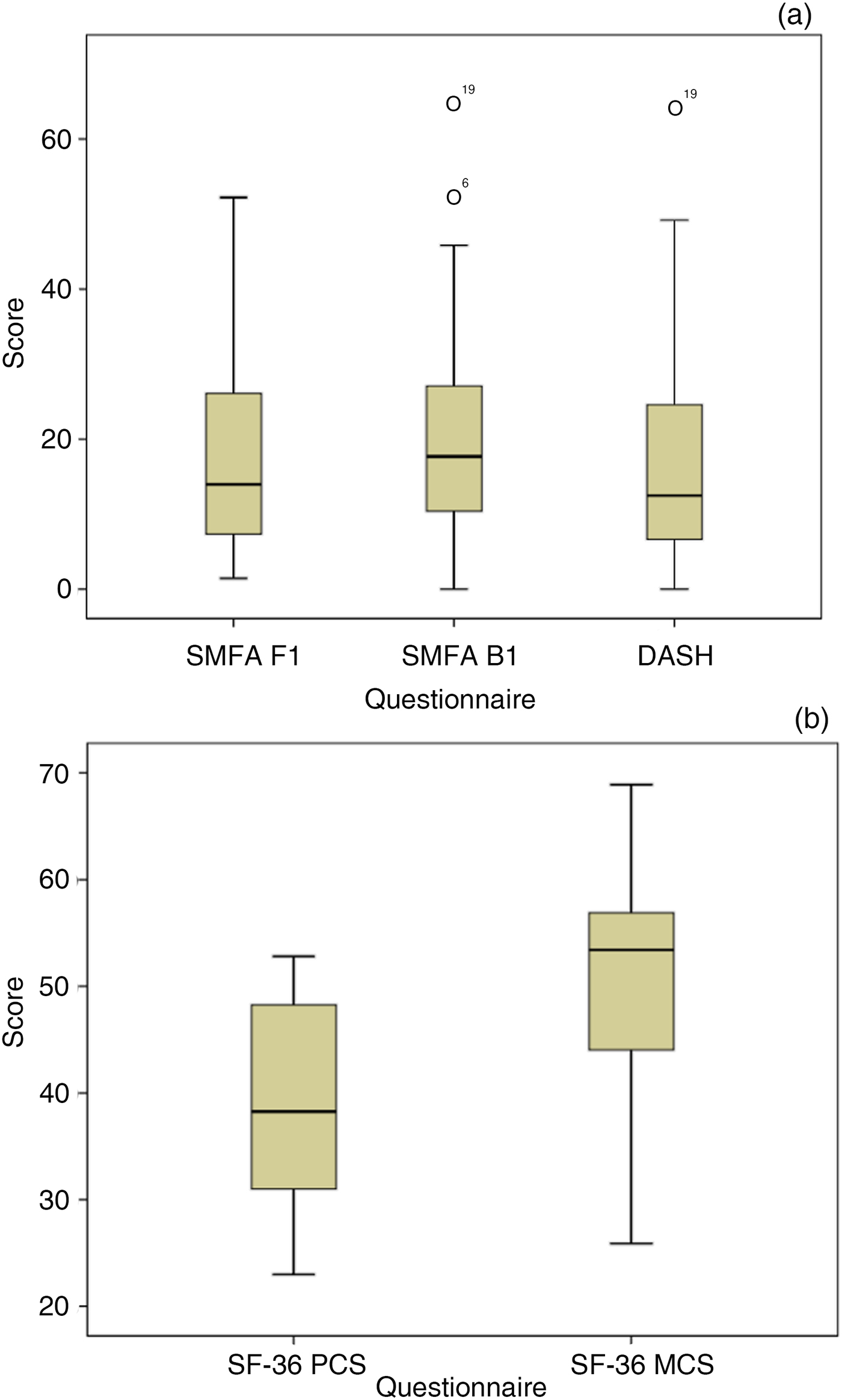
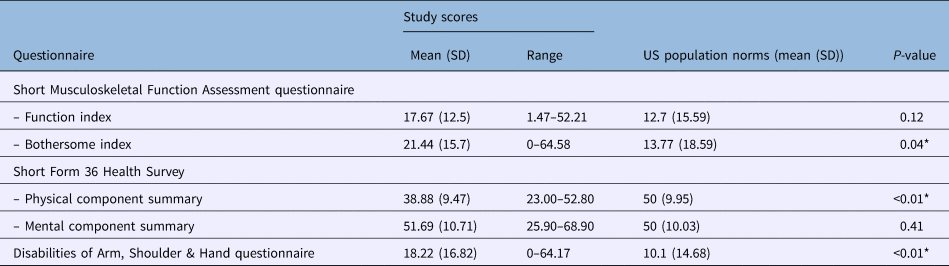
Questionnaire scores had a normal distribution. Results from each survey and corresponding key components were compared to US population norms (Table 1). Patients were found to have a statistically significant higher Short Musculoskeletal Function Assessment questionnaire bothersome index (21.44 vs 13.77, p = 0.04), demonstrating increased emotional strain (Figure 1a). They were also found to have statistically significant lower Short Form 36 Health Survey physical component summary scores (38.88 vs 50, p < 0.01) and higher Disabilities of the Arm, Shoulder and Hand questionnaire scores (18.22 vs 10.1, p < 0.01), signifying increased disability (Figure 1b). The Short Form 36 Health Survey mental component and Short Musculoskeletal Function Assessment questionnaire function index failed to demonstrate significant differences compared to US population norms.
Boxplots of: (a) Short Musculoskeletal Function Assessment (SMFA) questionnaire (function index (FI) and bothersome index (BI)) and Disabilities of the Arm, Shoulder and Hand (DASH) questionnaire scores (circles represent outliers); and (b) Short Form 36 Health Survey (SF-36) (physical component summary (PCS) and mental component summary (MCS)) scores.

Summary of study survey scores and comparison to US population norms

* Indicates statistical significance. SD = standard deviation
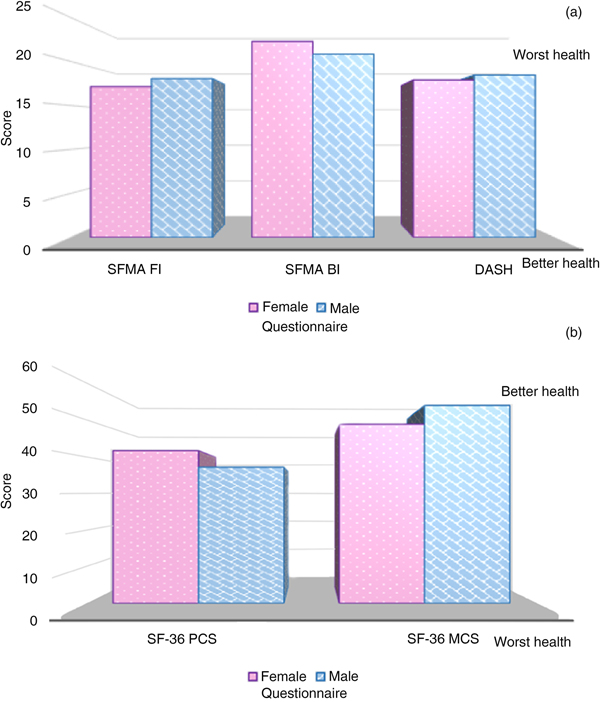
Additional analysis demonstrated that gender affected disability scores. Female patients observed greater disability compared to males based on higher mean scores for the bothersome index (22.29 vs 20.83) and lower mean scores for the Short Form 36 Health Survey mental component (48.75 vs 53.80). Additionally, male patients observed greater disability compared to females based on lower mean scores for the physical component summary (37 vs 41.53), and slightly higher mean scores for the Short Musculoskeletal Function Assessment questionnaire function index (18.06 vs 17.13) and Disabilities of the Arm, Shoulder and Hand questionnaire (18.45 vs 17.90) survey (Figure 2a, 2b). However, none of these differences were statistically significant.
Gender distributions for: (a) Short Musculoskeletal Function Assessment (SMFA) questionnaire (function index (FI) and bothersome index (BI)) and Disabilities of the Arm, Shoulder and Hand (DASH) questionnaire; and (b) Short Form 36 Health Survey (SF-36) (physical component summary (PCS) and mental component summary (MCS)).

Discussion
Head and neck disorders affect patients’ quality of life, and this is especially true for patients suffering from head and neck tumours.Reference Shepherd and Fisher1, Reference Tschiesner, Rogers, Harreus, Berghaus and Cieza10, Reference Infante-Cossio, Torres-Carranza, Cayuela, Hens-Aumente, Pastor-Gaitan and Gutierrez-Perez16 The main objective of this study was to evaluate the presence of subjective post-operative morbidity in the arm (donor site) in head and neck patients undergoing radial forearm free flap reconstruction. This evaluation was conducted using three clinically validated questionnaires, including general, disease-specific and site-specific surveys; namely, the Short Form 36 Health Survey, the Short Musculoskeletal Function Assessment questionnaire and the Disabilities of the Arm, Shoulder and Hand questionnaire, respectively. Understanding dysfunction at the donor site will aid pre-operative counselling and flap selection. In addition, the ability to efficiently evaluate dysfunction following radial forearm free flap harvest can help guide decisions for referral to physical therapy, potentially improving quality of life and post-operative function.
The Short Form 36 Health Survey results demonstrated that patients’ mental health was not statistically different from the general population. Patients had completed treatment on average 20 months prior to survey completion. The physical health component score was significantly worse in this study's patient group compared to the general population. As the Short Form 36 Health Survey is simply a general assessment, a more specific survey of musculoskeletal or upper limb function is required.
Both the Short Musculoskeletal Function Assessment questionnaire and the Disabilities of the Arm, Shoulder and Hand questionnaire examine functional outcome. The former evaluates general musculoskeletal function, while the latter specifically focuses on the musculoskeletal function of the upper extremity. Although not statistically significant, our patients reported a higher level of dysfunction compared to the general population, and they were significantly more bothered by this dysfunction. It should be noted that the Short Musculoskeletal Function Assessment questionnaire bothersome index has been found to increase as age increases.Reference Bardsley, Soutar, Elliot and Batchelor17 The average patient age in this study was almost 63.6 years, while the normative data were based on patients with an average age of 49 years.Reference Swiontkowski, Engelberg, Martin and Agel13 This trend is reflected in our results.
The Disabilities of the Arm, Shoulder and Hand questionnaire assesses core disabilities of the upper limb. A statistically significant difference existed between our patients and the general population, indicating that our sample showed higher dysfunction related to the upper limb. Both the Short Form 36 Health Survey and the Short Musculoskeletal Function Assessment questionnaire results demonstrated that patients perceived a dysfunction that was bothersome to them; the Disabilities of the Arm, Shoulder and Hand questionnaire results suggested that this dysfunction was related to their upper limb donor site.
The gender differences in reconstructive surgery have not been well studied or reported in the literature. Bardsley et al. found that females had higher subjective dissatisfaction scores than males when evaluating morbidity associated with the radial forearm free flap.Reference Bardsley, Soutar, Elliot and Batchelor17 In our sample, there was a trend for greater emotional disability (mental component summary and bothersome index) in female patients, but this difference was not significant. Additional analysis is necessary to determine if gender is a factor that influences overall morbidity or perception of disability.
Radial forearm free flap long-term morbidity is still controversial. Although the radial forearm free flap is commonly used, biomechanical studies that demonstrate objective long-term morbidity are still rare.Reference Loeffelbein, Al-Benna, Steinstrasser, Satanovskij, Rohleder and Mucke18 Despite short-term morbidity, most donor site issues are functional and improve with time. In the past, the consensus was that long-term morbidity was minimal for the radial forearm free flap donor site.Reference Bardsley, Soutar, Elliot and Batchelor17, Reference Skoner, Bascom, Cohen, Andersen and Wax19–Reference Swanson, Boyd and Manktelow23 However, patients still showed dissatisfaction when self-reporting their function and/or cosmesis.Reference de Bree, Hartley, Smeele, Kuik, Quak and Leemans9, Reference Richardson, Fisher, Vaughan and Brown20, Reference Swanson, Boyd and Manktelow23 Only a few studies have reported the patients’ subjective assessment of the donor site.Reference Orlik, Horwich, Bartlett, Trites, Hart and Taylor2 Most of them have found significant complaints or increased impairment of donor site function that do not correlate with objective findings.Reference de Bree, Hartley, Smeele, Kuik, Quak and Leemans9, Reference Richardson, Fisher, Vaughan and Brown20, Reference Lutz, Wei, Chang, Yang and Chen21, Reference Swanson, Boyd and Manktelow23 The patient's perception often differs substantially when compared to physical evaluation alone,Reference de Bree, Hartley, Smeele, Kuik, Quak and Leemans9, Reference Richardson, Fisher, Vaughan and Brown20, Reference Swanson, Boyd and Manktelow23–Reference Bozec, Demez, Gal, Chamorey, Louis and Blanchard25 and it could play an important role in the evaluation of morbidity post-surgery. Therefore, physical function alone does not seem to fully explain the patients’ discontent.
Long-term morbidity patient data have been collected using a wide variety of validated questionnaires, including: the University of Michigan version 4 Hospital Anxiety Depression Scale, the Short Form 36 Health Survey, the University of Washington Quality of Life Questionnaire, the European Organisation for Research and Treatment of Cancer Quality of Life Questionnaire – Core 30 (with Head and Neck Module 35), the Oral Health Impact Profile-14, and the Voice Handicap Index-10.Reference Sardesai, Fung, Yoo and Bakker8, Reference Bozec, Demez, Gal, Chamorey, Louis and Blanchard25–Reference Zhao, Xiang and Liu37 Recently, the Disabilities of the Arm, Shoulder and Hand questionnaire has been used in a few studies to evaluate donor site morbidity after radial forearm free flap harvest,Reference Riecke, Kohlmeier, Assaf, Wikner, Drabik and Catala-Lehnen24, Reference Sinclair, Gleysteen, Zimmermann, Wax, Givi and Schneider38–Reference Riecke, Assaf, Heiland, Al-Dam, Grobe and Blessmann40 and has been shown to be a reliable, simple and rapid tool to evaluate patients.
We believe that the Disabilities of the Arm, Shoulder and Hand questionnaire, combined with a general quality of life questionnaire (e.g. the Medical Outcomes Study 36-Item Short Form Health Survey) and a general musculoskeletal functional tool (e.g. the Short Musculoskeletal Function Assessment questionnaire), provide reliable results. The subjective evaluation of donor site morbidity is key to understanding the true morbidity of the radial forearm free flap.
• Radial forearm free flap is the favoured method for primary reconstruction following head and neck cancer ablative surgery
• There is a paucity of data on patients’ subjective assessment of morbidity
• The findings showed significant long-term disability after radial flap harvest, measured by Disabilities of the Arm, Shoulder and Hand questionnaire
• There was a trend for greater emotional disability in female patients
Future studies should add specific validated questionnaires that examine quality of life in head and neck cancer patients, along with donor site morbidity. Therapies to improve donor site function may also enhance quality of life in this population.
Limitations
This study included some limitations. No pre-operative scores were collected for the three validated questionnaires. Hence, no intergroup pre- and post-operative comparison was possible. In addition, arm dominance may be a confounder in the scores involving physical function.
Conclusion
This study demonstrated significant long-term disability after radial flap harvest, as measured by the Disabilities of the Arm, Shoulder and Hand questionnaire. Additionally, this study observed significantly higher disability and emotional strain compared to general population means, and these finding are related to donor site dysfunction. Our results show that patients have significant concerns about their radial forearm free flap donor site, despite the fact that they may not have physical limitations. This significantly affects how physicians counsel a patient on donor site morbidity.
Acknowledgement
The authors wish to thank Dr Keith A Casper, Associate Professor at the Department of Otolaryngology, University of Cincinnati, USA, for providing patients who enrolled in the study.
Competing interests
None declared