INTRODUCTION
Extensive studies in the past have advanced our understanding of the interaction of intense lasers with single atomic/ionic media. In particular, this has led to high-order harmonic generation (HHG) and the generation of short wavelength coherent radiation (Hafeez et al., Reference Hafeez, Shaikh and Baig2008; Ozaki et al., Reference Ozaki, Bom and Ganeev2008). Meanwhile, the enhanced nonlinear optical response of multi-atomic particles induced by quantum confinement has attracted much interest, with novel applications in optoelectronics, optical switchers, and limiters, as well as in optical computers, optical memory, and nonlinear spectroscopy. High values of third-order nonlinear susceptibility, especially near the surface plasmon resonances of nanostructured materials, are the trademark of these media, in particular metal clusters.
Clusters subject to intense laser pulses produce strong low-order nonlinear optical response (e.g., nonlinear refraction and nonlinear absorption), and can also emit coherent radiation through high-order harmonic generation (Liao et al., Reference Liao, Xiao, Fu and Wong1997; Shvetsov-Shilovski et al., Reference Shvetsov-Shilovski, Goreslavski, Popruzhenko, Becker and Paulus2007; Mulser et al., Reference Mulser, Kanapathipillai and Hoffmann2005). Such studies have shown that one can improve the harmonic generation efficiency by using cluster media. Meantime, previous studies on the harmonic generation in such objects were limited to exotic nanoclusters (Ar, Xe), which are formed in high-pressure gas jets via rapid cooling by adiabatic expansion.
High-order harmonic generation from atomic gas clusters has been observed with an increase in the cut-off order and harmonic intensity (Donnelly et al., Reference Donnelly, Ditmire, Neuman, Perry and Falcone1996; Tisch et al., Reference Tisch, Ditmire, Fraser, Hay, Mason, Springate, Marangos and Hutchinson1997; Vozzi et al., Reference Vozzi, Nisoli, Caumes, Sansone, Stagira, De Silvestri, Vecchiocattivi, Bassi, Pascolini, Poletto, Villoresi and Tondello2005), and tomographic measurement of high harmonic generation in a cluster jet has been demonstrated (Pai et al., Reference Pai, Kuo, Lin, Wang, Chen and Lin2006). Theoretical investigations on harmonic generation from clusters have also been performed (Hu & Xu, Reference Hu and Xu1997; Tisch, Reference Tisch2000; Veniard et al., Reference Veniard, Taïeb and Maquet2001; Vazquez de Aldana & Roso, Reference Vazquez De Aldana and Roso2001; Kundu et al., Reference Kundu, Popruzhenko and Bauer2007; Tajima et al., Reference Tajima, Kishimoto and Downer1999; Fomits'kyi et al., Reference Fomits'kyi, Breizman, Arefiev and Chiu2004; Fomichev et al., Reference Fomichev, Zaretsky, Bauer and Becker2005). For example, the enhancement in the harmonic yield has been modeled using simulation (Hu & Xu, Reference Hu and Xu1997), and it has been shown theoretically that one can use nanoparticles to improve phase matching conditions (Tisch, Reference Tisch2000). On the other hand, clusters have also been shown to have strong effects on low-order harmonics, such as the third-order harmonics from an expanding cluster (Shim et al., Reference Shim, Hays, Zgadzaj, Ditmire and Downer2007). Recently, there has been a new approach to generate high-order harmonics using metallic nanoparticles, and in particular using laser plasma of targets rich in nanoparticles as the nonlinear medium (Ganeev et al., Reference Ganeev, Suzuki, Redkin, Baba and Kuroda2007a, Reference Ganeev, Suzuki, Baba, Ichihara and Kuroda2008a, Reference Ganeev, Suzuki, Baba, Ichihara and Kuroda2008b, Reference Ganeev, Suzuki, Baba, Ichihara and Kuroda2008c).
An important issue in laser ablation of nanoparticles is their integrity during evaporation from the target (Fazio et al., Reference Fazio, Neri, Ossi, Santo and Trusso2009). One could expect fragmentation, melting, or aggregation of nanoparticles due to irradiation of the laser. To achieve harmonic generation from clusters, one should not over-excite the targets that are rich in nanoparticles when producing the plasma, where these species exist in their native neutral (or ionized) conditions.
In this paper, we demonstrate the high-order nonlinear optical properties of various nanoparticles. These HHG studies were carried out using the ablation of clustered media using sub-nanosecond laser prepulse, and subsequently irradiating the nanoparticle-rich plasma with a femtosecond pulse. The presence of nanoparticles in the plasma was carefully studied by analyzing the spatial characteristics of the debris of the ablated material deposited on a nearby substrate. We show that the nanoparticles maintain their integrity in the plasma plume under optimal conditions for exciting clusters. Moreover, through experimental results on harmonic generation using In2O3 nanoparticles and bulk, we show that it is the neutral atoms in the nanoparticle that emits the strong harmonic emission, which has been observed as an increased low-order harmonic yield for nanoparticle-rich plumes when compared with monoparticle-rich plasmas.
EXPERIMENTAL RESULTS AND DISCUSSION
High-Order Harmonic Generation from Nanoparticles
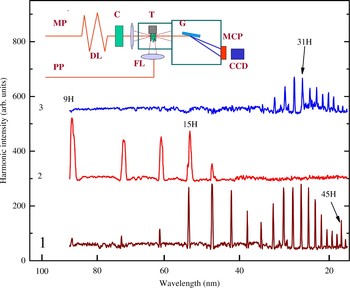
Experiments were carried out with the 10 Hz, 10 TW beam line of the Canadian Advanced Laser Light Source at the Institut national de la recherche scientifique (Ozaki et al., Reference Ozaki, Kieffer, Toth, Fourmaux and Bandulet2006). To create the ablation, a prepulse that was split from the uncompressed Ti:sapphire laser (t pp = 210 ps) was focused on a target placed in the vacuum chamber (see inset in Fig. 1). The intensity of the sub-nanosecond prepulse (I pp) on the target surface was varied between 2×10⁹ and 1×10¹⁰ Wcm−2. After a proper delay (6–74 ns), the femtosecond main pulse (t fp = 35 fs, λ = 800 nm central wavelength, 35 nm full width at half maximum) was focused on the plasma from the orthogonal direction. Our HHG experiments were performed with laser intensities of up to I fp = 7×10¹⁴ Wcm−2, above which the HHG efficiency decreased considerably due to several impeding processes in the laser plasma. The harmonics were spectrally dispersed by an extreme ultraviolet spectrometer, detected by a micro-channel plate, and recorded using a charge-coupled device camera.
(Color online) Harmonic spectra obtained from plasmas produced on the surfaces of (1) bulk Ag, and (2 and 3) Ag nanoparticle-rich target. The intensities of prepulse on the target surfaces were (1) 3×10¹⁰ Wcm−2, (2) 7×10⁹ Wcm−2, and (3) 2×10¹⁰ Wcm−2. Inset: Experimental setup. MP: main pulse; PP: prepulse; DL: delay line; C: grating compressor; FL: focusing lenses; T: target; G: gold-coated grating; MCP: micro-channel plate; CCD: charge-coupled device.

In these studies, we used various nanosized powders (Cr2O3, In2O3, Ag, Cu, MnTiO3, Sn, and Au; Alfa Aestar). The sizes of nanoparticles varied from 30 to 200 nm. The powder was glued on the glass substrate by mixing with epoxy. We also used bulk targets of the same materials to compare the HHG from the monoparticle-rich plumes.
These studies were concentrated on two issues: (1) comparison of the harmonic spectra generated in plasmas containing single atomic/ionic particles and nanoparticles, and (2) structural characterization of the plasma ingredients. First, we reproduced the harmonic generation in the plasmas produced from bulk targets, which has been reported in our previous studies (Elouga Bom et al., Reference Elouga Bom, Kieffer, Ganeev, Suzuki, Kuroda and Ozaki2007; Ganeev et al., Reference Ganeev, Elouga Bom, Kieffer and Ozaki2007b, Reference Ganeev, Elouga Bom, Kieffer and Ozaki2007c). In particular, the Ag plasma showed harmonics up to the 47th order (Fig. 1, curve 1).
When we ablated the Ag nanoparticle-rich targets and generated the harmonics in the plasma plumes, the cut-off was shifted toward the longer-wavelength part of the plateau. At the same time, the intensity of these harmonics was considerably higher compared with those generated in the monoparticle-rich plasma created on the surface of bulk Ag (Fig. 1, curve 2). Moreover, the spectral widths of harmonics were three to four times broader compared with the narrow lines of the harmonics generated in monoparticle-rich plasma. The enhancement factor of the harmonic intensity generated in nanoparticle-rich plumes (compared with monoparticle plume) varied from five-times to 12-times, depending on the harmonic order and the excitation conditions. Note that this intensity enhancement of low-order harmonics was observed for moderate excitation of Ag nanoparticle-rich targets [I pp ~ (5–7)×109 Wcm−2]. With further increase in the prepulse intensity, a dramatic change in the harmonic spectra was observed, which showed the disappearance of low-order harmonics and the appearance of high-order ones (Fig. 1, curve 3). The intensity of these harmonics was considerably weaker, when compared to the intensity of low-order harmonics for low prepulse intensities.
These observations demonstrate the dynamics of harmonic generation and point out the particles responsible for this process. At moderate prepulse intensities, the plasma contains predominantly neutral nanoparticles. In that case, the harmonic cut-off is defined by the interaction of femtosecond pulse with neutral clusters. The cut-off is low, and from the main pulse intensity used, we estimate a cut-off around the 13th to the 17th harmonics. Increasing the prepulse intensity led to both an increase in the nanoparticle density as well as their ionization. Ionization results in lower harmonic yield, while the conditions for higher cut-off become more favorable. We have also performed experiments with epoxy plasma without nanoparticles, which did not produce high-order harmonics. From this we can conclude that the HHG from epoxy molecules is negligible. The same can be said about HHG from the substrate plasma, which did not generate harmonics at these low prepulse intensities.
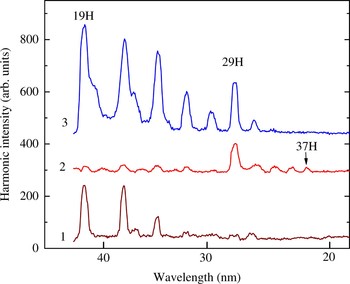
The harmonics from Cr2O3 nanoparticle-rich plume showed a featureless plateau with a cut-off at the 31st order (Fig. 2, curve 1), while harmonics generated from bulk chromium plasma demonstrated a resonantly enhanced 29th harmonic and a cut-off at the 35th order (Fig. 2, curve 2). Note that the latter harmonic spectrum with an enhanced single harmonic is similar to those observed in previous studies of HHG from chromium plasma (Ganeev, Reference Ganeev, Elouga Bom, Kieffer and Ozaki2007b, Reference Ganeev, Suzuki, Baba and Kuroda2005). As can be seen in Figure 2 (curve 2), the 29th harmonic intensity in that case was considerably higher than the nearest 27th and 31st harmonics. The extension of the harmonic cut-off for plasma produced from bulk chromium is attributed to the involvement of the Cr+ ions in harmonic generation, while for nanoparticles, the neutrals were dominant in the HHG process.
(Color online) Harmonic spectra obtained from the (1 and 3) Cr2O3 nanoparticle-rich plasma and (2) Cr monoparticle-rich plasma.

Indium Oxide Nanoparticle Harmonics
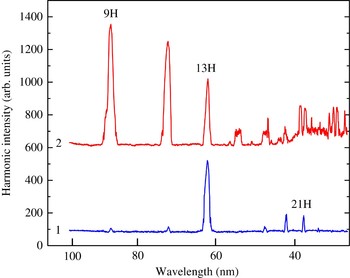
A clearer understanding of the reason behind strong high-order harmonics from nanoparticles can be obtained from our experimental results using In2O3 targets. Figure 3 shows the comparison of the harmonic spectra generated in the plasmas produced from In2O3 bulk target and In2O3 nanoparticle-rich target. One can see a strong 13th harmonic generated for bulk targets, which has also been reported for HHG from In plasma abundant with In+ ions (Ganeev et al., Reference Ganeev, Singhal, Naik, Arora, Chakravarty, Chakera, Khan, Kulagin, Redkin, Raghuramaiah and Gupta2006). The conversion efficiency of the 13th harmonic for bulk In2O3 target was measured to be close to 10−4. For In2O3 nanoparticle plasma, we see a plateau without any signs of enhancement of the harmonic (Fig. 3, curve 1). One can see that the intensities of the 9th to the 13th harmonics for In2O3 nanoparticle plasma are comparable with that of the intensity enhanced 13th harmonic generated from the In2O3 bulk target (Fig. 3, curve 1). Thus, one can estimate that the conversion efficiency of the plateau harmonics for In2O3 nanoparticle plasma to be about 10−4. This is the highest conversion efficiency reported so far for multiple harmonics generated in the plateau region.
(Color online) Harmonic spectra observed for HHG from plasmas containing (1) In2O3 monoparticles and (2) In2O3 nanoparticles.

Another important observation of Figure 3 is the cut-off. For In2O3 nanoparticle harmonics, the cut-off is at the 17th harmonic, whereas that for bulk targets extends to the 57th order (not shown in Fig. 3), which is similar to the cut-off observed using pure indium targets (Ganeev et al., Reference Ganeev, Singhal, Naik, Arora, Chakravarty, Chakera, Khan, Kulagin, Redkin, Raghuramaiah and Gupta2006). We should also note here that the optimum prepulse intensity for HHG from nanoparticles is much lower than for bulk targets. We have observed that we can extend the cut-off of nanoparticle harmonics, but only by increasing the prepulse intensity, which also results in a drastic decrease in the harmonic intensity.
The enhancement of a single harmonic in In2O3 monoparticle plasma was attributed, to the effect of strong ionic transitions that have large oscillator strengths (Ganeev et al., Reference Ganeev, Elouga Bom, Kieffer and Ozaki2007b). For neutral material, it is difficult to find transitions of neutral atoms or clusters with similarly large oscillator strengths at these shorter wavelengths. This results in the decrease or disappearance of the enhancement of single harmonic for neutral nanoparticle-rich media.
Note that by increasing the prepulse intensity, plasma of chromium oxide nanoparticle led to the appearance of strong 29th harmonic (Fig. 2, curve 3). This is a sign of the ionization of nanoparticles in the plasma, since enhanced single harmonic in this spectral range has previously been attributed to the giant 3p→3d ionic transitions of chromium ions (Ganeev et al., Reference Ganeev, Elouga Bom, Kieffer and Ozaki2007b).
Other nanoparticle-rich plasma plumes demonstrated the same features; that is, a considerable enhancement of low-order harmonic intensity and a lower harmonic cut-off, compared with results using monomer plasmas produced from bulk targets. Increasing the intensity of the femtosecond pulse did not lead to the extension of the harmonic cut-off generated in nanoparticle plumes, which is a sign of saturation of the HHG in these media. Moreover, at relatively high laser intensities, we observed a decrease of harmonic conversion efficiency due to several impeding factors (such as over-ionization, increased free electron density, and self-defocusing). The same can be said about increasing the prepulse intensity for nanoparticle-rich targets over a specific optimal value. In that case, inefficient harmonic generation was attributed to the increase in the free electron density and a subsequent phase mismatch.
These observations give a rough pattern of the ablation and HHG from the nanoparticle-rich targets. The material directly surrounding nanoparticles is epoxy, which has a lower ablation threshold than the nanoparticles. Therefore, the epoxy starts to ablate at relatively low prepulse intensities, carrying the nanoparticle with it, resulting in the lower prepulse intensity required for evaporating the target. This feature allowed for easier creation of the optimum plasma conditions, which resulted in better HHG conversion efficiency from the nanoparticle-rich plume compared with the plume from the bulk target. In particular, it was found that the HHG from multi-atomic particles started to be efficient at considerably smaller prepulse intensities ((3–6)×109 Wcm−2) compared with the case of bulk targets ((1–3)×1010 Wcm−2).
The results with In2O3 targets provide evidence for a clear understanding of intense harmonics from nanoparticles. First, we recall that the intensity enhancement of the 13th harmonic from indium plasma is due to the wavelength matching between the 13th harmonic and a strong radiative transition of the In+ ion (Ganeev et al., Reference Ganeev, Elouga Bom, Kieffer and Ozaki2007b). From the experimental results in this section, we see that (1) there is no enhancement of the 13th harmonic for In2O3 nanoparticles at relatively low prepulse intensities; (2) one can obtain enhancement of the 13th harmonic even with nanoparticles, but one needs to increase the prepulse intensity. In this case, the overall harmonic yield is reduced; (3) the cut-off for harmonics from In2O3 nanoparticles is much lower than that for bulk targets. From these observations, we can conclude that the intense high-order harmonics from In2O3 nanoparticles are generated from neutral atoms in the nanoparticles. Stronger harmonic emission from neutrals is reasonable, since neutral atoms are larger in size compared with their ions, and so in the three-step model, the returning electron has a larger target to recombine to. We would like to note that harmonics from nanoparticles are most probably also affected by their size. However, the important finding of this work is that we also need to take into account the effects of neutral atoms.
Structure of Nanoparticles in the Plasma
The presence of nanoparticles in the plasma plumes was confirmed by analyzing the ablated material deposited on a nearby glass or aluminum substrates. It was shown that, at optimal excitation conditions, the nanoparticles remain intact in the plasma plume until the main femtosecond pulse arrives at the interaction area. Below we present the results of our studies on the nanoparticle structures deposited on nearby substrates by the laser ablation from the surfaces containing initial clustered powders.
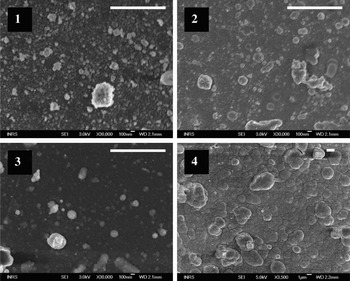
Under optimal conditions for harmonic generation, the scanning electron microscope (SEM) images of the deposited material revealed that the nanostructures remain roughly the same as the initial powders. The sizes of the deposited Cr2O3 nanoparticles were from 30 to 200 nm (Fig. 4.1). The same can be said about Au (40 to 250 nm, Fig. 4.2), Cu (60 to 180 nm, Fig. 4.3) and other deposited nanoparticles. The intensity of prepulse laser for the nanoparticle-rich targets in these experiments was kept in the range of 3×10⁹ to 8×10⁹ Wcm−2. Increasing the prepulse intensity above a certain level led to the appearance of aggregated clusters with much bigger sizes (for example, the SEM image of deposited Ag clusters under these conditions, Fig. 4.4).
The SEM images of deposited (1) Cr2O3, (2) Au, (3) Cu, and (4) Ag clusters during laser ablation of nanoparticle-rich targets. The length of lines corresponds to 1.5 µm.

These SEM studies have demonstrated that the harmonics generated under optimal prepulse conditions are the result of the interaction of the femtosecond pulse with the cluster. Some additional supporting confirmation of this conclusion is as follows. For HHG in cluster plasma, we did not observe an extension of the cut-off, which could be associated with the involvement of ionized particles in the HHG process. The harmonic cut-off for the nanoparticle-rich plumes should be in the range of 13th–17th harmonics, considering the saturation intensity at which the neutral nanoparticles ionize (~ 1×10¹⁴ Wcm−2). In most cases, high-order harmonics decreased or even disappeared with an increase in excitation and ionization of plasma. This is because the phase mismatch prevented the generation of harmonics above the cut-offs.
CONCLUSIONS
Our studies have shown that, for the nanoparticle-rich plumes investigated, there were no improvements in the extension of the harmonic cut-off. However, we have demonstrated an enhancement of the harmonic yield in the low-energy plateau range for the nanoparticle-rich plumes. The enhancement factor of the harmonics generated in nanoparticle-rich plumes (compared with the monoparticle-rich plasma plumes) varied from five-times to 12-times, depending on the harmonic order and the excitation conditions. Experimental results with In2O3 nanoparticles show that the intense harmonics from these targets are attributed to the contribution from neutral atoms in the nanoparticles.
ACKNOWLEDGMENT
R.A. Ganeev gratefully acknowledges the support from the Natural Sciences and Engineering Research Council of Canada to carry out this work.