Introduction
Rice (Oryza sativa L.) is the staple food for more than half of the world's population, and yet by 2030, global rice production must double to meet demand1, placing greater stress on already threatened land and water resources. The rising costs of fertilizers produced using fossil fuel, agricultural inputs and transportation also contribute to the increasing food insecurity in rice-dependent areas. To meet future rice demand while preserving environmental resources, new low-input solutions that can lead to stable, locally produced rice supplies are necessary2.
The System of Rice Intensification (SRI) has been used as a method to increase yield and reduce water and mineral fertilizer consumptionReference Barison3, Reference Randriamiharisoa, Barison, Uphoff, Uphoff, Ball, Fernandes, Herren, Husson, Laing, Palm, Pretty and Sanchez4. Developed in Madagascar in the 1980s, SRI was adopted in parts of Asia during the early 1990s, and more recently in Africa and Latin America. The SRI method relies on early transplanting, wide row spacing, organic fertilizer use and intermittent wetting and drying of the soil rather than the prolonged flooding practiced in conventional rice paddy systemsReference Stoop, Uphoff and Kassam5. Most SRI studies so far have involved small field trials comparing SRI methods with conventional methods of rice cultivation. Yield differences between the SRI and conventional system are highly variable and the potential of SRI has therefore been debated at length in the peer-reviewed literatureReference Surridge6–Reference Dobermann13. Proponents claim that SRI increases the physiological yield potential of rice, which can increase yield by 50–100%. The ‘SRI controversy’ stemmed from reports of SRI yields in Madagascar as high as 20 t ha−1. These yields were considered to be erroneous based on theoretical models of the photosynthetic capabilities of rice and led to major criticism of SRI in general from the rice research communityReference Sheehy, Sinclair and Cassman9, Reference Sheehy, Peng, Dobermann, Mitchell, Ferrer, Yang, Zou, Zhong and Huang10, Reference Dobermann13. Critics argue that yield increases reported with SRI were related to a decline in iron toxicity to rice plants and restricted to the highly ferralitic soils of MadagascarReference McDonald, Hobbs and Riha11. A previous meta-analysis of 40 studies comparing SRI with the conventional system concluded that SRI had no potential to increase yields outside of MadagascarReference McDonald, Hobbs and Riha11. However, these authors reported yield differences ranging from a 22% yield increase to a 61% yield decrease with SRI in regions outside Madagascar; they did not provide an explanation for the wide variability in yield response to SRIReference McDonald, Hobbs and Riha11.
Some researchers suggest that SRI has the potential to increase yield in marginal soils with low nutrient availability and low potential for rice production, but has little potential to increase yields in more favorable soils where rice is already grown near the yield potentialReference Hengsdijk and Bindraban12, Reference Dobermann13. This seems likely, because soil biological contributions to soil fertility and improved microbial turnover of organic phosphorus under aerobic soil conditions may be more important in highly weathered low-fertility soils where phosphorus is often the limiting nutrient to crop productionReference Randriamiharisoa, Barison, Uphoff, Uphoff, Ball, Fernandes, Herren, Husson, Laing, Palm, Pretty and Sanchez4, Reference Turner, Frossard, Oberson, Uphoff, Ball, Fernandes, Herren, Husson, Laing, Palm, Pretty and Sanchez14.
The objective of this study was to determine (1) whether SRI has a positive effect on rice yields in regions other than Madagascar and (2) if soil fertility can explain some of the regional variability in yield response to SRI management.
Materials and Methods
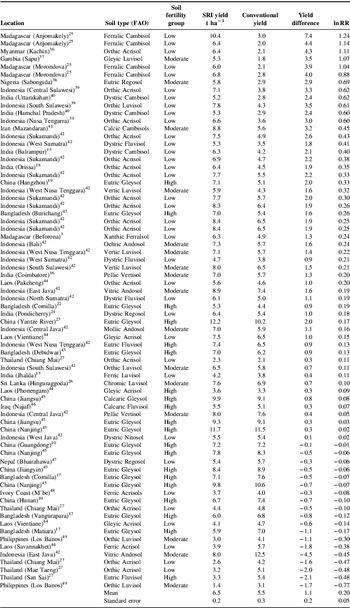
We collected yield data on SRI experiments and trials from peer-reviewed and non-peer-reviewed publications, reports and conference proceedings (n=72, Table 1). Only data that fulfilled the following criteria were retained for analysis: (1) the SRI treatment used intermittent flooding and drying and an early planting date (rice seedlings were less than 15 days old at transplanting), whereas the conventional treatment had continuously flooded soils and a later planting date (seedlings were more than 20 days old at transplanting); (2) the SRI and conventional treatments were grown in the same season and the same location; and (3) each treatment was replicated at least thrice during the study. In total, 81 SRI–Conventional system comparisons were collected; 72 were included and 9 were not included because they did not meet the criteria outlined above. Of the 40 data points used in the previous analysis by McDonald et al. (Reference McDonald, Hobbs and Riha2006), 29 were included and 11 were not included because they did not meet the previously stated criteria (n=5) or they were cited as personal communication. Treatment means (Table 1) were the average yield of each rice variety when replicated plots existed at a single site. In studies testing several varieties, values in Table 1 represent the average yield of all varieties grown at a site or the average yield of varieties grown on multiple farms in the same farming area. We chose to include studies that had not been peer-reviewed since there were only six peer-reviewed studies available at the timeReference Sheehy, Peng, Dobermann, Mitchell, Ferrer, Yang, Zou, Zhong and Huang10, Reference Sinha and Talati15–Reference Zhao, Wu, Li, Lu, Zhu and Uphoff19. So far, SRI has been mainly a grass-roots agricultural movement and there have been only a limited number of studies at major research institutions; most of the existing reports on SRI therefore come from local non-governmental and agricultural organizations. Given the stringent criteria for the inclusion of data in this analysis, we feel that the data set is strengthened by including non-peer-reviewed sources, which allows us to examine the effects of SRI on rice yield over a broader range of geographic regions and soil types.
Soil types, soil fertility group and rice yields from field experiments where SRI was evaluated against the conventional method. The yield difference was calculated as SRI Yield – Conventional Yield and the ln RR was ln(SRI Yield/Conventional Yield).

Most studies did not provide information on soil properties, and so the soil type at each site was determined by entering the latitude and longitude into the ISRIC-WISE global data set of derived soil properties on a 0.5 by 0.5 degree grid using ARC-GIS software. Soils were then grouped on the basis of their fertility and potential for rice productionReference Driessen, Deckers, Spaargaren and Nachtergaele20, Reference Sanchez21. Low-fertility soils were highly weathered soils rich in iron and aluminum oxides, namely Acrisols, Ferralsols and Dystric Cambisols. The moderate-fertility soils (Andisols, Luvisols, Regisols, Vertisols and Cambisols) were moderately weathered soils with a greater potential for agricultural production. Young alluvial soils and soils considered ideal for rice production (Fluvisols and Gleysols) were classified as having high fertility. While there is some uncertainty associated with using this general system of soil identification and grouping, we consider it a necessary tradeoff in taking the first step to examine the relationship between soil fertility and yield response to SRI at the global scale using the currently existing data. The soil types determined by the ISRIC map were compared with the soils information available from 22 field studies to validate the accuracy of the predicted soil typesReference Barison3, Reference Vijayakumar, Sundar Singh, Prabhakaran and Thiyagarajan16, Reference Latif, Islam, Ali and Saeque17, 22–Reference Gypmantasiri, Uphoff, Fernandes, Longping, Jiming, Rafaralahy and Rabenandrasana27.
The effect size of SRI management was calculated as the natural logarithm of the response ratio (ln RR) of SRI yield to conventional yield:
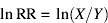
where X is the yield under SRI management and Y is the yield under conventional managementReference Hedges, Gurevitch and Curtis28. The response ratio is commonly used to describe the effect size in meta-analyses testing the response of a treatment. The effect size, expressed as the ln RR, was positive when SRI produced greater rice yield than the conventional system and negative when there was lower yield in SRI than the conventional system. The ln RR is appropriate for meta-analysis because it provides a dimensionless measure of effect sizes that can be used to compare among studiesReference Hedges, Gurevitch and Curtis28. The normality of the data was confirmed by examining Q–Q plots and using the Shapiro–Wilk test (α<0.5). Simple statistics (mean and t-test) were used to describe the performance of SRI relative to the conventional system in countries with more than two data points. The effect of soil fertility (low, moderate and high) on the ln RR was evaluated using the ANOVA procedure of SPSS statistical software (SPSS version 15.0, Chicago, IL). The model (ln RR=soil fertility group) indicated a significant (P<0.05) effect of soil fertility, and so a post-hoc mean separation test was performed (least significant difference (LSD), α=0.05).
Results and Discussion
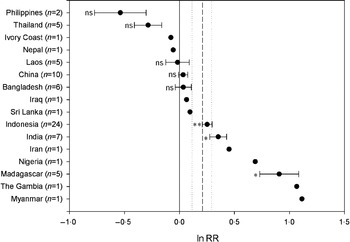
The results of 72 field trials comparing SRI and conventional rice production systems are summarized in Table 1. Overall, the mean ln RR was 0.20 and the 95% confidence interval ranged from 0.11 to 0.29, indicating that SRI had a positive effect on rice yields. Yield responses were grouped by country to determine if there were regions outside of Madagascar where SRI may have a positive effect on yield. The ln RR ranged from −0.54 in the Philippines to 1.11 in Myanmar (Fig. 1). The ln RR in Indonesia, India and Madagascar were significantly greater than zero, indicating a yield benefit from SRI compared to the conventional system (Fig. 1). Other countries with positive ln RR values were Iraq, Sri Lanka, Iran, Nigeria, Gambia and Myanmar (Fig. 1). The ln RR in studies from Thailand, Laos, China and Bangladesh did not differ significantly from zero, indicating no detectable difference in rice yield between SRI and conventional systems in these countries (Fig. 1).
The ln RR of rice yield in SRI and conventional systems grouped by country. The mean ln RR and standard error are shown for countries with more than two data points. A reference line is shown at zero (——) and the mean ln RR of the complete data set (---) (n=72) and its 95% confidence intervals (......) are shown. The significance of each mean from zero is shown (t-test; *, α<0.05; **α<0.001; ns, not significant).

A previous meta-analysis of 40 SRI trials concluded that SRI had no significant positive effect on yields in countries other than MadagascarReference McDonald, Hobbs and Riha11. The current study presents meta-analysis of a larger data set (72 SRI trials) and demonstrates that there are countries other than Madagascar, namely India and Indonesia, where SRI has a significant, positive effect on rice yield. However, there is no significant negative effect of SRI on yield in most other countries (Fig. 1). Both Thailand and the Philippines had mean ln RRs<0, although the means were not significantly different from 0 (P=0.083, df=4 and P=0.263, df=1 respectively; t-test) (Fig. 1). These results suggest that the introduction of SRI could increase or maintain rice yields over a broad range of geographic and climatic conditions.
Next we assessed if the regional variability found in the yield response to SRI could be explained by soil fertility. The soil type predicted by the ISRIC soil map agreed with soil information available in 22 of the reports. Of the 72 studies, only 15 provided soil texture information and seven provided soil pH. Soils with low pH (⩽5) had been classified as low-fertility Acrisols and neutral pH (⩾6) clay soils had been classified as Gleysols by the ISRIC soils map. The mean rice yields in SRI were 5.8, 7.0 and 7.7 t ha−1 in low-, moderate- and high-fertility soils, respectively. In the conventional systems, rice yields were on average 4.3, 6.1 and 7.4 t ha−1 in the low-, moderate- and high-fertility soils (Table 1). The rice yields therefore agreed with the soil fertility groupings, because lower yields were found in the low-fertility soils, higher yields were found in the moderate-fertility soils and the highest yields in the high-fertility soils.
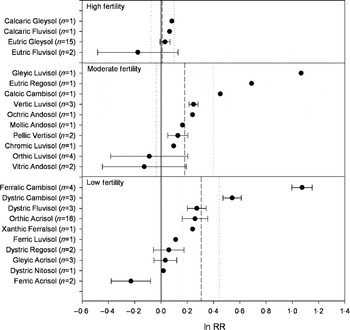
The ln RRs were highly variable among soil types, likely due to the wide range of climatic conditions associated with studies included in the meta-analysis. When grouped by soil fertility, the mean ln RR of the high-fertility soils (n=19) was −0.014 with the 95% confidence interval ranging from −0.07 to 0.10 (Fig. 2). In the moderate-fertility soils (n=17), the mean ln RR was 0.18 and the 95% confidence intervals were −0.04 and 0.40 (Fig. 2). The mean ln RR of the low-fertility soils (n=36) was 0.3061 and the 95% confidence intervals were 0.16 and 0.45. ANOVA showed that there was a significant effect of soil fertility on ln RR (P=0.026). Low- and high-fertility soils were significantly different (LSD, P=0.007), whereas the moderate-fertility soils were not different from the low- (LSD, P=0.114) and high- (LSD, P=0.330) fertility soils. The mean ln RR of the low-fertility soils was significantly different from 0 (t-test, df=35, P<0.0001), whereas the mean ln RR of the medium- and high-fertility soils were not significantly different from 0 (t-test, df=16, P=0.096 and df=18, P=0.745, respectively). The data from peer-reviewed sources (n=8) followed a similar trend as the complete data set. The average ln RR of the high-fertility soil group (n=4) was 0.02, whereas the average ln RR of the low-fertility soil group (n=3) was 0.29. These results show that SRI has a positive effect on rice yields in low-fertility soils, but no measurable effect on yields in moderate- to high-fertility soils. The adoption of SRI implies greater use of organic fertilizers than in conventional systems, and so SRI could be viewed as a low-input alternative with the potential to improve yields on low-fertility soils while maintaining yields and conserving resources on moderate- to high-fertility soils.
The ln RR of rice yield in SRI and conventional systems. Values are the mean and standard error for each soil type. Soils were assigned to fertility groups, namely high (n=19), moderate (n=17) and low (n=36) fertility. A reference line is shown at zero (——) and mean ln RR (---) and 95% confidence intervals (.......) are shown for each soil fertility group.

Global rice yields must increase by 50% in the next 20 years to meet the projected demand of the world's growing population1. Much of the increased demand will occur in areas with low-fertility soils, such as the highly weathered Acrisols and Ferralsols that are found in about two-thirds of the world's humid tropicsReference Olaleye, Tabi, Ogunkunle, Singh and Sahrawat29. By examining a larger number of field trials than considered previouslyReference McDonald, Hobbs and Riha11, we demonstrate that SRI increases rice yields in regions other than Madagascar, namely in areas of Indonesia and India, where rice is the staple food. In most other countries, there is generally no yield loss in SRI compared to the conventional system. Furthermore, differences in soil fertility and potential for rice production can explain in part the regional variability in yield response to SRI. We found that SRI increases rice yields on low-fertility soils, and has no effect on yields in moderate- to high-fertility soils where yields are already high (about 7–10 t ha−1). This agrees with the ideas outlined in a critical assessment of SRI by DobermannReference Dobermann13. In the context of augmenting food security while preserving natural resources, we suggest that SRI has the greatest potential to increase rice production on marginal soils, and thus could be an appropriate low-input technology for resource-poor farmers. Also, in areas where water is limited, the adoption of SRI may conserve water without sacrificing yields.
The mechanisms involved in the yield improvements with SRI on low-fertility soils remain poorly understood. Low-base cations are a key criterion in the classification of Acrisols and Ferralsols, and strongly weathered soils tend to be extremely low in available forms of phosphorusReference Tiessen, Schulte and Ruhiyat30, Reference Walker and Syers31. Here we posit four possible mechanisms whereby SRI modifies soil properties in a manner to increase rice yields on low-fertility soils: (1) aerobic conditions increase microbial activity, rates of organic fertilizer decomposition, organic phosphorus turnover and phosphorus availability in low-phosphorus soilsReference Turner, Frossard, Oberson, Uphoff, Ball, Fernandes, Herren, Husson, Laing, Palm, Pretty and Sanchez14, Reference Nziguheba, Palm, Buresh and Smithson32–Reference Turner and Haygarth34; (2) aerobic conditions favor root growth and increase nutrient acquisition by organically fertilized riceReference Barison3, Reference Stoop, Uphoff and Kassam5, Reference Dobermann13; (3) wetting–drying cycles create aerobic conditions that reduce accumulation of toxic Fe2+ and Mn2+(Reference Olaleye, Tabi, Ogunkunle, Singh and Sahrawat29, Reference Turner and Haygarth34); and (4) low-potential soils may have high drainage or permeability making them unsuitable for flooding. Further research on the chemical and biological mechanisms involved in yield improvements with SRI on low-fertility soils is required in order to provide a scientific basis for agronomic recommendations and predictions of the long-term sustainability of this novel rice production system.
Conclusion
There is significant evidence that (1) SRI increases rice yields in regions other than Madagascar; and (2) SRI increases rice yields on low-fertility soils and has no effect on yields in moderate- to high-fertility soils. The results of this meta-data analysis should be considered as preliminary and replicated field trials with detailed soil fertility data are needed to improve our confidence in the yield differences between SRI and conventional rice production systems. The biological and chemical mechanisms that lead to increased rice yields on these low-fertility soils remain to be elucidated. Although the scientific debate over SRI continues, more than a million farmers around the world have now adopted the system35. We suggest that the minimum data set to be provided by future field studies comparing the SRI versus conventional system should include data on soil fertility class, texture, pH, macronutrient availability, fertilizer use and standard deviation of the mean yield value.
Acknowledgements
We thank individuals who provided data for the meta-analysis, Rosa Orlandini and Joanna Hobbins (Walter Hitschfeld Geographic Information Centre) for their help with GIS, Rick Condit (STRI) for statistical advice, and anonymous reviewers for comments on the manuscript. Financial support for this work was from the Natural Sciences and Engineering Research Council of Canada.