INTRODUCTION
Parkinson's disease (PD) typically begins with unilateral motor symptoms and even with progression of the disease, the initial body side of motor symptom onset generally remains more affected (Lee et al., 1995). The asymmetric motor symptoms observed in PD have been found to be associated with asymmetrical depletion of dopamine (DA) in the basal ganglia at autopsy (Kempster et al., 1989). Studies using single proton emission computed tomography (SPECT) imaging have found changes in DA transporter binding contralateral to the side of initial motor symptoms (Innis et al., 1993). The asymmetry in uptake persists even after the disease has progressed from unilateral to bilateral motor symptoms (e.g. Antonini et al., 1995). The asymmetrical subcortical changes that accompany PD have been linked to dysfunction of certain hemisphere specific cognitive abilities.
The memory impairments typically observed in PD patients are characterized by deficits in aspects of memory requiring executive functions (i.e., learning and delayed free recall), whereas the process of consolidation is typically intact (i.e., savings and recognition are not impaired). This pattern of memory performance contrasts with the impaired consolidation abilities of patients with Alzheimer's disease (reviewed in Pillon et al., 2001).
A relation between lateralized motor symptoms and memory functions associated with hemispheric dominance has not been observed consistently. The expected pattern of impairment with worse performance on verbal memory tasks by patients with right body side motor symptom onset (RPD, inferred left hemisphere dysfunction) and poorer performance on visuospatial memory tasks by patients with left side onset (LPD, right hemisphere dysfunction) has been reported by some studies. For instance, RPD patients showed worse verbal memory performance than LPD patients, but both groups demonstrated comparable visual memory performance (Starkstein et al., 1987). By contrast, Blonder and colleagues (1989) reported that LPD patients performed worse on a measure of visual memory relative to a control group but not relative to an RPD subgroup. There also have been several reports of null findings regarding RPD and LPD performance on measures of verbal and visual memory (e.g., St. Clair et al., 1998) and reports that visual and verbal memory performance differs in LPD and RPD patients but not in the expected direction. Tomer and colleagues (1993) found that LPD patients demonstrated poorer performance on measures of verbal learning relative to RPD patients, but there was no difference in visual memory performance between groups.
Inconsistent findings across studies might be because of several factors. Studies have used different inclusion criteria such as including patients who may have dementia or treated with anticholinergic medications. Also, verbal and visual memory measures were not equivalent in format. Finally, different methods for measuring motor symptom laterality have been employed.
The current study examined visual and verbal memory, with measures requiring similar task demands, in non-demented PD patients with a specific side of motor symptom onset who were not treated with anticholinergic medications. We hypothesized that side of motor symptom onset would be associated with performance on memory tasks requiring predominantly left or right hemisphere functions. Specifically, it was predicted that within group LPD patients (inferred right hemisphere dysfunction) would demonstrate greater impairments on measures of visual than verbal memory, whereas within group RPD patients (left hemisphere dysfunction) would be more impaired on measures of verbal than visual memory.
METHODS
Participants
Participants were 30 PD patients (20 men, 10 women) from a hospital-based Movement Disorders Clinic. Participants were not demented (DRS scores ≥123) (Jurica et al., 2001). Patients were diagnosed as having idiopathic PD by a movement disorders specialist based on the following criteria: presence of 2 out of 3 cardinal PD manifestations (tremor, bradykinesia, and rigidity) and a good response to dopaminergic medications. Side of motor symptom onset was determined by chart review for each participant (based on patient report and motor examination). Two PD participants achieved scores >17 on the Beck Depression Inventory-II (BDI-II) and one participant achieved a score >7 on the Geriatric Depression Scale-short form. For each of these participants, inspection of their responses on the self-report measures indicated that the physical symptoms of PD were the major cause of elevated scores. Eleven participants were treated with antidepressants at the time of their evaluation. To be noted, in two cases there was no documentation of antidepressant treatment.
Procedure
Data were collected by retrospective chart review. All patients had participated in a comprehensive neuropsychological evaluation conducted or supervised by a licensed clinical neuropsychologist.
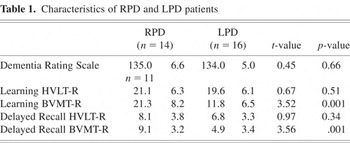
Demographic variables included age, education, and gender. Levodopa equivalent doses were calculated for each participant's medications (Herzog et al., 2003). Within two months of the neuropsychological measures, all patients were evaluated with the Hoehn and Yahr scale and the motor section of United Parkinson's Disease Rating Scale. Because the study is a retrospective chart review, no single global cognitive screening measure was administered. However most (n = 27) received either the DRS or an MMSE. Therefore, MMSE scores were converted to DRS scores using the equation derived by Bobholz and Brandt (1993). See Table 1.
Characteristics of RPD and LPD patients

The two memory measures were selected because they have similar formats (i.e., three learning trials of 12 units of information and delayed recall 25 minutes later).
Hopkins Verbal List Learning Test—Revised
The Hopkins Verbal List Learning Test—Revised (HVLT-R) is a test of verbal memory (Brandt & Benedict, 2001). A 12-item word list was presented orally three times. After each presentation the participants are asked to recall all the words they can recall from the list. The learning score is calculated by summing all words learned across the three trials (max score = 36). Delayed recall of the word list occurs after a 25-minute delay (max score = 12).
Brief Visual Memory Test—Revised
The Brief Visual Memory Test—Revised (BVMT-R) is a test of visuospatial memory (Benedict, 1997). There are three learning trials in which six abstract designs are presented visually for 10 seconds. The learning score is calculated by summing all designs recalled across the three encoding trials (max score = 36). Delayed recall of the designs occurred after a 25-minute delay. Recall is scored by accuracy and correct placement of each figure (max score = 12).
RESULTS
Data Analysis
In order to compare memory performance with a common metric and to equate tasks for difficulty, each memory score was converted to a Z-score using published normative data (Brandt & Benedict, 2001; Benedict, 1997).
To examine the association of body side of motor symptom onset and memory performance, the Z-scores for each participant were submitted to 2 separate mixed factorial ANOVAs (one for Learning scores and one for Delayed Recall scores) with a within-subjects factor of Modality of Memory Task (verbal, visual) and a between-subjects factor of Group (LPD, RPD). Independent samples t-tests compared performance between groups on the BVMT-R and HVLT-R. In order to evaluate differences on verbal and visual memory measures within group paired samples t-tests were conducted.
Participant variables
There was no significant difference (all ps > .05) between LPD and RPD patients, with respect to age (LPD; M = 66.8, SD = 7.5, RPD; M = 59.9, SD = 11.9), education (LPD; M = 12.9, SD = 2.7, RPD (n = 13); M = 15.2, SD = 3.9), years of illness duration (LPD; M = 9.3, SD = 7.9, RPD (n = 13); M = 8.6, SD = 6.2), levodopa equivalent dose (LPD; M = 781.3, SD = 794.0, RPD (n = 13); M = 1109.2, SD = 652.3), or disease severity (H&Y: LPD; range = 1–4, RPD; range 1–4, UPDRS: LPD (n = 13); M = 25.4, SD = 10.9, RPD (n = 13); M = 18.2, SD = 16.6).
Four of the LPD patients and two of the RPD patients were left handed. While handedness is typically associated with dominance of language in the contra-lateral hemisphere, which could have impacted our findings, we observed that the means of the left-handed participants did not differ from the right-handed participants within group (all ps > .15). Raw scores for performance on the HVLT-R and the BVMT-R are included in Table 1.
Learning
There was a main effect of Group (F[1,28] = 6.2, p = .02), because the LPD group performed more poorly on measures of learning relative to the RPD group. The main effect of Modality of Memory Task was not significant (F[1,28] = 0.21, p > .6). Most important for our hypotheses, the interaction of Group × Modality of Memory Task was significant [F(1,28) = 12.4, p = .002].
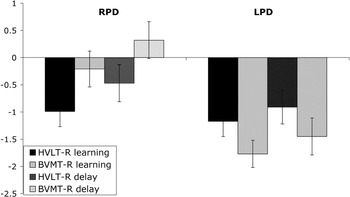
To examine this significant interaction, one-tailed t-tests were conducted as the direction of effects was predicted a priori. Between groups, the LPD and RPD groups had comparable Learning scores on the HVLT-R [t(28) = .46, p > .6]. Consistent with our hypothesis, the LPD group demonstrated significantly poorer learning scores on the BVMT-R than the RPD group [t(28) = 3.9, p = .001] (Fig. 1).

LPD and RPD patients demonstrate different patterns of memory performance on the BVMT-R and the Hopkins HVLT-R. Columns represent average Z-scores. Error bars represent standard error of the mean.
Within group differences were compared with one-tailed paired samples t-tests. As predicted and most critical to our hypotheses, the LPD patients demonstrated poorer visual relative to verbal memory [t(15) = 2.4, p = .02]. By contrast, RPD patients showed poorer verbal relative to visual memory [t(13) = 2.6, p = .01] (Fig. 1).
Delayed recall
Similar to the results for the Learning scores, there was a main effect of Group (F[1,28] = 6.9, p = .01) but not the main effect of Modality of Memory Task (F[1,28] = 0.4, p > 0.5). Consistent with our predictions, again the interaction of Group × Modality of Memory Task was significant (F[1,28] = 10.5, p = .003).
Between groups, the LPD and RPD groups had comparable Delayed Recall scores on the HVLT-R [t(28) = .97, p > .3], whereas the LPD group had significantly poorer Delayed Recall scores on the BVMT-R than the RPD group [t(28) = 3.7, p = .001] (Fig. 1). Again supporting our hypotheses, within group the LPD patients demonstrated poorer visual relative to verbal memory [t(15) = 1.7, p = .05]. By contrast, RPD patients showed poorer verbal relative to visual memory [t(13) = 3.2, p = .004] (Fig. 1).
DISCUSSION
The results from the current study indicate that body side of motor symptom onset is associated with performance on memory measures. The strongest support for this statement was obtained from our within group comparisons, which found that, the LPD group (inferred right hemisphere dysfunction) showed poorer visual learning and delayed recall (associated with right hemisphere functions) relative to their verbal memory functions (associated with left hemisphere functions). By contrast, within group the RPD patients (inferred left hemisphere dysfunction) had poorer verbal memory compared to their visual memory. The current findings emphasize the importance of considering body side of motor symptom onset when evaluating PD patients' memory performance.
Side of motor symptom onset is not always considered in research examining cognition in PD patients. Postle and colleagues (1997) found that PD patients demonstrated poorer performance on a task of spatial (associated with greater right hemisphere involvement) relative to object working memory (greater left hemisphere involvement). Whereas the authors reported that side of motor symptom onset was not associated with performance on measures of spatial working memory, it is possible that their results were influenced by the over inclusion of LPD (n = 11) compared to RPD patients (n = 4). Side of motor symptom onset may not fully account for previous reports of preferentially impaired visuospatial working memory, but on tasks that are associated with hemispheric dominance, we suggest that side of motor symptom be thoroughly considered.
Previous work in this area has focused on patients with hemi-parkinsonism (unilateral involvement only) or used involved methods for measuring symptom laterality. In this study, side of motor symptom onset was determined by chart review alone and many PD patients had already progressed to bilateral involvement; yet significant differences were still observed. Consequently, the effect of side of motor symptom onset is likely pervasive as it is observed even after the disease has begun to affect both hemispheres. The present findings emphasize that side of motor symptom onset can be reliably documented by chart review and/or patient and caregiver reported medical history, information that is frequently available for most neuropsychological evaluations.
In the current study commonly used measures of verbal (HVLT-R) and visual (BVMT-R) memory were selected to assess the integrity of left and right hemisphere functions in PD patients. It should be recognized that these measures differ, because the visuospatial task also includes a motor component (construction). We addressed the issue of differences in task difficulty by converting all raw scores to z-scores, based on published normative data. Motor symptoms do not account for our findings because the group with greater right hand involvement (RPD group) demonstrated poorer performance on measures of verbal memory compared to their visual memory performance. The present findings provide evidence of the construct validity of the HVLT-R and BVMT-R as measures of left and right hemisphere functioning, respectively.
The impact of dopamine replacement therapy on our results should be mentioned. The LPD group performed in the impaired range on all memory measures compared to the normative sample, whereas the RPD group performed in the impaired range only for verbal learning. Whereas not significant, the LPD group had higher UPDRS scores and were treated with less dopaminergic medications compared to the RPD group. It is possible that the differences in overall performance are related to suboptimal treatment of the LPD patients, and this may explain why there was no significant difference between groups on the HVLT-R measures and large differences on the BVMT-R measures. If optimally treated it might be speculated that the LPD group performance would improve and potentially lead to significant between group differences for all memory measures. Despite possible differences in the management of PD symptoms, within group we found asymmetrical memory performance in the expected directions. Future studies are needed to examine the association between side of motor symptom onset and performance on cognitive tasks requiring lateralized cognitive functions in PD patients both off and on their medications.
Neuroimaging studies reveal that there is an asymmetrical loss of dopamine within the basal ganglia associated with side of motor symptom onset. It is believed that the basal ganglia influence cognition through closed circuits formed with the frontal lobes (Middleton & Strick, 2000a; 2000b). Research focused on describing basal ganglia- thalamo-cortical circuits have revealed three distinct closed loops involving frontal regions (Middleton & Strick, 2000a; 2000b). Studies of cognition in PD have attributed deficits on memory tasks requiring encoding and free recall to the disruption of these basal ganglia-thalamo-frontal circuits (see Pillon et al. for review). Our results suggest that side of motor symptom onset may be associated with dysfunction of the contralateral basal ganglia-thalamo-frontal circuits. Neuroimaging addressing the association of side of motor symptom onset and performance on cognitive tasks requiring hemispheric dominance would add greatly to the understanding of the neurocognitive changes associated with PD.
In conclusion, LPD patients demonstrated greater impairments in visual than verbal memory both within group and in comparison to the RPD group, whereas within group the RPD patients showed greater impairments in verbal than visual memory. These findings emphasize that body side of motor symptom onset is a critical factor to consider when evaluating PD patients' cognitive performance. Inattention to side of motor symptom onset may lead to an inaccurate description of the cognitive impairments associated with this disease.