Dilated cardiomyopathy is usually idiopathic and may arise secondary to infections or metabolic or genetic causes. Another rare cause is hypocalcaemia.Reference Hershberger, Morales and Siegfried 1 – Reference Verma, Khadwal, Chopra, Rohit and Singhi 3 Owing to the fact that calcium plays an essential role in excitation and contraction of myocardial muscle, myocardial contractility may decline in patients with hypocalcaemia.Reference Ringer 4 Many case reports of hypocalcaemia-related reversible dilated cardiomyopathy and heart failure in childhood have been published.Reference Amirlak, Al Dhaheri and Narchi 5 – Reference Fabi, Gesuete, Petrucci and Ragni 12 Studies that took place in our region indicate that rachitis, which is an important cause of hypocalcaemia, remains to be a serious health problem.Reference Ozkan, Buyukavci, Aksoy, Tan and Akdag 13 , Reference Ozkan, Doneray and Karacan 14 In this study, the clinical and laboratory features of patients with cardiomyopathy and congestive heart failure secondary to severe rickets diagnosed between 1999 and 2012 were evaluated.
Methods
Patients with symptoms of congestive heart failure and rickets-related hypocalcaemia were assessed clinically and by echocardiography in a paediatric cardiology outpatient clinic. Heart failure was diagnosed with the help of clinical findings and chest radiography. Echocardiographic examination was performed for all patients. Rickets was diagnosed according to the clinical, laboratory, and radiologic findings. Clinical and laboratory data of the patients were digitally recorded and consistent with severe rickets. In all, eight patients with heart failure accompanied by dilated cardiomyopathy were identified. The following factors were investigated: total number of children in the family, feeding methods, ingestion of vitamin D supplements, and history of symptoms such as loss of appetite, frequent respiratory infections, and seizure without fever. Maternal lifestyle and living conditions were also evaluated. During physical examination of the 3-month-old patients, growth and development percentiles, presence of craniotabes, fontanel width, and rachitic rosary were evaluated. The blood glucose, urea, creatinine, sodium, potassium, chloride, calcium, phosphorus, alkaline phosphotase, complete blood count, C-reactive protein, 25-OH vitamin D3, and parathormone levels in the patients’ blood samples were analysed. Wrist X-rays were obtained. A paediatric cardiologist in an echocardiography laboratory performed echocardiographic examinations for all patients in the supine position with Vivid 5 and Vivid 7 echocardiography instruments (GE Medical Systems, Horten, Norway) and a 7 MHz probe. Left ventricle function and left ventricle end-systolic and end-diastolic diameters were measured. Carnitine levels were measured, and certain viral serologic studies – hepatitis A, B, and C; Epstein–Barr virus; cytomegalovirus; parvovirus; and mumps – were performed using blood samples of patients with dilated cardiomyopathy.
Results
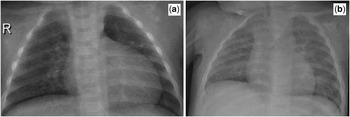
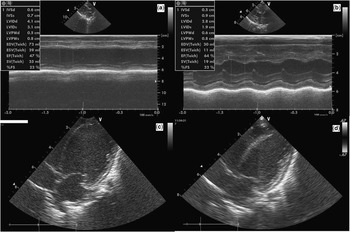
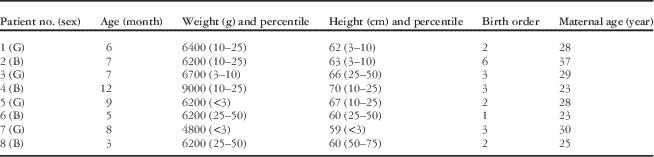
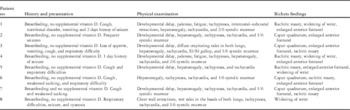
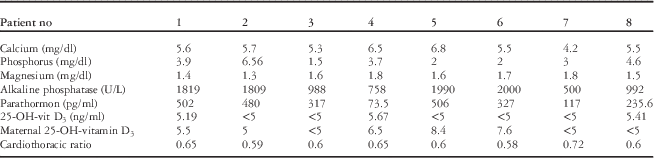
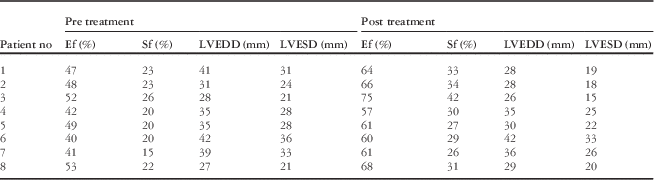
We evaluated eight patients who developed heart failure as a result of severe hypocalcaemia associated with rickets between August, 1999 and June, 2012. The age distribution of the patients was 3–12 months. In all, six patients had growth development impairment. Examination of maternal lifestyles and living areas revealed that mothers were living at the edge of Erzurum City and tended to keep the children covered, limiting exposure to sunlight. Maternal age and sibling number were variable. Demographic, clinical and familial characteristics of our patients are shown in Table 1. All patients were breastfed and were not taking supplemental vitamin D. Owing to the fact that none of the patients was in good general health, all were admitted to the hospital for treatment. Although they were brought to the hospital mostly for respiratory difficulties, nutritional impairment, or seizures, signs of congestive heart failure were discovered during the first examination. Clinical features of the patients are summarised in Table 2. Laboratory results were consistent with advanced-stage rickets, and severe hypocalcaemia was detected in all patients (Table 3). The mothers of all patients were examined by an endocrinologist. The maternal blood 25-OH vitamin D3 levels were <10 ng/ml. The echocardiographic examination revealed that the patients’ pre-treatment left ventricle end-systolic and end-diastolic diameters were increased for their age and that the ejection fraction and fractional shortening were reduced (Table 4). Vitamin D, elementary calcium, inotropic, and anticongestive treatments were initiated. After clinical improvement, patients were discharged. During follow-up, marked improvement was detected in the left ventricle function (Table 4). These patients were followed up for 6 months after anticongestive treatment was stopped. Follow-up echocardiographic examinations showed that left ventricle systolic functions were still normal. Pre-treatment and post-treatment changes seen on X-ray telecardiography and M-mode and echocardiography of Patient 1 are shown in Figures 1 and 2. Viral serologic evaluation results – hepatitis A, B, and C; Epstein–Barr virus; cytomegalovirus; parvovirus; and mumps – and blood carnitine levels were normal in all patients.
Changes in the pre-treatment ( a ) and post-treatment ( b ) cardiothoracic index in X-ray telecardiography of Patient 1.

Changes in the pre-treatment ( a ) and post-treatment ( b ) left ventricle function in M-mode echocardiography, and pre-treatment ( c ) and post-treatment ( d ) two-dimensional (four chambers) echocardiography of Patient 1.

Demographic and familial characteristics of patients.

B=boy; G=girl
Clinical features of patients.

Laboratory results of patients.

Echocardiographic findings of patients.

Ef=ejection fraction; LVEDD=left ventricular end-systolic diameter; LVESD=left ventricular end-diastolic diameter; Sf=fractional shortening
Discussion
Dilated cardiomyopathy is a left ventricle function disorder characterised by left ventricle enlargement and an ejection fraction of <50%. The most common causes of dilated cardiomyopathy are idiopathic (35–40%), familial (20–35%), and acute myocarditis (12%). Viral infections, endocrine disorders, metabolic diseases, cardiotoxic drugs, and certain systemic diseases may also cause dilated cardiomyopathy.Reference Akman, Omeroglu and Dindar 15 , Reference Brown, Nunez, Russell and Spurney 16 The presence of myocardiopathy related to hypocalcaemia and heart failure were reported in several patients with severe rickets.Reference Amirlak, Al Dhaheri and Narchi 5 , Reference Gillor, Groneck, Kaiser and Schmitz-Stolbrink 7 , Reference Olgun, Ceviz and Ozkan 9 – Reference Roy, El-Matary, Gladman and Isherwood 11 Many reports of with hypocalcaemia-associated reversible heart failure and dilated cardiomyopathy have appeared in international publications, typically presenting one or two cases each.Reference Amirlak, Al Dhaheri and Narchi 5 – Reference Roy, El-Matary, Gladman and Isherwood 11 Interestingly, eight patients who developed dilated cardiomyopathy and congestive heart failure because of marked rickets-associated hypocalcaemia were described in our region between 1999 and 2012. In their 10-year retrospective study, Brown et alReference Brown, Nunez, Russell and Spurney 16 reported four patients with signs of dilated cardiomyopathy related to rickets and congestive heart failure at the ages of 4–10 months. Inotropic and anticongestive treatments, as well as elementary calcium and vitamin D supplementation, were given to the reported patients. All patients responded to treatment and were discharged. Our centres are reference centres for a significant number of patients with chief clinical findings such as severe rickets with hypocalcaemia, respiratory infection, a seizure history, and developmental delay. Our region is located between 39°N and 41°N in eastern Anatolia, an area with a relatively low socio-economic level and a longer cold season that requires the use of extensive, thick clothing, which in turn decreases the benefits of the sun. Ozkan et alReference Ozkan, Buyukavci, Aksoy, Tan and Akdag 13 found that the incidence of rickets related to vitamin D deficiency in 0- to 3-year-old infants was 6.09% in our region in 1998. The Ministry of Health made an effort to provide vitamin D supplementation to prevent rickets related to vitamin D deficiency in this region in 2005. After that campaign, Ozkan et alReference Ozkan, Doneray and Karacan 14 identified 39 cases of rickets related to vitamin D deficiency in 39,133 infants aged 0–3 years between March, 2007 and February, 2008. The eight patients in our study were also diagnosed between 1999 and 2012. In spite of the campaigns to prevent rachitis, cases with dilated cardiomyopathy due to rachitis-induced hypocalcaemia are still encountered. This suggests that risk factors for nutritional rachitis need to be addressed more comprehensively. Andiran et alReference Andiran, Yordam and Ozön 17 listed the four most important risk factors for nutritional rickets in newborns as follows: a maternal serum vitamin D level of <10 ng/ml, clothing that covers the body, uneducated mothers, and low socio-economic level. In a study done in Erzurum, OrhonReference Orhan 18 showed that maternal lifestyle had a crucial effect on rickets development in babies, and they detected vitamin D deficiency (vitamin D deficiency basal level: 20 ng/ml) in 88% of the mothers. The socio-economic structure of the region, geographic characteristics, maternal lifestyle, and consequent maternal vitamin D levels <10 ng/ml in all of the present patients clearly show the necessity of preventing vitamin D deficiency in mothers to prevent rickets. Active vitamin D deficiency is present in patients with rickets. The essential role of active vitamin D is to help the absorption of intestinal calcium and phosphorus and maintain the calcium/phosphorus balance of the organism, along with parathyroid hormones. Calcium absorption is 10–15% in the absence of vitamin D, and it increases to 30–80% in the presence of vitamin D.Reference Vieth 19 When active vitamin D decreases to critical levels in the organism and/or calcium absorption in the intestine is insufficient, calcium mobilisation from bones increases in response to parathyroid hormone. In an infant with insufficient bone mineralisation, hypocalcaemia can easily occur.Reference Hatun, Bereket, Calikoglu and Ozkan 20 Ionised calcium plays a key role in myocardial contraction. Although low levels of plasma calcium decrease cardiac contractility, related heart failure is rare.Reference Uysal, Kalayci and Baysal 21 However, cardiac contractility may severely decline in prolonged hypocalcaemia, and heart failure cannot be controlled without correction of hypocalcaemia.Reference Price, Stanford, Braden, Ebeid and Smith 10 , Reference Uysal, Kalayci and Baysal 21 – Reference Kumar, Saikia, Kumar and Tomar 23 Uysal et alReference Uysal, Kalayci and Baysal 21 reported 27 patients whose heart function was decreased with no symptoms or signs of heart failure. Kumar et alReference Kumar, Saikia, Kumar and Tomar 23 noted that dilated cardiomyopathy and cardiogenic shock developed in a 2-month-old patient with severe hypocalcaemia as a result of vitamin D deficiency. In terms of cardiac effects based on the stages of rickets, we can conclude that in that patient rickets caused a clinical picture characterised by a decline in cardiac function with progression to cardiogenic shock.
In our series, cardiotonic and anticongestive treatments, as well as vitamin D and calcium supplementation, were started in all patients. After treatment, signs of congestive heart failure disappeared, and marked improvement was observed in heart function and dilated cardiomyopathy. One of the most common causes of dilated cardiomyopathy in infants is myocarditis. However, a definitive diagnosis of myocarditis requires endomyocardial biopsy.Reference Nishikawa, Uto and Kanai 24 We did not detect any positive findings in the viral serologic markers of our patients, and the blood carnitine levels were also normal. Laboratory findings, applied treatments, and satisfactory responses to these treatments supported the presence of rickets-associated cardiomyopathy.
Conclusion
Severe hypocalcaemia associated with rickets must always be kept in mind among the causes of dilated cardiomyopathy and impaired cardiac function in infants. If it is diagnosed and treated in time, dilated cardiomyopathy and severe heart failure related to rickets respond well to treatment.
Acknowledgement
None.
Financial Support
This research received no specific grant from any funding agency, commercial or not-for-profit sectors.