Attention deficit hyperactivity disorder is a relatively common psychiatric diagnosis,Reference Goldman, Genel, Bezman and Slanetz1 primarily made in school-aged children but also seen as being increasingly relevant to adults. As the symptoms of attention deficit hyperactivity disorder exist on a continuum into the healthy population, prevalence rates vary, but more severe presentations with significant impairment to functioning probably occur at a rate of around 1–5%.Reference Meltzer, Gatward and Goodman2 Symptoms can be sufficient to cause significant issues such as school failure, risk to daily safety, and risk to long-term development. In children and young people, attention deficit hyperactivity disorder is managed by child and adolescent psychiatrists and paediatricians, who will commonly have a low threshold for prescription of medication treatments, because of overall good efficacy and acceptable adverse effect profile.Reference Hechtman and Greenfield3, 4
The cardiac safety of drugs used to treat attention deficit hyperactivity disorder, however, remains of concern to many prescribers and families, following reports of sudden cardiac deaths of individuals taking both stimulant and the newly developed non-stimulant attention deficit hyperactivity disorder drugs. Child and adolescent psychiatrists and paediatricians, aware of “black box” or other advisory labels and advice to monitor cardiac parameters, may remain uncertain as to the true risks in both children with ostensibly normal hearts and those with identified risk factors. This presents problems in making risk assessment decisions for and with the child and their family, and in considering the threshold for referral for a specialist cardiology opinion. Cardiologists consulted in this respect may be unfamiliar with the implications of treatment for attention deficit hyperactivity disorder, and where the responsibility may lie for prescription and monitoring when there are cardiac concerns.
Regulatory decisions regarding attention deficit hyperactivity disorder drug licensing and labelling, along with a recent American Heart Association Scientific Statement,Reference Vetter, Elia and Erickson5 its revision, and a response/clarification by the American Academy of Paediatrics,6 raise questions of practice regarding the evaluation and treatment of patients with attention deficit hyperactivity disorder. Current practice in the area of attention deficit hyperactivity disorder drug treatment and cardiovascular evaluation is diverse, with little agreement on the safety of treatment of children with repaired or palliated congenital heart disease or structural or electrical cardiomyopathies with attention deficit hyperactivity disorder medications, and on the appropriate evaluation of children with no known heart disease.
To address these issues for the European community, the European Network for Hyperkinetic Disorders, through its European Attention Deficit Hyperactivity Disorder Guidelines Group), organised a meeting between attention deficit hyperactivity disorder specialists, paediatric cardiovascular specialists, and representatives of the major market authorisation holders for attention deficit hyperactivity disorder medications.7 Specialists met together and formulated questions for market authorisation holder representatives, following which market authorisation holder representatives presented pre- and post-market data for their products, responded to questions, and agreed to provide follow-up information including supplemental data, as well as any uncomplicated reanalysis, to the European Network for Hyperkinetic Disorders specialists. As per previous European Network for Hyperkinetic Disorders meetings, market authorisation holder companies supported the organisation of the conference through an unrestricted grant, and participants abided by rules providing reimbursement for basic meeting expenses only. Both psychiatric and cardiovascular actions and adverse effects were reviewed. This manuscript represents a consensus on cardiovascular aspects of attention deficit hyperactivity disorder medications.
Biological mechanisms potentially leading to sudden cardiac death, and the biological plausibility of attention deficit hyperactivity disorder drug interactions
The heart and its rhythms are affected by an individual's adrenergic state, which can alter the naturally paced rate of the heart, enhance myocardial current leaks leading to extra beats, which can then cause further triggered or re-entrant arrhythmias, or perpetuate arrhythmias that would otherwise spontaneously dissipate.
Attention deficit hyperactivity disorder medications include drugs that are broadly classed as stimulants, altering adrenergic metabolism or level, and are identified to have cardiac effects on heart rate, blood pressure, and perhaps QT interval. Large changes in these measurements are uncommon but do occur (see heart rate, blood pressure, and QT sections below), resulting in minimal mean changes in large patient samples, but suggesting that some individuals may be particularly affected. Further complexity is provided by variations in drug metabolism (also frequently under the influence of gene polymorphisms) and drug–drug interactions.
Thus, there is biological plausibility that important cardiac effects of attention deficit hyperactivity disorder medications may occur in some individuals, and that cardiac effects might contribute to sudden cardiac death in rare individuals. However, it remains unclear from current data sources whether such effects occur, beyond the background rates of sudden cardiac death seen in populations, even those of young age.
Sudden death in children and adolescents
Sudden death, whether occurring in children or adults, is a disastrous event. Fortunately, sudden death occurs only rarely in the paediatric population as compared with adults. Sudden death rates range from 0.8 to 8.5 per 100,000 patient-years.Reference Berger, Kugler, Thomas and Friedberg8–Reference Wren12 The median of published sudden death rates in children is ∼1.2–1.3 per 100,000 per year.
Sudden death in children and adolescents is associated with both known and previously unrecognised cardiac conditions. Among young persons with known congenital heart disease, the highest risks of sudden death (0.2% per year) occur with specific conditions (aortic stenosis, Mustard, Senning, or tetralogy of Fallot repairs),Reference Silka, Hardy, Menashe and Morris13 yet effective methods to stratify or treat these patients are elusive. Attention deficit hyperactivity disorder is common in the general paediatric population,Reference Sayal14 and is more prevalent among children with congenital heart disease, whether related to surgical/perioperative factors, or genetic conditions predisposing to both attention deficit hyperactivity disorder and congenital heart disease.Reference Hovels-Gurich, Konrad and Skorzenski15, Reference Shillingford, Glanzman, Ittenbach, Clancy, Gaynor and Wernovsky16 Such children should have all effective treatment options including medication available to them if no identifiable risks are present, or if important benefits outweigh risks after informed consideration.
Among sudden deaths in young persons with no previous diagnosed heart disease, heritable cardiac conditions – such as hypertrophic cardiomyopathy, long QT syndrome, arrhythmogenic right ventricular cardiomyopathy, catecholaminergic polymorphic ventricular tachycardia, and Brugada syndrome – or subclinical structural conditions – coronary artery anomalies – are often identified through post-mortem examination or clinical history. In some, these conditions may only be recognised at post mortem by using sophisticated genetic testing. In others, cardiac conditions that are yet to be identified may be present. A history of cardiac symptoms – syncope, palpitations – a positive family history for sudden death, or death associated with exercise are also often identified; in some, however, sudden death is the first presentation of the condition.
In children with attention deficit hyperactivity disorder, the risk of death from all causes is estimated at 58.4 per 100,000 patient-years,Reference Winterstein, Gerhard, Shuster, Johnson, Zito and Saidi17 but the risk of sudden death is unknown. Regulatory agencies in North America (the United States Food and Drug Administration and Health Canada) identified 25 sudden deaths in individuals prescribed attention deficit hyperactivity disorder medications from Adverse Event Reporting System data, raising concerns of a possible association. However, when the number of patient-years of prescribed medication was incorporated into the evaluation, the frequency of reported sudden deaths per year of attention deficit hyperactivity disorder therapy with methylphenidate, atomoxetine, or amphetamines among children was 0.2–0.5 per 100,000 patient-years.Reference Rappley, Moore and Dokken11 Despite the fact that it is recognised that adverse events are frequently under-reported in general (80% under-reporting is common), it is plausible that sudden deaths in young individuals on relatively new medications may be better reported. Death rates per year of therapy calculated using adverse event reporting system reports and prescription data are equivalent for two attention deficit hyperactivity disorder drugs of differing mechanisms (0.6 per 100,000 per year). Thus, using the best available data, it is likely that the sudden death risk of children on attention deficit hyperactivity disorder medications is similar to that of children in general, if an under-reporting rate of 50% is accepted. In addition, the frequency of structural heart disease, prior syncope, positive family history, and association with exercise was similar to that of sudden death in the general paediatric population.
Notwithstanding
Caveats to the above analysis include the observation that 2 out of 25 sudden deaths on attention deficit hyperactivity disorder medication occurred with initiation of medication. Thus, as with most therapies, exceedingly rare but real risks cannot be completely excluded. If childhood deaths on attention deficit hyperactivity disorder medications are under-reported to the same degree as with other medications, then some incremental risk may be present.
A recent case-control study by Gould et alReference Gould, Walsh and Munfakh18 compared stimulant use in two matched groups of 564 young people aged 7–19 years, in which one group had suffered sudden unexplained death, and the other had died in motor vehicle accidents. Stimulant use was found in 10 of the former group versus 2 of the latter group, which the authors used to conclude a possible association of stimulant use with sudden death. However, the Food and Drugs Administration suggests caution in responding to these findings, citing possible methodological flaws such as recall bias by the parents in reporting stimulant use.Reference Kuehn19 The study authors countered that either toxicology results or medical records confirmed the stimulant use reported by the parents in both case and control groups. However, it is possible that control individuals not reported to have taken stimulants may have done so. In addition, the physical and mental health comorbidities associated with a diagnosis that requires stimulant treatments may increase the risk of sudden death from other causes.
Schelleman et alReference Schelleman, Bilker and Strom20 assessed data assembled from 241 417 incident attention deficit hyperactivity disorder medication users matched 4:1 with non-users – a combined claims database study – and found no significant difference in cardiovascular events. That study was funded by an ADHD drug company from whom the authors' employers also received compensation, but the publication was otherwise “at arms length”. The Food and Drug Administration are currently conducting study to further examine this question. A “thorough QT analysis” is also being performed by one of the MAHs and remains pending. Thus, practice should be reassessed in the event of any new convincing data.
Attention deficit hyperactivity disorder medication and the electrocardiographic-corrected QT interval
Prolongation of the electrocardiographic-corrected QT interval (QTc) in individuals in the absence of known congenital Long QT Syndrome by a variety of medications is a recognised cause of sudden death.Reference Champeroux, Martel and Vannier21–Reference Reingardiene and Vilcinskaite24 Thus, the effect of stimulant medication on the QT interval is important given the concerns raised about the safety of this group of medications. The average QTc interval is not changed significantly by any of the drug groups – methylphenidate, mixed amphetamine salts, and atomoxetine. The average changes in any study cohort, however, do not highlight significant increases in a small proportion of individuals. More important than the average change in a study cohort is the proportion with an increment in QTc by 30–60 milliseconds, to above 470–500 milliseconds. Such data for the various preparations are available to regulatory organisations but not necessarily in the public domain.
From the available data, there do not seem to be major clinically significant changes in average QTc with any of the three drug classes.Reference Vetter, Elia and Erickson5 For atomoxetine, there are increases in some patients by more than 60 milliseconds and to above 500 milliseconds.Reference Wernicke, Faries and Girod25 Poor cytochrome P450 metabolisers are considered to be more likely to raise their atomoxetine levels and further studies are being performed in these patients.Reference Wernicke and Kratochvil26 Until this is clarified, patients with the Long QT Syndrome should not receive atomoxetine without electrocardiography monitoring.
Electrocardiography assessment
The American Heart Association statement published online on 21 April, 2008, along with its accompanying press release, created significant controversy regarding the evaluation of children with attention deficit hyperactivity disorder. Citing evidence arguing for electrocardiography screening in general or athletic populations to prevent sudden death, the American Heart Association writing committee initially recommended that an electrocardiogram be added to the evaluation of children receiving attention deficit hyperactivity disorder medications as a medically indicated test, although no evidence was provided that this provides an incremental benefit to this specific population. Following extensive correction of the document, the language was revised to state that it is “reasonable to consider adding an ECG” to the evaluation of children with attention deficit hyperactivity disorder, and provided as a IIa recommendation. The American Academy of Paediatrics/American Heart Association clarification of this statement further interprets the original American Heart Association scientific statement as follows:
It is reasonable for a physician to consider obtaining an ECG as part of the evaluation of children being considered for stimulant drug therapy, but this should be at the physician's judgment, and it is not mandatory to obtain one.
and
Treatment of a patient with ADHD should not be withheld because an ECG is not done. The child's physician is the best person to make the assessment about whether there is a need for an ECG.
Electrocardiography screening is considered to be a cost-effective method to prevent sudden cardiac death in athletes in the United States, with an estimated cost/year of life saved of US$44,000.Reference Fuller27 A recent modelled economic evaluation for the United States attention deficit hyperactivity disorder populations identifies a similar cost/year of life saved, at $39,000 for screening with history, physical examination and electrocardiogram, and US$27,000 for electrocardiogram only.Reference Denchev, Kaltman, Schoenbaum and Vitiello28 Japan has performed school-based electrocardiography screening of all children, with an estimated cost/year of life saved on US$8800.Reference Tanaka, Yoshinaga and Anan29 In Italy, electrcardiography screening of all athletes has been mandated for more than 30 years, and is considered to have reduced the incidence of sudden cardiac death.Reference Corrado, Basso, Pavei, Michieli, Schiavon and Thiene30 However, this reduction is in comparison to historical controls, and the current sudden death rate in Italian athletes who have been screened is similar to that of the unscreened United States general population. Other European health-care jurisdictions do not currently organise or fund electrocardiography screening for such populations. Given this, and in the absence of any demonstrated incremental benefit for electrocardiography screening in the attention deficit hyperactivity disorder population, there is no current indication to perform an electrocardiogram in a child before or during attention deficit hyperactivity disorder therapy when history, family history, and physical examination are normal.
Equity
The American Heart Association statementReference Vetter, Elia and Erickson5 has suggested that children receiving attention deficit hyperactivity disorder medication undergo electrocardiography screening but justified this recommendation primarily based on cost-effectiveness data for the general population. The attention deficit hyperactivity disorder population was seen as a subgroup where a screening programme might be feasible – and where there is widespread public concern – whereas screening may be considered infeasible within the general United States childhood population at present. However, in the absence of major improvements in cost-effectiveness within a particular sub-population, most ethicists recommend on the basis of equity that a screening test be applied to an entire population at risk.Reference Ubel, DeKay, Baron and Asch31
Subspecialty consultation
Attention deficit hyperactivity disorder appears to be common in congenital heart disease patients; however, heart specialists do not typically have training in the treatment of this disorder and are not intrinsically familiar with the indications for medications or their benefits. For the usual attention deficit hyperactivity disorder patient with no known heart disease or risk factors for sudden death, the risk of medication is not demonstrably higher than that for the general childhood population, and initiation of attention deficit hyperactivity disorder medication should be at the recommendation of an attention deficit hyperactivity disorder specialist. For patients with known congenital heart disease, certain disorders are known to have an associated risk of sudden death. Such patients should already be under the care of a heart specialist. There is no clear evidence that attention deficit hyperactivity disorder medications raise the risk of sudden death further. Thus, initiation of attention deficit hyperactivity disorder medication should be primarily at the recommendation of an attention deficit hyperactivity disorder specialist, although discussion with the responsible heart specialist is appropriate. For patients with newly identified risk factors for sudden death – such as syncope, family history of a high-risk condition or sudden cardiac arrest or abnormal cardiac examination – consultation with a heart specialist should be sought, whether or not attention deficit hyperactivity disorder medication will be prescribed. This would also be true in the non-attention deficit hyperactivity disorder patient.
Further considerations: heart rate and blood pressure
Stimulant medication is recognised to cause a small increase in heart rate averaging 1–2 beats per minute.Reference Findling, Short and Manos32 The averaging in clinical studies hides a small proportion where the increment is larger – up to 50 beats per minute.Reference Wernicke, Faries and Girod25 Heart rates consistently above 120 beats per minute should not be accepted without review. If there is a sustained increase in heart rate above this level, then psychological and medical causes will need to be considered and an electrocardiography performed to confirm that this is a sinus tachycardia and not an arrhythmia. Rarely, the sinus tachycardia may be symptomatic enough to require adjustment of the dose, a change in preparation or discontinuation.
All stimulants – and the non-stimulant medication Atomoxetine – for the treatment of attention deficit hyperactivity disorder are reported to cause elevations in blood pressure. Despite the fact that average increases range from 3 to 4 millimetres of mercury systolic and diastolic,Reference Findling, Short and Manos32, Reference Samuels, Franco, Wan and Sorof33 this small average change includes patients where the rise in blood pressure is more significant. Categorical data showing a rise in blood pressure to above the 95th percentile have been published for atomoxetine with a rise above the 95th percentile in 6.8%.Reference Wernicke, Faries and Girod25 From case reports and anecdotal experience, methylphenidate preparations also cause a rise in blood pressure beyond the 95th percentile. The true magnitude of this increase is not known.
Interestingly, the patient information leaflet of methylphenidate products in Europe has now changed after intervention of the European Medicines Association in 2009 (http://www.ema.europa.eu/htms/human/referral/article31/methylphenidate.htm). Now the patient is informed that methylphenidate often increases systolic and diastolic blood pressure by more than 10 millimetres of mercury. European Medicines Association has also provided a: “Guideline on Clinical Investigation of Medicinal Products for the Treatment of Attention Deficit Hyperactivity Disorder (ADHD)”.34 This guideline recommends that: “Special attention should be paid to cardiotoxicity, i.e. hypertension, arrhythmias and conduction disorders, in particular QT interval prolongation, if the medicinal product belongs to a class associated with cardiovascular effects.” and that “Cardiac safety in cardiovascular compromised patients (e.g. congenital abnormalities) should be monitored.”
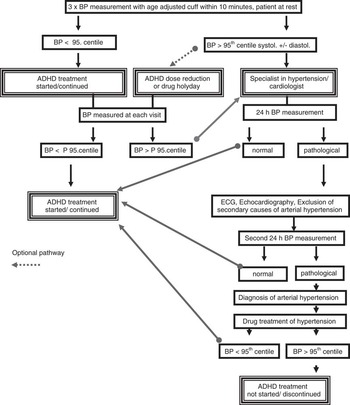
A recommended flow chart for both the attention deficit hyperactivity disorder specialist and hypertension specialist is attached (Fig 1).
Recommendation for blood pressure monitoring and management in attention deficit hyperactivity disorder patients.

Medication combinations
If risks for sudden cardiac death are difficult to identify for commonly prescribed single attention deficit hyperactivity disorder medications, they are even more difficult to determine for medication combinations that are used less frequently. However, the 1999 American Heart Association Scientific Statement on the cardiovascular monitoring of children and adolescents receiving psychotropic drugs remains useful in this regard,Reference Gutgesell, Atkins and Barst35 recognising that it does not address agents introduced after its date of publication. Clonidine and guanfacine are sometimes combined with stimulants in the therapy of attention deficit hyperactivity disorder. Despite the fact that their antihypertensive effect might seem advantageous in counterbalancing the blood pressure effects of stimulants in the treatment of attention deficit hyperactivity disorder, and their combination has been reported in a small series of patients,Reference Spencer, Greenbaum, Ginsberg and Murphy36 the American Heart Association Scientific Statement reported that clonidine had been associated with two deaths in patients who also received methylphenidate, although the mechanism of death was unknown.Reference Gutgesell, Atkins and Barst35
Recommendations for the cardiovascular assessment of candidates for attention deficit hyperactivity disorder medications
Patients being considered for attention deficit hyperactivity disorder medication should have a clinical assessment by their prescribing specialist, including identification of any known heart disease, any history of syncope with exercise, any family history of sudden unexpected death under the age of 40 years, baseline heart rate and blood pressure – repeated twice if initial reading is hypertensive – and auscultation to identify any murmurs – that is, beyond any innocent murmur that may be already known. Recommendations for the use of age-adapted cuff size for blood pressure measurement and height-adjusted blood pressure centiles are proposed by the European Society of Hypertension.Reference Lurbe, Cifkova and Cruickshank37
New-onset palpitations should be managed as for unmedicated patients. Occasional extra beats or brief runs of non-sustained supraventricular tachycardia are likely to be of no concern, while a more persistent uncomfortable tachycardia, or documented ventricular tachycardia, with or without exercise may be a more significant arrhythmia. In case of the latter, referral is warranted.
Summary points
• Despite the fact that sudden death has been identified in multiple young individuals on attention deficit hyperactivity disorder medication and has caused regulatory concern, when analysed for patient-years of exposure of these common long-term medications, sudden death does not appear to exceed that of the general population. Possible under-reporting and rare deaths with the initiation of medication remain reasons for concern.
• Congenital heart disease patients have an increased prevalence of attention deficit hyperactivity disorder, and can benefit from attention deficit hyperactivity disorder therapies, including appropriately prescribed medication.
• Electrocardiography screening is yet to be considered cost-effective and appropriate for prevention of sudden death in the general paediatric population in Europe (or the United States). There is no current evidence to suggest an incremental benefit to electrocardiography assessment of attention deficit hyperactivity disorder patients before medication.
• For attention deficit hyperactivity disorder patients without known heart disease, the attention deficit hyperactivity disorder specialist is the appropriate individual to evaluate benefit and risk and make recommendations for medication therapy.
• For attention deficit hyperactivity disorder patients with known heart disease followed by a heart specialist, the attention deficit hyperactivity disorder specialist remains the appropriate individual to evaluate the benefit and risk and make recommendations for medication therapy. Despite the fact that there is no evidence that medication increases the risk of sudden death, even if already elevated, discussion with the heart specialist is reasonable.
• For attention deficit hyperactivity disorder patients with suspected heart disease or risk factor/s for sudden death, assessment by a heart specialist is recommended, as would also be the case for a non-attention deficit hyperactivity disorder patient.
• The identification of risk factors for sudden death should not automatically exclude the use of attention deficit hyperactivity disorder medication. There is a theoretical concern of increasing the risk in this type of patient; however, there is no evidence that this is true, although lack of evidence is not proof (first and fifth points). In such a setting, for example, the congenital long QT syndrome, a frank discussion of these aspects between the family, attention deficit hyperactivity disorder specialist, and paediatric cardiologist or electrophysiologist should help refine the acceptability for an individual patient.