CME Information
Accreditation and Credit Designation Statements
The Neuroscience Education Institute is accredited by the Accreditation Council for Continuing Medical Education to provide continuing medical education for physicians.
The Neuroscience Education Institute designates this enduring material for a maximum of 1.5 AMA PRA Category 1 Credits ™. Physicians should claim only the credit commensurate with the extent of their participation in the activity.
Target Audience
This activity is designed to meet the educational needs of psychiatrists and others who treat patients with psychiatric conditions.
Needs Assessment
Medication nonadherence is a common problem in the treatment of schizophrenia. The consequences of nonadherence are numerous and can be quite serious, including increased risk of rehospitalization and suicide. There are numerous factors that affect a patient's decision and ability to take medication, including medication tolerability, cognitive deficits, and the patient's relationship with the treatment team. Fortunately, there are several strategies that may increase treatment adherence, including pharmacological options for decreasing adverse side effects, utilization of long-acting injectable depot formulations that eliminate the need for the patient to remember daily oral medication, and psychosocial approaches that emphasize the benefits of staying well.
Learning Objectives
After completing this activity, participants should be better able to:
• Recognize the importance of cognitive factors in schizophrenia, including evolving new diagnostic criteria and methods for assessing cognition in clinical practice
• Differentiate antipsychotic drug treatments from each other on the basis of pharmacologic mechanisms and evidence-based clinical trial results
• Implement evidence-based treatment strategies that maximize adherence and patient outcomes
• Combine practical experience with evolving new evidence in order to integrate new and soon-to-be introduced treatments into clinical practice
Date of Release/Expiration
Release date: March, 2012 CME credit expiration date: September, 2013
Acknowledgment of Financial Support
The activity is supported by an educational grant from Lilly USA, LLC. For further information concerning Lilly grant funding visit, www.lillygrantoffice.com.
Activity Instructions
This CME activity is in the form of a printed supplement and incorporates instructional design to enhance your retention of the information and pharmacologic concepts that are being presented. You are advised to review this activity from beginning to end, and then complete the posttest and activity evaluation. The estimated time for completion of this activity is 1.5 hours.
NEI Disclosure Policy
It is the policy of the Neuroscience Education Institute to ensure balance, independence, objectivity, and scientific rigor in all its educational activities. Therefore, all individuals in a position to influence or control content development are required by NEI to disclose any financial relationships or apparent conflicts of interest. Although potential conflicts of interest are identified and resolved prior to the activity being presented, it remains for the participant to determine whether outside interests reflect a possible bias in either the exposition or the conclusions presented.
These materials have been peer reviewed to ensure the scientific accuracy and medical relevance of information presented and its independence from commercial bias. NEI takes responsibility for the content, quality, and scientific integrity of this CME activity.
Disclosure Statements
Authors
Debbi Ann Morrissette, Ph.D, is an adjunct professor of biological sciences at California State University in San Marcos and a medical writer at the Neuroscience Education Institute in Carlsbad, CA. Dr. Morrissette has no other financial relationships to disclose.
Andrew J. Cutler, MD, is a courtesy assistant professor in the department of psychiatry at the University of Florida in Gainesville, and the CEO and chief medical officer of the Florida Clinical Research Center, LLC in Maitland. Dr. Cutler receives research support from Alkermes, AstraZeneca, Boehringer Ingelheim, Bristol-Myers Squibb, Dainippon Sumitomo, Forest, GlaxoSmithKline, Janssen, Johnson & Johnson, Lilly, Lundbeck, Merck, Ortho-McNeil, Otsuka America, Quintiles Transnational, Roche, Shionogi, Shire, Sunovion, Supernus, Takeda, and Targacept; is a consultant to AstraZeneca, Bristol-Myers Squibb, Cypress, Dainippon Sumitomo, Forest, Janssen, Labopharm, Lilly, Merck, Ortho-McNeil, Otsuka America, Pamlab, PharmaNeuroBoost N.V., Quintiles Transnational, Shionogi, Shire, Sunovion, Supernus, Takeda, and Targacept; and is on the speakers bureaus of AstraZeneca, Bristol-Myers Squibb, Dainippon Sumitomo, Forest, GlaxoSmithKline, Janssen, Labopharm, Lilly, Merck, Ortho-McNeil, Otsuka America, Pamlab, Shionogi, Shire, and Sunovion.
Content Editors
Meghan Grady is the director of content development at the Neuroscience Education Institute in Carlsbad, CA. She has no other financial relationships to disclose.
Stephen M Stahl, MD, PhD, is an adjunct professor of psychiatry at the University of California San Diego, honorary visiting senior fellow at the University of Cambridge, and chairman of the Neuroscience Education Institute. Dr. Stahl receives research support from AstraZeneca, BioMarin, Dainippon Sumitomo, Dey, Forest, Genomind, Lilly, Merck, Pamlab, Pfizer, PGxHealth/Trovis, Schering-Plough, Sepracor/Sunovion, Servier, Shire, and Torrent; is a consultant to Advent, Alkermes, Arena, AstraZeneca, AVANIR, BioMarin, Biovail, Boehringer Ingelheim, Bristol-Myers Squibb, CeNeRx, Cypress, Dainippon Sumitomo, Dey, Forest, Genomind, Janssen, Jazz, Labopharm, Lilly, Lundbeck, Merck, Neuronetics, Novartis, Ono, Orexigen, Otsuka, Pamlab, Pfizer, PGxHealth/Trovis, Rexahn, Roche, Royalty, Schering-Plough, Servier, Shire, Solvay/Abbott, Sunovion/Sepracor, Valeant, and VIVUS; and is on the speakers bureaus of Dainippon Sumitomo, Forest, Lilly, Merck, Pamlab, Pfizer, Sepracor/Sunovion, Servier, and Wyeth.
Peer Reviewer
Steven S. Simring, MD, MPH, is a clinical associate professor in the Department of Psychiatry at Columbia University College of Physicians and Surgeons, New York State Psychiatric Institute in New York City. Dr. Simring has no other financial relationships to disclose.
Design Staff
Nancy Muntner is the director of medical illustrations at the Neuroscience Education Institute in Carlsbad, CA. She has no other financial relationships to disclose.
Program Development
Rory Daley, MPH, is the associate director of program development at the Neuroscience Education Institute in Carlsbad, CA. He has no other financial relationships to disclose.
Steve Smith is the president and chief operating officer at the Neuroscience Education Institute in Carlsbad, CA. He has no other financial relationships to disclose.
Disclosed financial relationships with conflicts of interest have been reviewed by the Neuroscience Education Institute CME Advisory Board Chair and resolved. All faculty and planning committee members have attested that their financial relationships do not affect their ability to present well-balanced, evidence-based content for this activity.
Disclosure of Off-Label Use
This educational activity may include discussion of products or devices that are not currently labeled for such use by the FDA. Please consult the product prescribing information for full disclosure of labeled uses.
Disclaimer
Participants have an implied responsibility to use the newly acquired information from this activity to enhance patient outcomes and their own professional development. The information presented in this educational activity is not meant to serve as a guideline for patient management. Any procedures, medications, or other courses of diagnosis or treatment discussed or suggested in this educational activity should not be used by clinicians without evaluation of their patients’ conditions and possible contraindications or dangers in use, review of any applicable manufacturer's product information, and comparison with recommendations of other authorities. Primary references and full prescribing information should be consulted.
Introduction
Schizophrenia is the most common psychotic illness with nearly 1% lifetime prevalence in the population worldwide. There are numerous antipsychotic treatment options available, with various associated side effects and individual efficacy. However, one common issue in the treatment of schizophrenia is the high rate of nonadherence to medication. In fact, although definitions vary, some studies have estimated total or partial nonadherence to be as high as 74%.Reference Lieberman, Stroup and McEvoy1, Reference Donohoe, Owens and O'Donnell2 Treatment nonadherence is associated with symptom worsening and increased rehospitalization and relapse, as well as the accompanying financial burdens.Reference Lindenmayer, Liu-Seifert and Kulkarni3, Reference Marder4 Even partial nonadherence to medication is correlated with risk of relapse, such that a 20% reduction in treatment adherence may result in as much as a 3.1 point increase in PANSS total score.Reference Subotnik, Nuechterlein and Ventura5 Even small gaps in therapy of 1–10 days raise the likelihood of hospitalization 2-fold.Reference Weiden, Kozma, Grogg and Locklear6 Nonadherence has also been linked with increased alcohol-related problems, arrests, violence, suicide, and reduced satisfaction with life.Reference Ascher-Svanum, Faries, Zhu, Ernst, Swartz and Swanson7, Reference Herings and Erkens8 In addition to these negative consequences of nonadherence on functional outcomes for those with schizophrenia, medication nonadherence makes it nearly impossible to accurately evaluate the efficacy of antipsychotic agents. Nonadherence can lead to suboptimal response and, if it is assumed that the medication is being taken as prescribed, the clinician may be prompted to increase the medication dose. Such a dose increase may lead to adverse side effects that otherwise would be absent, and may even increase the risk of treatment resistance. Clinicians might also abandon a potentially effective medication or mistakenly label a patient as “treatment resistant.”
Measuring Treatment Adherence
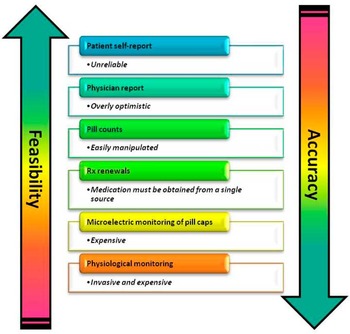
There are several ways that medication adherence can be measured; each has its positive and negative features (Figure 1). For instance, although patient self-reporting (e.g., When do you take your medications? In the last week, how many doses do you think you have missed?) may be the least invasive method for assessing adherence, it is also the least accurate. On the other hand, physiological monitoring of drug plasma levels, while perhaps the most accurate measurement of adherence, is expensive and the most invasive.Reference Velligan, Diamond and Mintz9 Electronic monitoring using medication caps that record each time a pill container is opened also provides a reliable measure; however, such devices are costly and not typically used outside of clinical trials.Reference Marder4 In addition to the negative consequences of medication nonadherence, it has also been shown that nonadherence as defined by missed outpatient and follow-up appointments is highly correlated with increased risk of relapse, and may also be predicted by such factors as previous nonadherence.Reference Kruse and Rohland10–Reference Compton, Rudisch, Weiss, West and Kaslow12 Thus, although it seems prudent to suggest that nonadherence has adverse effects on medication efficacy and patient outcomes, it is difficult to fully assess the extent of those effects.
Pros and cons of various measures of adherence.

Factors That May Influence Treatment Adherence
Numerous factors may affect whether or not a patient with schizophrenia takes medication as prescribed. In addition to logistical and financial barriers, there are factors inherent to the disease state or its treatment that may influence a patient's adherence to medication. In some cases, the patient may feel compelled to try and “solve the problem” on his or her own.Reference Kessler, Berglund and Bruce13 Interestingly, the factors that affect adherence may change over the course of the illness as the patient's experience with the illness and its treatment change.Reference Robinson, Woerner, Alvir, Bilder, Hinrichsen and Lieberman14
Positive symptoms
Not surprisingly, more severe positive symptoms and poor illness insight can dramatically affect medication adherence; those who do not see themselves as ill will likely not feel a need to take medication.Reference Pyne, Bean and Sullivan15 Unfortunately, decreased symptoms can also lead to poor medication adherence because patients may neglect taking medication once there are no symptomatic reminders.Reference Marder4 In fact, a patient may feel temporarily better after discontinuing medication due to relief from side effects.
Medication efficacy and tolerability
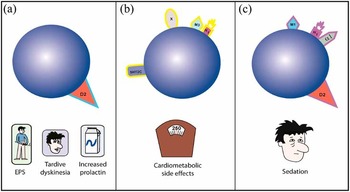
The “first generation” or conventional antipsychotics are effective in many patients for alleviating positive symptoms of schizophrenia such as hallucinations and delusions. However, the conventional antipsychotics have a high risk of extrapyramidal side effects (EPS) associated with them due to antagonism of dopamine (D2) receptors. The “second generation” or atypical antipsychotics are also effective for treatment of positive symptoms in many individuals with schizophrenia, and may possibly improve negative and cognitive symptoms as well due to more diverse receptor pharmacologic profiles. However, the actions of atypical antipsychotics at a wide range of receptors also increase the risk of a variety of adverse side effects including sedation and cardiometabolic issues. Not only may poor treatment response affect adherence, but adverse side effects associated with both conventional and atypical antipsychotics may also impact nonadherence, especially if the perceived efficacy of the antipsychotic is less than optimal.Reference Perkins, Gu, Weiden, McEvoy, Hamer and Lieberman16 In fact, the Clinical Antipsychotic Trials of Intervention Effectiveness (CATIE) study indicated that one of the most common reasons for discontinuing antipsychotic medication was intolerability of side effects.Reference Lieberman, Stroup and McEvoy1 EPS, weight gain, sedation, and sexual dysfunction have all been linked to nonadherence. The receptor functional groups responsible for some of these adverse side effects are outlined in Figure 2. Unfortunately, there may often be a “don't ask, don't tell” scenario in which there is an under-reporting of adverse side effects by patients and an under-recognition of side effects by clinicians.Reference Weiden17, Reference Weiden and Miller18 Given the apparent connection between side effects and medication nonadherence, it is important for both patient and clinician to investigate, recognize, and adequately address any adverse effects.
Receptor functional groups responsible for side effects linked to nonadherence. (A) Extrapyramidal side effects (EPS), tardive dyskinesia, and hyperprolactemia are attributable to the action of antipsychotics at dopamine (D2) receptors. (B) Serotonin (5HT 2C) and histamine (H1) antagonism have been linked to weight gain and muscarinic (M3) receptor antagonism can alter insulin regulation. The “X” functional group is a yet-unidentified mediator of insulin resistance. (C) D2, M1, H1, and alpha 1 adrenergic antagonism are all associated with sedation.

Treatment regimen
While there appear to be similar high discontinuation rates for both conventional and atypical antipsychotics, some studies have indicated that adherence may be better for some atypical antipsychotics in comparison to others.Reference Lieberman, Stroup and McEvoy1, Reference Dolder, Lacro, Dunn and Jeste19 For instance, both olanzapine and clozapine may have slightly higher adherence rates compared to risperidone.Reference Ritchie, Harrigan, Mastwyk, Macfarlane, Cheesman and Ames20 The complexity of the treatment regimen is also important for adherence; data have shown that number of doses per day is inversely related to adherence.Reference Claxton, Cramer and Pierce21, Reference Pfeiffer, Ganoczy and Valenstein22 More complex regimens may disrupt a patient's daily routine and further compound problems with adherence that are due to memory deficits. For this reason, long-acting depot formulations may be especially advantageous to those with cognitive impairments.
Therapeutic alliance
The relationship between patient and treatment team has also been found to greatly affect treatment adherence.Reference Mitchell and Selmes23 One study determined that over half of all patients who were nonadherent with medication had a poor therapeutic relationship with their clinician (compared to only 29% of patients who did adhere to their medication).Reference Olfson, Mechanic, Hansell, Boyer, Walkup and Weiden24 These data underline the value of the patient–clinician relationship and highlight the need for patients to be actively engaged in their own treatment. The patient needs to sense that there is an alliance with the treatment team and to feel respected and empowered, rather than feeling as though the relationship is one of control by the treatment team over the patient.
Cognitive and negative symptoms
In addition to the positive symptoms present in schizophrenia, both cognitive and negative symptoms are also prominent; however, cognitive dysfunction is not currently part of the diagnostic requirements. Both cognitive deficits (such as memory issues) and negative symptoms (such as apathy) have been linked to nonadherence.Reference Donohoe, Owens and O'Donnell2, Reference Perkins, Gu, Weiden, McEvoy, Hamer and Lieberman16 Cognitive deficits not only affect a patient's ability to remember to take medication, but also may limit the ability of the patient to budget finances to pay for medications or to be educated about incorrect perceptions regarding illness and treatment.Reference Robinson, Woerner, Alvir, Bilder, Hinrichsen and Lieberman14, Reference Bhanji, Chouinard and Margolese25 Perhaps due to the correlation with adherence, baseline cognition actually predicts later functional outcome, and verbal memory, working memory, and executive functioning have been specifically linked to functional outcome.Reference Green, Kern and Heaton26 In fact, while both cognitive and negative symptoms are associated with functional outcome, positive symptoms do not have that same correlation with functional outcomes.Reference Milev, Ho, Arndt and Andreasen27 Unfortunately, cognitive and negative symptom domains represent the two major unmet therapeutic areas in schizophrenia because they are less responsive, in general, to antipsychotic treatment compared to positive symptoms. Given their predictive power regarding both medication adherence and functional outcome, it has been suggested that improvement in cognitive or negative symptoms alone should warrant FDA approval of a therapeutic agent for treatment in schizophrenia.Reference Milev, Ho, Arndt and Andreasen27 It should be noted that it is difficult to separate how much each symptom domain uniquely affects functional outcome, as there is much overlap between the effects of cognitive and negative symptoms and, in fact, negative symptoms often predict deficits in neurocognition.Reference Riedel, Schennach-Wolff and Musil28
Strategies to Maximize Treatment Adherence and Improve Functional Outcome
Minimizing side effects and increasing drug efficacy
Given the correlation between adverse side effects and medication nonadherence, it is essential that the clinician be aware of any side effects experienced by the patient and seek to minimize those effects that the patient finds intolerable.Reference Fleischhacker, Meise, Gunther and Kurz29 Although individual response will differ, data from the CATIE study indicate that the atypical antipsychotic olanzapine has the longest time to discontinuation but is associated with the most discontinuation due to weight gain, whereas the conventional antipsychotic perphenazine is associated with the most discontinuation for EPS relative to second-generation atypical antipsychotics.Reference Lieberman, Stroup and McEvoy1 In patients experiencing tardive dyskinesia, it is recommended that a switch to clozapine or quetiapine be made.Reference Weiden and Miller18 For any given patient, it may be necessary to attempt several different monotherapies, and even antipsychotic combinations, prior to finding the most efficacious treatment offering the least adverse effects in order to maximize adherence. Although this practice remains questionable, when switching from one treatment to another, there are specific strategies recommended in order to minimize residual symptoms and adverse responses.Reference Stahl and Mignon30, Reference Cutler, Ball and Stahl31
Long-acting depot formulations
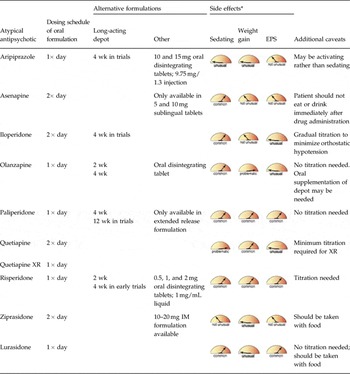
Long-acting formulations of antipsychotics offer many benefits over their oral counterparts.Reference Bhanji, Chouinard and Margolese25, Reference Fleischhacker, Meise, Gunther and Kurz29, Reference Gerlach32 Assured medication delivery and continuous antipsychotic coverage certainly increase medication adherence and have been shown to decrease the risk of psychotic relapse.Reference Gaebel, Schreiner and Bergmans33–Reference Tiihonen, Haukka, Taylor, Haddad, Patel and Korhonen36 There is no need for the patient to remember to take medication every day, and a decision to adhere to the treatment regimen need only be made a few times a month rather than every day or even several times a day. These factors may be especially important for patients with concomitant cognitive deficits or poor illness insight. The more frequent contact between the patient and treatment team required for administration of depot formulations offers possible strengthening of the patient–clinician alliance that is instrumental to adherence. Also, if a dose is missed, the clinician may be notified prior to the drug concentration dropping to ineffective levels and further increasing the chance of nonadherence. Also with depot formulations, there is avoidance of first-pass metabolism and thus a better relationship between dose and level of drugs available to the system. Depot formulations may also offer lower peak plasma levels and decreased peak-to-trough variability compared to oral formulations, and therefore may lead to better tolerability and safety. There are now several conventional and atypical antipsychotics available as depot formulations, and more are currently in development (Table 1).
Characteristics of various atypical antipsychotics that may affect adherence

*Side effects scale: Unusual = reported in few patients; Not unusual = occurs in a significant minority; Common = many experience or can be in significant amount; Problematic = occurs frequently, can be in a significant amount, and may be a health problem in some patients.
Psychosocial interventions
In addition to pharmaceutical-based interventions for improving adherence, there are several psychosocial measures that have been shown to enhance adherence. In terms of the patient–clinician alliance, it is important to clearly communicate with the patient regarding benefits and hazards of all treatment options and to take into account the patient's preferences in terms of the treatment regimen.Reference Mitchell and Selmes23 Refill reminders and organized packaging of daily medications have been shown to significantly improve adherence.Reference Valenstein, Kavanagh and Lee37 Compliance therapy involving the evaluation of patient illness insight and attitude toward medication followed by discussion with the patient emphasizing the importance of staying well and consequences of nonadherence have also been shown to be effective.Reference Kemp, Kirov, Everitt, Hayward and David38 Assertive community treatment (ACT) has also been associated with increased medication adherence in schizophrenia.Reference Bush, Langford, Rosen and Gott39 ACT involves use of a multidisciplinary treatment team that reaches out with a high frequency of contact to patients in the community.
Addressing cognitive deficits
The National Institute of Mental Health (NIMH)-sponsored Measurement and Treatment Research to Improve Cognition in Schizophrenia (MATRICS) study was designed to standardize the evaluation of therapeutic agents intended to improve cognitive deficits in schizophrenia. The MATRICS group developed a consensus battery to test 7 cognitive domains in schizophrenia.Reference Nuechterlein, Green and Kern40 However, there are inconsistent data regarding the relative benefits of individual antipsychotics for specific cognitive domains.Reference Tandon, Belmaker and Gattaz41 Cognitive adaptation training, which uses checklists, alarms, and organization of medications into daily use containers to cue adaptive behavior, and cognitive remediation therapy have also both been shown to improve adherence and prevent relapse in schizophrenia.Reference Velligan, Diamond and Mintz9, Reference Cutler, Ball and Stahl31, Reference McGurk, Twamley, Sitzer, McHugo and Mueser42, Reference Penades, Catalan and Salamero43
Conclusion
Given the profound impact of medication nonadherence on functional outcomes for the patient, it is of great importance that factors affecting treatment adherence be recognized and the necessary pharmaceutical and psychosocial measures be taken to minimize nonadherence.
CME Posttest and Certificate
CME Credit Expiration Date: September 30, 2013
CME Posttest Study Guide
PLEASE NOTE:The posttest can only be submitted online.The posttest questions have been provided below solely as a study tool to prepare for your online submission. Faxed/mailed copies of the posttest cannot be processedand will be returned to the sender. If you do not have access to a computer, contact customer service at 888-535-5600.
1. Factors that may affect a patient's adherence to antipsychotic treatment include:
a. Therapeutic alliance with the clinician
b. Cognitive deficits
c. Medication efficacy
d. Treatment regimen complexity
e. All of the above
2. Extrapyramidal side effects associated with some antipsychotics is most likely due to:
a. Serotonin (5HT7) receptor antagonism
b. Histamine (H1) receptor antagonism
c. Muscarinic (M3) receptor antagonism
d. Dopamine (D2) receptor antagonism
e. Alpha 1 adrenergic receptor antagonism
3. The following strategies may improve treatment adherence in schizophrenia:
a. Minimizing adverse side effects associated with medication
b. Use of a long-acting depot formulation
c. Cognitive Remediation Therapy
d. Refill reminders
e. All of the above
4. Which of the following antipsychotic treatments is currently available as a long-acting depot formulation?
a. Asenapine
b. Ziprasidone
c. Quetiapine
d. Paliperidone
e. All of the above
CME Online Posttest and Certificate
To receive your certificate of CME credit or participation, complete the posttest and activity evaluation, available only online at www.neiglobal.com/CME under “CNS Spectrums”. If a passing score of 70% or more is attained (required to receive credit), you can immediately print your certificate. There is no fee for CME credits. Questions? call 888-535-5600 or email customerservice@neiglobal.com