The historiography of mid-twentieth-century American religion has struggled with a paradox. On one hand, religion in the United States during the postwar era burgeoned into a variety of unexpected new developments, ranging from religious revival within the mainline churches and synagogues, an evangelical (or neo-evangelical, as some scholars call it) resurgence, the birth of new religious movements, and a fundamentalist backlash against all of these developments. On the other hand, scholars have found it difficult to understand all of these forces as part of the same phenomenon. There is a need for new theoretical models to understand these developments in twentieth-century American religion. An analogous term from the historical study of science in America, “big science” offers one such paradigm for understanding mid-century American religious history. This article argues for a model of American “big religion” that explains historical developments during the postwar era. The advantage of this model is that it unites what are apparently disparate social changes in American religion. While scholars of revivalism, new religious movements, the ecumenical movement, and neo-evangelicalism have made impressive strides in interpreting these historical developments, the idea of big religion brings them together.
Big science possesses several defining characteristics and qualities, namely heightened institutionalization, heightened professionalization, centralized knowledge production, increased government entanglements, and growing public support, particularly within the context of science's progressive possibilities and its value during the Cold War. Big religion possesses similar qualities. The value in the idea of big science is that scholars have used the concept to understand not just the rise of institutions, individuals, and movements within American science, but also backlashes and responses against them. With big science as a guide, the concept of big religion offers historians of American religion an analogous manner of understanding the development of institutions, individuals, and movements within American religion, as well as responses and backlashes against them. This article traces out the basic qualities of big science and applies them to the history of what I envision as big religion. At its heart, the article is historiographic. It does not claim that an actual organization or historical actor named “big religion” existed, but that the concept provides traction for understanding what changed in the American religious context after World War II. Big religion does not perfectly describe every postwar religious development, but it does provide a means to understanding some of the most important ones.
I. Big Science
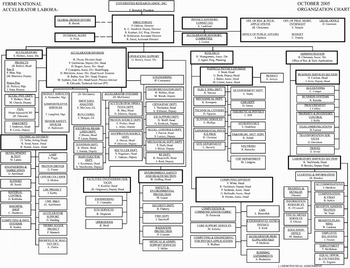
Big science emerged in the postwar United States, an amalgamation of a number of prewar trends smelted by the demands of World War II. The term itself is slippery. Bruce Hevly argues that a confluence of factors define big science: an increase in raw size and use of resources, concentration of research at a few elite institutions, proliferation of employees and specialized workforces, and the need to publicly justify its own value.Footnote 1 Characterized by vast research institutions with gigantic budgets spread across large swaths of land, big science swelled under the needs for—and funding from—military, corporate, educational, and government research. Nuclear research reactors, gene sequencing systems, and radio telescope arrays are three examples of big science, each requiring large numbers of scientists as well as constant funding, two of the defining characteristics of big science. A recent organizational diagram at the Fermi National Accelerator Laboratory (Fermilab) in Batavia, Illinois, a subatomic particle accelerator and jewel of American big science, reveals the multidisciplinary and multinational nature of big science. The chart lists astrophysics, cryogenics, medical support, educational services, and computing along with expected divisions such as experimental physics, the antiproton source department, and accounting.Footnote 2 Built at the height of big science between 1967 and 1972 at a cost of approximately 250 million dollars (not adjusted for inflation) and operating under a 316 million dollar budget in 2006, Fermilab ranks as one of the most costly institutions of American big science.Footnote 3 (See fig. 1.)
Organizational Chart of Fermi National Accelerator Laboratory. Used by permission of Fermi National Accelerator Laboratory.

Of course, one must resist the tendency to nostalgically imagine an earlier era of simple “small science.” Big science emerged from a hundred years of American academic, institutional, and professional scientific growth. The nineteenth century witnessed the transformation of American science and the laying of big science's groundwork. Throughout the eighteenth and early nineteenth centuries, scientists were often gentlemanly researchers, self-financed men (and they were almost always men) whose scientific interests ranged from biology to physics, following what historian Robert V. Bruce calls “small-scale, spare-time indulgence[s] of individual curiosity.”Footnote 4 The professional academic scientist largely replaced this earlier paradigm by the turn of the twentieth century, though scholars disagree on precisely when and how such a transformation occurred.Footnote 5 The research university served as the new nucleus of professional American science, and as it solidified this role during the postwar period, it represented the heightened institutionalization within big science. Until the late nineteenth century, American colleges followed the English model of liberal arts education, with a stress on classics, philosophy, and language. Yet both Britain and the United States lagged behind Continental science, and during the 1870s, university presidents pushed for changes intended to improve the state of American science vis-à-vis Europe. Johns Hopkins University first replicated the German university paradigm—namely a focus on research rather than teaching, and an emphasis on academic specialization in the United States—in 1876, and over the next decade, Yale, Harvard, and Princeton all followed suit, fashioning Ph.D. programs modeled on the German system of specialized research.Footnote 6 By the mid-twentieth century, nearly all of America's universities had done so. They became the natural home for the new breed of professional American scientists, and with them big science.
Simultaneously, the emergence of a trained class of people who treated science as a worldly vocation brought heightened professionalization to American science. The new breed of professional scientist derived their livelihood, rather than leisure, from the systematic study of nature, and this new class of scientists soon established societies, associations, and networks of likeminded individuals, effectively creating American scientific guilds. Central to the development of professional science, they also devised jargons, lexicons, methods, and theoretical paradigms for their fields, defining the bounds and content of conversation and debate. The exclusion of amateur scientists created and defined the new American science, transforming science from natural philosophy to an esoteric field of knowledge inaccessible to lay men and women.Footnote 7
Daniel Kleinman has argued that such an arrangement centralized knowledge production among a cadre of trained academic scientists, especially in the postwar period. Kleinman explains that “the university has progressively come to dominate the production and validation of knowledge—and even where there are opportunities for scientific employment outside the university, university employment retains uniquely high status in the area of knowledge production.”Footnote 8 Whereas government and corporate science eventually acquired similar prestige, Kleinman is correct that throughout the postwar period, academic scientists remain the professional elite. It is no coincidence that universities managed America's major postwar outposts of big science throughout that period, for example the University of California's Los Alamos National Laboratory and Lawrence Livermore National Laboratory; and the Oak Ridge, Brookhaven, and Fermi National Laboratories; the latter three of which are governed and operated by university-led consortiums.
World War I solidified the union between the ivory tower, emerging American big science, and government. It also reveals the increased government entanglements between big science and the U.S. government. Pragmatism dictated that what had worked so well before the war ought not be disturbed, and as government funneled wartime research money to science, professional university scientists at elite northeastern and California universities received the greatest windfall. In return the American university and professional scientists pioneered new explosives, poison gases, and submarine detectors (during World War I) and radar and nuclear weaponry (during World War II), all of which crucially assisted in defeating the Central and then Axis Powers. The “principle of elite scientist control,” as Kleinman calls it, solidified during the interwar period.Footnote 9 Despite President Franklin D. Roosevelt's New Deal programs, federal government support for science remained relatively small during the interwar period. What funding the government did make available fell unevenly, especially in the realms of agricultural and defense research. On the eve of American entrance into World War II, four universities, University of California, Harvard, the Massachusetts Institute of Technology, and Princeton, accounted for over a third of all 155 federal research contracts signed by the National Defense Research Committee. Only seven others out of the forty-one grantee institutes and universities even had five or more contracts.Footnote 10
All this indicates that World War II did not create big science, but rather encouraged a trend that had been well underway since at least the days of Andrew Jackson and Abraham Lincoln, and certainly those of Woodrow Wilson and Herbert Hoover. There is no denying, of course, that federal sponsorship and support of science spiraled up during and immediately after the war. Kleinman found that federal scientific spending rose by a factor of ten during the 1940s, with a predominant shift from funding agricultural research to defense spending. At the same time, the funding followed the same pattern as prewar research spending, with most of it going to major projects at elite universities.Footnote 11 As Derek J. de Solla Price argued in his seminal Little Science, Big Science, “the war looms as a huge milepost, but it stands at the side of a straight road of exponential growth.”Footnote 12
The Cold War resulted in a groundswell of public support for big science, with the advent of the Korean War (1950) and the launch of the Soviet satellite Sputnik (1957) as apogees. Even before the end of World War II, proponents of big science had sought to capitalize on that support. On July 5, 1945, a month and a day before the Enola Gay dropped its atomic bomb on Hiroshima, Dr. Vannevar Bush, head of the U.S. Office of Scientific Research and Development that oversaw the successful big science projects developing radar and nuclear weaponry, sent a proposal to President Harry S. Truman to create a permanent federal administration to support American peacetime science. His proposal both shaped and reflected a growing public support for science, particularly in both the progressive possibilities of science and the place of science in an America about to enter a dawning Cold War. Bush argued that government must provide long-term funds to a science foundation, ensure its independence from military and political pressures, and direct it to dispense large research grants to scientifically valuable basic research.Footnote 13 Congress took all these suggestions, establishing the National Science Foundation (NSF) in May 1950. The NSF became the permanent government-sponsored institutional home of American big science, supplemented by grants from other executive departments, most notably what became those of Energy, Defense, and Health and Human Services. By 1956 the federal government budgeted over three billion dollars to scientific research, most of which the Department of Defense controlled, but a growing amount administrated by the scientist-controlled NSF.Footnote 14 The Soviet launch of Sputnik—Earth's first artificial satellite—directly resulted in even more increased funds for scientific research, as historian Paul Dickson has documented. Its effects were “monumental,” in Dickson's words.Footnote 15 The American public widely saw Sputnik as a visible failure of the American scientific and educational system to keep up with the Soviets, and looked to science for help. President Eisenhower titled his speech series outlining a response to Sputnik his “Science and Security talks,” though they were widely known as his “chin-up talks.”
Bolstered by government money, big science continued to grow in the American postwar era. The expansion of the Stanford Linear Accelerator Center (SLAC) serves as a representative example. As SLAC's former director Wolfgang Panofsky wrote, “not a sudden transition to big science, but a step in an evolutionary pattern of growth,” the Standard Linear Accelerator Project demonstrates big science's fundamental characteristics: large numbers of people and amounts of money alongside an epic scale and growing influence and prestige.Footnote 16 Proposed in the year of Sputnik, 1957, and opened and operated by Stanford University almost a decade later with funds from the NSF and several other government agencies, the SLAC creates a beam of subatomic particles for use in physics research. Almost two miles long and running under an interstate highway, the SLAC is the largest linear accelerator ever built. Since the early 1970s, scientists at the accelerator have discovered three new subatomic particles, earning Nobel Prizes in the process, and even, as one of the original Advanced Research Project Administration (ARPA) grantees that created the internet, hosted the United States' first world wide web site. The proposal alone to create the SLAC required over a hundred employees and a million dollars in research funds and salary. Its construction cost one hundred million dollars, and at its completion employed over a thousand people. Dozens of collaborative research groups utilize the SLAC for experiments, requiring professional administrators and a time-share system.Footnote 17 SLAC, like much of American science, is big.
II. The Critique of Big Science
The very term “big science” originated in the self-critical appraisal of a big scientist, Dr. Alvin Weinberg, former head of the Oak Ridge National Laboratory, in Oak Ridge, Tennessee. Weinberg's critique of big science centered on its ramifications for science itself. According to Weinberg, big science reduced science's flexibility, turned scientists into managers, isolated and fragmented subfields, and disrupted the ability of scientists to communicate with each other.Footnote 18 Ironically, big science's demands infringed on the very academic freedoms that had incubated American academic science a century earlier. Other scientists, such as Stanford's Wolfgang Panofsky, questioned how individual scientists could pursue their own projects within the rubric and demands of big science, and fretted over the de-emphasis on teaching among academic big scientists.Footnote 19 Yet both Panofsky and Weinberg, along with other scientist-critics, accepted the need for big science and foresaw that it offered great benefits to the United States and its citizens. Panofsky asked rhetorically, “if certain answers crucial to man's understanding of nature can be obtained only by large effort, is that sufficient reason for not seeking such answers?”Footnote 20 As if responding to that very question, Weinberg declared, “society could hardly survive for many more generations without the fantastic developments that have come out of Big Science.”Footnote 21
Yet critics found other problems with big science, chief among them the elitism born of geographic concentration and a small cadre of academic scientists holding tremendous power. Geography physically revealed big science's elitism. By the early 1960s, institutions in nine states received about three quarters of all federal grant moneys, with universities, institutes, and individual scientists in California receiving about two fifths of all federal grants.Footnote 22 Among non-educational grantees the situation was similar. The high technology corridors surrounding San Jose, California, and Boston, Massachusetts, attracted top scientists from the elite institutions nearby, and subsequently received the vast majority of federal research and development contracts. Wisconsin Senator Gaylord Nelson, best remembered as one of the founders of Earth Day, questioned whether “creating [a] greater and greater imbalance” in the nation's scientific infrastructure was either fair or wise.Footnote 23 Leaders of other regions criticized the geographic concentrations while trying to duplicate them, for example the founders of North Carolina's Research Triangle Park.
The professional elitism of big science became a constant ground for critique by budget-cutting legislators, proponents of “small science,” and a wary public that was not consulted and could not understand the abstract terminology and concepts of big science. In a nation founded on Protestant and Jeffersonian traditions that extol the virtue of the individual and the common sense of a yeoman, the professional big scientist became a sort of despised but necessary clergy figure, as born out by Ralph E. Lapp's The New Priesthood: The Scientific Elite and the Uses of Power, a 1965 criticism of just such scientific elitism. “The danger is that a new priesthood of scientists may usurp the traditional roles of democratic decision-making,” declared Lapp.Footnote 24 A former director of the Department of Energy's Argonne National Laboratory and a Manhattan Project veteran, Lapp found that his critique echoed among non-scientists. Laypeople—note the latent religious language—could not understand the workings of the scientific guild that they funded, and neither could Congress as a whole. Only universal scientific education and willingness by non-scientists to direct and control big science would prevent science and technology from becoming “the Great Dictator of our times.”Footnote 25 Like a good Reformer, Lapp actually called for a priesthood of all believers, not the end of the priesthood of science. Science education and the encouraging of small-scale science represented the best chance to do this, he explained. As we shall see, critics of big religion made similar claims.
Despite criticisms of big science itself, few historians of science have criticized big science as a model. The most notable critique centers on the question of the notion of big science as a unique historical development. John Robert Christianson has argued that big science predated its postwar American development by over three centuries, and provides the example of the sixteenth-century Tycho Brahe (1546–1601) as exemplar of this earlier big science.Footnote 26 Though Tycho's work certainly reflects some of the characteristics of big science, namely its centralized knowledge production and entanglements with the Danish royal state, it lacked others, such as heightened professionalization and institutionalization. After Tycho died, his “big science” establishment died with him. As Mary Jo Nye has argued, there is little evidence in the physical science of what we mean by big science existing before the early twentieth century.Footnote 27 While scientists and non-scientists have criticized big science as a development, few historians doubt its value as a model.
Big science has never existed as a historical actor or actual institution, though both critics and proponents sometimes portrayed it as such. Its use is as a historical metaphor for a number of people, institutions, and social forces that remade American science during the postwar era. As such, it featured several defining characteristics: heightened institutionalization, heightened professionalization, centralized knowledge production, increased government entanglements, massive public support, and a tendency to inspire opposition from opponents who perceived these qualities as dangerous or immoral. Having considered the nature of big science, one can now turn to analogous developments in American religious history.
III. Big Religion
The term “big science” originated among scientists and remained primarily a category used within the scientific community. I find the concept of “big religion” a useful analog, though to my knowledge neither religious leaders, nor commentators, nor scholars have employed the term as such. To be clear, I employ big religion as a helpful concept and do not claim it as a historical actor or formal organization. Yet big religion was real. Just as big science loosely defined a set of locales, institutions, and organizations within science, big religion did the same for the postwar religious milieu. It shared the characteristics of big science (institutionalization, professionalization, centralization of knowledge, government entanglements, public support, and opposition). Like big science, big religion peaked during the postwar era, though it built on earlier foundations. The era witnessed booming churches and increased attendance at religious functions, alongside massive capital projects and church building campaigns. Religious figures such as Billy Graham and Normal Vincent Peale rose to great prominence, and so did religion more widely, as witnessed by the Cold War addition of “Under God” to the pledge of allegiance and “In God We Trust” to all American currency. The ecumenical and church-merger movements gained new appeal, while journalists, commentators, and public intellectuals noticed a “religious revival” and later an “evangelical resurgence” apparently unmatched since the days of Charles Grandison Finney. Finally, critics both inside and outside American big religion responded to big religion, assessing its impact on American religion and America more widely and critiquing it. Fundamentalists, members of new religious movements, and nondenominational Christians all rejected big religion in one form or another, though they often ended up replicating it in parallel institutions. The term “big religion” is useful because it brings all of these historical developments together under a single rubric: postwar revival, evangelical resurgence, the rise of the National Council of Churches, civil religion, positive thought, and the responses of neo-orthodoxy, new religious movements, and even fundamentalists all fall within the purview of big religion and its critics.
There are of course some elements of big science that do not carry over into big religion. Technological and scientific changes engendered big science, and while historical developments certainly influenced big religion, no analogous “quantum leap” necessitated its emergence. Likewise, the heightened professionalizing of big religion occurred primarily within religious bureaucracies such as crusades, councils, and parachurch movements, and not at the ground-level of ministers, priests, rabbis, and preachers, who had already professionalized during the preceding century. Yet the other characteristics of big science do appear in big religion, and while differences certainly exist, the model has more advantages than disadvantages. Similarly, not all postwar religious developments fit within the rubric of big religion or responses to it, but the model still has much to recommend it.
Historians and commentators on American religion in the immediate postwar period often fixate on the same characteristics of bigness that define big science. J. Ronald Oakley's God's Country: America in the Fifties is representative, including both quantitative and qualitative descriptions of postwar American big religion: “Year after year the statistics pointed to unprecedented increases in church membership, which grew from 86.8 million in 1950 to over 114 million in 1960. Each year saw record contributions to churches and other religious organizations, construction of new churches and synagogues and related religious buildings, record enrollments in college religion courses, overcrowding in religious seminaries, and growth in the prestige of clergymen.”Footnote 28 Oakley emphasized the sales figures of Bibles, the “popularity and influence” of religious personalities Billy Graham, Norman Vincent Peale, and Fulton Sheen, and of course President Dwight D. Eisenhower's very public personification of a broad yet friendly American Christianity, albeit one Oakley denigrates as “a fuzzy mixture of ill-defined feelings about God, Jesus, salvation, prayer, goodness and Americanism.”Footnote 29
Though it took many manifestations, two representative symbols reveal the character and nature of American postwar big religion. The first is the birth of an organization, the National Council of Churches (NCC), a sort of NSF of big religion. The second is the emergence and sudden popularity of the evangelical revivalist Billy Graham. One might add other symbols of American big religion as well, individuals such as Peale or Sheen, or events such as the enshrining of a national prayer, “In God We Trust,” as the American national motto and mantra of American currency. Yet the two representative examples—the birth of the NCC and Graham's revival crusades—reveal what I mean by “big religion” as well as demonstrate its rise in American postwar culture. Both reveal that heightened institutionalization lay at the heart of American big religion. In uniting the birth of two movements—Graham's evangelical crusade and the mainline institutionalization of the NCC—seldom understood as part of the same phenomenon, big religion helps historians understand the postwar developments of American religion. This is important, since historians seldom understand these two developments as somehow analogous, or part of a single historical pattern.
Much like the institutions of big science, the National Council of Churches grew out of prewar trends. Thirty-three Protestant denominations founded its immediate predecessor, the Federal Council of Churches (FCC) in 1908, which aimed to present a unified face of American Protestantism and support progressive social reform. Robert Schneider has argued that the FCC “functioned as an ‘established church.’. . . It embodied in a single institution the authority, interests, and activities of a religious establishment otherwise incorporated only in particular denominations.”Footnote 30 As Schneider demonstrates, in its statements and activities the Federal Council of Churches claimed for itself a role as guardian and steward of the nation's religious and moral identity, akin to the established churches of Europe and colonial America. In its early years, the council concentrated on broadly progressive concerns such as temperance and Christian education, but became increasingly focused on social gospel issues such as labor rights and worker conditions.Footnote 31 Yet individual denominational social and missionary projects as well as numerous interchurch organizations competed for funds and attention. Just before American entrance into World War II, leaders of the Federal Council and eight interdenominational agencies began discussing plans for a more centralized and unified body, with the initial face-to-face meeting inauspiciously falling on December 8, 1941, the day after the Japanese bombing of Pearl Harbor. They sought to create, in their own words, an “inclusive cooperative organization which will provide for the continued, expanded and more effective coordination and integration of our respective councils.”Footnote 32
The blueprint for America's biggest multi-denominational religious institution culminated between November 28 and December 1, 1950, with the constituting conference of the National Council of Christ in the United States of America (NCC) in Cleveland, Ohio. With twenty-five Protestant denominations, four Eastern Orthodox Patriarchies, and the backing of eight interdenominational agencies, which included the Federal Council of Churches, the new National Council of Churches claimed the allegiance of the denominations of over thirty-one million American Christians.Footnote 33 Its founders self-consciously understood themselves as creating a unified big institution, sometimes explained theologically and other times pragmatically. The closing sermon of its constituting conference offered an example of both justifications for the NCC's bigness. Methodist pastor and New York City divine Ralph Sockman opened his address with an explicit nod to the prophet of national unity, the martyred Abraham Lincoln, “Four score and seven years ago, a sad-faced but stout hearted Lincoln stood on the battlefield of Gettysburg and said: ‘Four score and seven years ago. . . .’” The chronological coincidence that 1950 fell 87 years after 1863, which fell 87 years after 1776 permitted this introduction, but Sockman employed it in order to laud the “spirit of unity” which both Lincoln's address during the Civil War and the National Council of Churches represented. Like Lincoln, the NCC envisioned itself as dedicated to holding America together. On a pragmatic level, Sockman explained, “more and more churchmen are coming to realize that unity within the church must lead the way if there is to be unity within the world.”Footnote 34 Yet as he continued his address, Sockman focused more on a theological rationale for big religion. The rhetorical climax of the speech fell in the third section of the oration when Sockman declared, “this Council represents more than a spirit of unity which we are trying to create. We are here to keep ‘the unity of the spirit’ which we have as an existing fact in the family of God. And the hopeful aspect is that more and more churchmen are coming to recognize this basic divine unity of the church.”Footnote 35 Theology could support bigness as well.
Both religious and secular commentators fixated on the size of the new National Council. Raw quantitative bigness was one mark. The mainline Christian Century headlined its November 22, 1950, issue with a story on the impending founding of the Council: “In Cleveland – The Churches!” The issue's first sentence trumpeted the “membership of more than 30 million souls” that would soon come together in union.Footnote 36 Three weeks later in its December 13 issue, the Christian Century published a chart that broke down Council membership by denomination and numbers of adherents. It concluded that a very precise 31,183,227 church members made up the constituent bodies of the new organization.Footnote 37 Secular news outlets focused even more on numerical size. In addition to the expected statistics of numbers of denominations and their members, Newsweek also described the Council's “100 man executive committee,” eight vice presidents, and 4.5 million dollars budget.Footnote 38Time opened its article on what it called “the new super-agency” by declaring, “when the work was completed, church leaders described it as ‘one of the most historical events in American Christianity.’ For four days last week 600 delegates and 3,000 observers had threaded their way to & from Cleveland's Public Auditorium . . . to found a new organization that will represent non-Roman Catholic Christianity as its has never been represented before in the U.S.”Footnote 39
Other publications highlighted numbers even more blatantly. Life dedicated a short nine sentence article to the Council's founding (tucked behind a mammoth twenty-three page “Christmas Fun in Color” section that bordered on an advertisement for the toy industry, perhaps hinting at editors' priorities). Half of the Life article's sentences contained at least one reference to the numerical size of the event, ranging from the number of denominations to the amount of delegates.Footnote 40 The Chicago Daily Tribune covered the merger with a more sizable one-column story, but a chart listing denominational membership numbers consumed a third of the space. The article's author, the Reverend John Evans of Chicago, included three paragraph headings, two of which merely indicated the NCC's size and complexity: “40 Boards Involved” and “9 Years of Planning.”Footnote 41 Other newspapers incorporated references to the Council's bigness in headlines themselves, for example the Los Angeles Times' “Churches' Council to Link Millions: Vast Religious Co-operative Group to Be Organized in Ohio Sessions.”Footnote 42 The pattern continued in subsequent coverage of the National Council of Churches. A 1952 Time cover story on the Council featured detailed description of the General Assembly, with its “600 lay and clerical delegates,” the 125-member General Board, and 20 units and divisions. The periodical explained that the “National Council reaches out to the grass roots through 875 city, county, and state councils, 1,720 councils of church women, and 2,000 local ministers associations. This is the base of the pyramid where the National Council will really affect Christian lives.”Footnote 43
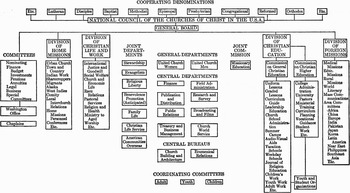
The magazine's extended description of the inner bureaucratic workings of the National Council of Churches hints at two other hallmarks of both big science and big religion that the Council embodied: heightened professionalization and the centralized production of knowledge—in this case, religious knowledge. Several media observers noted the professionalization of religion that the NCC represented. Newsweek described delegates hammering out the “endless details of setting up the vast machinery of the National Council,” which included, in addition to its four major divisions of Christian Education, Christian Life and Work, Home Missions, and Foreign Missions, “standing committees, departments, commissions and bureaus galore.”Footnote 44 Two separate stories in the December 13 issue of the Christian Century touched on the issue of heightened professionalization, and like the scientist-critics who witnessed the birth of big science, the Christian Century demonstrated an ambivalence toward the emergence of the premier institution of American big religion. The first, “Forward in the Dark Hours,” a reference to the midnight oil burnt by the Council's founders, sensed danger in the increased complexity, offering words of caution akin to those of Alvin Weinberg and Wolfgang Panofsky. “One danger everyone recognizes who watches the fitting together of so much ecclesiastical machinery as went into the making of the National Council of Churches is that the resulting organization may turn out to be nothing much but machinery—a Charlie Chaplin phantasmagoria of wheels and gears grinding away supposedly to the glory of God but actually to the employment of what [NCC planning committee acting chairman] Dr. Hermann N. Morse calls an army of ‘organizational mechanics.’”Footnote 45 An article later in the same issue, “What is the National Council?” amplifies, but then dismisses, those cautions. The story first detailed the general assembly, divisions, three kinds of departments (general, joint, and central), services bureaus, and the single joint commission (on missionary education) that make up the new Council, and noted a likely workforce of “between 800–1000 employees working in the church governance.” In a phrasing which itself embodies ambivalence, the Christian Century concluded, “this account of the way in which the machinery for united action has been fitted together may sound complicated and confusing, and it is complicated and confusing. But there is every reason to expect that, after the inevitable shakedown period, it will work, and work well.”Footnote 46 (See fig. 2: Organizational Chart of the N.C.C., especially in comparison to fig. 1.)
Organizational Chart of the National Council of Churches. Imagecopyright National Council of Churches. Used by permission.

The National Council of Churches not only reveals the increased levels of prestige that big religion both engendered and demanded, but how it centralized the prestige and authority of American religion. The Christian Century boasted in an article during the run-up to the Cleveland meeting that “it is expected that either the President of the United States or the secretary of state will speak,” though ultimately the outbreak of the Korean War prevented either appearance.Footnote 47 Another Christian Century article made what can only be called a presumptuous claim of historical importance, declaring that, “in convening to form the National Council of Churches of Christ in the U.S.A., [the delegates] are assembling to achieve an object more significant for Protestant Christianity than any one action taken since the passage of the Virginia Statute of Religious Freedom in 1785.” A Time editorial two years after the NCC's founding linked the new council to the fight against the “demonic” nature of denominationalism and Christian disunity. Invoking the memory of the Reformation, Time went so far as to declare the “U.S. Protestant Ideal” embodied in the National Council as the cure to secularism, which was “the weakness of Protestantism as sacerdotalism had been the Achilles' heel of Catholicism.”Footnote 48 In its role as an “informal national establishment,” in Robert Schneider's words, and embodied institution of American Protestantism and Eastern Orthodox Christianity, the NCC claimed a monopoly on religious programming on the nation's radio airwaves and issued periodic letters of pastoral guidance, what Time called “Protestant Encyclicals” to American Christians.Footnote 49 Like the Los Alamos big science veterans who published the progressive Bulletin of the Atomic Scientists, the big religionists of the NCC saw themselves as stewards of American morality and national policy.
What the National Council of Churches represented for mainline and liberal American Christians, and symbolized for institutional big religion, the revivals and crusades led by Billy Graham represented for evangelical and conservative Christians. The Reverend William Franklin Graham, known universally as Billy Graham, stormed into the American public in 1949. An accomplished preacher, his seven-week Los Angeles crusade captured the attention of media mogul William Hearst, and subsequently that of his readers of the many Hearst owned papers. Graham preached a moderate evangelical Christianity that emphasized the need for conversion and minimized theological wrangling. As the evangelist himself said, “my only specialty is soul-winning. I'm not a great philosopher, not a theologian, not an intellectual—God has given me the gift of winning souls.”Footnote 50 Raised a Presbyterian and ordained as a Southern Baptist, Graham did not concern himself with the specific variety of Protestantism espoused by those who “decided for Christ,” as he preferred to term it. Trained counselors referred converts to denominations of their choice, or failing that, the Graham organization matched converts to denominations by committee decision.Footnote 51
Yet, like the NCC or the NSF, Billy Graham's crusade depended on a complex bureaucracy, one that can only be called big, and one that reveals the heightened institutionalization and professionalization of the evangelical enterprise. Graham's vastly successful 1954 London crusade required a staff of thirty employees, plus at least three thousand volunteers, roughly divided between choristers, ushers, and one-on-one spiritual counselors.Footnote 52 Meanwhile a Minneapolis-based fulltime staff of one hundred people, equipped with state of the art office electronics, oversaw the crusade from the headquarters of Billy Graham Evangelical Association. As Time magazine described, “here, amid whirring office machines, the spirit of I.B.M. meets the Spirit.”Footnote 53 The 1957 New York crusade required additional on-site personal, sixty-five paid employees and two hundred volunteer clerical workers housed in a leased seven-room suite in Times Square.Footnote 54 Much like the birth of big science, Graham's evangelical crusades differed from their predecessors in degree, not nature. As historian William McLoughlin noted in a highly critical 1957 article, which despite its venom fairly straight forwardly assesses Graham's organization, revivalists from Charles Finney to Billy Sunday utilized similar methods of preparing for and operating revivals.Footnote 55 The Billy Graham Evangelical Association merely did more. Because Graham believed that “a true conversion . . . must involve not only the emotions, but the mind,” his organization retained satellite offices in crusade locations for up to a year after the conclusion of the revivals, periodically checking up on the progress of those who made decisions for Christ during the evangelist's visit.Footnote 56
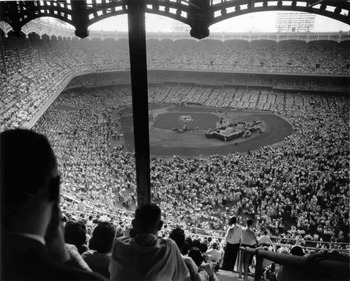
Much like their articles on the National Council of Churches, in their treatments of Billy Graham's activities the secular media sources emphasized bigness in various scopes: numerical size, complexity of organization, prestige, and access to places and people of power. One of the earliest publications on Graham in a mainstream American publication, Newsweek's May 1950 story, “Billy and His Beacon,” highlighted the numbers of people at Graham's crusades. The first half of the article utilized numbers as a central motif: nine thousand attended the opening of his recent Boston crusade, fifteen thousand came a week later, “chalking up 3,000 repentant New England sinners.” In Los Angeles he attracted “more than 300,000 people—6,000 of whom made their way weeping and happy down the aisles of the tent to declare themselves for Christ.” He “climaxed a visit to South Carolina by packing 40,000 people into the football stadium at Columbia,” and managed 12,000 conversions. Readers could be excused for thinking that Newsweek might have been keeping a scorecard.Footnote 57 Seven years later, after published an almost-yearly update on Graham's conversion statistics, the same magazine opened a “Special Religion Report” on Graham by emphasizing another aspect of big religion, public prestige. The article began, “on his way from North Carolina to New York, Billy Graham made a brief stop at the White House last week. It was ‘just a friendly visit,’ said Billy. He and President Eisenhower talked about ‘the need of a spiritual awakening in the United States,’ and the President wished him well.”Footnote 58 The juxtaposition of the first-name reference to Graham with the description of him visiting with the President of the United States conveyed a sense of familiarity between the evangelist and Eisenhower, implying the prestige in which the media as public gatekeeper held Billy Graham. (See fig. 3, a news photograph that shows how the press emphasized the bigness of Graham's crusade.)
Billy Graham Crusade, July 20, 1957, Yankee Stadium. Image copyright Billy Graham Evangelical Association, and held at Billy Graham Center Archives of Wheaton College. Used by permission.

Time magazine even more explicitly emphasized the bigness of Graham's crusade. Its May 31, 1954, issue literally sandwiched a short appraisal of Graham's London crusade between a story on the canonization of Pope Pius X and a numbers-laden recap of the planned merger of three Presbyterian Churches into the Presbyterian Church, USA.Footnote 59 The article's title captured the tenor of the piece: “34,586 Decisions.” Opening with a brief quote from Graham and a description of the blustery London weather, Time declared, “at London's White City Stadium 67,000 came to hear him, and at Wembley, a few hours later, about 120,000 turned out—more than had come there to the 1948 Olympic games. When Evangelist Graham called on them to step forward and ‘receive Christ as your Lord and Master and Saviour,’ 2,038 surged out of their seats at White City and 2,022 at Wembley, making the day's total of 4,060 ‘decisions.’ During his British campaign, 1,761,000* had come to hear him (many of them repeaters) and 34,586 had been stirred to come forward and give their names for later follow-up sessions with their own ministers.” Readers who followed the asterisk to the footer found a further explanation: “Not counting some 112,000 who have heard Graham speak at special meetings, or an estimated 500,000 throughout Britain who have listened to him over leased telephone lines in their own churches and town halls.” The article made no mention of what Graham preached and included no excerpts from the evangelist, though it did quote a British tabloid writer who gushed about the supposedly atheistic British public's love for the famous American revivalist.Footnote 60 The content of Graham's religion did not concern the magazine: with the exception of the single mention of receiving Christ, the article might as well have been describing the preaching tour of a Hindu Sanyassi, Chasidic Rebbe, or Muslim Imam. For Time, numbers and bigness mattered most. Subsequent articles in the magazine described the size of Graham's organization, the number of assistants he employed and the office equipment they utilized, the numbers of stations broadcasting his syndicated radio program, and the projected audience of those programs based on radio ratings systems.Footnote 61
Like big science, big religion owed much of its vibrancy to the Cold War and American anticommunism. Robert Ellwood referred to the aspect of postwar American religion that envisioned itself as battling communism as “Americanism,” which he likened to “a kind of state church.” At its heart, Americanism hoped for an American big religion to compete with the menace of Soviet communism. “The ideal America was unified spiritually, a righteous and God-fearing nation, giving expression to belief in God with one voice and concurring that in this cohesion would be powerful [sic]; those few who broke unanimity must be expelled like witches, for the good of the community as a whole,” explained Ellwood.Footnote 62 Certainly the rise of the NCC and Billy Graham reflect this trend, and the public support for big religion, both in terms of its progressive possibilities for America as well as its value during the Cold War. The constituting conference of the National Council of Churches fell during the opening days of the widening conflict in Korea, and according to a news reporter in attendance, “the delegates talked more about the atom bomb than the setting up of divisions and departments.”Footnote 63 Just two days into its life, NCC vice president Harold Stassen publicly demanded that the Chinese delegation to the United Nations be “promptly expelled” and deported, and that the United States “encourage the millions of freedom-loving Chinese in their efforts by counter-revolution to throw off the oppressive Communist dictatorship.”Footnote 64 Proponents and detractors alike of Graham pointed to his concern with communism and frequent pronouncements against it.Footnote 65 Anecdotes of communists deciding for Christ and thereby becoming good free market capitalists appeared as a trope in media coverage of Graham.Footnote 66
Scholars differ on whether anti-communist realism or American piety lay behind the movement to support what I call a big religion in America as a competing force to Soviet communism. Dianne Kirby, for example, editor of Religion and the Cold War, argued that “Christianity was appropriated by Western propagandists and policy-makers for their anti-communist arsenal.”Footnote 67 Martin E. Marty assumed a more moderate view that “liberals as well as conservatives, Democrats as well as Republicans, knew the need to address the Cold War spiritual contrast.”Footnote 68 Historian James Hudnut-Beumler, by contrast, saw the exertion rooted in the religious groups themselves, particularly the Protestant tradition of stewardship, preferring to generalize that “America's religious communities were deeply involved in the political thought and activity of the day.”Footnote 69 Certainly many religious leaders perceived communism as a threat. For example, Bishop Fulton Sheen, of whom Ellwood declared “can be thought of preeminently as a spokesperson for a Catholic version of the ‘American Way of Life,’” thundered against communism in his weekly television show, calling it “evil” and warning of communist infiltration and subterfuge.Footnote 70 Sheen mirrored similar pronouncements by Jewish and Protestant leaders as well.
Likewise, politicians and civil servants looked to religion as a defense against Communist encroachment, with Presidents Truman and Eisenhower as representative examples. This—in addition to the efforts to introduce religious statements onto the nation's currency and into its Pledge of Allegiance—reveals the increased government entanglements of big religion during this era. The nation's first postwar president, Harry S. Truman explicitly linked American religion and the fight against communism, declaring that America must fight communism so as to “preserve a world civilization in which man's belief in God can survive.”Footnote 71 Truman reached out to Roman Catholics and Jews in order to craft a big religion alliance against communism, an action for which some Protestants criticized him. Dianne Kirby in fact read Truman's explicit call for holy war against communism as an intentional “ideological crusade . . . that united American people and inhibited dissent.”Footnote 72 (Martin E. Marty more charitably saw Truman as “assum[ing] a priestly role, with the presidency serving as the pulpit for the nation's public religion.”Footnote 73) Truman's successor, Dwight D. Eisenhower, even more explicitly pushed for an American big religion. Setting the tone in his inaugural address, Eisenhower declared that the inauguration
expresses a purpose of strengthening our dedication and devotion to the precepts of our founding documents, a conscious renewal of faith in our country and in the watchfulness of a Divine Providence. The enemies of this faith know no god but force, no devotion but its use. . . . Here, then, is joined no argument between slightly differing philosophies. This conflict strikes directly at the faith of our fathers and the lives of our sons. No principle or treasure that we hold, from the spiritual knowledge of our free schools and churches to the creative magic of free labor and capital, nothing lies safely beyond the reach of this struggle.Footnote 74
While in office, Eisenhower frequently discussed the place of religion in American life in opposition to the godless faith of communism.Footnote 75
Like big science, big religion owed much of its vibrancy during the 1950s and 1960s to this anticommunism, and it is one of the more clear examples of parallels between the two. While big religion certainly could have existed without the communist threat, communism galvanized the American political establishment as well as social support. The same is true of big science, a fact most clearly demonstrated by the public reaction to Sputnik and the subsequent creation of the Advanced Research Project Administration (ARPA) and increase in funding to the NSF. In that regard, the addition of “Under God” to the Pledge of Allegiance and Eisenhower's invocations of religion can be read as an analog to the birth ARPA and the resurgence of NSF, two integral components of big science. Similarly, while Graham and Peele served as high priests of American big religion—or President Truman as a sort of lay pastor, to follow Martin E. Marty—scientists such as Einstein and Weinberg did the same for big science.
In a parallel manner, the latent tension between a functional priesthood and the Jeffersonian/Protestant model of a scientific and religious priesthood of all Americans resulted in critiques of big religion and science. Some scientists and non-scientists questioned the hegemony of big science as well as the resources it demanded. Some religious and non-religious Americans criticized the massive institutions of big religion, both crusades and councils, and sought a smaller-scale model. However, while scientists were unable to create a viable alternative, critics of big religion successfully molded new small-scale institutions such as non-denominational churches, Christian house churches and communes, new religious movements, and the Jewish chavurah (house-synagogue) movement. Ironically, many of those same small-scale institutions eventually became massive organizations themselves. The emergence of Calvary Chapel in 1965 as a church for countercultural and anti-establishment Christians seeking an alternative to big religion—and its subsequent transformation into a global denomination—serves as a model example, as do many other “nondenominational” Christian groups.Footnote 76
Unlike big science, the people who worked within big religion did not have a term for what surrounded them, and they tended to not critique it as a whole. Rather, critics questioned individual components of big religion, often those parts that disagreed with their personal theological commitments. Hence, fundamentalist Christian groups critiqued the National Council of Churches as too liberal, while the Unitarian Universalist Society rejected it as too conservative. Similarly, neo-orthodox theologian Reinhold Niebuhr engaged in extensive criticism of Billy Graham's failure to promote a socially oriented gospel, challenging him to at the very least publicly support racial integration and reconciliation.Footnote 77 Some commentators did highlight the problem of bigness, such as an unsigned Christian Century editorial calling for the need of Christians to question whether the “bigness” of Graham's crusades truly followed Christian practice, complaining that such mechanics might eclipse the more personal, small-scale, and quiet work of the Holy Spirit.Footnote 78 Many nondenominational Christian institutions, such as the aforementioned Calvary Chapel, or the Vineyard Christian Fellowship, began as reactions to the perceived coldness, bureaucracy, formalism, or quasi-established nature of American big religion. Today's “spiritual but not religious” Americans have the same critique.
Intellectuals certainly critiqued aspects of big religion, though not the whole. The scholar whose work gave form to the “American Way of Life,” Will Herberg, represented such a position, blasting it as “incurably idolatrous,” since such a way of life tends to venerate the nation-state itself. Herberg declared, “civic religion has always meant the sanctification of the society and culture of which it is the reflection.” It was a “spiritual reinforcement of national self-righteousness and spiritual authentication of national self-will.”Footnote 79 Even in its expressed form as Protestantism, Catholicism, or Judaism, Herberg rejected big American religion as “blunt,” with the uniqueness of each tradition subservient to the “American culture-religion.”Footnote 80 Despite Americans' self-declared religiosity, he complained, they failed to live up to the prophetic call of their own traditions. Robert Bellah's The Broken Covenant (1975), often described as a jeremiad against the worst parts of American civil religion, also provides an example of such critiques. Its own author described the book as “the voice of a prophet crying in the wilderness, alternatively denouncing and lamenting for his people.”Footnote 81 Yet Bellah concerns himself far more with the collective moral bankruptcy and individualism of Americans rather than big religion, or even civil religion, itself. Rather, Bellah targeted the “religious groups so privatistic and self-centered” that they had absconded from collective social responsibility.Footnote 82 Atheists certainly found plenty to critique in big religion, but their theological position outside of any religious commitments limited their ability to speak to a wide audience, to say nothing of the stigma of atheism during the Cold War. The adherents of new religious movements similarly rejected the notion of American big religion, joining the myriad of cults and sects which served as a vanguard of American “small religion.” Yet such critiques did not represent a large constituency. Especially early in the postwar period, the equation between American religiosity, the bigness of American religion, and anti-communism exerted such power that few Americans seemed willing to publicly critique big religion. Politicians certainly saw no reason to criticize what citizens considered as American as mom and apple pie. Likewise, the large denominations and churches stood little to gain by re-evaluating the phenomena that gave rise to their own prominence and size.
IV. Big Religion and Historiography
The notion of big religion solves a historiographic quandary: how to explain a number of apparently unrelated forces at work in postwar American religion. As an example, consider the topics covered in Edwin Gaustad and Leigh Schmidt's The Religious History of America, one of the most commonly used textbooks on American religion. Under the rubric of “religious transformations from World War II to the New Millennium,” they include Protestant, Catholic, and Jewish revivals, Billy Graham and his entanglements with Richard Nixon, shifts in religious architecture, the Catholicism of John Fitzgerald Kennedy, legal disputes over the limits of religious establishment and freedoms, church mergers, new religious movements, and religion in the public square.Footnote 83 While Gaustad and Schmidt treat these topics as separate developments, big religion unites them. A similar pattern repeats in other textbooks, and while the monographic literature cannot be expected to assume such a wide scope as the textbooks, the concept of big religion is still helpful to tighter studies. Though not quite a metanarrative in the sense of Sydney Ahlstrom's rise and fall of the Puritan empire or Martin E. Marty's encounter with modernism, big religion is a useful pattern that allows historians to fit together multiple historical developments. As such, it is useful for both scholarship and the classroom.
The National Council of Churches and Billy Graham embodied the rise of American big religion, but one might provide additional examples from the postwar period. The Roman Catholic Bishop Fulton J. Sheen, for example, whom Ronald Oakley describes as America's “first clergyman to become a television star,” had audience numbers that dwarfed Graham's (about ten million people), in part because his broadly ecumenical program pulled in Jewish and Protestant viewers as well as Catholics.Footnote 84 Yet it was a Jewish social critic and self-declared sociologist who did the most to both define and appraise much of what I call big religion. Akin to federal big scientist Ralph Lapp's critique of big science, The New Priesthood, Will Herberg's Protestant, Catholic, Jew (1955) illuminated and criticized big religion. Hailed by the author's friend Reinhold Niebuhr as “the most fascinating essay” on American religion in decades, the book's sphere of influence reached theologians, sociologists, historians, and laypeople—even the poet T. S. Eliot called Protestant, Catholic, Jew an “outstanding work” and introduced it to his interfaith dining club.Footnote 85 The book began with an obvious reference to big religion, opening with Herberg's question of why, amidst a “notable ‘turn to religion,’” “America seems to be at once the most religious and most secular of nations.”Footnote 86 America was religious, Herberg explained, if one looks at surveys and church membership statistics, yet simultaneously secular because Americans exhibited little knowledge of their religions and excluded it from many of their important life decisions, particularly their financial and business choices.
Herberg correctly recognized an increase in American religiosity, at least when measured in terms of self-identification, attendance at religious worship, and capital expenditures for church and synagogue building. In other words, American religion was getting big by all the quantitative measures. Church membership statistics showed a steady increase in the number of Americans belonging to church or synagogues, from 43 percent in 1920, to 47 percent in 1930, to 49 percent in 1940. The conclusion of the war heightened this already present trend, with church membership jumping to 57 percent in 1950, and 63 percent by 1958, just before Herberg released the second edition of Protestant, Catholic, Jew.Footnote 87 Sunday School enrollment meanwhile increased faster than the birthrate, hovering between a 7 and 8 percent increase every two years from 1949 to 1958.Footnote 88 Additionally, Herberg found that “virtually all surveys indicate also a very considerable expansion in church construction in the course of the past decade, particularly in the suburbs of the big cities. The value of new ‘religious buildings’ jumped from $76,000,000 in 1946, to $409,000,000 in 1950, to $868,000,000 in 1957.”Footnote 89 Finally, Herberg declared that the “enhanced standing of churches and religion among the American people is strikingly indicated by the enhanced status of religious leaders” and the “new intellectual prestige of religion on all levels of cultural life.”Footnote 90 Big numbers of people, big money, big prestige, and big scale: although Herberg never used the term, he described the rise of American big religion.
Yet Herberg's relevance for the study of American big religion especially lies in his description and critique of the big religion of 1950s America, what he called the American Way of Life. “The American Way of Life is, at bottom, a spiritual structure, a structure of ideas and ideals, of aspirations and values, of beliefs and standards; it synthesizes all that commends itself to the American as the right, the good, and the true in actual life.”Footnote 91 Defined by belief in individualism, pragmatism, self-reliance, optimism, progress, education, moralism, and of course the ideals of democracy and American exceptionalism, Herberg saw the American Way of Life as the “over-all American religion” of which Protestantism, Catholicism, and Judaism were but “expressions.”Footnote 92 Or, as Martin E. Marty explained, “Herberg contended that a single American-Way-of-Life religion prevailed, but that Americans attached themselves to it or ‘prismed’ it through at least three large basic faith communities.”Footnote 93 Like big science, Herberg's American Way of Life had outposts, manifestations, spokespeople, and symbols. Most obviously, the three major religious communities' mainstreams expressed the American Way of Life, as did the interfaith movement. President Dwight D. Eisenhower served as high prophet, to the extent that Herberg even created what one scholar called “a civil-religion proof text” by mangling and decontextualizing an actual Eisenhower quote on the nature of democracies as founded on diverse religious ethics. From Eisenhower's rather innocuous statement that “our form of government has no sense unless it is founded in a deeply felt religious faith, and I don't care what it is. With us of course it is the Judeo-Christian concept, but it must be a religion that all men are created equal,” Herberg repackaged the President's words as emblematic of American religious relativism: “our government makes no sense unless it is founded on a deeply felt religious faith—and I don't care what it is.” (Herberg's emphasis.)Footnote 94
In Looking for God in the Suburbs, his study of religion in the American postwar period, James Hudnut-Beumler explained that “despite all the criticisms leveled at the book, Herberg's description of the state of religion in America proved generally satisfactory to a generation of readers.”Footnote 95 One reason is because Herberg was fundamentally correct in his basic observation: the 1940s and 1950s witnessed a revival of religion that shaped the religious world of Americans well into the twenty-first century. The revival has been well chronicled elsewhere—namely Hudnut-Beumler's aforementioned Looking for God in the Suburbs, and Robert S. Ellwood's The Fifties Spiritual Marketplace. Both agree with Herberg that the American turn to religion in the postwar period reflected the need for social identity, especially in the growing suburban communities. Both also described a religious milieu that can only be called “big religion.”
Subtitling his book, The Religion of the American Dream and Its Critics, 1945–1965, James Hudnut-Beumler traced the boom in postwar religion to the nexus of meanings that suburban churches and synagogues offered their congregants. “For the popular religionist, God, Country, church, Bible reading, the free market, human dignity, and the virtues of neighborliness and niceness formed a seamless web of belief and practice—and the churches and synagogues of the 1950s to a large degree reflected this definition of religion.” Functionally, religion dispelled the “lonely and insecure feelings” that suburban life engendered.Footnote 96 Writing as a historian, Hudnut-Beumler found the same pattern of religious expansion that Herberg described forty years earlier: new churches, Sunday schools, and of course increased attendance. Like Herberg, Hudnut-Beumler emphasized the quantitative bigness of postwar American religion: “the 1950s witnessed the greatest church-building boom in American history, in which three billion dollars was spent on new church construction from the end of the war through the summer of 1955 . . . for a wide range of denominations, the 1950s were a time of increasing financial commitment to churches.”Footnote 97
Robert Ellwood even more explicitly links postwar religion to bigness, rooting the surge of American religiosity in the bigness of American religion itself. Employing the popular market paradigm for the sociological study of religion, Ellwood wrote, “the religious boom of the 1950s, it seems to me, can be understood first of all as a supply-side phenomenon. . . . [It is] certainly related to another reason for postwar religious booms—a booming birthrate.”Footnote 98 Religion became big for two reasons, explained Ellwood. First, the American population rose, with the inevitable result that more people became involved in religion. Second, individuals joined religious communities because there were a proliferation of religious options, that is, a large supply, as demonstrated by the hundreds of books on religion pouring out of religious and secular publishing houses, the thousands of new churches and synagogues, and public presentations by intellectuals and preachers of every theological stripe. With options for any religious taste, ranging from high to low commitment, intellectual to popular, and of course an array of denominational options, “each level had its own market, and the supply-side overall result was religion for almost everyone.”Footnote 99 Extending the economic metaphor, religious suppliers had saturated the market. Martin E. Marty phrased it somewhat more pessimistically: “As standards for church membership went down, membership rose,” yet his complaint reveals the underlying truth that low demand churches proliferated alongside the many other options.Footnote 100
Robert Bellah termed a similar sort of American religion, “American civil religion.” Big religion relates to but does not equate with American civil religion. Whereas the former encompassed religion in both its denominational and super-denominational senses, civil religion refers to, in Bellah's words, “a set of beliefs, symbols, and rituals” that exist outside Protestantism, Catholicism, and Judaism, yet nevertheless served as “common elements of religious orientation that the great majority of Americans share.”Footnote 101 Like any other religion, American civil religion possessed a ritual calendar (Memorial Day, President's Day), sacred spaces (monuments, national cemeteries), and prophets (Jefferson, Lincoln, Kennedy). Here I disagree with Bellah's assessment that Herberg and other “religious critics of ‘religion in general’ . . . or of the ‘American Way of Life’ . . . have really been talking about the civil religion.”Footnote 102 Herberg explicitly argued that the “American Way of Life” functioned as an “over-all American religion” but existed within the triumvirate of Protestant-Catholic-Jew.Footnote 103 Bellah's civil religion exists outside those groups.
The concept of big religion helps explain the historiographic quandary of how to relate Bellah's civil religion, Herberg's American Way of Life, and Ellwood's Americanism. As the complex of large numbers of people, money, prestige, and scale that characterized American religion in the postwar era, big religion included the individuals, churches, and institutions that circumscribed Herberg's American Way of Life, which themselves embody the theological tenets of that way of life, values such as pragmatism, moralism, optimism, and belief in the fundamental rightness of the American nation-state. Big religion certainly also included the more explicitly religious elements of Bellah's civil religion, the public pronouncements of God's providence favoring America, or the incorporation of “Under God” into the pledge of allegiance. Both reflected the preeminent place of religion in American life, the prestige as well as scope of postwar big religion. Even more importantly, big religion allows scholars to understand the rise of revivalism alongside mainline resurgence as of the same phenomenon. Billy Graham and the National Council of Churches—as well as positive thinking, public piety, civil religion, and evangelicalism—all serve as constituents of American big religion.
In the end, American big religion represents the specific historical context in which it developed. Like big science, big religion reveals the institutionalization, professionalization, and centralization of increasing segments of American society during the postwar period, as well as the increased government entanglements that came with them. Like big science, big religion thrived under the growing public support engendered by the Cold War, but it also inspired opposition and discord. Though a novel historiographic idea, I believe that the notion of “big religion” offers useful traction for understanding the diversity of American religious developments during the postwar period.