The cardiovascular reactivity hypothesis states that individuals showing exaggerated cardiovascular responses to stress are at higher risk of developing cardiovascular disease (CVD; Carroll et al., Reference Carroll, Ginty, Painter, Roseboom, Phillips and de Rooij2012; Carroll, Phillips, Der, Hunt, & Benzeval, Reference Carroll, Phillips, Der, Hunt and Benzeval2011; Chida & Steptoe, 2011; Flaa, Eide, Kjeldsen, & Rostrup, Reference Flaa, Eide, Kjeldsen and Rostrup2008). Further, most prospective studies have used simple measures, namely heart rate (HR) and blood pressure (BP), to index cardiovascular reactivity. However, a comprehensive assessment of cardiovascular functions such as cardiac output (CO) and total peripheral resistance (TPR) affords distinction of hemodynamic patterning of responses to active and passive coping tasks. Yet, the utility of hemodynamic reactions to predict future CVD (e.g., increases BP) has been examined in few prospective cohort studies. To date, only a few studies have applied these parameters as predictors of future BP, preclinical CHD and essential hypertension. According to Obrist (Reference Obrist1976), active coping tasks are psychological stressors that demand attention and vigilance or mental effort but require little physical effort or physical activity. Therefore, active coping tasks comprise cognitive tasks, stress interview tasks and public speaking tasks. Further, cardiovascular responses to active coping tasks are primarily beta-adrenergically mediated, whereas cardiovascular responses to passive coping tasks are primarily alpha-adrenergically mediated. That is, active coping tasks would be expected to result in an increase in CO and cardiac contractility whereas passive copings would be expected to result in an increase in TPR. However, there are few prospective studies that have examined the predictive utility of cardiovascular responses to different types of coping tasks (i.e., active and passive coping tasks) within the same study to predict future BP (Flaa et al., Reference Flaa, Eide, Kjeldsen and Rostrup2008; Girdler et al., Reference Girdler, Hinderliter, Brownley, Turner, Sherwood and Light1996; Markovitz, Raczynski, Wallace, Chettur, & Chesney, Reference Markovitz, Raczynski, Wallace, Chettur and Chesney1998). Moreover, results of these studies are quite inconsistent and very few prospective cohort studies have used hemodynamic reactions to predict future BP.
Further, earlier prospective cohort studies examined cardiovascular responses to a single task as a predictor of future cardiovascular risk status. However, aggregation of cardiovascular responses across multiple tasks should improve reliability and generalizability, as a more diverse range of situations are sampled (Schwartz et al., Reference Schwartz, Gerin, Davidson, Pickering, Brosschot, Thayer and Linden2003). Indeed, sseveral studies have found that aggregated responsivity across different tasks is more reliable and valid than reactivity scores from a single task (Kamarck, Debski, & Manuck, Reference Kamarck, Debski and Manuck2000). Therefore, aggregation of scores across multiple tasks and sessions allow greater generalisability and improves the reliability of reactivity assessment compared to single task measures and led to an increase in the laboratory–to–life generalizability. Furthermore, Treiber et al. (Reference Treiber, Kamarck, Schneiderman, Sheffield, Kapuku and Taylor2003) suggested that aggregated cardiovascular responses to multiple tasks might be more strongly associated with the prediction of development of hypertension than cardiovascular responses to single tasks. Given the small number of studies that have used multiple stressors, the current study examined the use of aggregated measure of cardiovascular responsivity to predict future BP. To our knowledge, this is the first study to explore the contributions of a range of hemodynamic responses (SBP, DBP, HR, CO, and TPR) to both active and passive coping tasks, and to compare responses to single and multiple tasks in the prediction of future resting BP in normotensive male and female participants. The objective of the study was to examine whether cardiovascular reactivity predicted changes in resting BP over a ten-month period, after controlling for baseline cardiovascular activity and traditional risk factors in active and passive coping tasks, and in single and multiple tasks. We sought to test the hypotheses that: (1) hemodynamic reactions to active and passive coping tasks will predict future BP; and (2) aggregated hemodynamic responsivity to multiple tasks will afford a better prediction of future BP ten-months later than hemodynamic reactions to single tasks.
Methods
Participants
The participants ranged in age between 18 and 65 years with mixed-ethnic (e.g., White, Asian, and Black) and included male and female adults. All the participants provided written informed consent for participation in the study and had no known history of: CVD or surgery, neurological disorder, stroke or symptomatic cerebral ischemia, chronic renal failure or liver disease and/or a diagnosed psychiatric problem. Participants who had a current fever or high temperature prior to or during the experimental test were also excluded from the current study, as were participants who were currently pregnant or reported having a history of any circulatory disorder including Raynaud’s Disease.
Psychological stress test
After a 15-minute rest period, participants were asked to complete a series of three mental tasks (i.e., mental arithmetic, speech, and cold pressor) that were randomized and counterbalanced to avoid any upward drift in cardiovascular activity. The study focused on active or passive coping tasks. As described by Obrist et al. (Reference Obrist1976), active coping tasks are defined as those where a participant copes with the situation through mental performance and primarily elicit cardiac responses. In contrast, passive coping tasks are defined as those where an individual has no control over the situation outcomes or no ability to control the situation and primarily elicit vascular responses. Therefore, mental arithmetic tasks and speech tasks were classified as active coping tasks and the cold pressor task was classified as a passive coping tasks.
The Mental Arithmetic Task
Here, a five minute, serial subtraction task was used. Participants were requested to subtract the number “13” iteratively starting from “1079” as quickly and accurately as possible while mistakes were corrected by the experimenter. During this task, a metronome was set at a frequency of 2Hz to elicit time pressure. In addition, performance scores (the number of correct responses) were recorded; participants were aware this was the case.
The Speech Task
This was composed of two major parts: two minutes of speech preparation, which manipulates the role of cognitive preparation in speech production by providing participants with the opportunity to think about what they would say, and three minutes of speech delivery. Participants were given instructions to read and prepare a speech about a salesman who refused to honor an advertised sale price. A video camera was set up to record during the task; participants looked at the camera and talked continuously during the speech.
The cold pressor task
Participants were required to immerse their right hand in a cold pressor tank with water circulated at 7°C. The participants were instructed to try to hold their hand in the cold water for as long as possible for two minutes.
Performance and perception of task
It is already known that the performance on the acute laboratory tasks might be associated with increased hemodynamic response patterns (Garcia-Leon, Paso, Robles, & Vila, Reference Garcia-Leon, Reyes del Paso, Robles and Vila2003; Richter & Gendolla, Reference Richter and Gendolla2006). Those studies reported that effect of task difficulty or perception of task difficulty was associated with heightened cardiovascular response during performance of the task. Therefore, measures of performance on the mental arithemtic task and self-reported percieved stress in each task were included.
For the mental arithmetic task, performance was assessed by recording the number of correct responses. For the cold pressor task, pain tolerance was assessed by using a stopwatch to record the total duration of hand immersion in the cold water tank. In addition, immediately after all tasks were completed, participants were asked to rate percieved stress for each task on an 11-point Likert scale with zero corresponding to “not stressful” and 10 corresponding to “very stressful”.
Procedure
Prior to arrival, participants were requested to refrain from drinking alcohol, caffeine or smoking for two hours prior to the session. Upon arrival at the laboratory, and following informed written consent, a set of questionnaires were presented to the participants including parental history of cardiovascular status. The study defined a positive family history of CVD as myocardial infarction, coronary revascularization, or sudden death before 55 years of age in father or other male first-degree relative, or before 65 years of age in mother or other female first-degree relative, or essential hypertension in one or both biological parents or siblings (Lloyd-Jones et al., Reference Lloyd-Jones, Nam, D’Agostino, Levy, Murabito, Wang and O’Donnell2004; Treiber, Turner, Davis, & Strong, Reference Treiber, Turner, Davis and Strong1997). The individuals were then measured for weight and height and BMI was calculated. Partipants were seated upright in a comfortable chair with back and arm supports. Two non-invasive BP monitors were connected to the participants: a Portapres continuous BP (Portapres®; TNO-TPD, Finapres Medical Systems, Biomedical Instrumentation, Amsterdam, the Netherlands) and an automated BP at right upper arm which is the Omron® M6 Comfort BP monitor (HEM-7211; Omron Healthcare B.V., Kruisweg, Hoofddorp, The Netherlands). The Portapres continous BP monitor assesses BP and hemodynamic indices on a beat-to-beat basis from the finger. The device is also a continuously monitor that provides a clearer understanding how mental stress affects the cardiovascular system. Accuracy and precision of changes in BP as measured with the Finapres have been shown sufficiently reliable for research purposes (Langewouters, Settels, Roelandt, & Wesseling, Reference Langewouters, Settels, Roelandt and Wesseling1998). Additionally, beat-to-beat BP recording via Finapres has demonstrated an accurate estimate of means and variability of intra-arterial BP via radial BP at rest and during laboratory testing (Parati, Casadei, Groppelli, Rienzo, & Mancia, Reference Parati, Casadei, Groppelli, Rienzo and Mancia1989). It has been validated and most commonly used to non-invasively measure participant’s BP and cardiac activity (Steptoe & Marmot, Reference Steptoe and Marmot2006; Steptoe, Donald, O’Donnell, Marmot, & Deanfield, Reference Steptoe, Donald, O’Donnell, Marmot and Deanfield2006). The Modelflow technique (Wesseling, Jansen, Settels, & Schreuder, Reference Wesseling, Jansen, Settels and Schreuder1993), which the Portapres uses, produces reliable estimates of stroke volume, total peripheral resistance (TPR), and cardiac output (CO) that compare well with CO and stroke volume measured by radial artery catheterization, and CO as determined by Doppler ultrasound (Lu & Mukkamala, Reference Lu and Mukkamala2006; Voogel & van Montfrans, Reference Voogel and van Montfrans1997). The Portapres continous BP monitor was used to measure BP, HR, CO, and TPR before and during the psychological stressors. The finger BP cuffs were attached to the left 3rd and 4th fingers which has been recommented from the manufacturer and readings were taken to acquaint individuals with the sensation of finger cuff inflation. Beat-to-beat readings were taken for 30-minutes on the left 3rd finger first and then switched automatically to the left 4th finger for 30 minutes. However, some have questioned the reliability of baseline BP readings taken by the Portapres monitor (Ristuccia, Grossman, Watkins, & Lown, Reference Ristuccia, Grossman, Watkins and Lown1997), so the Omron monitor was used to assess baseline blood pressure as it is a widely used BP monitor and corresponds to comparisons with intra-aortic values within American National Standard Institute / Association of Medicine Instrumentation standards for accuracy (a mean difference of ± 5 mmHg, and a standard deviation of ± 8 mmHg; the manufacturer recommendations); this approach accords with previous tests of the reactivity hypothesis (Carroll, Smith, Sheffield, Shipley, & Marmot, Reference Carroll, Smith, Sheffield, Shipley and Marmot1995). Further, the Omron M6 device meets the validation requirement of the 2010 European Society of Hypertension international protocol revision (Topouchian et al., Reference Topouchian, Agnoletti, Blacher, Youssef, Ibanez, Khabouth and Asmar2011).
In addition, the Omron® M6 Comfort BP monitor (HEM-7211; Omron Healthcare B.V., Kruisweg, Hoofddorp, The Netherlands) was used to measure at the right upper arm and record BP at 5, 9, and 13-minutes of the 15-minute resting period when participants were asked to sit quietly. It has been reported that measure BP whether the subject is right or left side does not appear to be determined (Pickering et al., Reference Pickering, Hall, Appel, Falkner, Graves, Hill and Roccella2005). After the resting period, volunteers underwent the set of psychological stressors (i.e., mental arithmetic, speech and cold pressor tasks; as described above), followed by an eight minute recovery period during which they completed after each task. These stressor tests were counterbalanced across participants and interspersed with eight minute recovery periods.
Briefly, a semi-automatic oscillometric BP monitor was used during a 15-minute resting period, which recorded BP at 5, 9, and 13 minute intervals, whereas the hemodynamic data was observed and recorded at beat-to-beat intervals for detection of SBP, DBP, HR, CO, and TPR during baseline, tasks and the recovery periods. The participants were asked to sit quietly for 15-minutes (during baseline period) and then three laboratory stressors were completed.
At follow-up, individuals who completed the initial assessment were contacted by telephone or email and invited to attend a 20-minute assessment for re-evaluation of BP. A total of 77 participants agreed to participate again. These individuals were asked to refrain from caffeine, alcohol and smoking for at least two hours before the follow-up session. In this session, participants were asked to sit quietly on a comfortable chair with back and pillow supports while resting BP and HR readings were obtained using the same Omron® M6 Comfort BP monitor. Using the same BP monitor would allow more accurate determination of change in resting BP over time. Therefore, the Omron BP was measured and recorded after 5, 9 and 13-minute of rest in the resting position and an average was computed.
Data Analysis and Statistical Analysis
The three BP readings from the Omron® M6 Comfort BP monitor taken at 5, 9 and 13-minutes during the rest period were averaged as measures of resting BP at initial baseline BP and follow-up.
Resting hemodynamic parameters (SBP, DBP, HR, CO, and TPR) from the Portapres continuous BP were created by averaging data from minute 5 to minute 13 of the resting period. Cardiovascular reactivity scores were calculated by subtracting initial baseline cardiovascular values from average task levels for each cardiovascular index.
Aggregated measures from the three mental stressors were calculated for responses to several types of stress (i.e., mental arithmetic, speech and cold pressor tasks). The calculation of cardiovascular responses scores were transformed into z-scores from each participant and then averaged to produce the aggregate measure of responses for each parameter (i.e., SBP, DBP, HR, CO, and TPR; Treiber et al., Reference Treiber, Musante, Kapuku, Davis, Litaker and Davis2001).
Independent samples t-tests and Mann-Whitney tests were used to indicate whether participants who attended the follow-up differed from eligible non-participants. ANOVA was used to examine differences cardiovascular responses to the three tasks. Paired samples t-tests were performed to analyze possible changes in continuous variables (e.g., BP) from entry to follow-up. To evaluate the effectiveness of three laboratory stressors for eliciting cardiovascular reactivity, one-way repeated measures ANOVAs were conducted. Pearson correlations coefficients were calculated between all pairs of cardiovascular responses to tasks. Further, Pearson correlations were used to examine relationships between cardiovascular reactivity and future BP. To evaluate the utility of cardiovascular reactivity for predicting future BP, a series of hierarchical linear regression analyses for follow-up resting future SBP and DBP were performed. Regression analyses were conducted to determine the unique contribution of cardiovascular reactivity to the prediction of follow-up resting BP after adjustment for baseline cardiovascular activity and traditional risk factors (e.g., initial resting cardiovascular parameters, initial BMI, initial age, gender, family history of CVD status, and current cigarette smoking status) and self-reported perceived stress, performance scores on mental arithmetic or pain tolerance to cold pressor. Therefore, the hierarchical liner regression analyses of future BP assessed the predictive power of resting cardiovascular measurements (model 1); the traditional risk factors of sex, age, BMI, parental history of CVD status, and current cigarette smoking status (model 2); and the cardiovascular responses during psychological stressors (model 3). In addition, the various possible confounders (i.e., self-perceived stress and performance scores on mental arithmetic) were entered as a covariate, since the study found it to correlate with cardiovascular reactivity. Therefore, baseline cardiovascular activity was entered in step one, the traditional risk factor were entered in step two, and mediator variables were entered in step three. Cardiovascular reactivity was entered in step four.
Results
Demographic and Cardiovascular Characteristics of Stress Responses
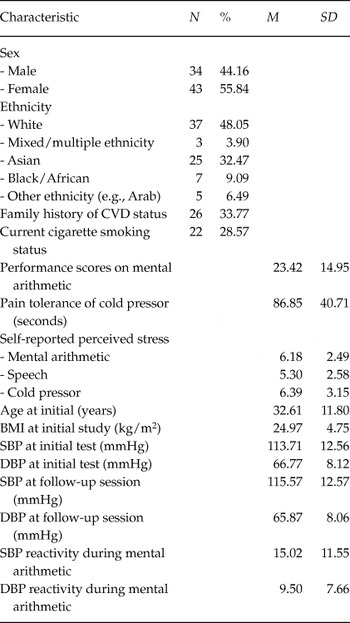
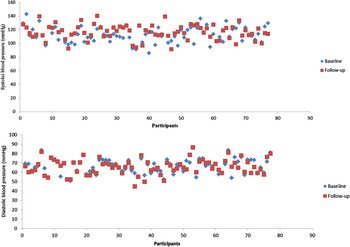
Characteristics of the participants at baseline and follow-up are shown in table 1. Further, Figure 1 shows baseline BP at initial and follow-up sessions. A total of 104 eligible participants participated in the initial examination; they were aged 32.61 ± 11.80 years (range 18–63 years). Seventy-seven eligible individuals attended follow-up. The duration of follow-up was on average 10.22 months (SD = 1.91 months). Only 44 participants (57.14%) immersed their hand in the cold pressor tank for two minutes. A comparison of eligible participants who did or did not participate in follow-up revealed no significant differences in gender, age, current cigarette smoking status, family history of CVD, BMI, initial resting cardiovascular values, and cardiovascular reactivity (p > .05), with two exceptions. Participants who attended follow-up had i) higher CO responses to the cold pressor task (M ± SD = .69 ± 0.85 vs. .24 ± .93; t(102) = 2.24, p = .027); and ii) lower TPR responses to the cold pressor task (M ± SD = 87.13 ± 94.84 vs. 161.86 ± 205.98; t(95) = –2.51, p = .014) than participants who attended follow-up. Paired-samples t tests revealed that resting SBP and resting DBP did not significantly increase over the ten-month follow-up (p > .05).
Descriptive of the individuals who participated in both the initial and follow-up sessions (n = 77)

Initial and follow-up blood pressure in the participants.

Hemodynamic Patterns of Cardiovascular Reactions to Mental Stress Tests
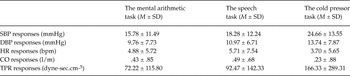
The patterns of cardiovascular reactions to psychological stressors were described in table 2. Briefly, in the individuals who participated in both the initial and follow-up sessions, the cold pressor task elicited higher BP and TPR reactions than mental arithmetic and speech, whereas the mental arithmetic task and the speech task provoked the greater HR reactions than the cold pressor task.
A comparison of cardiovascular reactivity (change) scores in the UK participants who completed initial and follow-up sessions (n = 77)

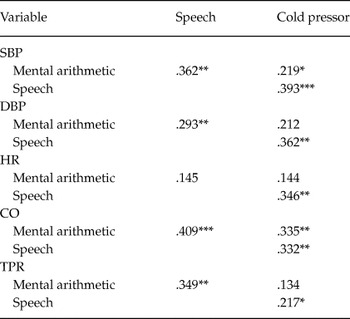
To determine whether responses to the three mental stress tasks were correlated with one another, intertask correlations based on the hemodynamic responses were computed; these coefficients are displayed in table 3. The majority of intertask correlation coefficients were significant. Therefore, aggregation across multiple tasks might allow greater generalizability.
Intertask correlations for cardiovascular reactivity in the UK participants who participated in the initial and follow-up sessions (n = 77)

Note: **p < .01; ***p < .001.
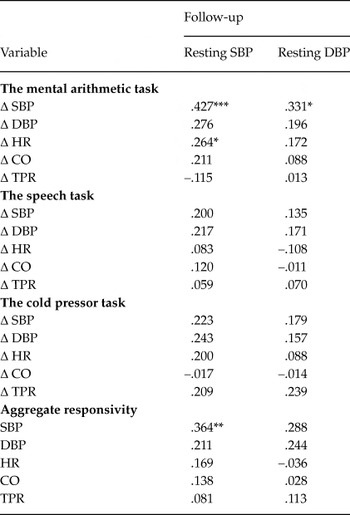
Analysis of the correlation reveled that SBP at follow-up was a significantly positively related to SBP and HR responses to the mental arithmetic task and aggregated SBP responsivity over the three tasks. In addition, SBP responses to the mental arithmetic task were associated with future DBP levels (table 4). Consequently, these cardiovascular reactivity measures were included at step three of the predictive regression models (along with baseline cardiovascular measures in step one, traditional risk factors in step two, and cardiovascular reactivity in step three where these were potential predictors).
Bivariate correlations between hemodynamic responses and resting SBP and DBP at follow-up after ten months follow-up in the UK participants who participated in the initial and follow-up sessions (n = 77)

Note: **p < .01; ***p < .001.
Prediction of Longitudinal Changes in SBP
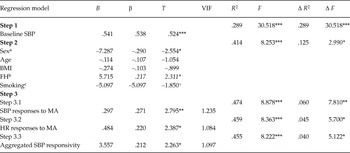
To investigate whether cardiovascular reactivity predicts follow-up SBP, a series of hierarchical regression analyses were performed to determine the contribution of cardiovascular reactivity to the prediction of follow-up resting SBP. Cardiovascular reactivity measures (e.g., SBP) to acute psychological stress were then entered into the regression model. Initial baseline SBP activity (step one) predicted future SBP, accounting for 28.9% of the variance. The traditional risk factors (step two) accounted for an additional 12.5% of the variance; with sex and family history of CVD significantly related to follow-up SBP. At step three, SBP responses to the mental arithmetic task (active coping) accounted for an additional 6.0% of the variance (β = .271, SE = .106; p = .007); with all predictors together accounting for 47.4% of the variance in follow-up SBP levels. In addition, HR responses to mental arithmetic (step three) accounted for an additional 4.5% of the variance (β = .220, SE = .203, p = .020; see table 5). By comparison, aggregated SBP responsivity to the predictor model resulted in smaller increases in R2 with values equivalent to only 4.0% of follow-up SBP (β = .212, SE = 1.571; p = .027; see table 5). In other words, SBP and HR responses to active coping tasks (mental arithmetic) predicted follow-up SBP over ten months above and beyond that of traditional risk factors. Aggregated cardiovascular responsivity across multiple tasks was also predictors of future SBP levels; however they were weaker predictors than responses to mental arithmetic (active coping), a single task (see Table 5). Further, the assumption of collinerity indicated that multicollinerity was not a concern (SBP responses to mental arithmetic, VIF = 1.235; HR responses to mental arithmetic, VIF = 1.084, aggregated SBP responsivity, VIF = 1.097). In addition, only SBP responses to mental arithmetic task remained a significant and strong independent predictor of future SBP over a 10-month follow-up, even after adjustment for alpha error inflation (p = .016). However, HR responses to mental arithmetic and aggregated SBP responsivity were not significantly related to follow-up SBP after adjusting for alpha error inflation.
Results of hierarchical linear regression analyses predicting SBP from baseline resting SBP activity, traditional risk factors, and cardiovascular reactivity data

Note: FH, family history of CVD; MA, mental arithmetic; VIF, variance inflation factor.
a sex: male = 1, female = 2.
b family history of CVD: negative = 0, positive = 1.
c current cigarette smoking status: non-smoking = 0, smoking = 1.
+ p < .1; *p < .05; ***p < .001.
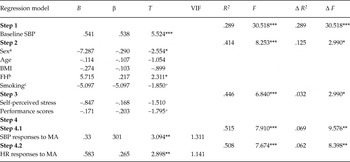
The present study also examined whether mediator variables (self-reported perceived stress, performance scores, and pain tolerance) altered the relationships between cardiovascular activity and future resting BP. The results found that the mediator variables entered at step three were not significantly related to follow-up SBP. At step four, SBP responses to the mental arithmetic task (active coping) accounted for an additional 6.9% of the variance (β = .301, SE = .107; p = .003) and HR responses to the mental arithmetic task (active coping) accounted for an addition 6.2% of the variance (β = .265, SE = .201; p = .005) (see table 6); similar to the proportion of variance accounted for in the model without the mediator variables (6.0% and 4.5 %, respectively). In addition, these responses to mental arithmetic task remained statistically significant after adjustment for alpha error inflation (adjusted alpha error inflation; p < .0125).
Results of hierarchical linear regression analyses predicting SBP from baseline resting SBP activity, traditional risk factors, performance, self-reported perceived stress and SBP responses to mental arithmetic data

Note: FH, family history of CVD; MA, mental arithmetic; VIF, variance inflation factor.
a sex: male = 1, female = 2.
b family history of CVD: negative = 0, positive = 1.
c current cigarette smoking status: non-smoking = 0, smoking = 1.
+ p < .1; *p < .05; ***p < .001.
Prediction of Longitudinal Changes in DBP:
A similar series of hierarchical regression analyses were conducted to determine the contribution of cardiovascular reactivity to the prediction of follow-up resting DBP. However, there was no relationship between cardiovascular reactivity and the prediction of future DBP (p > .05).
In summary, these results suggest that SBP and HR responses to active coping (mental arithmetic), and SBP aggregated responsivity predicted follow-up SBP above and beyond that of traditional risk factors and mediator variables, albeit modestly. Cardiovascular reactivity did not independently predict follow-up DBP.
Discussion
The present study investigated whether hemodynamic reactions to psychological stressors (namely mental arithmetic, speech and cold pressor tasks) predicted BP levels over a ten months period in 77 UK participants. Results revealed that the average SBP and DBP values at the follow-up session were not significantly higher than the values at the initial session: BP did not increase over the ten months of follow-up. Further, in a mixed-ethnic, mixed-gender sample of normal BP adults (as defined SBP ≤ 140 mmHg and/or DBP ≤ 90 mmHg), cardiovascular reactivity to laboratory challenges predicted follow-up resting BP levels ten-months later. Specifically, future SBP levels were predicted by SBP and HR responses to active coping (the mental arithmetic task), after controlling for baseline cardiovascular activity and traditional risk factors. Further, only SBP and HR reactions to active coping (the mental arithmetic task) remained a significant predictor of follow-up SBP, after adjustment for significant traditional risk factors, baseline SBP activity, performance, and self-reported perceived stress. In addition, the assumption of collinerity indicated that multicollinerity was not present in these reactivity measures (SBP and HR response to mental arithmetic and aggregated SBP responsivity). In addition, hemodynamic reactions to the speech task were not independent predictors of future SBP. Moreover, future DBP levels were not independently predicted by any measure of cardiovascular reactivity. To summarize, the present results showed that SBP and HR responses to the mental arithmetic task (active coping), but not the speech task or cold pressor test (passive coping), predicted future SBP levels. This is in accordance with some but not all previous studies (Carroll et al., Reference Carroll, Phillips, Der, Hunt and Benzeval2011; Markovitz et al., Reference Markovitz, Raczynski, Wallace, Chettur and Chesney1998). To date only one published prospective study (Girdler et al., Reference Girdler, Hinderliter, Brownley, Turner, Sherwood and Light1996) has evaluated the contributions of hemodynamic responses to both active and passive coping tasks in the prediction of future resting BP in adult participants. Girdler et al. (Reference Girdler, Hinderliter, Brownley, Turner, Sherwood and Light1996) found that only SBP and HR reactions to passive coping tasks (a cold pressor task and a speech preparation task) predicted future SBP levels in 40 adults; CO and TPR reactivity did not and cardiovascular responses to the active coping task did not. However, the present study contrasts to Girdler et al. (Reference Girdler, Hinderliter, Brownley, Turner, Sherwood and Light1996). The current findings accord with a larger study by Markovitz et al. (Reference Markovitz, Raczynski, Wallace, Chettur and Chesney1998). They found that SBP response to the video game were associated with SBP increases five years later, independent of resting SBP in a sample of over 3000 men and women (p < .001), whereas reactivity to the star-tracing task or the cold pressor test did not predict significant BP change; CO and TPR were not measured. Thus, the results from the current study accord with the larger studies that assessed cardiovascular responses to both active and passive coping tasks.
Self-reports of perceived stress were a potential explanation for the differences in explanatory power observed in the current study but, even though self-reports of perceived stress were higher for the mental arithmetic task than the speech task, they did not differ from those for the cold pressor task. This suggests perceived stress does not offer an explanation for the better prediction afforded by SBP responses to mental arithmetic compared with the other two tasks; indeed SBP responses to mental arithmetic were the only predictor after adjustment for the multiple statistical test made. Other measures, such as effort and coping, should be included in future studies (Richter & Gendolla, Reference Richter and Gendolla2006; Richter, Friedrich, & Gendolla, Reference Richter, Friedrich and Gendolla2008). Alternatively, the measures of performance and self-reported percieved stress may be poor indices of motivation or effort; although performance and perceived stress have been associated with motivation and effort, they are proxy measures of them. Accordingly, future studies need to assess the effort participants mobilized during task performance and anticipatory measures of motivation.
The mental arithmetic and speech tasks (active coping tasks) provoked a pattern of responses consistent with beta-adrenergic activation (namely, large CO and HR responses), whereas the cold pressor task (passive coping task) provoked a pattern of responses consistent with alpha-adrenergic activation (namely large TPR responses). Markovitz et al. (Reference Markovitz, Raczynski, Wallace, Chettur and Chesney1998) suggested that BP responses to stressors eliciting primarily beta-adrenergic cardiovascular responses may be more predictive of follow-up BP. They concluded that prediction of future BP among younger participants with a short-term follow-up might not be useful in cardiovascular reactions to cold pressor (passive coping). Similarly, Kasagi, Akahoshi and Shimaoka (Reference Kasagi, Akahoshi and Shimaoka1995) indicated that BP responses to the cold pressor task (passive coping) would be an effective predictor among participants with middle-aged older than 40 years. In addition, Flaa et al. (Reference Flaa, Eide, Kjeldsen and Rostrup2008) assumed responses to mental arithmetic tasks (active coping), which provoked a beta-adrenergic response with an increased CO, may support the notion of a hyperkinetic circulation state at the young age. Thus, in explaining our results, the cold pressor task may be a less useful stress task when measuring cardiovascular reactions in order to predict future BP levels; cardiovascular responses to cold pressor tasks, which primarily elicited an alpha-adrenergic response with an increased TPR, may be helpful in predicting hypertension among older adults. Further, a plausible explanation for the lack of independent predictive power of the speech task is that it might have provoked a more mixed alpha- and beta- adrenergic response given it involves both preparation and speech (Zanstra, Johnston, & Rasbash, Reference Zanstra, Johnston and Rasbash2010). Indeed, Chida and Steptoe’s review (2010) found evidence that only cardiovascular responses to cognitive tasks afforded prediction of future BP; public speaking and stress interviews did not predict future BP. Thus, the most likely explanation might be the relatively small number of participants in the current study that reduced the chance of detecting effects.
These findings are in line with prospective studies that have found BP responses to the mental arithmetic task to be predictive of future BP (Carroll et al., Reference Carroll, Phillips, Der, Hunt and Benzeval2011; Flaa et al., Reference Flaa, Eide, Kjeldsen and Rostrup2008). The proportion of variances in future BP accounted for by cardiovascular responses parameters after adjustment for controlling variable standard factors has ranged from 2 to 12% in these studies. In the current study, the amount of variance accounted for by BP responses in the significant models (range = 4.0–7.5%) is comparable to that observed in other reactivity studies involving adults (e.g., Light et al., Reference Light, Girdler, Sherwood, Bragdon, Brownley, West and Hinderliter1999; Matthews, Woodall, & Allen, Reference Matthews, Woodall and Allen1993; Tuomisto, Maiahalme, Kahonen, Fredrikson, & Turjanmaa, Reference Tuomisto, Majahalme, Kahonen, Fredrikson and Turjanmaa2005). Thus, BP reactivity appears to be a modest, independent predictor of future SBP. However, it should be noted that this was a relatively small study across a relatively short follow-up period.
Underlying hemodynamic responses, CO and TPR, did not predict future BP; only SBP and HR reactivity were predictive. It is possible that the non-invasive methods to assess hemodynamic changes were not sufficiently reliable to afford prediction of future BP. The use of the non-invasive methods for monitoring CO and BP are not the “gold standard” (Bogert & van Lieshout, Reference Bogert and van Lieshout2005; Stover et al., Reference Stover, Stocker, Lenherr, Neff, Cottini, Zoller and Bechir2009). Bogert and van Lieshout (Reference Bogert and van Lieshout2005) proposed that changes in stress and tone of smooth muscle in the arterial wall and in hematocrit affect the diameter of an artery under a cuff wrapped around the fingers at a given pressure. Furthermore, while the Portapres has been found to provide accurate estimates of CO and TPR, they may not be as good as estimates of BP. Indeed, some studies have found that the Portapres did not reliably estimate absolute values of CO such as thermodilution (Raaijmakers et al., Reference Raaijmakers, Faes, Kunst, Bakker, Rommes, Goovaerts and Heethaar1998; Remmen et al., Reference Remmen, Aengevaeren, Verheugt, van ver Werf, Luijten, Bos and Jansen2002) or rebreathing method (Pitt, Marshall, Diesch, & Hainsworth, Reference Pitt, Marshall, Diesch and Hanisworth2004). Therefore, assessment of CO by using Portapres should be interpreted cautiously. In addition, the mechanisms linking BP reactivity and future BP may not involve specific hemodynamic responses; the mechanisms involved may be more general, e.g., inflammation, endothelial dysfunction, and platelet aggregation (Hamer, Gibson, Wuononvirta, Williams, & Steptoe, Reference Hamer, Gibson, Wuononvirta, Williams and Steptoe2006; Isowa, Ohira, & Murashima, Reference Isowa, Ohira and Murashima2004) or BP reactivity may be a better marker of non-detectable disease associated with BP changes over time than hemodynamic responses (Gerin et al., Reference Gerin, Pickering, Glynn, Christenfeld, Schwartz, Carroll and Davisson2000). However, given the small sample sizes and limited follow-up, homogenous groups of sufficient size and longer follow-up periods will be important for future quantitative studies.
Finally, aggregated SBP responsivity over the three stress tasks predicted follow-up SBP after controlling for both baseline SBP activity and traditional risk factors. However, the proportion of variance in future SBP explained by aggregated SBP responsivity was smaller than by SBP responses to a single task; mental arithmetic. Aggregated SBP and DBP responsivity over the three tasks were correlated with future DBP in bivariate analyses, but did not predict future DBP independently of resting cardiovascular activity and traditional risk factors. Many researchers have recommended using multiple tasks to create aggregated measures of cardiovascular responsivity (Kamarck & Lovallo, Reference Kamarck and Lovallo2003; Treiber et al., Reference Treiber, Kamarck, Schneiderman, Sheffield, Kapuku and Taylor2003), but few published studies have examined whether aggregate measures of responsivity to psychological stress tasks afford better prediction of future BP or hypertension than cardiovascular responses to single tasks. Carroll et al. (Reference Carroll, Ginty, Painter, Roseboom, Phillips and de Rooij2012) found that aggregated SBP responsivity across speech, Stroop, and a mirror tracing task was a similar strength predictor of self-reported hypertension at five year follow-up as compared to SBP responses to the speech and Stroop tasks only; SBP responses to mirror tracing were not an independent predictor of hypertension status. Several other studies have found a strong positive relationship between laboratory-induced cardiovascular reactivity and the prediction of future BP or hypertension status. However, those studies used a mixture of psychological stressors and physical stressors (Matthews, Woodall, & Allen, Reference Matthews, Woodall and Allen1993; Moseley & Linden, Reference Moseley and Linden2006). Additional, larger studies are needed to ascertain whether aggregate responses to psychological stressors offer any better prediction than responses to single tasks or multiple versions of the same task.
There are a number of limitations with the current study. The present study had a relatively small sample size (n = 77) and a short period of follow-up (only a ten months period). Further, the average SBP and DBP values at the follow-up session were not significantly higher than the values at the initial session: BP did not increase over the ten months of follow-up. Therefore, research is needed using larger sample sizes and with a longer follow-up study to determine whether similar relationships exist between stress-induced reactivity and future BP.
In conclusion, CO and TPR reactivity to mental stress tests were not significant predictors of follow-up BP levels. These findings are consistent with other studies that have used hemodynamic reactivity to predict follow-up BP (Chida & Steptoe, Reference Chida and Steptoe2010) and suggest that they may be more helpful in determining patterns of hemodynamic responses to mental stress tasks rather than predicting follow-up BP. Further, SBP and HR reactions to a mental arithmetic task (an active coping task) and, to a lesser extent, aggregated SBP responsivity over three mental stress tasks predicted future SBP, and remained so after controlling for baseline SBP activity, traditional risk factors and/or mediator variables. In addition, responses to mental arithmetic task, which provoked a beta-adrenergic response with an increased CO, afforded better prediction of future SBP than cold pressor (passive coping task) which provoked an alpha-adrenergic response with an increased TPR. Thus, these findings are consistent with Falkner, Kushner, Onesti, and Angelakos (Reference Falkner, Kushner, Onesti and Angelakos1981) and Flaa et al. (Reference Flaa, Eide, Kjeldsen and Rostrup2008) who suggested that changes provoked by mental arithmetic may support the notion of a hyperkinetic circulation state. Future studies should examine the mechanisms underpinning these relationships in light of the findings that CO and TPR reactivity were not predictive.