


The modern welfare state started in Germany with Bismarck’s famous reforms. While numerous studies point to substantial social improvements,Footnote 1 the historiography of the political consequences provides us with two narratives (Wehler Reference Wehler2006; Nipperdey Reference Nipperdey1998; Eichengreen Reference Eichengreen2018; Ritter Reference Ritter1983): on the one hand, a success story from Bismarck’s perspective with the successful integration of the working class into the new German nation-state; on the other hand, a success story from the perspective of the Socialist Party with growing electoral popularity. This paper provides the first quantitative assessment of the reform’s political consequences, which also attempts to bring together both narratives with their different definitions of success.
For the analysis, I conceptualize Bismarck’s reform as an accommodation strategy to combat the Socialist Party as an emerging challenger party. Based on the political science literature on party competition, the political success of such a strategy crucially depends on issue ownership. Two competing hypotheses exist in the literature: Following Meguid (Reference Meguid2005, Reference Meguid2008), one would expect the government to gain issue ownership and benefit from this strategy due to greater legislative experience and better access to voters. Based on the political economy of political competition (Alesina Reference Alesina1988; Petrocik Reference Petrocik1996), one would expect that the government does not gain issue ownership due to credibility reasons. Building on the latter perspective, I propose that a stronger reformist stance in response to an accommodation strategy helps a challenger party to keep its credibility and retain issue ownership.
Analyzing Bismarck’s reform through the lenses of this framework delivers two major findings. First, the Socialist Party substantially benefited in elections from Bismarck’s accommodation strategy, whereas the parties that formed Bismarck’s coalition tended to lose vote shares. Second, I provide suggestive evidence that the Socialist Party became more moderate to retain its issue ownership in response to Bismarck’s reforms in times of heated debates within the Socialist Party between reform and revolution. I find no support for alternative economic channels as drivers of the Socialist Party’s increased success.
Bismarck’s social reform program of the 1880s included health insurance (1883), accident insurance (1884), and old-age and disability insurance (1889). These aimed to improve workers’ conditions and curb socialist influence. This paper focuses on the political consequences of health insurance reform until 1890 for three reasons. First, it accounted for 89 percent of total spending before 1890 (based on Khoudour-Casteras Reference Khoudour-Casteras2008). Second, it had the most immediate and visible impact, covering common illnesses and minor accidents, unlike the less tangible benefits of accident or old-age insurance. Third, it offers a more credible empirical setting, which becomes harder to sustain with the 1889 pension reform. This is not to say that the other parts of the social reform did not matter for elections. However, finding a suitable empirical approach for these reforms is even more challenging.
To come to the first major finding, I need to solve the following empirical challenge: distinguish between the specific effect of social insurance and the general role of blue-collar workers in the increase in support for the Socialist Party. This is hard because only blue-collar workers were eligible for the social insurance and, at the same time, formed the core group of voters for the Socialist Party. To tackle this obstacle, I focus on health insurance reform and exploit the fact that local and industry-specific health insurance schemes existed already before the introduction of Bismarck’s public scheme. I rely on a detailed and previously unused firm census of 1876 to capture this variation. Around 35 percent of all blue-collar workers already had health insurance before Bismarck’s reform. These schemes are considered role models for Bismarck’s reform and became redundant with the introduction of the public insurance scheme, which extended health insurance to 100 percent of all blue-collar workers. Hence, my treatment variable is the share of newly insured workers. I employ this variable in an event study and difference-in-differences framework, in which I compare changes in votes in constituencies where Bismarck’s health insurance led to large additional insurance coverage with regions that experienced less of a coverage increase over seven elections between 1874 and 1890—the end of Bismarck’s reign as chancellor. Crucially, I allow for flexible effects for the share of blue-collar workers. Common pre-treatment election trends corroborate the validity of the identification strategy.
The first set of empirical results shows that Bismarck’s health reform causally led to an increase in votes for the Socialist Party. The magnitude of the positive effect is quite large: An increase of one standard deviation explains around 80 percent of the average increase in votes for the Socialist Party when comparing the elections directly before and after the introduction of social insurance. The growing success tends to come at the expense of the vote share of the Conservatives and National Liberals, the two parties that formed Bismarck’s coalition. While Bismarck remained in power until 1890, the growing success of the Socialist Party, which became the strongest party in terms of votes in 1890, was one of the main reasons for his end as chancellor.
In the second part of the paper, I examine the mechanisms behind the impact of the reform on the Socialist Party’s electoral success, focusing on the response of the Socialist Party, which debated between a stronger reformist stance and a revolutionary approach. I claim that the stronger reformist stance dominated by providing three pieces of evidence consistent with this interpretation.
First, it was after Bismarck’s reform that the party adopted a stronger reformist stance, transforming into “a political party in the modern parliamentary sense, involving the possibilities of swapping votes in elections, parliamentary maneuverings and compromises on elections” (Lidtke Reference Lidtke1966, p. 185). In line with this shift toward reform, parts of the party actively engaged in implementing the welfare state by providing health insurance organized by the workers. Moreover, the elected members of parliament (MPs) most strongly valued pragmatism over principles in a core debate within the party.
Second, the activities of the radical wing do not explain the party’s growing success. Here, I use archival material on the subscription lists of an illegal newspaper that was the core outlet of the radical wing. The Prussian minister of the interior, Robert von Puttkamer, described this newspaper as “one of the most dangerous attacks on the security and inner peace of the German Reich” (cited after Engelberg (Reference Engelberg1959, p. 51, own translation)). By allowing for an interaction effect between the treatment variable and a dummy variable for constituencies with readers of the newspaper as an indicator of a stronghold of the radical wing, I show that the newspaper did not matter for the growing electoral success of the party.
Third, I rule out economic consequences of the reform as drivers of voting behavior. I find no evidence that the reform spurred selective migration to more affected constituencies. Nor did it lead to stronger employment or wage growth, or to larger increases in firm size, in areas or sectors with higher treatment intensity.
My paper speaks to several strands of literature in political economy and economic history. First, this study is related to the extensive historical literature on worker parties. Socialist parties were the first challenger parties in modern electoral systems. During the twentieth century, part of these parties—the social democratic wing—turned to a more reform-oriented approach (see Bartels, Kersting, and Wolf (Reference Bartels, Kersting and Wolf2025) for a quantitative assessment of the beginning of this debate) and, thereby, helped to integrate democracy and capitalism (Berman Reference Berman2006) and became one of the most successful party groups in Europe (Benedetto, Hix, and Mastrorocco Reference Benedetto, Hix and Mastrorocco2020). From the present vantage point, this development is a successful integration of a challenger party. Despite this tremendous political importance, we have little empirical knowledge of how this came about. In this paper, I analyze the initial role of the welfare state in this development.
Second, this paper speaks to the rich economic history literature on Imperial Germany, notably related to the welfare state and political economy aspects. Existing studies on Bismarck’s social insurance analyze the effect on mortality (Guinnane and Streb Reference Guinnane and Streb2015; Bauernschuster, Driva, and Hornung Reference Bauernschuster, Driva and Hornung2020), savings (Lehmann-Hasemeyer and Streb Reference Lehmann-Hasemeyer and Streb2018), fertility (Fenge and Scheubel Reference Fenge and Scheubel2017; Guinnane and Streb Reference Guinnane and Streb2021), and out-migration (Khoudour-Casteras Reference Khoudour-Casteras2008). There is a consensus in this literature that introducing social insurance led to social improvements. However, we lack a thorough quantitative analysis of the political effects of Bismarck’s reform, which is my core contribution to this literature. Regarding the political economy of Imperial Germany, influential quantitative studies have stressed the role of landed elites in conducting electoral fraud (Ziblatt Reference Ziblatt2009) and blocking the democratization of the Prussian three-class franchise (Ziblatt Reference Ziblatt2008). Becker and Hornung (Reference Becker and Hornung2020) study roll-call votes in the Prussian parliament and highlight the influence of business interests. In addition to these papers, I provide new insights into the labor movement in Imperial Germany, whose political system featured both democratic and autocratic elements. This study provides new insights about the Socialist Party.
The rest of the paper is organized as follows. The first section describes the historical background. The second section outlines the conceptual framework. The third section describes the data. The fourth section analyzes the political effect of the health insurance reform. The fifth section studies the mechanism. The sixth section concludes.
HISTORICAL BACKGROUND: BISMARCK, THE WELFARE STATE AND THE SOCIALISTS
In the 1870s, after the German unification in 1871, the socialist movement gained popularity among German society. In 1875, the Sozialistische Arbeiterpartei Deutschlands (SAP; Socialist Workers’ Party of Germany) was founded as a coalition of the previous workers’ parties in Germany, the Sozialdemokratische Arbeiterpartei (SDAP; Social Democratic Workers’ Party) and the Allgemeine Deutsche Arbeiterverein (ADAV; General German Workers’ Association). In the next general election in 1877, the party received 9.1 percent of the votes after only 3.2 percent six years earlier. Their core demands in the Gothaer Programm were, on the one hand, reforms, for example, the introduction of a 10-hour working day, the prohibition of Sunday work, more rights for trade unions, and more education, especially for younger workers. On the other hand, the program also contained a radical revolutionary outlook by advocating for the defeat of capitalism and the abolishment of private property (Bartel, Schröder, and Seeber Reference Bartel, Schröder and Seeber1980, pp. 30–33).
Support for the Paris Commune and unseen levels of strike activity (at least 530 strikes between 1871 and 1873) increased the bourgeoisie’s fear of a socialist revolution. Chancellor Bismarck, for instance, fueled the bourgeoisie’s fears by spreading rumors that supporters of the SAP formed a kind of army in the middle of Germany that even limited the economic recovery after the Gründerkrise (Bismarck 2004, original from 1878). August Bebel, the leader of the Socialist Party, triggered the fears by famously claiming in parliament “that before a few decades pass, the battle cry of the Parisian proletariat ‘War to the palaces, peace to the huts, death to misery and idleness!’ will become the battle cry of the entire European proletariat” (Bebel Reference Bebel1911, p. 184, own translation, original from 1871).
After two failed assassinations of the emperor, for which the Socialist Party—without clear evidence—was held responsible, Bismarck’s government reacted to the growing socialist movement by introducing the so-called Sozialistengesetze (anti-socialist laws) in 1878. The anti-socialist laws prohibited most activities of the SAP and trade unions. Bismarck aimed to conduct a “war of extermination” with laws against the “red enemies of the empire” (Bismarck 2004, original from 1878). Overall, the anti-socialist laws led to a ban on more than 200 associations and 400 publications within a year. The implementation did not differentiate between social clubs or trade unions with a strong focus on local economic assistance on the one hand and socialist agitators on the other hand (Lidtke Reference Lidtke1966, p. 80). Centralized party activities were forbidden. However, supporters of the banned party were still allowed to run for parliament as private persons. Still, the historical literature has a broad consensus that Bismarck did not successfully introduce anti-socialist laws.Footnote 2
To complement the repressive policy that contemporaries already considered a failure, Bismarck’s government introduced a new social policy to reduce support for socialist candidates in 1883. Bismarck formulated his goals bluntly: “Give the worker the right to work as long as he is healthy, give him care when he is sick, give him care when he is old. When you do that […], then I believe that the gentlemen of the Wydener program [the SAP] will blow their whistle in vain” (Bismarck 1885b, p. 481, own translation). In addition, he aimed to “create a conservative mindset among the great mass of the dispossessed” (Bismarck Reference Bismarck1881, p. 195, own translation).
The social insurance reform was built upon three pillars: Health insurance, accident insurance, and pension insurance. The Gesetz betreffend die Krankenversicherung der Arbeiter enacted 15 June 1883, and implemented on 1 December 1884, provided public health insurance coverage for blue-collar workers in non-agricultural sectors. It covered sick pay (up to 13 weeks, at least 50 percent of the local wage), doctor appointments, and expenditures for medicine, with employers paying one-third of the contributions and employees two-thirds. One year later, the government provided accident insurance targeting the same worker group. The pension insurance was implemented in 1889, shortly before Bismarck’s reign as chancellor ended, and had strict eligibility criteria, especially regarding the age requirement. Overall, these policies targeted the workers, not the working poor, and, thus, the core voters of the Socialist Party (Ritter and Tenfelde Reference Ritter and Tenfelde1992, p. 702).
The introduction of the health insurance reform was supported by a broad coalition of the Conservatives and the National Liberals—the two parties that formed Bismarck’s coalition—as well as the Catholic Zentrum (Hänlein, Tennstedt, and Winter Reference Hänlein, Tennstedt and Winter2009, p. XVIII). Parts of the left-liberals and the socialists voted against the law. Although the socialists were in principle supportive of social reform, they opposed Bismarck’s law in parliament because they demanded a broader and more comprehensive approach.
What were the aspects of the health insurance that made it attractive? The health insurance led to a common public insurance scheme with basic healthcare for all blue-collar workers. The level of sick pay, however, was barely sufficient to subsist while being sick at home. Still, as previous research on Bismarck’s reform has shown (Bauernschuster, Driva, and Hornung Reference Bauernschuster, Driva and Hornung2020), the health insurance reform increased blue-collar workers’ life expectancy, mainly due to better medical care. Moreover, social insurance led to higher “indirect wages” consisting of the social insurance benefits (Khoudour-Casteras Reference Khoudour-Casteras2008). However, it is unclear whether the social insurance had redistributive effects because the employers and employees co-financed it (Lindert Reference Lindert2004, p. 174). Without any doubt, the health insurance reform brought substantial social improvements to blue-collar workers.
Before Bismarck’s reform, insurance coverage existed but depended on local and industry-specific decisions. In some cases, insurance was founded in the sixteenth century (Jopp and Streb Reference Jopp and Streb2023). For instance, miners’ guilds (Knappschaften) offered health insurance for miners, and factory health insurance (Fabrikkassen) covered health insurance for the employees of firms. In addition to employees, employers often contributed to the financing of these insurance programs. These existing health insurance schemes are a crucial part of my empirical strategy.
It was challenging for the Socialist Party to take a clear position on the new social security policies. On the one hand, the party could choose a more moderate stance at the risk of becoming part of the institutions they—at least partially—opposed. On the other hand, the party could stick to fierce opposition, helping the government claim the credit for the reform, which contemporaries and potential voters interpreted as “socialist.” This dilemma led to fierce debates within the Socialist Party. While the radical wing opted for illegal activities and a revolutionary program, the moderate wing aimed to show voters the benefits of reform activity and to stop the party’s isolation, which the radicals criticized as opportunistic. Bebel and Engels, as the major advocates of the radicals, even thought that a failure of more moderate candidates like Ignaz Auer, Louis Viereck, Paul Singer, and August Heine during the election in 1884 would have been a success for the party (Lidtke Reference Lidtke1966, p. 190). This conflict within the party will be key for analyzing the mechanism.
How did others perceive the social insurance reform? Bismarck acknowledged in parliament that “if there were no social democracy, and if a lot of people were not afraid of it, the modest progress we have made so far in social reform would not exist” (Bismarck 1885a, p. 25, own translation), suggesting that the topic was on the agenda because of social democracy. The Socialist Party often mentioned Bismarck’s quote in their election campaigns to be seen as the “original” regarding social reform (Lidtke Reference Lidtke1966, p. 177). The head of police expressed similar views in his internal reports on the Socialist Party: he noted that one reason for the party’s growing influence among workers was its credible claim to have achieved social reform. He later resigned, emphasizing that this was a key reason why further government efforts to curb the party’s appeal might prove ineffective (von Richthofen Reference von Richthofen1983, p. 290, original from 1886).
Regarding the political evaluation of Bismarck’s welfare reform, diverging interpretations coexist in the literature, arguably due to different definitions of success. In one strand, the historical literature tends to see Bismarck’s welfare reform as a blueprint for successful social integration, at least in the long run. Notably, Wehler (Reference Wehler2006, p. 915) claims that Bismarck’s introduction of social insurance successfully integrated the working class into the new German nation-state (see for a similar take Nipperdey (Reference Nipperdey1998) and Ritter (Reference Ritter1989)). According to classic German historiography, the social insurance reform strengthened the ties between the workers and the state—visible, for example, via the self-organization of parts of social insurance (Nipperdey Reference Nipperdey1998, p. 345). One sign of increased state support is the backing of social democrats for WWI (Wehler Reference Wehler2006, p. 915). After all, there was no socialist revolution in Imperial Germany. In this sense, one can argue that introducing the welfare state was a success. This interpretation, however, does not suggest a declining popularity of the Socialist Party but is instead about declining radicalism.
Another strand focuses on the immediate political consequences for the Socialist Party in elections. Here, we can start with Bismarck’s assessment: He wrote to a Bavarian diplomat that his reform could not strengthen the ties between the state and the workers (Wehler Reference Wehler2006, p. 914). Also, historians regard the reform not as a success (in the sense of declining support for the SAP) for Bismarck. Ritter (Reference Ritter1983, pp. 50–52) highlights its limited distributional impact, while Nipperdey (Reference Nipperdey1998, p. 346) stresses the resilience of class-based political divisions. Moreover, Ritter (Reference Ritter1989, p. 12) highlights the room for political activities that came with the social insurance reform, particularly due to the mutual health funds (Hilfskassen).
Taken together, this overview points to the declining radicalism of the party in the long run and the growing popularity of the party, at least in the short run. In the next section, I outline a conceptual framework to reconcile both aspects.
CONCEPTUAL FRAMEWORK: CHALLENGER PARTIES AND ISSUE OWNERSHIP
In this section, I outline the conceptual framework to investigate the political consequences of Bismarck’s reform, drawing upon the political science literature on challenger parties.Footnote 3 I expand the existing approaches by highlighting the response of the challenger parties to the accommodation strategy.
The influential work by Meguid (Reference Meguid2005, Reference Meguid2008) suggests that the success of challenger parties—defined as parties that do not coincide with existing political divides—crucially depends on the response of the competitors (in my case the incumbent). One option is to choose an accommodation strategy, that is, adopting the position of the challenger party on a given issue that the challenger “owns.” Meguid (Reference Meguid2005, pp. 349–51) hypothesizes that accommodation strategies lead to declining success for challenger parties. The underlying rationale posits that the issue ownership translates to the competitor because this party has more legislative experience and better access to voters. As an important conditioning factor, Meguid (Reference Meguid2008, p. 39) stresses the role of timing: An early accommodation strategy should be more successful from the vantage point of the competitors. In this framework, the competitor gains issue ownership.
One alternative conceptual avenue builds upon older work on political competition by Alesina (Reference Alesina1988) and Petrocik (Reference Petrocik1996). The starting point is to explain why political parties choose particular issues in their campaigns. The key prediction is that parties focus on issues that they “own.”Footnote 4 With this strategy, parties appear credible, as the issues remain consistent with the party’s image. Therefore, it is questionable whether the competitor can achieve issue ownership through the lens of a party’s credibility.
I add the response of the challenger party to the conceptual framework. Here, I rely on the spatial notion of political competition. Given its position at the political fringes, the challenger party can decide between a more moderate stance and fierce opposition. With this addition, the conceptual framework crucially includes two dimensions (popularity and radicalism) that the historical literature on the political consequences emphasizes. A stronger reformist stance comes at the expense of becoming part of the institutions the challenger criticizes and potentially losing some more extreme voters. The revolutionary approach implies the risk of losing credibility when the party simultaneously criticizes the mainstream party for neglecting its agenda, and the mainstream party attempts to accommodate its agenda. Stressing the challenger’s response for theoretical understanding builds upon classic work on socialist parties by Przeworski (Reference Przeworski1985) and Przeworski and Sprague (Reference Przeworski and Sprague1986). The decision between constructive engagement and fierce opposition partially mirrors the famous dictum “the crucial choice was whether to participate” (Przeworski Reference Przeworski1985, p. 7), and the debate about the participation of socialist parties in elections within a capitalist system.
In summary, the logic can be outlined as follows. When a challenger party rises, a competitor may adopt an accommodation strategy by implementing a policy initially “owned” by the challenger. The success of this strategy hinges on who ultimately retains issue ownership. According to the framework proposed by Meguid (Reference Meguid2005, Reference Meguid2008), issue ownership is shaped by factors such as legislative experience and resource advantages—implying that it would shift to the incumbent. In contrast, the perspectives of Alesina (Reference Alesina1988) and Petrocik (Reference Petrocik1996) emphasize credibility, suggesting that issue ownership is more likely to remain with the party whose position is more consistent with its established image. Following the incumbent’s accommodation strategy, the challenger must decide between a moderate or radical response—a choice that involves a trade-off between appealing to more extreme voters and maintaining issue ownership.
Existing Empirical Evidence
Empirical studies on recent challenger parties offer mixed evidence on the effectiveness of accommodation strategies. Several papers show that mainstream parties often adopt such strategies (Abou-Chadi Reference Abou-Chadi2016; Abou-Chadi and Krause Reference Abou-Chadi and Krause2020). National-level evidence in Meguid (Reference Meguid2005, Reference Meguid2008) supports her hypothesis described previously. Hjorth and Larsen (2022) find support for the hypothesis by Meguid (Reference Meguid2005, Reference Meguid2008): in a Danish survey experiment, the left attracted anti-immigration voters by adopting tougher stances, even as it lost some pro-immigration voters—ultimately increasing overall support for the left. However, other studies question this effect. Chou et al. (Reference Chou, Dancygier, Egami and Jamal2021) find that while some far-right voters can be won over, more mainstream supporters are lost. Similarly, Dahlström and Sundell (Reference Dahlström and Sundell2012) and Krause, Cohen, and Abou-Chadi (Reference Krause, Cohen and Abou-Chadi2023) find little evidence that accommodation reduced support for radical right parties, as issue ownership remained with the challengers.
Application to Bismarck’s Reform
There are two main reasons why this framework is helpful for the case studied here. First, the Socialist Party was a challenger party in this period (Sperber Reference Sperber1997, p. 37). Its emergence added a new salient cleavage to the existing political parties with its focus on the workers. Second, Bismarck’s policy fits the notion of an accommodation strategy. Given the relatively quick introduction after the emergence of the Socialist Party, one can even say that his approach was in line with the reasoning outlined by Meguid (Reference Meguid2008). Moreover, rather than simply incorporating such a strategy into a party platform, Bismarck’s government actually implemented reform through legislative change—making this a particularly meaningful accommodation.
In the empirical analysis, I interpret rising vote shares for the Socialist Party as evidence in favor of the hypothesis that the party retained issue ownership. Conversely, declining vote shares are taken to support the alternative hypothesis that Bismarck’s government successfully claimed issue ownership.
DATA
My empirical analysis builds on several new datasets described in this section. My main specification uses Reichstag electoral constituencies as the unit of analysis. As some of my sources, primarily those on the existing health insurance, are only available for Prussia, I restrict my analysis to this part of Germany. Prussia was by far the largest state in Imperial Germany, covering roughly two-thirds of the population. The restriction to Prussia gives me the advantage of analyzing a homogeneous institutional setting.
Health Insurance
To capture the political impact of Bismarck’s welfare state, I focus on the public health insurance scheme outlined earlier. To construct a treatment variable, I collect new data from multiple sources to calculate health insurance coverage before Bismarck’s reform. This approach is similar to the one by Finkelstein (Reference Finkelstein2007), who also uses the share of newly insured to capture the impact of a health reform in the United States. To calculate the treatment variable, three groups must be taken into account: firstly, employees in (larger) factories; secondly, employees in handcrafts; and thirdly, employees in the mining industry who play a special role. In the following, I describe how I calculate the share of already insured employees for these three groups.
To consider employees in larger companies, my main source is an official firm census conducted by the Minister für Handel, Gewerbe und öffentliche Arbeiten (1876a). From this census, I obtained information on every firm with more than 30 workers that offered health insurance to its workers before Bismarck’s reform in Prussia.Footnote 5 The census aimed to provide a detailed report on the social and economic situations of the workers. The administration conducted the census because of the growing concerns over the rising popularity of the socialist movement. The data include information on the number of workers employed and their sector. Information on the firm’s location helps me link the data with electoral constituencies. In total, 2,067 firms offered health insurance for 361,574 employees in 1876.
While this firm census provides a complete picture for larger factories, workers in smaller factories were also covered by health insurance (around 142,000 workers) before the reform. Here, I rely on official data on the district level provided by the Minister für Handel, Gewerbe und öffentliche Arbeiten (1876b). I disaggregate district-industry-level data to the constituency-industry level using (1) industry shares of insured workers from the firm census and (2) the distribution of industry employment across constituencies within each district.
To cover health insurance in handcrafts, I rely on official data on the district level provided by the Minister für Handel, Gewerbe und öffentliche Arbeiten (1876b). These insurances cover 157,000 workers. I distribute these already insured workers according to the proportion of workers in handcrafts in a constituency relative to all workers in handcrafts in a district. Hence, I have to assume that the share of workers in handcrafts with ex-ante existing health insurance is the same within one district. Given that only about 15 percent of all previously insured workers were employed in handcrafts—and that I exploit variation across 36 districts—this assumption appears to have only a limited impact on the overall identification strategy.
Finally, I take into account that miner guilds (Knappschaften) provided mandatory health insurance for all workers in mining (Jopp Reference Jopp2012). In 1878, 85 miner guilds provided health care for 261,118 workers in more than 3,000 mines, smelting, and salt works. Notably, the miner guilds were heavily concentrated in the coal regions in the Ruhr area, Silesia, and Saxony. Following Guinnane and Streb (Reference Guinnane and Streb2021), I assume that all blue-collar workers in mining already had health insurance. The data on blue-collar workers in mining as of 1882 is provided by Galloway (Reference Galloway2007).
Based on these sources and assumptions,Footnote 6 I estimate that around 35 percent of all blue-collar workers were already insured. Note that this share varied significantly between sectors (see Online Appendix Table A1). While about 60 percent of all blue-collar workers in textiles already benefited from ex-ante existing health insurance, only 18 percent of all blue-collar workers employed in the construction and timber industry were covered by health insurance. I use these differences across industries to validate my empirical strategy.
Firms had several reasons to support health insurance (Frevert Reference Frevert1984, pp. 185–219). Importantly, there were economic arguments; for example, potential productivity increases due to the provision of health insurance. In addition, firms hoped to strengthen the loyalty and discipline of the workers in times of high turnover. These forms of health insurance had a long tradition in Germany, which dated back to the beginnings of industrialization. Thus, the amount of ex-ante existing health insurance does not reflect an immediate reaction of employers to the growing popularity of the Socialist Party in the 1870s. This is also shown by the fact that the development of such health insurance before 1876 was quite flat (Bauernschuster, Driva, and Hornung Reference Bauernschuster, Driva and Hornung2020, p. 2571). Thus, the share of ex-ante-insured workers is arguably exogenous to the increase in votes for the Socialist Party during the 1870s.
Anti-Socialist Laws
My source is information published in the official Reichsanzeiger and collected by Teich (Reference Teich1879). This list includes the type and location of the organization. All of these associations were prohibited on the basis of the anti-socialist law; that is, they had links with the Socialist Party or the trade union. There was a wide range of banned associations: explicitly political associations (27 percent), so-called workers’ associations, and electoral associations, but also social associations (33 percent), including singing associations, as well as other groups of associations (see Online Appendix Table A2). Based on this information, I construct a dummy variable for all constituencies with at least one banned organization. Overall, 30 of 229 electoral constituencies in Prussia were affected (see Online Appendix Table B1 and Online Appendix Figure B2). While I lost some variation due to the dummy approach, only 5 percent of the constituencies had more than one banned organization. Still, further research should focus more explicitly on the anti-socialist laws.
Legal Support for the Socialist Party
The main dependent variable of all baseline regressions is vote shares for the Socialist Party in general elections, as made available by Caramani (Reference Caramani2004). Given the prohibition of other legal activities, for example, party membership, voting behavior is among the best available measurements of legal support for the SAP. Despite the partially monarchic character of the German Kaiserreich and some evidence of electoral fraud (Ziblatt Reference Ziblatt2009), the electoral system is regarded as the most democratic in Europe at that time (Sperber Reference Sperber1997).Footnote 7 What is more, the general elections were important for the government and the Socialist Party. The government needed a majority to enact laws. Bismarck, for instance, even dissolved the parliament to get a majority for the anti-socialist laws. For the Socialist Party, electoral successes remained their main public stage. Because of the majority voting system, I focus on the vote shares. In additional analysis, I also use a dummy variable for whether the Socialist Party nominated a candidate in a constituency and whether the Socialist Party was in the top 2 among all parties in a constituency. Interestingly, support for the Socialist Party was skewed; that is, the mean in all elections was higher than the median (see Online Appendix Table B1).
The vote shares for the Socialist Party increased until 1877 (see Online Appendix Figure B3(a)). Afterward, the vote shares declined following the introduction of the anti-socialist laws. However, they recovered in 1884 and 1887 and experienced a sharp increase in 1890, the last election before the anti-socialist laws were abolished. Due to disproportionally more rural constituencies, the share of seats held by the Socialist Party was lower throughout (see Online Appendix Figure B3(b)). The SAP even got the most votes in this election. Online Appendix Figure B3(a) also shows the important role of the National Liberals and Conservatives, forming the backbone of Bismarck’s coalition.
THE POLITICAL EFFECT OF BISMARCK’S HEALTH INSURANCE REFORM
In this section, I present evidence on the political effects of the health insurance reform. I proceed in four steps: I describe the treatment variable before I introduce my empirical approach. Then, I present my main findings using an event-study approach. To validate my results, I conduct several robustness checks. The corresponding replication package is available in Kersting (Reference Kersting2026).
Treatment Variable: Share of Newly Insured Workers
Based on the ex-ante existing health insurance schemes, I calculate the share of newly insured workers at the level of electoral constituencies. I combine data on ex-ante existing health insurance coverage with information on blue-collar workers as of 1882 from Galloway (Reference Galloway2007). The number of blue-collar workers captures the share of the workforce that was eligible for public health insurance. I subtract the number of workers with ex-ante existing health insurance from blue-collar workers in each constituency. Finally, I weight this number by the population of each constituency because I relate this measure to electoral outcomes, which are not provided by occupation.Footnote 8
The share of newly insured workers was, on average, around 5 percent of the local population (see Online Appendix Table B1). Online Appendix Figure B1 shows the share of newly insured workers for each constituency. The share is higher in constituencies of industrialized regions in the Ruhr area in the West, parts of Saxony in the Center, around Berlin, and Silesia in the South-east. In line with these spatial patterns, the share of newly insured workers is positively correlated with the share of blue-collar workers, as shown in Online Appendix Table C2.
Using this treatment variable relies on three key assumptions. First, I assume that the number of insured workers remained stable between 1876 (the data source) and 1883 (the year before the reform), which is plausible given the flat trend in membership in pre-existing schemes (Bauernschuster, Driva, and Hornung Reference Bauernschuster, Driva and Hornung2020, p. 2571). Second, selective migration could bias results if constituencies with higher pre-reform coverage attracted more workers. To test this, I decompose population growth into natural growth and net migration using census and vital statistics data. Online Appendix Table C1 shows no correlation between treatment intensity and net migration or pre-reform industrial employment growth (1867–1882). Third, one might worry that the reform disproportionately affected sectors already sympathetic to the Socialist Party. Using sector-level union newspaper data from 1877 (Knaack and Schröder Reference Knaack and Schröder1981), I find no positive correlation between union strength and the share of newly insured workers; if anything, the relationship is inverse U-shaped (Online Appendix Table A1).
Two aspects of the reform are crucial for the empirical analysis. First, voters could not anticipate the health insurance reform in the election of 1881 because the government announced the reform after the election. The speech of the monarch, read by Bismarck in the German parliament, was a turning point as it openly addressed the potential pitfalls of rising social cleavages. Related to the timing of the reform, it is important to mention that the insurance only started after the election in 1884, the first election in the post-treatment period. The welfare state was among the key topics of this election, and the Socialist Party focused its campaign on this topic. In their call for votes in 1884, they wrote: “Whoever wants social reform, whoever wants to prevent a social catastrophe through real social reform, and whoever does not want our fatherland to be ruined by police exceptional laws and dubious social experiments, should vote for the Social Democratic candidates in the upcoming Reichstag elections” (Sozialistische Arbeiterpartei Deutschlands 1909, p. 248, own translation, original from 1884). Hence, the socialist campaign suggests that voters anticipated the government’s accommodation strategy with the health and accident insurance reform. Second, a key criterion for using geographic variation in existing insurance coverage for the workers to identify the political impact of Bismarck’s reform is that this insurance was redundant to what the public health insurance subsequently covered. In line with this, Hänlein, Tennstedt, and Winter (Reference Hänlein, Tennstedt and Winter2009, p. XX) argue that Bismarck used these existing insurance forms (for instance, the so-called Fabrikkassen) as a blueprint for the implementation and that the benefits were comparable.
Empirical Approach
I compare changes in voting shares for the SAP in constituencies where Bismarck’s health insurance led to large additional insurance coverage to constituencies where there was less additional insurance coverage conditional on the share of blue-collar workers. I estimate the following event-study approach

The dependent variable, SAP it , denotes the vote share received by the SAP in electoral constituency i and year t. The specification includes constituency fixed effects α i , election year fixed effects θ t , and a set of control variables X it . The key explanatory variables are interaction terms between year dummies and a continuous treatment variable measuring the share of newly insured workers—capturing the local impact of Bismarck’s health insurance reform. The coefficients on these interaction terms (γ t ) indicate the change in SAP vote share associated with a 1 percentage point larger increase in the share of newly insured workers in a constituency, relative to the last election before the reform in 1881. In the first election of the post-reform period in 1884, the reform had been approved by parliament and its details were known to voters, but it had not yet been implemented. I discuss this aspect in greater detail when interpreting my results.
In my preferred specification, I allow for a flexible effect of the share of blue-collar workers as of 1882 to capture the specific effect of the health insurance reform and not the general correlation between blue-collar workers and votes for the Socialist Party. The empirical approach is, therefore, to control for the share of blue-collar workers and to look at whether there is a break in any pre-existing differences in the trend of election outcomes after the introduction of Bismarck’s public health insurance in 1884. The identifying assumption is that without Bismarck’s reform, pre-treatment differences would have continued with the same trends.
As further controls, I include flexible effects for the share of Protestants to capture the religious cleavage in Imperial Germany. For instance, the end of the Kulturkampf might have led to changing patterns in how religious composition affected electoral outcomes, for example, in the Catholic and industrialized Ruhr area. In addition, I include interactions between a dummy variable, indicating whether there was at least one banned socialist organization and election dummies to account for the anti-socialist law. In several robustness tests, I add other control variables, for example, the share of the urban population. Standard errors are clustered at the district level.
In the regressions, I include all seven general elections for the Reichstag between 1874 and 1890. I exclude the election in 1871, which was special along two important dimensions. Most importantly, there were still two left-wing parties. In contrast to the later elections, one of these socialist parties—the General German Workers’ Association—even endorsed Bismarck and the German unification. Second, the election in 1871 was dominated by the end of the French-German War in 1870/71 (Sperber Reference Sperber1997, p. 161). The election took place on 3 March, while the foundation of the German Empire occurred less than two months earlier, on 18 January. The election in 1890 serves as an end in the main specification for two main reasons: First, ending in 1890 allows me to identify the health insurance’s effect better and avoid the challenge of dealing with a bundled treatment. Second, Bismarck, the face of this reform, had to resign as chancellor after this election. In additional results (Online Appendix Table D3), I also show the results until 1912, the last election before WWI.
Relying on this approach comes with one caveat: The counterfactual for the analysis is not straightforward. My approach leverages variation in the treatment intensity but cannot identify any effect of the reform that was common across constituencies. While the variation in my treatment variable and the share of blue-collar workers suggest substantial differences in the degree to which constituencies were affected, the approach does not allow for conclusive statements on how electoral support for the Socialist Party would have developed without the reform.
Before presenting the results, it is important to relate the key variables to Bismarck’s broader social reform and the underlying conceptual framework. The primary motivation for using the share of newly insured workers is identification. Health insurance was a particularly salient issue for workers who had not been previously insured. In general, health insurance arguably had the most visible and short-term impact on voters because it covered illness and minor accidents. In contrast, accident or old-age insurance was less easy to verify personally, as major accidents were rare and receiving old-age insurance only became relevant after years of work. Hence, my treatment variable arguably captures the most visible dimension of Bismarck’s reform. Still, to proxy the potential relevance of blue-collar workers in general, I present event-study results based on the share of blue-collar workers. Structural breaks following the reform would provide tentative evidence regarding the broader impact on this group.
Main Empirical Findings
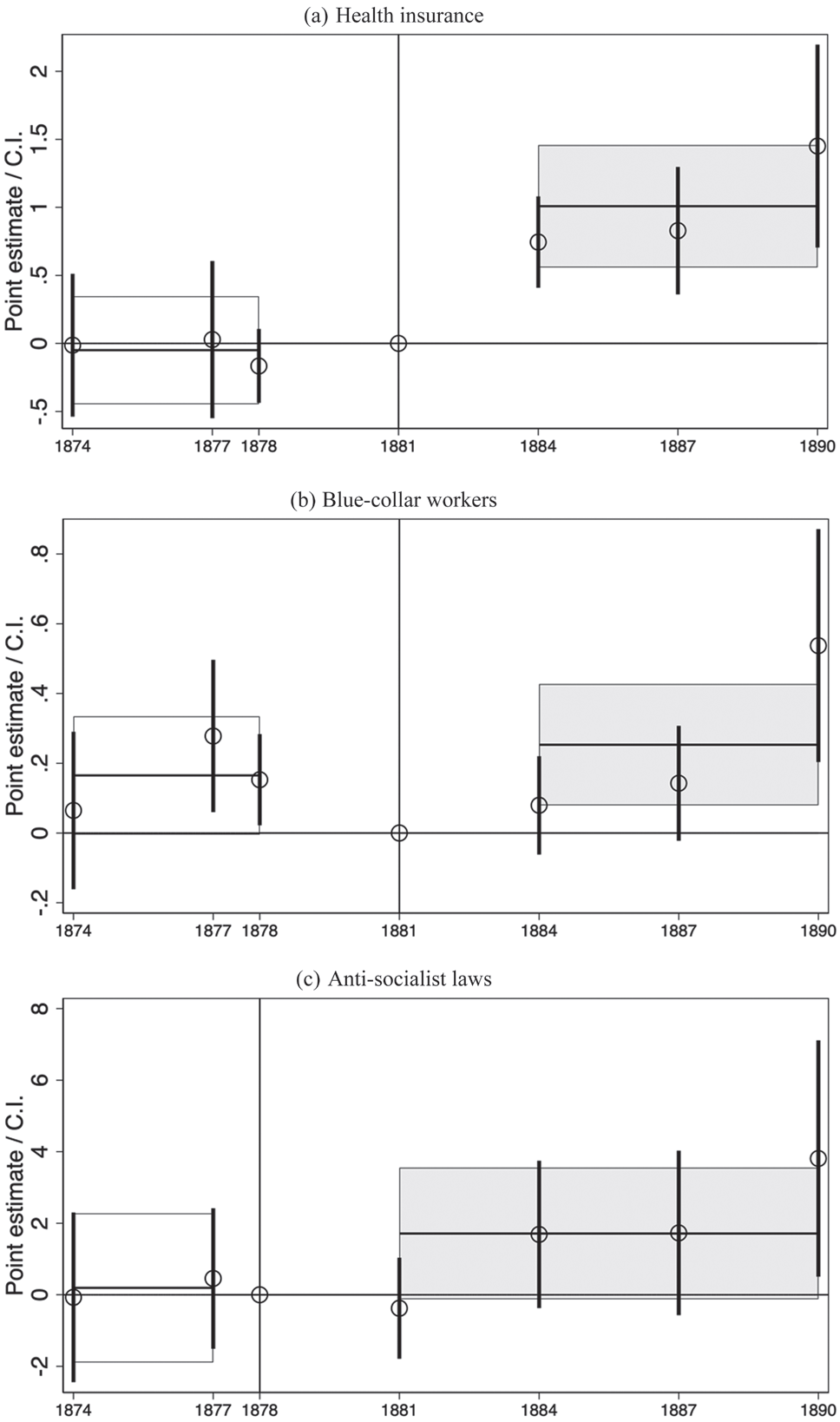
The event study results in Figure 1(a) show that the Socialist Party gained in constituencies with a higher share of newly insured workers after the health insurance reform.Footnote 9 Figure 1(a) shows only weak evidence for a significant pre-trend, as the coefficients for the elections before 1884 remain insignificant. The point estimates do not reveal any clear trend; that is, the pre-trend is not due to large standard errors. Overall, the pre-trends look highly stable: The coefficients are close to zero—the average coefficient for the pre-period is β = –0.049 (p = 0.832). This absence of a pre-trend is reassuring for my identifying assumption.
DRIVERS OF SUPPORT FOR THE SOCIALIST PARTY
Notes: The figure presents the effect of the share of newly insured workers on the vote share of the Socialist Party (Figure 1(a)). Additional results document event-study findings for the share of blue-collar workers (Figure 1(b)) and the anti-socialist laws (Figure 1(c)). Regressions are estimated using OLS, and include constituency and year fixed effects. Yearly regression coefficients of interest are interactions between the variable of interest and year fixed effects and are estimated relative to the omitted interaction with 1881, the last election before the reform, or 1878, the last election before the anti-socialist laws. Coefficient estimates on the election interactions are plotted as dots with their 95 percent confidence intervals indicated by vertical lines. Coefficient estimates on the aggregate interactions are shown with horizontal lines, and their 95 percent confidence intervals are indicated as boxes. Additional controls (next to the variables documented in these figures) include: share Protestants × election dummies. Standard errors are clustered at the district level.
Sources: See Online Appendix Section A.

To demonstrate the economic significance of the effect, I calculate the share of the change between the election in 1881 and 1884 that the effect of newly insured workers can explain. On average, the Socialist Party gained 2.05 percentage points between 1881 and 1884. Multiplying the standard deviation of newly insured workers (2.15, see Online Appendix Table B1) and the effect size (0.745 for 1884, see Column (4), Online Appendix Table D2) yields that the Socialist Party increases their vote share by 1.6 percentage points in a hypothetical electoral constituency with the same share of blue-collar workers and a higher share of newly insured workers of one standard deviation compared to the election in 1881.Footnote 10 Hence, one standard deviation in my treatment variable explains 80 percent of the increase in votes for the Socialist Party immediately after the reform. It is worth pointing out that the Socialist Party gained already in 1884. This result suggests that the party benefited when the accommodation strategy was decided upon. Hence, this finding rules out alternative mechanisms related to the economic consequences of the reform.
Figure 1(b) presents the flexible correlation between the share of blue-collar workers and votes for the Socialist Party. Compared to the omitted election year of 1881, vote shares appear higher in the pre-reform period, while the post-reform coefficients—except for 1890—are generally lower. Overall, the average coefficients before and after the reform are relatively similar. As noted previously, interpreting these results is challenging. Unlike Figure 1(a), this figure does not reveal a clear break around the time of the reform. It is therefore difficult to draw firm conclusions about how voters already covered by existing health insurance schemes, or those benefiting from accident insurance, responded to the reform. This represents a limitation of the study, partly due to data constraints and the structure of the reform itself. Nevertheless, focusing on newly insured workers enables a cleaner empirical identification for at least one segment of the blue-collar population—specifically, the group for whom health insurance was particularly salient. What is more, health insurance was likely more visible and relevant for short-term electoral decisions, as workers frequently fell ill or suffered minor accidents, with treatment costs covered for the first 13 weeks.Footnote 11 This allowed them to quickly experience the practical benefits of the reform. In contrast, personal experiences with accident insurance or old-age insurance were far less common, as serious accidents were rare and old-age benefits only became relevant after decades of continuous employment. Notwithstanding the caveats regarding voters already covered by existing health insurance or those benefiting from accident insurance, these considerations suggest that the share of newly insured workers captures a highly relevant dimension—particularly for understanding short-term political outcomes.
The impact of the anti-socialist law is illustrated in Figure 1(c) and Online Appendix E. Consistent with the historical literature discussed previously, I find no evidence of a decline in vote shares for the Socialist Party attributable to the law. If anything, the results suggest that the Socialist Party performed better in constituencies affected by the ban, relative to those that were not. Other studies have used alternative measures to capture the effects of the Anti-Socialist Law. In her dissertation, Bielefeld (Reference Bielefeld2023, chap. 3) employs time-varying censorship as the main explanatory variable and likewise finds that the Socialist Party benefited—helping to address concerns about the limitations of my measure, which lacks variation over time. In a related study, Thomson (Reference Thomson2022) examines another aspect of the law: the expulsion of socialist leaders from cities. His findings indicate a negative effect on Socialist Party vote shares. In contrast to his approach, my measure focuses on the law’s core feature—the ban on socialist organizations. While not the primary focus of this paper, the results based on my variable align with both the historical narrative and the findings of Bielefeld (Reference Bielefeld2023).
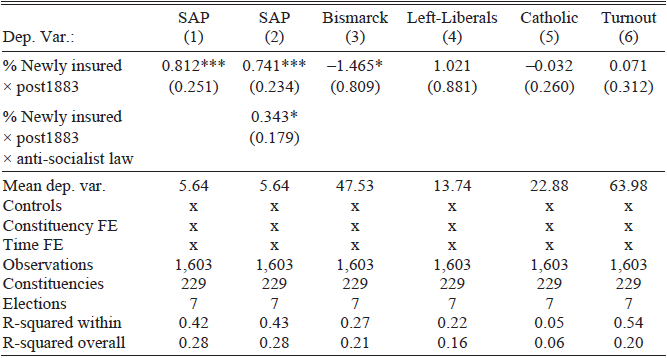
Table 1 documents the results using a difference-in-differences approach. Next to the net effect, the table also allows for an interaction between health insurance and the anti-socialist law. While the main coefficient of interest drops slightly, there is a weak positive interaction effect between Bismarck’s carrot (the health reform) and stick (the anti-socialist laws).
EFFECTS ON PARTIES AND TURNOUT

Notes: The dependent variable measures the share of votes for the Socialist Party (Columns (1) and (2)), Bismarck’s coalition of the National-Liberal Party and the Conservatives (Column (3)), the left-liberals (Column (4)), the Catholic party (Column (5)), and turnout (Column (6)). Treatment variable: share of newly insured population × post1883. Controls: Share Protestants × post1883, share blue-collar workers × post1883, and share urban population × post1883, banned socialist organization (dummy) × post1883. Standard errors, clustered at the district level, in parentheses. *** p<0.01, ** p<0.05, * p<0.1.
Sources: See Online Appendix Section A.
Where did the vote gains for the Socialist Party come from? Although a precise analysis of voter migration is not possible here, the approach allows us to analyze the effect of Bismarck’s reforms on the vote shares for other parties and on voter turnout. The results in Table 1 indicate that, in particular, Bismarck’s coalition lost after the reform. In other words, part of the increase for the Socialist Party came at the expense of Bismarck’s coalition. Turnout did not increase significantly in constituencies with a higher share of newly insured workers.
Online Appendix Table D1 explores alternative definitions of socialist electoral success. The reform is linked to a modest rise in the likelihood of the Socialist Party placing among the top two candidates, but offers only weak evidence of seat gains. This suggests the reform boosted socialist vote shares without threatening the established parties’ parliamentary dominance. There is no consistent change in the likelihood of a socialist candidate running or in voter turnout. Online Appendix Table D3 shows suggestive long-term effects, with a lasting increase in socialist vote share, though uncovering the underlying mechanisms is beyond this paper’s scope.Footnote 12
I do several exercises to account for the remaining concerns about my findings. One identification concern is that local industry shares could predict votes for the socialist parties through channels other than the health reform. I follow the approach of Goldsmith-Pinkham, Sorkin, and Swift (Reference Goldsmith-Pinkham, Sorkin and Swift2020) and construct pre-trend figures by industry to preclude other channels (see Online Appendix C for further details). I do not find evidence of systematic and significant pre-trends for the different industries in the change of votes for the Socialist Party (Online Appendix Figure C1). Moreover, my findings suggest that industries with a low share of ex-ante-insured workers drive my results. In addition, I conduct several other robustness checks dealing with potential violations of the parallel trend assumption (following Rambachan and Roth (Reference Rambachan and Roth2023), Online Appendix Figure C2), alternative treatment definition (Online Appendix Table D4), serial autocorrelation (Online Appendix Table D5), the spatial feature of the underlying data set (following Colella et al. (Reference Colella, Lalive, Sakalli and Thoenig2023), Online Appendix Table D6), sample definitions (Online Appendix Table D7), and other social cleavages (Online Appendix Table D2). Throughout these additional results, my core finding, which is the increase in votes for the Socialist Party, remains qualitatively the same and highly significant.
In sum, the results suggest that, with the health insurance reform, the Socialist Party gained higher vote shares in those areas where more people were affected by this reform. In principle, these votes could also come from voters not eligible for the health insurance reform. However, the historical literature strongly suggests that the Socialist Party was the party of the working class.Footnote 13 The lack of individual-level data does not allow a precise calculation of whether it was mainly the newly insured workers who voted for the Socialist Party or other blue-collar workers. Comparing Figure 1(a) with Figure 1(b) provides tentative evidence in favor of the former.
TOWARD THE MECHANISM
The last section has established the positive impact of the welfare reform on the growing success of the Socialist Party. Through the lenses of the conceptual framework, this finding strongly suggests that the challenger party gained from the accommodation strategy. In this section, I discuss this finding in light of the conceptual framework and potential alternative interpretations. In particular, I hypothesized that a stronger reformist stance helps the challenger party to retain issue ownership. I begin by providing qualitative and quantitative evidence for this reasoning. Next, I rule out several economic channels that would imply a different interpretation of my finding.
Reform vs. Revolution
The historical literature stresses the integration of the working class as a result of the reform. However, throughout the late nineteenth century, there were heated debates within the Socialist Party about the correct strategy (Berman Reference Berman2006). Parts of the party opted for a reformist approach to improve the working conditions. Others chose a more radical approach, aiming for a political and economic revolution, often based on rather orthodox Marxist thinking. Evidence in favor of the historical literature would point toward a more moderate position of the party.
After Bismarck’s reform, the party turned to “a political party in the modern parliamentary sense, involving the possibilities of swapping votes in elections, parliamentary maneuverings and compromises on elections” (Lidtke Reference Lidtke1966, p. 185). Within the party, it was primarily the elected members of parliament who strongly advocated the reform stance. Directly after the reform, most MPs (19 of 24) even aimed to support the government’s bill to subsidize steamship lines abroad (Lidtke Reference Lidtke1966, p. 185). On the one hand, the subsidy was part of the colonial strategy of the government, which the party refused; on the other hand, the subsidy was beneficial for workers at shipyards that experienced high levels of unemployment. The debate shifted into a conflict over how to weigh the advantages of reforms against political principles, which even threatened to split the party. The compromise eventually became conditioned on support for some amendments, which the other parties in parliament refused. Still, the conflict over the steamship subsidy revealed the dividing line within the party. Indicative of change among influential figures is Wilhelm Liebknecht, one of the leading politicians of the SAP and once a fierce opponent of parliamentarism, who started to advocate reform-oriented activities during this period (Lidtke Reference Lidtke1966, p. 239).
What is more, the reform wing used the reform itself to show its ability to organize health insurance in particular and reforms in general. Specifically, the party used one form of health insurance: mutual health funds. Mutual health funds were part of the institutional structure of health insurance. The insurance was organized in different forms at a local level, most notably local funds (Allgemeine Ortskrankenkasse), factory health insurance (Fabrikkassen), parish funds (Gemeindekrankenversicherungen), and mutual health funds (Hilfskassen). All these organizations had to provide the same service.
The mutual health funds represented the local social solidarity—organized by the party and the workers themselves—that the Socialist Party envisioned as an alternative to the other forms of health insurance (Collin Reference Collin2011, p. 201). Still, this form of insurance had a price for the workers. Employers did not contribute to this form of insurance, that is, employees paid more to become members of the mutual health fund. This cost makes it astonishing that this form of insurance became popular. Roughly 800,000 workers joined this type of health insurance in 1885 alone, accounting for almost 20 percent of all insured workers.Footnote 14 This share remained stable throughout the following years. The Socialist Party organized more than 1000 events in Germany to convince workers to join the mutual health funds (Hänlein, Tennstedt, and Winter Reference Hänlein, Tennstedt and Winter2009, p. XXXIV).Footnote 15 Providing this alternative arguably helped their case in convincing voters and showcasing their competence regarding social reforms in general and health insurance reform in particular.
However, what about the role of the radical wing that advocated a political revolution and fundamentally opposed the political system, including welfare reform? My proxy for the activity of this wing is the newspaper Der Sozialdemokrat. The Prussian Minister of the Interior von Puttkamer described this newspaper as “one of the most dangerous attacks on the security and inner peace of the German Reich” (cited after Engelberg (Reference Engelberg1959, p. 51, own translation)). Within the Socialist Party, the moderate wing often complained that only radical voices were allowed and that other opinions were taboo in the newspaper (Grillenberger Reference Grillenberger2019). The distribution of the newspaper heavily relied on local structures, suggesting that the distribution of the newspaper itself indicates the local strength of the radical camp.Footnote 16
Luckily, despite its illegal status, the subscribers’ lists are available in the archive of Julius Motteler, who was in charge of distributing the newspaper. Based on Motteler (Reference Motteler2019), I calculate the number of subscribers for each constituency between 1887 and 1890. Unfortunately, this information is not available for other years. I plot the spatial distribution of the number of subscribers in Online Appendix Figure B4. While there were many constituencies without subscribers, constituencies around Berlin, in the Ruhr area, parts of Saxony, and northern Prussia had quite large readerships.Footnote 17
To assess whether the distribution of the newspaper mattered for the electoral success, I use the following regression model, including an interaction term between the share of newly insured workers and the newspaper dummy variable; that is, testing whether there was a different effect of social insurance on votes in constituencies with a radical newspaper:

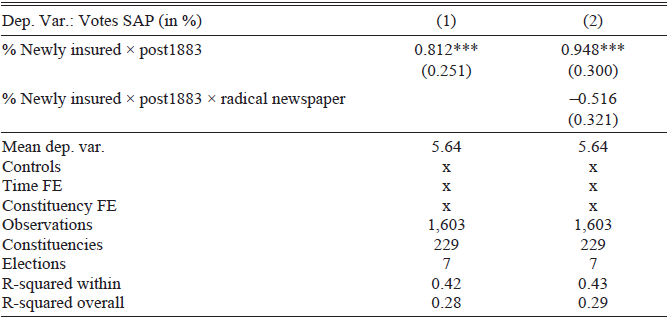
The results in Table 2 show no sign of a positive interaction effect; that is, no evidence that the Socialist Party particularly gained in constituencies with a higher share of newly insured workers and readers of their newspaper. In addition, the coefficient for the health insurance reform remains almost identical (comparing Columns (1) and (2)). This finding provides evidence that the strength of the radicals does not explain the growing popularity of the Socialist Party.
INTERACTION EFFECT BETWEEN HEALTH INSURANCE AND RADICAL NEWSPAPER

Notes: Unit of analysis: constituency. The dependent variable measures the share of votes for the social democratic party. Controls: Share Protestants × post1883, share blue-collar workers × post1883, and share urban population × post1883, banned socialist organization (dummy) × post1883. Standard errors, clustered at the district level, in parentheses. *** p<0.01, ** p<0.05, * p<0.1.
Sources: See Online Appendix Section A.
The presented qualitative and quantitative insights suggest that the Socialist Party turned to a more moderate approach to maintain issue ownership. In line with this argument, activities related to the radical wing did not explain the rising success of the party.
Economic Channels
Bismarck’s reform could have changed economic dynamics, which, in turn, could have affected voting decisions. I focus on migration, employment, wages, and firm size as alternative channels. In addition, I consider the mortality decline as a result of the reform to be a further alternative explanation.
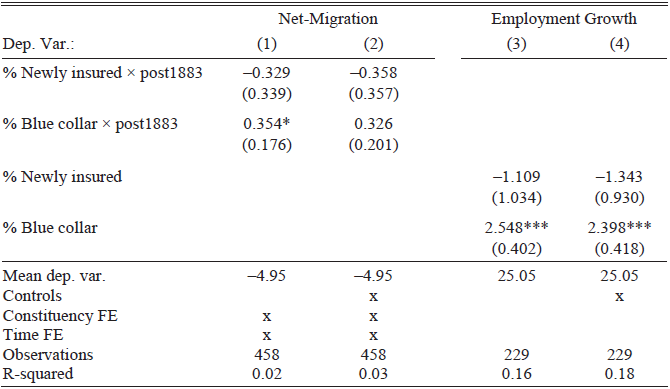
Internal migration could confound the interpretation of my results. Rural workers might migrate to the cities, potentially due to the ongoing industrialization, and extend the electoral base of the Socialist Party. Thus, I test whether constituencies with a higher share of ex-ante uninsured workers experienced differential migration rates after the reform. For this purpose, I rely on the population census made available by Galloway (Reference Galloway2007), which allows me to calculate net migration for each constituency 10 years before and after the reform.Footnote 18 The results in Columns (1) and (2) of Table 3 do not provide evidence for differential migration rates before and after the reform.Footnote 19
IMPACT OF NEWLY INSURED WORKERS ON MIGRATION AND EMPLOYMENT

Notes: Unit of analysis: constituency. The dependent variable measures net-migration (in percent) in Columns (1) and (2) and employment growth (in percent) in Columns (3) and (4). Further controls (Column (2)): share Protestants × post1883, banned socialist organization × post1883. Further controls (Column (4)): share Protestants, banned socialist organization. Standard errors in parentheses. *** p<0.01, ** p<0.05, * p<0.1.
Sources: See Online Appendix Section A.
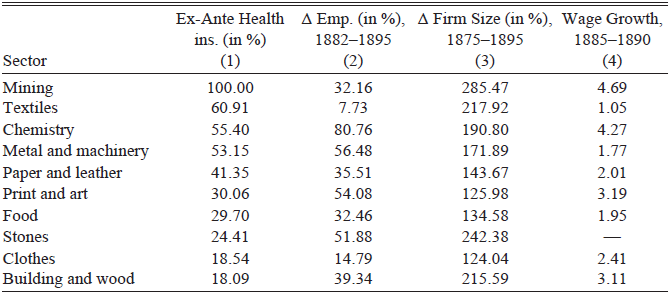
The welfare reform may have affected growth and firm dynamics in ways that advantaged the socialists. One concern could be that industries with a lower share of ex-ante-insured workers grow faster than industries with a high share of ex-ante-insured workers. To rule out this concern, I calculate the growth in employment by industry between the two censuses of 1882 and 1895 in Column (2) of Table 4. Overall, the pattern supports my argument. Industries with a low share of ex-ante insured workers (stones, food, clothing, construction and timber, print and art) grow on average at a comparable rate (38.5 percent) as industries (mining, metal and machinery, chemistry, textiles, paper and leather) with a high share of ex-ante insured workers (42.5 percent). If anything, this pattern works against the concern: the sectors most affected by the reform were not the faster-growing ones. Moreover, Columns (3) and (4) of Table 3 show that constituencies with a higher share of newly insured workers did not experience more industrial employment growth between 1882 and 1895 (relying on data from the occupation census).
ECONOMIC CHARACTERISTICS OF SECTORS

Notes: Unit of analysis: sector. In addition to the share of ex-ante insured workers, the table reports employment growth, firm size growth, and wage growth by sector.
Sources: See Online Appendix Section A.
Moreover, the reform may have increased small firms’ costs and led to the expansion of large firms already offering health insurance. If socialists had an advantage in organizing labor in large firms, their success might reflect large firms’ expansion. The descriptive evidence collected in Column (3) of Table 4 suggests this was not the case. If anything, sectors with a higher share of ex-ante-insured workers experienced stronger increases in firm size. Next, I show that wages grew in all sectors in line with the evidence on employment growth (Column (4) in Table 4). While there were some differences between the sectors, there is no clear pattern among sectors with a relatively low share of ex-ante-insured workers and sectors with a higher share of ex-ante-insured workers.
Bauernschuster, Driva, and Hornung (Reference Bauernschuster, Driva and Hornung2020) show that the reform led to a decline in mortality for workers. Hence, it is possible that potential voters of the Socialist Party may have died in lower numbers in areas more affected by the reform. This could represent an alternative mechanism. To rule out this possibility, I control for time-varying mortality rates in Online Appendix Table D2. Comparing the results of my preferred specification (Column (4)) with a specification including mortality rates (Column (5)) shows that the inclusion of this variable does not influence my main finding, which could be due to the fact that it took some time until the mortality decline became visible (Bauernschuster, Driva, and Hornung Reference Bauernschuster, Driva and Hornung2020, fig. 4).
The presented evidence on economic channels and the mortality impact of the reform corroborates my interpretation, according to which the Socialist Party gained votes due to its increasing reformist stance and issue ownership.
CONCLUSION
It was in Germany that the welfare state was invented. Investigating the political consequences of this landmark event, focusing on the health insurance reform, I show that the Socialist Party substantially benefited from the reform in elections. Through the lenses of the conceptual framework, this finding supports the idea that challenger parties can gain from an accommodation strategy due to credibility reasoning. Moreover, I provide some evidence that the Socialist Party adopted a stronger reform orientation after the reform. Taken together, the results link the narratives in the historiography, which are rarely thought of together.
My empirical analysis is based on an event-study approach that exploits different levels of treatment intensity for social insurance due to existing health insurance schemes. To address concerns regarding my key identification assumptions, I provide evidence that industry sectors with a low share of ex-ante-insured workers show the strongest positive correlation with vote shares for the Socialist Party after the health insurance reform and conduct several robustness tests. I investigate alternative political and economic mechanisms to validate my interpretation of the mechanism. Based on these additional results, I reject mechanisms related to a more radical strategy of the Socialist Party and to economic dynamics such as differential migration, employment growth, and firm size growth. Instead, I argue that parts of the Socialist Party turned to a stronger reformist stance.
What are the implications for our interpretation of Bismarck’s reform? Was it a success from his perspective? On the one hand, the Socialist Party became more successful due to Bismarck’s reform. This success of the Socialist Party also mattered for Bismarck’s career. Not only did the Conservative Party and National-Liberal Party lose in elections due to the reform, but he also had to resign as chancellor in 1890 when the Socialist Party became the strongest party in terms of absolute votes. On the other hand, the reform arguably strengthened the reform-oriented wing of the party. In this sense, it was a success for Bismarck.
Can the historical case study of nineteenth-century Germany inform modern-day debates? The debate about political responses to the growing support for populist parties is ongoing, with no clear consensus and a lack of empirical knowledge (Guriev and Papaioannou Reference Guriev and Papaioannou2022, p. 820). Based on the historical case of Bismarck’s Germany, it seems imperative to consider issue ownership when following radical parties’ demands to reduce their support. Mimicking competitors’ policies has the risk of strengthening their popularity and the potential to increase their reformist stance.


 Open access

