

Introduction
Cocoa is Ghana's main export crop. According to the Bank of Ghana, export receipts of cocoa beans and products for the first quarter of 2011 amounted to US$859.4 million, accounting for about 61% of total export earnings, compared with US$682.5 million in 2010 (GAIN, 2012). Production increased from 395,000 metric tons in 2000 to 740,000 metric tons in 2005, and to more than one million metric tons in 2011. Processed cocoa exports have increased from US$83.6 million in 2004 to US$152.9 million in 2006.
Yield per hectare is constrained by a number of factors including aged trees, low-yielding varieties, declining soil fertility levels, poor maintenance practices, predominance of old farmers (Baah and Garforth, Reference Baah and Garforth2008) and attack by pests and diseases (Dormon, Reference Dormon2006). Of these, pests and diseases are the most important factors, causing a 30% production loss annually and globally (Lass, Reference Lass, Flood and Murphy2004). In West Africa, the two most important insect pest species are mirids, Distantiella theobroma (Dist.) and Sahlbergella singularis Hagl. (Hemiptera: Miridae) (Owusu-Manu, Reference Owusu-Manu1985), occurring both in natural forests and on cultivated cocoa (Owusu-Manu, Reference Owusu-Manu1990; Padi and Owusu, Reference Padi and Owusu2001). The insects attack both young and mature cocoa trees and, in the former case, tree damage and mortality caused is a major limiting factor in the establishment of new cocoa areas. Young cocoa trees are particularly attractive to mirids as they feed on and lay their eggs in the succulent shoots. Further damage is inflicted by a number of Fusarium and Lasiodiplodia species invading mirid-feeding lesions and causing dieback disease that results in significant yield decline (Crowdy, Reference Crowdy1947; Owen, Reference Owen1956; Adu-Acheampong, Reference Adu-Acheampong2009; Adu-Acheampong and Archer, Reference Adu-Acheampong and Archer2011; Adu-Acheampong et al., Reference Adu-Acheampong, Archer and Leather2012). Severe mirid attack may leave several leafless trees in the row and their appearance is aptly described as ‘stag-headedness’ (Wright, Reference Wright1938). The high mortality rates recorded in mature cocoa trees are often due to the combined effects of mirid attack and fungal growth, and this explains the disproportionate damage that follows the presence of very low numbers of mirids. An average daily population of just over one mirid per tree has resulted in the loss of every tree in some areas (Nicol, Reference Nicol1953).
The most commonly used control measure for mirids is insecticide applications (Graham, Reference Graham1908; Dungeon, Reference Dungeon1910; Collingwood and Marchart, Reference Collingwood and Marchart1971; Owusu-Manu, Reference Owusu-Manu2001; Padi and Owusu, Reference Padi and Owusu2001; Adu-Acheampong and Ackonor, Reference Adu-Acheampong and Ackonor2005). Insecticide treatments can have severe environmental and human health consequences (Murray and Lopez, Reference Murray and Lopez1996; Bouwman et al., Reference Bouwman, Sereda and Meinhardt2006). The negative effects of indiscriminate pesticide use on natural enemies such as the weaver ant Oecophylla longinoda (Hymenoptera: Formicidae) in cocoa have been well documented, a reason either to refrain from pesticide use (Ayenor et al., Reference Ayenor, Röling, van Huis, Padi and Obeng-Ofori2007) or for applying relatively small quantities of insecticide in a selective manner (Leston, Reference Leston1970). Furthermore, the appropriateness of foliar applications in tree crops has been questioned (Muir et al., Reference Muir, Teixeira and Wania2004).
In recent decades, mirid populations and damage have been reported to have increased in West Africa, associated with changes in farm management practices and farming systems, such as use of improved varieties and fertilizers. In Ghana, we examined the proposition that this increase is because pesticide recommendations have not changed since the 1950s.
The earliest insecticides used were rotenone (extracted from Derris root), nicotine, dichlorodiphenyltrichloroethane (DDT) (Nicol, Reference Nicol1953) and a host of later additions. We provide here a list of these to indicate the tendency of industry actors to resubmit for approval of older generations of chemicals of known harm (e.g. persistent organic pollutants) and ineffectiveness, and to show the continued promotion by suppliers to farmers of out-of-date products that are now banned from use in other countries. Later additions include: aldrin, Gammalin 20 (lindane), dieldrin, endrin, heptachlor, malathion (Johnson et al., Reference Johnson, Burge and Gibbs1970), carbaryl, Shell SD 8280, Shell SD 8530, Shell SD 8436, Bayer 37 344, naled, dichlorvos, fenitrothion, phenthoate, fenthion, diazinon, chorthion, dimethrin, endosulfan, trichlorphon, dimethrin-piperonyl butoxide, fenchorphos (Prins, Reference Prins1965), C17018, arprocarb, Ortho 5353, dioxacarb, promecarb, methomyl, dicrotophos, monocrotophos, C 9643, GS 13 005, U-12 927, WL 21 959, MC-A-600, aminocarb, carbaryl, phosphamidon, cyanthoate, amidithion, dimethoate, mecarbam, formothion, chlorphenamidine, M 2840, C 8874, bromophos, dimetilan, OMS 786, ASP-51, SD 8447, PPO 62, bromophos-ethyl (Marchart, Reference Marchart1971), decamethrin, cypermethrin, permethrin, propoxur, fenvalerate (Owusu-Manu, Reference Owusu-Manu1985), imidacloprid, bifenthrin (Adu-Acheampong and Ackonor, Reference Adu-Acheampong and Ackonor2005), thiamethoxam, natural pyrethrum and its combination with deltamethrin (Cudjoe et al., Reference Cudjoe, Adu-Acheampong, Dwomoh and Nkansah2012, in press).
Owing to the very low numbers of mirids normally present on cocoa and their inconspicuous and concealed way of living, applying any insecticides is difficult to achieve. In Ghana, insecticides as aqueous emulsions or soluble concentrates are applied on mature cocoa trees with mist blowers and at the rate of 55–56 l/ha (Stapley and Hammond, Reference Stapley and Hammond1957). Operators with mist blowers on their backs walk slowly through the cocoa stand along transects, 3 m apart, aiming the spray up the stem of each tree, into and across the canopy and then down the stem (Johnson et al., Reference Johnson, Burge and Gibbs1970). Use of insecticides, as practised by some farmers, when there are no mirids or signs of mirid damage (i.e. not need-based) is wasteful. Sometimes, previously non-important pests have become important because of spraying that destroys their natural enemies, as has been the case in cocoa with respect to the shift in the status of the stink bug Bathycoelia thalassina (Herrich-Schaeffer) (Hemiptera: Pentatomidae) from a minor to major pest (Owusu-Manu, Reference Owusu-Manu1974).
Recommended mirid control in Ghana is calendar-based, with applications in August, September, October and December at 4-week intervals. The recommendation was based on the population build-up of mirids in the 1950s, which started in July and peaked in either October or November, using lindane as the main treatment (Stapley and Hammond, Reference Stapley and Hammond1957). Minor revisions were made in the 1960s (Peterson et al., Reference Peterson, Bond, Darko, Manteaw and Gerard1966; Collingwood and Marchart, Reference Collingwood and Marchart1971), but the recommendation has remained largely unchanged ever since.
Cocoa production started to decline in the 1980s to 1990s. Since 2001, the government has provided inputs (e.g. insecticides and spraying equipment) to support mirid control throughout the entire cocoa area under the mass-spraying programme. The programme is organized through locally contracted spraying gangs, and is widely believed to be the main reason for the increased cocoa production to more than 1 million tonnes in the 2010/2011 season. However, the increased production in this year coincided with a substantial increase in cocoa prices to producers and may simply be a correlation and no causation. Also, Abankwah et al. (Reference Abankwah, Aidoo and Osei2010) questioned whether the programme could have appeared to have improved farmers' income levels and standards of living because of contemporaneously pronounced inflationary effects. Smallholder cocoa farmers rarely generate sufficient income to purchase their own motorized spraying equipment. If they do apply their own control measures and are not properly trained in pesticide applications, usually their efforts are ineffective, because of mismanagement of the timing, quantity or type of chemical used.
Some of the chemicals used in the mass spraying and many of the pesticides utilized by farmers fall into World Health Organization (WHO) toxicity classes I and II, with severe consequences for environmental and human health (Muir et al., Reference Muir, Teixeira and Wania2004). The combined effects of the treatments are thought to have influenced insect population complexes, with associated impacts on the food web, potentially leading to a reduction in invertebrate species diversity, including ants and spiders, some of which act as the natural enemies of mirids (Leston, Reference Leston1970). Also, the development of pesticide-resistant strains of mirids has been reported (Leston, Reference Leston1970). Research on alternatives to conventional insecticides gained momentum in the 1990s as the Cocoa Research Institute of Ghana (CRIG) became alarmed about the long-term negative effects of conventional pesticide use (Adu-Acheampong, Reference Adu-Acheampong1997). An European Union (EU)-funded CRIG study initiated in the late 1990s gave a first indication that pest and disease cycles, and insect complexes, had changed since the 1970s (Padi and Adu-Acheampong, Reference Padi and Adu-Acheampong2003). For instance, the peak incidence of mirids was found to have shifted from August–December to September–April. The cocoa harvest traditionally is divided into the main crop (October–June) and the light crop (July–September). Because of widespread planting of the newer hybrid varieties, which begin to bear fruit after only 12 to 24 months and produce pods throughout the year, mirids can find food and breeding sites all year round, irrespective of the harvesting season.
More generally, the management and productivity of cocoa farms has been transformed over the last 20–30 years, largely through greater use of fertilizer and pest control in order to increase yields (The World Bank, 2011). These changes have undoubtedly played an important role in altering cycles of mirid populations and damage, although the mechanisms involved are poorly understood.
In 2011, a national-level multi-stakeholder platform, whose members comprise all the major actors in the cocoa sector (including farmers), reviewed the available data and added the following observations: the industry's stakeholders in Ghana have come to favour integrated pest management (IPM) as the industry standard, to meet buyers' increasingly stringent standards, reduce toxic loads on the environment, and increase farmers' skills and capacity to control pests by applying locally relevant, observation-based treatments. Moreover, for the 2009/2010 season, members of the platform calculated the components of the free-on-board export price, and so revealed the extent to which farmers indirectly pay for the mass-spraying programme. Since not all farmers receive mass-spraying services (because of poor management of the contracting process and inadequate supervision), both equity and efficiency concerns were subsequently raised by the stakeholders, including cocoa farmers' organizations. Economic analyses suggest that raising producer prices to compensate for increases in general price levels in the economy would improve the purchasing power of farmers (Abankwah et al., Reference Abankwah, Aidoo and Osei2010), and increase the incentives for farmers to maintain healthy plantations and produce quality beans (Quarmine, Reference Quarmine2013).
Owusu-Manu (Reference Owusu-Manu2001) already in 2001 called for a review of the chemical control strategy. Currently, the multi-stakeholder platform working together with the Ghana Cocoa Board (COCOBOD) is considering opening pest and disease control to farmers' decision-making and private sector supply of agro-inputs. However, the stakeholders are anxious that this should not lead to negative environmental and human health consequences, and the kinds of misuse and abuse of pesticides seen in other countries under market-based supply of pesticides. Farmers also should have the opportunity and time to learn to understand and apply IPM principles and practices if the pesticide recommendations were to be brought up-to-date. According to those principles, the development of any new recommendation would need to be based on sound knowledge of mirid population dynamics (Gibbs and Leston, Reference Gibbs and Leston1970) under contemporary farming systems. This article aims to provide up-to-date information to help evaluate the current recommendations.
The scope of the article covers the following: (i) the 1970 recommendations, i.e. the calendar-based regime, volumes applied, pesticides and active ingredients (Collingwood and Marchart, Reference Collingwood and Marchart1971), WHO toxicity classes and current temporal distribution of common cocoa pests – based on a quantitative study (Padi and Adu-Acheampong, Reference Padi and Adu-Acheampong2003); (ii) a description and distribution of the new cocoa varieties; (iii) results of farmers' group discussions and interviews conducted in 33 cocoa-growing districts over 3 years (2010 to 2012) to better understand farmers' concerns and questions regarding pesticide use; (iv) the growth of organic cocoa – extent, location, pest management options and the role of natural pyrethrum (Cudjoe et al., Reference Cudjoe, Adu-Acheampong, Dwomoh and Nkansah2012) and (v) the actual and potential role of cultural practices in pest management (Quarmine, Reference Quarmine2011). The discussion assesses the IPM options for pest management and pesticide use in cocoa, if IPM were to become the new industry standard in the context of a shift towards market-based supply of pesticides. The discussion is positioned in relation also to policy changes at the global and country levels.
Materials and methods
Description of sampling sites
Mirid abundance on a total of 102 cocoa farms across the six cocoa-growing regions of Ghana (Fig. 1) was sampled and measurement of mirid population dynamics made on a total of 23 farms during the 1999, 2003 and 2012 growing seasons. Data from inventories made in 1991 were included for comparison. The farms covered as wide a variety of farming systems as possible and ranged in size from 0.2 to 20 ha (mean = 2.39, SE = 0.39), and comprised 87 farms planted with mixed hybrid and 15 farms with mature Amelonado (unimproved) cocoa. Rain in all seasons fell primarily between the months of March and October. The mean annual rainfall was 1640 mm, with a pronounced dry season from November to February (monthly precipitation < 60 mm). The average daily maximum temperatures during the study period ranged from 27.8 to 32.7 °C. No systematic differences in the cocoa farming systems of farms with young or mature cocoa, especially when both young and mature trees occurred either on the same or adjacent piece of land, were found, so this variable is ignored in the analysis. Various combinations of food crops, including plantain, cassava and oil palm, bordered most farms. Most were also reasonably weed-free with closed canopies, but shrubs and annual weeds were abundant along the fringes. In addition, before initiating pest control, interviews with 85 farmers who agreed to be included in the study and 18 focus group discussions involving 253 farmers were conducted in 33 cocoa-growing districts for information on farming systems and areas of decision-making.
(colour online) Map of Ghana showing cocoa farms surveyed

Sampling of mirid populations
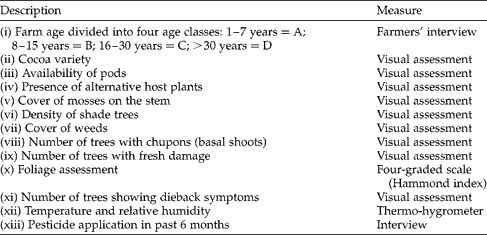
Mirid data were collected monthly from January to December on 100 randomly selected cocoa trees per plot of 0.4 ha area by visually counting up to hand height (2 m). Mirid counts for separate species were recorded on 23 farms by direct inspection. Cocoa variety was recorded for each farm. The mirid count for every month/farm was aggregated after initial categorization into the age classes of nymphs and adults. Mirid damage was assessed on 100 plants per plot by counting the percentage of trees with new damage to foliage, and by recording the percentage of trees with severe, medium, mild or nil damage using the Hammond index for the state of the canopy (Johnson, Reference Johnson1971). On each cocoa farm, we quantified 13 farm-specific variables (Table 1).
Description of the 13 farm-specific variables on 102 cocoa farms
Farmer survey
From an initial random survey of 115 farmers, 85 who agreed to be part of a further study were identified for a follow-up interview. In addition, 18 focus group discussions comprising 253 farmers were held, with participants recruited by open invitation to members of cocoa-growing societies across 33 cocoa-growing districts. Lists of the societies were obtained from the licensed buying companies (LBCs) operating in the different districts. The interview was based on a one-on-one questionnaire that included the name, age, sex, farm size, farming practices, cocoa varieties, the pests for which farmers applied pest control methods, and their perception about the national Cocoa Diseases and Pests Control Programme. The respondents were asked also whether they currently used conventional insecticides as part of their pest management programmes. The respondents currently using additional conventional insecticides were asked questions on their reasons for applying additional insecticides, the timing of the treatments and the distance of their farm from the nearest agro-input store. Non-users of insecticides were asked their reasons for not using insecticides. Because absentee cocoa farming is common, the respondents were classified as land owners or caretakers. Primary data from the focus group discussions were collected through manual recording of the views and responses exchanged by the farmers.
Statistical analyses
Generalized linear models were used for data analysis using the R statistical package (Crawley, Reference Crawley2005). Principal component analysis was used to reduce the 13 cocoa farm-specific variables to a few essential components that could explain more than 10% of the variance among them. The analysis in this study combined the two data sets to investigate the relationship between farm-specific variables and mirid populations. Spearman's rank correlation was used to analyse the farm-specific variables and the relationship between the principal components and mirid populations. The overall relationship between the farm-specific variables was analysed by means of Kendall's coefficient of concordance (W). Kruskal–Wallis analysis of variance by ranks (H) was used to test the overall differences between the cocoa varieties grown in the different farms. For the age-specific comparison between the age classes of cocoa and the location of cocoa farms, the Mann–Whitney U test was applied.
Results
Farm-specific variables
Many of the 13 farm-specific variables (Table 1) recorded were associated with each other (W= 0.53, n= 437, P< 0.001). The presence of numerous basal shoots and pod availability were positively correlated with cocoa variety (r 1= 0.5; r 2= 0.4, respectively), whereas the number of trees with dieback disease was negatively correlated (P< 0.05) with the number of trees with fresh mirid damage (r= − 0.3). Also, moss-covered tree trunks were positively correlated with the age class of the trees (r= 0.6). The moss covering on trees was generally higher in the age classes C and D (16–30 and >30 years, respectively).
The three principal components from the analysis were availability of pods, presence of numerous basal shoots and cocoa variety. Pod availability explained 30% of all variances among the farm-specific variables, presence of numerous basal shoots 22% and cocoa variety 12%. These variables are related to both biological and farm management practices.
Mirid population dynamics
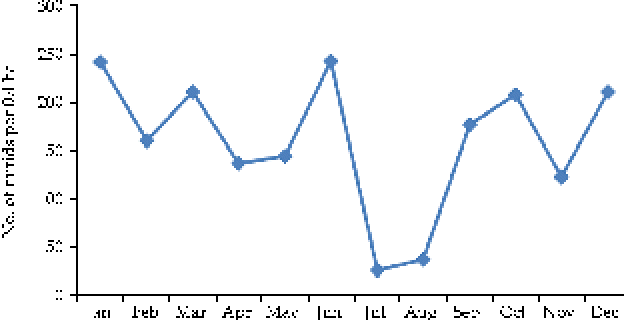
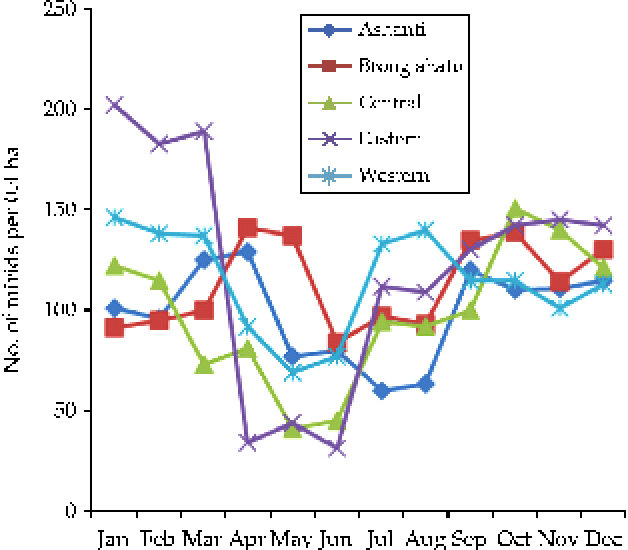
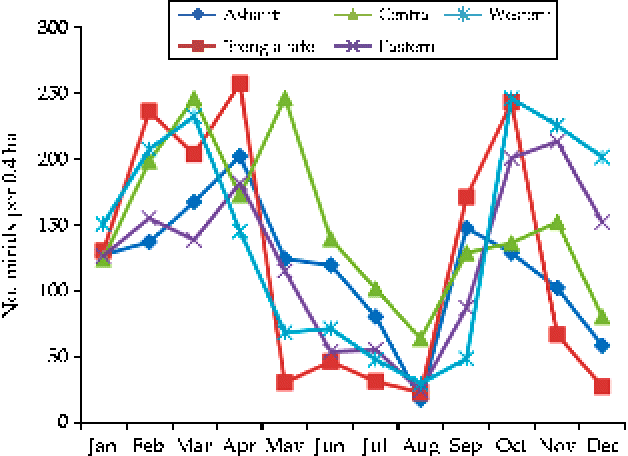
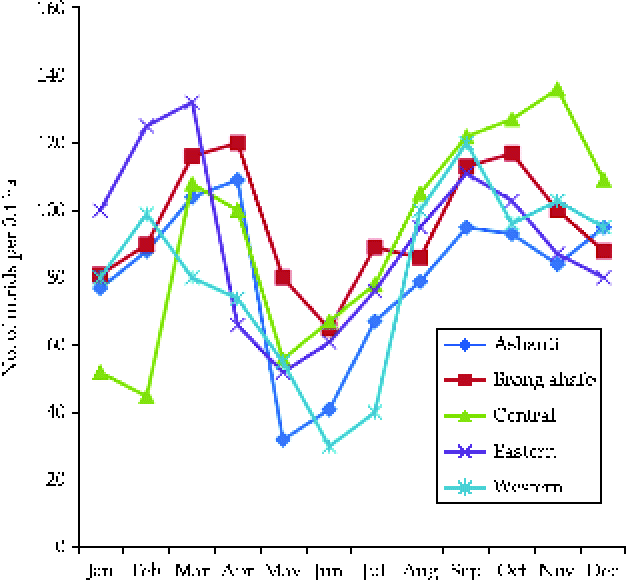
A total of 19,714 mirids comprising D. theobroma (Dist.), S. singularis Hagl., Bryocoropsis laticollis Schumacher and Helopeltis spp. were sampled over the course of the study period. There was a marked seasonal variation in mirid populations, but only data on the two most important species, namely D. theobroma and S. singularis, were used for the analyses, as B. laticollis and Helopeltis spp. formed a very small proportion of the total (3.6%). Data from the two dominant species were pooled (Figs 2–5). There were marked differences in the proportion of nymphs and adults, i.e. 72 and 28%, respectively. Distantiella theobroma accounted for 41% of the sample and S. singularis 59%. Because of the large variations between farms, we considered it unnecessary to compare data among the farms statistically. The population densities of the mirids also varied significantly from month to month; nonetheless, the data clearly showed some trends. High mirid populations occurred from January to March or April, dropping to low but consistent levels until August. A second peak was recorded from October to November at most locations (Figs 2–5). An exception to this was in 1991, when a third peak was recorded in June. The presence of different developmental stages of mirids throughout the season at all locations indicates overlapping generations. The drop in November illustrated in Fig. 2 is associated with the peak harvesting period (which reduces the number of pods and sites where mirids can feed and reproduce).
(colour online) Mean seasonal abundance of mirids assessed on cocoa trees in Ghana in 1991.
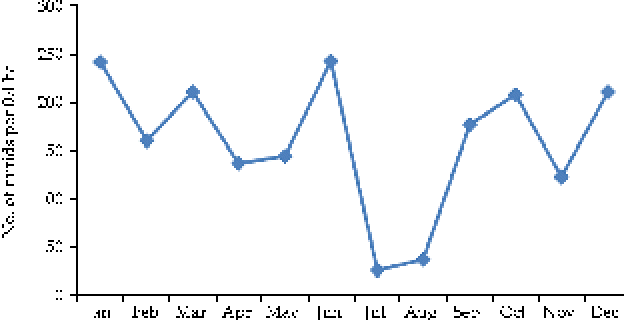
(colour online) Seasonal abundance of mirids on cocoa trees in Ghana in 1999.
(colour online) Seasonal abundance of mirids assessed on cocoa trees in Ghana in 2003.
(colour online) Seasonal abundance of mirids assessed on cocoa trees in Ghana in 2012.
Farmer survey results
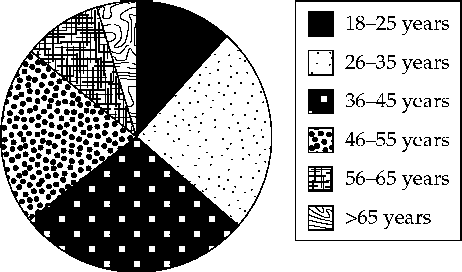
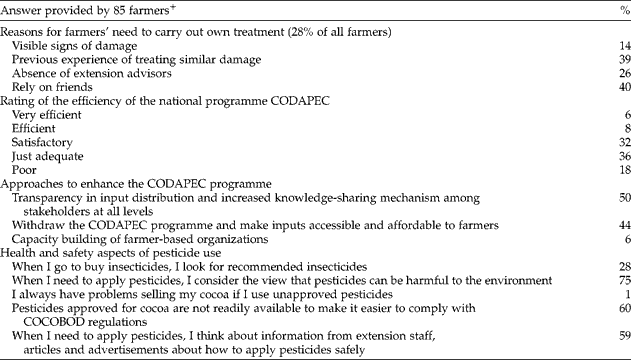
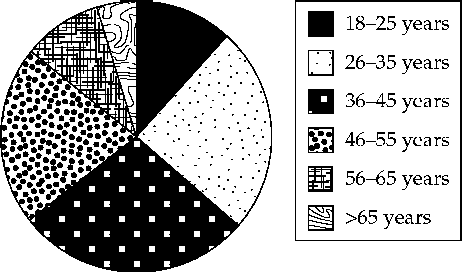
Table 2 shows the farm size and pest management practices of the interviewed farmers (58% received mass spraying in the survey seasons). The age structure of the respondents is summarized in Fig. 6. In 72% of the cases, males were the head of the household. About half of the labour used in cocoa was carried out either by the wives (28%) or hired labour (20%). The survey further indicated that 28% applied an additional insecticide in January to March, 14% in April to June, 23% in July to September and 35% in October to December. The majority of those using insecticides (72%) bought the insecticides that were available in chemical input stores. More than 50% of the respondents lived more than 50 km away from the nearest agro-input shop, 12% lived within 2 km and 36% within 5–6 km. Twenty-four percent of the farmers spent GH¢100–150 (US$50–75) on insecticides, 37% spent GH¢200–300 (US$100–150) annually on fungicides and 15% spent equal amounts on insecticides and fungicides. Chlorpyrifos and endosulfan (neither recommended for use in cocoa) were the most commonly used pesticides.
Farm size and pest management practices practised by cocoa farmers (n=85) (the numbers in parentheses represent the percentage of cocoa farmers using a particular practice or input)

Age structure of 85 respondents interviewed in farmer survey.
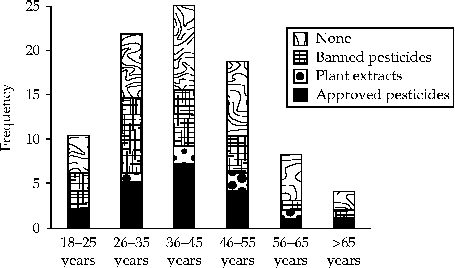
The common reasons that the farmers gave for carrying out their own pesticide applications in addition to the government's approved mass sprayings included visible signs of damage, previous experience of treating a similar problem, emergence of secondary pests (e.g. stink bugs, stemborers and leaf-feeding caterpillars) and absence of extension advisors. Forty percent of the respondents who carried out their own treatment accepted the recommendations of family and friends. Frank responses were obtained from the respondents participating in the focus groups because they realised that the issues raised in the discussions were not directly related to themselves. They said that this gave them a feeling of security that they could speak openly. The two main concerns of the farmers during the focus group discussions were the (i) politicization of the national mass-spraying programme and (ii) unavailability of approved pesticides in the open market. Some of the insecticides sold in the input stores were either not officially recommended or were banned for use on cocoa, or were concocted from a mixture of insecticides by the farmers themselves. A significantly higher proportion of young ( < 45 years) male respondents had used non-approved insecticides than the other age groups (Fig. 7).
Pesticide use pattern by different age groups of respondents.
Neither ownership nor farm size was associated with the age of the respondent for reasons not explored in the study. However, larger cocoa farms operated by owners were associated with the application of additional insecticide treatments (P< 0.05). The survey also revealed that about 10% of the respondents encouraged a mass-spraying gang to apply higher than recommended doses of the treatments. Responses in the focus group discussions suggested that some of the farmers influenced the gangs by asking them to mix approved and non-approved insecticides in the hope that efficacy would be improved.
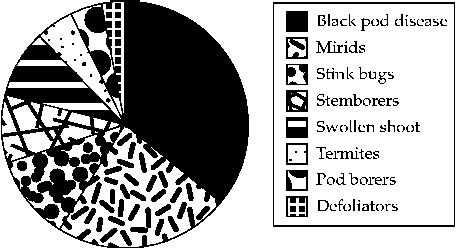
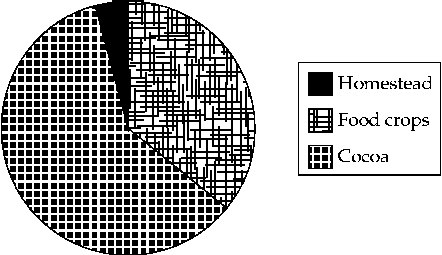
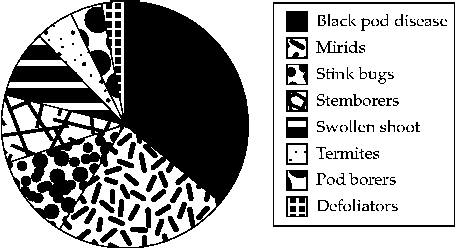
In the study areas, the mean farm size was 2.3 ha, with most of the respondents operating between 3.7 and 7.2 ha. Thirty-six percent of the village land was used for food crops, while 4% was used for village settlement; the rest (60%) was available for cocoa (Fig. 8). The respondents stated in the interviews that the land reserved for food crops tends to be determined by the area dedicated to cocoa production rather than vice versa. They also stated that when they had income to invest in cocoa, they preferred to invest in disease and pest control rather than in other cocoa production activities. They indicated that yield loss through black pod disease and canker (36%) was by far their most pressing concern, followed by mirids (23%) (Fig. 9).
Land use for different agricultural purposes.
Farmer-identified pest and disease constraints.
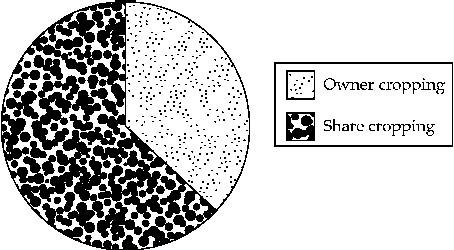
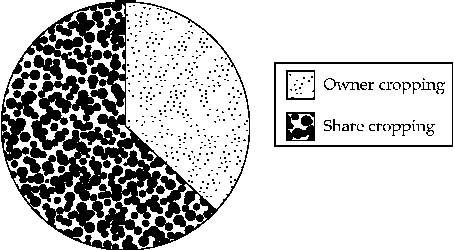
Around a third of the respondents (37%) owned their farms and 63% were caretakers who operated as many farms as they were able to, because there were no restrictions on the number they could look after (Fig. 10). Seventy-five percent of the landowners and 25% of the caretakers applied insecticides to the cocoa.
Land tenure arrangements.
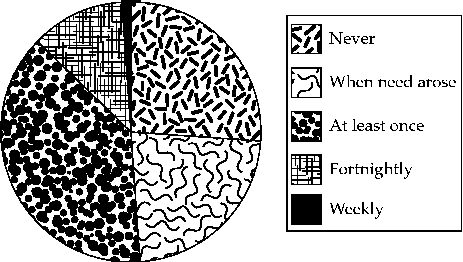
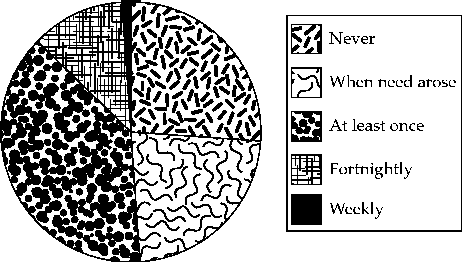
The survey indicated that 19% of the respondents were never visited at all by the extension workers, while 15% were visited only when the need arose. Fifty-two percent were visited at least once a year, 13% fortnightly and 1% weekly (Fig. 11).
Visit by extension advisors.
The farmers who were visited by cocoa extension officers and who adopted all the CRIG/COCOBOD pest control recommendations were few in number and hard to find in our sample (Table 2). Over 50% of the respondents further mentioned incomplete coverage by the mass-spraying agency (Cocoa Diseases and Pests Control Programme – CODAPEC) as a major concern, especially in the 2011 and 2012 seasons (Table 3).
Farmers' opinion about pesticides: own applications, national programme and health and environmental issues
CODAPEC, Cocoa Diseases and Pests Control.
+ More than one answer possible.
Discussion
This article reports the results of the surveys of the numbers of cocoa mirids on cocoa farms in Ghana, along with the results of a survey of cocoa farmers interviewed in 2010–2012. The results show the potential interaction between mirid populations and some farm-specific parameters. They suggest that revision of the treatment recommendations is long overdue. They pinpoint in particular the importance of the temporal dimension of treatments. We discuss each of these points in turn.
Sampling of mirid populations
Mirid population dynamics on the 23 farms revealed a seasonal rise in January to April followed by a decline in May to August and a second rise in September to December. Although the populations were sampled in different years with perhaps different conditions, the general pattern of the results was similar. This cyclic effect is a feature of many insect and animal populations. In our study, the mirid population was highest in cocoa farms where the trees were < 30 years old, which is similar to the results obtained by Collingwood et al. (Reference Collingwood, Marchart and Manteaw1973), who found higher populations on coppiced and younger cocoa than mature cocoa trees. We also found that a higher population was positively pod-related (length of time that trees carry pods) and to the presence of numerous basal shoots. This is generally so because both plant parts provide breeding sites, food and shelter for mirids. Although we only studied mirid temporal distribution and abundance over the years, populations of other emerging pests such as the stink bug also seem to be promoted by the year-round availability of pods on the newer varieties recently introduced and planted by farmers. The results indicate that the treatments in March or April/May might help to also manage stink bug damage on cocoa because the bugs are more prevalent during these months.
The relationship between pod loads on mirid populations is strong with both displaying similar peaks, such that the highest mirid population density occurs when pod numbers on trees are highest. Mirid densities decline as pod harvesting continues and the cocoa season enters into the light crop, i.e. the period for small beans (May/June). A possible reason for this pattern is the elimination of the preferred site for oviposition. Most of the reported declines in mirid populations have been due to changes that arise upon harvesting of pods (Collingwood et al., Reference Collingwood, Marchart and Manteaw1973). Williams (Reference Williams1953) showed that mirids prefer to hide under pods, especially the immature stages.
As mirids prefer pods and basal shoots for shelter, oviposition and food, it is probably the reason why the pest is abundant on newer varieties and favours cocoa less than 30 years old. In our study, for hybrid cocoa, the seasonal pattern was nearly entirely explained by the availability of pods and basal shoots. In contrast, on the older Amelonado variety of cocoa, the seasonal pattern was distinct within a narrower temporal opportunity for mirid activity, and it was weakly associated with either the presence of pods on the trees or basal shoots. Following the results of our study, we explored why mirid occurrence over time follows the fruiting pattern and a tree's ability to produce more basal shoots, and why fruiting and shade are important to the variance in the incidence of mirids between the varieties. Work on plant genotypes suggests several mechanisms (e.g. morphology, physical barriers, composition of primary and secondary metabolites) by which insect activity might be positively correlated with plant variety (Manrique et al., Reference Manrique, Cuda, Overholt, Williams and Wheeler2008). Nitrogen may indirectly affect mirids via its effects on protein synthesis, which can influence survival through a variety of mechanisms (Bentz et al., Reference Bentz, Reeves, Barbosa and Francis1995; Manrique et al., Reference Manrique, Cuda, Overholt, Williams and Wheeler2008), but we know very little as yet about this aspect of mirid physiology.
In addition, we note that our survey identified a number of recently introduced or emerging pests including leaf defoliators (Anomis sp.), pod borers (Characoma stictigrapta), stink bugs (B. thalassina), stemborers (Eulophonotus myrmeleon Fldr.) and a certain species of ant that inhabits tree trunks after pesticide applications, as previously noted by Leston (Reference Leston1970).
Youdeowei (Reference Youdeowei1971), working in Nigeria over 40 years ago, reported good control of mirid populations and their damage with Gammalin 20 and Arkotine 25. Following insecticide application on large contiguous plantations, Collingwood and Marchart (Reference Collingwood and Marchart1971) and Johnson et al. (Reference Johnson, Burge and Gibbs1970) reported reduced mirid populations in Ghana. In the Eastern Region of Ghana, the effect of insecticide sprays on farm condition was greater than could be expected from the minimal effects on mirid density by cultural control (Owusu-Manu, Reference Owusu-Manu2001).
Farmer survey
Pest control by cocoa farmers themselves can be defined as a panic reaction to visible damage, in the absence of expert advice on prevention and control. The cocoa sector in Ghana is made up mainly of smallholder farmers who are disadvantaged in accessing inputs, credit, extension services and markets for their produce. They expect government extension personnel of the Cocoa Swollen Shoot Virus Disease Control Unit (CSSVDU), who are responsible for both advisory and treatment work, to provide them with the essential information to increase their yields. These personnel are supposed to advise cocoa farmers on good farm husbandry practices, and treatment of diseases and pests. They are also expected to visit farmers on a regular basis and to be stationed at places where farmers can easily reach them. It is expected that more frequent visits by these personnel would lower the significance of diseases. Thus, it was surprising to find no correlation between the frequency of visits by the extension staff and the application by farmers of pest control measures. Our interviews indicated that there are not many extension personnel in the cocoa-growing areas. The few who were present tended to assume that the mass-spraying programme had removed the need for them to guide farmers on insecticide treatments and appeared unwilling to spend time to advise farmers on their individual pest problems. Ghana has some 237 cocoa extension officers working with the country's over 800,000 cocoa farmers (Adu-Acheampong, Reference Adu-Acheampong2009). This translates into a ratio of one extension agent to 3375 farmers, which is far shorter than the United Nations Food and Agriculture Organization's estimate of 1:1809 for sub-Saharan Africa (Roseboom, Reference Roseboom2004). Thus, cocoa farmers turn to family, friends, LBCs and input suppliers for advice.
Of the respondents, fifty (50%) had carried out some form of pest control on cocoa during the preceding 6 months. In previous studies, the prevalence of reactive treatment varied widely from 13 to 95% (Padi and Owusu, Reference Padi and Owusu2001). The average for the number of pesticides used by the 50 respondents in our study was 1 per person per year. Because men have a better socio-economic status compared with women, better earning power and a higher educational level, this finding seems counter-intuitive and needs further study.
Cocoa farmers also said they use plant extracts. Some of these plants/trees, for instance neem, are abundant particularly on the southern plains. Some respondents said they feel more comfortable using plant extracts because they mistrusted the power of chemical treatments. We observed that the treatments sold through the LBCs were mixtures (of unknown composition and potency). Some farmers considered these mixtures to be more efficient, safer and devoid of adverse effects. Some of the older farmers in our sample still keep in store obsolete stocks of chemicals such as lindane that was banned over a decade ago.
We discussed in our interviews what observations the farmers were making to trigger a decision to purchase a treatment. The recommended threshold observation is 100 mirids per hectare (Collingwood et al., Reference Collingwood, Marchart and Manteaw1973). However, we found that none of the farmers in our sample were aware of this recommendation and had developed a variety of local rules to guide their decision. For instance, a few farmers said that they applied insecticides when they saw signs of dieback or when there were symptoms of pod damage. This suggests that for the sector, relying on pest control through the open market could have severe negative consequences for management and farmers' income. A considerably strengthened public advisory service would be necessary to support farmers to make informed decisions.
At the same time, the CRIG is investigating new forms of mirid control. These include the use of insect sex pheromones (Ayenor et al., Reference Ayenor, Röling, van Huis, Padi and Obeng-Ofori2007; Sarfo, Reference Sarfo2013). The Institute has recently approved the use of a natural pyrethrum for use on cocoa. Pyrethrum, in the form of pyrethrins, is on Annex 1 of the new EU legislation on pesticide residues, with the maximum residue limit (MRL) set at 0.5 mg/kg. The stability of pyrethrum, coupled with its acceptance to most certification bodies, adds to its unique positive attributes for organic cocoa production in the country. Organic cocoa is being produced on an 8200 ha tract of cocoa in the Suhum District of the Eastern Region of Ghana (05°59.439′N, 00°34.724′W), currently involving 4685 smallholder farmers (Cudjoe et al., Reference Cudjoe, Adu-Acheampong, Dwomoh and Nkansah2012).
Conclusion
This study presents evidence and a rationale for revising cocoa mirid control recommendations. We recommend considerably expanded investment in farmer education to help them understand the population dynamics and field ecology of mirids and the provision of advice to support their management decisions on the basis of economic thresholds. This means no more mass spraying but need-based farmers' assessment of pest incidence. We also suggest further study and promotion of the potential of treatments used in the organic cocoa sector with the view of wider application in non-organic areas.
Acknowledgements
The authors are grateful to Messrs Emmanuel Obeng, Laurence Adu, Alfred Adjabeng, Afari Boateng, Kwame Frimpong and Yaw Nkroma Dankwa for technical support. The Concertation and Innovation Group of the Cocoa Domain of CoS-SIS Programme is acknowledged for their support. This paper is published with the kind permission of the Executive Director of the CRIG.
Appendix 1. Author details
colsep="0" rowspan="0"