Preferences for the redistribution of earned income have received considerable attention across the social sciences (Alesina and Giuliano Reference Alesina, Giuliano, Benhabib, Bisin and Jackson2011; Margalit Reference Margalit2013; Owens and Pedulla Reference Owens and Pedulla2014). Survey-based studies identify material self-interest (Alesina and La Ferrara Reference Alesina and La Ferrara2005) and ideological factors, most notably political left–right ideology (Alesina and Glaeser Reference Alesina and Glaeser2004; Fong Reference Fong2001), as the principle determinants of such preferences. In most of these studies, redistributive preferences are quantified using politically framed survey questions invoking specific redistributive schemes or welfare policies. This being the case, if individuals’ redistributive preferences vary depending on which policy they have in mind, these frames could be driving the results (Cavaillé and Trump Reference Cavaillé and Trump2015; Jaime-Castillo and Sáez-Lozano Reference Jaime-Castillo and Sáez-Lozano2016).Footnote 1
To eliminate the possible effects of political framing, some studies use behavioral laboratory experiments designed to reveal individuals’ redistributive preferences through the decisions that they make under abstract and controlled conditions (Barber et al. Reference Barber, Beramendi and Wibbels2013; Barr et al. Reference Barr, Burns, Miller and Shaw2015; Barr et al. Reference Barr, Miller and Úbeda2016; Durante et al. Reference Durante, Putterman and van der Weele2014; Esarey et al. 2012). These consistently show that economic status affects redistributive preferences, while the association between political ideology and redistributive preferences appears to be more nuanced. Durante et al. (Reference Durante, Putterman and van der Weele2014) show that, among students, self-identified political liberalism is positively associated with demand for redistribution. However, Esarey et al. (2012) find strong support for the self-interest hypothesis, but only an indirect effect of ideology, specifically, conservatives are more responsive to their self-interests than liberals. And Brown-Iannuzzi et al. (Reference Brown‐Iannuzzi, Lundberg, Kay and Payne2015) find that attitudes towards redistribution are driven by subjective, relative economic status with ideological principles being used to justify attitudes ex post.
We complement this literature, by using a “lab-in-the-field” experiment (Morton and Williams Reference Morton and Williams2010) to investigate the associations between economic status, political ideology, and preferences for the redistribution of earned income. The experiment involves a distributive justice game designed to measure individual acknowledgement of earned entitlement, i.e., the strength of the preference not to redistribute money that is earned compared to money gained owing to pure luck, and participants’ political left–right ideology is measured using a standard survey question. To identify the effect of economic status on redistributive preferences, employed, and unemployed individuals were invited to participate in the experiment. In this regard, we follow recent longitudinal and experimental studies that show that experiencing unemployment is associated with increased demand for welfare policy (Margalit Reference Margalit2013), redistribution (Owens and Pedulla Reference Owens and Pedulla2014), and the public provision of unemployment benefits (Naumann et al. Reference Naumann, Buss and Bähr2016), and a reduced inclination to reward effort and productivity (Barr et al. Reference Barr, Burns, Miller and Shaw2015; Barr et al. Reference Barr, Miller and Úbeda2016). Then, to build a link to the literature on laboratory-based behavioral experiments, we also invited students to participate.
Drawing on the extant attitudinal and behavioral literature on unemployment and redistribution and using the psychological concepts of cognitive dissonance (Festinger Reference Festinger1957) and self-serving bias (Babcock and Loewenstein Reference Babcock and Loewenstein1997), Barr and coauthors (Reference Barr, Burns, Miller and Shaw2015; Reference Barr, Miller and Úbeda2016) develop a theoretical framework describing the effect of economic status on redistributive preferences. Within this framework, the unemployed gravitate towards egalitarian principles of justice to reduce the dissonance otherwise caused by sticking to meritocratic ideals, while necessarily receiving resources to which they do not feel entitled. In contrast, the employed gravitate towards meritocratic ideals to reduce the dissonance otherwise caused by sticking to egalitarian principles, while not fully redistributing their own earnings in the pursuit of equity. When applied to our experiment, this framework predicts that the employed acknowledge earned entitlement and the unemployed do not, with political ideology playing no role.Footnote 2 For students, cognitive dissonance is less of a concern. They can receive resources despite not working and maintain meritocratic ideals without suffering cognitive dissonance because they are investing in their own future earning capacity. For this reason, Barr et al. (Reference Barr, Burns, Miller and Shaw2015) hypothesized that, students, like the employed, acknowledge earned entitlement. However, note that students could, alternatively, choose not to redistribute their own resources to others and maintain egalitarian principles without suffering cognitive dissonance because they have little to redistribute and are investing in their future capacity to contribute to society. In summary, in contrast to those of the employed and the unemployed, students’ redistributive preferences can be aligned with their political ideologies without a psychological cost being incurred.
Note that this framework explains the regularities observed in survey data, while being distinct from the material self-interest hypothesis. Specifically, this framework posits that individuals, rather than acting directly in accordance with their own material self-interest, apply the principles of distributive justice that best serve their self-interests in everyday life.
METHODS
The experiment consisted of two parts. In the first part, participants were asked to engage in a real-effort task, an easy-to-understand, manual task for which no skills were required. In the second part, participants engaged in a four-player dictator game (4PDG). A tray divided into four quadrants, with each quadrant corresponding to one of the four players, was handed to each participant. Each participant knew which of the quadrants on the tray corresponded to him- or herself. The initial endowments of each of the four were indicated by black counters placed in each quadrant (1 counter = 1€). The four initial endowment values were 6€, 10€, 12€, and 16€. Participants were then told they could redistribute the counters, however, they wanted. Once everyone had finished, the final allocations proposed by one of the four, randomly selected, were used to determine the final payoffs for all four players. Three or four groups of four participated in each experimental session. The participants did not know who they were playing with and their redistribution decisions were made in private and kept anonymous.Footnote 3
There were two treatments. In the earned treatment, participants’ initial endowments in the 4PDG were directly related to their within-session rankings in the real-effort task—participants who were more productive started the 4PDG with higher initial endowments—and participants knew this. In the random treatment, the initial endowments were randomly assigned, and again, participants knew this.
Following the experiment, participants completed a survey which included questions on employment status, political left–right placement (LERI), and other characteristics. The LERI question invited them to place themselves on a 10-point scale. It was worded as follows: “When people talk about politics, the terms left and right are usually used. Below there is a left-right axis. Where would you place yourself on this axis? Indicate it with an X.”Footnote 4
We ran 29 experimental sessions involving 161 employed people, 137 unemployed people, and 114 students from across two Spanish cities, Bilbao and Cordoba. The sub-samples were balanced across genders and cities with the students being marginally but not significantly younger and less educated (in terms of years completed). The average participant was 27 years old and had post-secondary education. Ideology was slightly skewed to the left, with a mean value of four.Footnote 5 Each experimental session involved a mix of employed, unemployed, and students.
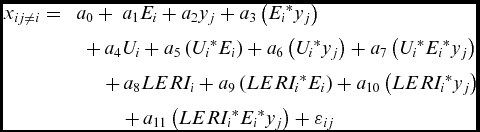
To investigate the effects of economic status and LERI on redistributive preferences, we start by estimating an extension of Barr et al.’s (Reference Barr, Burns, Miller and Shaw2015) model:
 $$\begin{eqnarray}
{x_{ij \ne i}} & = & \ \ {a_0} + \ {a_1}{E_i} + {a_2}{y_j} + {a_3}\left( {{E_i}^{*}{y_j}} \right) \nonumber\\
&& \quad +\, {a_4}{U_i} + {a_5}\left( {{U_i}^{*}{E_i}} \right) + {a_6}\left( {{U_i}^{*}{y_j}} \right) + {a_7}\left( {{U_i}^{*}{E_i}^{*}{y_j}} \right) \nonumber\\
&&\qquad +\, {a_8}LER{I_i} + {a_9}\left( {LER{I_i}^{*}{E_i}} \right) + {a_{10}}\left( {LER{I_i}^{*}{y_j}} \right)\nonumber\\
&&\quad \qquad +\, {a_{11}}\left( {LER{I_i}^{*}{E_i}^{*}{y_j}} \right) + {\varepsilon _{ij}}
\end{eqnarray}$$
where, as in Barr et al. (Reference Barr, Burns, Miller and Shaw2015), xij is participant i’s allocation to participant j in the 4PDG expressed as a proportion of the maximum amount that i could allocate to j (€44), Ei takes the value 1 if i played under the earned treatment and 0 if i played under the random treatment, yj is j’s initial endowment, Ui takes the value 1 if player i is unemployed and zero if they are employed or a student and, in the extension of the model, LERIi ranges from 1 (extreme left) to 10 (extreme right), a 0 to a 11 are the coefficients to be estimated, and εij is the error term.Footnote 6 This model identifies the slope of the relationship between j’s initial endowment, yj, and i’s final allocation to j, xij, and the effects of whether j earned her initial endowment and i’s economic status and political ideology on that slope. In this model, acknowledgement of earned entitlement (AEE) manifests as the slope being more positive in the earned compared to the random treatment. The coefficient a 7 identifies the effect of i’s economic status on the difference in the slope between the treatments, i.e., the effect of economic status on AEE. If, as Barr et al. (Reference Barr, Burns, Miller and Shaw2015) predicted and found in the UK, the unemployed do not acknowledge earned entitlement, while the employed and students do, a 7 will be negative. The coefficient a 11 identifies the effect of i’s political ideology on the difference in the slope between the treatments, i.e., the effect of political ideology on AEE. If AEE is strong among people on the political right and absent among people on the political left, a 11 will be positive.Footnote 7
The estimation of Model (1) is informative about whether, for the full sample of participants, being unemployed and/or political ideology explain variations in AEE. However, it is not informative about whether and how the relationship between political ideology and AEE varies depending on economic status. To investigate this, we estimate Model (1) excluding the Ui indicator and all interactions involving the Ui indicator separately for the employed, unemployed and student participants.Footnote 8
Following Barr et al. (Reference Barr, Burns, Miller and Shaw2015), the zero allocations to others made by participants who took all the counters for themselves (41 participants did this) and all participants’ allocations to themselves are excluded from the analysis.Footnote 9 Finally, the allocations to others made by seven additional participants are excluded from the analysis because they did not answer the LERI question in the survey. This leaves three observations for each of 364 participants (144 employed, 121 unemployed, and 99 students), 1,092 observations in total. The estimations are conducted using ordinary least squares and then the standard errors are adjusted parametrically to account for clustering within decision-making participants, i.e., within i's.Footnote 10
RESULTS
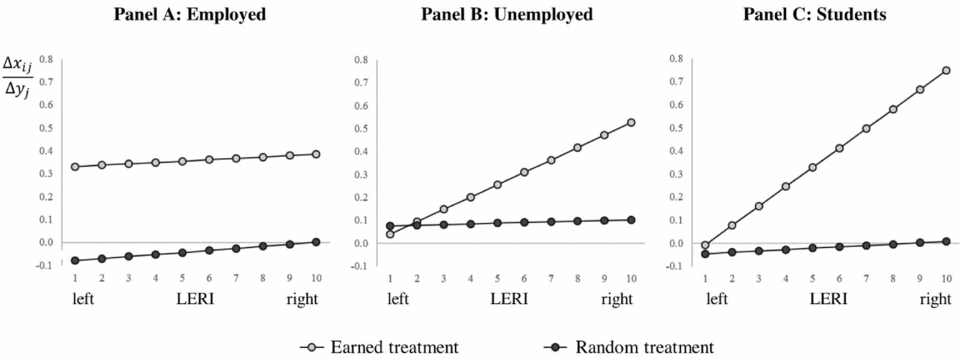
Column (1) of Table 1 presents the OLS estimation of model (1) for the full sample. In this estimation, the coefficient on Ui is insignificantly different from zero. However, the coefficients on the three interaction terms involving Ui are each significant at the 5% level (or better).Footnote 11 The significance of these coefficients indicates that economic status is associated with AEE. The significant positive coefficient on yj interacted with Ei indicates that the employed and students acknowledge earned entitlement and the significant negative coefficient on yj interacted with Ei and Ui indicates that the unemployed acknowledge earned entitlement considerably less. Further, a linear restriction test indicates that we cannot reject the null hypothesis that AEE is zero among the unemployed. In contrast, the coefficients on LERIi and the three interaction terms involving LERIi are jointly and all individually insignificant; this estimation provides no support of the hypothesis that AEE is associated with political ideology.
Regression Analysis of the Effect of Ideology and Employment Status on Distributive Preferences (Dependent Variable = i’s Allocation to j)
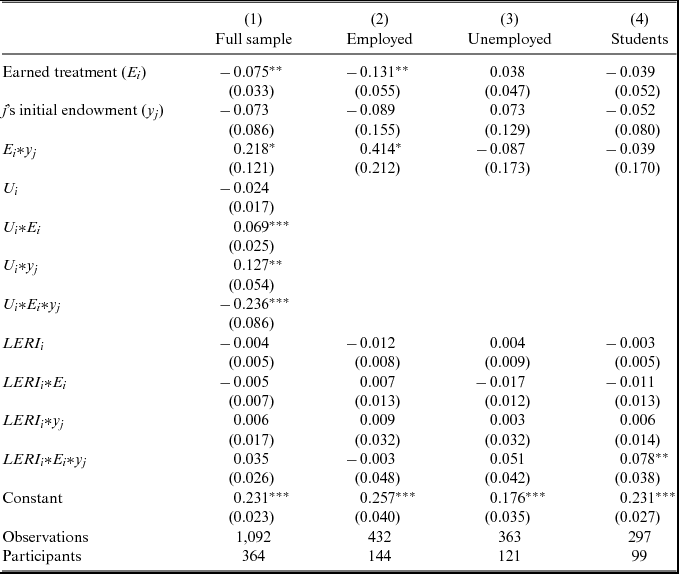
Notes: Sample includes final allocations made to others by participants who made at least one positive final allocation to another; there are three observations per participant; j’s initial endowment (yj) = j’s initial endowment expressed as a proportion of the 44 tokens in the game; Earned (Ei)=1 if i made allocations under the earned treatment, =0 if i made allocations under the random treatment; standard errors clustered at the individual level using the standard parametric approach; ***– sig. at 1%; **– sig. at 5%, *– sig. at 10%
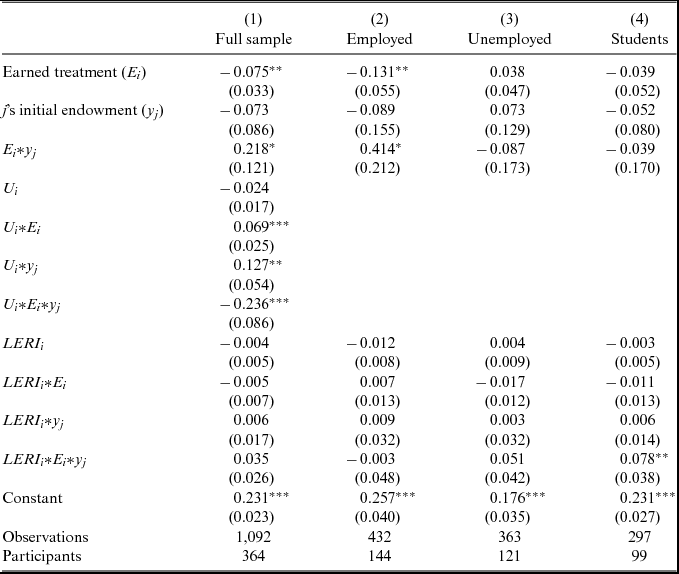
Columns (2) to (4) of Table 1 present the estimations of Model 1, excluding the Ui indicator and all interactions involving the Ui indicator, for the employed, unemployed, and students separately and Figure 1 contains a set of corresponding graphs. The graph in each panel is derived from one of the estimations and plots the effect of a one unit increase in j’s initial endowment on i’s allocation to j, Δxij/Δyj, against i’s LERIi placement. The effects under the earned and random treatments are graphed separately. The graph in Panel A is derived from the estimation for the employed, the graph in Panel B from the estimation for the unemployed and the graph in Panel C from the estimation for the students.
The Effect of Ideology on the Acknowledgement of Entitlement.
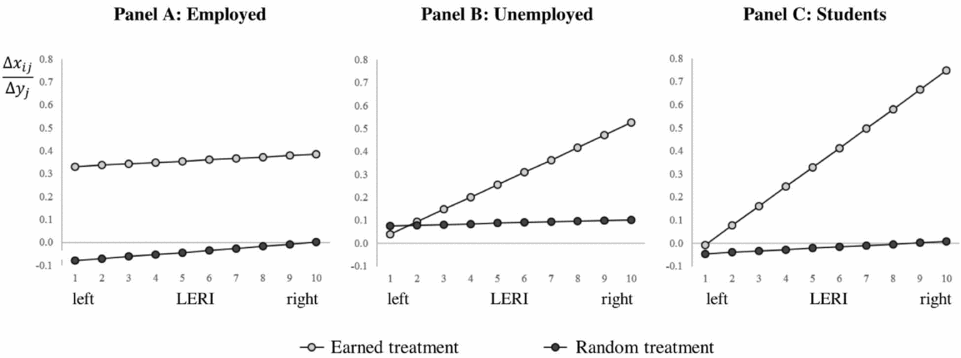
In the estimation for the employed (column (2)), the coefficient on the interaction between j’s initial endowment and Ei is positive, large and significant at the 10% level and the coefficients on all the terms involving LERIi including the interaction with yj and Ei, are small and insignificant. Panel A, which is derived from this estimation, indicates that, among the employed, when initial endowments are randomly assigned, j’s initial endowment has little or no effect on i’s allocation to j and that this is the case for all values of LERIi. In contrast, when initial endowments are earned, i’s allocation to j is positively affected by j’s initial endowment and the magnitude of the effect is similar across all values of LERIi. Finally, among the employed, AEE (the vertical distance between the lines) does not depend on LERIi . In summary, across the political spectrum, employed people acknowledge earned entitlement.
In the estimation for the unemployed (column (3)) the coefficient on the interaction between j’s initial endowment and Ei is insignificant and the coefficients on all the terms involving LERIi are also insignificant. Panel B, which is derived from this estimation, shows an increasing-to-the-right vertical separation between the lines for the random and earned treatments, suggesting that AEE is greater among unemployed people who are further to the political right. However, the insignificance of the coefficient on the interaction between j’s initial endowment, Ei and LERIi combined with a set of linear restrictions tests designed to test for AEE at each possible value of LERIi indicate that, across the political spectrum, unemployed people do not acknowledge earned entitlement.Footnote 12
Finally, in the estimation for students (column (4)), the coefficient on the interaction between j’s initial endowment and Ei is insignificant, while the coefficient on the interaction between j’s initial endowment, Ei and LERIi is positive and significant at the 5% level. Panel C, which is derived from this estimation, indicates that, among students, when initial endowments are randomly assigned, j’s initial endowment has little or no effect on i’s allocation to j and that this is the case for all values of LERIi. However, when initial endowments are earned, while j’s initial endowment continues to have no effect on i’s allocation to j if i is located on the political left, when i is located on the political right, i’s allocation to j is positively affected by j’s initial endowment. A series of linear restriction tests indicate that the increasing-to-the-right vertical separation between the two lines is significant at the 5% level or better when LERIi is greater than two. In summary, students on the far left do not acknowledge earned entitlement and, as we move to the right, among students, AEE increases.Footnote 13
DISCUSSION
This paper contributes to the growing literature on preferences for redistribution in two ways. First, it provides an analysis of the associations between political left–right ideology, economic, specifically employment, status, and experimentally elicited distributive preferences. This analysis shows that, when making redistributive decisions in a political-frame-free context, the employed acknowledge earned entitlement, the unemployed do not and, in both cases, political ideology plays no or a very minor role. This is consistent with the findings of several prior survey-based and the experimental studies of Esarey et al. (2012) and Brown-Iannuzzi et al. (Reference Brown‐Iannuzzi, Lundberg, Kay and Payne2015).
Second, the paper analyses the relationship between political ideology and redistributive preferences, not only for the employed and unemployed, but also for students, thereby encompassing various heretofore distinct strands in the literature. Here, the analysis reveals that, in contrast to that of the employed and unemployed, students’ AEE is directly and strongly related to their political ideology; those on the far left do not acknowledge earned entitlement and those further to the right do. This is consistent with self-declared liberal students choosing a higher tax rate, as reported by Durante et al. (Reference Durante, Putterman and van der Weele2014).
Our findings are consistent with the idea that, when people are in full time education, they incur no psychological cost from aligning their redistributive preferences with their political ideology. However, when they enter the labor force, especially when they are working, such psychological costs can loom large and their redistributive preferences and political ideology cease to be associated as a consequence.
These findings need to be viewed with a degree of caution. For the employed, the absence of an association between political ideology and AEE is clear and striking. However, for the unemployed, while there is no statistical evidence of AEE anywhere on the political spectrum, Panel B of Figure 1 suggests that movement towards the political right is associated with an inclination towards AEE. Here, working with larger samples and including other covariates in the analysis to account for heretofore unexplained heterogeneity could yield further insights.
For students, the well-defined relationship between self-proclaimed political ideology and the redistributive decisions they make when given the opportunity is robust to the inclusions of age and other demographic characteristics in the analysis.
SUPPLEMENTARY MATERIALS
To view supplementary material for this article, please visit https://doi.org/10.1017/XPS.2018.14