





This article considers how Gertrude Bell moved from unofficial status before the First World War to a more official status working for the British in Mesopotamia from 1916. Rather than concentrating on her later roles, for example, as oriental secretary and honorary director of antiquities in Mesopotamia, it examines Gertrude Bell’s activities before the First World War. Much of her later agency rested on experience and networks built up during the fifteen years she spent travelling in the Ottoman Empire before the outbreak of war. ‘Unofficial’ status before and after her appointment to more official posts enabled Bell to exploit hierarchical structures to her own benefit in ways that would have been out of the question for many.
While her friend Janet Courtney (née Hogarth) wrote that Bell did not travel for notoriety,Footnote 1 exploring the Ottoman Empire in search of archaeological sites became a vehicle for building a profile and a network of connections with people in positions of authority. It was these connections and this knowledge that opened up new opportunities. Focusing primarily on the Gertrude Bell Archive and the archives of the Royal Geographical Society (RGS), this article considers how Bell’s unique experience before the First World War led to one such opportunity: a role working for military intelligence in Cairo in late 1915, which in turn led to a position working for the British administration in Mesopotamia in 1916.
Writing from Cairo in January 1916, nearly eighteen months after the start of the First World War, Bell informed her father that she would be travelling to Delhi. This was to be an unofficial and speculative visit to see the viceroy of India. Her trip was an unorthodox approach to solving a problem between different elements in the British establishment, but it demonstrated a remarkable ability to use her pre-existing personal contacts to cut through ‘red tape’. Bell had volunteered to act in her own name on behalf of British military intelligence. As an ‘unofficial diplomat’ she had used her personal connections to bypass the complex administrative and bureaucratic hierarchies faced by her colleagues in Cairo to exploit contacts she had made long before the war. Knowing that she had the financial resources to make the trip even if the expenses were not covered by the proper authorities, she had reached out for an audience with one of the most powerful individuals in the British Empire, an old acquaintance; and she had done so with the help of an influential friend:
When I got Lord H.’s [Lord Hardinge, the Viceroy of India’s] message through Domnul [Sir Valentine Chirol] I suggested that it might be a good plan if I, a quite unimportant and unofficial person, were to take advantage of the Viceroy’s invitation and go out to see what could be done by putting this side of the case before them and hearing that. My chiefs here approved, … I shall go straight up to Delhi to Lord H. … It will all be interesting – I feel a little anxious about it, but take refuge in my own extreme obscurity and the general kindness I find everywhere. I think they will probably pay my journey, if not I shall go all the same because I think it’s a good thing to do – in which case you will understand why my bank is called upon to honour a big cheque to the P. & O. Coy. I expect you will approve of my proceedings as usual!Footnote 2
Bell’s connection with Valentine Chirol and Charles Hardinge had begun decades before. Chirol was a diplomat who would become correspondent for The Times; he was a family friend whom Bell had met on multiple previous occasions, for instance when in 1887 Bell had been encouraged by her step-aunt Lady Lascelles to experience diplomatic life in Bucharest and Tehran where her husband Sir Frank Lascelles was minister.Footnote 3 Bell saw Chirol in Bucharest and, as planned by her family, the time abroad exposed Gertrude to many new contexts and contacts. It was in Bucharest, for example, that she met Hardinge. Chirol spent time with Hardinge in Delhi after his appointment as viceroy.Footnote 4 As events unfolded during the First World War, Gertrude’s connections with both men carried new significance.
In proposing to visit Delhi, Bell was seeking Hardinge’s assistance to address what had become an intractable problem between the group responsible for British intelligence based in Cairo and those from India who were responsible for the British military campaign in Mesopotamia. Her letter continued, ‘The longer it goes on the worse it gets and meantime we are losing invaluable opportunities for information’. Her aim was to discuss with the viceroy the establishment of ‘a permanent Intelligence Bureau for the Near East, which shall endure after the war is over – it would be invaluable’. Shortly afterwards, the Arab Bureau was founded.Footnote 5
War with the Ottoman Empire highlighted the need for British intelligence in the Middle East to ensure the Suez Canal as a strategic route to India and to secure oil which was increasingly essential for the Royal Navy.Footnote 6 While the military campaign in Mesopotamia had begun in 1914 under the responsibility of the British in Delhi, few from India fighting there had existing knowledge of Mesopotamia or the wider region. The group that would form the Arab Bureau, by contrast, had been recruited because of their knowledge of Ottoman lands. Several who had worked as archaeologists before the war would be part of a group reporting to London: they included David G. Hogarth, C. Leonard Woolley, Thomas E. Lawrence and Gertrude L. Bell.Footnote 7
Hogarth was keeper of the Ashmolean Museum and a former director of the British School in Athens. In November 1915, as a newly appointed officer in the Royal Navy Volunteer Reserve, he was instrumental in pulling together this group of archaeologists familiar with the people, topography and languages of the Middle East.Footnote 8 Woolley and Lawrence had assisted Hogarth with excavations at Carchemish conducted on behalf of the British Museum between 1910 and 1914.Footnote 9 Woolley had also worked in Nubia and Italy. Bell had been at Oxford University with Hogarth’s sister Janet and had become acquainted with him in Italy in 1896 and Greece in 1899. She met Lawrence when she visited at Carchemish in 1911.
Gertrude Bell made several trips to Europe and around the world, often with family members, but for fifteen years from 1899 she carried out a series of long journeys in the Ottoman Empire accompanied by local guides. Wealth and diplomatic connections afforded her freedom to travel; after her trip lasting seven months in 1899–1900, she returned to the Ottoman Empire in 1905, 1907, 1909, 1911 and 1913 – driven primarily by a desire to visit archaeological sites. It was through these journeys that Gertrude Bell made herself increasingly visible as one of a small group of British individuals with knowledge both of early Islamic and Byzantine architecture and of the geography of particular regions of the Middle East.
Bell’s expeditions were not conducted under the auspices of any formal institution; her excavations of ecclesiastical sites with William Ramsay in 1907 were funded by her family. By contrast many of her contemporaries were financed by more formal institutions. Arts and Crafts architects recording buildings in Thessaloniki and Constantinople, for example, were funded by the Byzantine Research Fund of the British School at Athens.Footnote 10 Hogarth worked at Carchemish in 1911 under the auspices of the British Museum; Ramsay’s excavations in 1912, at Antioch in Pisidia, were funded by Princeton University. Bell’s independent means gave her access to these networks of individuals while at the same time being independent of the institutions that funded them.
In Cairo from November 1915, Bell worked in what was to become the Arab Bureau advising on the political geography of tribal groups in the Middle East. Following her trip to India early in 1916, she was sent to Basra in Mesopotamia where she joined the British administration under Percy Cox accompanying the military campaign against Ottoman forces.Footnote 11 She was to be based in Mesopotamia for the rest of her life, overseeing its transition from the Ottoman Empire into the British Mandate. Most notably, in 1921, it was Bell and Lawrence who joined Cox – by then high commissioner of Mesopotamia – as part of the political committee at the Cairo Conference that had an instrumental role in shaping Winston Churchill’s decisions about the establishment of the modern state of Iraq.Footnote 12
Bell trod a fine line between unofficial and official roles – a space she seems to have appreciated and used to her advantage. Her somewhat maverick ability to exploit and at times circumvent the usual bureaucratic structures of society was a hallmark of her life. This article will consider ways in which her earlier experiences and approach both prepared her for and brought about her future work.
Biographical background
Gertrude Bell has been the subject of several biographies and academic studies. These have included works focusing not only on her early life but also her later contributions to the creation of the modern state of Iraq.Footnote 13 She was born in 1868 in Washington, County Durham in England’s North East at the home of her grandfather the industrialist Sir Isaac Lowthian Bell. She grew up in Redcar, a town on the Yorkshire coast near Middlesbrough before being educated at Queen’s College, Harley Street (an elite girl’s school in London) and at Lady Margaret Hall, Oxford. Enormous wealth and political influence enjoyed by the family came from success over generations as pioneers of industry in the nineteenth century. Their status and diplomatic connections were to afford Gertrude levels of independence enjoyed by few people at the time and a sense of authority and self-confidence that seems to have been complemented by considerable abilities both intellectual and physical.Footnote 14 Having travelled initially with family members, Bell increasingly employed the resources available to her in support of her own more independent journeys.
Building authority
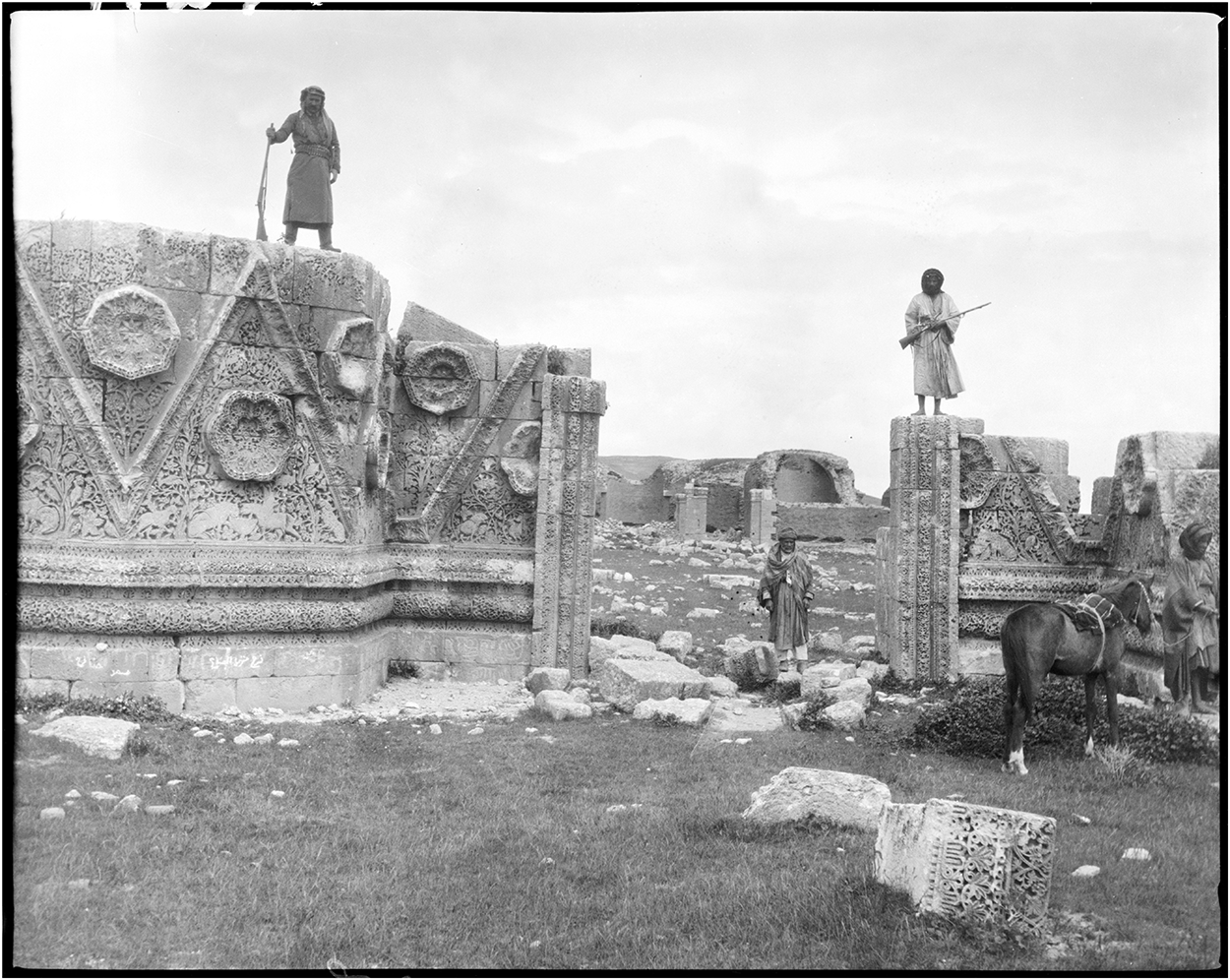
Residing at Jerusalem for six months between 1899 and 1900, Bell’s first visits to sites in the region at this time were facilitated by the German consul Dr Friedrich Rosen and his family, while she visited some of the most iconic archaeological sites in the region. In March 1900, as little more than a tourist, Bell photographed the Late Antique palace at Mshatta, located in modern-day Jordan (Figure 1). Mshatta had long drawn the attention of European visitors,Footnote 15 but soon after Bell’s visit, and quite independently, the art historian Josef Strzygowski persuaded museum director Wilhelm von Bode in Berlin to petition Kaiser Wilhelm II to ask the Ottoman Sultan ‘Abd al-Hamid II for the building as a gift. By 1903, the gateway of Mshatta with its ornately decorated walls and towers had been deconstructed and transported via the new Hejaz railway to Berlin for installation in the new Kaiser-Friedrich-Museum.Footnote 16
The gateway at Mshatta in situ. 22 March 1900. Photograph: Gertrude Bell, GB/3/1/1/1/233.

Figure 1 Long description
Four people pose for the camera among ancient ruins. Two individuals each bearing rifles are standing elevated above an ornately carved stone gateway. One stands on the top of asemi-octagonal tower to the left of the gateway, the second man stands on a carved orthostat on the other side of the gateway, while a third person stands on the ground in the entrance and the fourth, to the right, holds the reins of a horse. The ruined façade features ornate carvings and geometric patterns. The area is grassy, with scattered masonry. . Remnants of the complex are visible through the gateway in the background .
In 1904 Bell’s passing knowledge of the site, which she had acquired from her visit, gave her an opportunity to venture into academic circles. While in Paris being mentored by the French archaeologist Salomon Reinach, editor of the journal Revue archéologique, she was encouraged to write a review of the study of Mshatta published that year by Strzygowski and Bruno Schulz.Footnote 17 In rather uncritically championing Strzygowski’s new argument for an early construction date,Footnote 18 Bell strayed into a hotly contested debate about the cultural origins of particular features of architectural form and decoration. While some scholars were highly critical of Strzygowski’s interpretation, the search for the origins of architectural ideas was part of a methodologically problematic approach typically taken by art historians and archaeologists at the time known as ‘Culture History’.Footnote 19 This approach employed diffusionism to trace elements of architecture across time and space.Footnote 20 It is perhaps understandable, given her inexperience and Strzygowski’s status, that Bell described his (incorrect) redating of the structure without critique of his methods and their Orientalist perspectives. That she made no mention of the wider critique of Strzygowski or the new location of the building perhaps serves to highlight her lack of recognition of the deeply political context in which archaeological interpretation and European archaeological work took place.Footnote 21 Nevertheless, her first published review of an established authority’s publication on such an internationally significant site enabled Bell to introduce her work to academics.
As well as building her archaeological expertise, Bell’s journeys established her as one of the few authorities with knowledge of the region and its people. Gradually she projected her status as an informed author to a wider audience via a range of different publications aimed both at a general readership and at more scholarly audiences. There is little evidence that she was operating in an official capacity at any point before the war. Travel in the Ottoman Empire necessarily facilitated introductions with people in the areas through which she journeyed so that Bell became familiar with networks of influential people living and working in both European and Ottoman contexts. Relying on others for safe passage, Bell travelled with the help of a small party of assistants while supported by her independent financial means. Her journeys gradually became more ambitious and her writing more political and confident.
In 1907, Bell published The Desert and the Sown, which was based both on her time with the Rosens in 1900 and on another journey in 1905 through parts of modern Syria and Türkiye.Footnote 22 The final leg of that expedition along the Mediterranean coast of Cilicia and up through the Taurus Mountains to the Anatolian Plateau was serialised in Revue archéologique in 1906–7. It was then that she visited ‘The Thousand and One Churches’ (Binbirkilise) in central Türkiye. Strzygowski’s volume Kleinasien, ein Neuland der Kunstgeschichte was published in 1903.Footnote 23 Kleinasien was the reason for Bell to visit Binbirkilise in 1905 when afterwards – travelling back via the nearby town at Konya – by chance she met the New Testament scholar Sir William Ramsay, author in 1890 of The Historical Geography of Asia Minor and one of the leading authorities on the region.Footnote 24 She convinced Ramsay to return to conduct excavations with her in 1907, justifying to her stepmother the time and money being spent.Footnote 25 Her name was established in the field with the publication of The Thousand and One Churches co-written with Ramsay and with a dedication to Josef Strzygowski.Footnote 26
Ramsay and Bell’s enthusiasm for excavating at Binbirkilise showed high-handedness towards the regulations designed to protect archaeological sites. As Gözde Demir-Merzi has shown, Ramsay appealed directly to the grand vizier, who was second only in authority to the Ottoman sultan, and Bell wrote subsequently for permission to Osman Hamdi Bey, who was in charge of antiquities. Although they were granted permission, the Ottoman authorities kept a close eye on their movements.Footnote 27 While from their perspective Ramsay and Bell made strategic use of their contacts, their work only took place because of the goodwill of those in authority. Taking advantage of strategic contacts, Bell and Ramsay not only bypassed concerns of local authorities by dealing with their superiors, they also took advantage of their privileged position by carrying out the excavations in ways that went beyond that they were permitted to do. Even though Bell had permission to take photographs in 1907 and they had requested consent to excavate a wall, it seems that she had not received authorisation for as much excavation as was undertaken.Footnote 28
Indeed, her team of men with shovels prompted concern from local authorities in Konya. Letters to her mother reveal that she was aware that they were taking advantage of the system:
Now whether we really had the right to do all we have done doesn’t seem to matter since they have let us do it.Footnote 29
I hear from Konia [Konya] that the Vali [Governor] has received special instructions from Constantinople [Istanbul] that he is not to interfere with us and to give us all assistance he can. I expect that’s the Grand Vizier, Ferid Pasha; he and Hamdy Beg [Osman Hamdi Bey] have stood by us like men. …There is nothing like being on excellent terms with high Turkish officials.Footnote 30
This approach reveals a sense of entitlement and arrogance that had been typical of foreign archaeologists for some time but also a naivety since those responsible were in fact keeping a watchful eye on their activities.Footnote 31
While their project resulted in one of the most important contributions to knowledge of Byzantine archaeology in central Anatolia, as with any excavation, evidence from these churches was destroyed during the work. Bell took a significant number of photographs and made measured drawings in the field which were complemented by a careful analysis of the buildings, but her excavation methodology lacked stratigraphical rigour and there was no finds analysis.Footnote 32
By the time The Thousand and One Churches was published in 1909, the political situation in the Ottoman Empire had changed dramatically. The Young Turk Revolution in July 1908 resulted in the restoration of the 1876 Constitution and the parliament that had been suspended since 1878 by Sultan Abdül-Hamid II.Footnote 33 On 13 April 1909, a counter revolution against the Committee of Union and Progress (CUP) was staged by those loyal to the Sultan and a period ensued in mid-April when social tensions led to bloodshed in Anatolia. Ultimately Abdül Hamid was deposed and the CUP formed a new government, at precisely the time that Bell was travelling through the Ottoman Empire. Bell’s future confidant Charles Doughty-Wylie was acting British vice-consul when she had met him in 1907 in Konya on her way to Binbirkilise. He famously put down an insurrection on 21 April 1909 in the town of Mersin close to the Mediterranean coast,Footnote 34 but Bell, journeying through Mesopotamia, witnessed no such events.
As her letters, diaries and various publications make clear, Bell’s driving motive for travel was to record the standing architectural remains of Byzantine and early Islamic period monuments but she also reported on the contemporary situation. While the spring of 1909 would have been a particularly dangerous time to be travelling in Anatolia, she did not arrive there until the summer. Leaving Beirut at the end of January 1909, Bell went via Aleppo to the Euphrates, then south along the east bank of the river into Mesopotamia, and finally to Babylon. On 4 April, she left Babylon to begin her return journey north along the river Tigris via Mosul, arriving in early June at Diyarbakir before travelling west via Harput, Malatya, Tomarza and Kayseri to Konya, and finally reaching Constantinople in early July. The first part of her journey from Tel Ahmar to Hit was recorded without much political comment in her paper for the Royal Geographical Society,Footnote 35 but in Amurath to Amurath – a book aimed at a general audience – she described in more detail events reported to her that had taken place in previous months.Footnote 36
In June as she journeyed west into central Anatolia she saw evidence of the looting and burning of the Christian village of Shahr – an atrocity which she was informed had taken place over the course of nine days from 20 April, and which had been perpetrated apparently by Kurds, Turks and Circassians from neighbouring villages.Footnote 37 Her letters and diaries – as well as her published account in Amurath to Amurath – document the situation and her conversations with local authorities and foreigners working in the region. In a diary entry for 7 June, she records her conversations with the American consul, Mr William Wesley Masterson, who shared with her events that had taken place at Harput in April when the potential for bloodshed had been avoided.Footnote 38 Having tried to work out what had been taking place, in a letter to her stepmother Florence Bell, begun on 10 June, Bell recalls a volatile situation:
the American consul … sat with me for near 2 hours and gave me exactly the information I wanted. Here, as at Diarbekr, they were on the very edge of a terrible massacre … On Ap 25 the Vali came to him looking like a man who was on the verge of nervous collapse. He said that on the 17th a telegram had come from C’ple [Istanbul (Constantinople)] ordering massacres. He swore that no one but himself and the telegraphji [sic] knew of its existence, but he added that for 4 days he had been holding the Kurds at bay. For 4 days they had been clamouring at his gate, demanding that he should give them the word to fall upon the Xians. This quite tallies with other things that I have put together bit by bit. … But there is no end to surprises in this country …Footnote 39
Her letters and diaries go into more detail than the text she produced in Amurath to Amurath, but there she noted how a governor could resist pressure and protect the peace:
I believe that no great massacre has taken place in Turkey without the encouragement of the central authority, or a passivity which amounts to connivance on the part of the local officials; a strong Vali backed by an enlightened government would keep peace in the most fanatical province of the empire.Footnote 40
It does not seem that she was collecting information officially but in print Bell made public her own perspectives on the situation she had witnessed.
Muhammed Parlakoğlu has noted recently that it was not until an article written by Semavi Eyice in 1978 that any academic study intimated that Bell might have been sent formally to the Ottoman Empire for the purpose of espionage, and that the idea has since been treated rather uncritically by a variety of academic and non-academic writers who have repeated the notion unquestioningly.Footnote 41 Her own private letters and diaries endorse the view that she was not travelling for the purpose of gathering intelligence in any official capacity. Bell, however, appreciated the confusion felt by those who could not understand her purpose there.Footnote 42 At Tomarza in Kayseri Province of central Anatolia, she explained that, ‘By all Tomarza I was regarded as an itinerant missionary collecting evidence with regard to the massacre.’Footnote 43 While she acknowledged that the local people were hoping she might help them with their plight, she presented herself both to those she met and to her readers as too busy contemplating ‘the occidental and oriental themes’ of the church architecture to engage with the fate of the contemporary communities to whom they belonged.Footnote 44 While Bell was perhaps posturing in her book to accentuate her academic credentials, the callousness of her comments both in print and in her private correspondence, as we have seen in the letter to her stepmother on 10 June, are telling in view of the trauma experienced by the community she was visiting. All the more blind seems the comment she makes in the preface to Amurath to Amurath: ‘I have drawn too heavily upon the good-will of the inhabitants of Asiatic Turkey to regard their fortunes with an impartial detachment.’Footnote 45
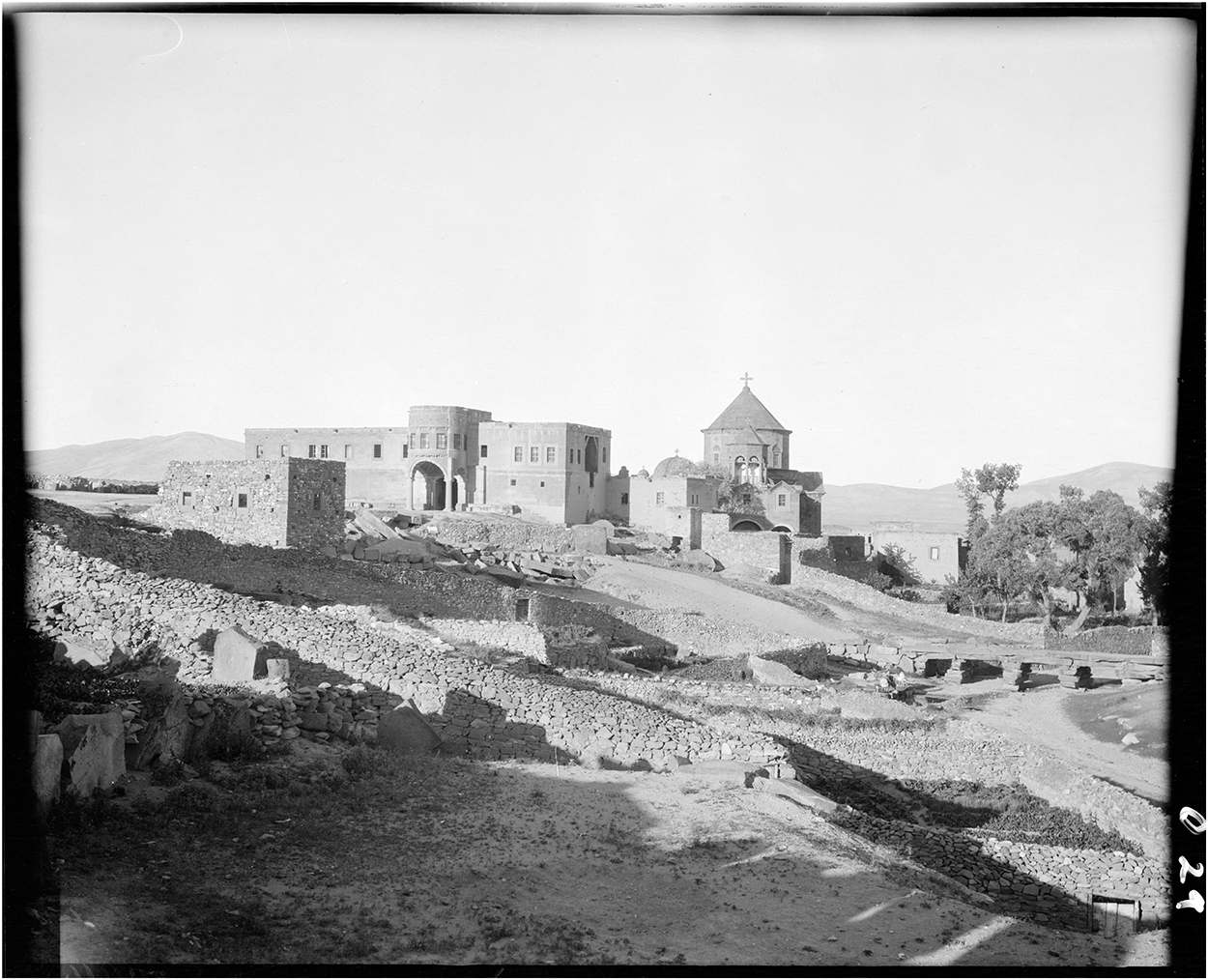
The occidental and oriental themes she was referring to derived from the debate informed by Strzygowski’s work about the origins of architectural motifs, which had been prompted initially by Orient oder Rom and more particularly in Asia Minor by Kleinasien. While these might seem entirely academic concerns, Bell’s representation of herself as academically minded in the aftermath of events in 1909 make her contemplation of intellectual ideas all the more symbolically violent. Bell fails to appreciate fully the severity of the contemporary situation. At Tomarza, nevertheless, she managed to make an important photographic study of a long-ruined church.Footnote 46 She also took photographs of the monastery and church still in use by the community that tried to reach out to her in 1909; these buildings were destroyed during the 1920s so they form an important historical and archaeological record (Figure 2).
Monastery Tomarza, Türkiye. 18 June 1909. Photograph: Gertrude Bell, GB/3/1/15/1/29.

Figure 2 Long description
The historical photograph shows dry stone walls in the foreground, with the carefully constructed walls of a monastery in the background and hills rising in the distance. The structures are situated on the left side of the image, on the bank above a dried river bed and a stone bridge. . The architecture of the monastery features a variety of visible elements including domes, columns and arches. At least four of the roofs are topped with carved crosses..
While Amurath to Amurath is a travelogue, Bell had witnessed events of international interest. Writing very publicly about her experiences travelling in the Ottoman Empire in the first half of 1909 rather than in a covert report for the British government, she was nevertheless signalling herself to British audiences as an informed commentator. To reinforce her credentials, the dedication at the front of Amurath to Amurath, written in 1910 from her family’s home at Rounton Grange, Northallerton, was to Lord Cromer, Evelyn Baring, former controller-general of Egypt.
Recalling that ‘the return of prosperity to the peoples of the Near East began with’ Cromer’s administration in Egypt – and to contextualise many of the events in her book – in her introduction Bell looks forward to a time when ‘Turkey’ will have
a strong and orderly government, among civilised states, turning her face from martial adventure and striving after the reward that waits upon good administration and sober industry, the peace of the world will be set upon a surer basis, and therein lies our greatest advantage as well as her own. That day may yet be far off, but when it comes …Footnote 47
Bell assumes authority to comment but her self-confidence to pronounce on the future of the Ottoman Empire nevertheless seems strikingly arrogant. Helen Berry has suggested that ‘Her upbringing instilled in her the sense that to share in the concerns of the government was her birthright.’Footnote 48 While dedicating her book to Lord Cromer may seem to have been presumptuous, Bell and Cromer both at that time held leading positions in the anti-suffrage movement, so in linking herself to Cromer, Bell was not only signalling her connection to him but also publicly building her profile with a known ally.
Operating increasingly in hierarchical spaces where she volunteered her opinion, Bell sought to make known her personal and unofficial comments on the regions through which she had travelled. They were recorded and published, for example, after papers read at the RGS.Footnote 49 Although she was not made a fellow of the RGS until 1913, recognition of the respect already given to her is emphasised by her being awarded the Gill Memorial Prize that same year for ‘her many years of exploration into the geography and archaeology of Syria, Mesopotamia and Turkey and Asia’.Footnote 50
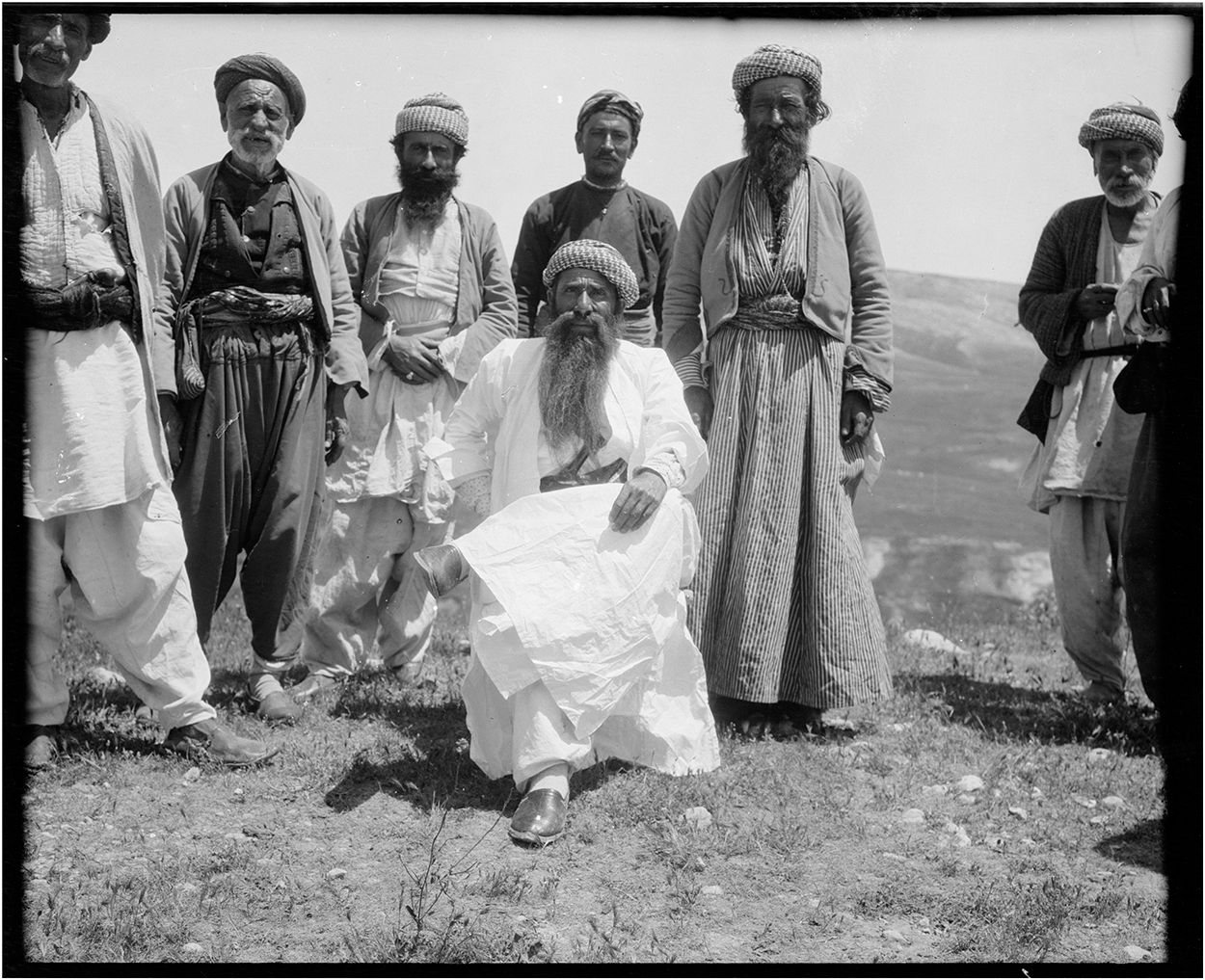
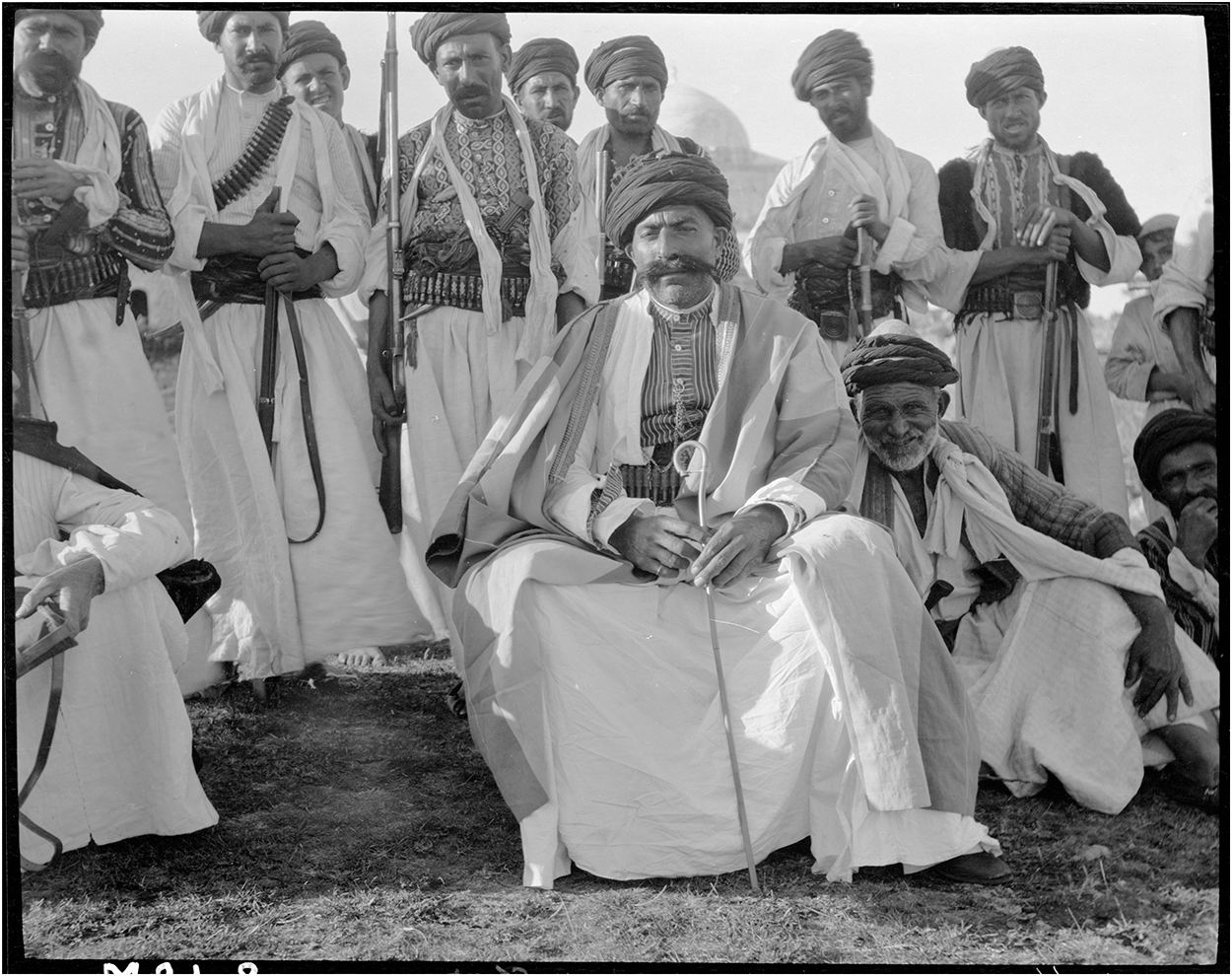
Official Ottoman and cultural protocols ensured foreign travellers were kept under scrutiny. The requirements also gave Bell access to authorities at a regional and local level and their protection. She would report to the highest-ranking official in the locality to make her introductions. Bell’s letters and diaries provide something of a ‘who’s who’ of the regions through which she travelled. Working under the auspices of those with authority was an approach that she used in other contexts to her benefit. As Helen Berry has noted, Bell drew on ‘the patrician attitudes of her family’ and her experience of metropolitan authority to achieve her aims by dealing directly with powerful people.Footnote 51 Bell records, for example, her reception in the Sinjar mountains where the Yezidi high priest Ali Beg and his sister treated her very well.Footnote 52 By contrast on the night of 24 May 1909 she was robbed, but she was able to turn for help to a local leader the chelabi Ibn Ismail.Footnote 53 Losing the bags containing her notes and photographs was a disaster for Bell but the chelabi ensured that her belongings and fieldnotes were returned on 28 May (Figures 3 and 4).Footnote 54 There is no indication that the theft was officially sanctioned, but the return of her possessions with the help of local authorities revealed how much she had been operating under the power structures of the region; it revealed too that Bell knew how to call upon them to resolve what seemed to have the makings of a diplomatic incident.
Ali Beg high priest of the Yezidis (seated), Iraq. 7 May 1909. Photograph: Gertrude Bell, GB/3/1/13/1/44.

Figure 3 Long description
Seven men are present, wearing a variety of traditional forms of attire and headscarves. Ali Beg high priest of the Yezidis is seated in the center, wearing a long beard and white garment . Directly behind him stands Fattuh, Gertrude Bell's guide. The setting is outdoors with a rural landscape visible in the background.
The chelabi (seated) and his men at Anıtlı (historically Hah), Tur Abdin, Türkiye. 23 May 1909. Photograph: Gertrude Bell, GB/3/1/13/1/260.

Figure 4 Long description
A group of men wearing traditional attire, including mostly white robes and distinctive headscarves, are gathered outdoors. One man, the chelabi, is seated in the centre holding a staff, while others stand or crouch around him. The men are dressed similarly, with sashes and cartridge belts; some have visible weapons. The setting appears to be a grassy area with the exterior of the dome of El Adra monastery visible in the background.
The connections Bell built up throughout her life as well as her family’s contacts both in diplomatic and in political circles mean, however, that she would have been engaging in conversation with people who may have had an interest in news from her travels. On 15 April, for example, she wrote to her father letting him know not about unfolding political events but about investment opportunities in railways and irrigation projects in Mesopotamia – which she hoped Britain would pursue:
I would a great deal rather it were taken up by us than by anyone else, because we don’t expect such exhorbitant [sic] profits as – the Germans, for example. But if we don’t do it, someone else will, and anyway it will work out well for Turkey. There is a good margin for profit all round, but I should like to see the lion’s share go into the pockets of Ottoman subjects. There will be plenty for the capitalists even then.Footnote 55
She seemed concerned to speak to her father – a businessman and politician – about investment potential that might benefit Britain and the people of the Ottoman Empire. Having sent a letter to Chirol for The Times, she encouraged Hugh Bell to use his influence on the Board of Trade and with Sir Ernest Cassel, a wealthy banker with similar investments. On 7 July, Bell wrote to her stepmother about plans for her return: ‘What shd you say if Father were to suggest to the Tyrrells that I shd go to them over that Sunday … Then … on the 19th, I wd spend the evening with George Lloyd with whom I want to have a long talk about Turkey, or with someone …’Footnote 56 In 1905, Bell had helped George Lloyd with his early aspirations to become a diplomat. When Bell resolved to meet Lloyd in 1909, it was because in 1908 he had been appointed ‘Special Commissioner to inquire into and report upon the future of British trade in Turkey, Mesopotamia’.Footnote 57 She also planned to speak with Sir William Tyrrell, who was at the time with Louis Mallet, principal private secretary to Sir Edward Grey, the secretary of state for foreign and commonwealth affairs.Footnote 58
In a letter to her stepmother written at Ereğli on 27 June 1909, Bell mentions others she would like to see on her way home:
I shall leave for C’ple [Istanbul (Constantinople)], arriving there July 5. I really must stay there a few days – it will be so exciting to see it under the present conditions and I want to see Ferid Pasha and Hamdy Beg and others. So probably I shall leave there about the 12th. I may go to Graz for a couple of nights on my way home– I shall telegraph from C’ple to Strzyg [Strzygowski]. That wd bring me to London about the 18th …Footnote 59
Bell’s enthusiasm to see Ferid Pasha is of particular note. Avlonyalı Mehmed Ferid Pasha was the grand vizier from 1903 until the summer of 1908. Thus, he was in post when Bell was first travelling through Anatolia in 1905 and it was he who had supported her work with Ramsay at Binbirkilise in 1907. In July 1908, Ferid Pasha an Ottoman-Albanian had been removed from office by the sultan for failing to prevent the July Revolution. But the following summer, on 6 June 1909, Bell wrote to her mother that her ‘friend Ferid Pasha has been made Minister for the Interior!’.Footnote 60 Indeed the former grand vizier had been appointed to this new post in May 1909, holding office for just three months during the time she was travelling through Anatolia.Footnote 61 In Constantinople on 7 July 1909, a letter home records that she called on Ferid Pasha but he was out.Footnote 62 On 10 July 1909, Bell mentioned that the then grand vizier, Hussein Hilmi Pasha, visited the British Embassy for lunch while she was staying there. She also had lunch with Hamdi Bey the following week.Footnote 63 In her private letters Bell reveals no sign that she had any appreciation that the authorities would be concerned about her activities, but an order was made by the Ministry for the Interior on 10 June 1909 that demanded Bell’s travelling be stopped.Footnote 64 Interestingly, this was shortly after she had had her conversations in Kharput including those with the vali on 7 June, after which she had written home on 10 June about ‘official visits which have taken up all my time’.Footnote 65 Perhaps it was these conversations which had raised the attention of the authorities. A later similar document issued by the Ministry for the Interior on 20 July 1909 repeated official concerns but it was issued a week after she left Constantinople, by which time she was on her way home.
Bell travelled again through Mesopotamia and Anatolia in the spring of 1911, the year Amurath to Amurath was published. Her preface and the discussion of events during her journey reported in that volume reveal a confidence to pronounce on foreign political matters but no sense that she saw herself as a threat to the Ottoman authorities.
Official recognition
In November 1913, Bell set off on a journey in a new direction for Ha’il in north-western Arabia.Footnote 66 Ha’il was the home of the Al-Rashid dynasty. In twenty years only one European, a Turkish officer, was known to have visited Ha’il so a Bell journey there would bring her further notoriety.Footnote 67 Having received formal training in surveying from the RGS and with the Gill Memorial Prize in the form of a theodolite, there is no indication that Bell travelled to Arabia officially for the British government. Indeed, while a later map produced by the intelligence department MI4 was based on the records Bell left with the War Office and RGS, it was drawn up once the First World War had broken out.Footnote 68 Her private correspondence makes clear that she journeyed specifically without the support or protection of either the Ottoman or the British authorities. That the expedition itself was at her own expense is proved by her correspondence with her father and in her diaries.
On 29 November 1913, at Damascus, she wrote to Hugh Bell asking him to fund her journey. Having established that her trip would need £601 she explained that she had sent a ‘telegram which I fear will rather surprise you, asking you to make the National Bank telegraph £400 to my credit through the Ottoman Bank London, to the Ottoman Bank here’. What followed was a long explanation of why she was asking her father to transfer so much money to her. The key points of persuasion were that ‘there never was a year more favourable for a journey into Arabia than this. The desert is absolutely tranquil, and there should be no difficulty whatever in getting to Hayyil.’ Furthermore, she went on, ‘I have got today exactly the right man as a guide’. She needed ready money to provision her expedition. As she explained, ‘I have to begin by buying everything I shall need here [Damascus]. She estimated 17 camels costing £221, £50 for food, £50 for presents, £80 to take with her, and £200 ‘to a Nejd merchant who lives in Damascus in return for a letter of credit which will permit me to draw the sum in Hayyil’. The letter continues at length explaining her plans.Footnote 69
Gertrude Bell’s motivation for taking such a risk across the Najd desert was the glory of the potential discovery of unknown archaeological sites rather than any official government mission. She kept two diaries on the journey: one for herself and a second written for ‘Dick’ [Charles] Doughty-Wylie with whom she had fallen in love and whose uncle Charles Doughty had travelled to Arabia.Footnote 70 On 16 January 1914, in the diary kept for Doughty-Wylie, she recorded: ‘Louis Mallet [by then British Ambassador in Constantinople] has informed me that if I go on towards Nejd [Najd] my own government washes its hands of me, and I have given a categorical acquittal to the Ottoman Government, saying that I go on at my own risk.’Footnote 71 That her mission was unofficial and archaeological is reinforced in other diary entries. One example is the entry she made on 16 February 1914, when she was struggling with the lack of archaeological discoveries:
I am beginning to wonder what profit I shall get out of it all. A compass traverse over country which was more or less known, a few names added to the map – names of stony mountains and barren plains and of a couple of deep desert wells (for we have been watering at another today) – and probably that is all. … I wish something would happen – something exciting a raid, or a battle! And yet that’s not my job either. What do ineffective archaeologists want with battles?Footnote 72
On 24 February 1914, she arrived finally within sight of Ha’il, but the trip had turned out to be something of a disappointment. She had found no new sites of note and sending men on to announce her imminent arrival she heard that the emir Saud bin Abdulaziz Al Rashid was away raiding.Footnote 73 His family members were reticent to do more than offer her hospitality and would not facilitate her journey onward to the southern Nejd and the home of the rival Ibn Saud dynasty.Footnote 74
The Al-Rashid family had been particularly powerful in the region, but Bell noted that by the time she visited it was his rival Ibn Saud who had become the main power broker. As she had spent time with them, it may not have been in the strategic interest of the Rashids to let Bell travel on to Ibn Saud’s territory; Bell seems to have accepted also that it would have been too dangerous. For whatever reason, her credit note was not cashed at Ha’il and she had no choice but to sell some camels and abandon intentions of going further into Arabia, before returning via Baghdad and the British Embassy in Constantinople.Footnote 75
Bell’s correspondence with the RGS after her journey also makes it clear that she did not see her work in Arabia as official. She had planned a trip to the RGS in London for 6 August 1914 to work on a map of her journey in Arabia. This was abandoned because of the mobilisation of troops after the declaration of war and was subsequently put off several times because it was deemed less important than more pressing war-related matters. John Keltie, secretary of the RGS, saw Bell’s map as work of ‘the Society’ rather than ‘war work’, but he was concerned that the RGS cartographers should continue the work of the Society by helping to produce a map of her journey alongside its obligations for the War Office.Footnote 76 Bell meanwhile prioritised her work for the Red Cross. She made it clear that she did not have any time to devote to a lecture on Arabia and the independent nature of her relationship with the RGS is confirmed by the fact that she offered her own money to the RGS for ‘mounting’ of her map done by a certain Mr Ashley.Footnote 77
A dramatic change came in 1915 when, on 26 August, Bell wrote to Arthur Hinks, Keltie’s successor at the RGS, saying that a man from the Indian Office who was drawing up a gazetteer of Arabia had written to her. She was working seven days a week for the Red Cross and had no time to consult her notebooks and map to check the details needed to supplement the gazetteer so she asked Hinks to supply the latitude, longitude and altitude of Ha’il.Footnote 78 On 30 August 1915, Hinks wrote to Bell to let her know that the RGS were ‘working up the observations’ of Captain William Shakespear and Bell ‘that we may be able to finish the map of Arabia which has been in hand for some time’.Footnote 79 Shakespear had also travelled in Arabia before the outbreak of war. Suddenly their work was recognised as potentially valuable for the war effort.
Bell’s status remained unofficial but became more formally recognised when Hogarth invited her to Cairo in November 1915.Footnote 80 There her knowledge was put to use at the nascent Arab Bureau, which was a new branch of British Intelligence in the Middle East. Initially not sure whether she would be in Cairo more than a few weeks, Bell found herself working alongside archaeologists including Leonard Woolley and T. E. Lawrence. There she filled intelligence files with information about tribes and tribal leaders in the Middle East.Footnote 81 The information she had gathered before the war was used for mapping. Indeed, early in 1916, Hogarth sought permission from the Special Committee Maps to take to Cairo for the War Office sheets in the RGS on which Bell’s journey and Shakespear’s route had been plotted.Footnote 82 The diary she made was reported to have provided information on Bedouin life and became an important resource for Lawrence in his campaigns of 1917 and 1918.Footnote 83 But there is little evidence to suggest that at the time she was gathering this information for any such purpose.
Conclusion
In late 1918, while she was in Baghdad, Bell’s father accepted on her behalf the Founder’s Medal of the RGS ‘for her important explorations and travels in Asia Minor, Syria, Arabia and on the Euphrates’. By then she had already played a significant role in helping the British administration while troops had wrestled the land from the Ottomans; in that context the medal was perhaps particularly appropriate. Working for Arnold Wilson, who was acting civil commissioner, she wrote to her father on 6 December 1918, less than a month after the armistice:
A. T. Wilson and I spend a considerable part of our time laying down acceptable frontiers – by request. It’s an amusing game when you know the country intimately, as I do, thank goodness, almost all of it. Was ever anything more fortunate than that I should have criss-crossed it in very nearly every direction?Footnote 84
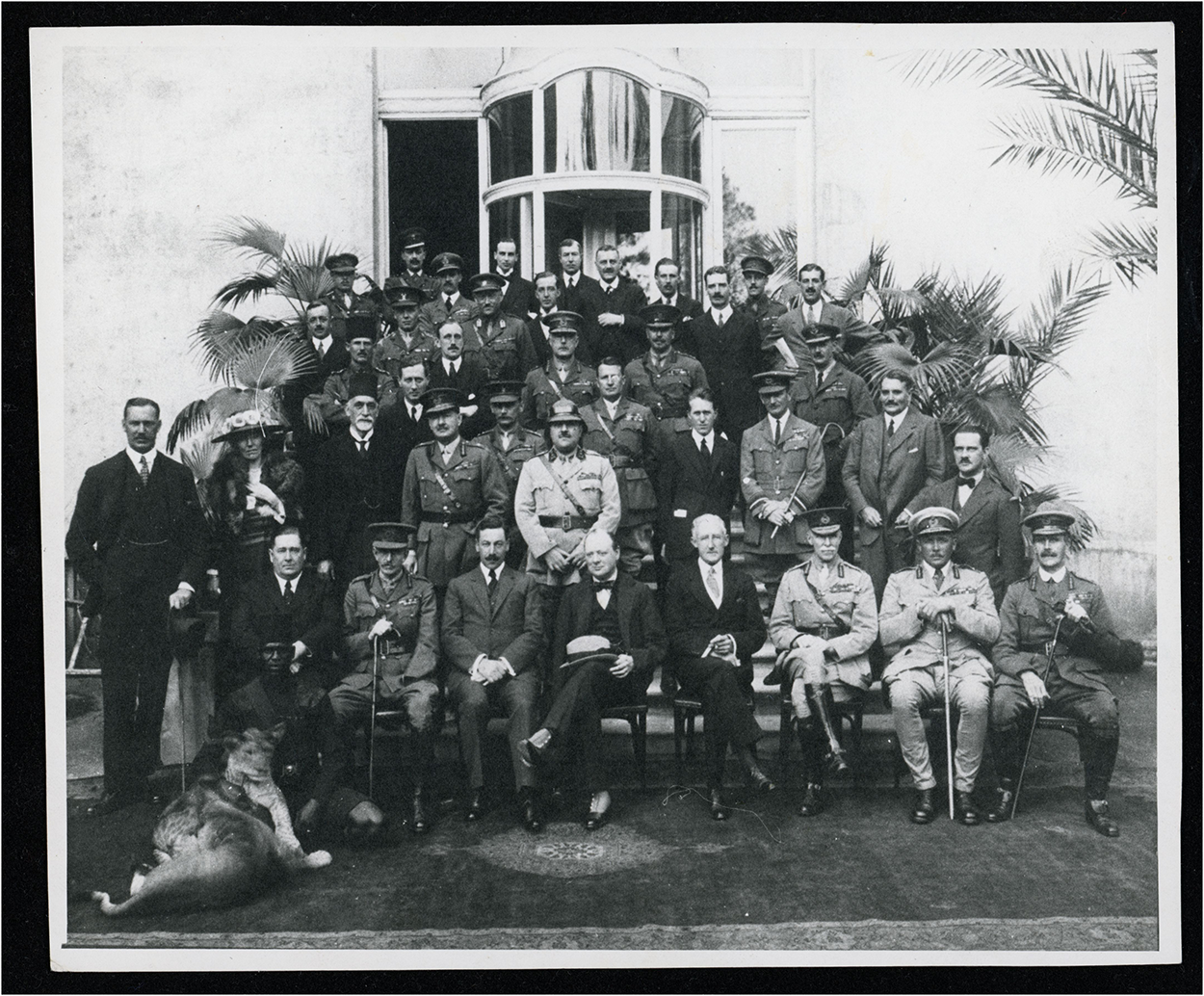
Bell’s later work during the final decade of her life as an administrator in Mesopotamia was recognised in various official and unofficial ways, including by Cox after his return to Mesopotamia as high commissioner in 1920, when she wrote home that she would be ‘taking on a sort of temporary Oriental Secretary job till people find their feet’.Footnote 85 As we saw when she made contact with the viceroy of India, it was her unusual background and experience that set her on the trajectory that was to enable her later to exert considerable agency both during the conflict and in its aftermath. In 1920, after more than four years in Mesopotamia working closely with Wilson and Cox, Bell was given the task of preparing a White Paper for Parliament on behalf of the India Office about the situation in Mesopotamia. This was published in December 1920.Footnote 86 Weeks later, in March 1921, Winston Churchill, the newly appointed secretary of state for the colonies, convened the Cairo Conference (Figure 5). Churchill chaired the political committee with five others including Bell, Cox and Lawrence. Their discussions would serve to determine the future of Mesopotamia as the Kingdom of Iraq.Footnote 87
Group photograph of attendees at the Cairo Conference including Gertrude Bell and Winston Churchill. 1 March 1921. Gertrude Bell Archive, GB/PERS/F/005.

Figure 5 Long description
A group of 40 men and one woman, Gertrude Bell, posed on a large carpet and steps in front of a building with an open window and plants. The group is arranged in at least six rows. The front row is seated on chairs, with Winston Churchill in the middle, Sir Percy Cox to his left, and T.E. Lawrence standing behind Cox. Most of the men are wearing suits or military uniforms. Gertrude Bell is standing towards the left side of the image wearing a hat and fur. One man sits directly on the carpet with two lion cubs on the left side of the image.
Bell’s legacy remains contested, but over a century after its creation the Gertrude Bell Archive affords opportunities for critical investigation and for facilitating official and unofficial diplomacy and impact in multiple contexts. Now a UNESCO International Memory of the World, the Archive is an essential resource for understanding the people, places and events during a period of significant societal change with its own significant agency. Major projects between 2020 and 2026 generously funded by the Harry and Alice Stillman Foundation have included Challenging Legacies: The Kingdom of Iraq and Gertrude Bell, an exhibition at the Great North Museum Hancock in Newcastle upon Tyne. In 2023, Challenging Legacies and the archive were visited at Newcastle University by the minister of culture of Iraq, the head of the State Board of Antiquities and Heritage and the chancellor of the University of Mosul. Visits to the archive served as a catalyst for strategic meetings with the university’s executive board. Challenging Legacies was subsequently re-curated at the Centre for Arab and Islamic Studies, University of Exeter and for the Iraq Britain Business Council Conference in 2024 in London, thus serving to open new avenues for research and for fostering international collaboration. A new project with the RGS will culminate in an exhibition at the RGS in August 2026 and the digitisation of Bell’s archive material there to facilitate analysis of documents across collections. Indeed, the Gertrude Bell Archive website attracted 535,135 visits from across the world in 2024–5.Footnote 88 Archives and research into Bell and her legacy continue to have both official and unofficial impact today.
Gertrude Bell’s archives at Newcastle University and at the RGS, as well as her academic publications and travel writing reveal that her pre-war journeys were very much unofficial, conducted at private expense for her own independent purposes. She did nevertheless use these journeys to create a name for herself. However, it was not until later in 1915, during the First World War, that more formal authorities – and indeed Bell herself – recognised the value of her work for the war effort. Her unofficial records and knowledge at that point became of demonstrable importance in the creation of official maps and reports. It was this acknowledgement of her experience and Bell’s own ability to make herself viable as an authority in British contexts that set the final decade of her life on a more official if unconventional trajectory.
Acknowledgements
I would like to thank Jessica Varsallona and Anna Kelley for their invitation to present ideas for this article for Unofficial Diplomats at the University of Edinburgh in December 2023. I would also like to acknowledge with thanks the comments of anonymous reviewers and the editors. I acknowledge the research of Dr Semih Celik which resulted in the reproduction and analysis of documents relating to Bell from the Ottoman Archives in the Newcastle-Exeter Challenging Legacies exhibition at the Institute for Arab and Islamic Studies of the University of Exeter in 2023–4.

 Open access

