In autumn of 2012, Hurricane Sandy—second only to Katrina as the most costly hurricane in US historyReference Blake, Kimberlain and Berg 1 —made landfall in New Jersey. In the wake of Sandy came floods, disruptions to electrical and transportation systems, and widespread home evacuations. Previous research has shown that treatment interruptions, from weather disasters or otherwise, can have serious or even fatal health consequences in populations with chronic diseases.Reference Jhung, Shehab and Rohr-Allegrini 2 For example, within 24 hours of disrupted insulin treatment, ketoacidosis can arise in diabetics with a mortality rate of 5% in the elderly.Reference Kitabchi, Umpierrez and Miles 3 Patients with chronic kidney disease relying on peritoneal dialysis need access to supplies and electricity or they will incur the same risks as patients who cannot access hemodialysis services.Reference Kleinpeter 4 In addition, other vulnerable populations—such as ethnic minorities, the aged, the uninsured, and those without a regular source of medical care—may have their access to medical care compromised during a natural disaster. This study investigates access to medical care, including prescription medicines, among subjects with selected chronic conditions and other vulnerable populations in New Jersey in the immediate aftermath of the storm.
METHODS
We used the New Jersey Behavioral Risk Factor Survey (NJ BRFS) to examine the extent to which health care access by adult residents of New Jersey was affected by Hurricane Sandy in 2012. NJ BRFS is a component of the Centers for Disease Control-sponsored Behavioral Risk Factor Surveillance System (BRFSS), an annual complex sample cross-sectional survey of adult health that is conducted by state health departments in all 50 states. 5 Originally based on random digit dialing of home phones (landlines), the survey’s methodology was expanded in 2011 to include cellular telephones. 6 In addition to standard modules that are administered nationally, additional questions may be posed by states. The 2014 NJ BRFS administration included several Sandy-related modules. These data, combined with responses to questions regarding prevalent chronic conditions and other elements that are part of the standard annual NJ BRFS questionnaire, formed the basis of our analysis.
NJ BRFS 2014 included questions on access to medical care during the storm, including medical prescriptions or supplies, and hurricane experiences such as evacuation and environmental exposures. Analysis was conducted overall, and among vulnerable groups, such as persons reporting a chronic disease, the medically uninsured, those without a regular source of medical care, and persons aged ≥65 years. We also compared access to care within New Jersey’s largest demographic groups: US-born whites, US-born ethnic minorities (Hispanics and African-Americans), and foreign-born residents (especially recent arrivals, that is, within 10 years of 2012). We used census estimates of the adult population in New Jersey at the time of Hurricane Sandy to estimate the size of these demographically defined subgroups. We also considered populations whose vulnerability was storm-induced, such as persons who evacuated their homes because of Sandy and those who were residing in municipalities that were more highly impacted by Sandy. Sandy impact was based on Hoopes Halpin’s index that combined data on electricity outages, residential and commercial damage, and FEMA municipal assistance into a single score.Reference Hoopes Halpin 7 We used this impact index because it combined metrics of both flooding and wind damage in New Jersey, whereas other indices relied on flood damage only. We created a categorical variable from this score, with cut points selected to divide New Jersey’s population into three impact levels: low, medium, and high, defined by cut points at the 60th and 90th percentiles. We defined chronic disease as a self-reported history of asthma, diabetes, arthritis, kidney disease, chronic obstructive pulmonary disease, angina, coronary heart disease, or a heart attack, conditions that are part of the annual NJ BRFS; these self-reported conditions have been validated in other studies, such as Newell et al.Reference Newell, Girgis and Sanson-Fisher 8 We evaluated associations between categorical variables using contingency tables and logistic regression models that adjusted for the complex sample survey and nonresponse. All statistical analyses were conducted using SAS 9.3, and use a P value of .05 as a criterion for statistical significance.
RESULTS
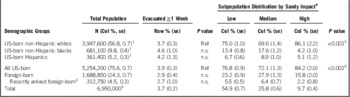
According to the US Census, the number of noninstitutionalized adults residing in New Jersey at the time of Hurricane Sandy was approximately 6.95 million. The largest demographic group was US-born non-Hispanic whites (≈3.9 million), followed by foreign-born persons (≈1.7 million) of any race, approximately 312,000 of whom arrived in the United States within the last 10 years. African-Americans constituted approximately 15% of the overall population, somewhat less than the national percentage of 13%. 9 Table 1a shows how these major demographic subgroups were distributed by the impact of the hurricane, as well as the percentage of each that evacuated their home for at least 1 week. Overall, 3.7% of the population evacuated for at least one week; the majority of persons did not evacuate at all (81.3%) or evacuated for less than one week (8.8%). Note that US-born non-Hispanic whites constituted 86.1% of persons residing in the most highly impacted municipalities; the percentages of this population in the lowest- and medium-impacted municipalities were significantly lower (75.0% and 69.6%, respectively). Differences in the distribution of these major demographic groups by Sandy impact score were statistically significant: P<.0001 by Rao-Scott chi-square test.
Distribution of Major Demographic Groups Living in New Jersey by Sandy Evacuation Status and Sandy Impact Levels

1. Percentages do not add up to 100% because groups other than US-born whites, African-Americans, Hispanics not included as well as missing values.
2. Subset of all foreign-born; time of arrival not known for 7.7% of foreign-born.
3. Total New Jersey noninstitutionalized adult population in 2014.
4. Column percentages for Sandy impact do not add up to 100% because of because groups other than US-born whites, African-Americans, and Hispanics not included as well as missing values.
5. P value compares distribution of selected US-born groups across levels of Sandy impact.
6. P value compares distribution of US-born versus foreign-born across levels of Sandy impact.
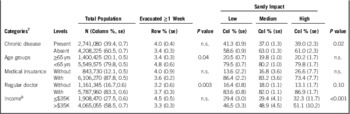
We assessed vulnerable adult populations living in New Jersey at the time of Hurricane Sandy, which included approximately 2.7 million persons who reported having a chronic disease, 1.4 million persons ≥65 years, over 800,000 persons without medical insurance, nearly 1 million without a regular doctor and nearly 2 million with a combined household income less than $35,000. As noted in Table 1b, these categories are not mutually exclusive; a person may belong to more than 1 vulnerable category. Arthritis and similar joint diseases (eg, gout, lupus, and fibromyalgia) constitute the largest percentage of chronic disease conditions (22.6%), followed by diabetes (9.5%), and asthma (8.2%) (data not shown). Younger persons were more likely to evacuate their homes for at least 1 week as compared with older persons (4.8% vs 3.4%; P=.04) as were those with a regular doctor compared to those without one (3.7% vs 3.2%; P=.003). No other differences were observed among the percentage of persons who evacuated for at least 1 week by factors evaluated. There was a statistically significant association (P=.02) between Sandy impact levels and chronic disease prevalence, driven by a slightly smaller percentage of persons with chronic disease residing in areas designated as having a medium Sandy impact level: 37.0% in the medium impact area compared to 41.3% in the lowest and 39.0% in the highest impact areas. A greater percentage of persons with a higher income resided in the most impacted areas: 51.1% vs 46.5% for highest vs lowest impact areas, respectively (P=.001).
Distribution of Intrinsic Risk Factors in New Jersey by Sandy Evacuation Status and Sandy Impact Levels

7. Categories are not mutually exclusive.
8. Percentages do not add up to 100% because of missing income values.
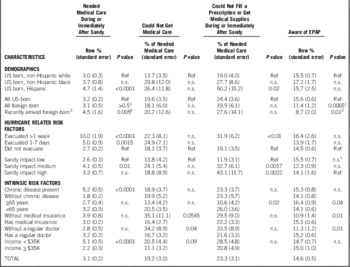
Table 2 shows that 3.1% of persons reported that during or immediately following Sandy, they required medical care; among those, 19.2% could not get medical care and 23.3% could not refill a prescription or obtain needed medical supplies. People who lived in more highly impacted municipalities who needed medical care during or immediately after the storm were more likely to be unable to have a prescription filled or obtain medical supplies than those residing elsewhere (43.1% vs 32.7% and 11.9%, respectively, for high vs medium- and low-impacted areas; P=.02 for both comparisons). Approximately 3.7% (standard error=0.2%) of adults who lived in New Jersey at the time of Sandy evacuated their home for at least 1 week, or approximately 250 000 people. The highest percentage of persons needing medical care were those who evacuated for at least 1 week: 10.0% (vs 5.0% and 2.7% for shorter evacuations those who did not evacuate; P=.01 for both comparisons). Approximately 30% of all persons who evacuated (regardless of evacuation duration) were unable to fill a prescription, given a need for medical care compared with 20% of those who did not evacuate (31.9% vs 19.1%; P=.01).
Distribution of Subjects Needing Medical Care During or Immediately After Hurricane Sandy, by Demographic, Hurricane-Related and Intrinsic Risk Factors. (n.s.=not significant)

1. P value for foreign-born vs US-born
2. P value for recent foreign-born vs US-born
3. Recently-arrived foreign-born is a subset of all foreign-born.
Table 2 shows that during or immediately following Sandy, US-born Hispanics compared to US-born non-Hispanic whites and recently arrived foreign-born and compared to all US-born persons were more likely to report that they required medical care during or immediately after Sandy. However, the only statistically significant difference in access to care by demographic group was that US-born Hispanics were more likely than US-born non-Hispanic whites to be unable to fill a medical prescription, given a need for medical care during or immediately following Sandy (P=.02). As expected, persons with a chronic disease had a greater need for medical care than those without a chronic disease (P=.001), and this finding was repeated (although at different magnitudes of effect) when stratified by place-of-birth and among the US-born, by racial/ethnic subgroup. Among the foreign-born, the odds ratio (OR) for needing care was 4.0 (95% CI=[2.0, 8.0]) and among the US-born, the OR was 2.7 (95% CI=[1.9, 3.9]) comparing those with and without a chronic disease. Among the US-born, the ORs for needing care were 2.2 (95% CI=[1.5, 3.4]), 3.9 (95% CI=[1.6, 9.8]), and 6.7 (95% CI=[1.9,23.7]), respectively for non-Hispanic whites, Hispanics, and non-Hispanic blacks, comparing those with and without a chronic disease There was, in addition, an increasing gradient of the impact of chronic disease by Sandy impact: The respective ORs for requiring medical care were only 2.9 (95% CI=[1.9, 4.7]) and 3.3 (95% CI=[1.8, 5.8]) for the areas with low and medium Sandy impact, respectively, but 5.2 (95% CI=[1.7, 16.1]) for the area with the highest Sandy impact.
Other factors were associated with access, with persons who reported not having a personal doctor or health care provider showed 60% lower odds of getting needed medical care during Sandy or immediately after (P=.04). Additionally, persons aged ≥65 years versus <65 years were more likely to be able to fill a prescription or medical supplies: 10.6% vs 26.0% (P=.02), respectively, reported being unable to do so. Although lower income was associated with an increased need for medical care during or immediately after Sandy, there were no statistically significant differences by income levels in the ability to get medical care or refill prescriptions. Persons with chronic diseases were as likely as those without to be able to obtain medical care or to fill a prescription during or immediately following Sandy.
On November 4, 2012, a week after Sandy made landfall, New Jersey’s health commissioner announced the activation of the Emergency Pharmaceutical Assistance Program (EPAP) in selected New Jersey areas 10 ; EPAP activation was ultimately extended in early 2013. 11 EPAP, a program created following Hurricane Katrina, allows uninsured individuals to get a one-time 30-day refill of an existing prescription medicine and limited durable medical equipment at pharmacies that participate in the program. 12 Residents in 8 specific New Jersey counties (Atlantic, Cape May, Essex, Hudson, Middlesex, Monmouth, Ocean, and Union) were eligible for EPAP. Individuals and households in these counties had been designated by the Federal Emergency Management Agency (FEMA) as eligible for direct federal assistance after Sandy. 13
The percentage of 2014 NJ BRFS respondents who lived in New Jersey at the time of Hurricane Sandy and had heard of EPAP was 14.6% overall and 13.2% among those residing in the 8 eligible counties. The more recently arrived foreign-born were the least likely demographic group to have heard of EPAP (8.7%); for US-born, 15.6% had heard of EPAP, foreign-born with >10 years residence in the United States, 11.4%. Compared to all US-born persons, pairwise comparisons to all foreign-born and recently arrived foreign-born groups showed that the foreign-born persons were statistically significantly less likely to be aware of EPAP (P=.0065 and .01, respectively). Among New Jersey adults without insurance, the odds of having heard of EPAP was 30% lower than those with insurance, even after controlling for the existence of one or more chronic conditions (OR=0.7, 95% CI=[0.5, 0.9]); further controlling for residence in a county where EPAP had been activated did not modify this effect. It is notable that persons residing in the 8 counties included in the EPAP activation were more likely to be uninsured than those residing elsewhere in New Jersey (OR=1.6, 95% CI=[1.3, 2.0]).
DISCUSSION
This is the first analysis of BRFSS data that not only estimated the extent of chronic diseases by degrees of hurricane impact throughout an entire state but also directly assessed access to medical care in the wake of this natural disaster. Both evacuation as well as residence in a more severely impacted area of New Jersey impaired the ability to fill a prescription among persons who needed medical care during or immediately following Sandy. This parallels findings associating treatment disruptions with residential instability among Katrina survivors. 14 Unsurprisingly, those with a chronic disease had greater medical care needs after the storm; however, the need for medical care followed a well-known gradient, with non-Hispanic blacks with chronic disease having the greatest needs followed by US-born Hispanics and then by US-born whites. These latter findings are consonant with the long-observed association between socioeconomic status and access to care that exist independently of any natural disaster.Reference Laser, Himelstein and Woolhandler 15 , Reference Andrulis 16
Previous analyses of vulnerable populations, including those with chronic diseases as assessed by BRFSS, defined hurricane sensitive geographies as areas lying within a 50-mile buffer zone, a metric that may overstate the populations at risk.Reference Holt, Mokdad and Ford 17 Other reports on access to care for persons with chronic conditions focused on hurricane evacuees only.14 We linked NJ BRFS data to Hoopes Halpin’s detailed analysis of municipal level Sandy impact throughout the State of New Jersey and compared those who evacuated with those who did not. Because municipalities in New Jersey are geographically small in land area (15 square miles), 18 this permitted us to create relatively refined Sandy impact level groupings. While certain areas were more severely impacted by Sandy than others, that the whole state experienced Sandy’s impact is supported by FEMA’s determination that the entire state was eligible for hazard mitigation. 13
The Sandy impact scores were developed from data collected following the storm; thus, their utility in public health planning for future natural disasters is unknown. However, 10 years before the advent of Hurricane Sandy, sea level was anticipated to rise due to global warming, thereby predicting an increase in frequency and extent of flooding due to coastal storms and hurricanes in the New Jersey/New York City areaReference Gornitz, Couch and Hartig 19 ; another study, 10 months prior to Sandy, New Jersey was identified as one the 5 US states with the largest population living on land that is vulnerable to damaging floods from storm surges.Reference Strauss, Ziemlinski and Weiss 20 Models from the latter study estimated that high tide rises should be compared with the empirically derived Sandy impact data that reflect the economic effects of the storm rather than the underlying causes of these effects. Such an analysis will aid in anticipating the location and magnitude of vulnerable populations in advance of future storms; this, in turn, will inform disaster planning efforts. Climatologists can help by providing model outputs in terms of geographies that are meaningful for health departments, that is, congruent with jurisdictions at which public health activities and budgets are organized.
This study has several limitations. Survey-based studies are subject to nonresponse bias, and NJ BRFS is no exception. Chronic diseases not included in NJ BRFS in 2014 included hypertensionReference Nwankwo, Yoon and Burt 21 and HIV/AIDS, a disease that has become, for those in care, a chronic condition requiring complex medical management. Our study therefore cannot assess the impact of Sandy by HIV or hypertension status. Moreover, as a cross-sectional survey without subject identifiers that could be linked to hospitalization and emergency room visits, NJ BRFS cannot assess the storm’s ultimate impact on morbidity and mortality, either immediately following the storm or in the long term. In addition, the temporal nature of chronic conditions and access to care are not easily explicated given a cross-sectional survey design administered over a 1-year period. Finally, complex multivariable analyses by subpopulations and specific chronic diseases were difficult to implement because NJ BRFS is not designed to oversample specific subpopulations, resulting in insufficient power to execute such analyses. It is possible that insulin-dependent diabetics were more acutely in need of medical care following the storm than persons with other chronic diseases. However, only 9% of our sample self-reported diabetes, and this was not broken down by diabetic type. Thus, our sample was inadequate to meaningfully examine medical needs for this particular disease.
In addition to NJ BRFS-related limitations, there are specific Sandy-related shortcomings in this study. First, people who moved out of New Jersey after Sandy were not part of the sampling frame. It is possible that some of these persons left because of Sandy’s impact and that patterns of population loss differed by Sandy impact. Indeed, local newspapers continue to report ongoing struggles among Sandy-impacted New Jerseyans to reestablish their lives, including re-occupancy of their original homes.Reference Spoto 22 Second, there was a 2-year lag between the storm and the inclusion of Sandy-related questions in NJ BRFS, and while we have no reason to suspect any purposeful inaccuracies in reporting, self-reported Sandy experiences are subject to recall bias. Third, the impact of Sandy on the physical and economic environment was missing data for a few New Jersey municipalities. However, the municipalities with missing impact data were generally far away from the Atlantic coast and have relatively small population sizes.
The most impacted areas had the lowest percentage of low-income people, and these areas did not generally observe impaired access to care. The reason for this finding may be that beachfront communities where persons with higher incomes (including affluent retirees) may reside are located in some of the most highly impacted areas. As access to care is generally better among persons with a higher socioeconomic status, this may explain some of the paradoxical results.
We found that of those persons who required medical care, 19.2% could not obtain it and 23.3% could not refill a prescription or obtain needed medical supplies. A previous study of disaster preparedness in 6 US states, including two on the Atlantic coast (Delaware and Georgia), found that a high percentage (87%) of persons with chronic diseases were likely to have a 3-day supply of medicine on hand (although the American Red Cross currently recommends a 7-day medication supply, that specific study asked about a 3-day supply).Reference Bethel, Foreman and Burke 23 , 24 As this question was not part of the NJ BRFS questionnaire, we do not know whether persons stating that they could not fill a prescription or obtain medical supplies did not have recommended levels of supplies on hand or had exhausted their supplies despite having the recommended levels on hand when Sandy occurred. Hurricane Sandy presented the most formidable natural disaster in the United States since Hurricane Katrina 7 years earlier and, as such, provides a real opportunity to evaluate EPAP. Until that analysis is done, it is still valuable to understand the extent of awareness by potential program users. EPAP use by the uninsured for whom the program had been crafted—especially those with chronic diseases and the recently arrived foreign-born—may mitigate health effects during and subsequent to future widespread disasters.
The difficulty in publicizing EPAP lies in the fact that it is a program activated only at the time of a widespread disaster; promoting it in non-disaster times may lead to confusion. In New Jersey, the New Jersey Department of Health publicized EPAP though press releasesReference Livio 25 that were picked up by The Star Ledger, the state’s main newspaper. 10 The penetration of social media use in the years since Sandy provides a new vehicle for contacting citizenry and has already proved to be a useful population-based source of information, as demonstrated in recent terrorist attacks in France. 26 State and local governments should increase social network connections to its citizenry well in advance of the next disaster, natural or otherwise. In New Jersey, these connections should take into account the state’s highly diverse population, including older persons and foreign-born residents who will constitute an ever-increasing proportion of the uninsured because of exclusions to the Affordable Care Act.Reference Breen 27
Finally, we need to recognize the unique aspects of a disaster occurring in the world’s richest nation. In low- and middle-income countries, concerns about infectious disease outbreaks among populations displaced due to natural disaster take priority over tertiary prevention of chronic diseases. Such concerns are particularly acute in populations with low immunization rates and predisposing factors, such as widespread malnutrition. The creation of programs such as EPAP to address the post-disaster management of chronic disease is possible only when sufficient resources to manage chronic diseases are readily available and outbreaks of infectious diseases are unlikely.
Acknowledgments
The authors have no disclosures. The authors thank Dr Kenneth O’Dowd for help in designing the Sandy modules of the 2014 New Jersey Behavioral Risk Factor Survey, coordination of survey administration, and methodological assistance.
Funding
This study was supported in part by the Centers for Disease Control and Prevention Public Health Preparedness and Response Research to Aid Recovery from Hurricane Sandy grant (# CDC RFA-TP-13-001).